
Transects and quadrants methods in landscape surveying ONLINE
- Slides: 22
Transects and quadrants methods in landscape surveying ONLINE CLASS FOR 5 TH SEMESTER Field Work and Research Methodology (C 11) Fieldwork (Unit II) Presented by Dinabandhu Patra Department of Geography Kharagpur College
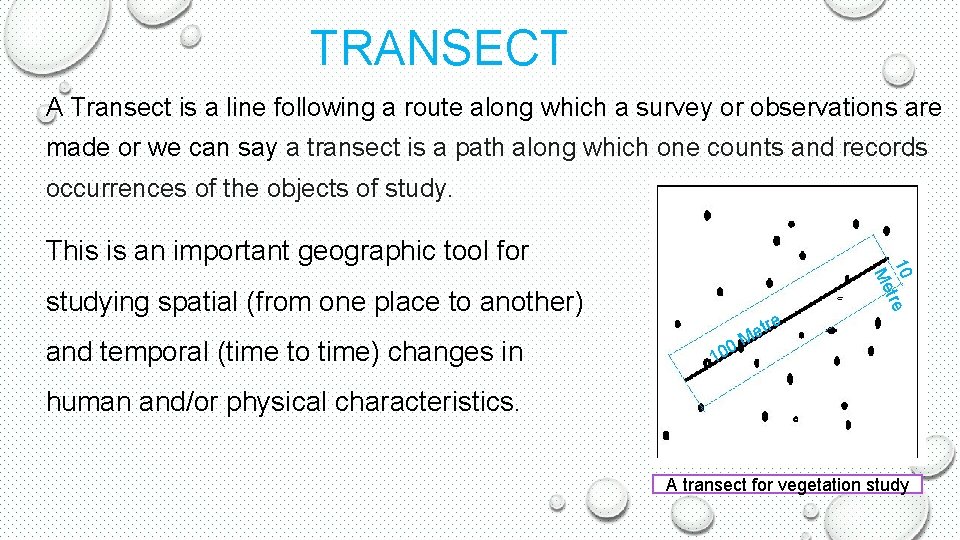
TRANSECT A Transect is a line following a route along which a survey or observations are made or we can say a transect is a path along which one counts and records occurrences of the objects of studying spatial (from one place to another) and temporal (time to time) changes in 0 10 tr e M e 10 tre Me This is an important geographic tool for human and/or physical characteristics. A transect for vegetation study
TYPES OF TRANSECTS There are different types of transect can be drawn based on purpose. Not only geography, there are different subject like Botany, Zoology, Anthropology, History and Sociology also apply transect method in their field survey. Different types of transect method as a Geographical tool are there discussed below- Line transect: Transects may show features that are along the actual line selected. A tape or string laid along the ground in a straight line between two poles as a guide to a sampling method used to measure the distribution of organisms. Sampling is rigorously confined to organisms that are actually touching the
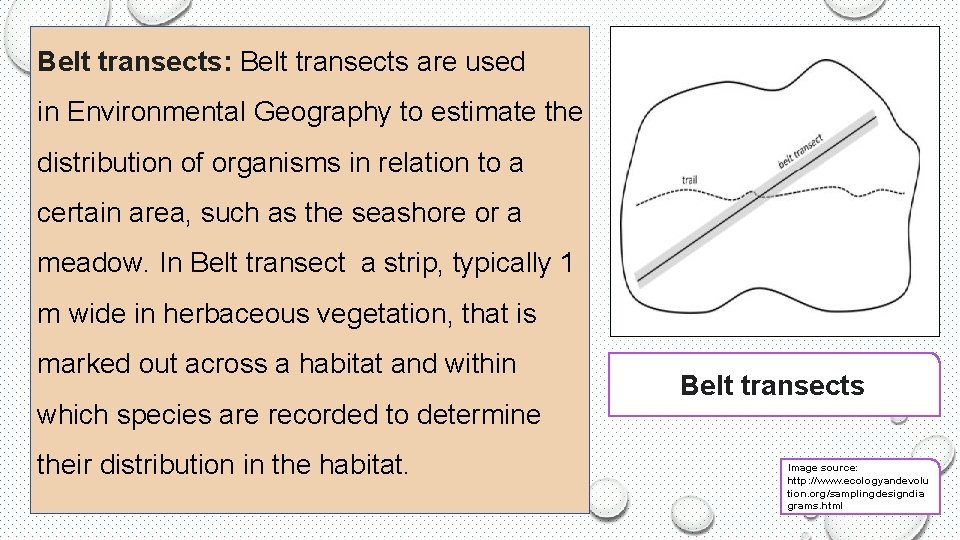
Belt transects: Belt transects are used in Environmental Geography to estimate the distribution of organisms in relation to a certain area, such as the seashore or a meadow. In Belt transect a strip, typically 1 m wide in herbaceous vegetation, that is marked out across a habitat and within which species are recorded to determine their distribution in the habitat. Belt transects Image source: http: //www. ecologyandevolu tion. org/samplingdesigndia grams. html
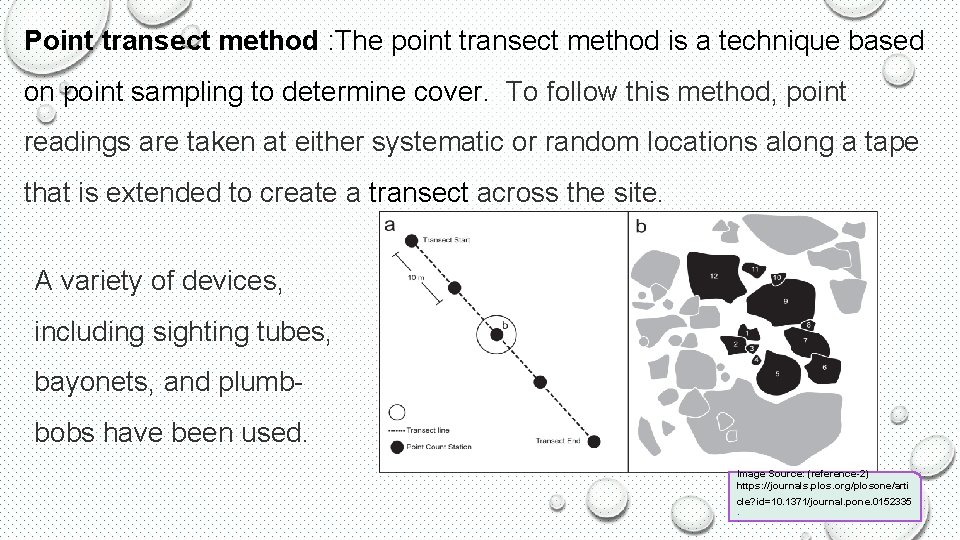
Point transect method : The point transect method is a technique based on point sampling to determine cover. To follow this method, point readings are taken at either systematic or random locations along a tape that is extended to create a transect across the site. A variety of devices, including sighting tubes, bayonets, and plumbbobs have been used. Image Source: (reference-2) https: //journals. plos. org/plosone/arti cle? id=10. 1371/journal. pone. 0152335 :
Ø The length and number of sampling points along the transect depend upon the Study object. Ø Sometime for more efficient record more transects are drawn with fewer points per transect. Ø Each transect is considered as sample unit and summarized data from several transects are required for statistical analysis. Ø To comparing data we can store data of different places and different period.
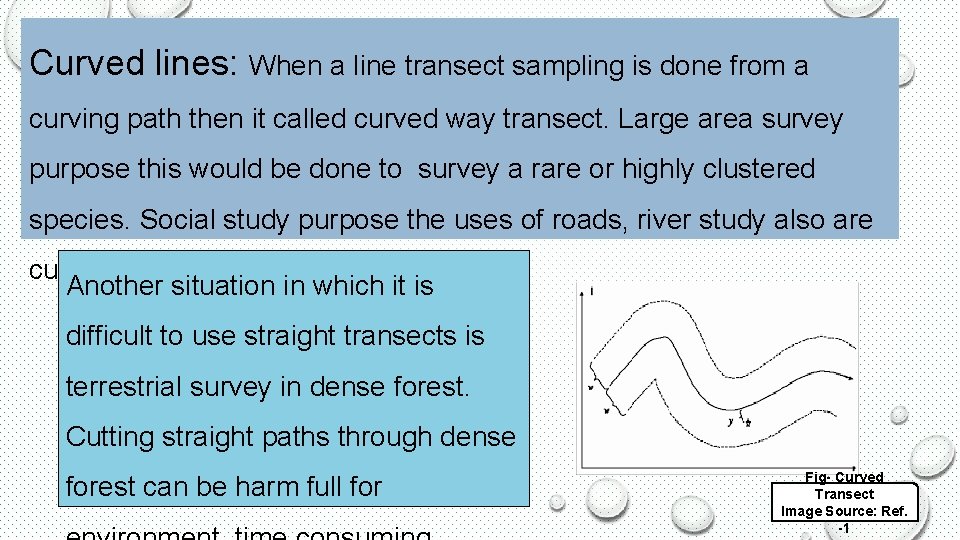
Curved lines: When a line transect sampling is done from a curving path then it called curved way transect. Large area survey purpose this would be done to survey a rare or highly clustered species. Social study purpose the uses of roads, river study also are curve transect. Another situation in which it is difficult to use straight transects is terrestrial survey in dense forest. Cutting straight paths through dense forest can be harm full for Fig- Curved Transect Image Source: Ref. -1
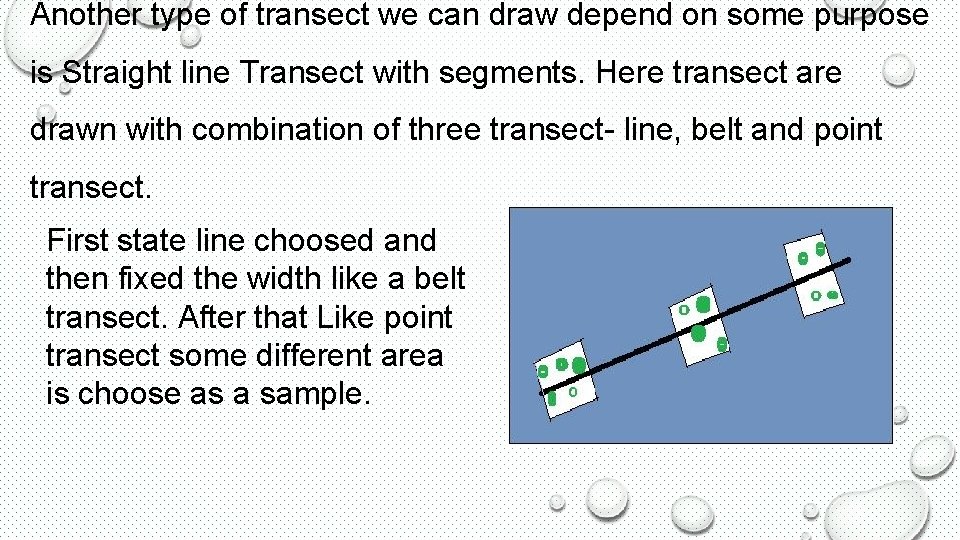
Another type of transect we can draw depend on some purpose is Straight line Transect with segments. Here transect are drawn with combination of three transect- line, belt and point transect. First state line choosed and then fixed the width like a belt transect. After that Like point transect some different area is choose as a sample.
Zigzag transect Zigzag survey lines are frequently used in shipboard and transect surveys of animal populations. There are many algorithm related to areal coverage probability. Analysis proceeds assuming that coverage probability through the survey region is uniform. Marine resource surveys in large areas have high cost, randomized zigzag design for straight line and curved transects is developed that have a equal coverage probability (Harbitz, 2019).
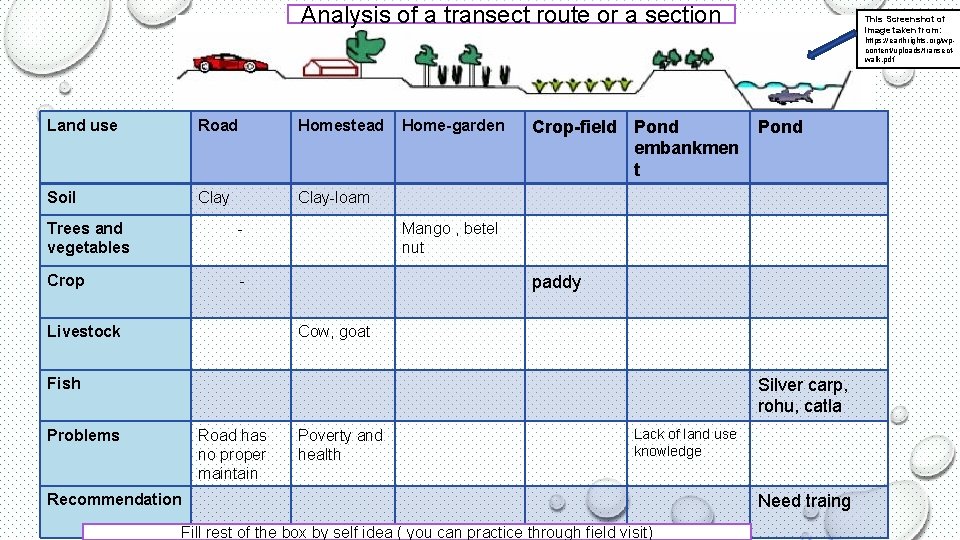
TRANSECT WALK A transect walk is a tool for describing and showing the location and distribution of resources, features, landscape, and main land uses along a given transect. “A transect walk is a systematic walk along a defined path (transect) across the community/project area together with the local people to explore the water and sanitation conditions by observing, asking, listening, looking and producing a transect diagram. ” - Source: http: //www. sswm. info/
MATERIALS NEEDED FOR TRANSECT WALK • Notebook and pen • Pitch board • Appropriate clothing and footwear for the area and time of year • camera and voice recorder to record certain things (if have permission). • Maps or aerial photographs if available, e. g. from Google Earth • GPS (Global Positioning System) device. • Large sheets of paper (see also managing flipcharts) • Coloured pens/Sketch men, pencil • Small coloured cards (marking particular items of interest) • Other thins if necessary
IMPORTANCE OF TRANSECT WALK Ø Many thing can be learn about local technology and practices in present and past. Ø Contributing as a tool for site selection. Ø You can identify major problems and possibilities in relation to features or areas along the transect. Ø Identifying and explaining the cause and effect relationships among different land use pattern). Ø Triangulating data collected through other tools. DISADVANTAGE • In a transect based on current record and observation, interpret the past issues are really time taking process; Also, to study more depth analysis is difficult. • Sometime, It might be impossible to bring together all the relevant things and corelate them.
Analysis of a transect route or a section This Screenshot of image taken from: https: //earthrights. org/wpcontent/uploads/transectwalk. pdf Land use Road Homestead Soil Clay-loam Trees and vegetables - Crop - Livestock Home-garden Crop-field Pond embankmen t Pond Mango , betel nut paddy Cow, goat Fish Silver carp, rohu, catla Problems Road has no proper maintain Poverty and health Lack of land use knowledge Recommendation Fill rest of the box by self idea ( you can practice through field visit) Need traing
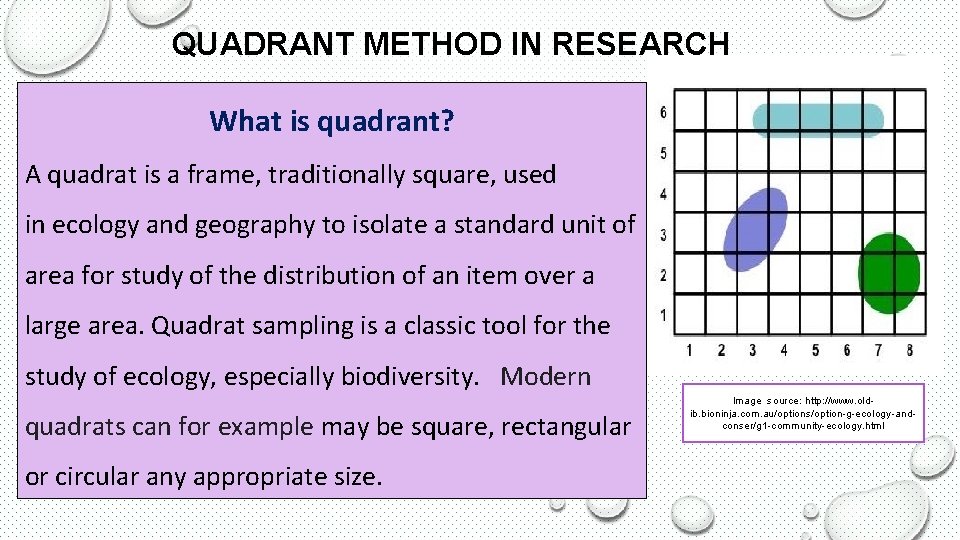
QUADRANT METHOD IN RESEARCH What is quadrant? A quadrat is a frame, traditionally square, used in ecology and geography to isolate a standard unit of area for study of the distribution of an item over a large area. Quadrat sampling is a classic tool for the study of ecology, especially biodiversity. Modern quadrats can for example may be square, rectangular or circular any appropriate size. Image source: http: //www. oldib. bioninja. com. au/options/option-g-ecology-andconser/g 1 -community-ecology. html
HISTORY OF QUADRANTS The systematic use of quadrats was developed by the pioneering plant ecologists R. Pound and F. E. Clements between 1898 and 1900. § The method was then swiftly applied for many purposes in ecology, such as the study of plant succession. § Botanists and ecologists such as Arthur Tansley soon took up and modified the method. § The ecologist J. E. Weaver applied the use of quadrats to the teaching of ecology in 1918. Information Source: https: //en. wikipedia. org/wiki/Quadrat
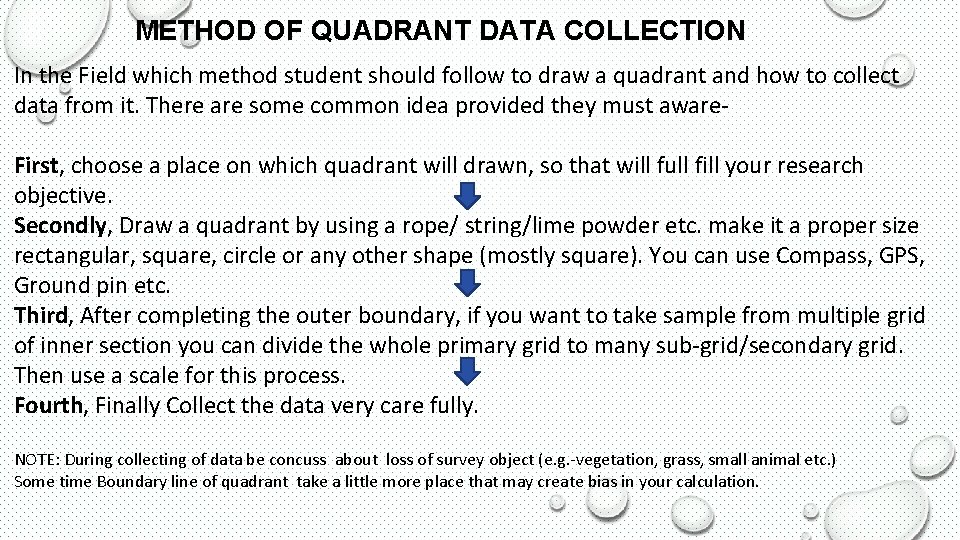
METHOD OF QUADRANT DATA COLLECTION In the Field which method student should follow to draw a quadrant and how to collect data from it. There are some common idea provided they must aware. First, choose a place on which quadrant will drawn, so that will full fill your research objective. Secondly, Draw a quadrant by using a rope/ string/lime powder etc. make it a proper size rectangular, square, circle or any other shape (mostly square). You can use Compass, GPS, Ground pin etc. Third, After completing the outer boundary, if you want to take sample from multiple grid of inner section you can divide the whole primary grid to many sub-grid/secondary grid. Then use a scale for this process. Fourth, Finally Collect the data very care fully. NOTE: During collecting of data be concuss about loss of survey object (e. g. -vegetation, grass, small animal etc. ) Some time Boundary line of quadrant take a little more place that may create bias in your calculation.
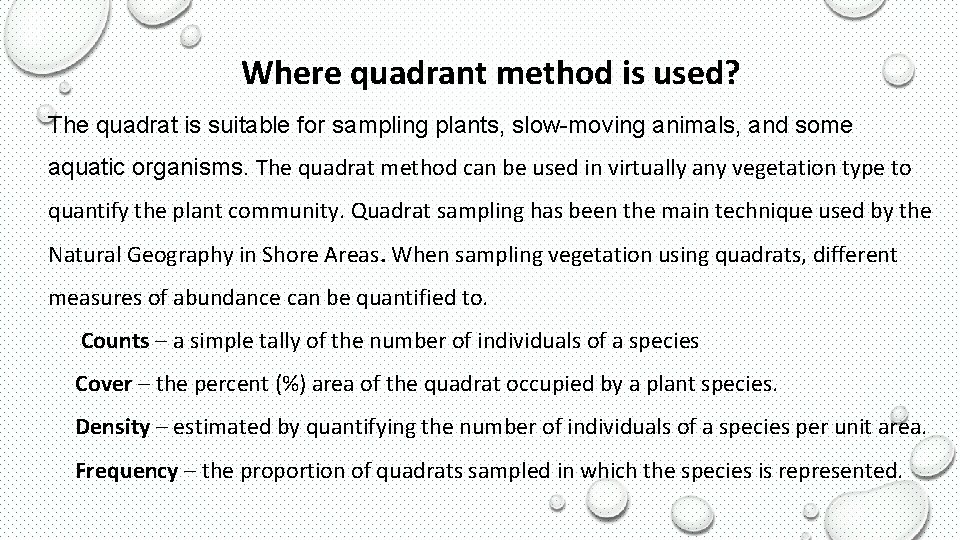
Where quadrant method is used? The quadrat is suitable for sampling plants, slow-moving animals, and some aquatic organisms. The quadrat method can be used in virtually any vegetation type to quantify the plant community. Quadrat sampling has been the main technique used by the Natural Geography in Shore Areas. When sampling vegetation using quadrats, different measures of abundance can be quantified to. Counts – a simple tally of the number of individuals of a species Cover – the percent (%) area of the quadrat occupied by a plant species. Density – estimated by quantifying the number of individuals of a species per unit area. Frequency – the proportion of quadrats sampled in which the species is represented.
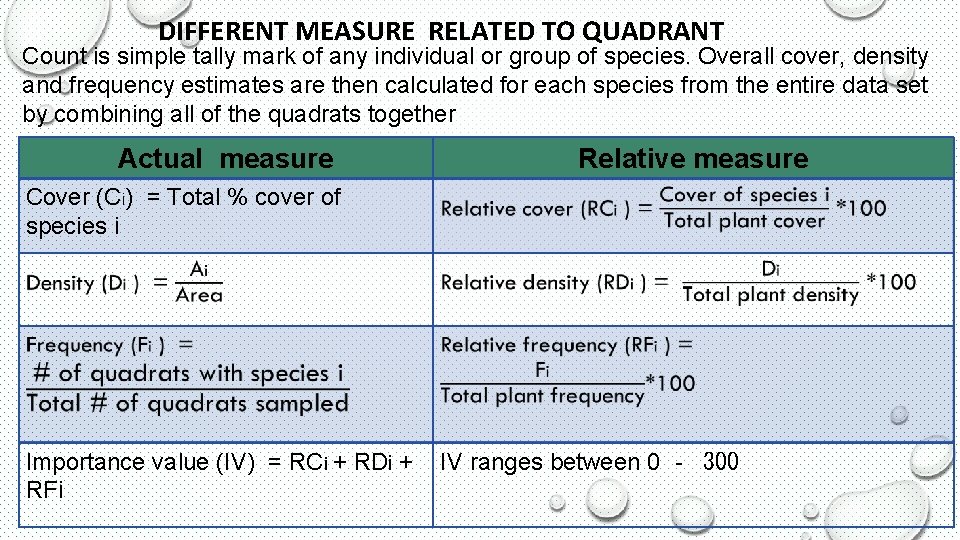
DIFFERENT MEASURE RELATED TO QUADRANT Count is simple tally mark of any individual or group of species. Overall cover, density and frequency estimates are then calculated for each species from the entire data set by combining all of the quadrats together Actual measure Relative measure Cover (Ci) = Total % cover of species i Importance value (IV) = RCi + RDi + RFi IV ranges between 0 ‐ 300
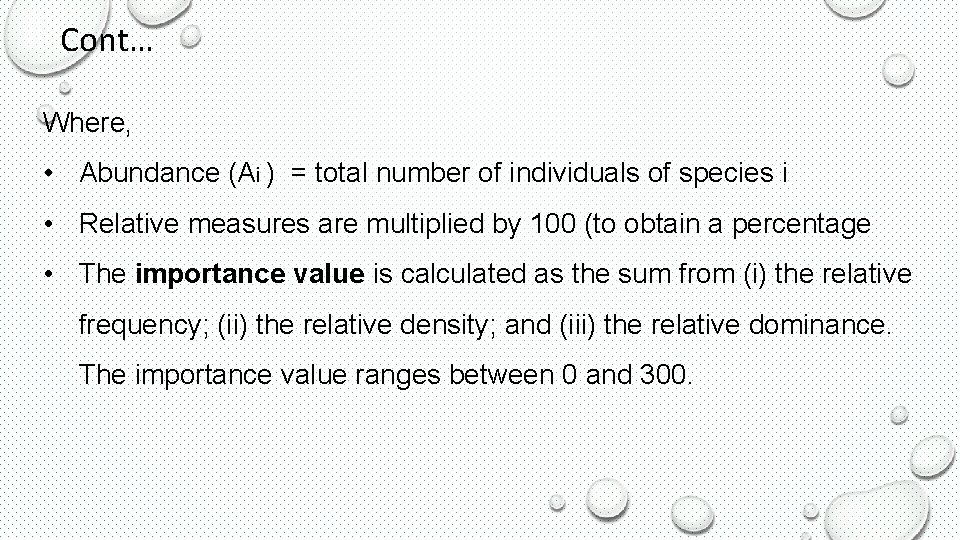
Cont… Where, • Abundance (Ai ) = total number of individuals of species i • Relative measures are multiplied by 100 (to obtain a percentage • The importance value is calculated as the sum from (i) the relative frequency; (ii) the relative density; and (iii) the relative dominance. The importance value ranges between 0 and 300.
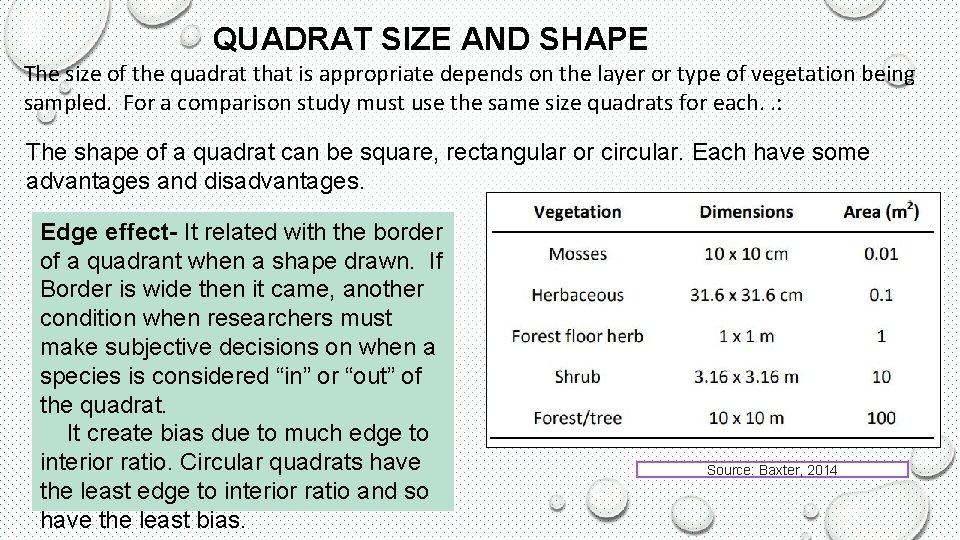
QUADRAT SIZE AND SHAPE The size of the quadrat that is appropriate depends on the layer or type of vegetation being sampled. For a comparison study must use the same size quadrats for each. . : The shape of a quadrat can be square, rectangular or circular. Each have some advantages and disadvantages. Edge effect- It related with the border of a quadrant when a shape drawn. If Border is wide then it came, another condition when researchers must make subjective decisions on when a species is considered “in” or “out” of the quadrat. It create bias due to much edge to interior ratio. Circular quadrats have the least edge to interior ratio and so have the least bias. Source: Baxter, 2014
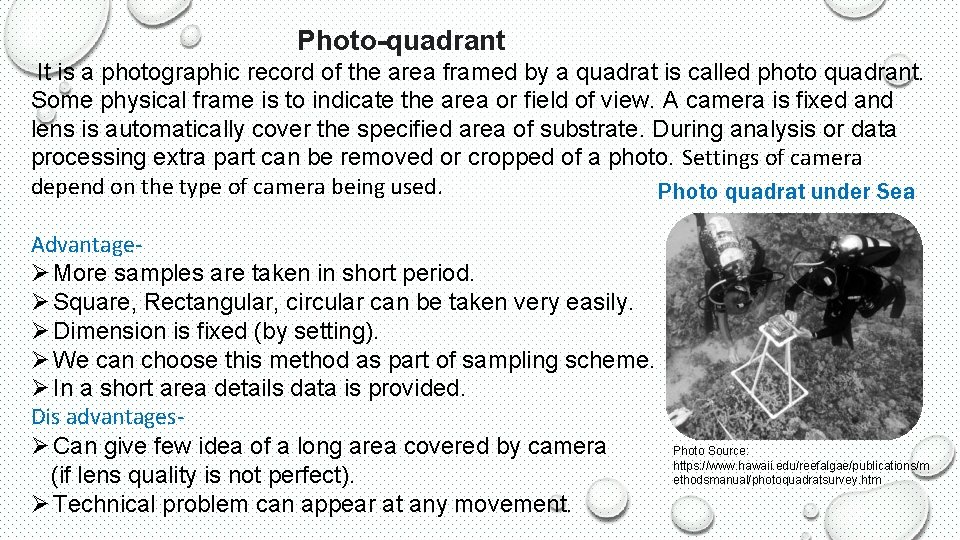
Photo-quadrant It is a photographic record of the area framed by a quadrat is called photo quadrant. Some physical frame is to indicate the area or field of view. A camera is fixed and lens is automatically cover the specified area of substrate. During analysis or data processing extra part can be removed or cropped of a photo. Settings of camera depend on the type of camera being used. Photo quadrat under Sea AdvantageØ More samples are taken in short period. Ø Square, Rectangular, circular can be taken very easily. Ø Dimension is fixed (by setting). Ø We can choose this method as part of sampling scheme. Ø In a short area details data is provided. Dis advantagesØ Can give few idea of a long area covered by camera (if lens quality is not perfect). Ø Technical problem can appear at any movement. Photo Source: https: //www. hawaii. edu/reefalgae/publications/m ethodsmanual/photoquadratsurvey. htm
REFERENCE: 1. Hiby, L. , & Krishna, M. B. (2001). Line transect sampling from a curving path. Biometrics, 57(3), 727 -731 2. Roberts, T. E. , Bridge, T. C. , Caley, M. J. , & Baird, A. H. (2016). The point count transect method for estimates of biodiversity 3. Harbitz, A. (2019). A zigzag survey design for continuous transect sampling with guaranteed equal coverage probability. Fisheries Research, 213, 151 -159. 4. Strindberg, S. , & Buckland, S. T. (2004). Zigzag survey designs in line transect sampling. Journal of Agricultural, Biological, and Environmental Statistics, 9(4), 443. 5. Baxter, J. (2014). Vegetation sampling using the quadrat method. Department of Biological Sciences. California State University, Sacramento. [American]. 6. https: //www. edu. gov. mb. ca/k 12/cur/socstud/frame_found_sr 2/tns/tn-19. pdf 7. https: //www. hawaii. edu/gk-12/opihi/classroom/measuring. pdf 8. https: //sswm. info/humanitarian-crises/urban-settings/planning-process-tools/exploring-tools/transectwalk#: ~: text=A%20 transect%20 walk%20 is%20 a, and%20 producing%20 a%20 transect%20 diagram.