
Transect survey biases and correction methods in Southern
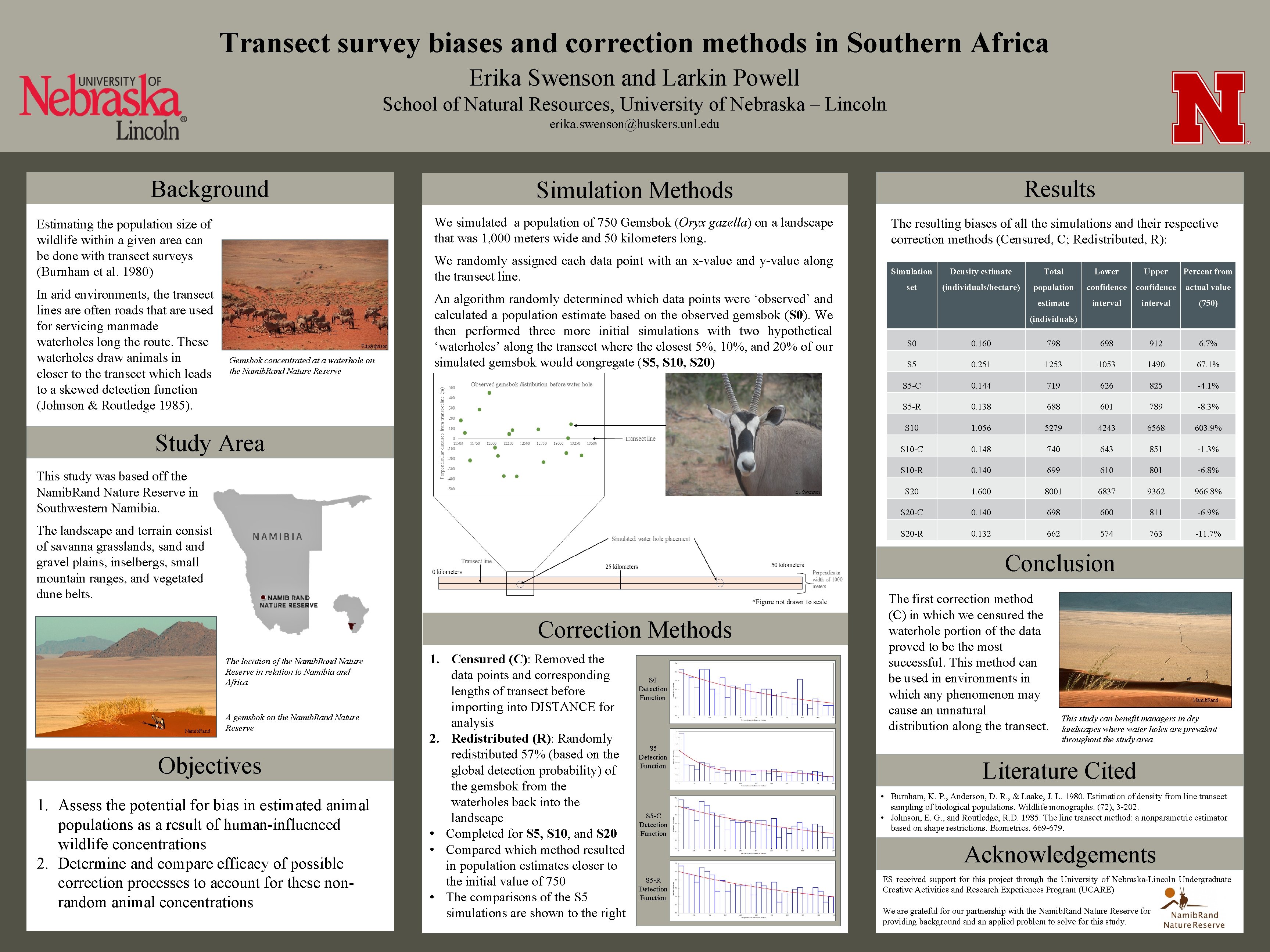
Transect survey biases and correction methods in Southern Africa Erika Swenson and Larkin Powell School of Natural Resources, University of Nebraska – Lincoln erika. swenson@huskers. unl. edu Background Estimating the population size of wildlife within a given area can be done with transect surveys (Burnham et al. 1980) In arid environments, the transect lines are often roads that are used for servicing manmade waterholes long the route. These waterholes draw animals in closer to the transect which leads to a skewed detection function (Johnson & Routledge 1985). Results Simulation Methods Trip. Advisor Gemsbok concentrated at a waterhole on the Namib. Rand Nature Reserve We simulated a population of 750 Gemsbok (Oryx gazella) on a landscape that was 1, 000 meters wide and 50 kilometers long. The resulting biases of all the simulations and their respective correction methods (Censured, C; Redistributed, R): We randomly assigned each data point with an x-value and y-value along the transect line. Simulation Density estimate Total Lower Upper Percent from set (individuals/hectare) population confidence actual value estimate interval (750) An algorithm randomly determined which data points were ‘observed’ and calculated a population estimate based on the observed gemsbok (S 0). We then performed three more initial simulations with two hypothetical ‘waterholes’ along the transect where the closest 5%, 10%, and 20% of our simulated gemsbok would congregate (S 5, S 10, S 20) Study Area This study was based off the Namib. Rand Nature Reserve in Southwestern Namibia. E. Swenson The landscape and terrain consist of savanna grasslands, sand gravel plains, inselbergs, small mountain ranges, and vegetated dune belts. S 0 0. 160 798 698 912 6. 7% S 5 0. 251 1253 1053 1490 67. 1% S 5 -C 0. 144 719 626 825 -4. 1% S 5 -R 0. 138 688 601 789 -8. 3% S 10 1. 056 5279 4243 6568 603. 9% S 10 -C 0. 148 740 643 851 -1. 3% S 10 -R 0. 140 699 610 801 -6. 8% S 20 1. 600 8001 6837 9362 966. 8% S 20 -C 0. 140 698 600 811 -6. 9% S 20 -R 0. 132 662 574 763 -11. 7% Conclusion …. Correction Methods The location of the Namib. Rand Nature Reserve in relation to Namibia and Africa Namib. Rand (individuals) A gemsbok on the Namib. Rand Nature Reserve Objectives 1. Assess the potential for bias in estimated animal populations as a result of human-influenced wildlife concentrations 2. Determine and compare efficacy of possible correction processes to account for these nonrandom animal concentrations 1. Censured (C): Removed the data points and corresponding lengths of transect before importing into DISTANCE for analysis 2. Redistributed (R): Randomly redistributed 57% (based on the global detection probability) of the gemsbok from the waterholes back into the landscape • Completed for S 5, S 10, and S 20 • Compared which method resulted in population estimates closer to the initial value of 750 • The comparisons of the S 5 simulations are shown to the right S 0 Detection Function S 5 -C Detection Function The first correction method (C) in which we censured the waterhole portion of the data proved to be the most successful. This method can be used in environments in which any phenomenon may cause an unnatural distribution along the transect. Namib. Rand This study can benefit managers in dry landscapes where water holes are prevalent throughout the study area Literature Cited • Burnham, K. P. , Anderson, D. R. , & Laake, J. L. 1980. Estimation of density from line transect sampling of biological populations. Wildlife monographs. (72), 3 -202. • Johnson, E. G. , and Routledge, R. D. 1985. The line transect method: a nonparametric estimator based on shape restrictions. Biometrics. 669 -679. Acknowledgements S 5 -R Detection Function ES received support for this project through the University of Nebraska-Lincoln Undergraduate Creative Activities and Research Experiences Program (UCARE) We are grateful for our partnership with the Namib. Rand Nature Reserve for providing background an applied problem to solve for this study.
- Slides: 1