
Transcription Translation From DNA to Proteins Proteins DNA
- Slides: 28
Transcription & Translation From DNA to Proteins
Proteins �DNA codes for proteins in our bodies �What are Proteins? http: //learn. genetics. utah. edu/content/basics/proteins/ �Interactive Protein Activity: http: //learn. genetics. utah. edu/content/basics/proteintypes/
Transcription �Our cells make proteins from our DNA �There are 2 steps to doing this: TRANSCRIPTION and TRANSLATION �Step 1: Transcription �Making an RNA molecule from DNA �RNA = ribonucleic acid
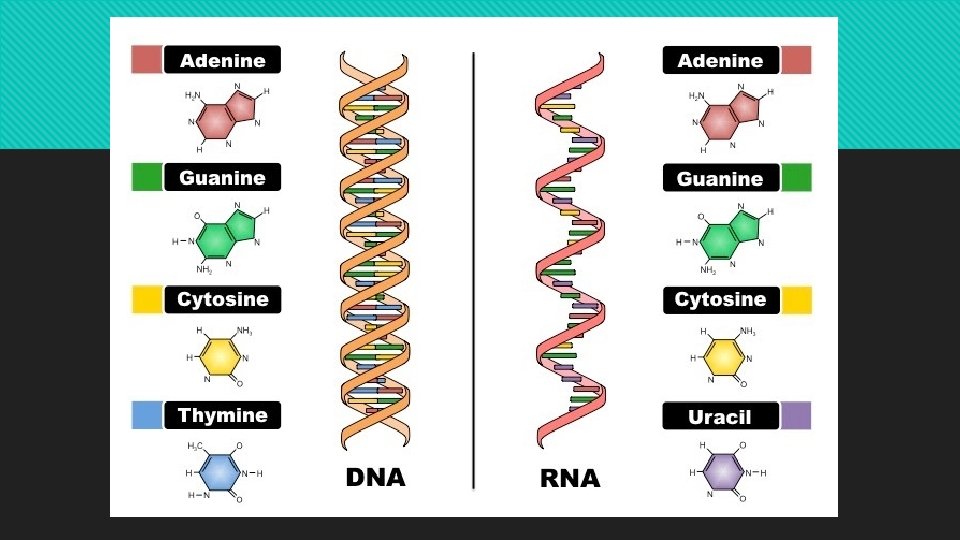
Transcription �RNA Similarities to DNA �RNA is a long chain of nucleotides �RNA contains many of the same nitrogenous bases
�How is RNA different from DNA? �The sugar in RNA is ribose (What is the sugar in DNA)? �RNA is present outside of the nucleus in a cell (where is DNA located? ) �RNA has only one strand (how many does DNA have? )
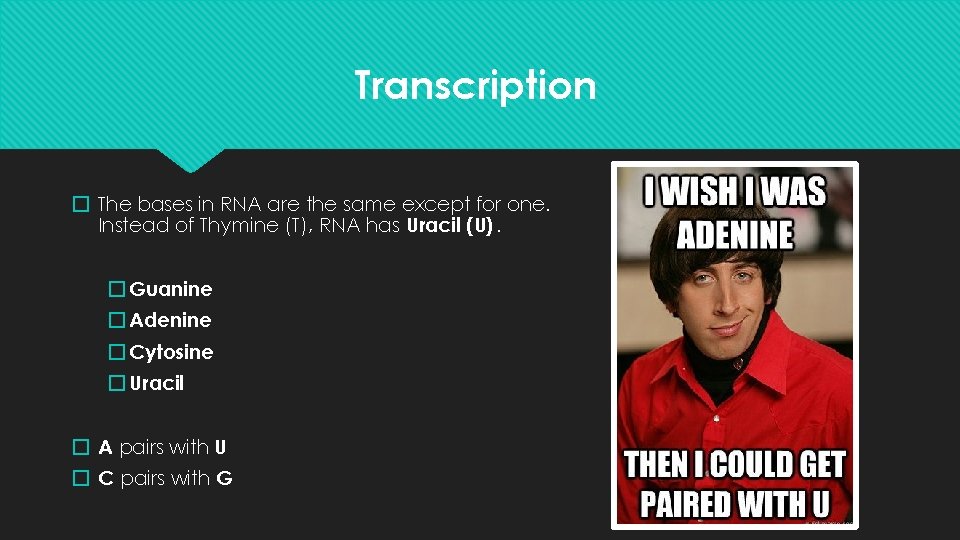
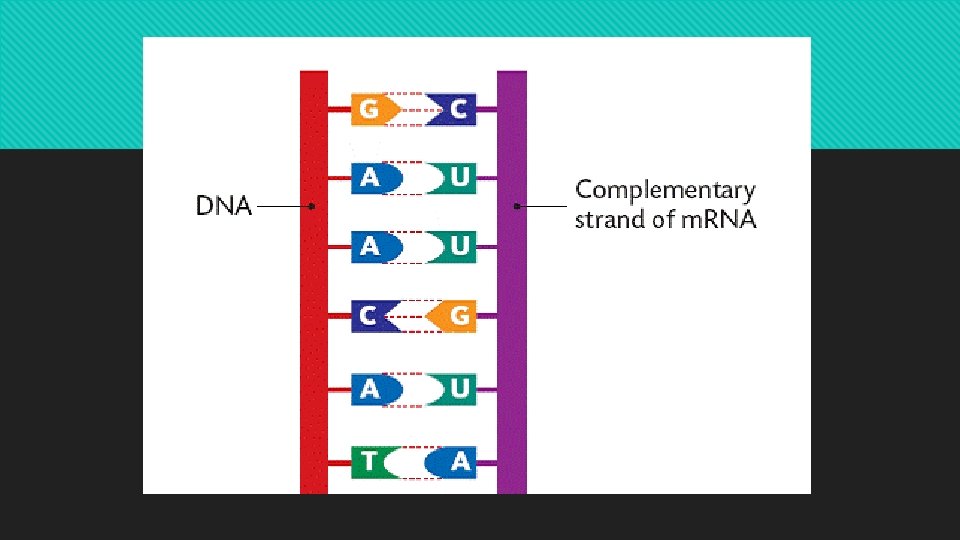
Transcription � The bases in RNA are the same except for one. Instead of Thymine (T), RNA has Uracil (U). � Guanine � Adenine � Cytosine � Uracil � A pairs with U � C pairs with G
Transcription
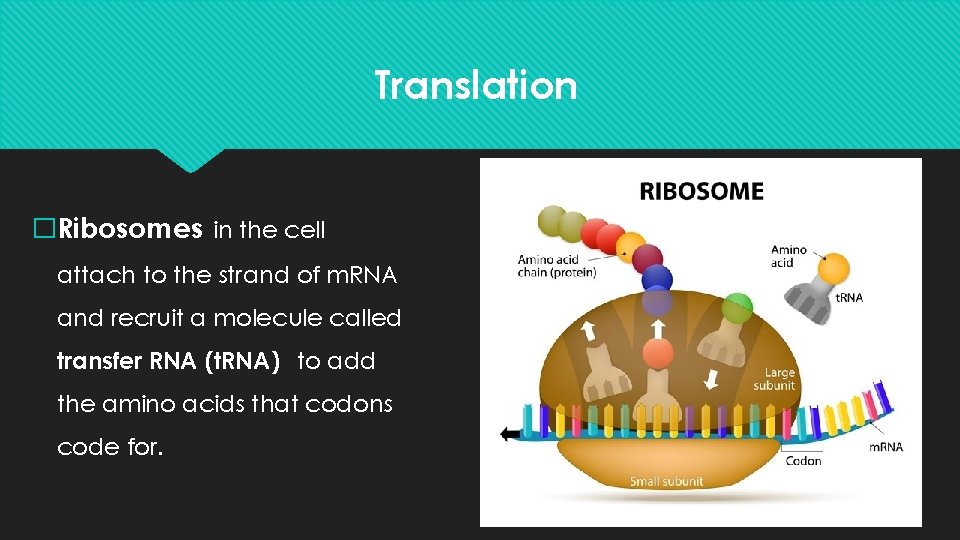
Types of RNA � m. RNA (Messenger RNA): A single strand of RNA nucleotides which is copied in a process called transcription. The m. RNA strand is used to bring the DNA code to the ribosome in the cytoplasm. � t. RNA (Transfer RNA): A segment of RNA nucleotides which carries amino acids to the ribosomes. Each t. RNA is composed of 3 parts: an amino acid, a sequence of RNA nucleotides, and an anti-codon. � r. RNA (Ribosomal RNA): Ribosomes are made up of r. RNA. The role is to hold m. RNA in place. r. RNA arranges the amino acids in the correct order. r. RNA also folds the growing protein strand at the ribosome.
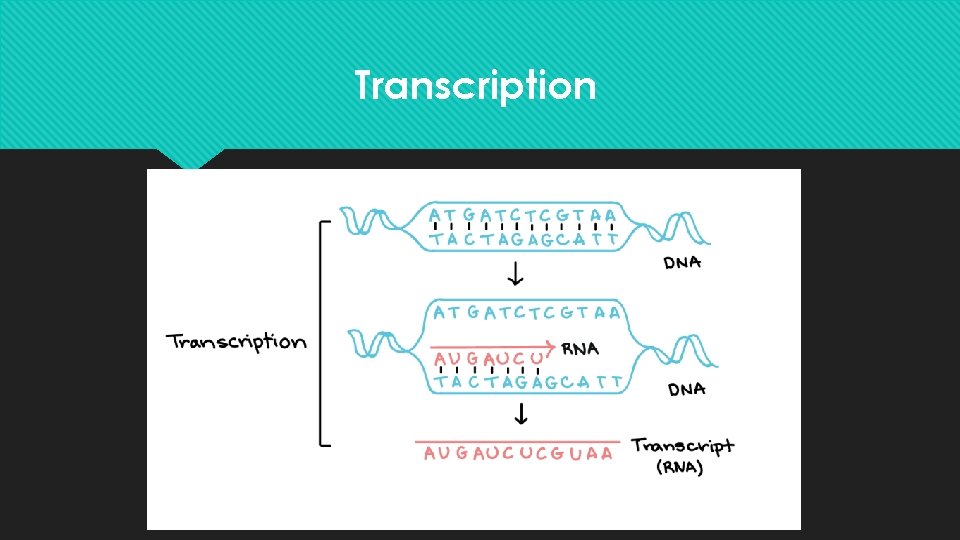
Transcription � The RNA that we make from DNA is called messenger RNA, or m. RNA � We can make m. RNA from DNA through complementary base pairing � Using a DNA template strand , m. RNA bases are joined together, making an m. RNA strand
Transcription
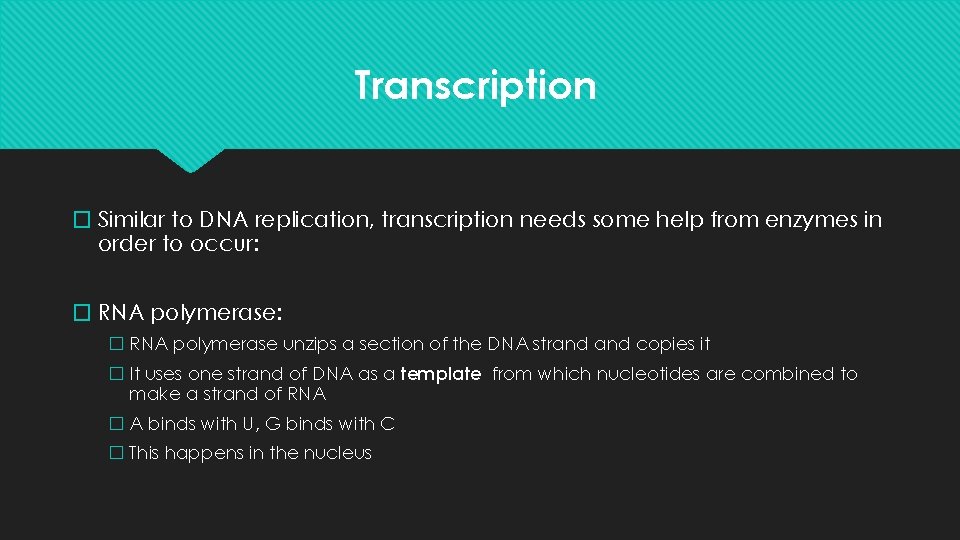
Transcription � Similar to DNA replication, transcription needs some help from enzymes in order to occur: � RNA polymerase unzips a section of the DNA strand copies it � It uses one strand of DNA as a template from which nucleotides are combined to make a strand of RNA � A binds with U, G binds with C � This happens in the nucleus
Transcription �The RNA polymerase unzips a segment of the DNA molecule that codes for a protein called a gene �INTRONS �DON’T code for proteins, are spliced (cut) out �EXONS �DO code for proteins (“ex-ons are ex-pressed”)
Transcription �Once transcription is finished there is a complete strand of m. RNA composed of codons. �We will cover this more in our next section.
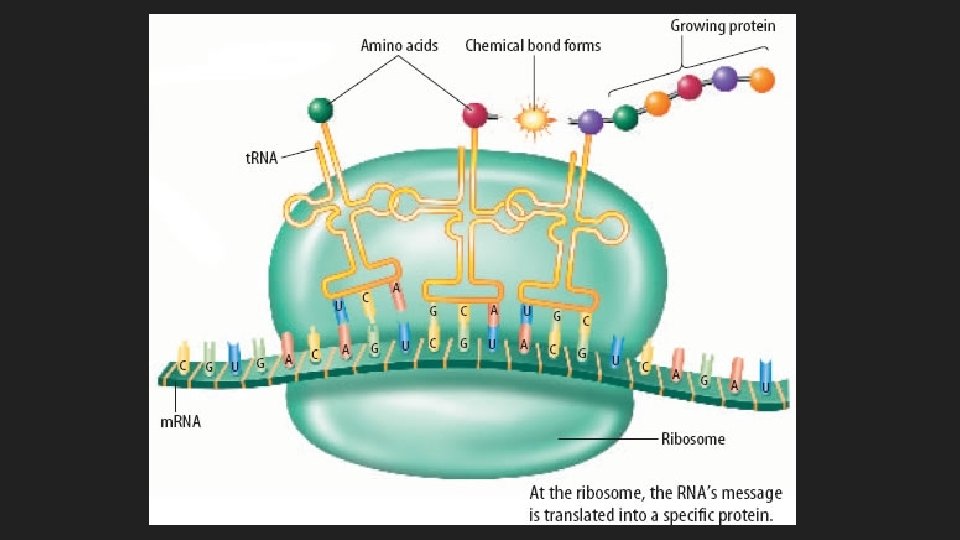
Translation �TRANSLATION is the process of making proteins from m. RNA. �Sections of m. RNA code for certain amino acids, which when linked together, make up proteins
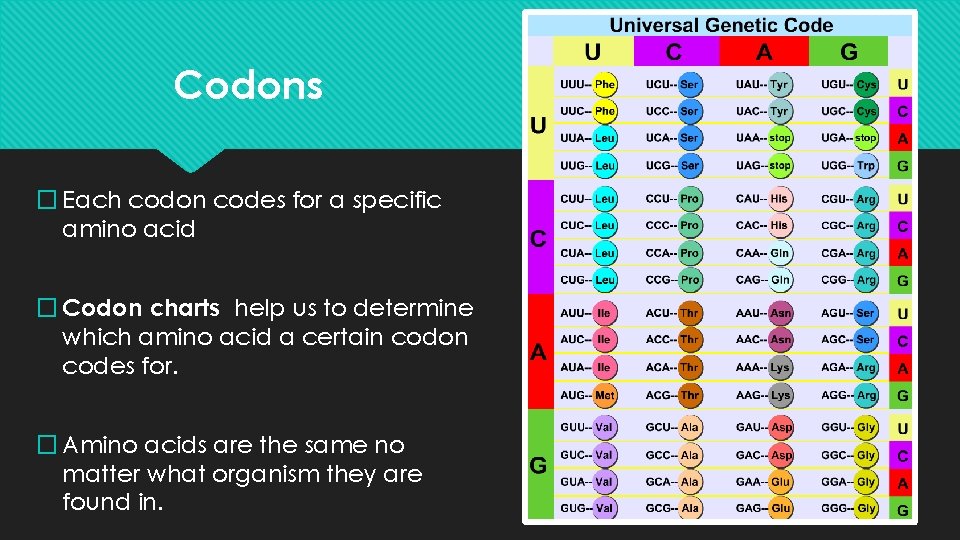
Codon � m. RNA is divided into sections with 3 bases each. Each section is called a CODON. �Codon: section of m. RNA made up of 3 bases (A, U, C, or G) � For example, a strand of m. RNA that looks like this: A U G C A U � Is read like this: A U G – C A U
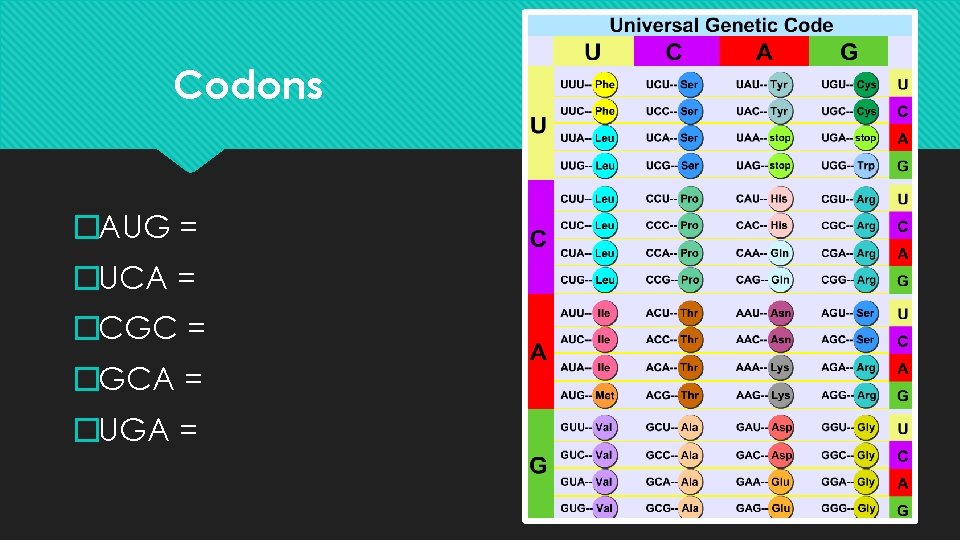
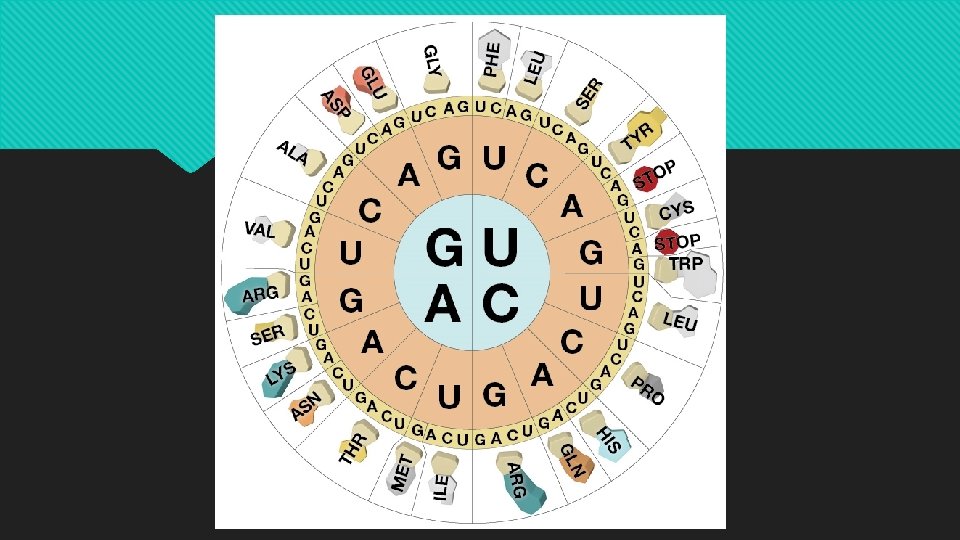
Codons � Each codon codes for a specific amino acid � Codon charts help us to determine which amino acid a certain codon codes for. � Amino acids are the same no matter what organism they are found in.
Codons �AUG = �UCA = �CGC = �GCA = �UGA =
Codons
Activity Transcription & Codons � � � � Model the process of Transcription and identify the following structures: RNA Polymerase, m. RNA, Exons, Codons, Uracil, and two differences between DNA vs RNA. (To explain this it would be helpful to draw both strands to see what they look like. ) Please answer the following questions as well: Each set of three RNA nucleotides is called a…. ? The process of making a m. RNA strand using the DNA strand as a template is called…? DNA: Deoxyribose: : RNA: …. . ? This is the location where m. RNA is produced? What are 2 differences between DNA vs RNA?
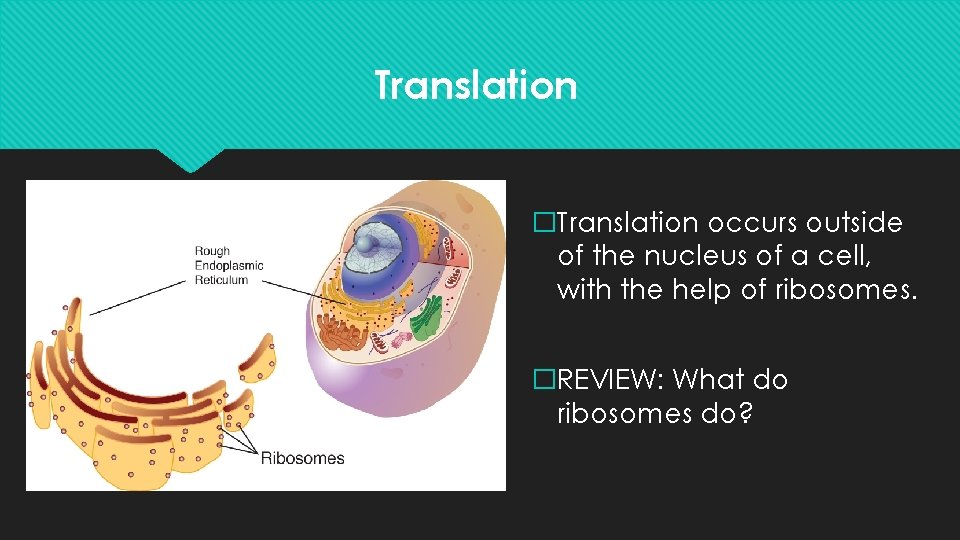
Translation �Translation occurs outside of the nucleus of a cell, with the help of ribosomes. �REVIEW: What do ribosomes do?
Translation �Ribosomes in the cell attach to the strand of m. RNA and recruit a molecule called transfer RNA (t. RNA) to add the amino acids that codons code for.
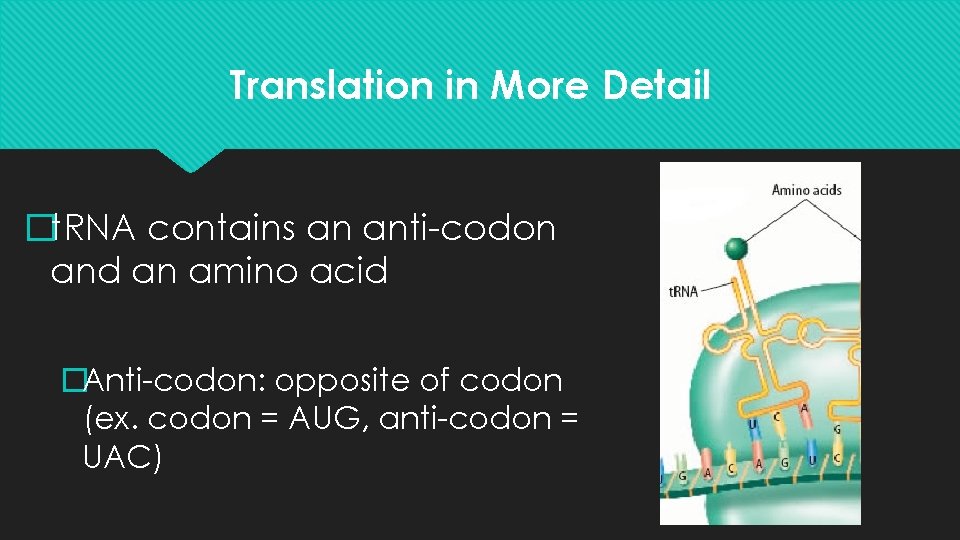
Translation in More Detail �t. RNA contains an anti-codon and an amino acid �Anti-codon: opposite of codon (ex. codon = AUG, anti-codon = UAC)
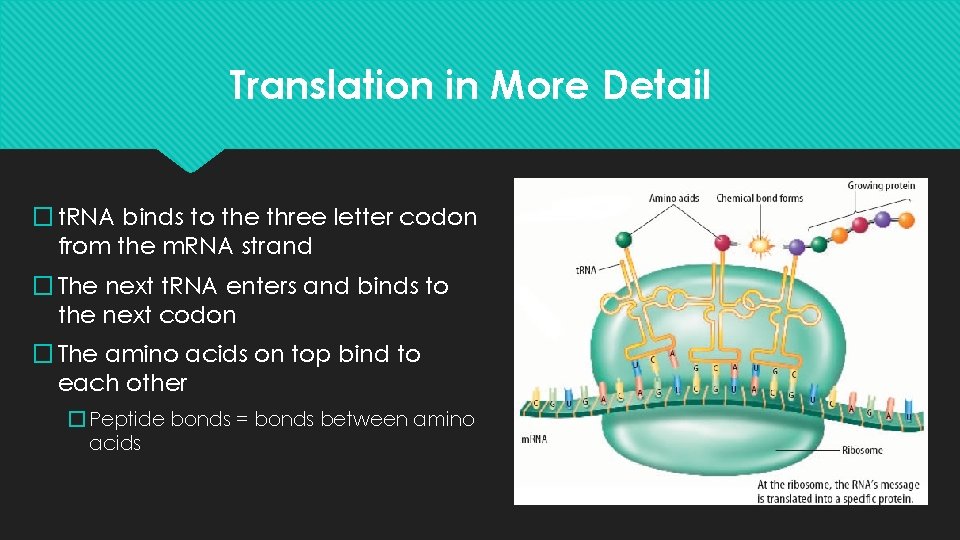
Translation in More Detail � t. RNA binds to the three letter codon from the m. RNA strand � The next t. RNA enters and binds to the next codon � The amino acids on top bind to each other � Peptide bonds = bonds between amino acids
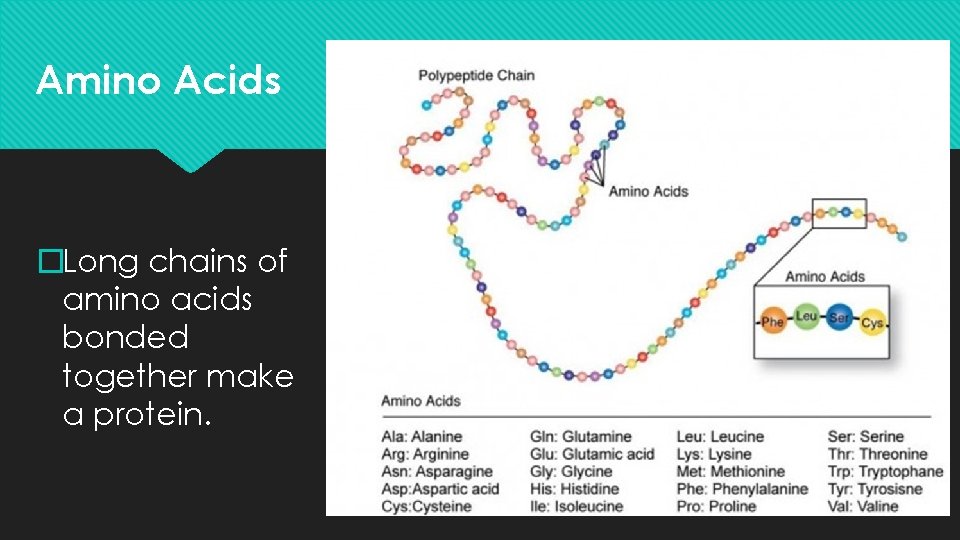
Amino Acids �Long chains of amino acids bonded together make a protein.
Ribosomal RNA (r. RNA) �Holds the m. RNA in place �Arranges the amino acids in the correct order �Folds protein to make it usable
Transcription & Translation Activity �http: //learn. genetics. utah. edu/content/basics/transcribe/ �TIP: “Group by 3 after AUG” �Paper Transcription and Translation