
Transcription RNA Processing The Central Dogma of life

- Slides: 45
Transcription RNA Processing
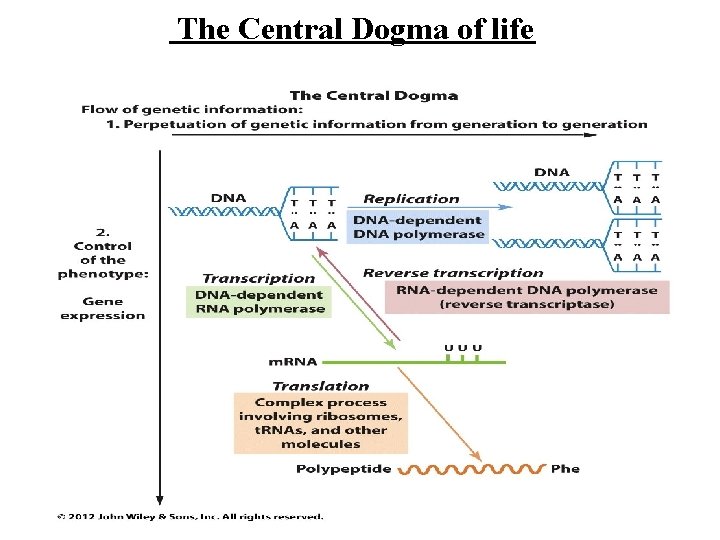
The Central Dogma of life
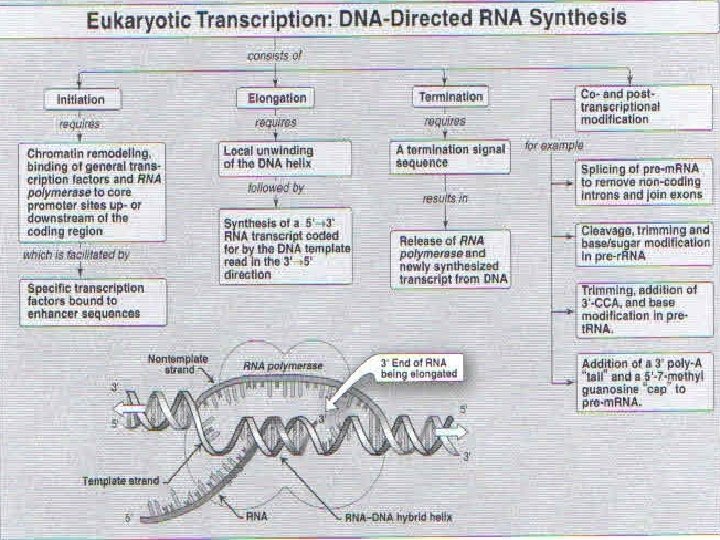
Overview of transcription first stage in the expression of genetic information is e information in the DNA deoxyribonucleotides sequence into RNA ribonucleotides sequence. or any gene, only one strand of the DNA molecule, called the template strand, is transcribed by RNA polymerase. ause RNA polymerase moves in the 3' to 5' direction he template strand of DNA, the RNA product is antiparallel and complementary to the template. NA polymerase recognizes start signals (promoters) and gnals (terminators) for each of the thousands of transcription units in the genome of an organism.
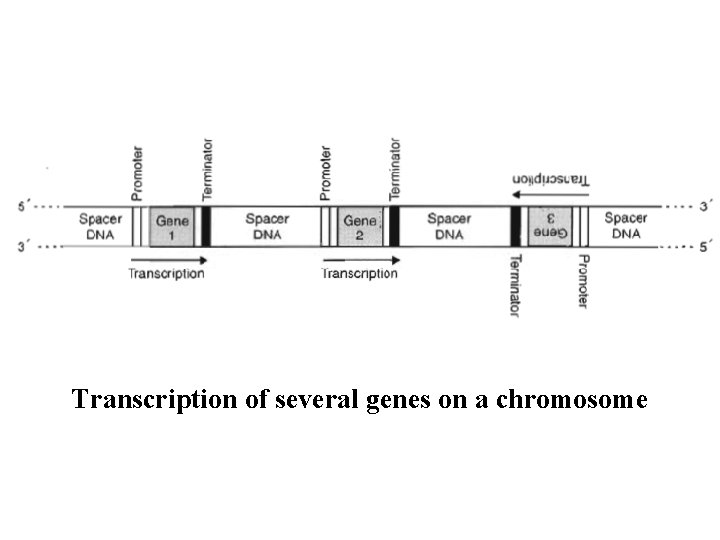
Transcription of several genes on a chromosome
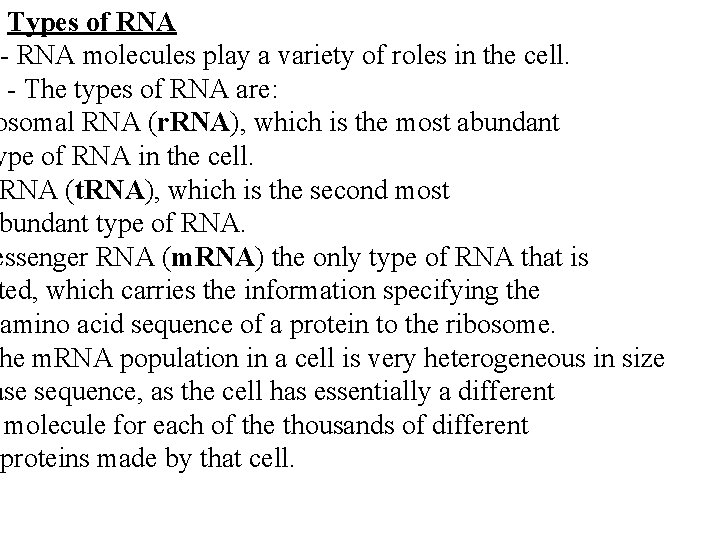
Types of RNA - RNA molecules play a variety of roles in the cell. - The types of RNA are: osomal RNA (r. RNA), which is the most abundant ype of RNA in the cell. RNA (t. RNA), which is the second most bundant type of RNA. essenger RNA (m. RNA) the only type of RNA that is ted, which carries the information specifying the amino acid sequence of a protein to the ribosome. he m. RNA population in a cell is very heterogeneous in size ase sequence, as the cell has essentially a different molecule for each of the thousands of different proteins made by that cell.
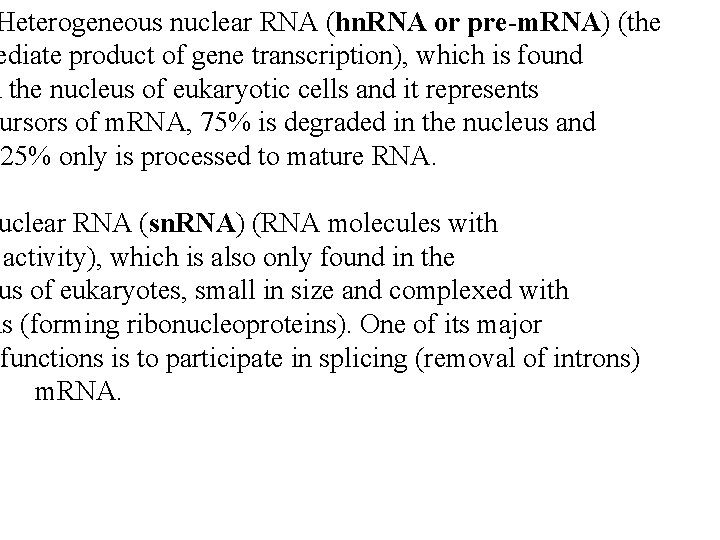
Heterogeneous nuclear RNA (hn. RNA or pre-m. RNA) (the ediate product of gene transcription), which is found n the nucleus of eukaryotic cells and it represents ursors of m. RNA, 75% is degraded in the nucleus and 25% only is processed to mature RNA. uclear RNA (sn. RNA) (RNA molecules with activity), which is also only found in the us of eukaryotes, small in size and complexed with ns (forming ribonucleoproteins). One of its major functions is to participate in splicing (removal of introns) m. RNA.
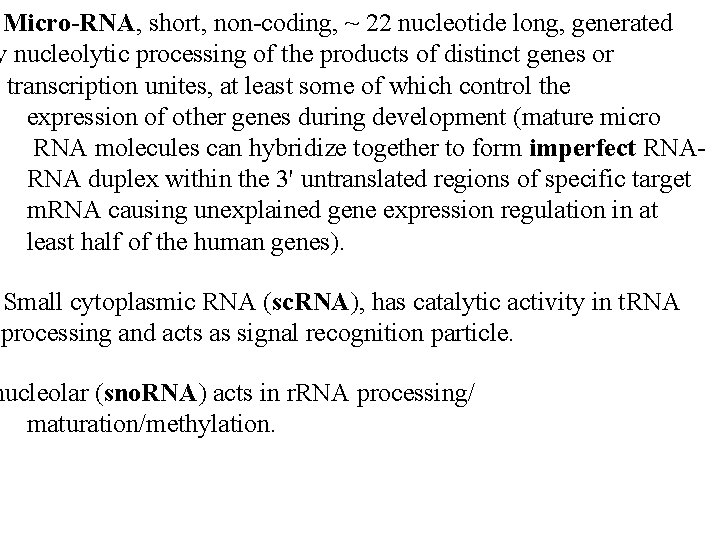
Micro-RNA, short, non-coding, ~ 22 nucleotide long, generated y nucleolytic processing of the products of distinct genes or transcription unites, at least some of which control the expression of other genes during development (mature micro RNA molecules can hybridize together to form imperfect RNARNA duplex within the 3' untranslated regions of specific target m. RNA causing unexplained gene expression regulation in at least half of the human genes). Small cytoplasmic RNA (sc. RNA), has catalytic activity in t. RNA processing and acts as signal recognition particle. nucleolar (sno. RNA) acts in r. RNA processing/ maturation/methylation.
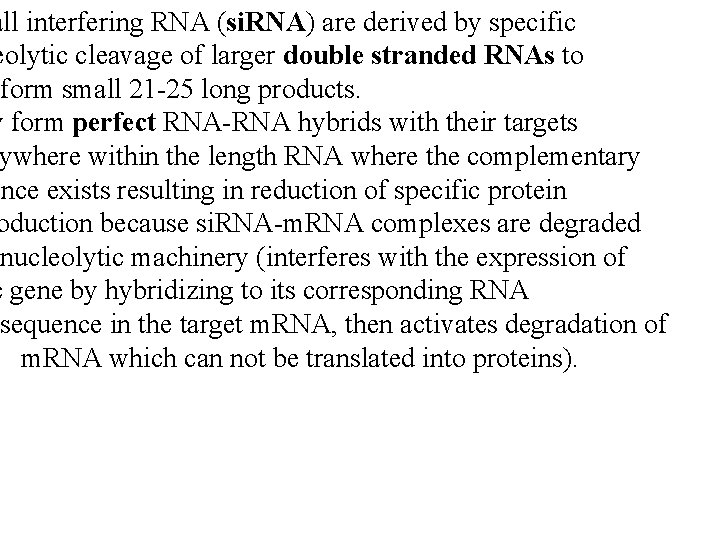
all interfering RNA (si. RNA) are derived by specific eolytic cleavage of larger double stranded RNAs to form small 21 -25 long products. y form perfect RNA-RNA hybrids with their targets ywhere within the length RNA where the complementary ence exists resulting in reduction of specific protein oduction because si. RNA-m. RNA complexes are degraded nucleolytic machinery (interferes with the expression of c gene by hybridizing to its corresponding RNA sequence in the target m. RNA, then activates degradation of m. RNA which can not be translated into proteins).
Transcription: important concepts and terminology A polymerase locates genes in DNA by searching for promoter regions. he promoter is the binding site for transcription factors and RNA polymerase. nding establishes where transcription begins, which of DNA is used as the template, and in which direction transcription proceeds. RNA polymerase moves along the template strand in the 3' to direction as it synthesizes the RNA product in the 5' to 3' direction using NTPs (ATP, GTP, CTP, UTP) as substrates. - RNA polymerase does not proofread its work. The RNA product is complementary and antiparallel to the template strand.
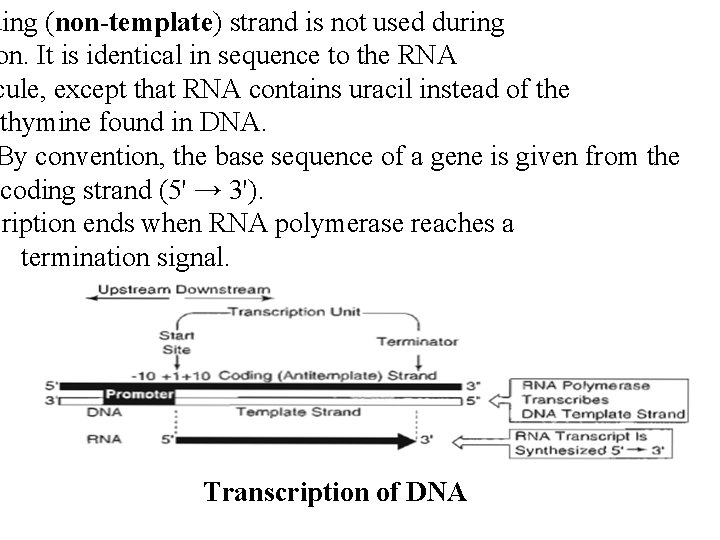
ding (non-template) strand is not used during on. It is identical in sequence to the RNA cule, except that RNA contains uracil instead of the thymine found in DNA. By convention, the base sequence of a gene is given from the coding strand (5' → 3'). cription ends when RNA polymerase reaches a termination signal. Transcription of DNA
RNA Polymerases - There is a single prokaryotic RNA polymerase that synthesizes all types of RNA in the cell. - The core polymerase has the subunit structure (α 2ββ`). n factor called sigma (σ) is required for the initiation of transcription at the promoter. - σ factor is released immediately after transcription initiation. Functions of the subunits: : assembly of the tetrameric core : ribonucleoside triphosphate binding site (link ribonucleotides together) ’: DNA template binding region (sigma factor): initiation of transcription mination of transcription sometimes requires a protein called rho (ρ) factor. - This enzyme is inhibited by rifampin and actinomycin D.
Promoter “Strength” (activity) - Affects amount of RNA made, so, it affects level of expression for that gene. - Not all promoters have same “strength” - Promoters differ in DNA sequences and “strength” - RNA polymerase binds differently to different sequences rong promoters” initiate transcription more often than “weak promoters” - r. RNA has strong promoter: ~1 initiation per second - lac. Z has a weak promoter: ~1 initiation per minute
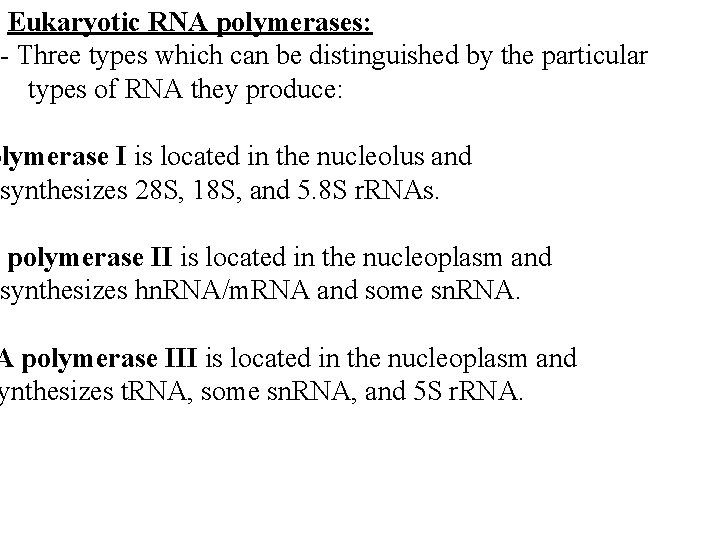
Eukaryotic RNA polymerases: - Three types which can be distinguished by the particular types of RNA they produce: olymerase I is located in the nucleolus and synthesizes 28 S, 18 S, and 5. 8 S r. RNAs. A polymerase II is located in the nucleoplasm and synthesizes hn. RNA/m. RNA and some sn. RNA. A polymerase III is located in the nucleoplasm and ynthesizes t. RNA, some sn. RNA, and 5 S r. RNA.
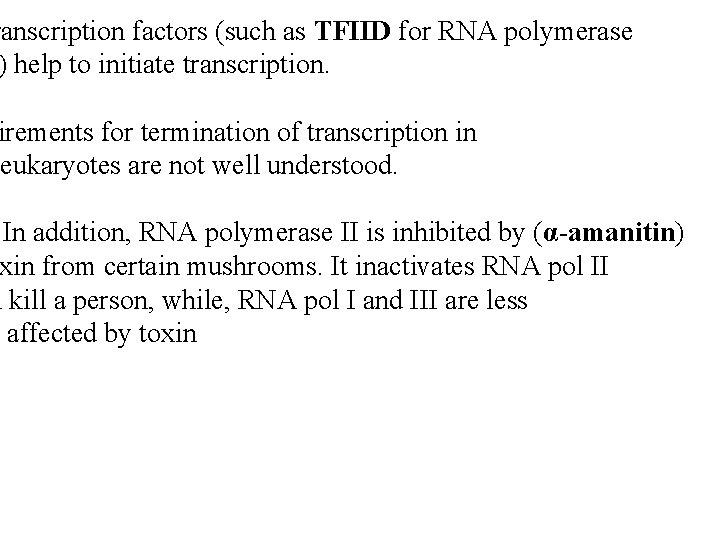
ranscription factors (such as TFIID for RNA polymerase ) help to initiate transcription. irements for termination of transcription in eukaryotes are not well understood. In addition, RNA polymerase II is inhibited by (α-amanitin) xin from certain mushrooms. It inactivates RNA pol II n kill a person, while, RNA pol I and III are less affected by toxin
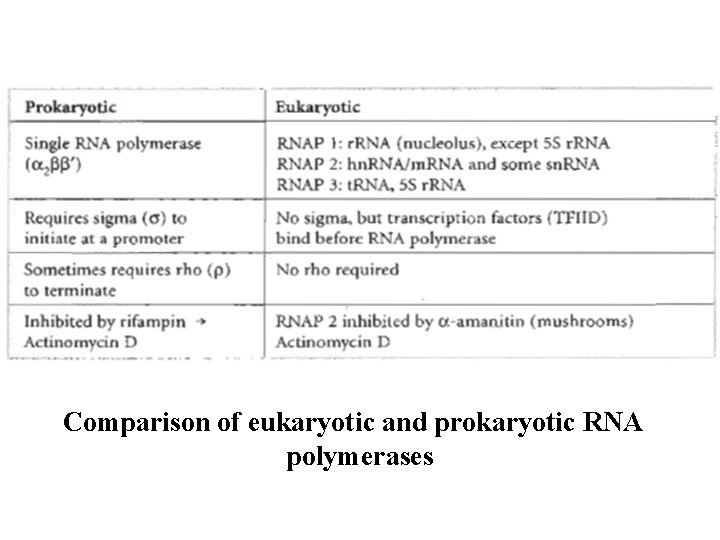
Comparison of eukaryotic and prokaryotic RNA polymerases
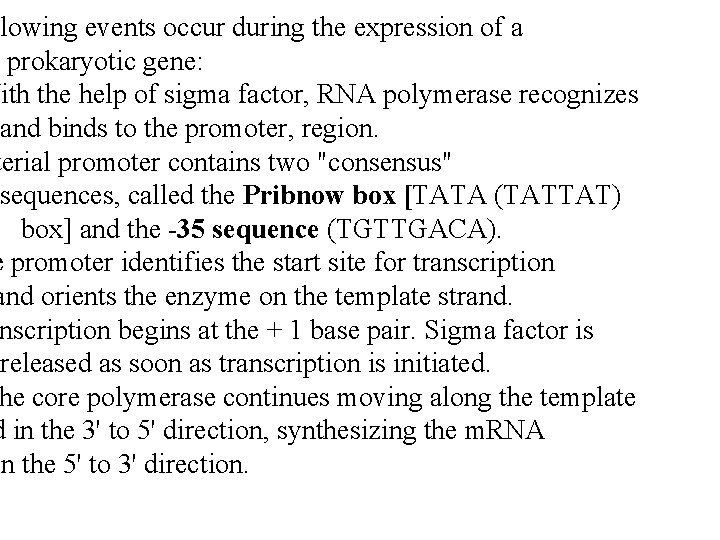
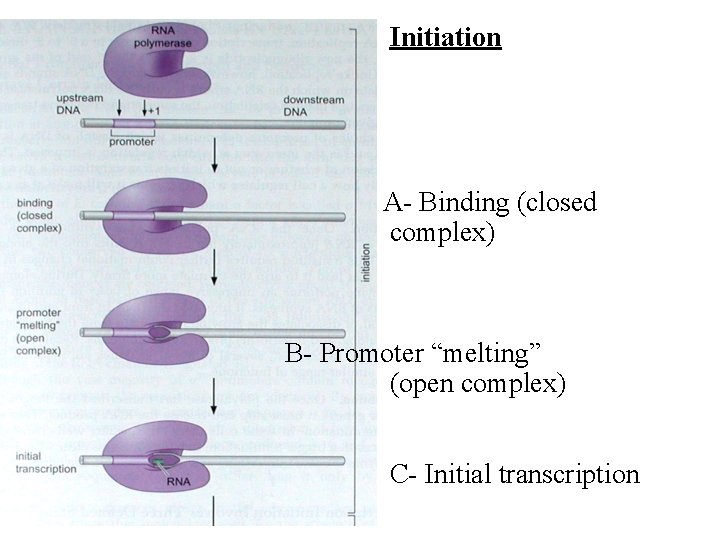
llowing events occur during the expression of a prokaryotic gene: With the help of sigma factor, RNA polymerase recognizes and binds to the promoter, region. terial promoter contains two "consensus" sequences, called the Pribnow box [TATA (TATTAT) box] and the -35 sequence (TGTTGACA). e promoter identifies the start site for transcription and orients the enzyme on the template strand. nscription begins at the + 1 base pair. Sigma factor is released as soon as transcription is initiated. he core polymerase continues moving along the template d in the 3' to 5' direction, synthesizing the m. RNA in the 5' to 3' direction.
Initiation A- Binding (closed complex) B- Promoter “melting” (open complex) C- Initial transcription
Elongation Termination
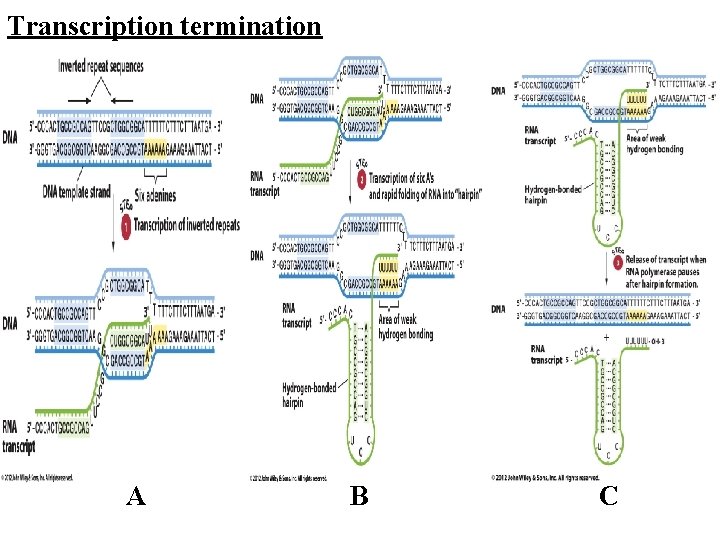
olymerase eventually reaches a transcription mination signal, at which point it will stop transcription and release the completed m. RNA molecule. here are two kinds of transcription terminators commonly found in prokaryotic genes: Rho-independent termination occurs when the newly RNA folds back on itself to form a GC-rich rpin loop closely followed by 6 -8 U residues. These tructural features of the newly synthesized RNA promote dissociation of the RNA from DNA template. Bo-dependent termination requires participation of or. This protein binds to the newly formed d moves toward the RNA polymerase that used at a termination site. Rho then displaces RNA polymerase from the 3' end of the RNA.
Transcription termination A B C
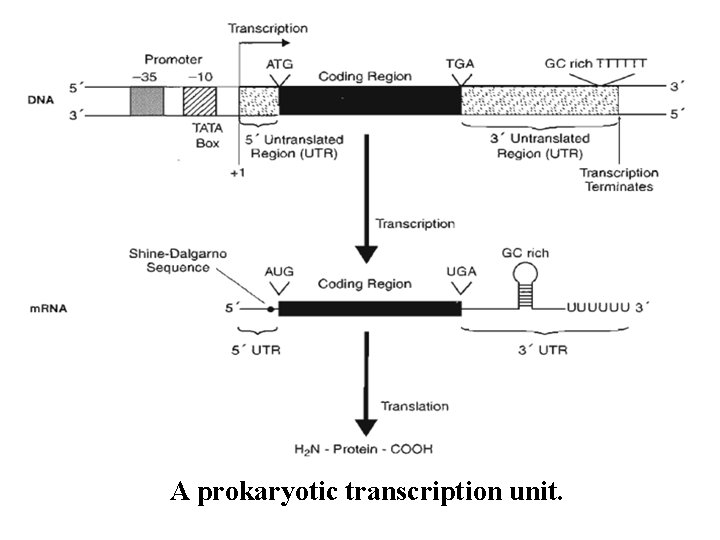
anscription and translation can occur simultaneously in because there is no processing of prokaryotic enerally no introns), ribosomes can begin the message even before transcription is plete. Ribosomes bind to a sequence called Shine-Dalgarno sequence in the 5' untranslated region (UTR) of the message n synthesis begins at an AUG codon at the ng of the coding region and continues until the me reaches a stop codon at the end of the coding region. 6. The ribosome translates the message in the 5' to 3' direction, synthesizing the protein from amino terminus to carboxyl terminus.
A prokaryotic transcription unit.
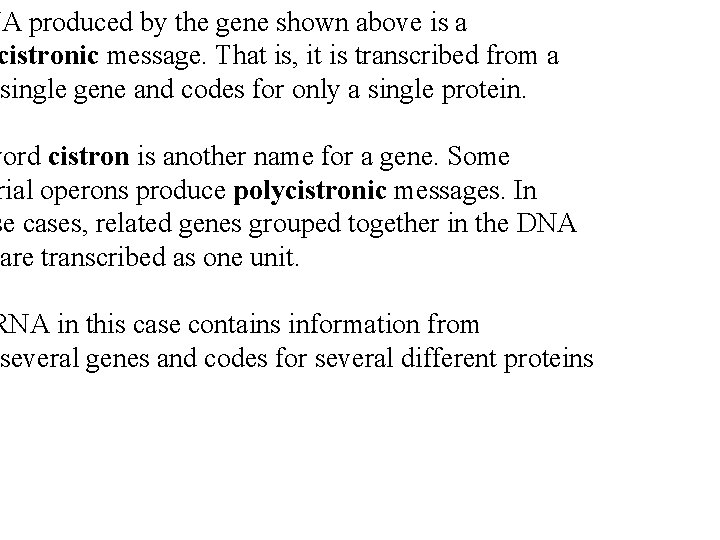
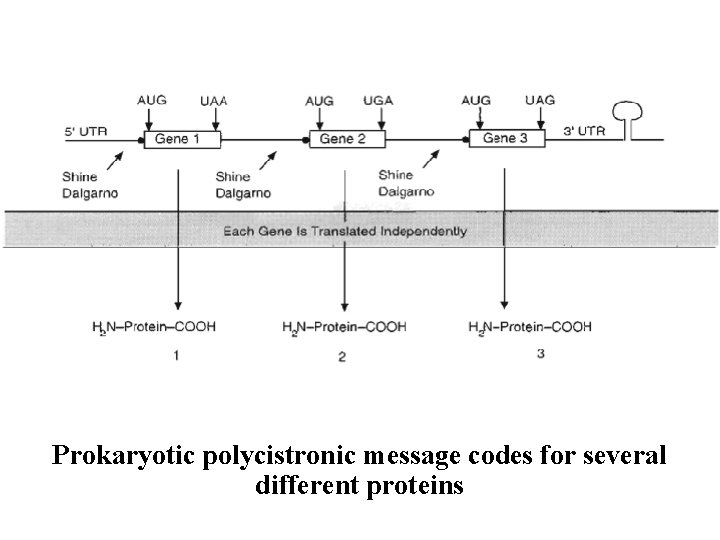
NA produced by the gene shown above is a cistronic message. That is, it is transcribed from a single gene and codes for only a single protein. word cistron is another name for a gene. Some rial operons produce polycistronic messages. In se cases, related genes grouped together in the DNA are transcribed as one unit. RNA in this case contains information from several genes and codes for several different proteins
Prokaryotic polycistronic message codes for several different proteins
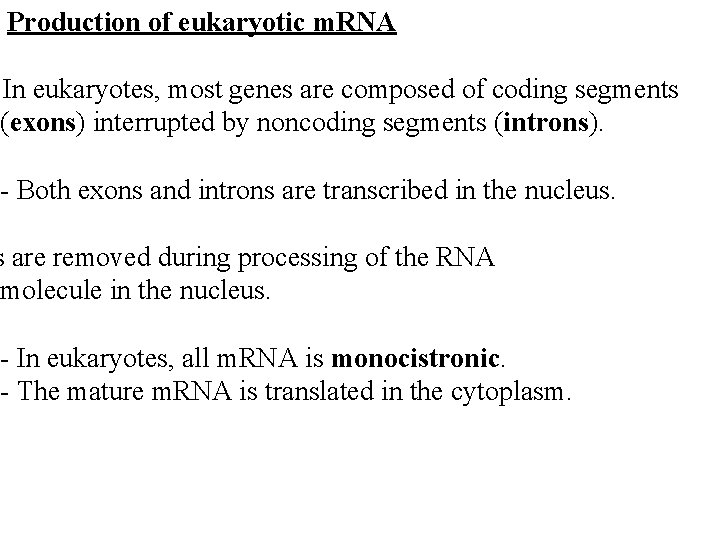
Production of eukaryotic m. RNA In eukaryotes, most genes are composed of coding segments (exons) interrupted by noncoding segments (introns). - Both exons and introns are transcribed in the nucleus. s are removed during processing of the RNA molecule in the nucleus. - In eukaryotes, all m. RNA is monocistronic. - The mature m. RNA is translated in the cytoplasm.
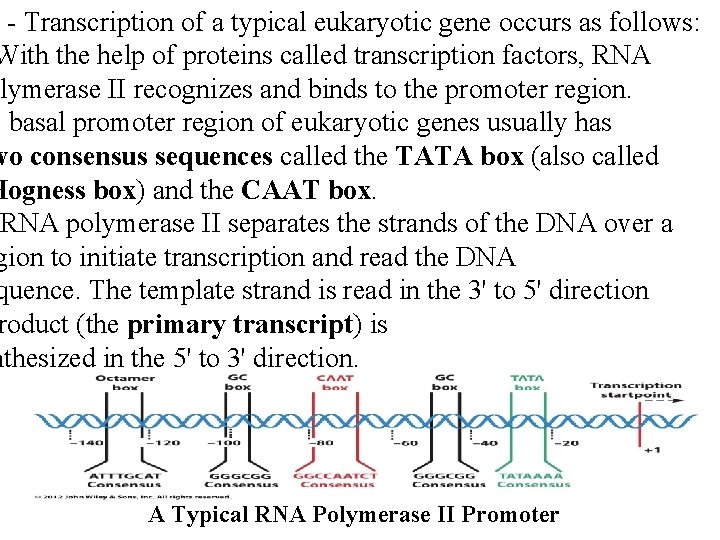
- Transcription of a typical eukaryotic gene occurs as follows: With the help of proteins called transcription factors, RNA olymerase II recognizes and binds to the promoter region. e basal promoter region of eukaryotic genes usually has wo consensus sequences called the TATA box (also called Hogness box) and the CAAT box. RNA polymerase II separates the strands of the DNA over a gion to initiate transcription and read the DNA quence. The template strand is read in the 3' to 5' direction roduct (the primary transcript) is nthesized in the 5' to 3' direction. A Typical RNA Polymerase II Promoter
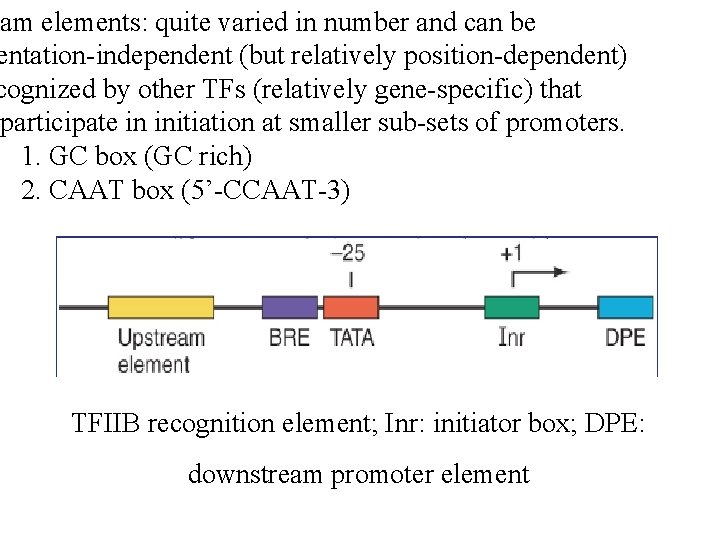
Class II promoters (most similar to bacterial promoters) - Common type of promoter (most genes use this) tions, but “consensus” has a “Core” + “Upstream” Core (3 elements): 1. “TATA box” (5’-TATA-3’) 2. TFIIB recognition element (BRE) 3. Initiator box (Inr) with an “A” at +1, most common - Downstream promoter element (DPE, less common) ore promoter is recognized by general TFs that associate NA pol to form a preinitiation complex at great majority of promoters - At least one of these elements is missing in most promoters highly expressed specialized genes tend to have ATA boxes, but promoters for housekeeping genes tend to lack them
eam elements: quite varied in number and can be entation-independent (but relatively position-dependent) cognized by other TFs (relatively gene-specific) that participate in initiation at smaller sub-sets of promoters. 1. GC box (GC rich) 2. CAAT box (5’-CCAAT-3) TFIIB recognition element; Inr: initiator box; DPE: downstream promoter element
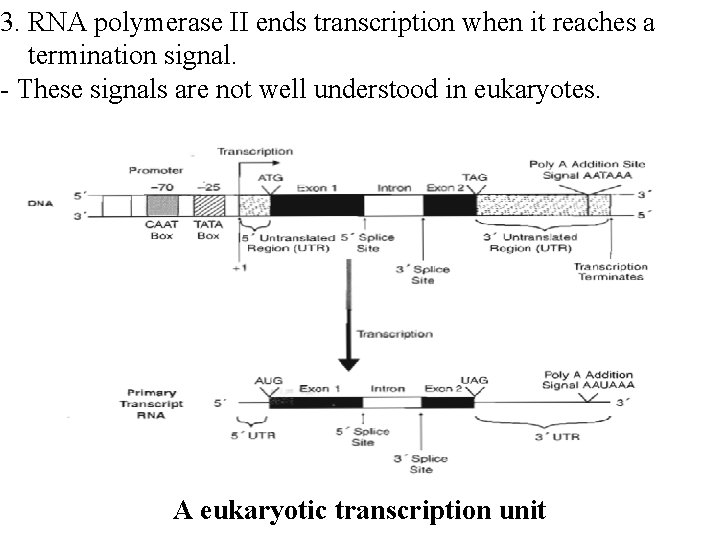
3. RNA polymerase II ends transcription when it reaches a termination signal. - These signals are not well understood in eukaryotes. A eukaryotic transcription unit
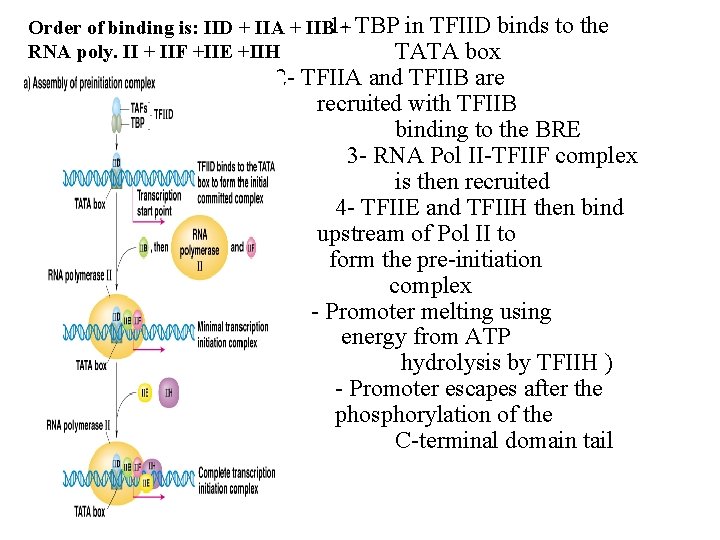
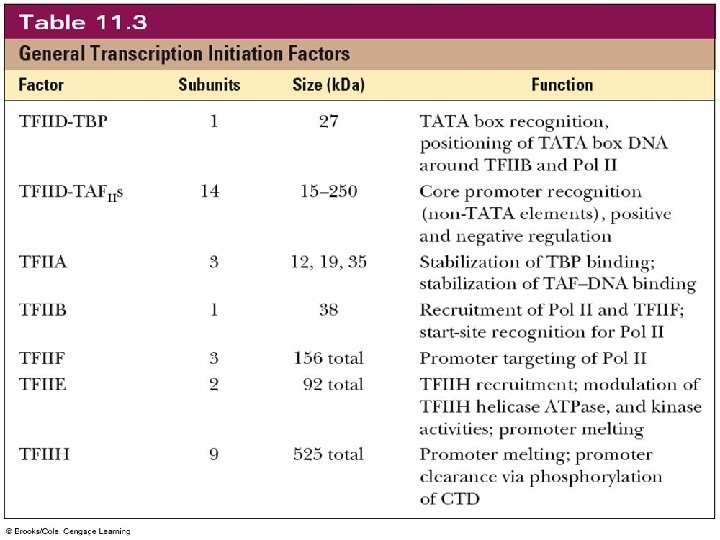
Order of binding is: IID + IIA + IIB 1 -+ TBP in TFIID binds RNA poly. II + IIF +IIE +IIH TATA box to the 2 - TFIIA and TFIIB are recruited with TFIIB binding to the BRE 3 - RNA Pol II-TFIIF complex is then recruited 4 - TFIIE and TFIIH then bind upstream of Pol II to form the pre-initiation complex - Promoter melting using energy from ATP hydrolysis by TFIIH ) - Promoter escapes after the phosphorylation of the C-terminal domain tail
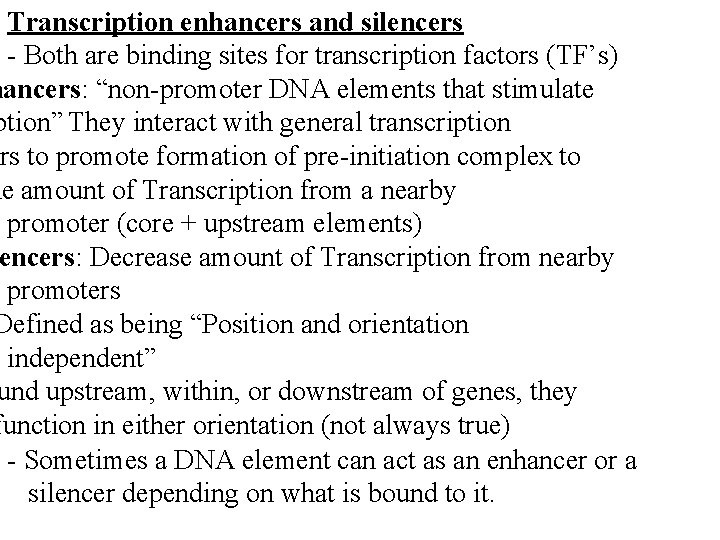
Transcription enhancers and silencers - Both are binding sites for transcription factors (TF’s) hancers: “non-promoter DNA elements that stimulate ption” They interact with general transcription ors to promote formation of pre-initiation complex to he amount of Transcription from a nearby promoter (core + upstream elements) encers: Decrease amount of Transcription from nearby promoters Defined as being “Position and orientation independent” und upstream, within, or downstream of genes, they function in either orientation (not always true) - Sometimes a DNA element can act as an enhancer or a silencer depending on what is bound to it.
Posttranscriptional processing of RNAs: erial r. RNAs and t. RNAs undergoes no additional ocessing, after being transcribed they are immediately ready for use in translation of bacterial m. RNAs can begin even before nscription is completed due to the lack of the nuclearplasmic separation that exists in eukaryotes and to ue opportunity for regulating the transcription of certain genes. An additional feature of bacterial m. RNAs is that most are cistronic which means that multiple polypeptides can be synthesized from a single primary transcript. olycistronic m. RNAs are very rare in eukaryotic cells but have been identified. - In addition, several viruses encode polycistronic RNAs.
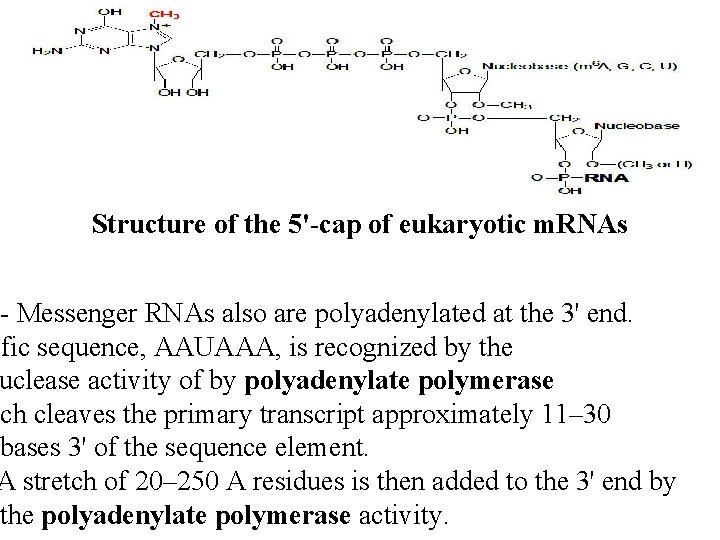
contrast to bacterial transcripts, eukaryotic RNAs (all 3 classes) undergo post-transcriptional processing. All 3 classes of RNA are transcribed from genes that contain ons. uences encoded by the intronic DNA must be ed from the primary transcript prior to the RNAs ng biologically active, this process of intron removal is NA splicing, additional processing occurs to As, the 5' end of all eukaryotic m. RNAs are capped with a unique 5'→ 5' linkage to a 7 -methyl GTP. pped end of the m. RNA is thus, protected from ases and more importantly is recognized by specific proteins of the translational machinery. capping process occurs after the newly synthesizing m. RNA is around 20– 30 bases long.
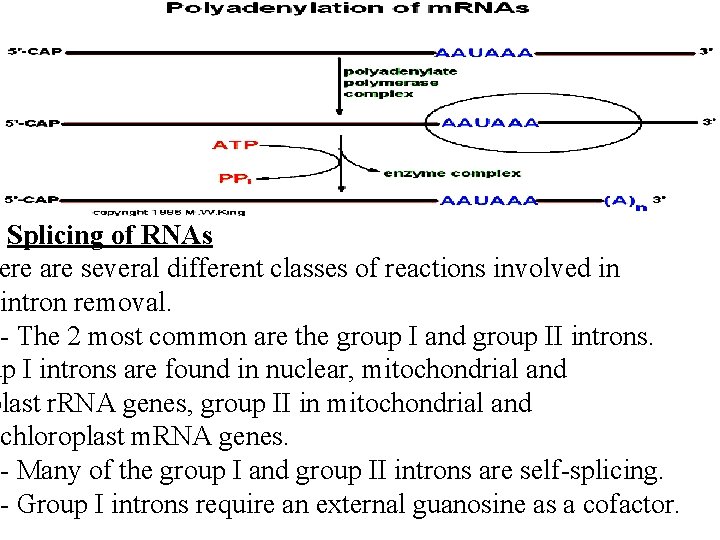
Structure of the 5'-cap of eukaryotic m. RNAs - Messenger RNAs also are polyadenylated at the 3' end. ific sequence, AAUAAA, is recognized by the uclease activity of by polyadenylate polymerase ich cleaves the primary transcript approximately 11– 30 bases 3' of the sequence element. A stretch of 20– 250 A residues is then added to the 3' end by the polyadenylate polymerase activity.
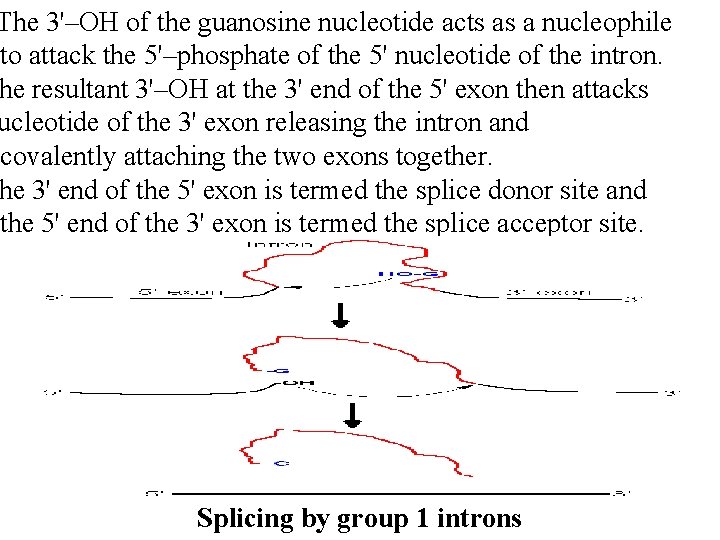
Splicing of RNAs ere are several different classes of reactions involved in intron removal. - The 2 most common are the group I and group II introns. up I introns are found in nuclear, mitochondrial and plast r. RNA genes, group II in mitochondrial and chloroplast m. RNA genes. - Many of the group I and group II introns are self-splicing. - Group I introns require an external guanosine as a cofactor.
The 3'–OH of the guanosine nucleotide acts as a nucleophile to attack the 5'–phosphate of the 5' nucleotide of the intron. he resultant 3'–OH at the 3' end of the 5' exon then attacks ucleotide of the 3' exon releasing the intron and covalently attaching the two exons together. he 3' end of the 5' exon is termed the splice donor site and the 5' end of the 3' exon is termed the splice acceptor site. Splicing by group 1 introns
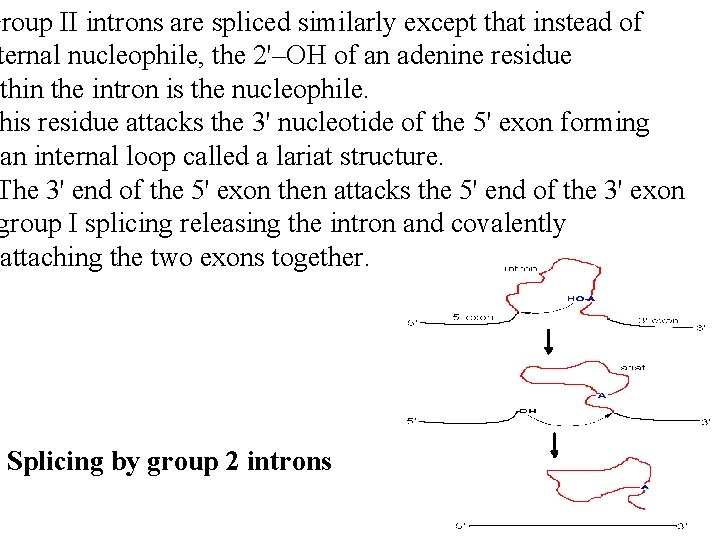
Group II introns are spliced similarly except that instead of ternal nucleophile, the 2'–OH of an adenine residue ithin the intron is the nucleophile. his residue attacks the 3' nucleotide of the 5' exon forming an internal loop called a lariat structure. The 3' end of the 5' exon then attacks the 5' end of the 3' exon group I splicing releasing the intron and covalently attaching the two exons together. Splicing by group 2 introns
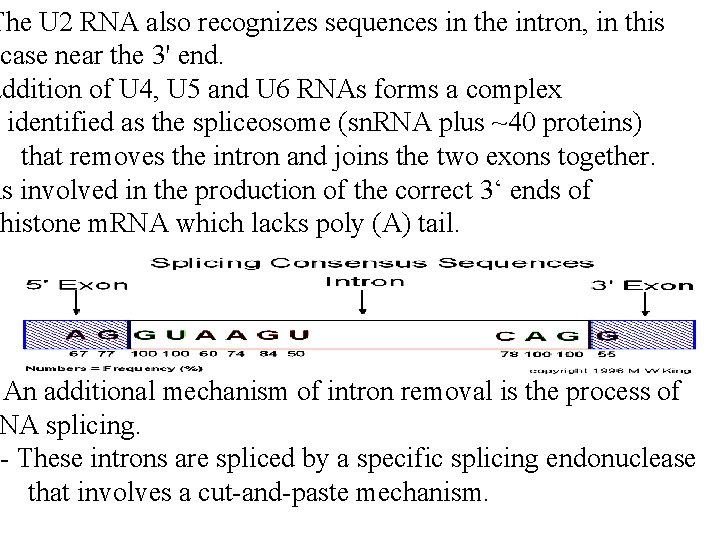
e third class of introns is also the largest class found in uclear m. RNAs, that undergoes a splicing reaction similar to group II introns in that an internal lariat structure is formed. wever, the splicing is catalyzed by specialized RNA– ein complexes called small nuclear ribonucleoprotein particles (sn. RNPs). e RNAs found in sn. RNPs are identified as U 1, U 2, U 4, U 5 and U 6. nalysis of a large number of m. RNA genes has led to the dentification of highly conserved consensus sequences at the 5' and 3' ends of essentially all m. RNA introns. 1 RNA has sequences that are complimentary to ences near the 5' end of the intron, its binding allows tinguishing the GU at the 5' end of the intron from other randomly placed GU sequences in m. RNAs.
The U 2 RNA also recognizes sequences in the intron, in this case near the 3' end. addition of U 4, U 5 and U 6 RNAs forms a complex identified as the spliceosome (sn. RNA plus ~40 proteins) that removes the intron and joins the two exons together. is involved in the production of the correct 3‘ ends of histone m. RNA which lacks poly (A) tail. An additional mechanism of intron removal is the process of NA splicing. - These introns are spliced by a specific splicing endonuclease that involves a cut-and-paste mechanism.
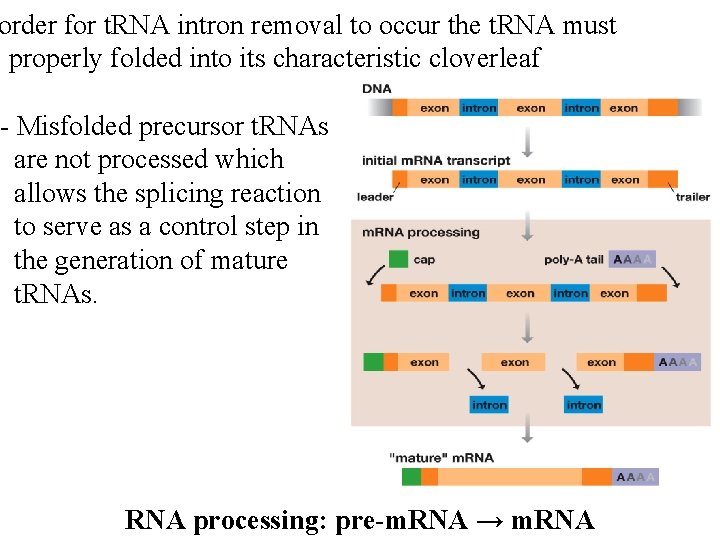
order for t. RNA intron removal to occur the t. RNA must e properly folded into its characteristic cloverleaf - Misfolded precursor t. RNAs are not processed which allows the splicing reaction to serve as a control step in the generation of mature t. RNAs. RNA processing: pre-m. RNA → m. RNA
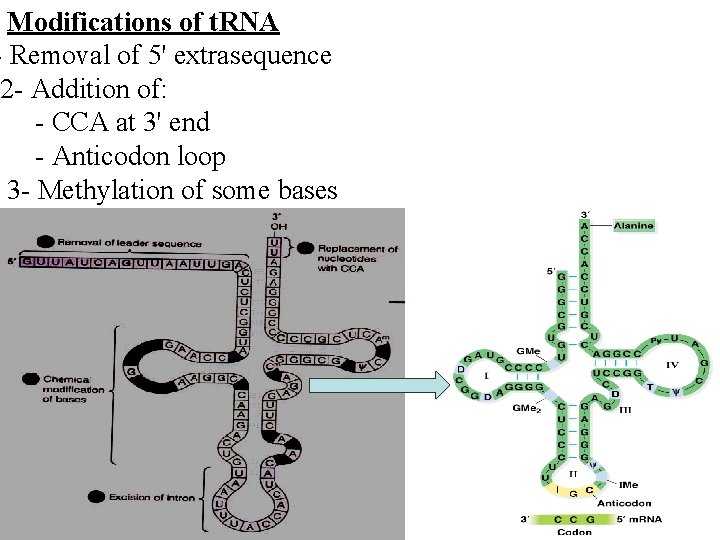
Modifications of t. RNA - Removal of 5' extrasequence 2 - Addition of: - CCA at 3' end - Anticodon loop 3 - Methylation of some bases
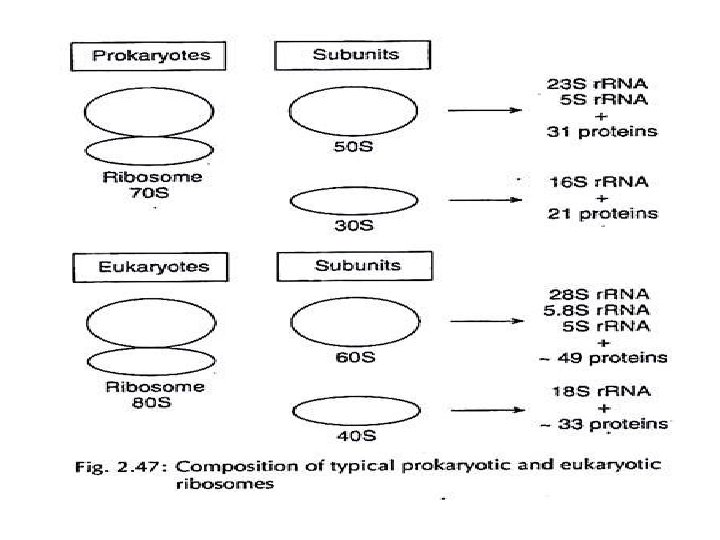
r. RNA is used to construct ribosomes Eukaryotic ribosomal RNA is transcribed in the nucleolus by A polymerase I as a single piece of 45 S RNA, which is sequently cleaved to yield 28 S r. RNA, 18 S r. RNA, and 5. 8 S r. RNA. A polymerase III transcribes the 5 S r. RNA unit from a e gene. The ribosomal subunits assemble in the us as the r. RNA pieces combine with ribosomal proteins. ukaryotic ribosomal subunits are 60 S and 40 S. They join during protein synthesis to form the whole 80 S ribosome.