
TRANSCRIPTION AND TRANSLATION A CLOSER LOOK Biology 12
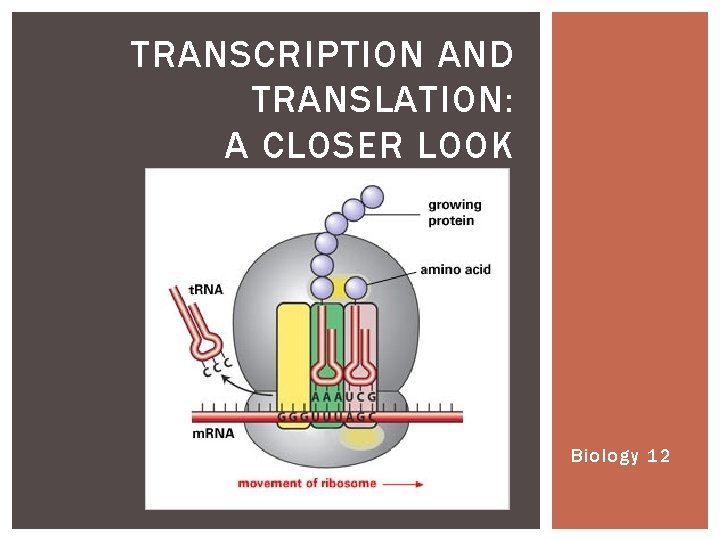
TRANSCRIPTION AND TRANSLATION: A CLOSER LOOK Biology 12
JOKE OF THE DAY:
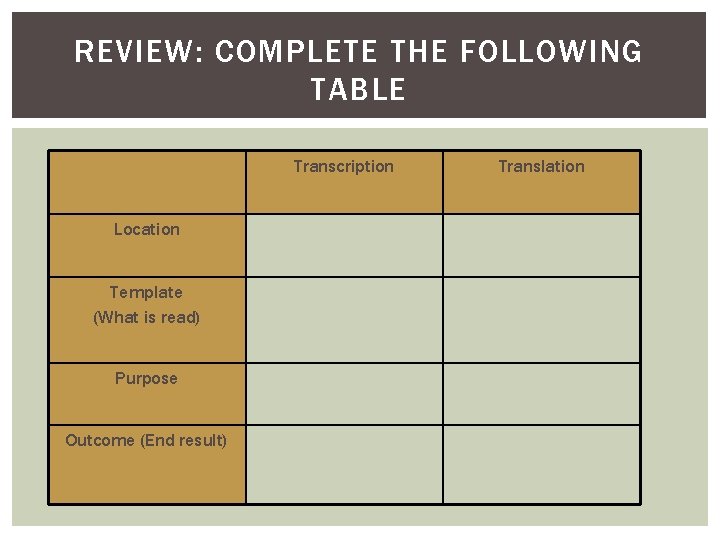
REVIEW: COMPLETE THE FOLLOWING TABLE Transcription Location Template (What is read) Purpose Outcome (End result) Translation
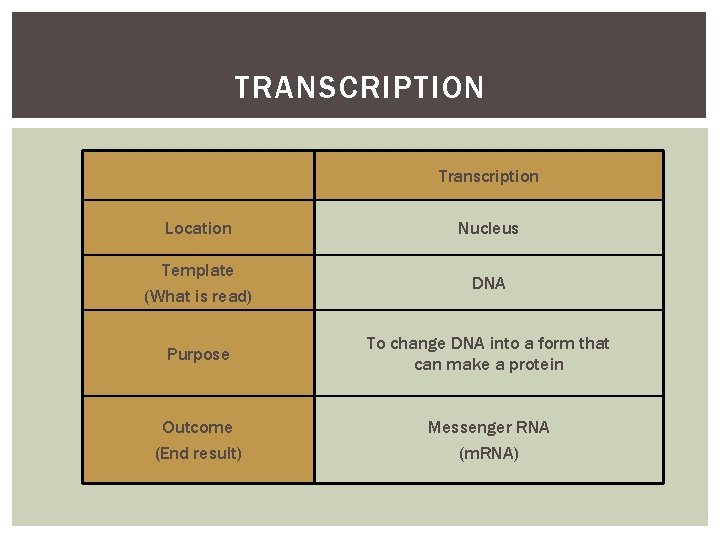
TRANSCRIPTION Transcription Location Nucleus Template (What is read) DNA Purpose To change DNA into a form that can make a protein Outcome (End result) Messenger RNA (m. RNA)
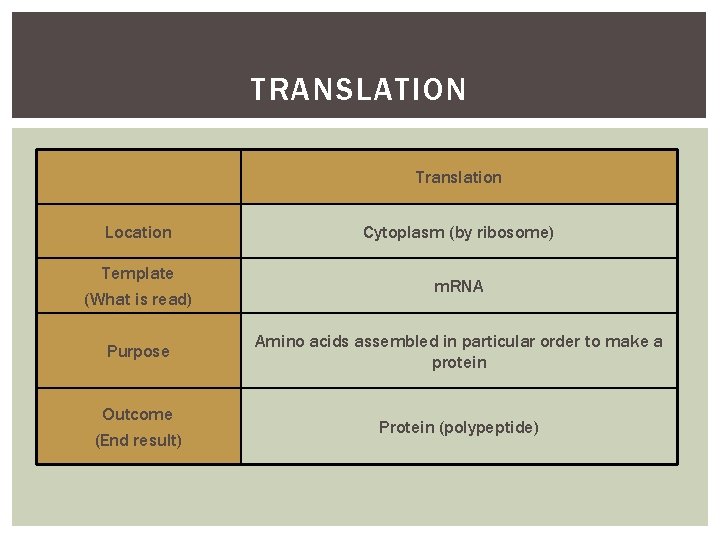
TRANSLATION Translation Location Cytoplasm (by ribosome) Template (What is read) m. RNA Purpose Amino acids assembled in particular order to make a protein Outcome (End result) Protein (polypeptide)
TRANSCRIPTION: Read pages 242 -244 and make your own summary notes for the four stages of transcription Make notes for EACH about: § § Initiation (how it starts) Elongation (how it is built) Termination (how it ends) Post-transcriptional modification
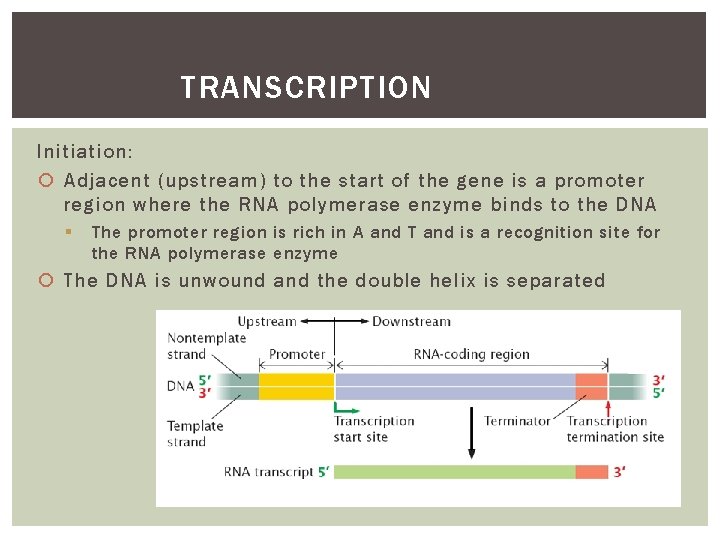
TRANSCRIPTION Initiation: Adjacent (upstream) to the start of the gene is a promoter region where the RNA polymerase enzyme binds to the DNA § The promoter region is rich in A and T and is a recognition site for the RNA polymerase enzyme The DNA is unwound and the double helix is separated
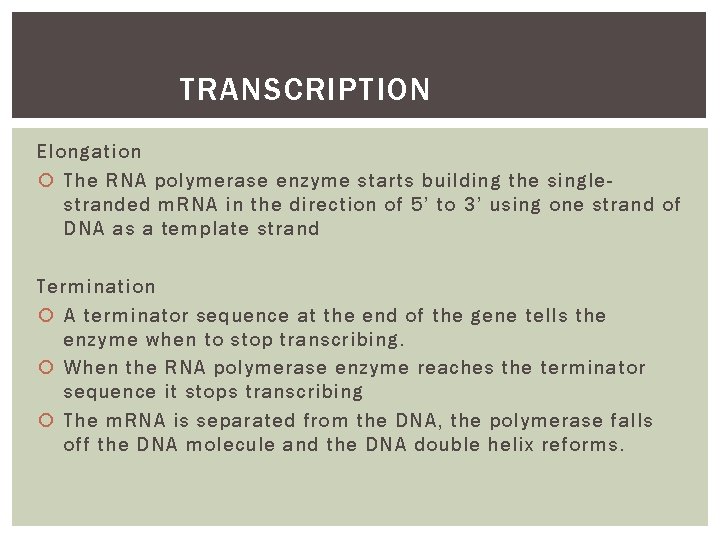
TRANSCRIPTION Elongation The RNA polymerase enzyme starts building the singlestranded m. RNA in the direction of 5’ to 3’ using one strand of DNA as a template strand Termination A terminator sequence at the end of the gene tells the enzyme when to stop transcribing. When the RNA polymerase enzyme reaches the terminator sequence it stops transcribing The m. RNA is separated from the DNA, the polymerase falls off the DNA molecule and the DNA double helix reforms.
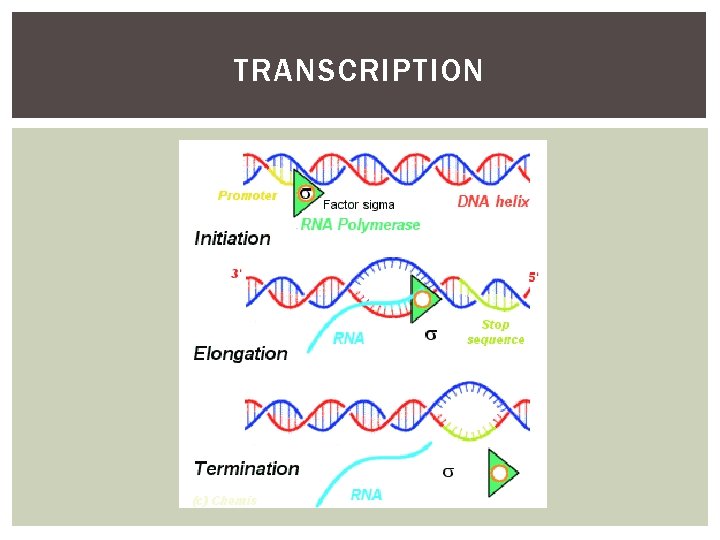
TRANSCRIPTION
TRANSCRIPTION Posttranscriptional modifications Only in eukaryotes Before it can be used for translation the m. RNA must be modified A 5’ cap is added to the m. RNA to protect it from digestion in the cytoplasm and provide a starting point for translation At the 3’ end about 200 adenine ribonuclieotides are added (the poly-A tail) This m. RNA also contains regions which code for proteins (exons) and regions which do not (introns). The introns must be removed before the m. RNA is ready. Spliceosomes remove the introns and stick the exons together.
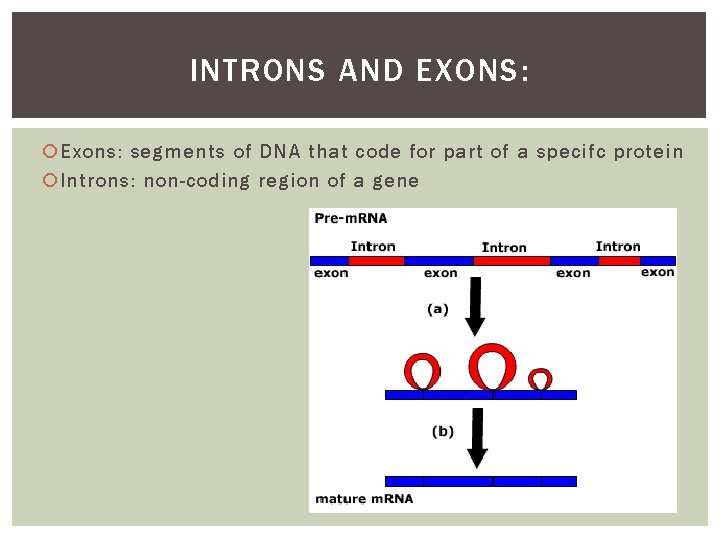
INTRONS AND EXONS: Exons: segments of DNA that code for part of a specifc protein Introns: non-coding region of a gene
TRANSCRIPTION VIDEOS: http: //www. youtube. com/watch? v=zt. Pkv 7 wc 3 y. U Introns, etc. § http: //www. youtube. com/watch? v=a. Vgwr 0 Qp. YNE
TRANSLATION: Review: It is the synthesis of a protein from m. RNA Read pages 250 -253 and make your own summary notes the process of translation
START AND STOP CODONS Start Codon Begins translation Signals the ribosome to start translation § AUG (universal start codon) § AUG also Codes for Met § Sometimes GUG or UUG Stop Codon Ends translation Signals to the ribosome to stop translation § UGA, UAG
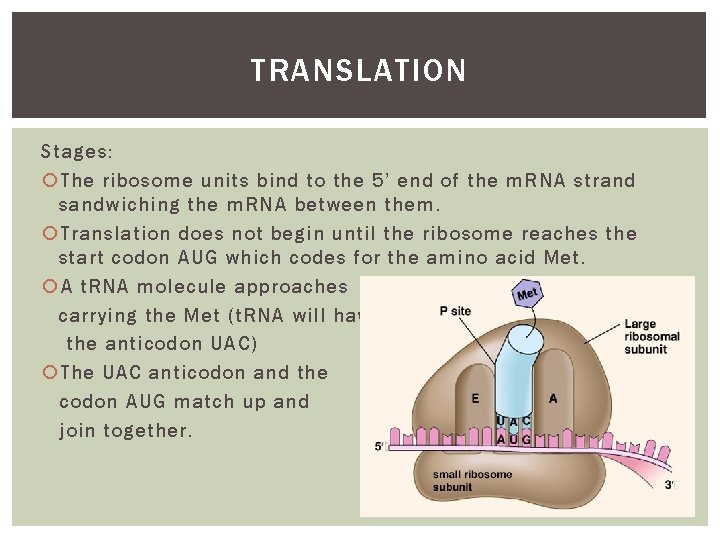
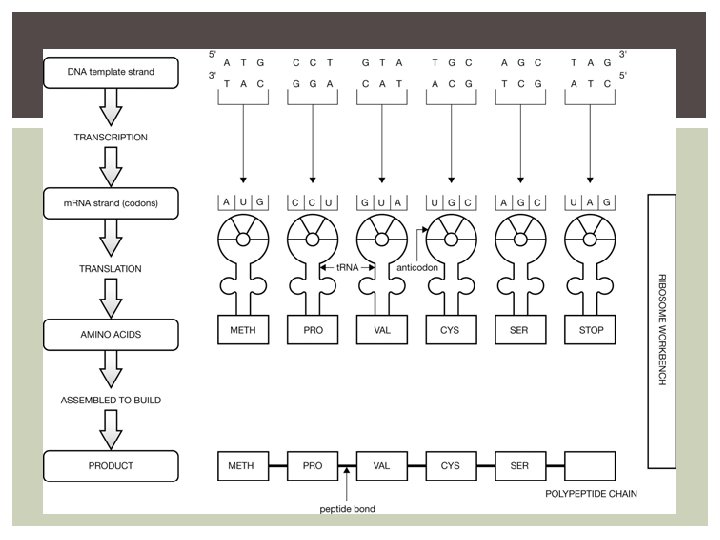
TRANSLATION Stages: The ribosome units bind to the 5’ end of the m. RNA strand sandwiching the m. RNA between them. Translation does not begin until the ribosome reaches the start codon AUG which codes for the amino acid Met. A t. RNA molecule approaches carrying the Met (t. RNA will have the anticodon UAC) The UAC anticodon and the codon AUG match up and join together.
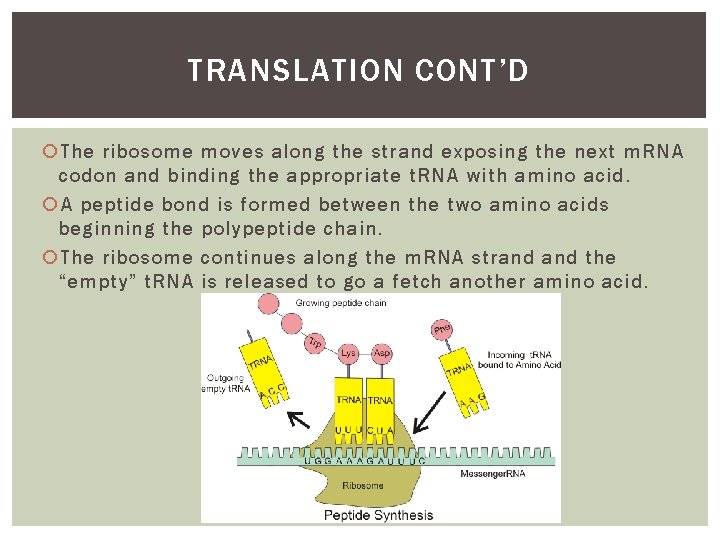
TRANSLATION CONT’D The ribosome moves along the strand exposing the next m. RNA codon and binding the appropriate t. RNA with amino acid. A peptide bond is formed between the two amino acids beginning the polypeptide chain. The ribosome continues along the m. RNA strand the “empty” t. RNA is released to go a fetch another amino acid.
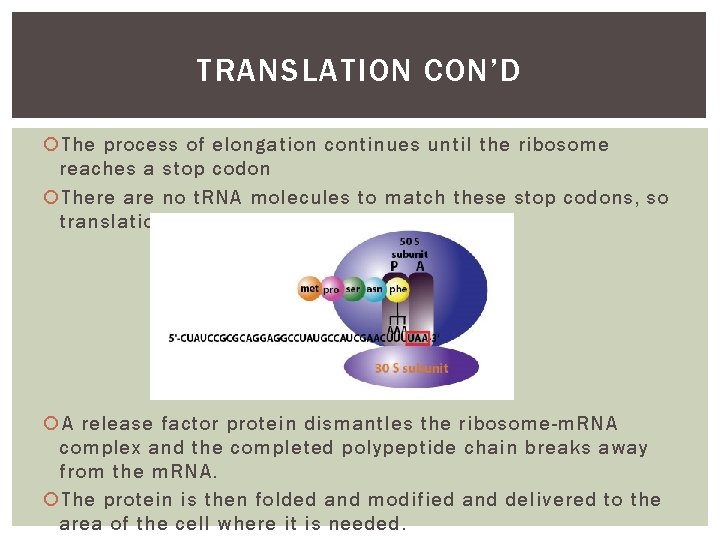
TRANSLATION CON’D The process of elongation continues until the ribosome reaches a stop codon There are no t. RNA molecules to match these stop codons, so translation stops. A release factor protein dismantles the ribosome-m. RNA complex and the completed polypeptide chain breaks away from the m. RNA. The protein is then folded and modified and delivered to the area of the cell where it is needed.
TRANSLATION VIDEO: http: //www. youtube. com/watch? v=Ikq 9 Ac. Bcoh. A
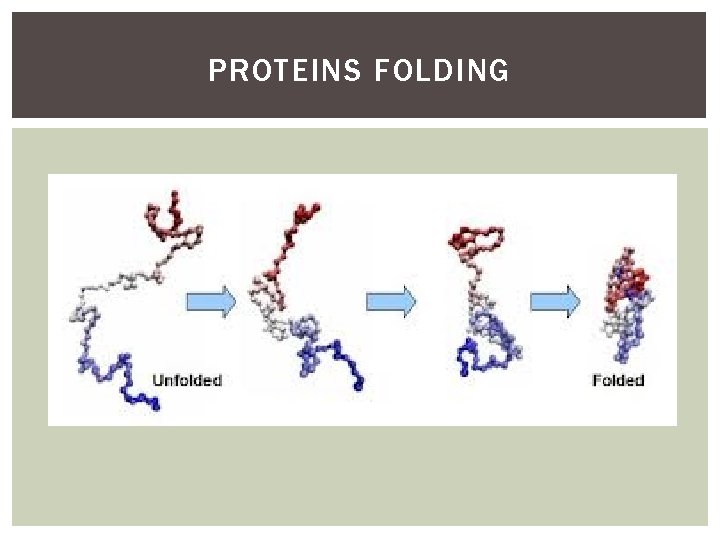
PROTEINS FOLDING
EXAMPLE: DNA template: 3’ TAC ACA CGG AAT GGG TAA ACT 5’ § Complimentary DNA § Read from DNA template (start reading at 3’) § m. RNA codon § Read from DNA template (start reading at 3’) § t. RNA anticodon § Read from m. RNA § Amino Acids (protein) § Read from m. RNA
TO DO: Page 241 § Questions: 5, 6, 9, 10, 11 Page 249 § Questions: 3, 4, 8 Page 254 § Questions: 1 (b, c), 3, 4, 6
- Slides: 22