
Transcription and the Central Dogma 1 1961 DNA
- Slides: 27
Transcription and the Central Dogma 1 • 1961: DNA is the molecule which stores genetic information, but – DNA is in nucleus, ribosomes (where protein synthesis takes place) are in the cytoplasm. – RNA is synthesized in the nucleus, is similar to DNA. – RNA migrates to cytoplasm (where ribosomes are) – Amount of RNA generally proportional to amount of proteins in the cell. • All this suggests role of RNA as messenger.
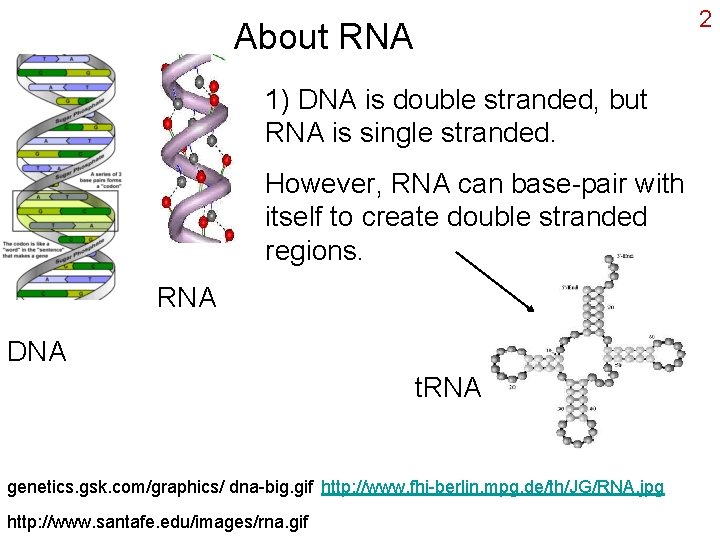
2 About RNA 1) DNA is double stranded, but RNA is single stranded. However, RNA can base-pair with itself to create double stranded regions. RNA DNA t. RNA genetics. gsk. com/graphics/ dna-big. gif http: //www. fhi-berlin. mpg. de/th/JG/RNA. jpg http: //www. santafe. edu/images/rna. gif
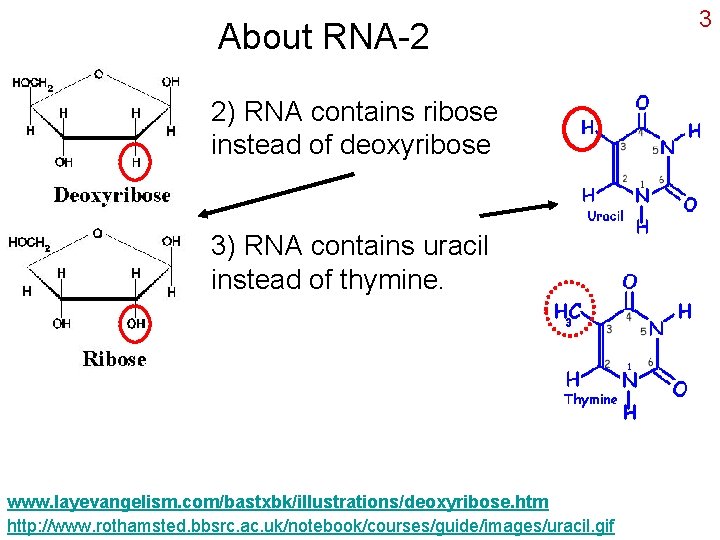
About RNA-2 2) RNA contains ribose instead of deoxyribose 3) RNA contains uracil instead of thymine. www. layevangelism. com/bastxbk/illustrations/deoxyribose. htm http: //www. rothamsted. bbsrc. ac. uk/notebook/courses/guide/images/uracil. gif 3
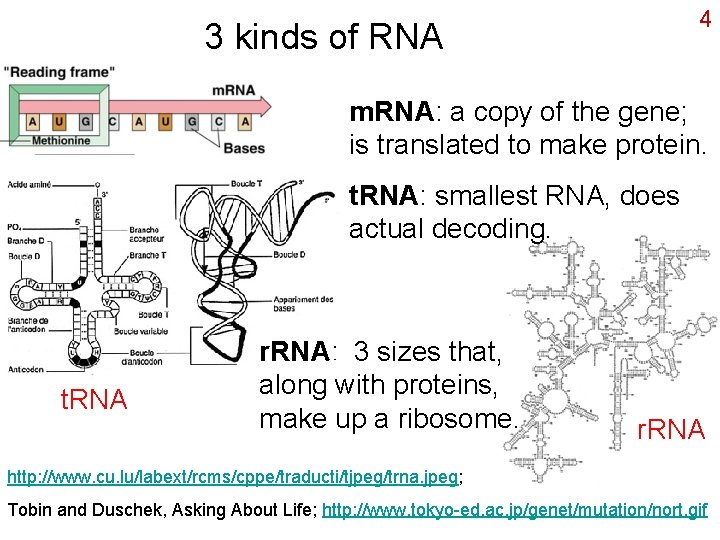
4 3 kinds of RNA m. RNA: a copy of the gene; is translated to make protein. t. RNA: smallest RNA, does actual decoding. t. RNA r. RNA: 3 sizes that, along with proteins, make up a ribosome. r. RNA http: //www. cu. lu/labext/rcms/cppe/traducti/tjpeg/trna. jpeg; Tobin and Duschek, Asking About Life; http: //www. tokyo-ed. ac. jp/genet/mutation/nort. gif
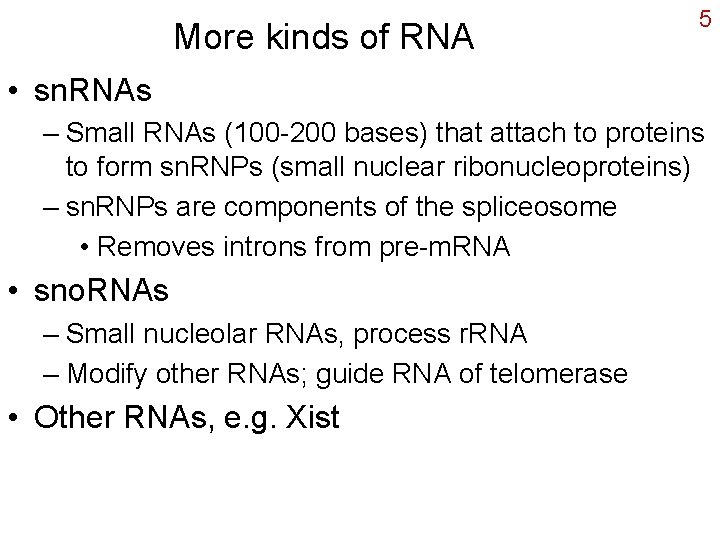
More kinds of RNA 5 • sn. RNAs – Small RNAs (100 -200 bases) that attach to proteins to form sn. RNPs (small nuclear ribonucleoproteins) – sn. RNPs are components of the spliceosome • Removes introns from pre-m. RNA • sno. RNAs – Small nucleolar RNAs, process r. RNA – Modify other RNAs; guide RNA of telomerase • Other RNAs, e. g. Xist
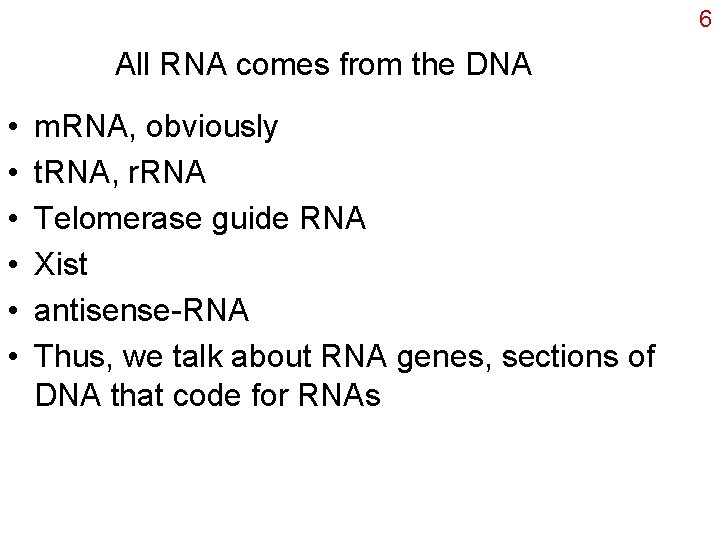
6 All RNA comes from the DNA • • • m. RNA, obviously t. RNA, r. RNA Telomerase guide RNA Xist antisense-RNA Thus, we talk about RNA genes, sections of DNA that code for RNAs
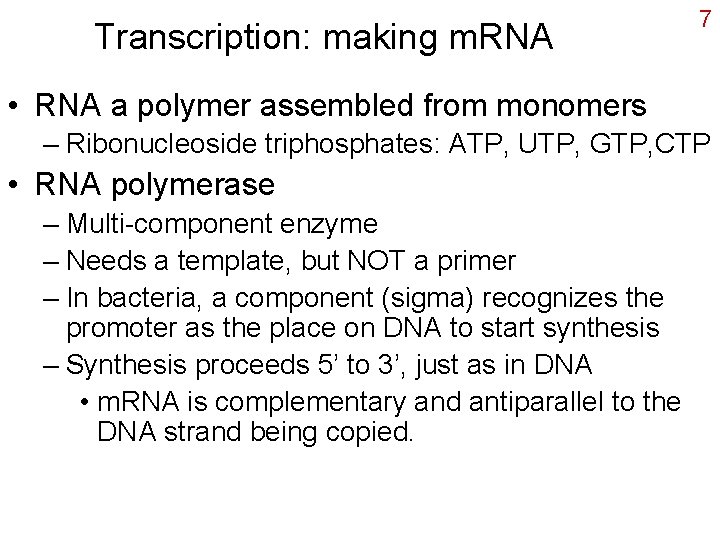
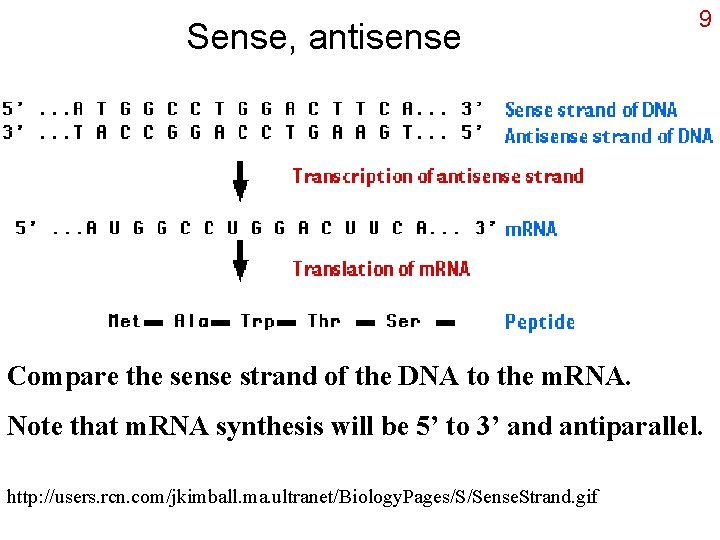
Transcription: making m. RNA 7 • RNA a polymer assembled from monomers – Ribonucleoside triphosphates: ATP, UTP, GTP, CTP • RNA polymerase – Multi-component enzyme – Needs a template, but NOT a primer – In bacteria, a component (sigma) recognizes the promoter as the place on DNA to start synthesis – Synthesis proceeds 5’ to 3’, just as in DNA • m. RNA is complementary and antiparallel to the DNA strand being copied.
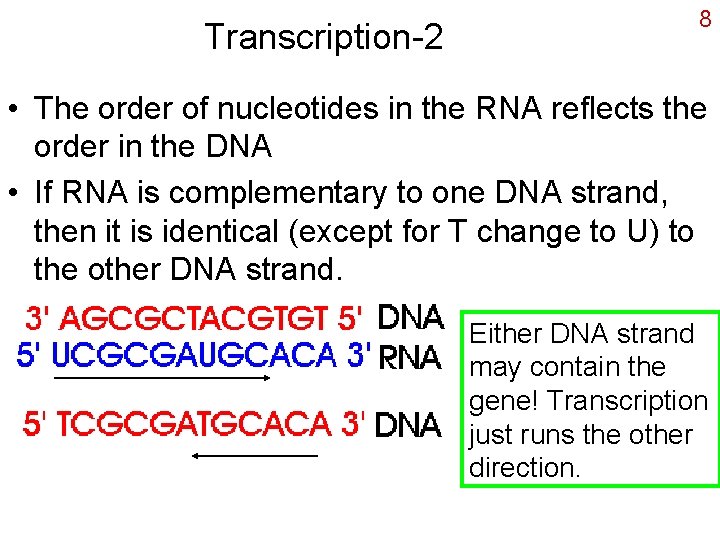
Transcription-2 8 • The order of nucleotides in the RNA reflects the order in the DNA • If RNA is complementary to one DNA strand, then it is identical (except for T change to U) to the other DNA strand. Either DNA strand may contain the gene! Transcription just runs the other direction.
Sense, antisense 9 Compare the sense strand of the DNA to the m. RNA. Note that m. RNA synthesis will be 5’ to 3’ and antiparallel. http: //users. rcn. com/jkimball. ma. ultranet/Biology. Pages/S/Sense. Strand. gif
More about RNA polymerase 10 • In bacteria, components are ββ’α 2φσ • RNA polymerase is processive; once enzyme attaches to DNA, it can copy >10, 000 nucleotides without falling off. • In eukaryotes, there are 3 RNA polymerases: – One for r. RNA – One for t. RNAs and some r. RNA – One for all m. RNAs and some small RNAs (involved in RNA processing)
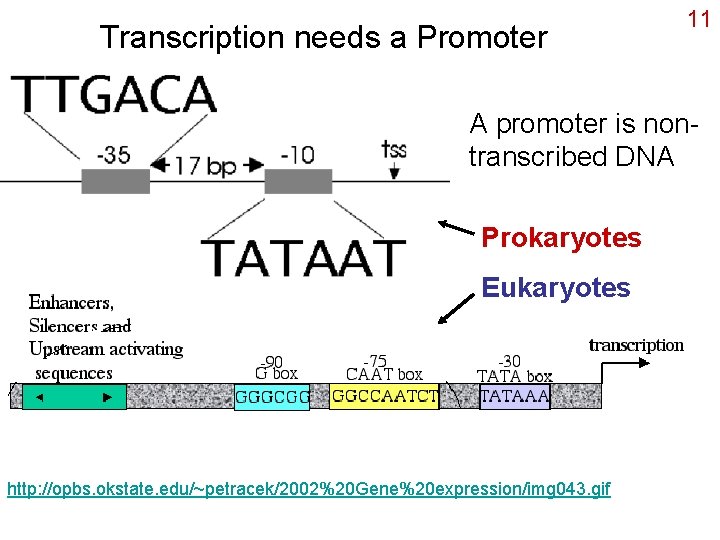
Transcription needs a Promoter 11 A promoter is nontranscribed DNA Prokaryotes Eukaryotes http: //opbs. okstate. edu/~petracek/2002%20 Gene%20 expression/img 043. gif
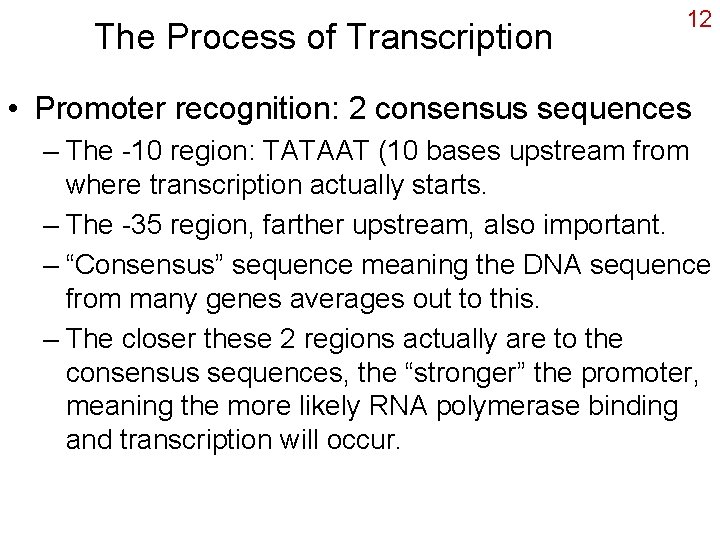
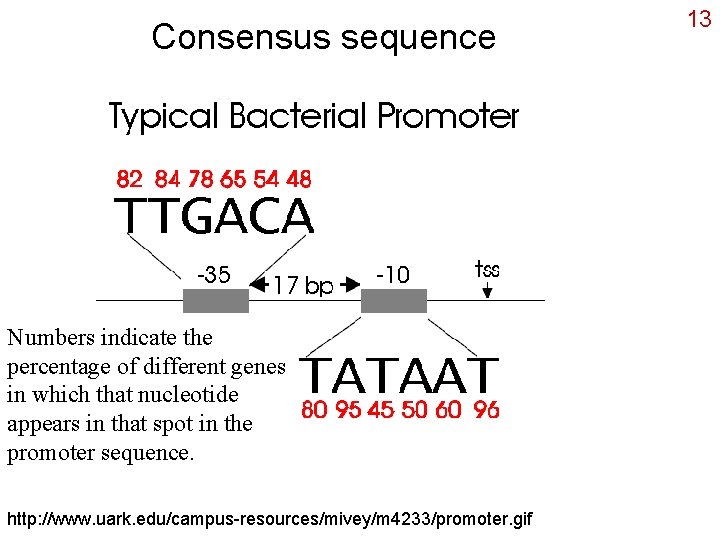
The Process of Transcription 12 • Promoter recognition: 2 consensus sequences – The -10 region: TATAAT (10 bases upstream from where transcription actually starts. – The -35 region, farther upstream, also important. – “Consensus” sequence meaning the DNA sequence from many genes averages out to this. – The closer these 2 regions actually are to the consensus sequences, the “stronger” the promoter, meaning the more likely RNA polymerase binding and transcription will occur.
Consensus sequence Numbers indicate the percentage of different genes in which that nucleotide appears in that spot in the promoter sequence. http: //www. uark. edu/campus-resources/mivey/m 4233/promoter. gif 13
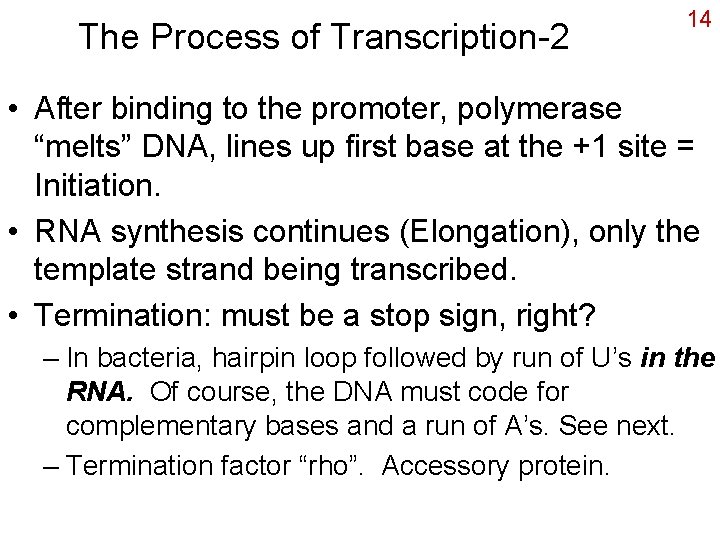
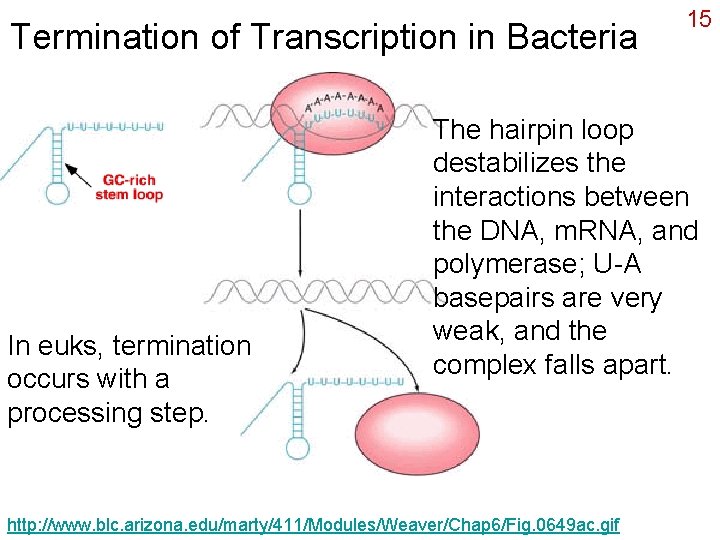
The Process of Transcription-2 14 • After binding to the promoter, polymerase “melts” DNA, lines up first base at the +1 site = Initiation. • RNA synthesis continues (Elongation), only the template strand being transcribed. • Termination: must be a stop sign, right? – In bacteria, hairpin loop followed by run of U’s in the RNA. Of course, the DNA must code for complementary bases and a run of A’s. See next. – Termination factor “rho”. Accessory protein.
Termination of Transcription in Bacteria In euks, termination occurs with a processing step. 15 The hairpin loop destabilizes the interactions between the DNA, m. RNA, and polymerase; U-A basepairs are very weak, and the complex falls apart. http: //www. blc. arizona. edu/marty/411/Modules/Weaver/Chap 6/Fig. 0649 ac. gif
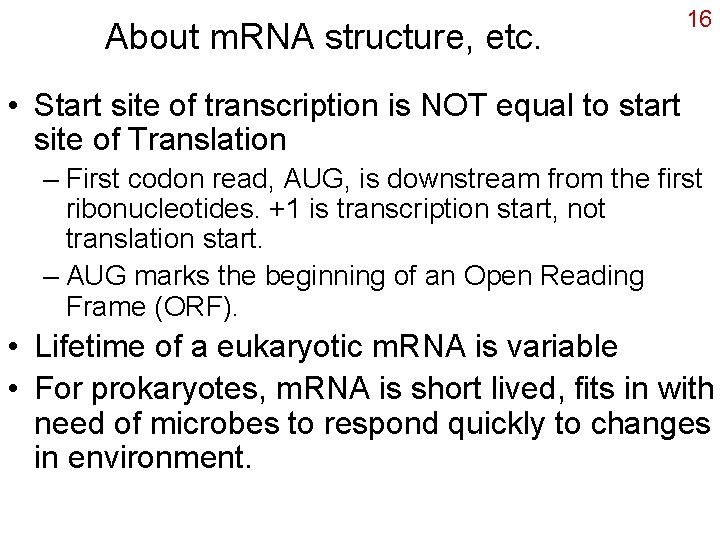
About m. RNA structure, etc. 16 • Start site of transcription is NOT equal to start site of Translation – First codon read, AUG, is downstream from the first ribonucleotides. +1 is transcription start, not translation start. – AUG marks the beginning of an Open Reading Frame (ORF). • Lifetime of a eukaryotic m. RNA is variable • For prokaryotes, m. RNA is short lived, fits in with need of microbes to respond quickly to changes in environment.
Eukaryotic transcription • Occurs in nucleus, then m. RNA goes to cytoplasm • Promoters but also enhancers – Enhancers also segments of DNA • Eukaryotic RNA requires processing – Pre-m. RNAs found in nucleus as hn. RNA • Heterogeneous nuclear RNA • hn. RNPs: heterogeneous nuclear ribonucleoproteins 17
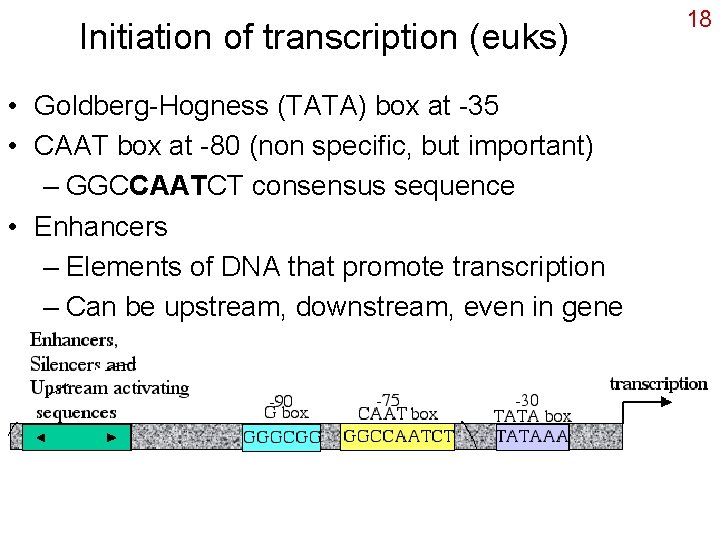
Initiation of transcription (euks) • Goldberg-Hogness (TATA) box at -35 • CAAT box at -80 (non specific, but important) – GGCCAATCT consensus sequence • Enhancers – Elements of DNA that promote transcription – Can be upstream, downstream, even in gene 18
Eukaryotic RNA polymerase 19 • A 10 subunit machine • Makes several attempts, abortive transcription • Key: successful synthesis of short DNA-RNA hybrid, stabilizes association of Pol with DNA – Then, processive to a high degree, transcribes until knocked off by termination signal.
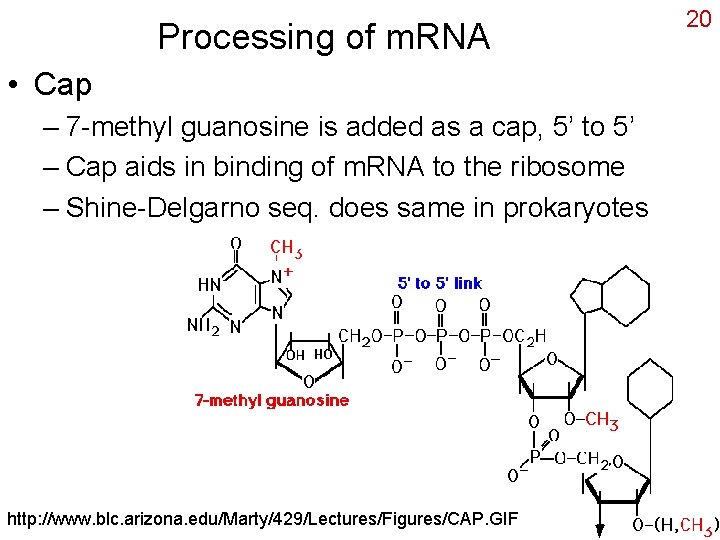
Processing of m. RNA • Cap – 7 -methyl guanosine is added as a cap, 5’ to 5’ – Cap aids in binding of m. RNA to the ribosome – Shine-Delgarno seq. does same in prokaryotes http: //www. blc. arizona. edu/Marty/429/Lectures/Figures/CAP. GIF 20
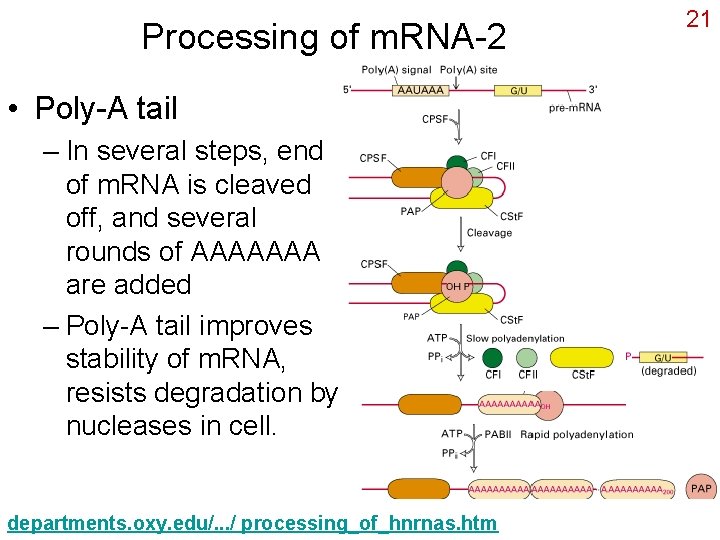
Processing of m. RNA-2 • Poly-A tail – In several steps, end of m. RNA is cleaved off, and several rounds of AAAAAAA are added – Poly-A tail improves stability of m. RNA, resists degradation by nucleases in cell. departments. oxy. edu/. . . / processing_of_hnrnas. htm 21
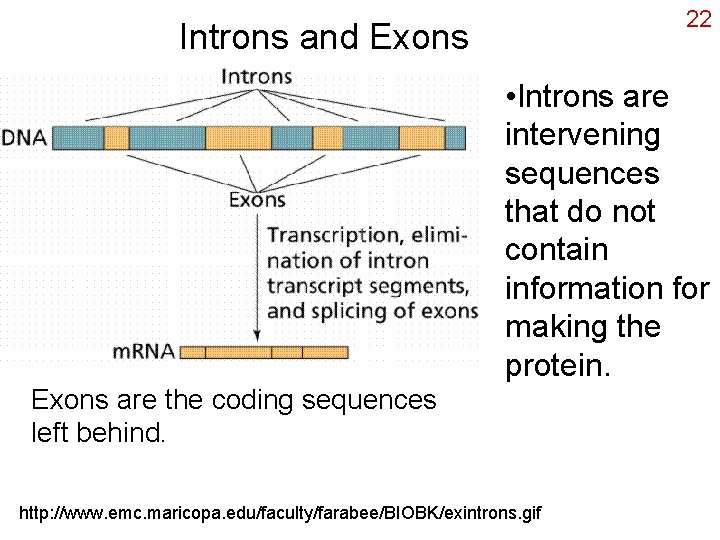
22 Introns and Exons • Introns are intervening sequences that do not contain information for making the protein. Exons are the coding sequences left behind. http: //www. emc. maricopa. edu/faculty/farabee/BIOBK/exintrons. gif
Removal of Introns • Three types of intron-removal mechanisms – Spliceosomes: • hn. RNA or pre-m. RNA (to be processed) • sn. RNPs: small nuclear ribonucleoproteins • sn. RNAs: involved structurally and catalytically – In some systems, intron codes for protein that splices out the intron! – In Tetrahymena, intron is self-splicing: ribozyme 23
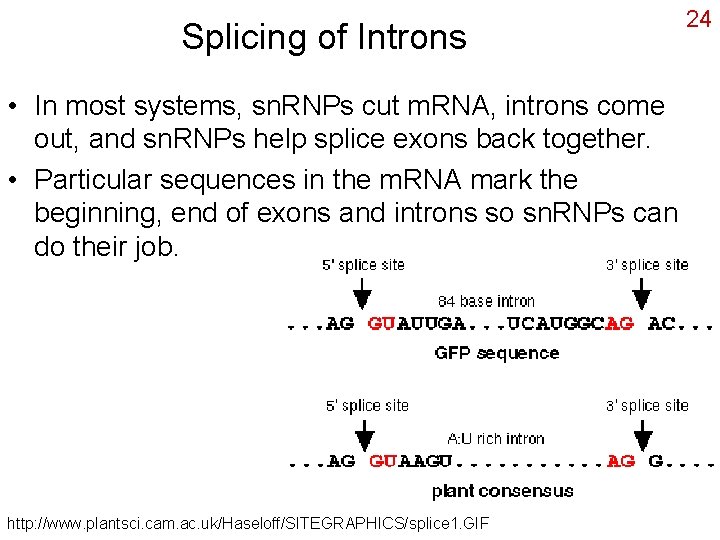
Splicing of Introns • In most systems, sn. RNPs cut m. RNA, introns come out, and sn. RNPs help splice exons back together. • Particular sequences in the m. RNA mark the beginning, end of exons and introns so sn. RNPs can do their job. http: //www. plantsci. cam. ac. uk/Haseloff/SITEGRAPHICS/splice 1. GIF 24
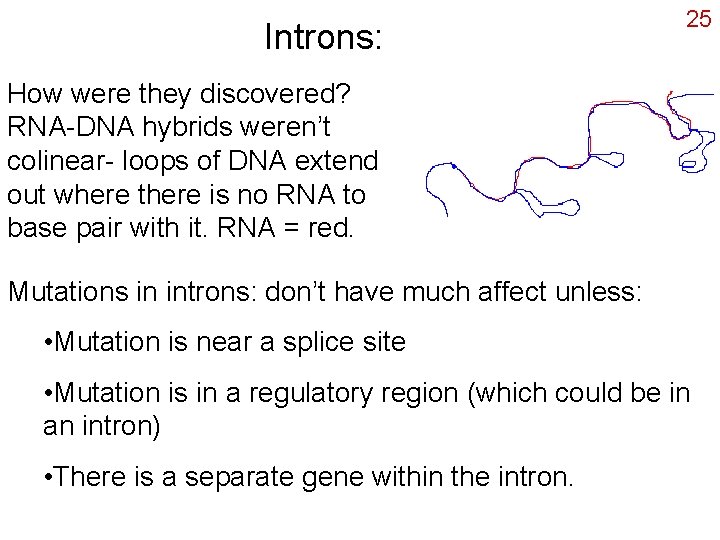
Introns: 25 How were they discovered? RNA-DNA hybrids weren’t colinear- loops of DNA extend out where there is no RNA to base pair with it. RNA = red. Mutations in introns: don’t have much affect unless: • Mutation is near a splice site • Mutation is in a regulatory region (which could be in an intron) • There is a separate gene within the intron.
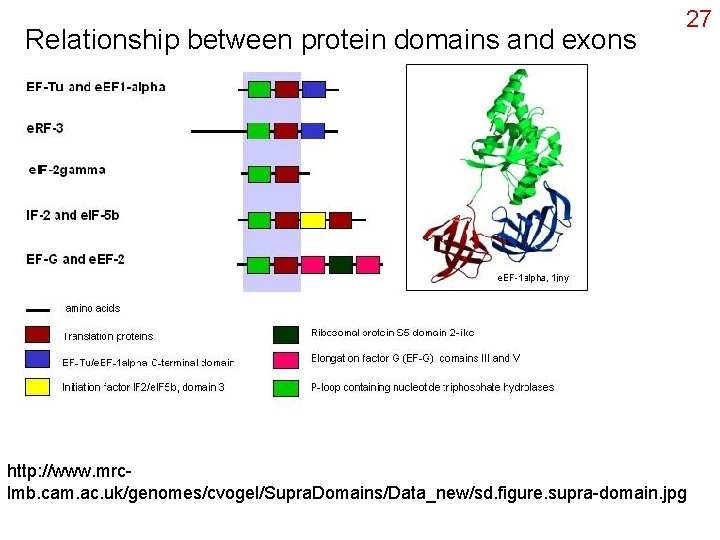
Why are there introns? 26 • Very ancient? – Located in the same positions in genes common to plants and animals. Maybe bacteria had them once and lost them. – Self-splicing RNAs may be related to RNA as the first nucleic acid, a popular idea in evolution. • Exon-shuffling: a model for gene evolution – Some proteins fold into connected, functional sections called domains; these correspond to exons – Perhaps exons were copied, shuffled to create new genes. Several human genes share exons.
Relationship between protein domains and exons 27 http: //www. mrclmb. cam. ac. uk/genomes/cvogel/Supra. Domains/Data_new/sd. figure. supra-domain. jpg