
Transcendentalism Ralph Waldo Emerson and Henry David Thoreau
- Slides: 9
Transcendentalism Ralph Waldo Emerson and Henry David Thoreau
American between 1830 - 1850 A Relatively New Nation • A time of self-definition • Effort to distinguish itself from Europe Economic and Social Changes • Industrialization and urbanization • Factories with poor working conditions • A new breed of materialism
Transcendentalism • An American philosophical movement that influenced literature (Emily Dickinson, Walt Whitman) and art (The Hudson River School) • A protest against American society at that time • An offshoot of European Romanticism (Goethe, Coleridge, Wordsworth)
Tenets of Transcendentalism • • • Man is inherently good Society corrupts man’s goodness Conformity is death Rely on your intuition The Oversoul connects God, man, and nature • Find spiritual transcendence in nature
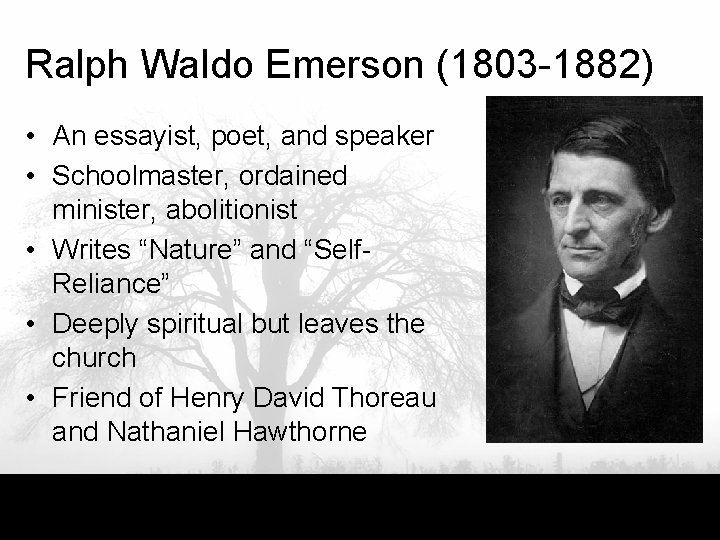
Ralph Waldo Emerson (1803 -1882) • An essayist, poet, and speaker • Schoolmaster, ordained minister, abolitionist • Writes “Nature” and “Self. Reliance” • Deeply spiritual but leaves the church • Friend of Henry David Thoreau and Nathaniel Hawthorne
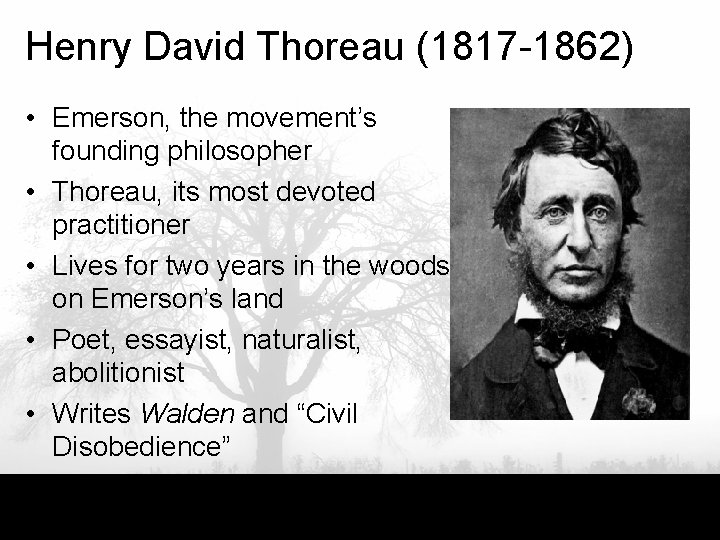
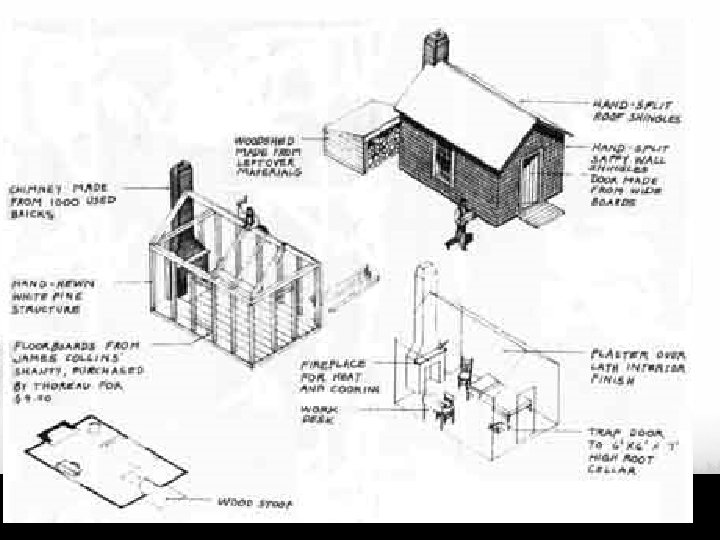
Henry David Thoreau (1817 -1862) • Emerson, the movement’s founding philosopher • Thoreau, its most devoted practitioner • Lives for two years in the woods on Emerson’s land • Poet, essayist, naturalist, abolitionist • Writes Walden and “Civil Disobedience”
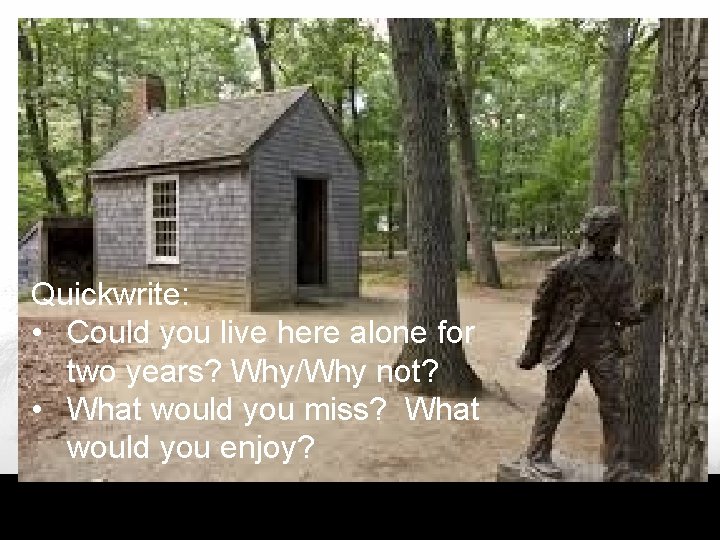
Quickwrite: • Could you live here alone for two years? Why/Why not? • What would you miss? What would you enjoy?
Homework: • Find a song with lyrics that express Transcendentalist beliefs. • Write down the artist, title, and the lyrics that exhibit Transcendentalist thought.