
Transcatheter vs Surgical Aortic Valve Replacement in Patients
- Slides: 1
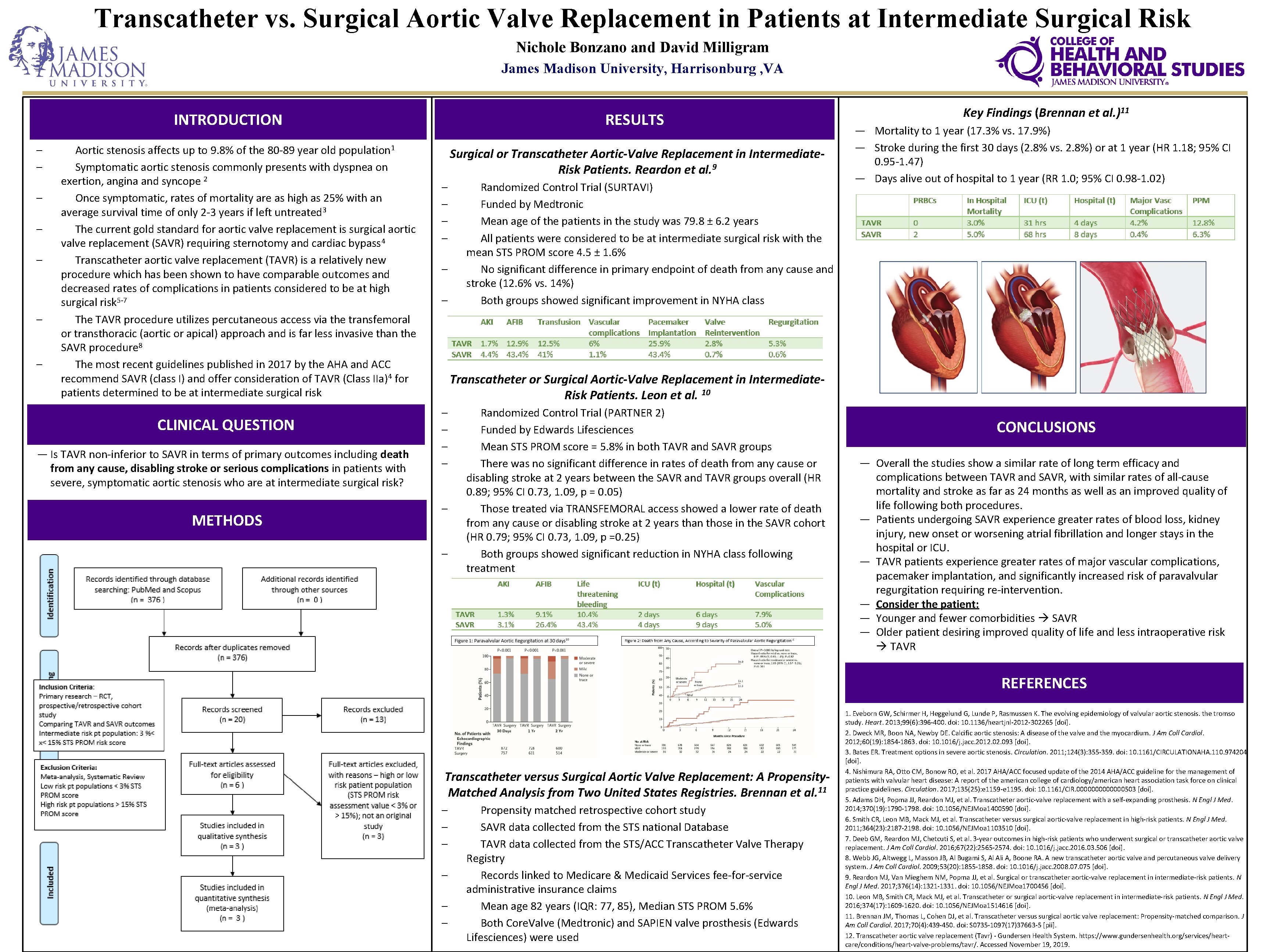
Transcatheter vs. Surgical Aortic Valve Replacement in Patients at Intermediate Surgical Risk Nichole Bonzano and David Milligram James Madison University, Harrisonburg , VA INTRODUCTION – – – – Aortic stenosis affects up to 9. 8% of the 80 -89 year old population 1 Symptomatic aortic stenosis commonly presents with dyspnea on exertion, angina and syncope 2 Once symptomatic, rates of mortality are as high as 25% with an average survival time of only 2 -3 years if left untreated 3 The current gold standard for aortic valve replacement is surgical aortic valve replacement (SAVR) requiring sternotomy and cardiac bypass 4 Transcatheter aortic valve replacement (TAVR) is a relatively new procedure which has been shown to have comparable outcomes and decreased rates of complications in patients considered to be at high surgical risk 5 -7 The TAVR procedure utilizes percutaneous access via the transfemoral or transthoracic (aortic or apical) approach and is far less invasive than the SAVR procedure 8 The most recent guidelines published in 2017 by the AHA and ACC recommend SAVR (class I) and offer consideration of TAVR (Class IIa)4 for patients determined to be at intermediate surgical risk CLINICAL QUESTION ― Is TAVR non-inferior to SAVR in terms of primary outcomes including death from any cause, disabling stroke or serious complications in patients with severe, symptomatic aortic stenosis who are at intermediate surgical risk? METHODS RESULTS Surgical or Transcatheter Aortic-Valve Replacement in Intermediate. Risk Patients. Reardon et al. 9 – – – Randomized Control Trial (SURTAVI) Funded by Medtronic Mean age of the patients in the study was 79. 8 ± 6. 2 years All patients were considered to be at intermediate surgical risk with the mean STS PROM score 4. 5 ± 1. 6% No significant difference in primary endpoint of death from any cause and stroke (12. 6% vs. 14%) Both groups showed significant improvement in NYHA class Key Findings (Brennan et al. )11 ― Mortality to 1 year (17. 3% vs. 17. 9%) ― Stroke during the first 30 days (2. 8% vs. 2. 8%) or at 1 year (HR 1. 18; 95% CI 0. 95 -1. 47) ― Days alive out of hospital to 1 year (RR 1. 0; 95% CI 0. 98 -1. 02) Reconstructed side Transcatheter or Surgical Aortic-Valve Replacement in Intermediate. Risk Patients. Leon et al. 10 – – – Randomized Control Trial (PARTNER 2) Funded by Edwards Lifesciences Mean STS PROM score = 5. 8% in both TAVR and SAVR groups There was no significant difference in rates of death from any cause or disabling stroke at 2 years between the SAVR and TAVR groups overall (HR 0. 89; 95% CI 0. 73, 1. 09, p = 0. 05) Those treated via TRANSFEMORAL access showed a lower rate of death from any cause or disabling stroke at 2 years than those in the SAVR cohort (HR 0. 79; 95% CI 0. 73, 1. 09, p =0. 25) Both groups showed significant reduction in NYHA class following treatment Reconstructed side CONCLUSIONS ― Overall the studies show a similar rate of long term efficacy and complications between TAVR and SAVR, with similar rates of all-cause mortality and stroke as far as 24 months as well as an improved quality of life following both procedures. ― Patients undergoing SAVR experience greater rates of blood loss, kidney injury, new onset or worsening atrial fibrillation and longer stays in the hospital or ICU. ― TAVR patients experience greater rates of major vascular complications, pacemaker implantation, and significantly increased risk of paravalvular regurgitation requiring re-intervention. ― Consider the patient: ― Younger and fewer comorbidities SAVR ― Older patient desiring improved quality of life and less intraoperative risk TAVR REFERENCES Transcatheter versus Surgical Aortic Valve Replacement: A Propensity. Matched Analysis from Two United States Registries. Brennan et al. 11 – – – Propensity matched retrospective cohort study SAVR data collected from the STS national Database TAVR data collected from the STS/ACC Transcatheter Valve Therapy Registry Records linked to Medicare & Medicaid Services fee-for-service administrative insurance claims Mean age 82 years (IQR: 77, 85), Median STS PROM 5. 6% Both Core. Valve (Medtronic) and SAPIEN valve prosthesis (Edwards Lifesciences) were used 1. Eveborn GW, Schirmer H, Heggelund G, Lunde P, Rasmussen K. The evolving epidemiology of valvular aortic stenosis. the tromso study. Heart. 2013; 99(6): 396 -400. doi: 10. 1136/heartjnl-2012 -302265 [doi]. 2. Dweck MR, Boon NA, Newby DE. Calcific aortic stenosis: A disease of the valve and the myocardium. J Am Coll Cardiol. 2012; 60(19): 1854 -1863. doi: 10. 1016/j. jacc. 2012. 093 [doi]. 3. Bates ER. Treatment options in severe aortic stenosis. Circulation. 2011; 124(3): 355 -359. doi: 10. 1161/CIRCULATIONAHA. 110. 974204 [doi]. 4. Nishimura RA, Otto CM, Bonow RO, et al. 2017 AHA/ACC focused update of the 2014 AHA/ACC guideline for the management of patients with valvular heart disease: A report of the american college of cardiology/american heart association task force on clinical practice guidelines. Circulation. 2017; 135(25): e 1159 -e 1195. doi: 10. 1161/CIR. 0000000503 [doi]. 5. Adams DH, Popma JJ, Reardon MJ, et al. Transcatheter aortic-valve replacement with a self-expanding prosthesis. N Engl J Med. 2014; 370(19): 1790 -1798. doi: 10. 1056/NEJMoa 1400590 [doi]. 6. Smith CR, Leon MB, Mack MJ, et al. Transcatheter versus surgical aortic-valve replacement in high-risk patients. N Engl J Med. 2011; 364(23): 2187 -2198. doi: 10. 1056/NEJMoa 1103510 [doi]. 7. Deeb GM, Reardon MJ, Chetcuti S, et al. 3 -year outcomes in high-risk patients who underwent surgical or transcatheter aortic valve replacement. J Am Coll Cardiol. 2016; 67(22): 2565 -2574. doi: 10. 1016/j. jacc. 2016. 03. 506 [doi]. 8. Webb JG, Altwegg L, Masson JB, Al Bugami S, Al Ali A, Boone RA. A new transcatheter aortic valve and percutaneous valve delivery system. J Am Coll Cardiol. 2009; 53(20): 1855 -1858. doi: 10. 1016/j. jacc. 2008. 075 [doi]. 9. Reardon MJ, Van Mieghem NM, Popma JJ, et al. Surgical or transcatheter aortic-valve replacement in intermediate-risk patients. N Engl J Med. 2017; 376(14): 1321 -1331. doi: 10. 1056/NEJMoa 1700456 [doi]. 10. Leon MB, Smith CR, Mack MJ, et al. Transcatheter or surgical aortic-valve replacement in intermediate-risk patients. N Engl J Med. 2016; 374(17): 1609 -1620. doi: 10. 1056/NEJMoa 1514616 [doi]. 11. Brennan JM, Thomas L, Cohen DJ, et al. Transcatheter versus surgical aortic valve replacement: Propensity-matched comparison. J Am Coll Cardiol. 2017; 70(4): 439 -450. doi: S 0735 -1097(17)37663 -5 [pii]. 12. Transcatheter aortic valve replacement (Tavr) - Gundersen Health System. https: //www. gundersenhealth. org/services/heartcare/conditions/heart-valve-problems/tavr/. Accessed November 19, 2019.