
Transcatheter Mitral Valve Implantation Disclosure Statement of Financial
- Slides: 13
Transcatheter Mitral Valve Implantation Disclosure Statement of Financial Interest Within the past 12 months, I or my spouse/partner have had a financial Interest /arrangement or affiliation with the organization (s) listed below Research Funding: Abbott, Inc. Edwards Life. Sciences, Inc. Speaking Honoraria: Edwards Life. Sciences, Inc. Consultant / Equity: Endovalve, Inc. Discussion will include unapproved and off-label devices, procedures, and indications Howard C. Herrmann, MD Professor of Medicine Director, Interventional Cardiology and Cardiac Catheterization Laboratories University of Pennsylvania Medical Center
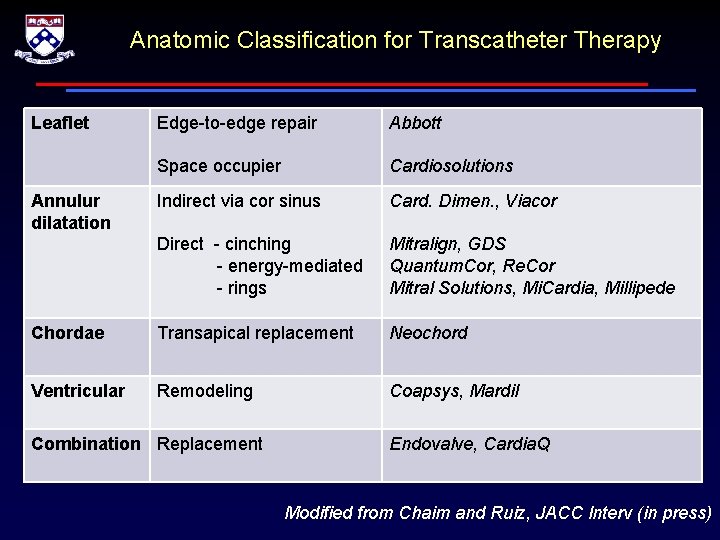
Anatomic Classification for Transcatheter Therapy Leaflet Edge-to-edge repair Abbott Space occupier Cardiosolutions Indirect via cor sinus Card. Dimen. , Viacor Direct - cinching - energy-mediated - rings Mitralign, GDS Quantum. Cor, Re. Cor Mitral Solutions, Mi. Cardia, Millipede Chordae Transapical replacement Neochord Ventricular Remodeling Coapsys, Mardil Annulur dilatation Combination Replacement Endovalve, Cardia. Q Modified from Chaim and Ruiz, JACC Interv (in press)
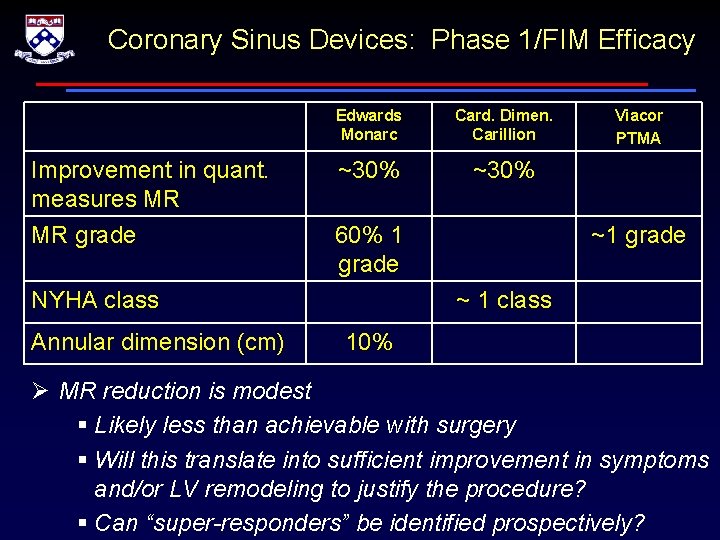
Coronary Sinus Devices: Phase 1/FIM Efficacy Edwards Monarc Card. Dimen. Carillion Improvement in quant. measures MR ~30% MR grade 60% 1 grade NYHA class Annular dimension (cm) Viacor PTMA ~1 grade ~ 1 class 10% Ø MR reduction is modest § Likely less than achievable with surgery § Will this translate into sufficient improvement in symptoms and/or LV remodeling to justify the procedure? § Can “super-responders” be identified prospectively?
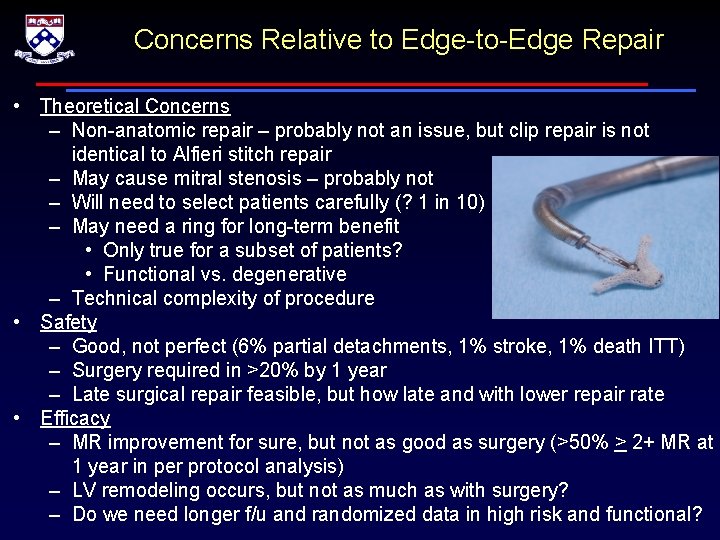
Concerns Relative to Edge-to-Edge Repair • Theoretical Concerns – Non-anatomic repair – probably not an issue, but clip repair is not identical to Alfieri stitch repair – May cause mitral stenosis – probably not – Will need to select patients carefully (? 1 in 10) – May need a ring for long-term benefit • Only true for a subset of patients? • Functional vs. degenerative – Technical complexity of procedure • Safety – Good, not perfect (6% partial detachments, 1% stroke, 1% death ITT) – Surgery required in >20% by 1 year – Late surgical repair feasible, but how late and with lower repair rate • Efficacy – MR improvement for sure, but not as good as surgery (>50% > 2+ MR at 1 year in per protocol analysis) – LV remodeling occurs, but not as much as with surgery? – Do we need longer f/u and randomized data in high risk and functional?
Transcatheter Mitral Valve Implantation • • Increasing evidence that percutaneous approaches are more limited than surgical techniques and unlikely to achieve equal efficacy Efficacy and risks of surgical mitral valve replacement are well understood • • Better reduction in MR than repair • Risks equivalent to repair in functional etiology, higher-risk, older patients with current generation of bioprostheses and complete valvesparing operations • • Not all patient populations, disease etiologies, anatomical variations will be compatible with repair However surgical MVR has significant morbidity and mortality due to risks of incision and CPB For these reasons it is important to offer clinicians and patients a less invasive, valve-sparing means of performing a MV replacement
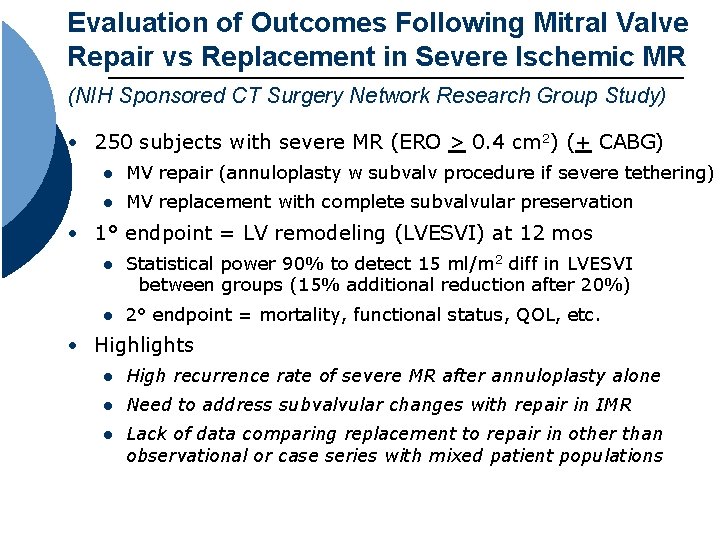
Evaluation of Outcomes Following Mitral Valve Repair vs Replacement in Severe Ischemic MR (NIH Sponsored CT Surgery Network Research Group Study) • 250 subjects with severe MR (ERO > 0. 4 cm 2) (+ CABG) l MV repair (annuloplasty w subvalv procedure if severe tethering) l MV replacement with complete subvalvular preservation • 1° endpoint = LV remodeling (LVESVI) at 12 mos l Statistical power 90% to detect 15 ml/m 2 diff in LVESVI between groups (15% additional reduction after 20%) l 2° endpoint = mortality, functional status, QOL, etc. • Highlights l High recurrence rate of severe MR after annuloplasty alone l Need to address subvalvular changes with repair in IMR l Lack of data comparing replacement to repair in other than observational or case series with mixed patient populations
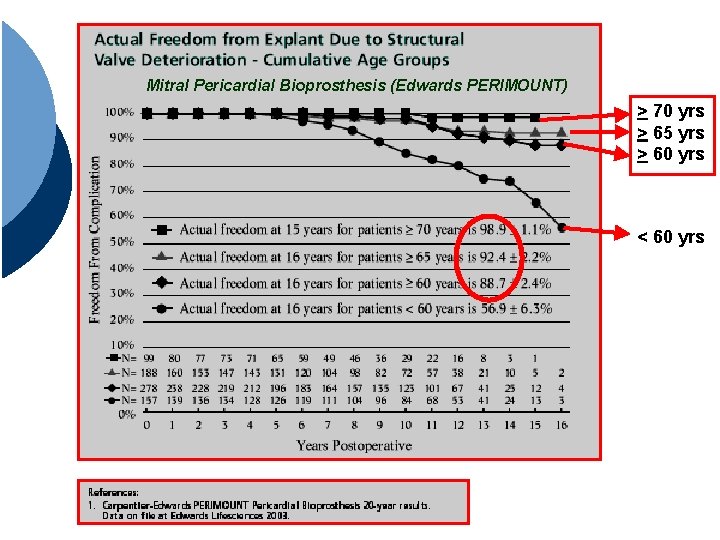
Mitral Pericardial Bioprosthesis (Edwards PERIMOUNT) > 70 yrs > 65 yrs > 60 yrs < 60 yrs
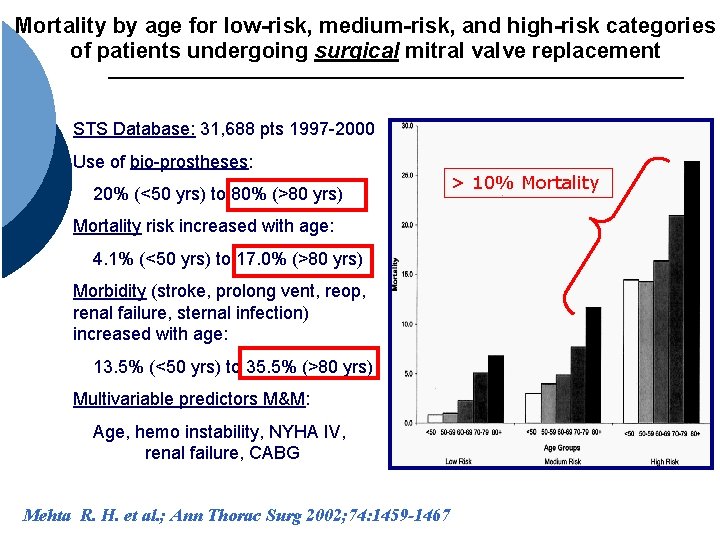
Mortality by age for low-risk, medium-risk, and high-risk categories of patients undergoing surgical mitral valve replacement STS Database: 31, 688 pts 1997 -2000 Use of bio-prostheses: 20% (<50 yrs) to 80% (>80 yrs) Mortality risk increased with age: 4. 1% (<50 yrs) to 17. 0% (>80 yrs) Morbidity (stroke, prolong vent, reop, renal failure, sternal infection) increased with age: 13. 5% (<50 yrs) to 35. 5% (>80 yrs) Multivariable predictors M&M: Age, hemo instability, NYHA IV, renal failure, CABG Mehta R. H. et al. ; Ann Thorac Surg 2002; 74: 1459 -1467 > 10% Mortality
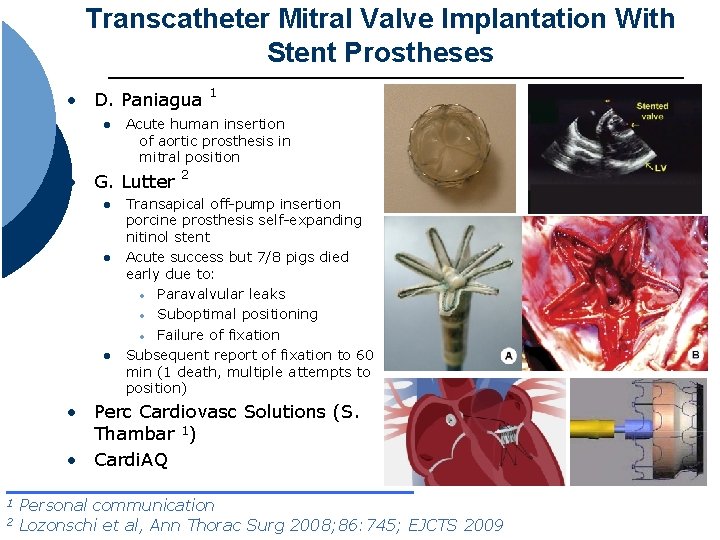
Transcatheter Mitral Valve Implantation With Stent Prostheses • D. Paniagua l Acute human insertion of aortic prosthesis in mitral position • G. Lutter l l l 1 2 Transapical off-pump insertion porcine prosthesis self-expanding nitinol stent Acute success but 7/8 pigs died early due to: • Paravalvular leaks • Suboptimal positioning • Failure of fixation Subsequent report of fixation to 60 min (1 death, multiple attempts to position) • Perc Cardiovasc Solutions (S. Thambar 1) • Cardi. AQ 1 2 Personal communication Lozonschi et al, Ann Thorac Surg 2008; 86: 745; EJCTS 2009
Transcatheter MV Implantation: Challenges • Delivery l Fold/compress, size (larger than aortics) • Fixation l l More complex structure No calcium to grab radially Not a round valve, particularly when diseased and less pliable Orientation may be important • Seal l Paravalvular leak likely less well tolerated than aortic (hemolysis) • Function l l LVOT obstruction a concern Need to preserve the subvalvular apparatus
Endovalve Inc. • Endovalve Inc is a cardiovascular device company developing a mitral valve replacement system designed initially for insertion during a minimally invasive surgical (MIS) procedure • The proprietary Endovalve system is designed to allow for a complete mitral valve replacement without the risks and complications usually associated with open-heart surgery, avoiding both sternotomy and cardio-pulmonary bypass. l Clinical advantages of this approach include: • Reduction in MR as good as surgery • Takes advantage of improving durability of bioprosthetic leaflets • Fully valve-sparing (similar to repair) • Initially based on patented technology from the Univ of PA, our platform will allow for later development of a percutaneous system utilizing the same valve design.
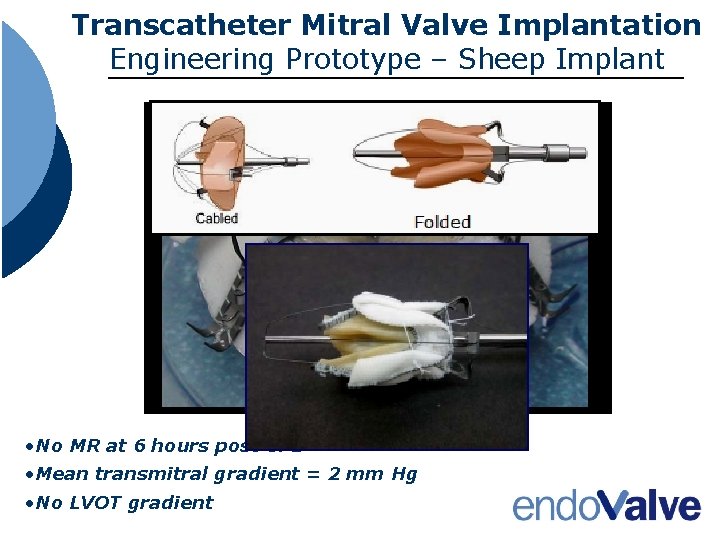
Transcatheter Mitral Valve Implantation Engineering Prototype – Sheep Implant • No MR at 6 hours post CPB • Mean transmitral gradient = 2 mm Hg • No LVOT gradient
Conclusions • Minimally-invasive surgical (MIS) insertion of a foldable bio-prosthetic mitral valve is feasible • Advantages of this approach include: l Avoidance of the complications of conventional cardiac surgery • Cardiopulmonary bypass • Sternotomy l Fully valve sparing l MR reduction equivalent to surgical valve replacement • Demonstrated unique product design and function • Current focus is on improving delivery efficiency for both MIS and fully percutaneous approaches • Animal trials with improved designs planned 2011