
Transboundary Conservation Areas Lesson 1 Introduction and Background
Transboundary Conservation Areas Lesson 1: Introduction and Background to Transboundary Conservation Areas

Factors of Success Assess the enabling environment to pursue transboundary conservation Define the transboundary context and relationships affecting the achievement of the conservation targets and the resulting geographic extent Identify and involve stakeholders, obtain support of decision makers and ensure political will and buy-in Agree on common values and joint vision Determine common transboundary management objectives and develop cooperative agreements

Lesson Overview & Goals Introduction and Background Defining transboundary conservation Importance, benefits and challenges of transboundary conservation International frameworks and approaches Overview of the transboundary conservation process

Transboundary Conservation: Defined What is transboundary conservation? What are some examples? • …

Transboundary Conservation: Defined Transboundary Conservation: “A process of cooperation to achieve conservation goals across one or more international boundaries” Elements of International Cooperation: ● ● ● Identifying common values and needs concerning shared natural resource Coordinating (inter)national objectives and management Improving conservation efforts beyond national boundaries Harmonizing laws and programmes Engaging with relevant stakeholders Developing collaboration among different governance systems

Typology of TBCAs: Examples Transboundary Protected Area & Park for Peace Waterton-Glacier International Peace Park (Canada, USA) Transboundary Conservation Landscape/Seascape Transboundary Migration Conservation Area W-Arly-Pendjari Complex (Benin, Burkina Faso, Niger) Eastern Tropical Pacific Marine Corridor (Colombia, Panama, Ecuador, Costa Rica)
Importance and Benefits What are the benefits of transboundary conservation? • …
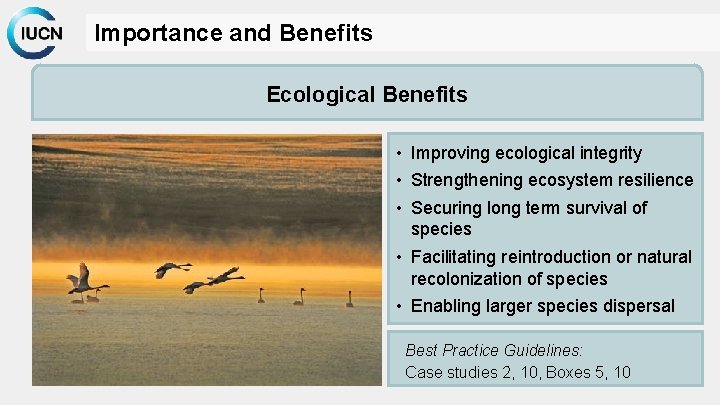
Importance and Benefits Ecological Benefits • Improving ecological integrity • Strengthening ecosystem resilience • Securing long term survival of species • Facilitating reintroduction or natural recolonization of species • Enabling larger species dispersal Best Practice Guidelines: Case studies 2, 10, Boxes 5, 10
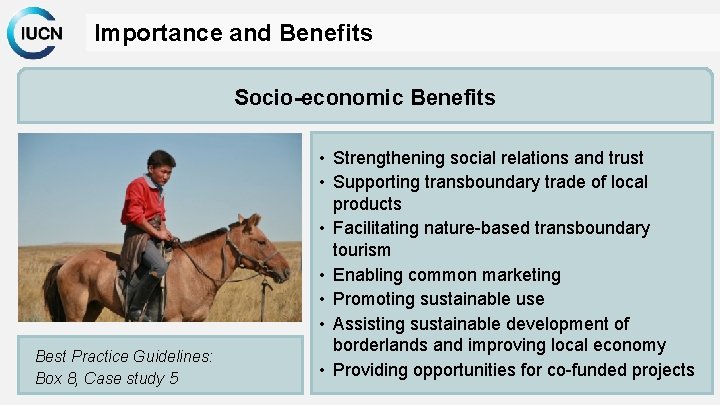
Importance and Benefits Socio-economic Benefits Best Practice Guidelines: Box 8, Case study 5 • Strengthening social relations and trust • Supporting transboundary trade of local products • Facilitating nature-based transboundary tourism • Enabling common marketing • Promoting sustainable use • Assisting sustainable development of borderlands and improving local economy • Providing opportunities for co-funded projects
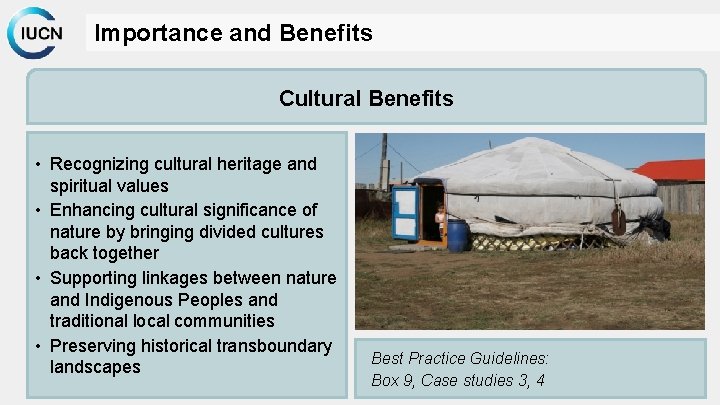
Importance and Benefits Cultural Benefits • Recognizing cultural heritage and spiritual values • Enhancing cultural significance of nature by bringing divided cultures back together • Supporting linkages between nature and Indigenous Peoples and traditional local communities • Preserving historical transboundary landscapes Best Practice Guidelines: Box 9, Case studies 3, 4
Importance and Benefits for Day-to-Day Management and Research • Enhancing efficiency of day-to-day management of shared issues, e. g. : sharing equipment, joint patrols and cooperation in wildfire management, ecosystem restoration, search and rescue operations, and control of invasive species • Supporting coordinated capacity development for protected area staff • Promoting dynamic problem-solving • Enabling exchange of knowledge, information and expertise • Facilitating joint research and harmonized monitoring of species and habitats • Supporting integrated management and development of common conservation strategies Best Practice Guidelines: Case studies 5, 9, Boxes 6, 16
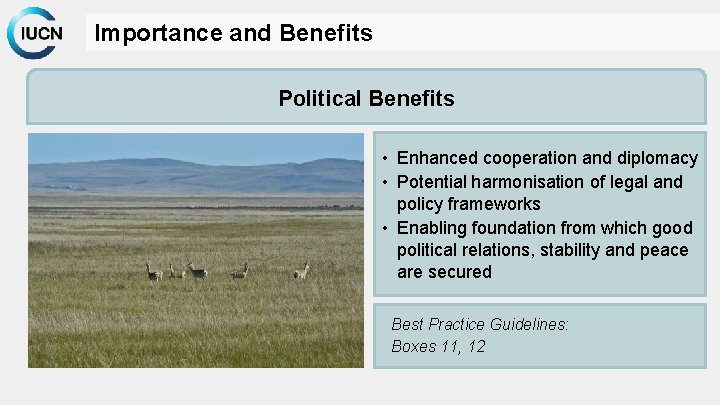
Importance and Benefits Political Benefits • Enhanced cooperation and diplomacy • Potential harmonisation of legal and policy frameworks • Enabling foundation from which good political relations, stability and peace are secured Best Practice Guidelines: Boxes 11, 12
Challenges in Transboundary Conservation What are the challenges in transboundary conservation? • …

Challenges in Transboundary Conservation • • • • Different languages Cultural differences Political indifference Differences in law Different levels of economic development Unequal resources and capacity Unequal professional standards Undetermined vision and intangible goals Poor communication Lack of commitment Lack of cooperative spirit Need for increased coordination Inaccessible terrain
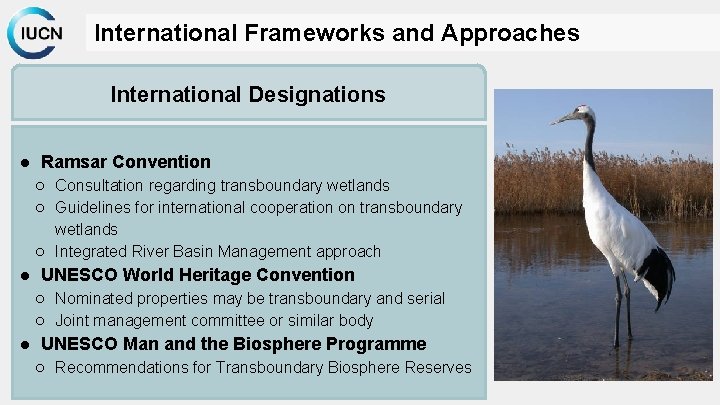
International Frameworks and Approaches International Designations ● Ramsar Convention ○ Consultation regarding transboundary wetlands ○ Guidelines for international cooperation on transboundary wetlands ○ Integrated River Basin Management approach ● UNESCO World Heritage Convention ○ Nominated properties may be transboundary and serial ○ Joint management committee or similar body ● UNESCO Man and the Biosphere Programme ○ Recommendations for Transboundary Biosphere Reserves
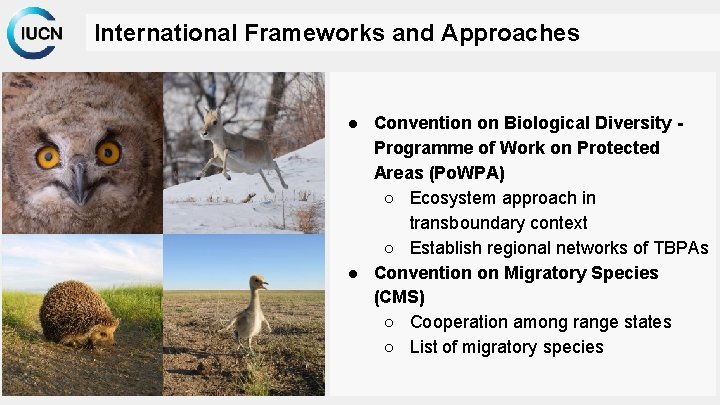
International Frameworks and Approaches ● Convention on Biological Diversity Programme of Work on Protected Areas (Po. WPA) ○ Ecosystem approach in transboundary context ○ Establish regional networks of TBPAs ● Convention on Migratory Species (CMS) ○ Cooperation among range states ○ List of migratory species
Regional Programmes and Frameworks Regional Frameworks ● Southern African Development Community (SADC) ○ Leads regional efforts to establish Transfrontier Conservation Areas (TFCAs) ○ Regional network of TFCA practitioners ● EU Natura 2000 Network ○ Sites established under Birds Directive and Habitats Directive ○ Focus on habitats that cross international borders ● International Centre for Integrated Mountain Development (ICIMOD) ○ Eight member countries of the Hindu Kush Himalaya ○ Transboundary Landscapes Programme supports conservation and sustainable use ○ Transboundary conservation initiatives in six transboundary landscapes
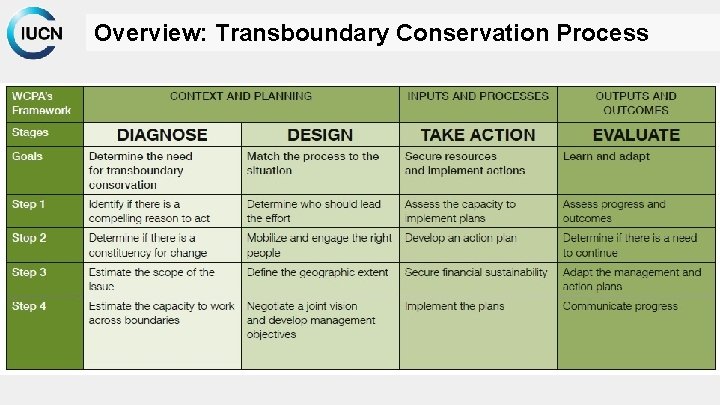
Overview: Transboundary Conservation Process
Overview: Transboundary Conservation Process Context and Planning ● Diagnose: Determining the need for TBCAs ○ Identify a compelling reason to act ○ Determine if there is a constituency for change ○ Estimate the scope ○ Estimate the capacity to work across borders ● Design: Match the process to the situation ○ Determine leadership ○ Mobilize public ○ Define the geographic extent ○ Negotiate a joint vision and develop management objectives
Overview: Transboundary Conservation Process Inputs and Processes Take action: Secure resources and implement actions ● Assess the capacity to implement plans ● Develop an action plan ● Secure financial resources ● Implement the plans Outputs and Outcomes Evaluate: Learn and adapt ● Assess progress and outcomes ● Determine if there is a need to continue ● Adapt the management and action plans ● Communicate progress
Discussion What current or proposed Transboundary Conservation Areas are you involved in? What are the challenges? What are the real or potential benefits? • …
Transboundary Conservation Areas End of Lesson 1
- Slides: 22