
Transboundary Conservation Areas Introduction Overview and Objectives of
Transboundary Conservation Areas Introduction: Overview and Objectives of the Training Module
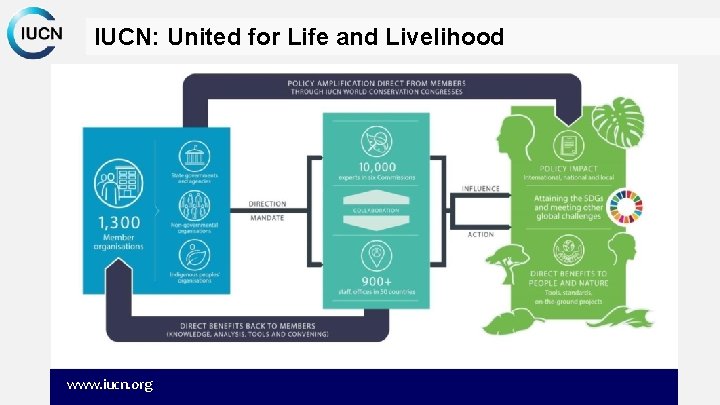
IUCN: United for Life and Livelihood www. iucn. org
Project: Development and Piloting a Training Module on Initiating Transboundary Conservation Objective: Develop a three-day, globally applicable training module on initiating transboundary conservation based on the IUCN Best Practice Protected Area Guidelines ”Transboundary Conservation: A systematic and integrated approach” (2015) Implementation: IUCN ECARO, IUCN ELC, IUCN WCPA Transboundary Conservation SG Duration: February 2018 – January 2019 Donor: German Federal Agency for Nature Conservation (Bundesamt für Naturschutz, Bf. N)
The Federal Agency for Nature Conservation (Bf. N) Bf. N is the German government’s scientific authority with responsibility for national and international nature conservation. Bf. N is one of the government’s departmental research agencies and reports to the German Environment Ministry. The Agency provides the German Environment Ministry with professional and scientific assistance in all nature conservation and landscape management issues and in international cooperation activities. Bf. N furthers its objectives by carrying out related scientific research and is also in charge of a number of funding programmes. With its International Academy for Nature Conservation on the Isle of Vilm, Bf. N has initiated this project in frame of its international capacity building activities.
Objective and Aim Initiating Transboundary Conservation Strengthen capacity to assess the feasibility of establishing a Transboundary Conservation Area Enable practitioners to develop strategies to address critical issues and success factors
Factors of Success Assess the enabling environment to pursue transboundary conservation Define the transboundary context and relationships affecting the achievement of the conservation targets and the resulting geographic extent Identify and involve stakeholders, obtain support of decision makers and ensure political will and buy-in Agree on common values and joint vision Determine common transboundary management objectives and develop cooperative agreements
Nature of the Module Globally applicable and generic Adaptable for different regions and environments National, regional and local level Designed for face-to-face instruction Accessible and open
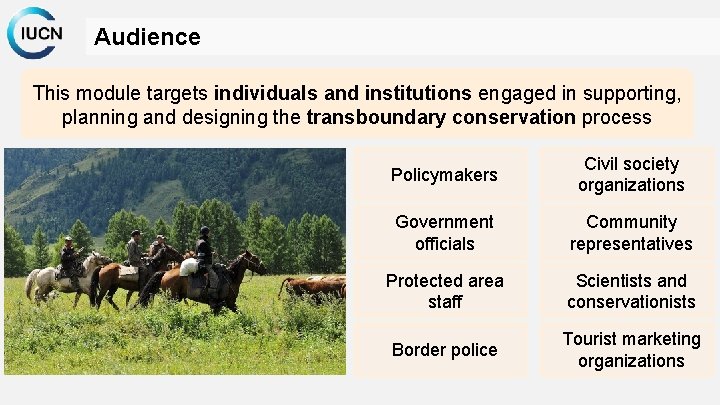
Audience This module targets individuals and institutions engaged in supporting, planning and designing the transboundary conservation process Policymakers Civil society organizations Government officials Community representatives Protected area staff Scientists and conservationists Border police Tourist marketing organizations
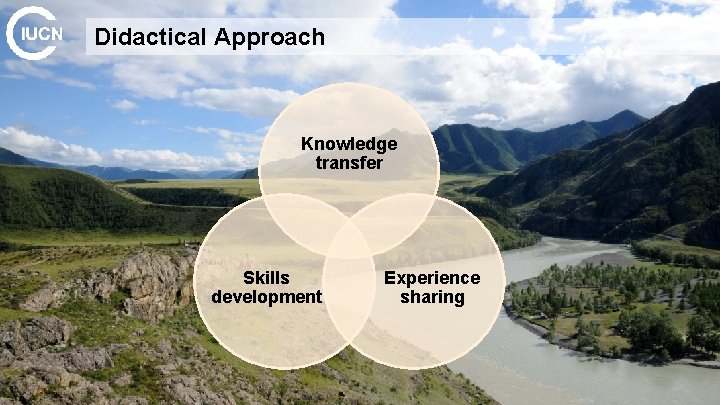
Didactical Approach Knowledge transfer Skills development Experience sharing

Lessons Lesson 1 Introduction and background to Transboundary Conservation Areas Lesson 2 Typology of Transboundary Conservation Areas Lesson 3 Initiating transboundary conservation: Diagnose the situation Lesson 4 Transboundary conservation governance Lesson 5 Initiating transboundary conservation: Design the process I Lesson 6 Cooperative management in transboundary conservation Lesson 7 Initiating transboundary conservation: Design the process II Lesson 8 Final thoughts
Team Maja Vasilijević, Vice-Chair, IUCN WCPA Transboundary Conservation Specialist Group Lydia Slobodian, Senior Legal Officer, IUCN Environmental Law Centre Boris Erg, Director, IUCN Regional Office for Eastern Europe and Central Asia Steering Group Members: Clara Bocchino, Network Coordinator and Facilitator, SADC TFCA Goran Gugić, Senior Adviser NATURA 2000 and Protected Areas, GIZ/CIM-IF Alois Lang, Public Relations and Ecotourism Expert, Neusiedler See-Seewinkel National Park Bert Lenten, Former Deputy Executive Secretary of the Convention on the Conservation of Migratory Species of Wild Animals (CMS) and former Executive Secretary AEWA, Lenten Conservation Consultancy Andrea Strauss, Deputy Head of Unit "International Academy for Nature Conservation", German Federal Agency for Nature Conservation
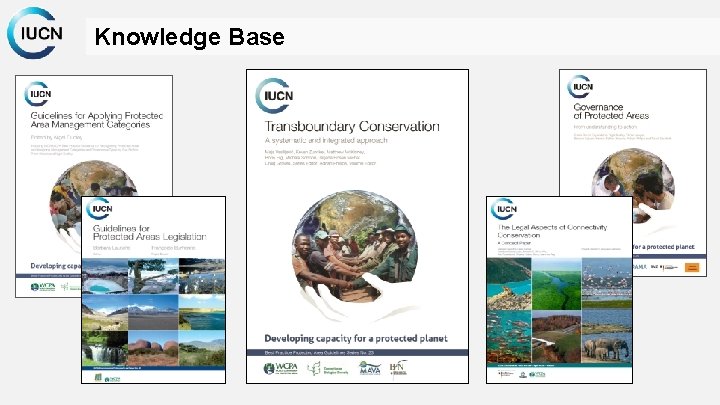
Knowledge Base
“The national divisions of today may coincide to some greater or lesser extent with ethnic, religious, linguistic, or ideological groupings. What they do not very often coincide with is units determined by ecological factors, that is, ecosystems or ecogeographical regions” (Westing, 1993) “Start anywhere: just get started” (Ramsar Convention on Wetlands: Resolution IX. 1 Annex C I, Chapter IV) www. iucn. org www. tbpa. net
Transboundary Conservation Areas End of Introduction
- Slides: 14