
Transactions That Affect Revenue Expenses and Withdrawals Making




- Slides: 10
Transactions That Affect Revenue, Expenses, and Withdrawals Making Accounting Relevant Businesses earn revenue by selling products or services. Think of a business in your community. How does this business earn its revenue?
Section 1 Relationship of Revenue, Expenses, and Withdrawals to Owner’s Equity What You’ll Learn = The reason for having temporary and permanent accounts. = The rules of debit and credit for the revenue, expense, and withdrawals accounts.
Section 1 Relationship of Revenue, Expenses, and Withdrawals to Owner’s Equity (cont'd. ) Why It’s Important The proper handling of transactions that affect temporary and permanent accounts is essential to maintaining accurate financial records. Key Terms = temporary capital accounts = permanent accounts
Section 1 Relationship of Revenue, Expenses, and Withdrawals to Owner’s Equity (cont'd. ) Temporary Capital Accounts = Revenue, expense, and withdrawals accounts are used to collect information for a single accounting period. = At the end of that period, the balances in the temporary capital accounts are transferred to the owner’s capital account.
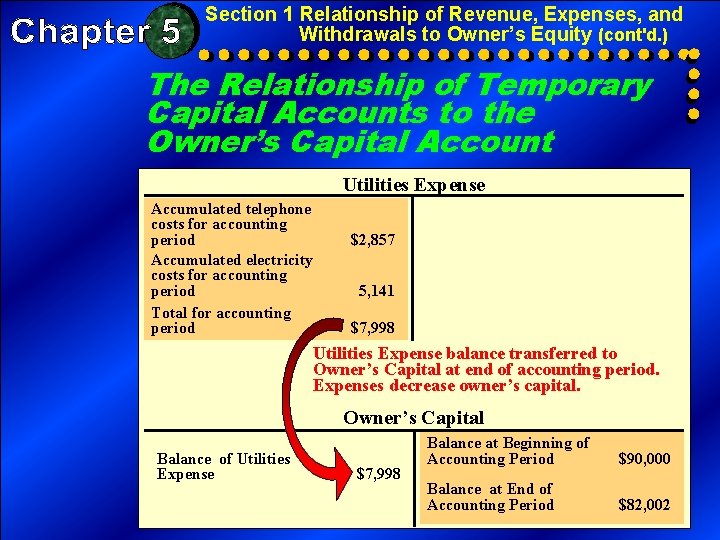
Section 1 Relationship of Revenue, Expenses, and Withdrawals to Owner’s Equity (cont'd. ) The Relationship of Temporary Capital Accounts to the Owner’s Capital Account Utilities Expense Accumulated telephone costs for accounting period Accumulated electricity costs for accounting period Total for accounting period $2, 857 5, 141 $7, 998 Utilities Expense balance transferred to Owner’s Capital at end of accounting period. Expenses decrease owner’s capital. Owner’s Capital Balance of Utilities Expense $7, 998 Balance at Beginning of Accounting Period $90, 000 Balance at End of Accounting Period $82, 002
Section 1 Relationship of Revenue, Expenses, and Withdrawals to Owner’s Equity (cont'd. ) Permanent Accounts = Owner’s capital account = Asset and liability accounts = Permanent accounts are continuous from one accounting period to the next.
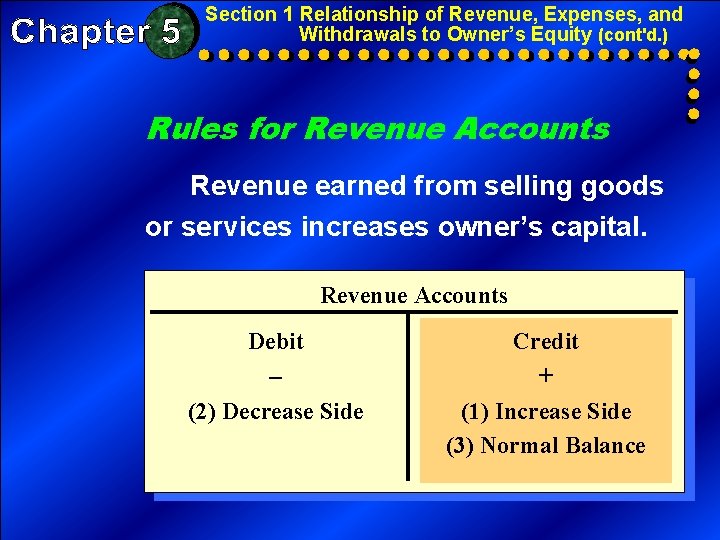
Section 1 Relationship of Revenue, Expenses, and Withdrawals to Owner’s Equity (cont'd. ) Rules for Revenue Accounts Revenue earned from selling goods or services increases owner’s capital. Revenue Accounts Debit – (2) Decrease Side Credit + (1) Increase Side (3) Normal Balance
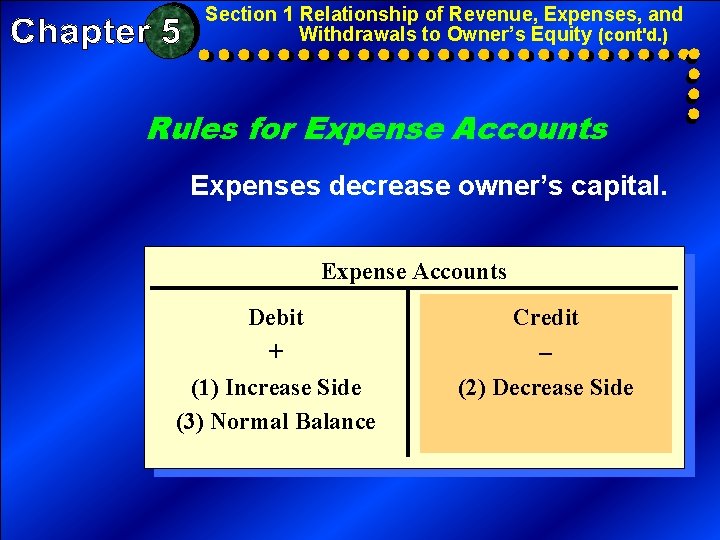
Section 1 Relationship of Revenue, Expenses, and Withdrawals to Owner’s Equity (cont'd. ) Rules for Expense Accounts Expenses decrease owner’s capital. Expense Accounts Debit + (1) Increase Side (3) Normal Balance Credit – (2) Decrease Side
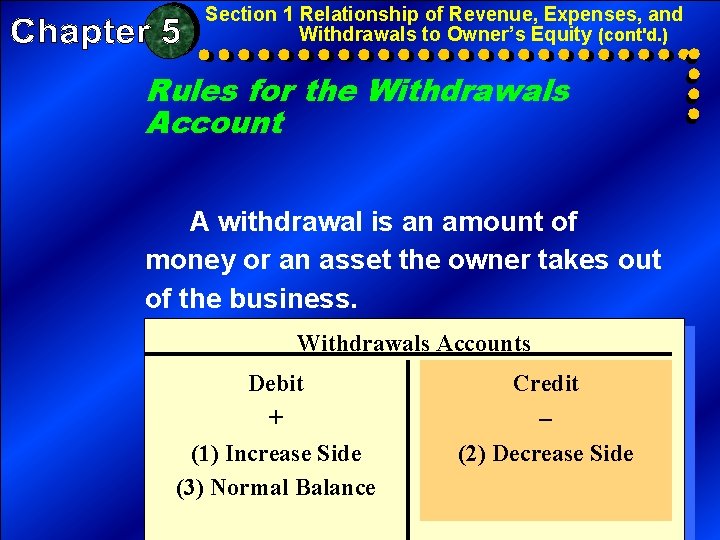
Section 1 Relationship of Revenue, Expenses, and Withdrawals to Owner’s Equity (cont'd. ) Rules for the Withdrawals Account A withdrawal is an amount of money or an asset the owner takes out of the business. Withdrawals Accounts Debit + (1) Increase Side (3) Normal Balance Credit – (2) Decrease Side
Section 1 Relationship of Revenue, Expenses, and Withdrawals to Owner’s Equity (cont'd. ) Check Your Understanding Changes to revenue accounts eventually affect another account. What other account is affected? Explain.