
Transactional Memory Part 2 SoftwareBased Approaches Transactional Memory
Transactional Memory Part 2: Software-Based Approaches
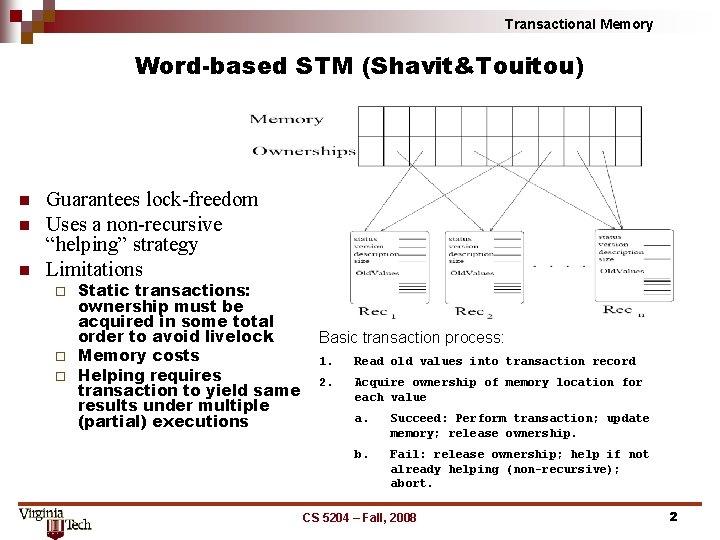
Transactional Memory Word-based STM (Shavit&Touitou) n n n Guarantees lock-freedom Uses a non-recursive “helping” strategy Limitations Static transactions: ownership must be acquired in some total order to avoid livelock ¨ Memory costs ¨ Helping requires transaction to yield same results under multiple (partial) executions ¨ Basic transaction process: 1. Read old values into transaction record 2. Acquire ownership of memory location for each value a. Succeed: Perform transaction; update memory; release ownership. b. Fail: release ownership; help if not already helping (non-recursive); abort. CS 5204 – Fall, 2008 2
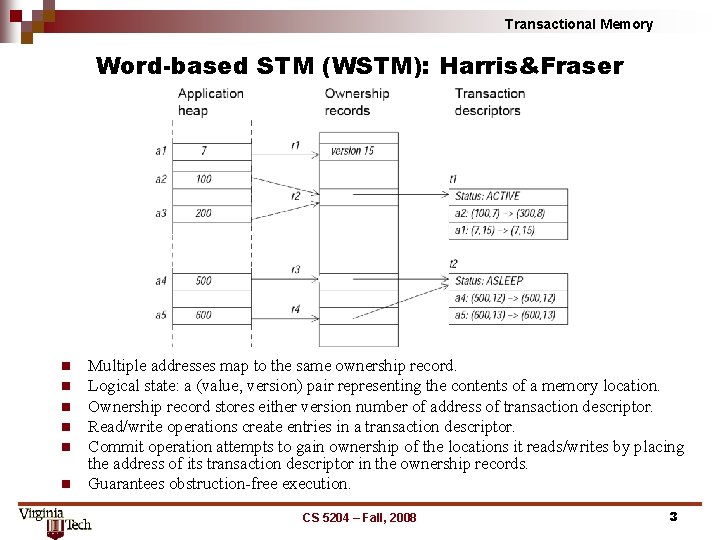
Transactional Memory Word-based STM (WSTM): Harris&Fraser n n n Multiple addresses map to the same ownership record. Logical state: a (value, version) pair representing the contents of a memory location. Ownership record stores either version number of address of transaction descriptor. Read/write operations create entries in a transaction descriptor. Commit operation attempts to gain ownership of the locations it reads/writes by placing the address of its transaction descriptor in the ownership records. Guarantees obstruction-free execution. CS 5204 – Fall, 2008 3

Transactional Memory Stealing n n n Transaction attempting to commit, “steals” transaction entry from conflicting transaction Provides non-blocking commit operation (guarantee of obstruction-free execution) Requires ownership record to store the number of transaction holding a transaction record for a location mapping to the ownership record CS 5204 – Fall, 2008 4
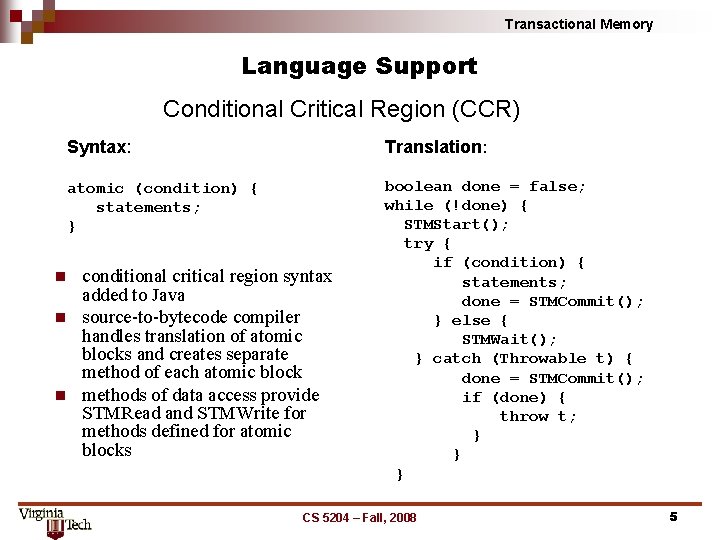
Transactional Memory Language Support Conditional Critical Region (CCR) n n n Syntax: Translation: atomic (condition) { statements; } boolean done = false; while (!done) { STMStart(); try { if (condition) { statements; done = STMCommit(); } else { STMWait(); } catch (Throwable t) { done = STMCommit(); if (done) { throw t; } } } conditional critical region syntax added to Java source-to-bytecode compiler handles translation of atomic blocks and creates separate method of each atomic block methods of data access provide STMRead and STMWrite for methods defined for atomic blocks CS 5204 – Fall, 2008 5
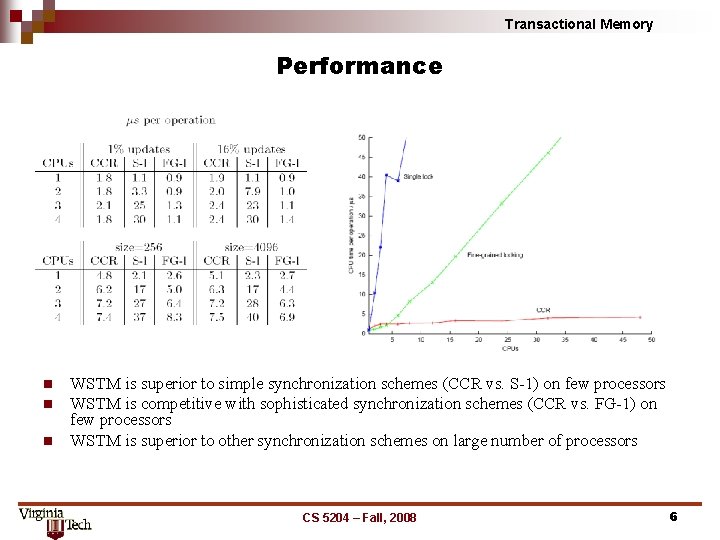
Transactional Memory Performance n n n WSTM is superior to simple synchronization schemes (CCR vs. S-1) on few processors WSTM is competitive with sophisticated synchronization schemes (CCR vs. FG-1) on few processors WSTM is superior to other synchronization schemes on large number of processors CS 5204 – Fall, 2008 6

Transactional Memory Dynamic STM (DTSM): Herlihy et. al. TM Object Locator Transaction New Object Old Object object data n n n TMObject is a handle for an object. An “open” operation on the TMObject is required before object can be accessed. Transaction state may be: ACTIVE, COMMITTED, ABORTED. The “current” form of the object data is maintained (Old Object). A shadow copy of to-be-committed updates to the object is also maintained. CS 5204 – Fall, 2008 7

Transactional Memory Opening a TMObject for Writing Locator Transaction T 1: Committed New Object Old Object TM Object object data CAS object data Copy Locator Transaction T 2: Active New Object Old Object CS 5204 – Fall, 2008 object data 8
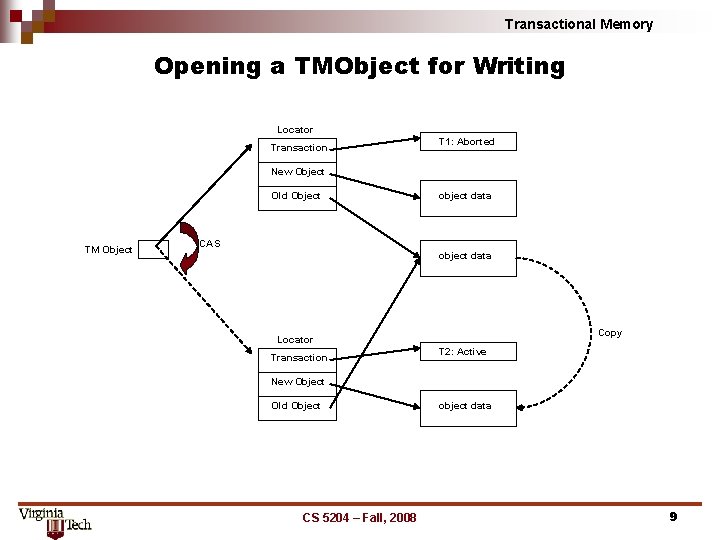
Transactional Memory Opening a TMObject for Writing Locator Transaction T 1: Aborted New Object Old Object TM Object object data CAS object data Copy Locator Transaction T 2: Active New Object Old Object CS 5204 – Fall, 2008 object data 9
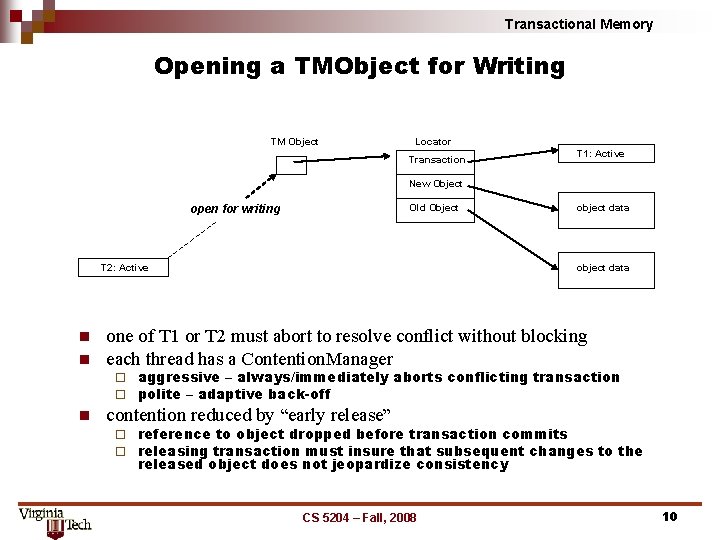
Transactional Memory Opening a TMObject for Writing TM Object Locator Transaction T 1: Active New Object Old Object open for writing T 2: Active n n object data one of T 1 or T 2 must abort to resolve conflict without blocking each thread has a Contention. Manager ¨ ¨ n object data aggressive – always/immediately aborts conflicting transaction polite – adaptive back-off contention reduced by “early release” ¨ ¨ reference to object dropped before transaction commits releasing transaction must insure that subsequent changes to the released object does not jeopardize consistency CS 5204 – Fall, 2008 10
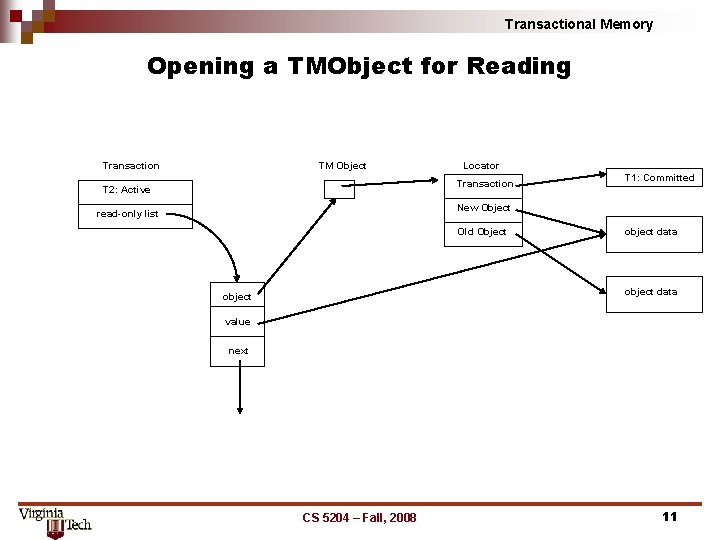
Transactional Memory Opening a TMObject for Reading Transaction TM Object Locator Transaction T 2: Active T 1: Committed New Object read-only list Old Object object data object value next CS 5204 – Fall, 2008 11
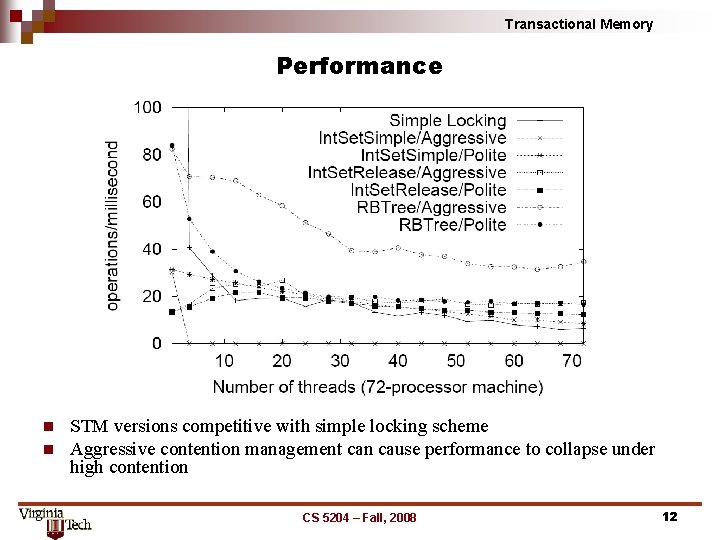
Transactional Memory Performance n n STM versions competitive with simple locking scheme Aggressive contention management can cause performance to collapse under high contention CS 5204 – Fall, 2008 12
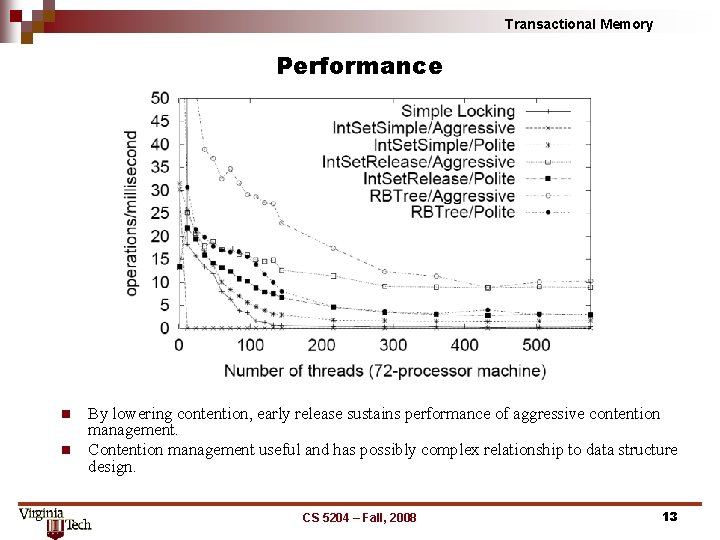
Transactional Memory Performance n n By lowering contention, early release sustains performance of aggressive contention management. Contention management useful and has possibly complex relationship to data structure design. CS 5204 – Fall, 2008 13
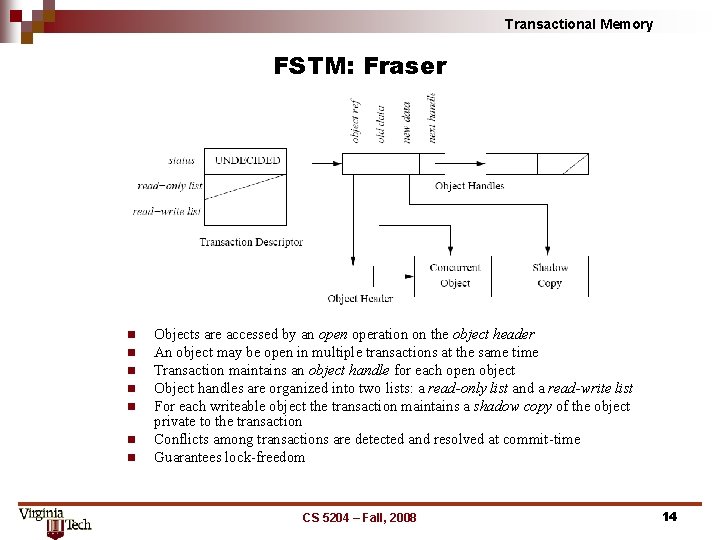
Transactional Memory FSTM: Fraser n n n n Objects are accessed by an operation on the object header An object may be open in multiple transactions at the same time Transaction maintains an object handle for each open object Object handles are organized into two lists: a read-only list and a read-write list For each writeable object the transaction maintains a shadow copy of the object private to the transaction Conflicts among transactions are detected and resolved at commit-time Guarantees lock-freedom CS 5204 – Fall, 2008 14
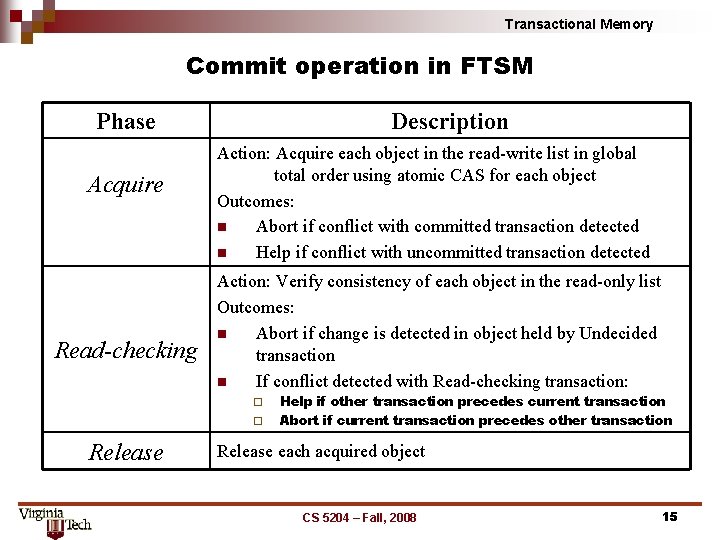
Transactional Memory Commit operation in FTSM Phase Acquire Read-checking Description Action: Acquire each object in the read-write list in global total order using atomic CAS for each object Outcomes: n Abort if conflict with committed transaction detected n Help if conflict with uncommitted transaction detected Action: Verify consistency of each object in the read-only list Outcomes: n Abort if change is detected in object held by Undecided transaction n If conflict detected with Read-checking transaction: ¨ ¨ Release Help if other transaction precedes current transaction Abort if current transaction precedes other transaction Release each acquired object CS 5204 – Fall, 2008 15
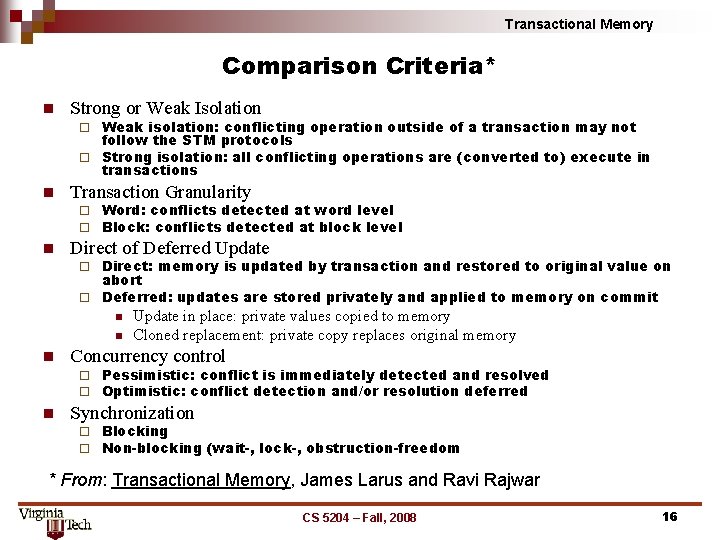
Transactional Memory Comparison Criteria* n Strong or Weak Isolation Weak isolation: conflicting operation outside of a transaction may not follow the STM protocols ¨ Strong isolation: all conflicting operations are (converted to) execute in transactions ¨ n Transaction Granularity ¨ ¨ n Word: conflicts detected at word level Block: conflicts detected at block level Direct of Deferred Update Direct: memory is updated by transaction and restored to original value on abort ¨ Deferred: updates are stored privately and applied to memory on commit ¨ n n n Concurrency control ¨ ¨ n Update in place: private values copied to memory Cloned replacement: private copy replaces original memory Pessimistic: conflict is immediately detected and resolved Optimistic: conflict detection and/or resolution deferred Synchronization ¨ ¨ Blocking Non-blocking (wait-, lock-, obstruction-freedom * From: Transactional Memory, James Larus and Ravi Rajwar CS 5204 – Fall, 2008 16
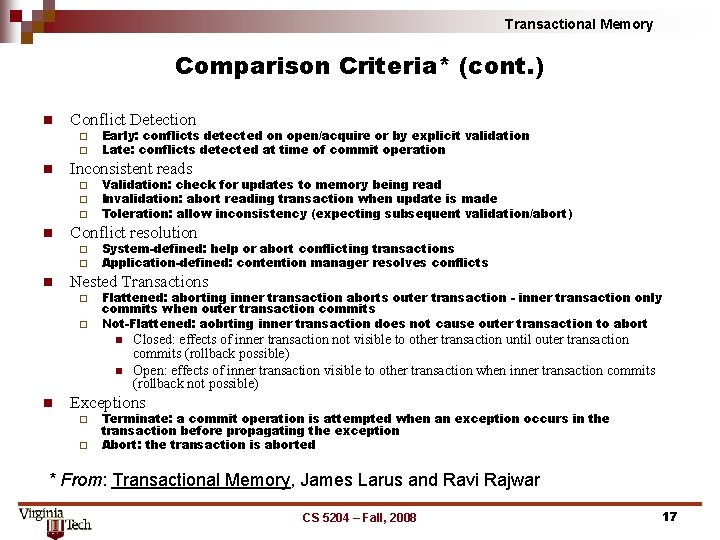
Transactional Memory Comparison Criteria* (cont. ) n Conflict Detection ¨ ¨ n Inconsistent reads ¨ ¨ ¨ n Validation: check for updates to memory being read Invalidation: abort reading transaction when update is made Toleration: allow inconsistency (expecting subsequent validation/abort) Conflict resolution ¨ ¨ n Early: conflicts detected on open/acquire or by explicit validation Late: conflicts detected at time of commit operation System-defined: help or abort conflicting transactions Application-defined: contention manager resolves conflicts Nested Transactions ¨ ¨ Flattened: aborting inner transaction aborts outer transaction - inner transaction only commits when outer transaction commits Not-Flattened: aobrting inner transaction does not cause outer transaction to abort n n n Closed: effects of inner transaction not visible to other transaction until outer transaction commits (rollback possible) Open: effects of inner transaction visible to other transaction when inner transaction commits (rollback not possible) Exceptions ¨ ¨ Terminate: a commit operation is attempted when an exception occurs in the transaction before propagating the exception Abort: the transaction is aborted * From: Transactional Memory, James Larus and Ravi Rajwar CS 5204 – Fall, 2008 17
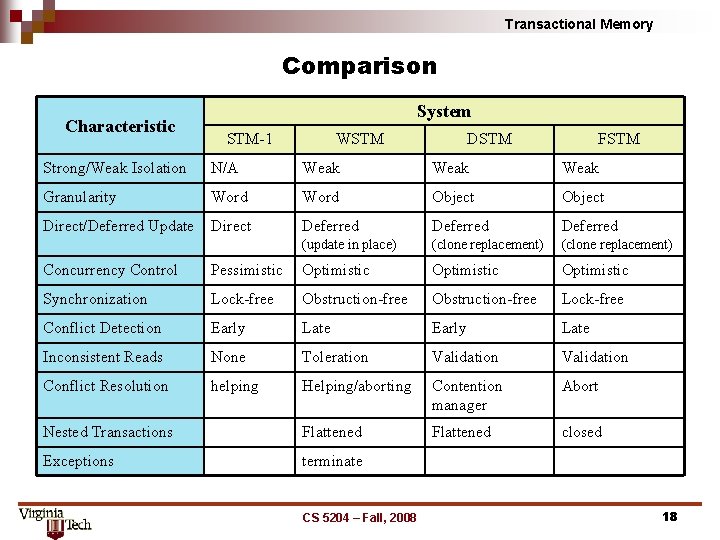
Transactional Memory Comparison Characteristic System STM-1 WSTM DSTM FSTM Strong/Weak Isolation N/A Weak Granularity Word Object Direct/Deferred Update Direct Deferred (update in place) (clone replacement) Concurrency Control Pessimistic Optimistic Synchronization Lock-free Obstruction-free Lock-free Conflict Detection Early Late Inconsistent Reads None Toleration Validation Conflict Resolution helping Helping/aborting Contention manager Abort Nested Transactions Flattened closed Exceptions terminate CS 5204 – Fall, 2008 18
- Slides: 18