
Transactional Memory Part 1 Concepts and Hardware Based
Transactional Memory Part 1: Concepts and Hardware. Based Approaches CS 5204 -Operating Systems
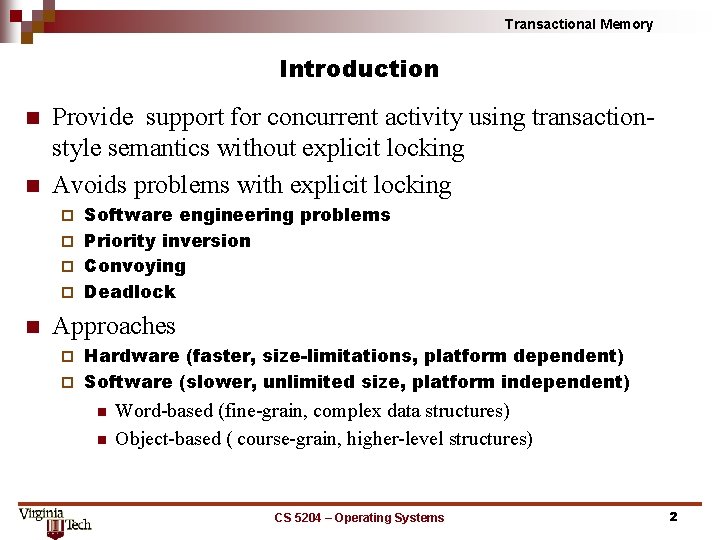
Transactional Memory Introduction n n Provide support for concurrent activity using transactionstyle semantics without explicit locking Avoids problems with explicit locking Software engineering problems ¨ Priority inversion ¨ Convoying ¨ Deadlock ¨ n Approaches Hardware (faster, size-limitations, platform dependent) ¨ Software (slower, unlimited size, platform independent) ¨ n n Word-based (fine-grain, complex data structures) Object-based ( course-grain, higher-level structures) CS 5204 – Operating Systems 2
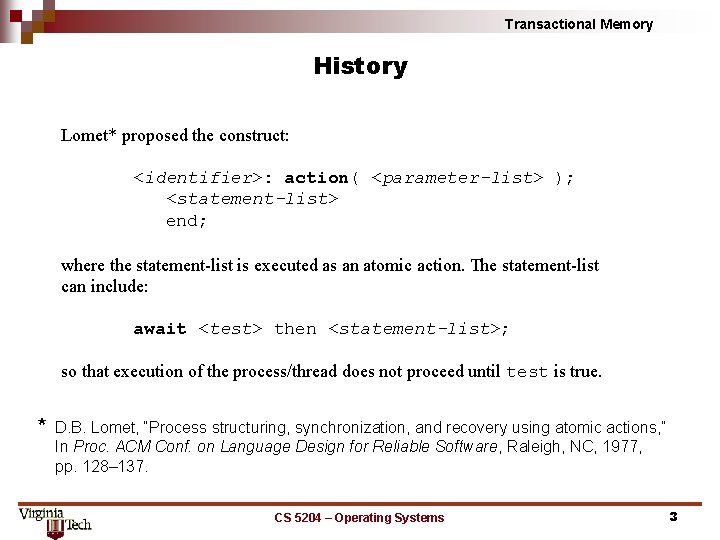
Transactional Memory History Lomet* proposed the construct: <identifier>: action( <parameter-list> ); <statement-list> end; where the statement-list is executed as an atomic action. The statement-list can include: await <test> then <statement-list>; so that execution of the process/thread does not proceed until test is true. * D. B. Lomet, “Process structuring, synchronization, and recovery using atomic actions, ” In Proc. ACM Conf. on Language Design for Reliable Software, Raleigh, NC, 1977, pp. 128– 137. CS 5204 – Operating Systems 3
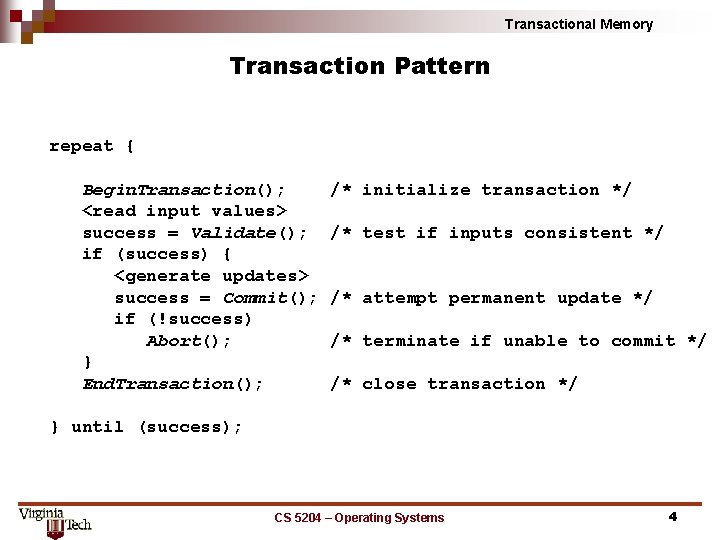
Transactional Memory Transaction Pattern repeat { Begin. Transaction(); <read input values> success = Validate(); if (success) { <generate updates> success = Commit(); if (!success) Abort(); } End. Transaction(); /* initialize transaction */ /* test if inputs consistent */ /* attempt permanent update */ /* terminate if unable to commit */ /* close transaction */ } until (success); CS 5204 – Operating Systems 4
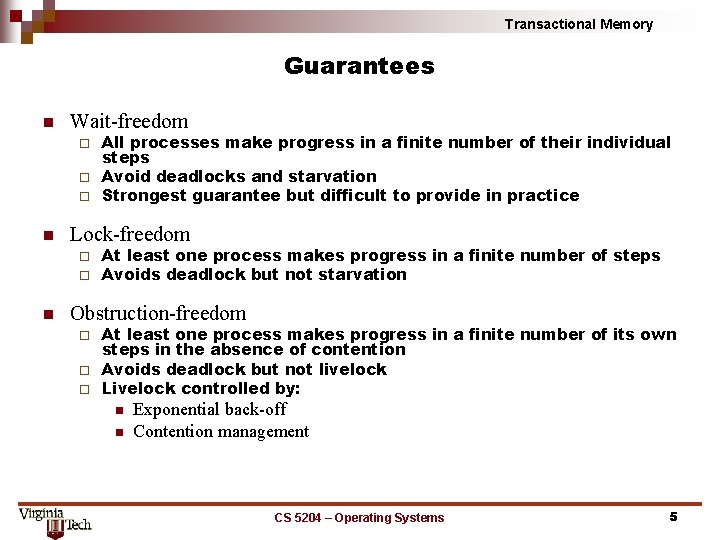
Transactional Memory Guarantees n Wait-freedom All processes make progress in a finite number of their individual steps ¨ Avoid deadlocks and starvation ¨ Strongest guarantee but difficult to provide in practice ¨ n Lock-freedom ¨ ¨ n At least one process makes progress in a finite number of steps Avoids deadlock but not starvation Obstruction-freedom At least one process makes progress in a finite number of its own steps in the absence of contention ¨ Avoids deadlock but not livelock ¨ Livelock controlled by: ¨ n n Exponential back-off Contention management CS 5204 – Operating Systems 5
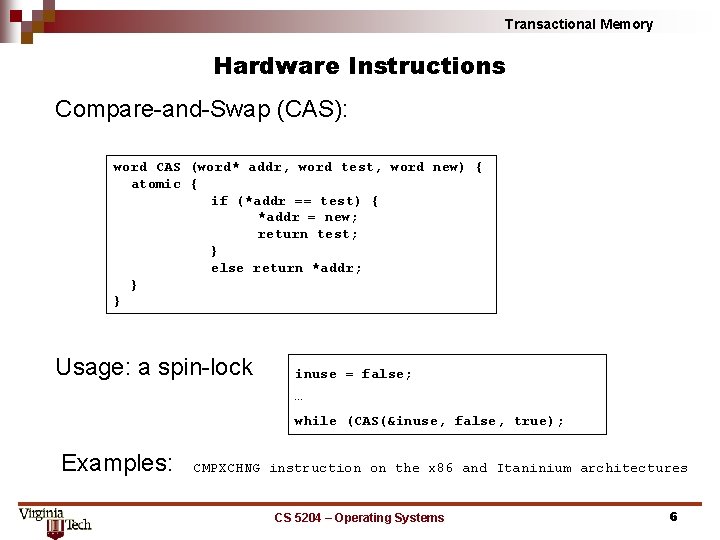
Transactional Memory Hardware Instructions Compare-and-Swap (CAS): word CAS (word* addr, word test, word new) { atomic { if (*addr == test) { *addr = new; return test; } else return *addr; } } Usage: a spin-lock inuse = false; … while (CAS(&inuse, false, true); Examples: CMPXCHNG instruction on the x 86 and Itaninium architectures CS 5204 – Operating Systems 6
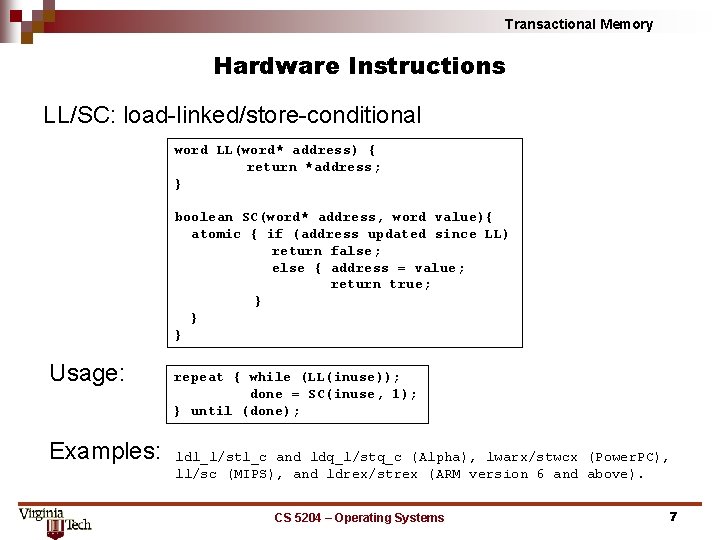
Transactional Memory Hardware Instructions LL/SC: load-linked/store-conditional word LL(word* address) { return *address; } boolean SC(word* address, word value){ atomic { if (address updated since LL) return false; else { address = value; return true; } } } Usage: Examples: repeat { while (LL(inuse)); done = SC(inuse, 1); } until (done); ldl_l/stl_c and ldq_l/stq_c (Alpha), lwarx/stwcx (Power. PC), ll/sc (MIPS), and ldrex/strex (ARM version 6 and above). CS 5204 – Operating Systems 7
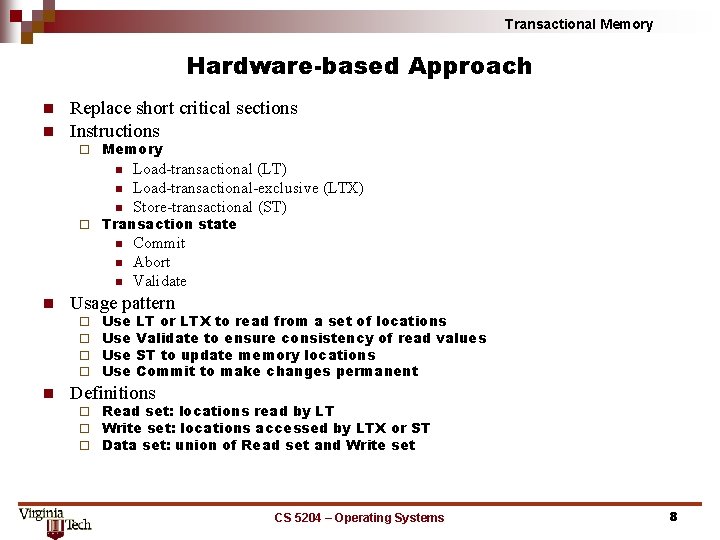
Transactional Memory Hardware-based Approach n n Replace short critical sections Instructions ¨ Memory n n n ¨ Transaction state n n Commit Abort Validate Usage pattern ¨ ¨ n Load-transactional (LT) Load-transactional-exclusive (LTX) Store-transactional (ST) Use Use LT or LTX to read from a set of locations Validate to ensure consistency of read values ST to update memory locations Commit to make changes permanent Definitions ¨ ¨ ¨ Read set: locations read by LT Write set: locations accessed by LTX or ST Data set: union of Read set and Write set CS 5204 – Operating Systems 8
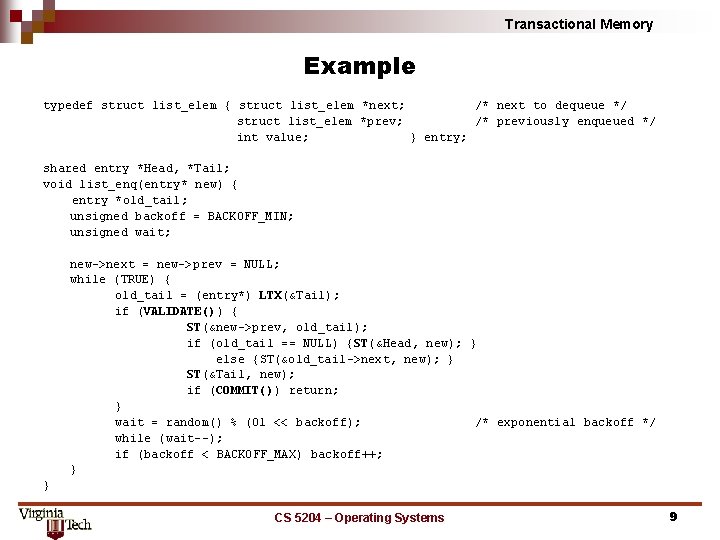
Transactional Memory Example typedef struct list_elem { struct list_elem *next; /* next to dequeue */ struct list_elem *prev; /* previously enqueued */ int value; } entry; shared entry *Head, *Tail; void list_enq(entry* new) { entry *old_tail; unsigned backoff = BACKOFF_MIN; unsigned wait; new->next = new->prev = NULL; while (TRUE) { old_tail = (entry*) LTX(&Tail); if (VALIDATE()) { ST(&new->prev, old_tail); if (old_tail == NULL) {ST(&Head, new); } else {ST(&old_tail->next, new); } ST(&Tail, new); if (COMMIT()) return; } wait = random() % (01 << backoff); /* exponential backoff */ while (wait--); if (backoff < BACKOFF_MAX) backoff++; } } CS 5204 – Operating Systems 9
Transactional Memory Hardware-based Approach CS 5204 – Operating Systems 10
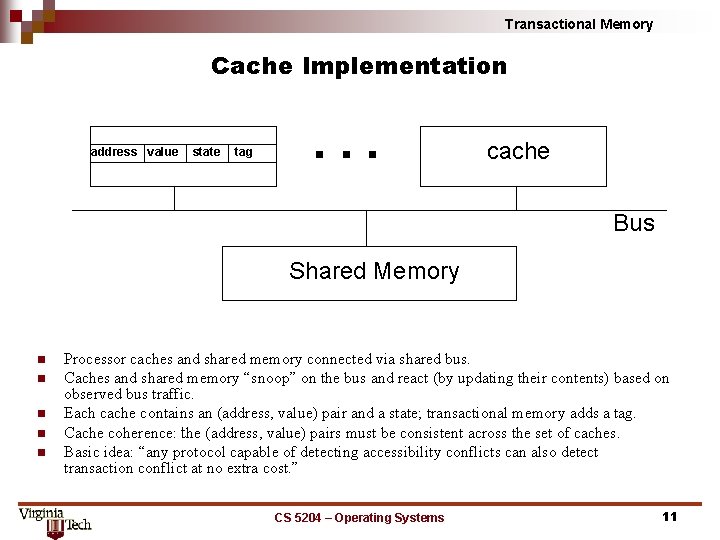
Transactional Memory Cache Implementation address value state tag . . . cache Bus Shared Memory n n n Processor caches and shared memory connected via shared bus. Caches and shared memory “snoop” on the bus and react (by updating their contents) based on observed bus traffic. Each cache contains an (address, value) pair and a state; transactional memory adds a tag. Cache coherence: the (address, value) pairs must be consistent across the set of caches. Basic idea: “any protocol capable of detecting accessibility conflicts can also detect transaction conflict at no extra cost. ” CS 5204 – Operating Systems 11
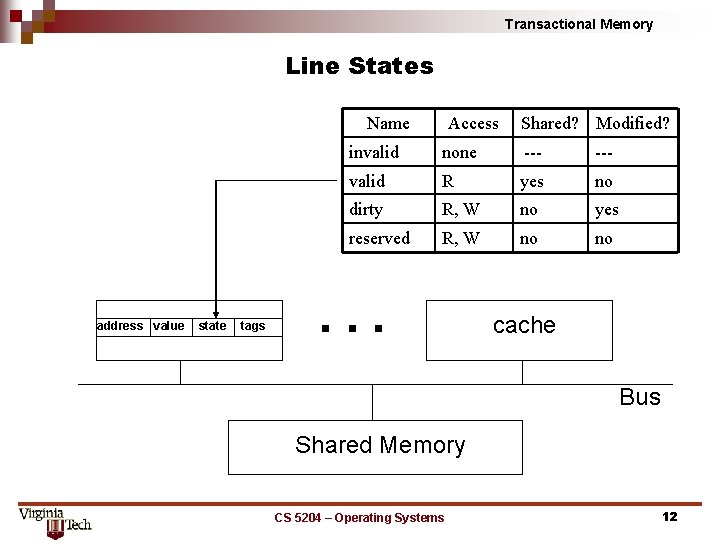
Transactional Memory Line States Name address value state tags Access Shared? Modified? invalid none --- valid R yes no dirty R, W no yes reserved R, W no no . . . cache Bus Shared Memory CS 5204 – Operating Systems 12
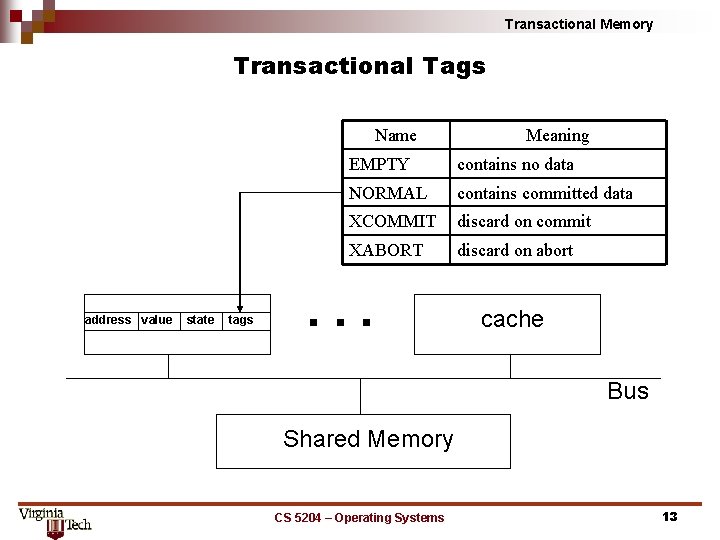
Transactional Memory Transactional Tags Name address value state tags Meaning EMPTY contains no data NORMAL contains committed data XCOMMIT discard on commit XABORT discard on abort . . . cache Bus Shared Memory CS 5204 – Operating Systems 13
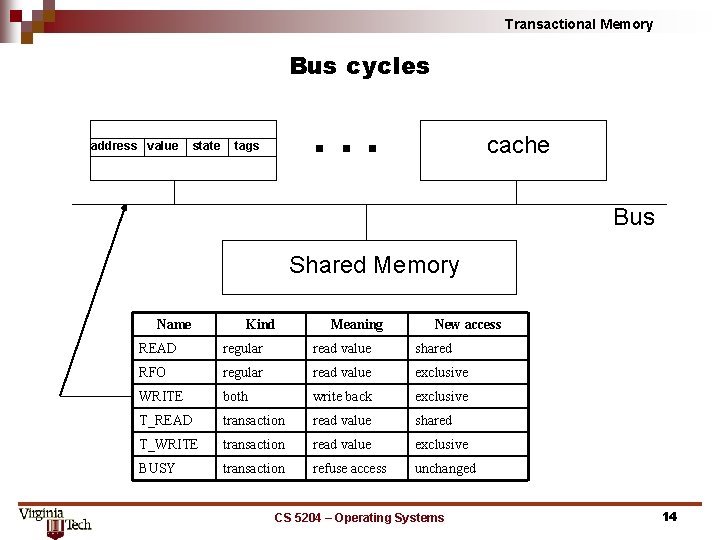
Transactional Memory Bus cycles address value state . . . tags cache Bus Shared Memory Name Kind Meaning New access READ regular read value shared RFO regular read value exclusive WRITE both write back exclusive T_READ transaction read value shared T_WRITE transaction read value exclusive BUSY transaction refuse access unchanged CS 5204 – Operating Systems 14
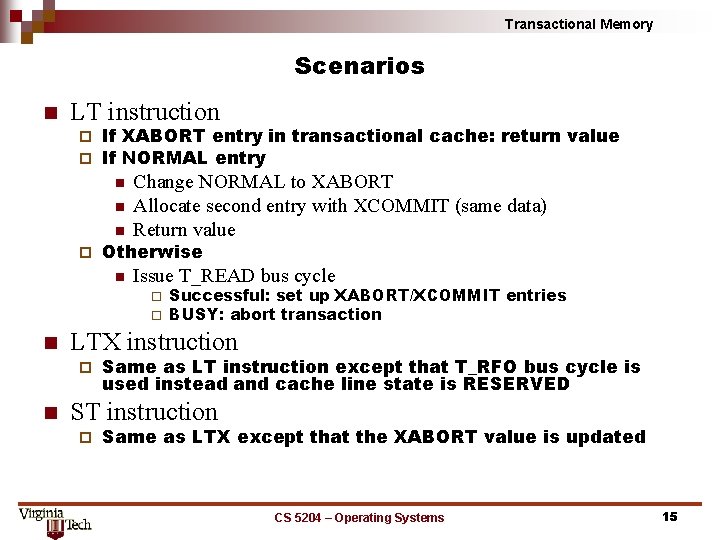
Transactional Memory Scenarios n LT instruction ¨ ¨ If XABORT entry in transactional cache: return value If NORMAL entry n Change NORMAL to XABORT Allocate second entry with XCOMMIT (same data) Return value n Issue T_READ bus cycle n n ¨ Otherwise ¨ ¨ n LTX instruction ¨ n Successful: set up XABORT/XCOMMIT entries BUSY: abort transaction Same as LT instruction except that T_RFO bus cycle is used instead and cache line state is RESERVED ST instruction ¨ Same as LTX except that the XABORT value is updated CS 5204 – Operating Systems 15
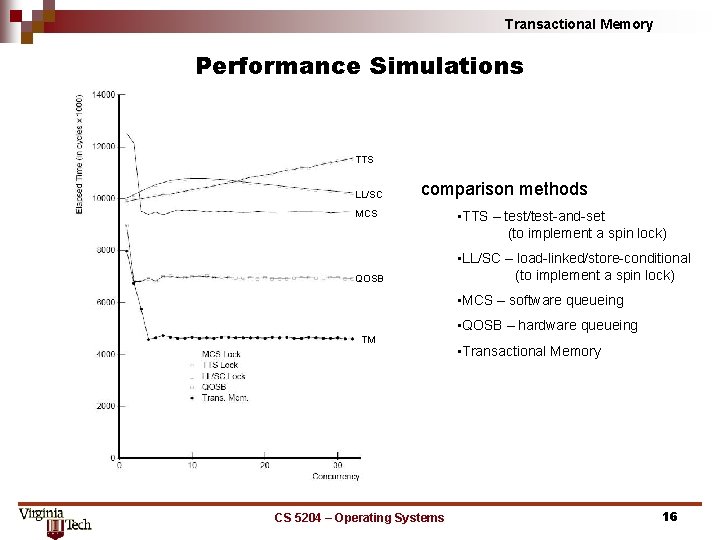
Transactional Memory Performance Simulations TTS LL/SC comparison methods MCS QOSB • TTS – test/test-and-set (to implement a spin lock) • LL/SC – load-linked/store-conditional (to implement a spin lock) • MCS – software queueing • QOSB – hardware queueing TM CS 5204 – Operating Systems • Transactional Memory 16
- Slides: 16