
Transactional and Transformational Leadership An Overview Jeremy Dutschke

- Slides: 22
Transactional and Transformational Leadership: An Overview Jeremy Dutschke, Ph. D. Dallas Baptist University
History of Leadership • • • Great Man Theory Trait Theories Behavioral Leadership Theories Situational Leadership Theories Contingency Leadership Theories Neocharismatic Leadership Theories
Neocharismatic Leadership Theories • Effective leadership involves charismatic characteristics: – Visionary – Energetic – Innovative – Empowering – Inspires followers to greater levels of effectiveness • Transactional Leadership • Transformational Leadership – Burns (1978) – Bass (1985, 1993) – Bass and Avolio (1995)
Transactional Leadership • Leadership grounded in exchange theory in which leaders. . . exchange punishment and rewards for follower compliance and effort in order to achieve organizational performance (Bass, 1985) • Attributes: – Contingent Rewards – Management-by-Exception (Active/Passive) – Laissez-Faire leadership
Contingent Reward • Leaders engage in a constructive path-goal transaction of reward for performance • Clarify expectations, exchange promises and resources, arrange mutually satisfactory agreements, negotiate for resources, exchange assistance for effort, and provide commendations for successful follower performance
Management-by-Exception - Active • Leaders monitor followers' performance and take corrective action if deviations from standards occur • Enforce rules to avoid mistakes
Management-by-Exception - Passive • Leaders fail to intervene until problems become serious • Wait to take action until mistakes are brought to their attention
Laissez-Faire Leadership • A non-leadership component • Leaders avoid accepting their responsibilities, are absent when needed, fail to follow up requests for assistance, and resist expressing their views on important issues
Transformational Leadership • Leadership providing vision, charisma, and empowerment. . . to elevate followers, and the leader, to higher levels of performance and achievement (Bass, 1985) • Attributes: – – Idealized Influence (Attributed/Behavior) Inspirational Motivation Intellectual Stimulation Individualized Consideration
Idealized Influence - Attributed • Leaders are admired as role models • Generate pride, loyalty, confidence, and alignment around a shared purpose
Idealized Influence - Behavior • • • Leaders display conviction Emphasize trust Take stands on difficult issues Present their more important values Emphasize the importance of purpose, commitment, and the ethical consequences of decision
Inspirational Motivation • Leaders articulate an appealing vision of the future • Challenge followers with high standards • Talk optimistically and with enthusiasm • Provide encouragement and meaning for what needs to be done
Intellectual Stimulation • Leaders question old assumptions, traditions, and beliefs • Stimulate in other new perspectives and ways of doing things • Encourage the expression of ideas and reasons
Individualized Consideration • Leaders deal with others as individuals • Consider their individual needs, abilities and aspirations • Listen attentively • Further their development • Advise • Teach • Coach
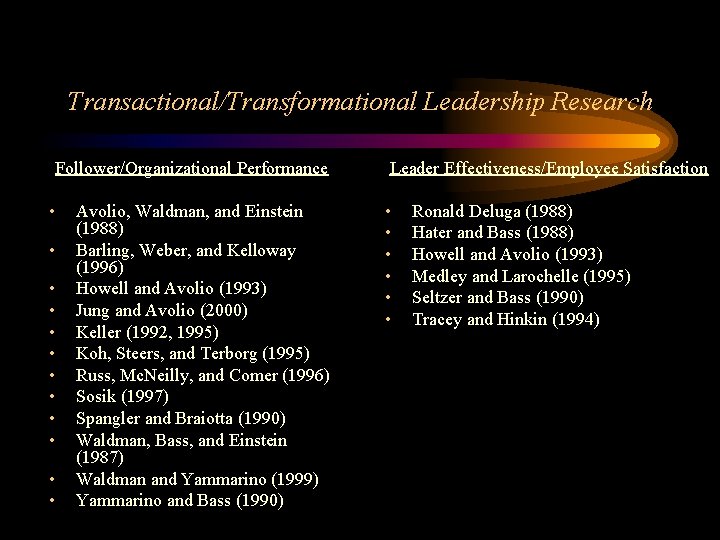
Transactional/Transformational Leadership Research Follower/Organizational Performance • • • Avolio, Waldman, and Einstein (1988) Barling, Weber, and Kelloway (1996) Howell and Avolio (1993) Jung and Avolio (2000) Keller (1992, 1995) Koh, Steers, and Terborg (1995) Russ, Mc. Neilly, and Comer (1996) Sosik (1997) Spangler and Braiotta (1990) Waldman, Bass, and Einstein (1987) Waldman and Yammarino (1999) Yammarino and Bass (1990) Leader Effectiveness/Employee Satisfaction • • • Ronald Deluga (1988) Hater and Bass (1988) Howell and Avolio (1993) Medley and Larochelle (1995) Seltzer and Bass (1990) Tracey and Hinkin (1994)
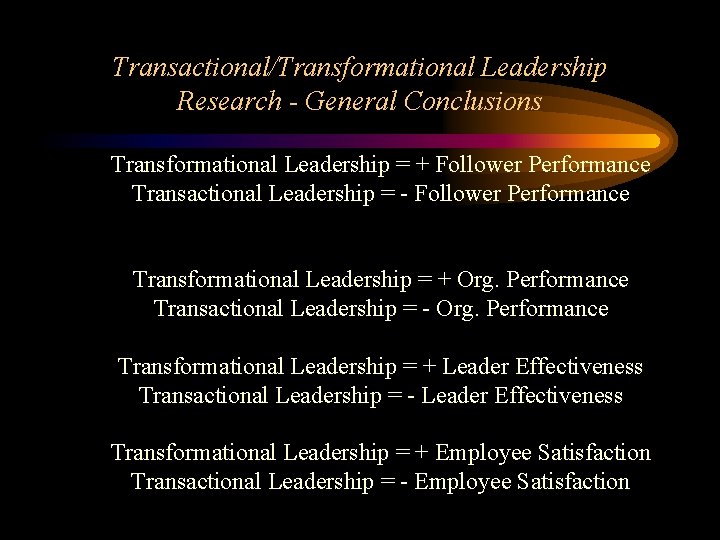
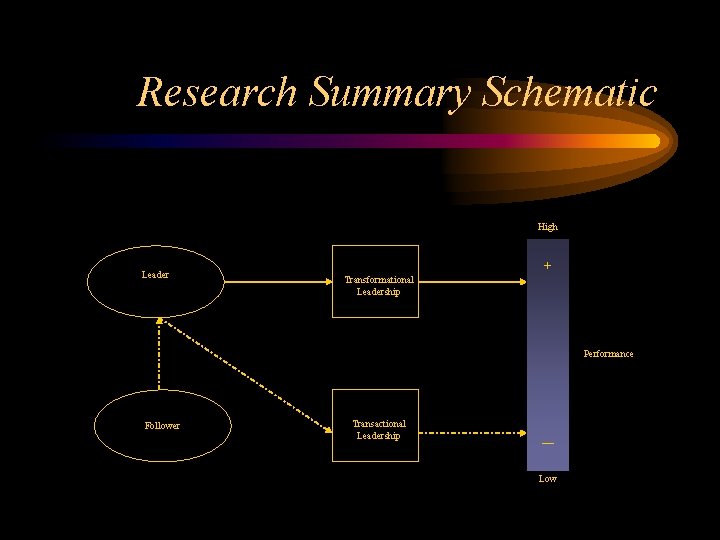
Transactional/Transformational Leadership Research - General Conclusions Transformational Leadership = + Follower Performance Transactional Leadership = - Follower Performance Transformational Leadership = + Org. Performance Transactional Leadership = - Org. Performance Transformational Leadership = + Leader Effectiveness Transactional Leadership = - Leader Effectiveness Transformational Leadership = + Employee Satisfaction Transactional Leadership = - Employee Satisfaction
Research Summary Schematic High Leader + Transformational Leadership Performance Follower Transactional Leadership Low
Multifactor Leadership Questionnaire • Developed by Bass and Avolio in 1995 • Quantifies attributes of transformational leadership - Idealized Influence [Attributed], Idealized Influence [Behavior], Inspirational Motivation, Intellectual Stimulation, and Individualized Consideration • Quantifies attributes of transactional leadership - Contingent Rewards, Management-by-Exception [Active], and Management-by-Exception Passive] • 0 to 4 rating scale
Strengths of the Transformational Approach • Widely researched from many different perspectives • Possesses an intuitive appeal • Treats leadership as a process that occurs between followers and leaders • Provides a broader view of leadership that augments other leadership models • Places strong emphasis on followers’ needs, values, and morals • Substantial evidence that transformational leadership is an effective form of leadership
Criticisms of the Transformational Approach • Lacks conceptual clarity – difficult to exactly define its parameters • Validity and reliability of the MLQ is still be established • Treats leadership as a personality trait, rather than a behavior in which people can be trained in and learn • Elitist and antidemocratic – “Heroic leadership” bias • Based primarily on qualitative data collected from leaders serving in very visible positions within organizations • Potential to be abused by the leader – changing follower values, moving in a wrong direction, etc.
Transformational Leadership and Servant Leadership
THANK YOU! GOD BLESS YOU!