
TRANSACTION PROCESSING TECHNIQUES BY SON NGUYEN VIJAY RAO
TRANSACTION PROCESSING TECHNIQUES BY SON NGUYEN VIJAY RAO
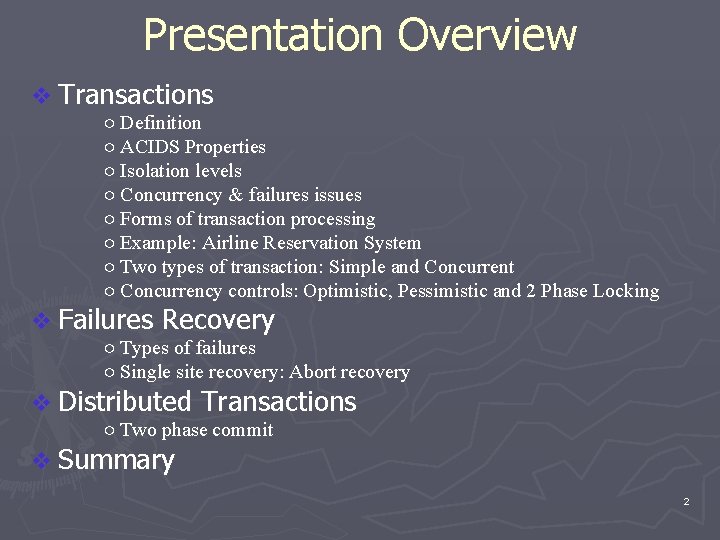
Presentation Overview v Transactions ○ Definition ○ ACIDS Properties ○ Isolation levels ○ Concurrency & failures issues ○ Forms of transaction processing ○ Example: Airline Reservation System ○ Two types of transaction: Simple and Concurrent ○ Concurrency controls: Optimistic, Pessimistic and 2 Phase Locking v Failures Recovery ○ Types of failures ○ Single site recovery: Abort recovery v Distributed Transactions ○ Two phase commit v Summary 2
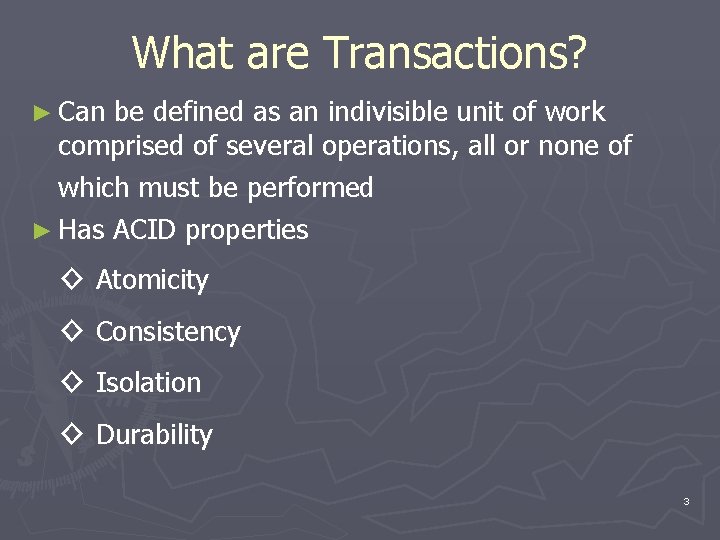
What are Transactions? ► Can be defined as an indivisible unit of work comprised of several operations, all or none of which must be performed ► Has ACID properties ◊ Atomicity ◊ Consistency ◊ Isolation ◊ Durability 3
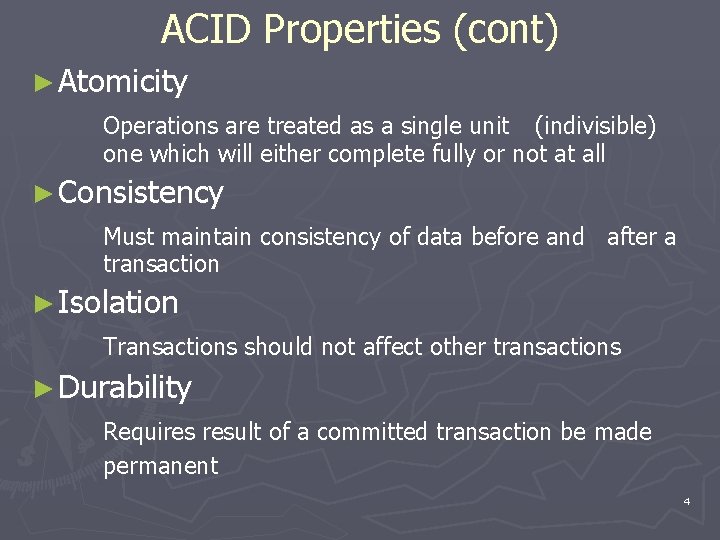
ACID Properties (cont) ► Atomicity Operations are treated as a single unit (indivisible) one which will either complete fully or not at all ► Consistency Must maintain consistency of data before and after a transaction ► Isolation Transactions should not affect other transactions ► Durability Requires result of a committed transaction be made permanent 4
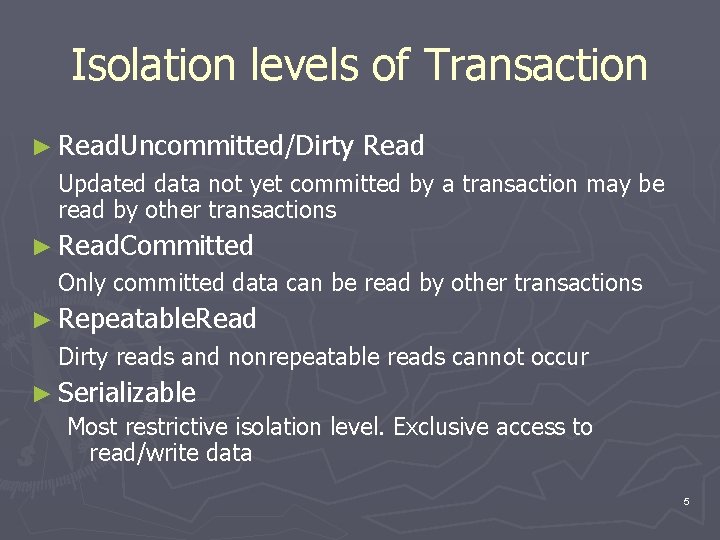
Isolation levels of Transaction ► Read. Uncommitted/Dirty Read Updated data not yet committed by a transaction may be read by other transactions ► Read. Committed Only committed data can be read by other transactions ► Repeatable. Read Dirty reads and nonrepeatable reads cannot occur ► Serializable Most restrictive isolation level. Exclusive access to read/write data 5
Why are Transactions needed? To resolve: ► Concurrency issues ◊ Race condition ◊ Inconsistent updates ► Failures issues ◊ System failures ◊ Communication failures 6
Forms of transaction processing ► Sequential specification ◊ Transactions are executed in order ◊ Do not allow concurrency ◊ Allow failures ► Concurrent specification ◊ Allow transactions to happen concurrently ◊ Record the history and the result values of operations executed by each transaction ◊ Use transaction identifiers to distinguish concurrent transaction’s operations ◊ Allow failures 7
Applications that use transactions ► Banking systems ► Airline reservation system ► Online shopping 8
Airline Reservation example (cont) ► What happens if the reservation system tries to book the same seat concurrently? ◊ Two passengers might end up with the same seat (concurrency issue) ► Invalid booking also happens if: ◊ Reservation system reads data from one of its replicated database that has not been updated due to a network failure 9
Simple Transaction ►Turn Auto. Commit off ►Execute a bunch of inserts and updates ►Commit ►If error then rollback What happens if multiple threads are running? 10
Concurrent Transactions ► Need a robust transaction processing application server with services to manage all the issues with concurrent processing ► JTA (Java transaction API) provides the API for managing transactions ► Application servers such as BEA Weblogic and IBM Websphere provide a robust implementation for transaction management 11
Concurrency Control ► Optimistic concurrency ◊ Operations are simply carried out ◊ Synchronization takes place at the end of a transaction ► Pessimistic concurrency ◊ Use Murphy’s law “If something can go wrong, it will” ◊ Operations are synchronized before they are carried out ► 2 Phase Locking ◊ An algorithm to keep transactions in sync ◊ Acquire/Release locks concept ◊ Growing phase and Shrinking phase ◊ Locks must be strong to ensure only one transaction can write at a time. Read is not allowed while writing. 12
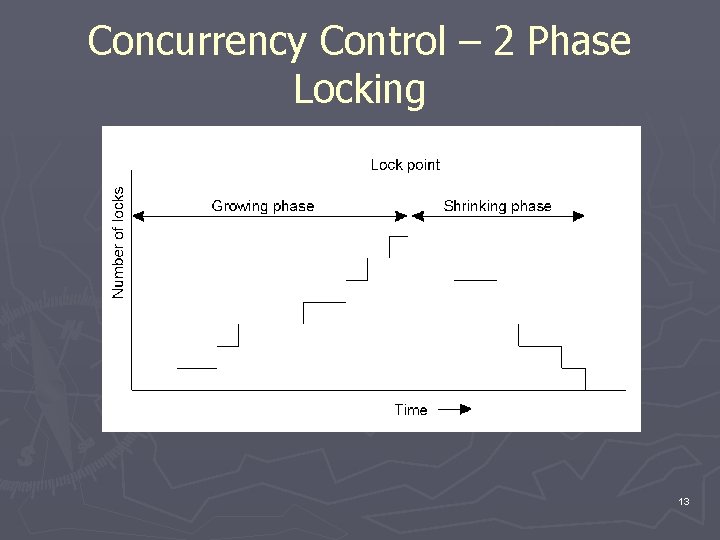
Concurrency Control – 2 Phase Locking 13
Concurrency Control – 2 Phase Locking (cont) ► Problems with 2 Phase locking ◊ Deadlocks ► Solutions? 14
Single Site Recovery ► Possible types of failures: ◊ Transaction abort ◊ System crash ◊ Media failures ◊ Catastrophe ► Possible ways of recovery ◊ Abort recovery ◊ Crash recovery 15
Single Site Recovery - Abort Recovery Two methods to recover from transaction abort: ► Update-in-place ◊ Update the database as a transaction runs and undoing updates if aborts. ◊ Actions implementation: □ Update: record old value in an undo log and update □ Read: simply just read the desired data □ Commit: discard transaction’s undo log □ Abort: use undo log to back out updates 16
Single Site Recovery - Abort Recovery (cont) ► Deferred update ◊ Saving a transaction’s updates while it runs and using the saved updates to update the database when the transaction commits. ◊ Actions implementation: □ Update: record updated value in an redo log □ Read: combine the redo log and the database □ Commit: update the database by applying redo log □ Abort: discard the transaction’s redo log ► Which method is better? 17
Single Site Recovery – Crash Recovery ► Use log to record updates, commits, and abort status ► Use log information to tell which updates belong on disk and which do not ► Abort transaction that doesn’t have a commit record in the log. 18
Distributed Transactions ► Distributed Transactions include one or more statements that individually or as a group update data at two distinct nodes in a distributed environment. ► Example of distributed transactions in Oracle UPDATE scott. dept@hq. us. acme. com SET loc = 'REDWOOD SHORES' WHERE deptno = 10; UPDATE scott. emp SET deptno = 11 WHERE deptno = 10; UPDATE scott. bldg@maint. us. acme. com SET room = 1225 WHERE room = 1163; COMMIT; 19
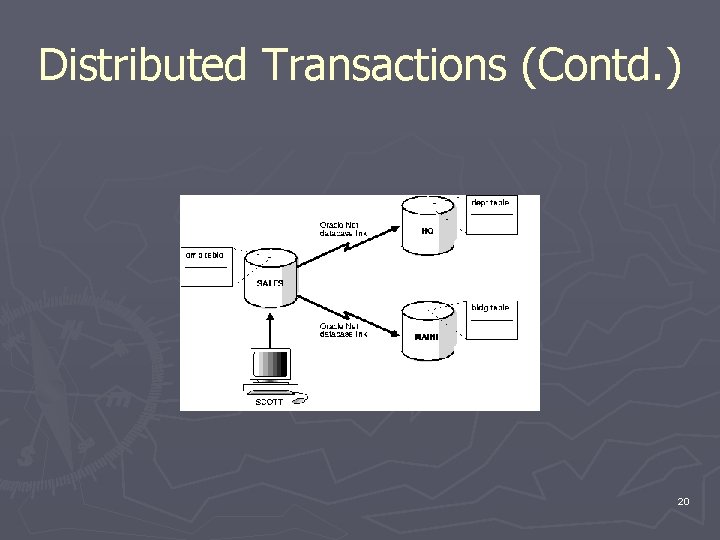
Distributed Transactions (Contd. ) 20
Distributed Transactions – 2 Phase Commit ►A distributed transaction involves altering data across multiple databases. ► Databases can be geographically located like database 1 in SFO and 2 in NYC ► This protocol ensures integrity of data ► This consists of 2 phases managed by a global co-ordinator § Prepare Phase § Commit Phase 21
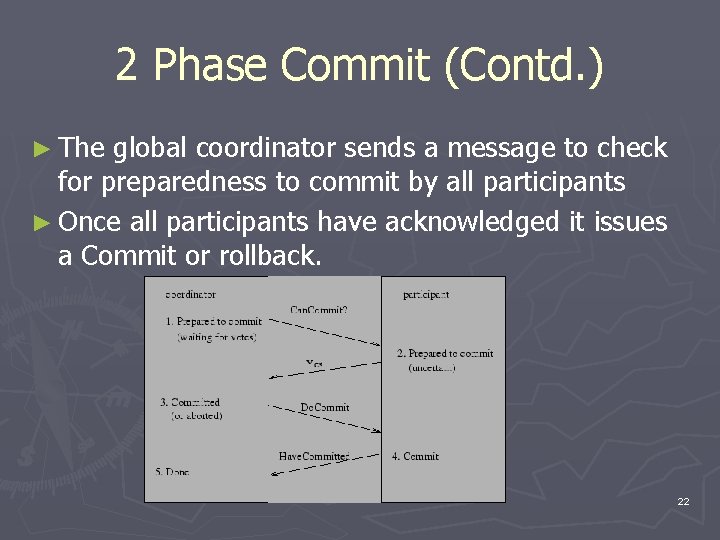
2 Phase Commit (Contd. ) ► The global coordinator sends a message to check for preparedness to commit by all participants ► Once all participants have acknowledged it issues a Commit or rollback. 22
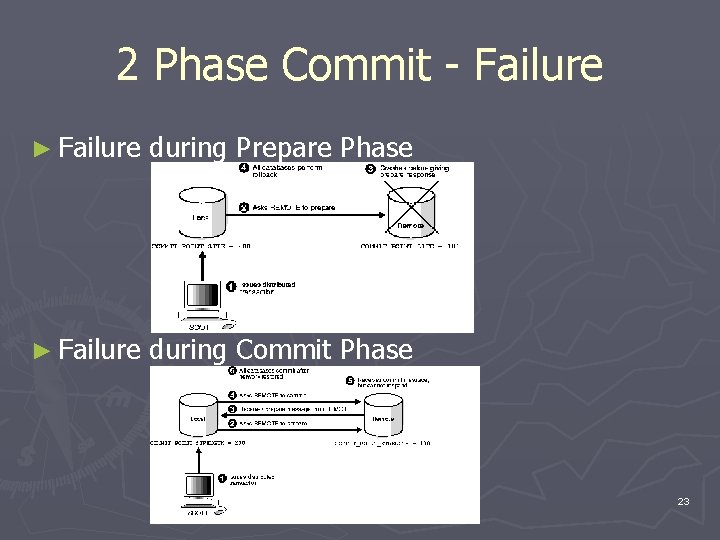
2 Phase Commit - Failure ► Failure during Prepare Phase ► Failure during Commit Phase 23
Real Life Examples ► Transactions in J 2 EE Java Transaction API (JTA) ► Enterprise Java Beans Robust and scalable component in J 2 EE architecture that can participate in transactions. ► Transaction Attributes for EJB Declarative Transaction Management Required, Requires. New, Mandatory, Supports, Not. Supported and Never 24
Nested Transactions ► Transactions within transactions ► Sub-transactions can commit but outer transaction could rollback…? ► Complex Issues! ► Not supported by J 2 EE and hence JDBC! ► Only flat transactions are supported 25
Summary ► Transactions are important ► Transactions in a distributed environment are much more complex compare to a single site transactions ► Must handle transactions appropriately ► Failed to recovery a transaction might cause a lot of troubles 26
Bibliography http: //www. javaworld. com/javaworld/jw-07 -2000/jw-0714 transaction. html ► http: //www. mssqlcity. com/Articles/General/TIL. html ► http: //www. cse. scu. edu/~jholliday/transproc. html ► http: //www. ietf. org/rfc 2371. txt ► http: //www. cs. umb. edu/cs 634/ora 9 idocs/server. 920/a 9652 1/ds_txns. htm ► http: //www. cogs. susx. ac. uk/users/ianw/teach/dist-sys/dsnode 246. html ► Distributed Systems: Principles and Paradigms by Tanenbaum and Van Steen ► 27
Q&A ► Q&A 28
- Slides: 28