
Transaction Level Modeling An Overview Daniel Gajski Lukai
- Slides: 22
Transaction Level Modeling: An Overview Daniel Gajski Lukai Center for Embedded Computer Systems University of California, Irvine www. cecs. uci. edu/~{gajski, lcai} Copyright Ó 2003 Dan Gajski and Lukai Cai
Acknowledgement We would like to thank transaction level team at CECS that has contributed many ideas through numerous lunch discussions: Samar Abdi Rainer Doemer Andreas Gerstlauer Junyu Peng Dongwan Shin Haobo Yu Copyright Ó 2003 Dan Gajski and Lukai Cai 2
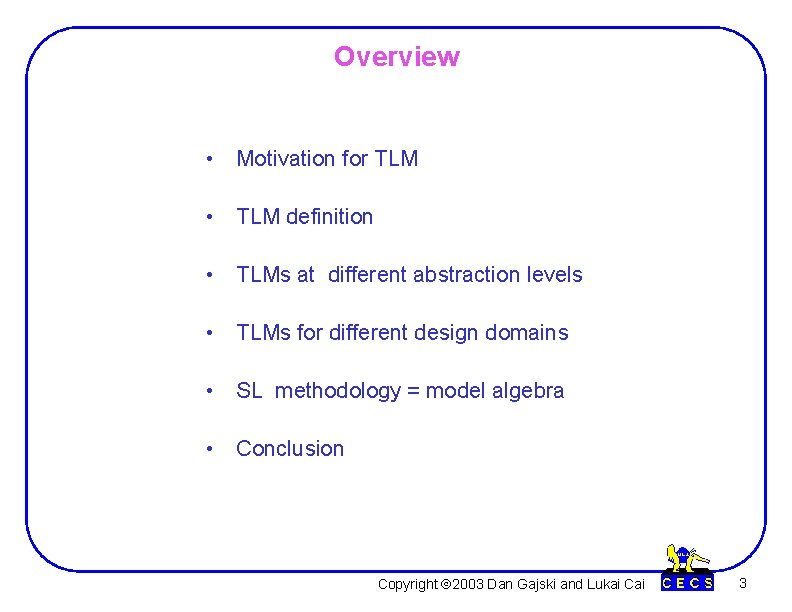
Overview • Motivation for TLM • TLM definition • TLMs at different abstraction levels • TLMs for different design domains • SL methodology = model algebra • Conclusion Copyright Ó 2003 Dan Gajski and Lukai Cai 3
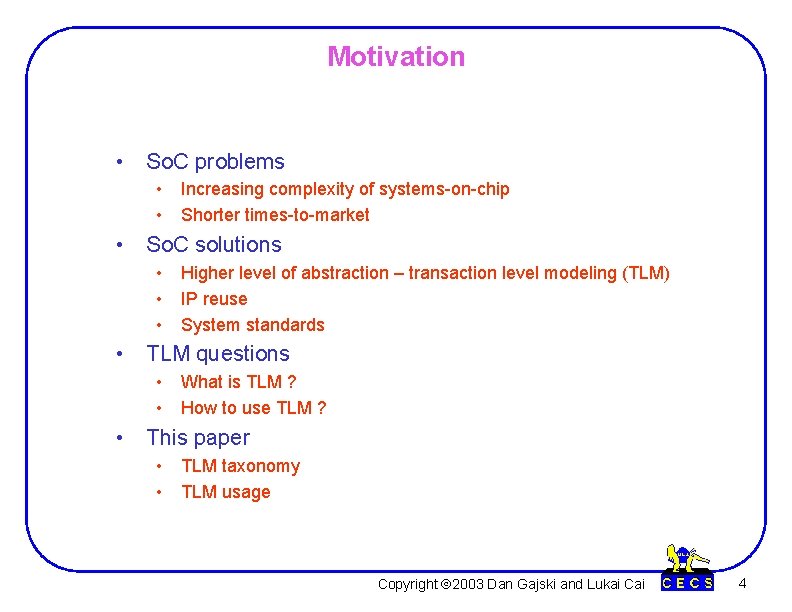
Motivation • So. C problems • • Increasing complexity of systems-on-chip Shorter times-to-market • So. C solutions • • • Higher level of abstraction – transaction level modeling (TLM) IP reuse System standards • TLM questions • • What is TLM ? How to use TLM ? • This paper • • TLM taxonomy TLM usage Copyright Ó 2003 Dan Gajski and Lukai Cai 4
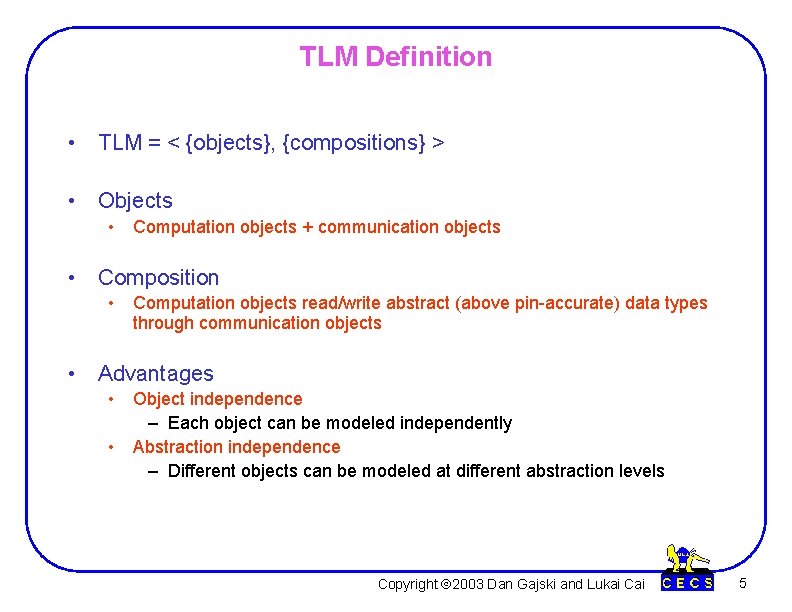
TLM Definition • TLM = < {objects}, {compositions} > • Objects • Computation objects + communication objects • Composition • Computation objects read/write abstract (above pin-accurate) data types through communication objects • Advantages • • Object independence – Each object can be modeled independently Abstraction independence – Different objects can be modeled at different abstraction levels Copyright Ó 2003 Dan Gajski and Lukai Cai 5
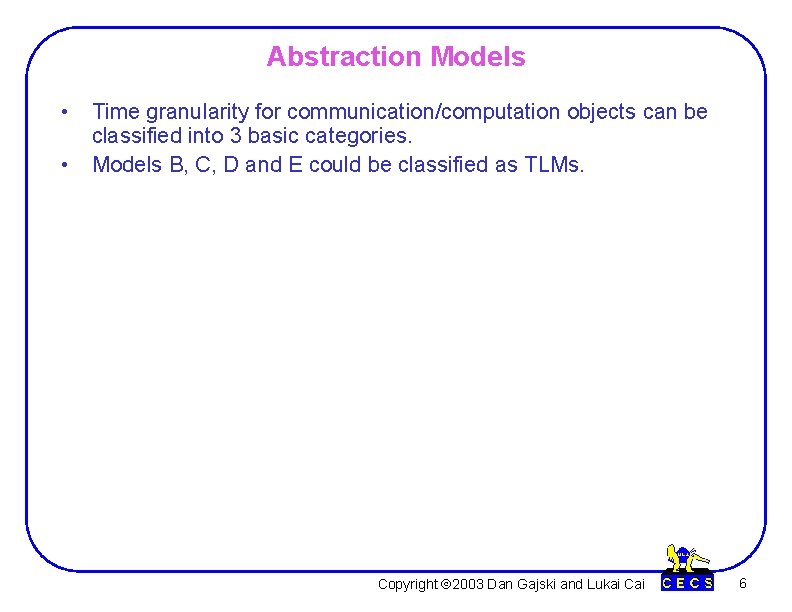
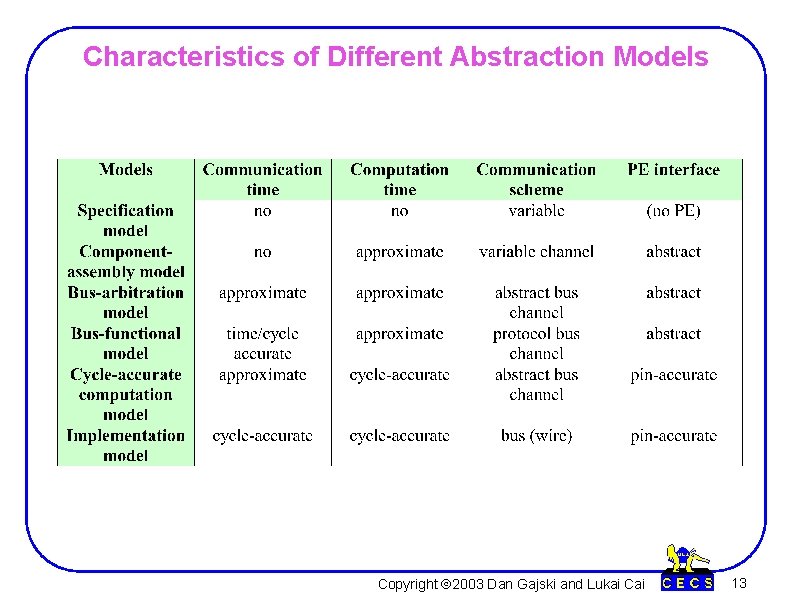
Abstraction Models • Time granularity for communication/computation objects can be classified into 3 basic categories. • Models B, C, D and E could be classified as TLMs. Copyright Ó 2003 Dan Gajski and Lukai Cai 6
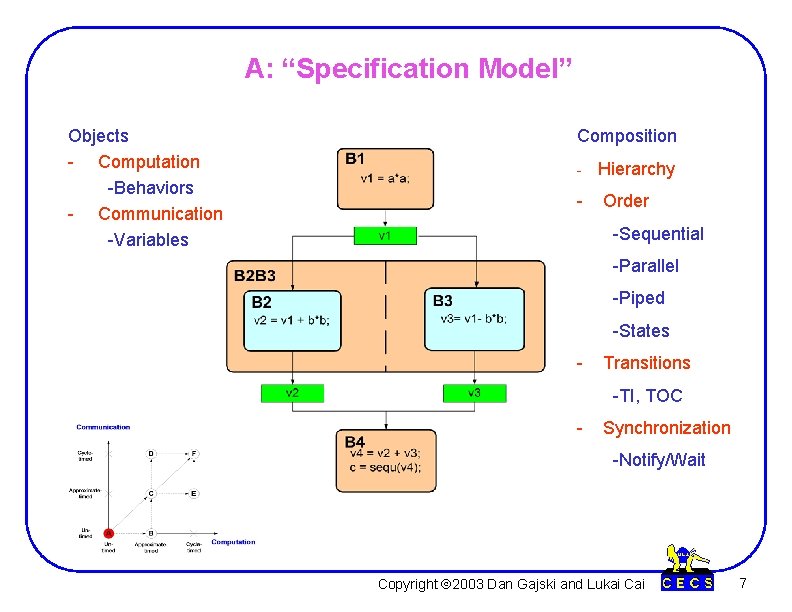
A: “Specification Model” Objects - Computation -Behaviors - Communication -Variables Composition - - Hierarchy Order -Sequential -Parallel -Piped -States - Transitions -TI, TOC - Synchronization -Notify/Wait Copyright Ó 2003 Dan Gajski and Lukai Cai 7
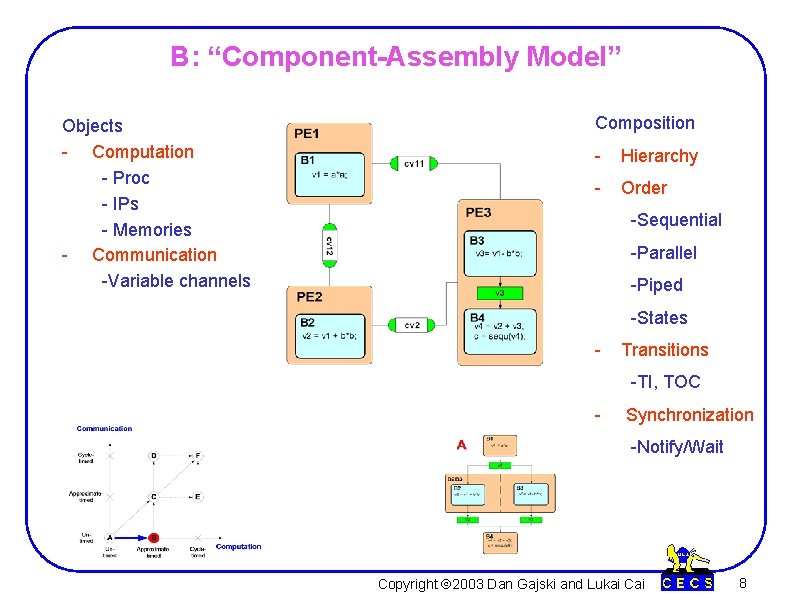
B: “Component-Assembly Model” Objects - Computation - Proc - IPs - Memories - Communication -Variable channels Composition - Hierarchy - Order -Sequential -Parallel -Piped -States - Transitions -TI, TOC - Synchronization -Notify/Wait Copyright Ó 2003 Dan Gajski and Lukai Cai 8
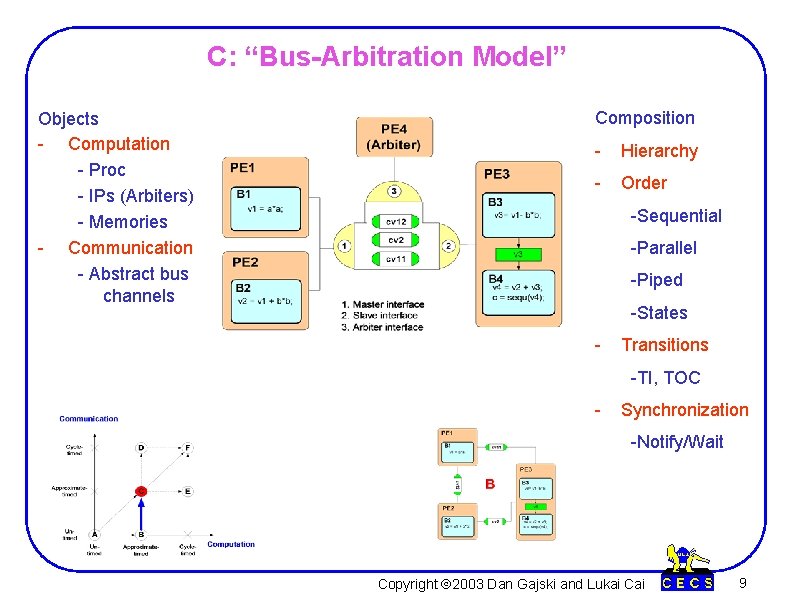
C: “Bus-Arbitration Model” Objects - Computation - Proc - IPs (Arbiters) - Memories - Communication - Abstract bus channels Composition - Hierarchy - Order -Sequential -Parallel -Piped -States - Transitions -TI, TOC - Synchronization -Notify/Wait Copyright Ó 2003 Dan Gajski and Lukai Cai 9
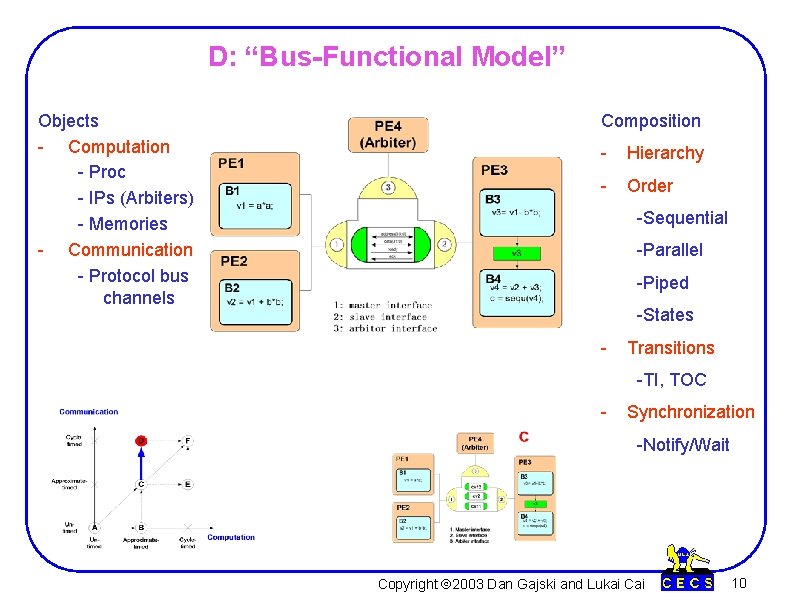
D: “Bus-Functional Model” Objects - Computation - Proc - IPs (Arbiters) - Memories - Communication - Protocol bus channels Composition - Hierarchy - Order -Sequential -Parallel -Piped -States - Transitions -TI, TOC - Synchronization -Notify/Wait Copyright Ó 2003 Dan Gajski and Lukai Cai 10
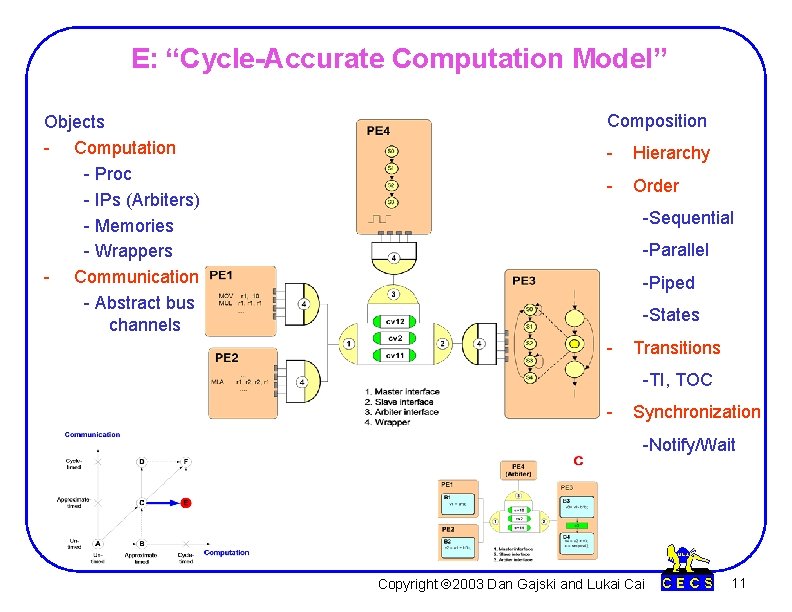
E: “Cycle-Accurate Computation Model” Objects - Computation - Proc - IPs (Arbiters) - Memories - Wrappers - Communication - Abstract bus channels Composition - Hierarchy - Order -Sequential -Parallel -Piped -States - Transitions -TI, TOC - Synchronization -Notify/Wait Copyright Ó 2003 Dan Gajski and Lukai Cai 11
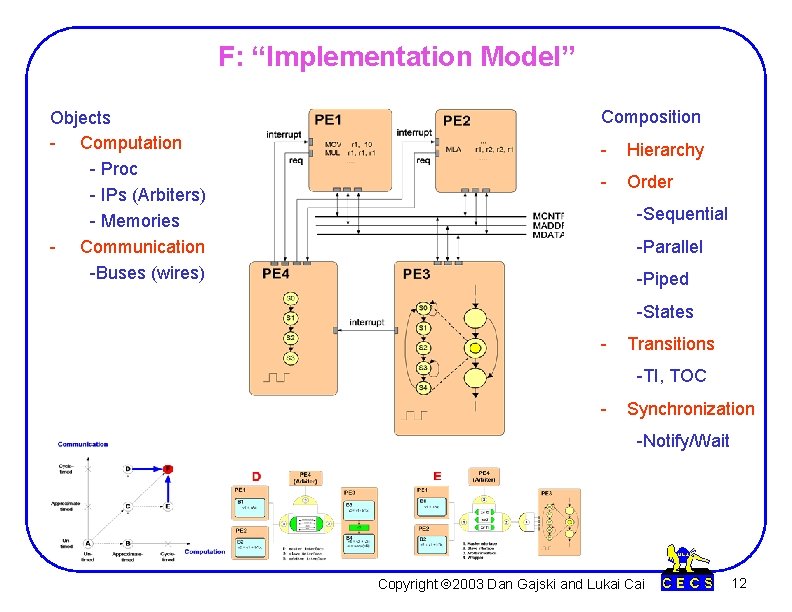
F: “Implementation Model” Objects - Computation - Proc - IPs (Arbiters) - Memories - Communication -Buses (wires) Composition - Hierarchy - Order -Sequential -Parallel -Piped -States - Transitions -TI, TOC - Synchronization -Notify/Wait Copyright Ó 2003 Dan Gajski and Lukai Cai 12
Characteristics of Different Abstraction Models Copyright Ó 2003 Dan Gajski and Lukai Cai 13
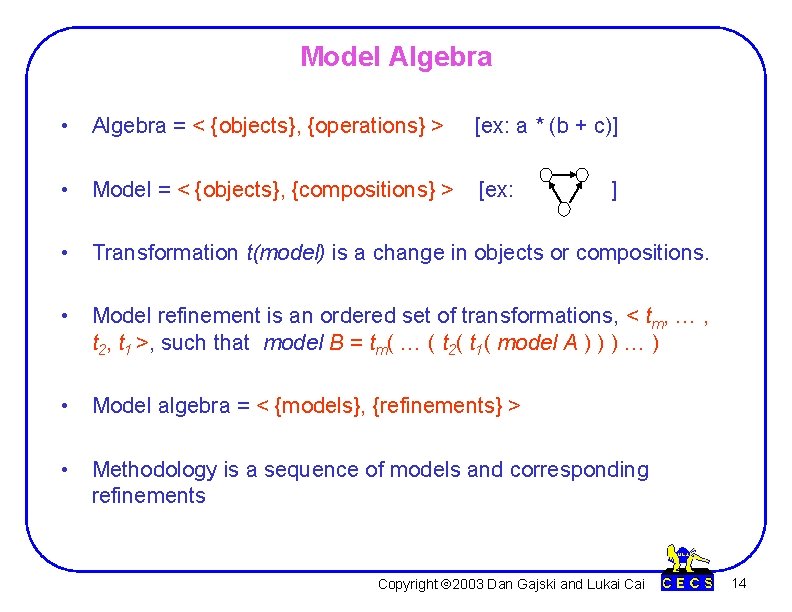
Model Algebra • Algebra = < {objects}, {operations} > [ex: a * (b + c)] • Model = < {objects}, {compositions} > [ex: ] • Transformation t(model) is a change in objects or compositions. • Model refinement is an ordered set of transformations, < tm, … , t 2, t 1 >, such that model B = tm( … ( t 2( t 1( model A ) ) ) … ) • Model algebra = < {models}, {refinements} > • Methodology is a sequence of models and corresponding refinements Copyright Ó 2003 Dan Gajski and Lukai Cai 14
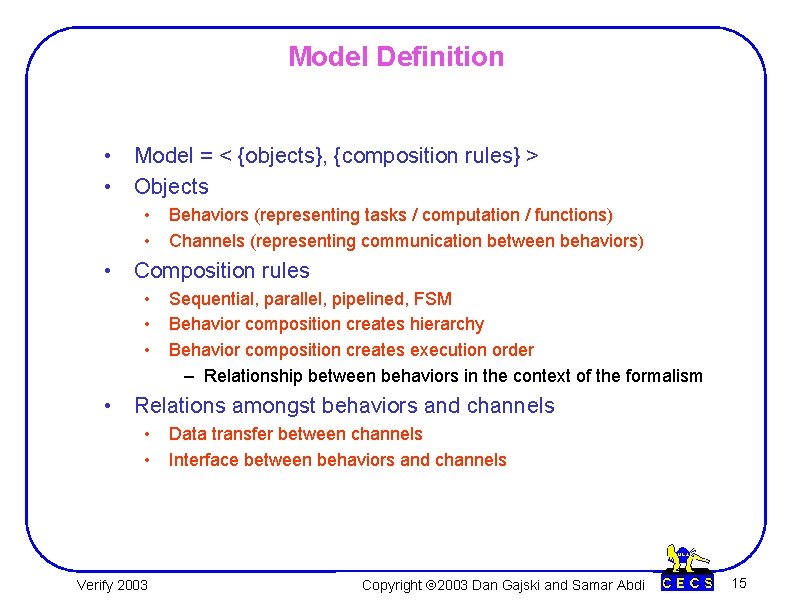
Model Definition • Model = < {objects}, {composition rules} > • Objects • • Behaviors (representing tasks / computation / functions) Channels (representing communication between behaviors) • Composition rules • • • Sequential, parallel, pipelined, FSM Behavior composition creates hierarchy Behavior composition creates execution order – Relationship between behaviors in the context of the formalism • Relations amongst behaviors and channels • • Verify 2003 Data transfer between channels Interface between behaviors and channels Copyright Ó 2003 Dan Gajski and Lukai. Abdi Cai Copyright Ó 2003 Dan Gajski and Samar 15
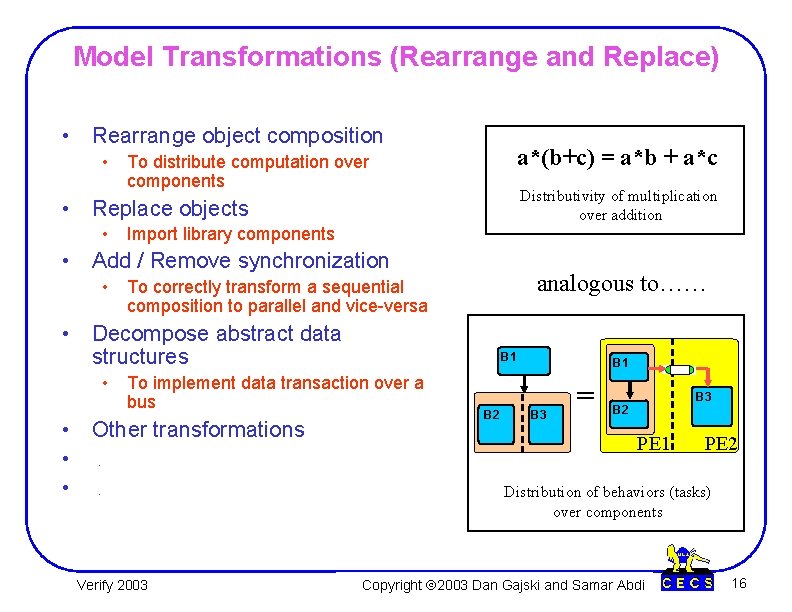
Model Transformations (Rearrange and Replace) • Rearrange object composition • a*(b+c) = a*b + a*c To distribute computation over components Distributivity of multiplication over addition • Replace objects • Import library components • Add / Remove synchronization • analogous to…… To correctly transform a sequential composition to parallel and vice-versa • Decompose abstract data structures • B 1 To implement data transaction over a bus • Other transformations • • B 2 B 1 B 3 = B 3 B 2 PE 1 PE 2 . . Verify 2003 Distribution of behaviors (tasks) over components Copyright Ó 2003 Dan Gajski and Lukai. Abdi Cai Copyright Ó 2003 Dan Gajski and Samar 16
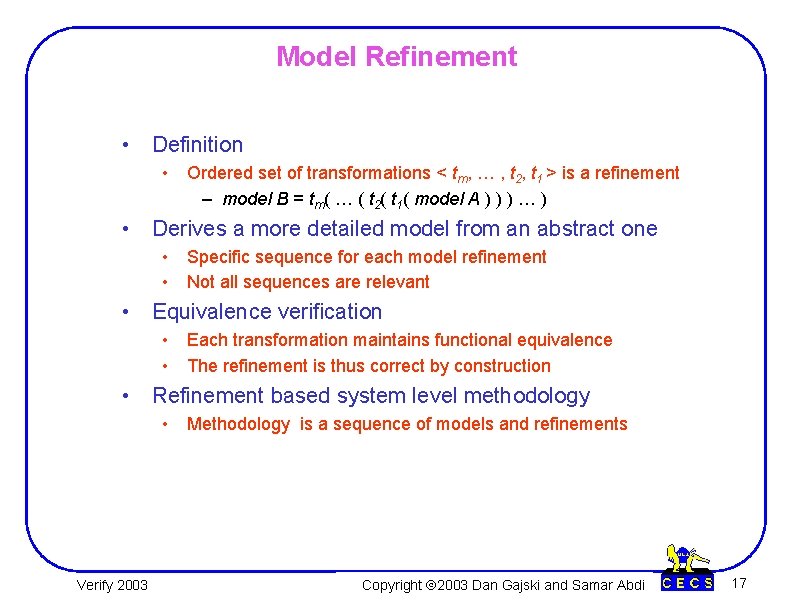
Model Refinement • Definition • Ordered set of transformations < tm, … , t 2, t 1 > is a refinement – model B = tm( … ( t 2( t 1( model A ) ) ) … ) • Derives a more detailed model from an abstract one • • Specific sequence for each model refinement Not all sequences are relevant • Equivalence verification • • Each transformation maintains functional equivalence The refinement is thus correct by construction • Refinement based system level methodology • Verify 2003 Methodology is a sequence of models and refinements Copyright Ó 2003 Dan Gajski and Lukai. Abdi Cai Copyright Ó 2003 Dan Gajski and Samar 17
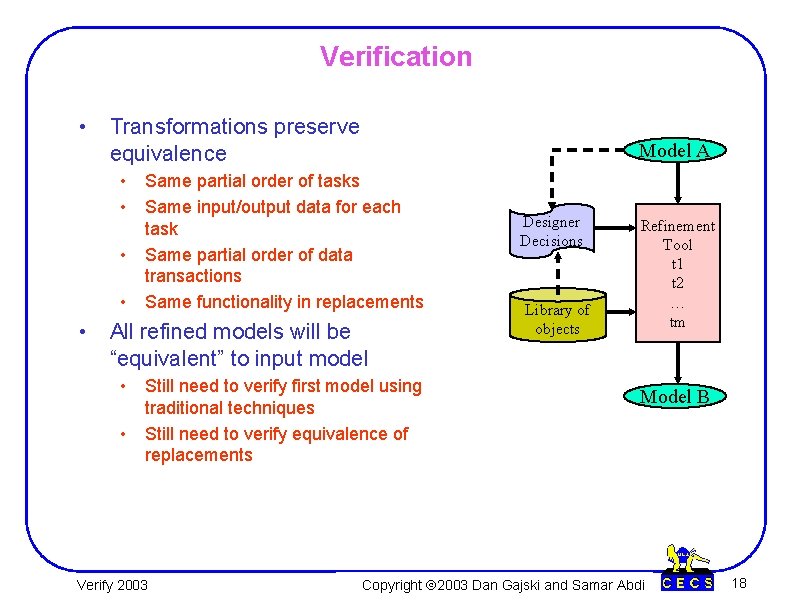
Verification • Transformations preserve equivalence • • Model A Same partial order of tasks Same input/output data for each task Same partial order of data transactions Same functionality in replacements • All refined models will be “equivalent” to input model • • Still need to verify first model using traditional techniques Still need to verify equivalence of replacements Verify 2003 Designer Decisions Library of objects Refinement Tool t 1 t 2 … tm Model B Copyright Ó 2003 Dan Gajski and Lukai. Abdi Cai Copyright Ó 2003 Dan Gajski and Samar 18
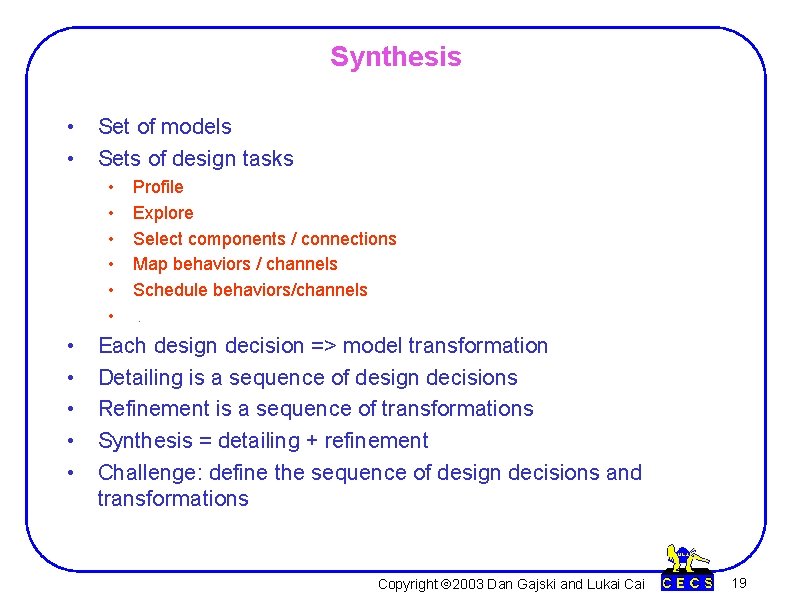
Synthesis • Set of models • Sets of design tasks • • • Profile Explore Select components / connections Map behaviors / channels Schedule behaviors/channels. Each design decision => model transformation Detailing is a sequence of design decisions Refinement is a sequence of transformations Synthesis = detailing + refinement Challenge: define the sequence of design decisions and transformations Copyright Ó 2003 Dan Gajski and Lukai Cai 19
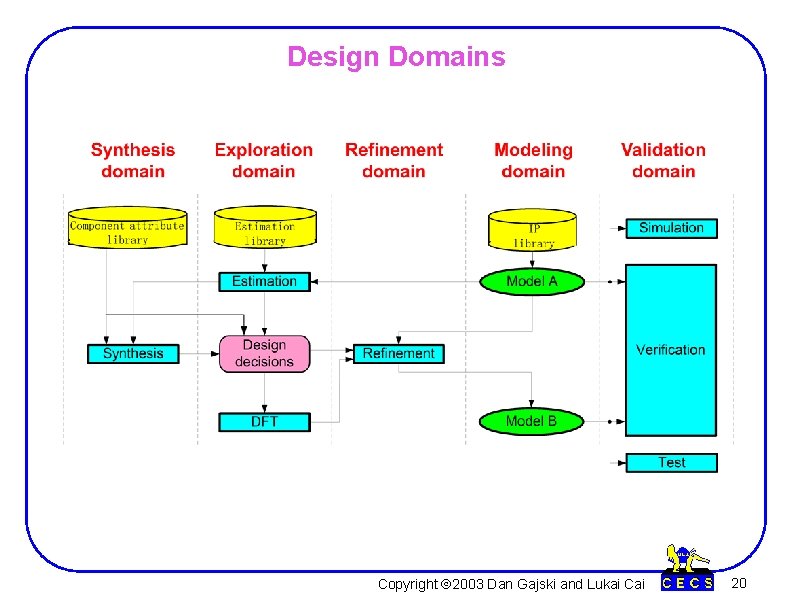
Design Domains Copyright Ó 2003 Dan Gajski and Lukai Cai 20
SCE Experiment is Very Positive Source: http: //www. cecs. uci. edu/~cad/sce. html Copyright Ó 2003 Dan Gajski and Lukai Cai 21
Conclusion • Computation and communication objects of TLM are connected through abstract data types • TLM enables modeling each component independently at different abstraction levels • The major challenge is to define necessary and sufficient set of models for a design flow • The next major challenge is to define model algebra and corresponding methodology for each application such that algorithms and tools for modeling, verification, exploration, synthesis and test can be easily developed • Opportunities are bigger than anything seen before Copyright Ó 2003 Dan Gajski and Lukai Cai 22