
Transaction And Concurrency Control Bhavya Kilari Dr Yanqing
Transaction And Concurrency Control -Bhavya Kilari Dr. Yanqing Zhang, CSc 8320
PREVIEW � PART I: INTRODUCTION o Transaction Processing System [R. Chow & T. Johnson, 1997] o Serializability [M. Duckett, 1995] o Concurrency Control Protocols � PART II: CURRENT RESEARCH o o � ZODB[zope cor, Wikipedia, 2009] Muntiversion Concurrency Control (MVCC) PART III: FUTURE POTENTIAL o RWC [Andrews, 2009] o Dynamic Switching � REFERENCES
Transaction Processing �Motivation : to make use of clean and powerful atomic transaction semantics (ACID Properties)
![Distributed Transaction Processing System[1]](http://slidetodoc.com/presentation_image_h/c8c2df895f4e4c1230a5e913a648f759/image-4.jpg "Distributed Transaction Processing System[1]")
Distributed Transaction Processing System[1]
Atomicity �All or None - Two-Phase Commit �Indivisible – SCH Concurrency Control Protocol �Atomic update – OM Replica Management
![Transaction Processing System[1] o Client Process: �Issue a begin transaction �Is at liberty to](http://slidetodoc.com/presentation_image_h/c8c2df895f4e4c1230a5e913a648f759/image-6.jpg "Transaction Processing System[1] o Client Process: �Issue a begin transaction �Is at liberty to")
Transaction Processing System[1] o Client Process: �Issue a begin transaction �Is at liberty to abort Tr anytime �Issues end transaction o Transaction Manager (TM) �Creates TID and work space �Access request to data object carries TID sent to scheduler �Rejection causes TM to send abort to the client and other TMs �COMMIT must be atomic: two phase commit protocol
o Scheduler (SCH) �Chooses a concurrency control protocol to ensure consistency �Inconsistency can be prevented or avoided or consistency can be validated o Object Manager (OM) �Interfacing with underlying file service �Consistency of replicas using replica management protocol �Cache management for efficiency and failure recover for durability.
Serializability �Schedule: set of actions of transactions �Serial Schedule: serial execution of actions of set of transactions �Serializable schedule: �Serializability ensures consistency �Conflicts: write-write, read-write or write-read
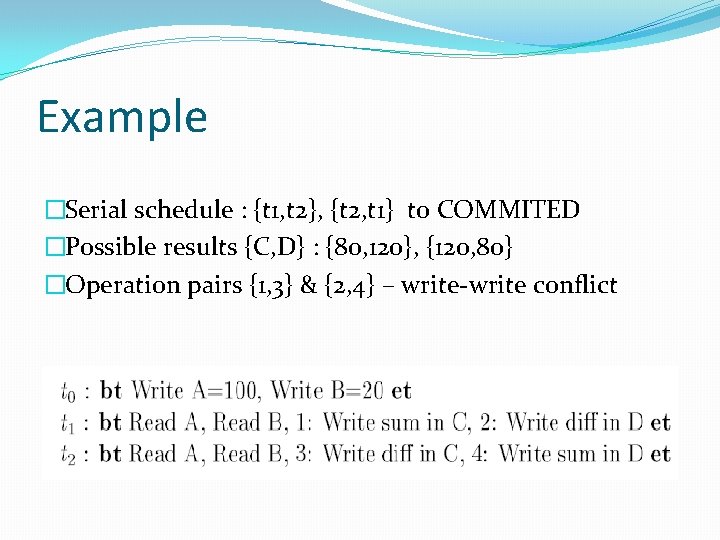
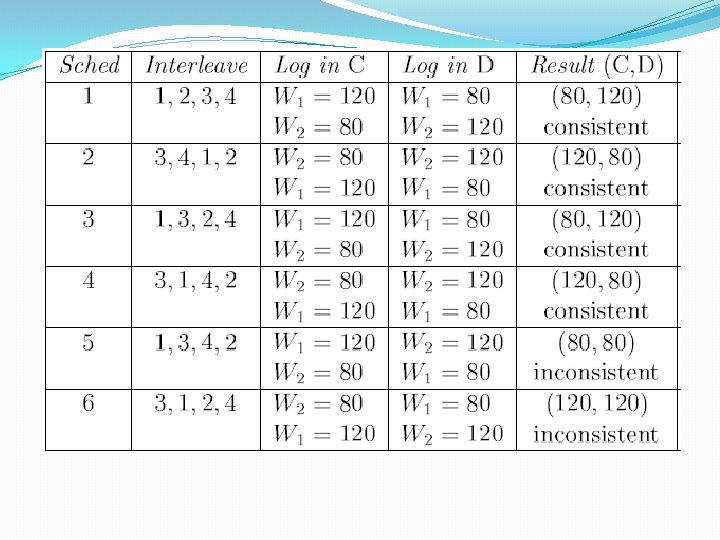
Example �Serial schedule : {t 1, t 2}, {t 2, t 1} t 0 COMMITED �Possible results {C, D} : {80, 120}, {120, 80} �Operation pairs {1, 3} & {2, 4} – write-write conflict
![Concurrency Control Protocols[1] o Two-Phase Locking o Timestamp Ordering o Optimistic Concurrency Control](http://slidetodoc.com/presentation_image_h/c8c2df895f4e4c1230a5e913a648f759/image-11.jpg "Concurrency Control Protocols[1] o Two-Phase Locking o Timestamp Ordering o Optimistic Concurrency Control")
Concurrency Control Protocols[1] o Two-Phase Locking o Timestamp Ordering o Optimistic Concurrency Control
![Dining Philosophers Problem[4] �“Common computing problem in concurrency”](http://slidetodoc.com/presentation_image_h/c8c2df895f4e4c1230a5e913a648f759/image-12.jpg "Dining Philosophers Problem[4] �“Common computing problem in concurrency”")
Dining Philosophers Problem[4] �“Common computing problem in concurrency”
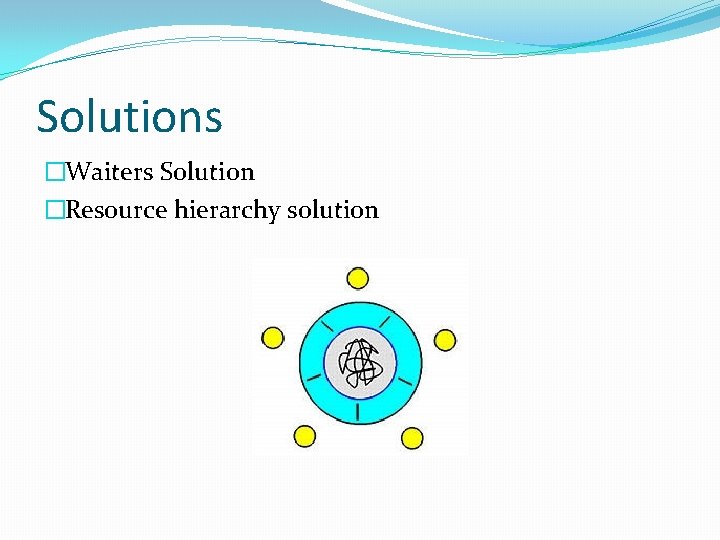
Solutions �Waiters Solution �Resource hierarchy solution
![Zope Object Database(ZODB) [9, 10] �Object-oriented database for transparently and persistently storing objects �Features](http://slidetodoc.com/presentation_image_h/c8c2df895f4e4c1230a5e913a648f759/image-14.jpg "Zope Object Database(ZODB) [9, 10] �Object-oriented database for transparently and persistently storing objects �Features")
Zope Object Database(ZODB) [9, 10] �Object-oriented database for transparently and persistently storing objects �Features of the ZODB include: transactions, history/undo, transparently pluggable storage, builtin caching, multiversion concurrency control (MVCC), and scalability across a network (using ZEO). �Speed , ease of use and administration
![Multiversion Concurrency Control[2, 3] �Each user connected to the database with a snapshot �Changes](http://slidetodoc.com/presentation_image_h/c8c2df895f4e4c1230a5e913a648f759/image-15.jpg "Multiversion Concurrency Control[2, 3] �Each user connected to the database with a snapshot �Changes")
Multiversion Concurrency Control[2, 3] �Each user connected to the database with a snapshot �Changes seen by other users only after the transaction COMMITS �MVCC uses timestamps or increasing transaction IDs to achieve serializability �Microsoft SQL Server, My. SQL, Oracle, Sybase SQL etc uses MVCC
![Concurrency Control Mechanisms[3] �Basic criteria: 1. Degree of Concurrency provided 2. Potential for deadlocks](http://slidetodoc.com/presentation_image_h/c8c2df895f4e4c1230a5e913a648f759/image-16.jpg "Concurrency Control Mechanisms[3] �Basic criteria: 1. Degree of Concurrency provided 2. Potential for deadlocks")
Concurrency Control Mechanisms[3] �Basic criteria: 1. Degree of Concurrency provided 2. Potential for deadlocks 3. Level of Consistency guaranteed
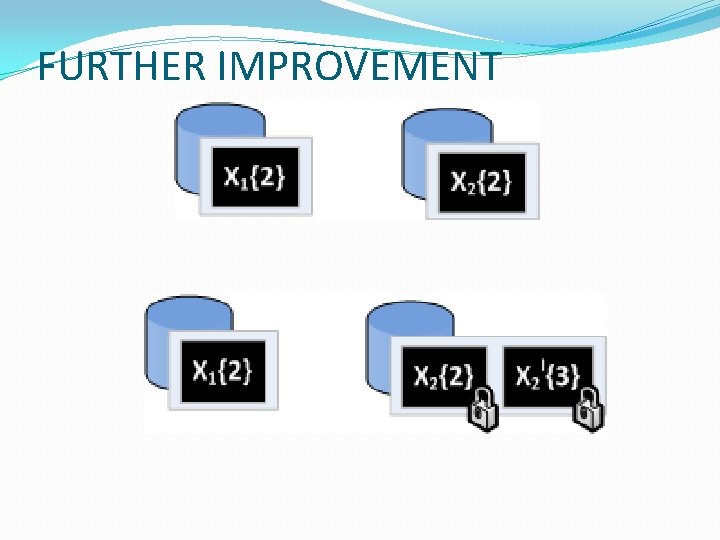
![Design Of Concurrency Control Mechanisms-RWC [6] �Read-write-certify (RWC)](http://slidetodoc.com/presentation_image_h/c8c2df895f4e4c1230a5e913a648f759/image-17.jpg "Design Of Concurrency Control Mechanisms-RWC [6] �Read-write-certify (RWC)")
Design Of Concurrency Control Mechanisms-RWC [6] �Read-write-certify (RWC)
FURTHER IMPROVEMENT
![New Proposal[5] �Dynamically switching between different types of concurrency control techniques to provide an](http://slidetodoc.com/presentation_image_h/c8c2df895f4e4c1230a5e913a648f759/image-19.jpg "New Proposal[5] �Dynamically switching between different types of concurrency control techniques to provide an")
New Proposal[5] �Dynamically switching between different types of concurrency control techniques to provide an adaptive access strategy[5]
REVIEW �TPS AND ITS COMPONENTS �SERIALIZABILITY �CONCURRENCY CONTROL �LATEST TECHNIQUES (Zope ODB, MVCC)
![REFERENCES [1]Distributed Operating Systems and Algorithm Analysis, Andy Chow & Theodore Johnson, 1997 [2]Wikipedia](http://slidetodoc.com/presentation_image_h/c8c2df895f4e4c1230a5e913a648f759/image-21.jpg "REFERENCES [1]Distributed Operating Systems and Algorithm Analysis, Andy Chow & Theodore Johnson, 1997 [2]Wikipedia")
REFERENCES [1]Distributed Operating Systems and Algorithm Analysis, Andy Chow & Theodore Johnson, 1997 [2]Wikipedia [3]Bernstein, Philip A. and Goodman, Nathan (1981), Concurrency Control in Distributed Database Systems, ACM Computing Surveys [4]Chandy, K. M. ; Misra, J. (1984). The Drinking Philosophers Problem. ACM Transactions on Programming Languages and Systems. [5]http: //www. patentstorm. us/patents
![[6]http: //blogs. cs. st-andrews. ac. uk/angus/2009/09/ [7]A. S. Tanenbaum, “Distributed Operating Systems”, Prentice Hall,](http://slidetodoc.com/presentation_image_h/c8c2df895f4e4c1230a5e913a648f759/image-22.jpg "[6]http: //blogs. cs. st-andrews. ac. uk/angus/2009/09/ [7]A. S. Tanenbaum, “Distributed Operating Systems”, Prentice Hall,")
[6]http: //blogs. cs. st-andrews. ac. uk/angus/2009/09/ [7]A. S. Tanenbaum, “Distributed Operating Systems”, Prentice Hall, pp. 22 -25, 2001. [8] “The Two-Phase Commit Protocol”, Mike Duckett, http: //ei. cs. vt. edu/~cs 5204/ sp 99/distributed. DBMS/duckett/tpcp. html, 4 -30 -1995. [9]http: //en. wikipedia. org/wiki/Zope_Object_Database [10] http: //www. zope. org/

QUERIES? ?
- Slides: 23