
Traits of economic importance in dairy cattle v

- Slides: 19
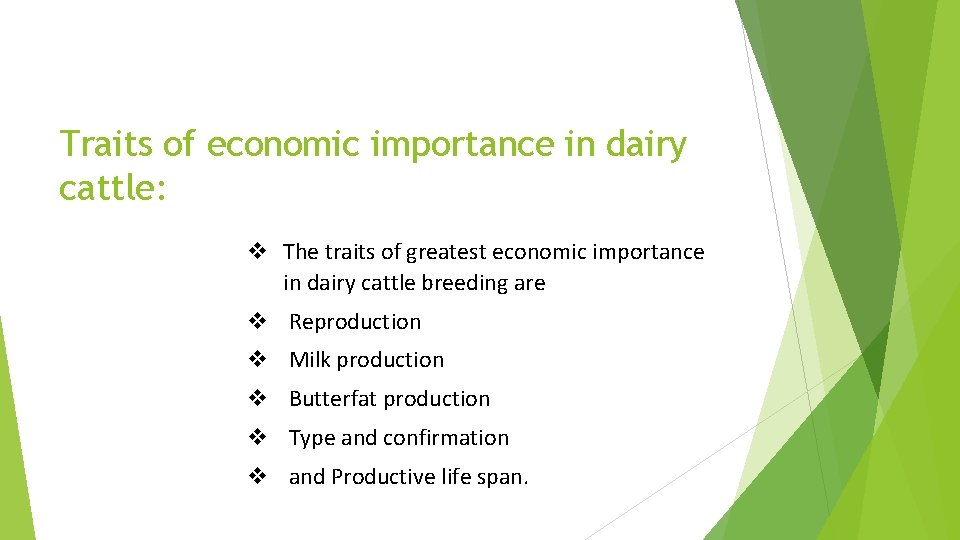
Traits of economic importance in dairy cattle: v The traits of greatest economic importance in dairy cattle breeding are v Reproduction v Milk production v Butterfat production v Type and confirmation v and Productive life span.
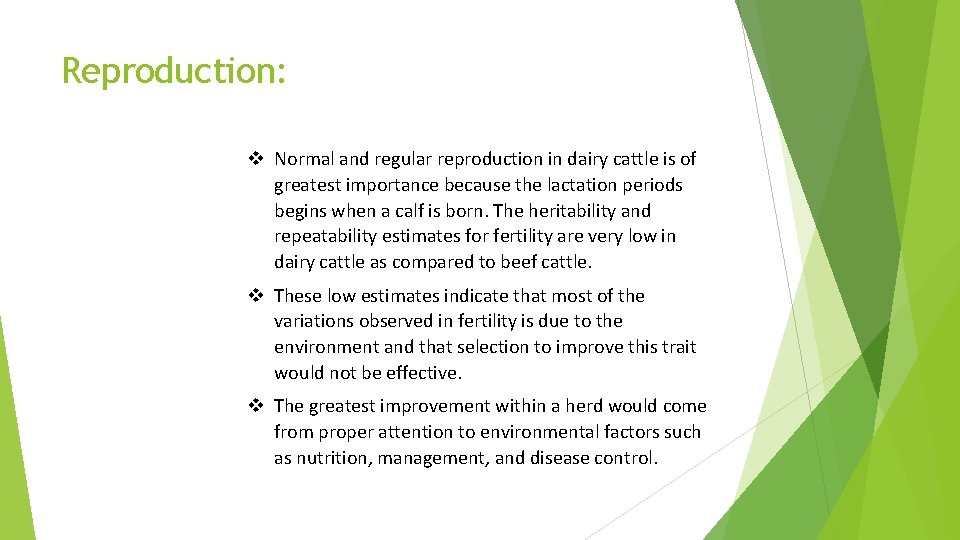
Reproduction: v Normal and regular reproduction in dairy cattle is of greatest importance because the lactation periods begins when a calf is born. The heritability and repeatability estimates for fertility are very low in dairy cattle as compared to beef cattle. v These low estimates indicate that most of the variations observed in fertility is due to the environment and that selection to improve this trait would not be effective. v The greatest improvement within a herd would come from proper attention to environmental factors such as nutrition, management, and disease control.
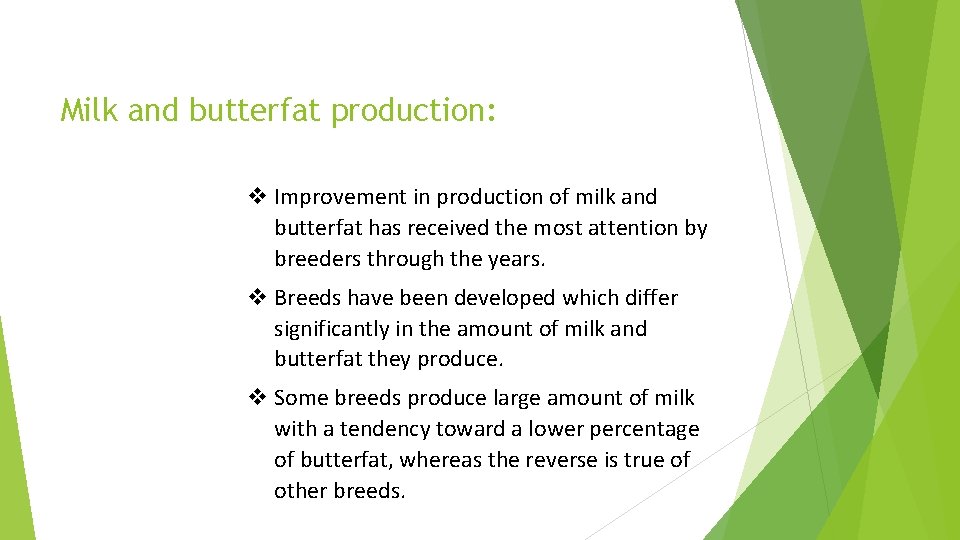
Milk and butterfat production: v Improvement in production of milk and butterfat has received the most attention by breeders through the years. v Breeds have been developed which differ significantly in the amount of milk and butterfat they produce. v Some breeds produce large amount of milk with a tendency toward a lower percentage of butterfat, whereas the reverse is true of other breeds.
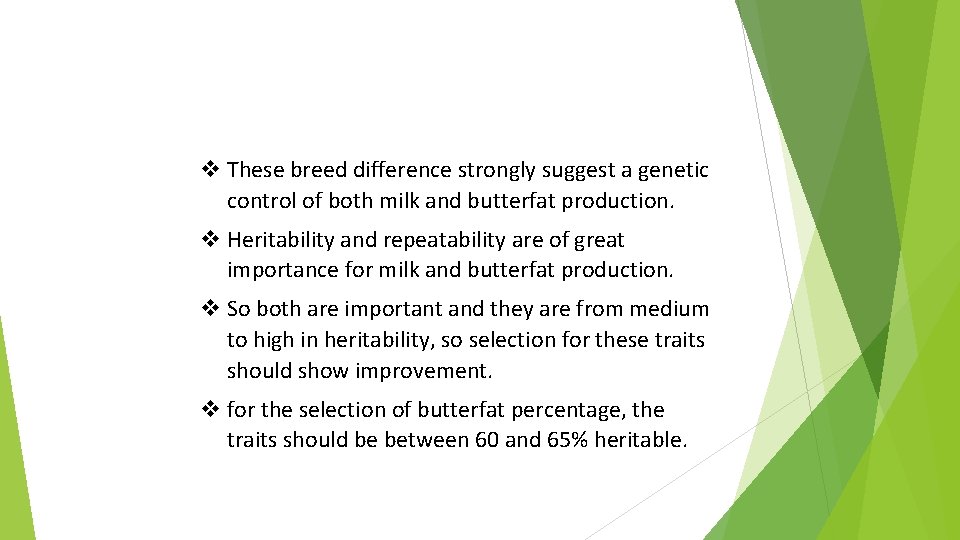
v These breed difference strongly suggest a genetic control of both milk and butterfat production. v Heritability and repeatability are of great importance for milk and butterfat production. v So both are important and they are from medium to high in heritability, so selection for these traits should show improvement. v for the selection of butterfat percentage, the traits should be between 60 and 65% heritable.
Measurement of milk and butterfat production: v Several non-genetic factors are known to cause variations in the production record of dairy cattle. v Adjusting records for factors known to cause variations would make selection more effectively because the superior animal would then be more likely to be superior because of inheritance. v Some of these factors may be corrected for by the recording production for a standard length of time or by using the adjustment factors derived from a large body of data from many animals.
v The dairy herd improvement association recommends that records of production be adjusted for length of lactating period, for the number of milkings per day, and for the age of the cows when they produce the records. v Dairy herd improvement association have been formed in many states. They are self-supporting, nonprofit, cooperative associations, organized and operated by dairymen foe the purpose of obtaining and using information on breeding and production and management for the improvement of the efficiency of milk production.
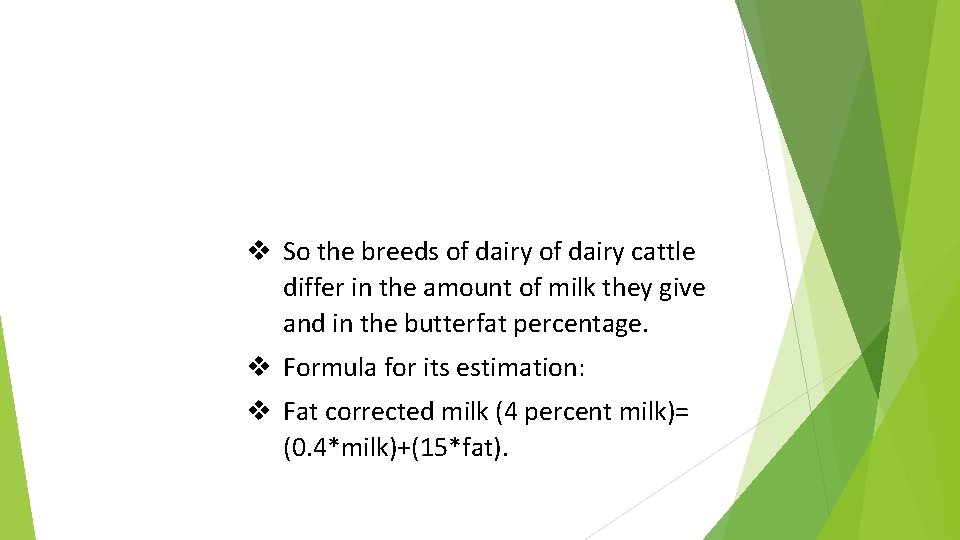
v So the breeds of dairy cattle differ in the amount of milk they give and in the butterfat percentage. v Formula for its estimation: v Fat corrected milk (4 percent milk)= (0. 4*milk)+(15*fat).
Productive life span in dairy cattle: v Productive life span is another trait of economic importance. v The average productive life of dairy cows in a herd is maintained mostly by purchased replacement after entering the herd at a two year of age. v The basic reason behind the replacement is low production and reproductive disorders. v And the association between the productive life span and breeding efficiency was low and insignificantly.
Type and confirmation: v Type in dairy cattle has received much attention in both selection and replacement of animals. v Type and confirmation are valuable because superiority in these traits may help the animals to maintain a long and highly productive life. v The basic type and confirmation is included large size and development of mammary glands, proper placement of the teats, soundness of feet and legs, and large body capacity which should give some indication of the animals ability to consume large amounts of grains and roughages. v If the animals have best body form and milk production then should such type of animals for selection purposes.
Selection of superior dairy cows: v Dairy cows produce a number a limited a number of offspring in their lifetime because their productive life span is short and their productive rate is slow, usually being limited to one year per year. v For this reason, it is not possible to make much improvements through selection over a period of years by placing emphasis only on selection among cows for higher milk production.
v A cows record can be used along with the bulls record with which she is mated, however, to make selection more accurate. v Estimated average transmitting ability(EATA) v It is used to estimate the ability of a cow to transmit genes for milk production to her offspring.
v The calculations of the EATA is based on milk production records from several sources. v The cows v Her dam v Her daughter v Half sibs or other daughters of her sire v Half sibs which other daughters of her dam. v Combining a cows EATA with the expected PD (predicted difference) of the sire to which she is bred gives an estimate of the dairy merit of their offspring. v Cow production records can also be used for culling the poor producing cows and for selecting replacement stock from the superior dams.
Calculation of a selection index: v An index may by developed by simple means or by more complex methods where several genetic parameters may be used in their calculations. The selection index includes 1 -Phenotypic and genotypic correlations among traits. 2 -genetic and phenotypic variances for the traits. 3 -the relative economic values for the traits included in the index.
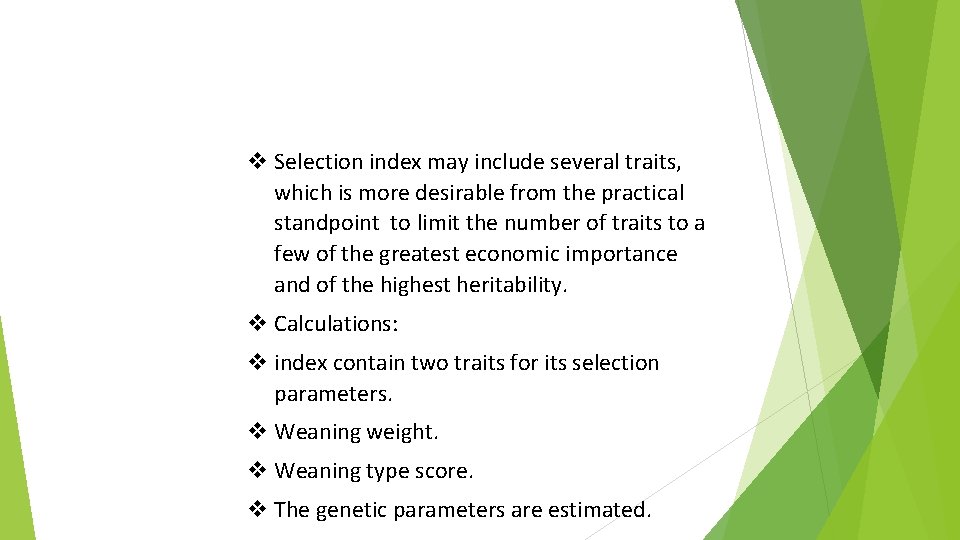
v Selection index may include several traits, which is more desirable from the practical standpoint to limit the number of traits to a few of the greatest economic importance and of the highest heritability. v Calculations: v index contain two traits for its selection parameters. v Weaning weight. v Weaning type score. v The genetic parameters are estimated.
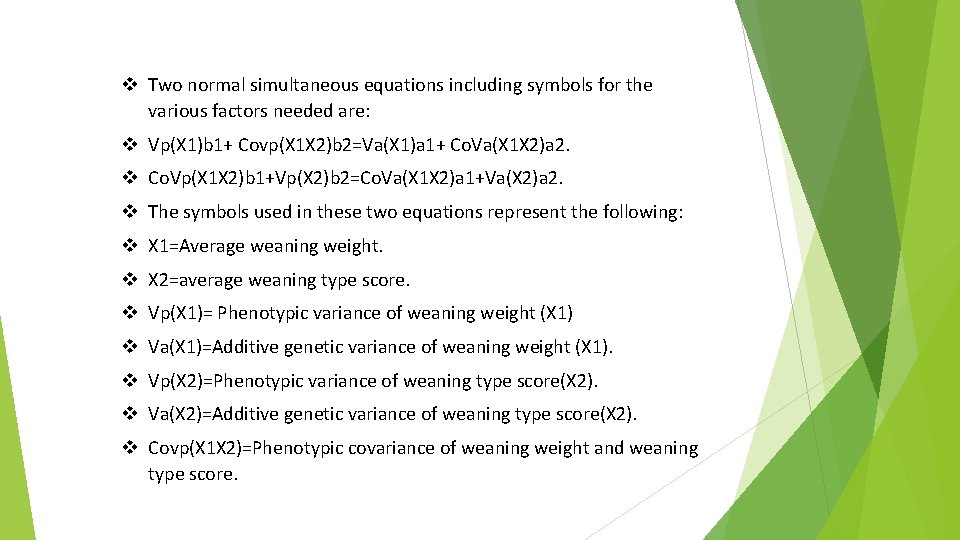
v Two normal simultaneous equations including symbols for the various factors needed are: v Vp(X 1)b 1+ Covp(X 1 X 2)b 2=Va(X 1)a 1+ Co. Va(X 1 X 2)a 2. v Co. Vp(X 1 X 2)b 1+Vp(X 2)b 2=Co. Va(X 1 X 2)a 1+Va(X 2)a 2. v The symbols used in these two equations represent the following: v X 1=Average weaning weight. v X 2=average weaning type score. v Vp(X 1)= Phenotypic variance of weaning weight (X 1) v Va(X 1)=Additive genetic variance of weaning weight (X 1). v Vp(X 2)=Phenotypic variance of weaning type score(X 2). v Va(X 2)=Additive genetic variance of weaning type score(X 2). v Covp(X 1 X 2)=Phenotypic covariance of weaning weight and weaning type score.
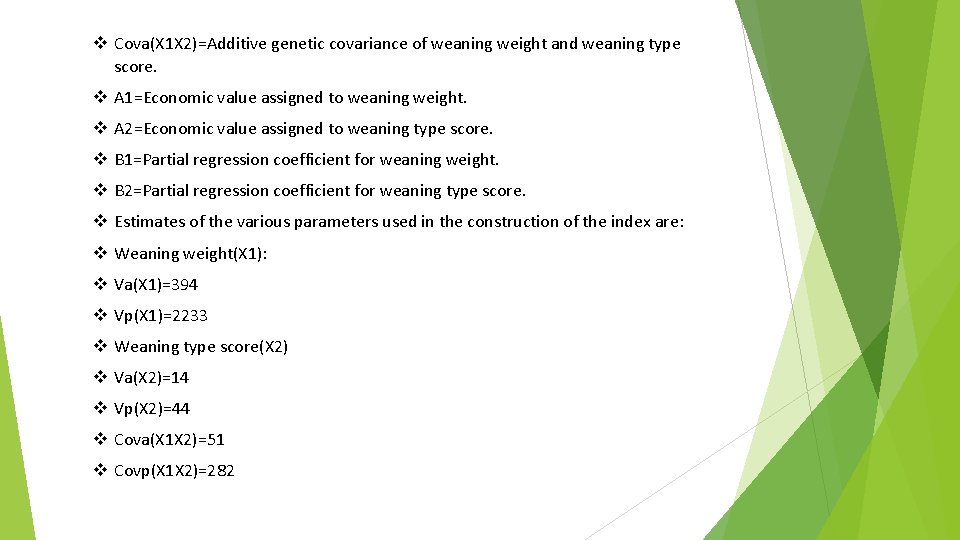
v Cova(X 1 X 2)=Additive genetic covariance of weaning weight and weaning type score. v A 1=Economic value assigned to weaning weight. v A 2=Economic value assigned to weaning type score. v B 1=Partial regression coefficient for weaning weight. v B 2=Partial regression coefficient for weaning type score. v Estimates of the various parameters used in the construction of the index are: v Weaning weight(X 1): v Va(X 1)=394 v Vp(X 1)=2233 v Weaning type score(X 2) v Va(X 2)=14 v Vp(X 2)=44 v Cova(X 1 X 2)=51 v Covp(X 1 X 2)=282
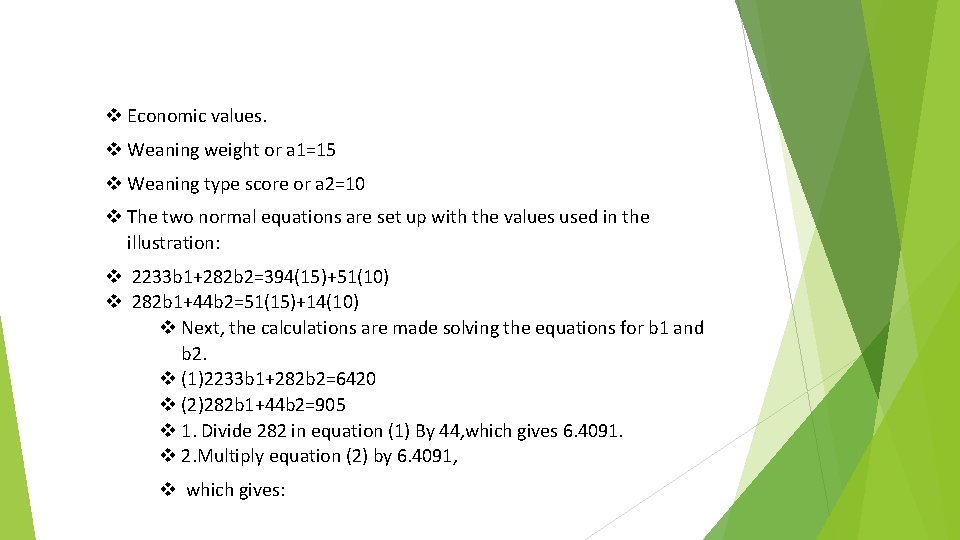
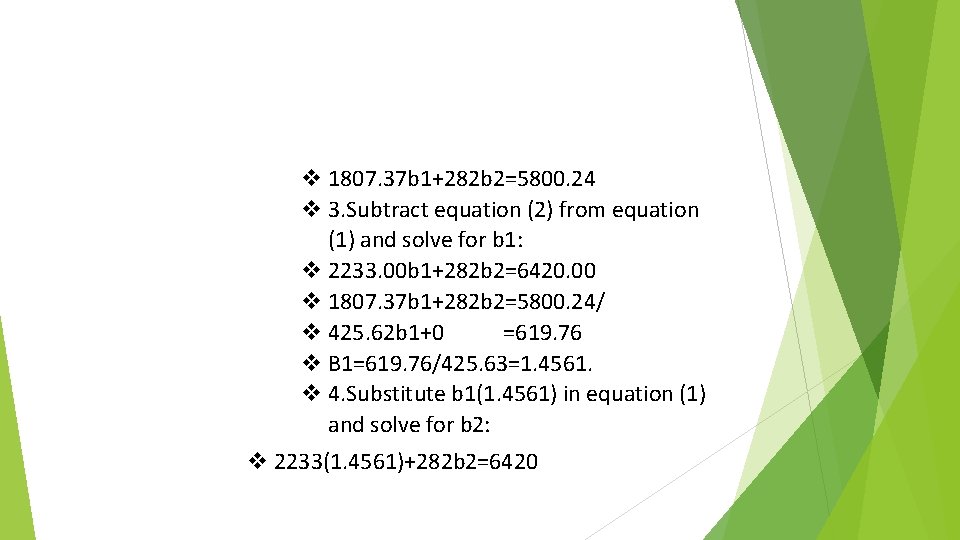
v Economic values. v Weaning weight or a 1=15 v Weaning type score or a 2=10 v The two normal equations are set up with the values used in the illustration: v 2233 b 1+282 b 2=394(15)+51(10) v 282 b 1+44 b 2=51(15)+14(10) v Next, the calculations are made solving the equations for b 1 and b 2. v (1)2233 b 1+282 b 2=6420 v (2)282 b 1+44 b 2=905 v 1. Divide 282 in equation (1) By 44, which gives 6. 4091. v 2. Multiply equation (2) by 6. 4091, v which gives:
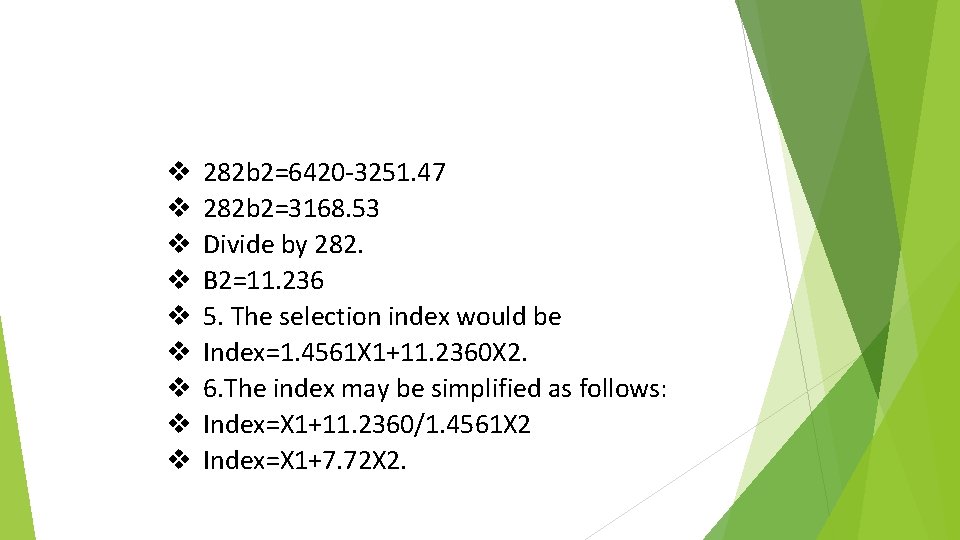
v 1807. 37 b 1+282 b 2=5800. 24 v 3. Subtract equation (2) from equation (1) and solve for b 1: v 2233. 00 b 1+282 b 2=6420. 00 v 1807. 37 b 1+282 b 2=5800. 24/ v 425. 62 b 1+0 =619. 76 v B 1=619. 76/425. 63=1. 4561. v 4. Substitute b 1(1. 4561) in equation (1) and solve for b 2: v 2233(1. 4561)+282 b 2=6420
v v v v v 282 b 2=6420 -3251. 47 282 b 2=3168. 53 Divide by 282. B 2=11. 236 5. The selection index would be Index=1. 4561 X 1+11. 2360 X 2. 6. The index may be simplified as follows: Index=X 1+11. 2360/1. 4561 X 2 Index=X 1+7. 72 X 2.