
TRAIT PERSONALITY THEORIES Individual characteristics that define a





- Slides: 37
TRAIT PERSONALITY THEORIES Individual characteristics that define a person. AP Psychology
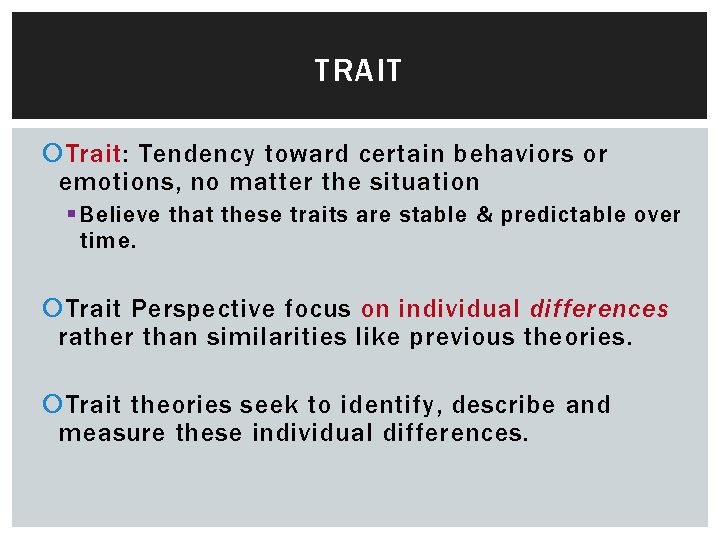
TRAIT Trait: Tendency toward certain behaviors or emotions, no matter the situation § Believe that these traits are stable & predictable over time. Trait Perspective focus on individual differences rather than similarities like previous theories. Trait theories seek to identify, describe and measure these individual differences.
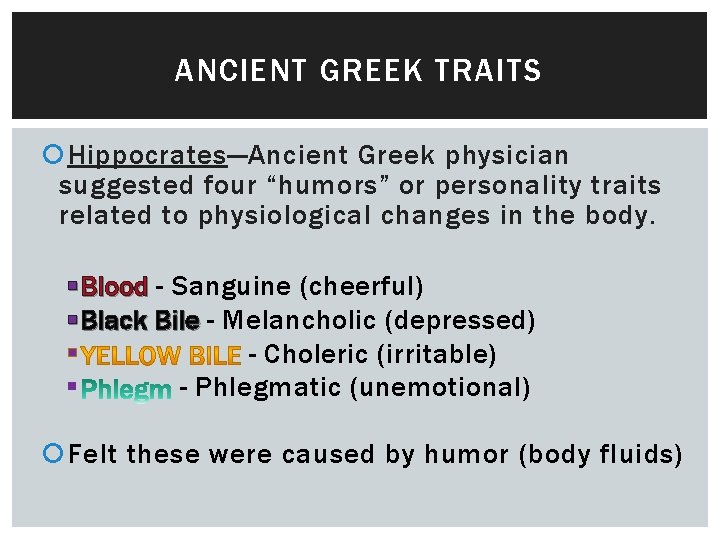
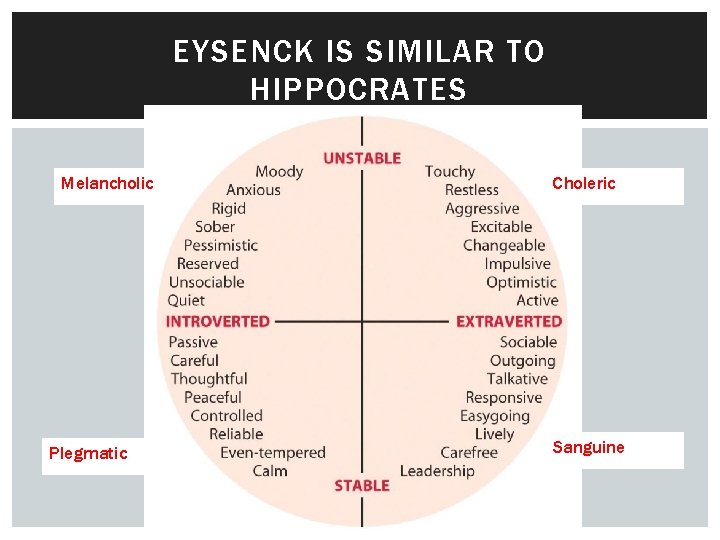
ANCIENT GREEK TRAITS Hippocrates—Ancient Greek physician suggested four “humors” or personality traits related to physiological changes in the body. § Blood - Sanguine (cheerful) § Black Bile - Melancholic (depressed) § - Choleric (irritable) § - Phlegmatic (unemotional) Felt these were caused by humor (body fluids)
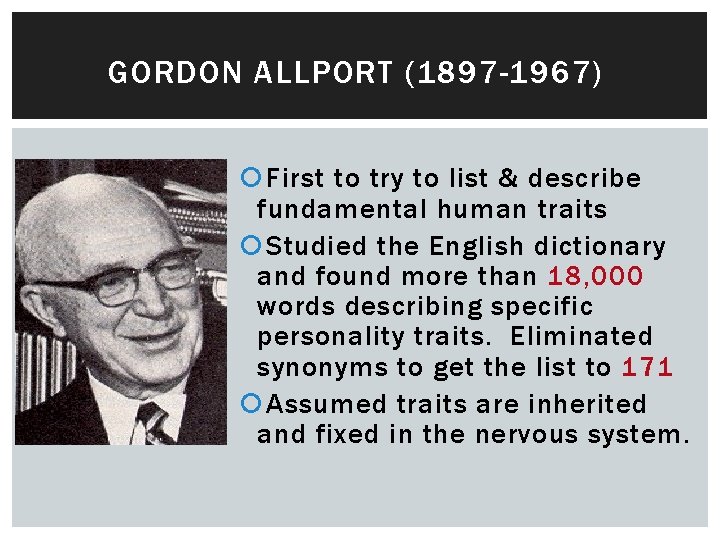
GORDON ALLPORT (1897 -1967) First to try to list & describe fundamental human traits Studied the English dictionary and found more than 18, 000 words describing specific personality traits. Eliminated synonyms to get the list to 171 Assumed traits are inherited and fixed in the nervous system.
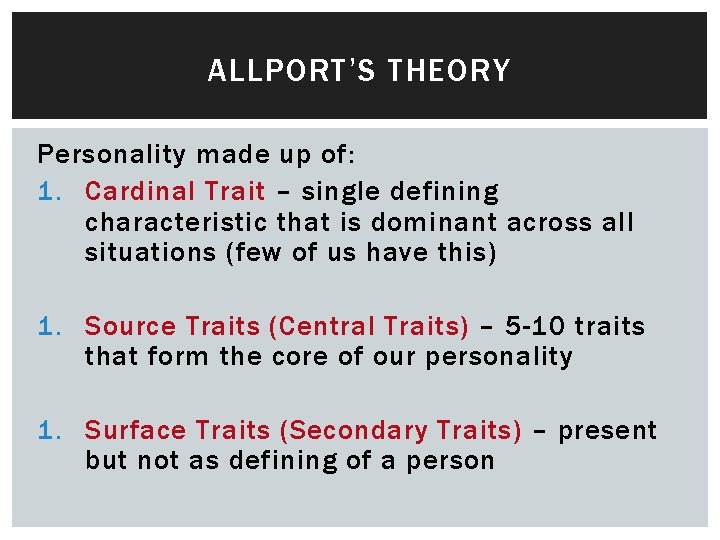
ALLPORT’S THEORY Personality made up of: 1. Cardinal Trait – single defining characteristic that is dominant across all situations (few of us have this) 1. Source Traits (Central Traits) – 5 -10 traits that form the core of our personality 1. Surface Traits (Secondary Traits) – present but not as defining of a person
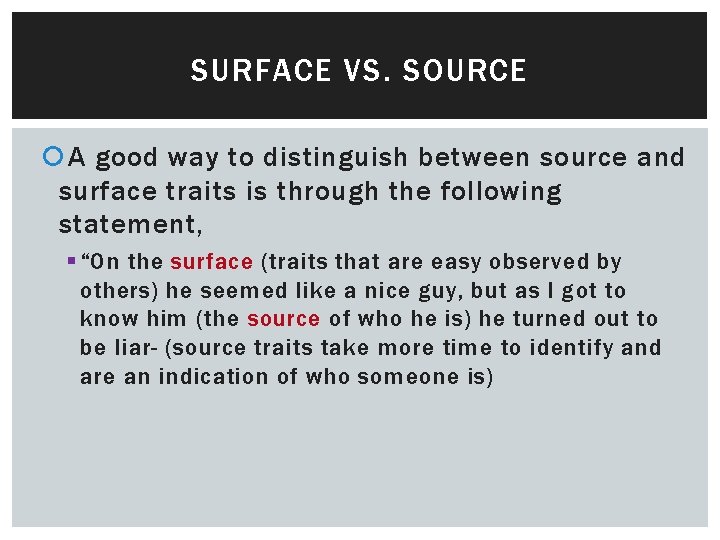
SURFACE VS. SOURCE A good way to distinguish between source and surface traits is through the following statement, § “On the surface (traits that are easy observed by others) he seemed like a nice guy, but as I got to know him (the source of who he is) he turned out to be liar- (source traits take more time to identify and are an indication of who someone is)
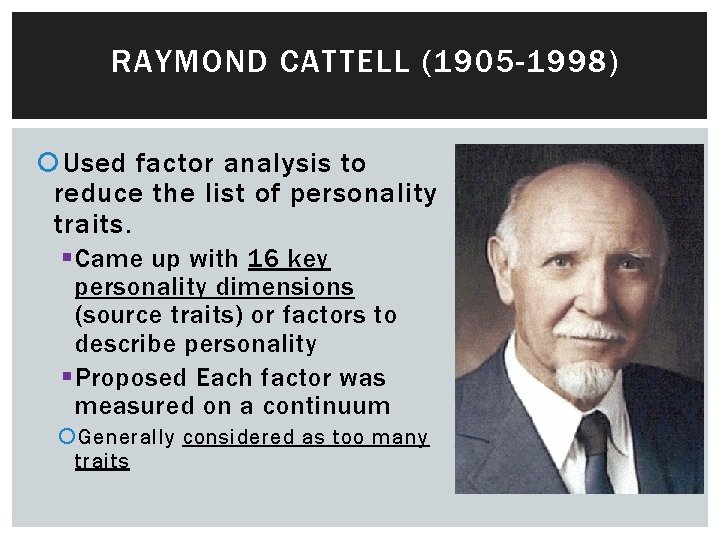
RAYMOND CATTELL (1905 -1998) Used factor analysis to reduce the list of personality traits. § Came up with 16 key personality dimensions (source traits) or factors to describe personality § Proposed Each factor was measured on a continuum Generally considered as too many traits
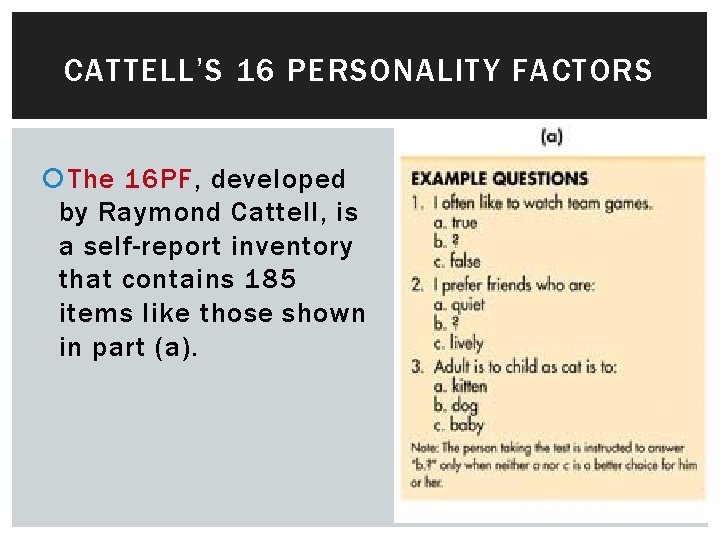
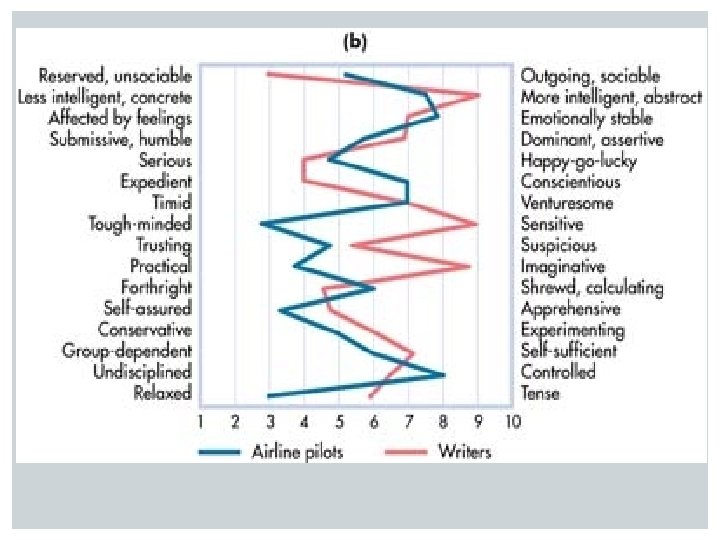
CATTELL’S 16 PERSONALITY FACTORS The 16 PF, developed by Raymond Cattell, is a self-report inventory that contains 185 items like those shown in part (a).
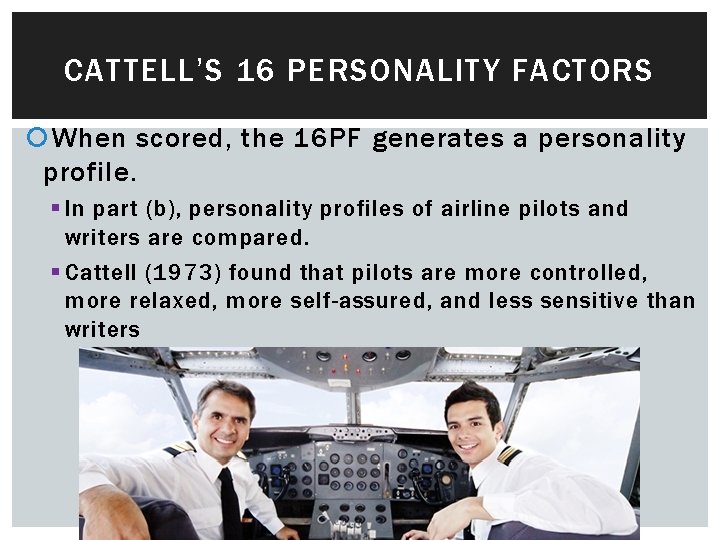
CATTELL’S 16 PERSONALITY FACTORS When scored, the 16 PF generates a personality profile. § In part (b), personality profiles of airline pilots and writers are compared. § Cattell (1973) found that pilots are more controlled, more relaxed, more self-assured, and less sensitive than writers
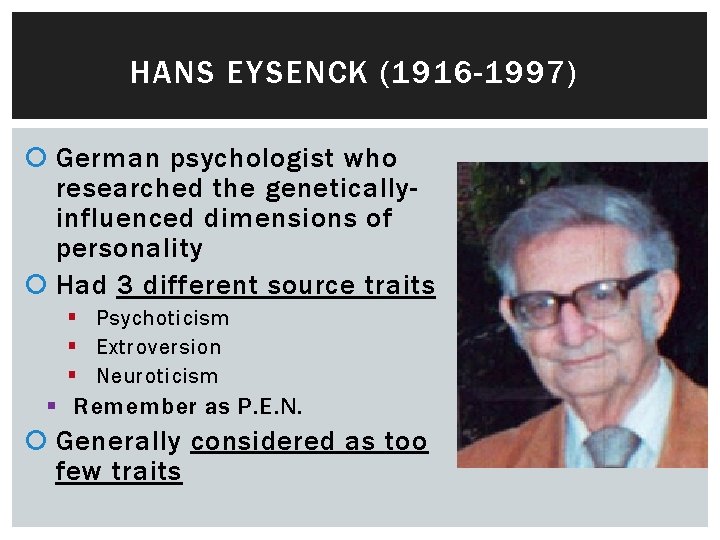
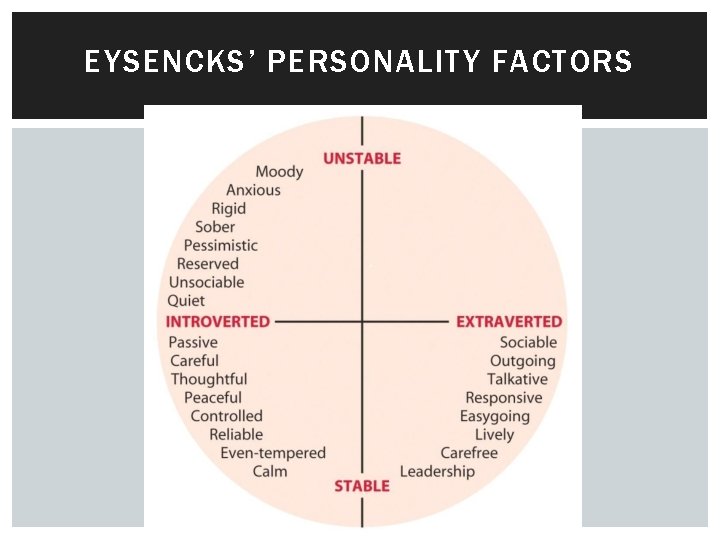
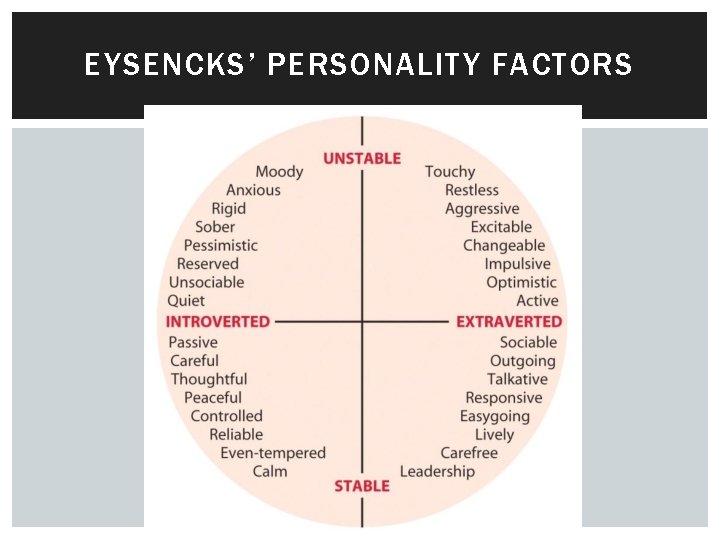
HANS EYSENCK (1916 -1997) German psychologist who researched the geneticallyinfluenced dimensions of personality Had 3 different source traits § Psychoticism § Extroversion § Neuroticism § Remember as P. E. N. Generally considered as too few traits
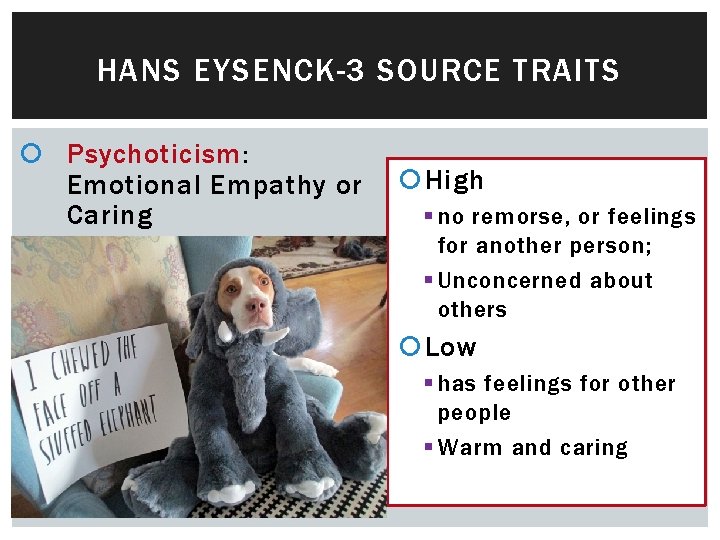
HANS EYSENCK-3 SOURCE TRAITS Psychoticism: Emotional Empathy or Caring High § no remorse, or feelings for another person; § Unconcerned about others Low § has feelings for other people § Warm and caring
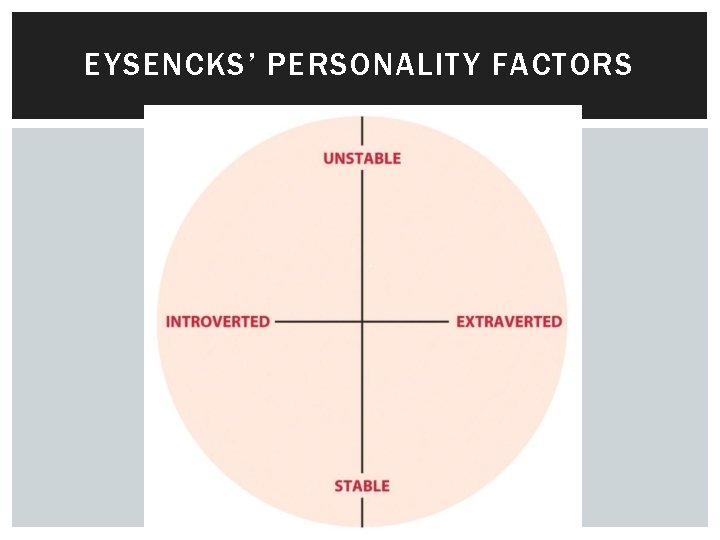
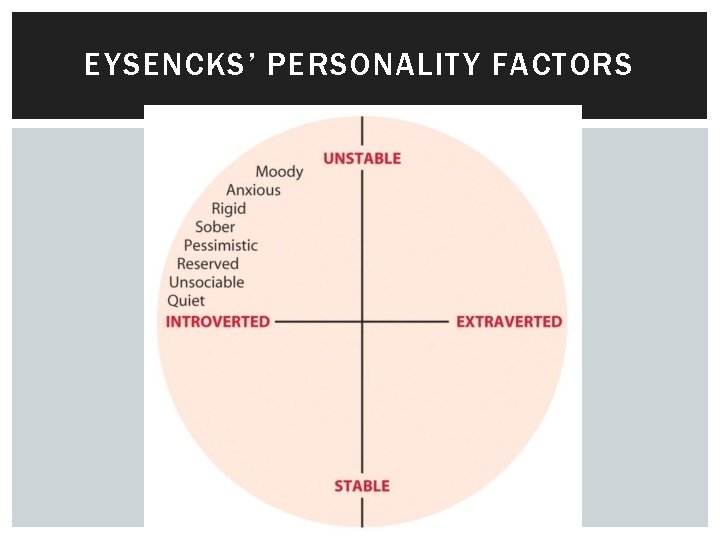
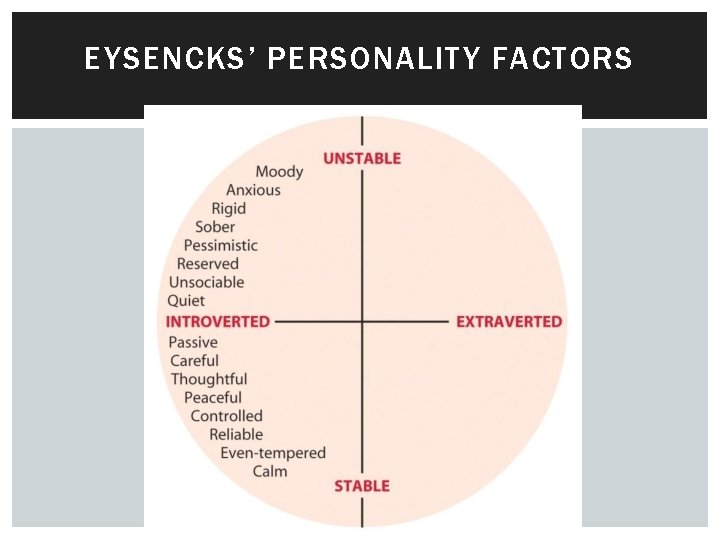
HANS EYSENCK-3 SOURCE TRAITS Extroversion: Introversionextraversion – Degree to which a person directs their energies inward toward themselves (introvert) or outward onto others (extrovert). Extraversion § Outgoing, likes to go out, and being around other people Introversion § Someone who stays at home and likes quiet time
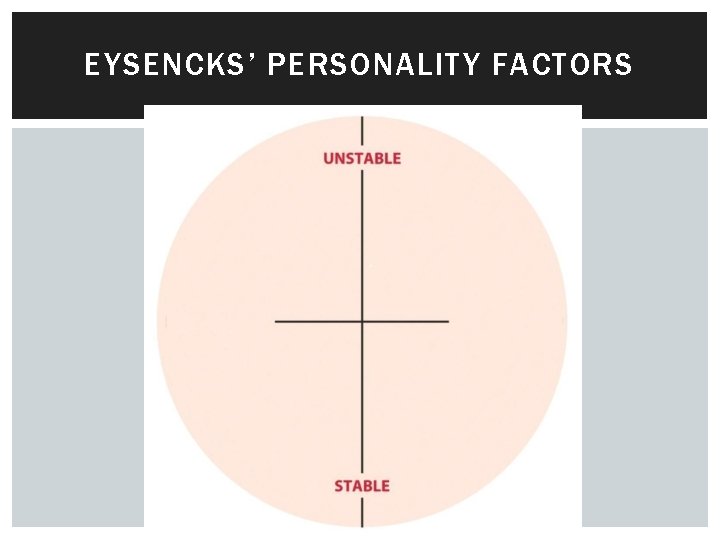
HANS EYSENCK-3 SOURCE TRAITS Neuroticism: Emotional stability- Instability (Stable – Unstable) – A person’s predisposition to become unpredictable & emotionally upset (unstable) or stay composed, rational and emotionally even (stable). Neuroticism § A person who is moody Emotional Stable § A person who is not overly emotional,
EYSENCKS’ PERSONALITY FACTORS
EYSENCKS’ PERSONALITY FACTORS
EYSENCKS’ PERSONALITY FACTORS
EYSENCKS’ PERSONALITY FACTORS
EYSENCKS’ PERSONALITY FACTORS
EYSENCKS’ PERSONALITY FACTORS
EYSENCK IS SIMILAR TO HIPPOCRATES Melancholic Plegmatic Choleric Sanguine
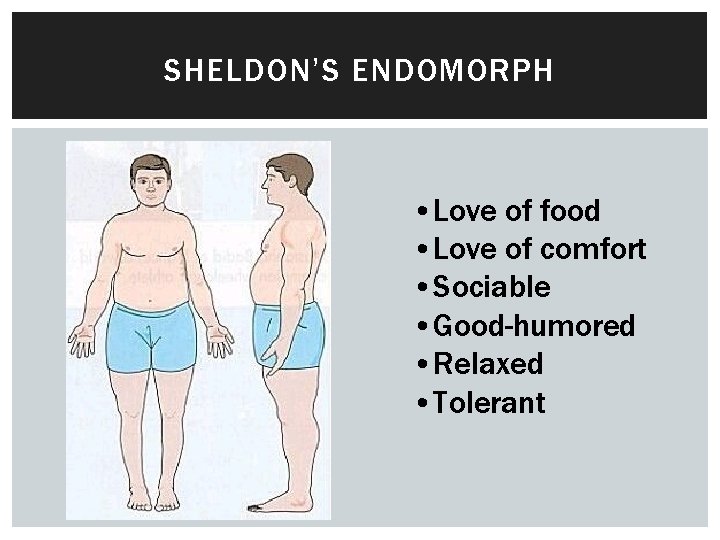
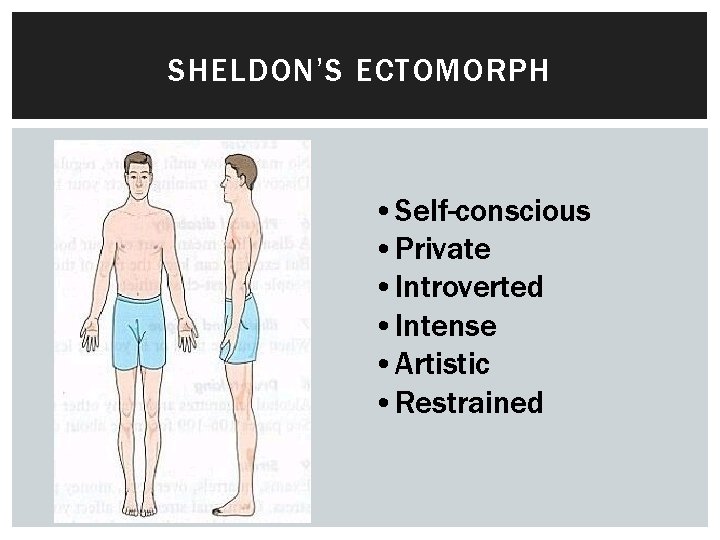
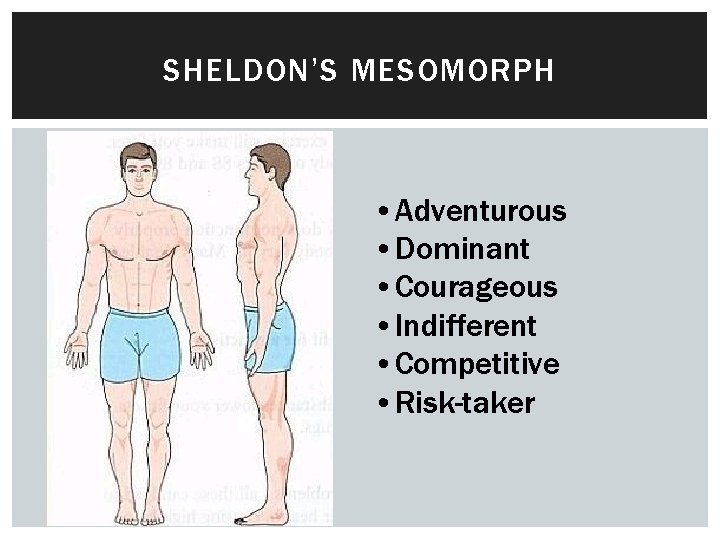
WILLIAM SHELDON & BODY TYPES (1898 -1977) Your body type determines your personality
SHELDON’S ENDOMORPH • Love of food • Love of comfort • Sociable • Good-humored • Relaxed • Tolerant
SHELDON’S ECTOMORPH • Self-conscious • Private • Introverted • Intense • Artistic • Restrained
SHELDON’S MESOMORPH • Adventurous • Dominant • Courageous • Indifferent • Competitive • Risk-taker
IS SHELDON’S THEORY ACCURATE? No, It is based on Stereotypes.
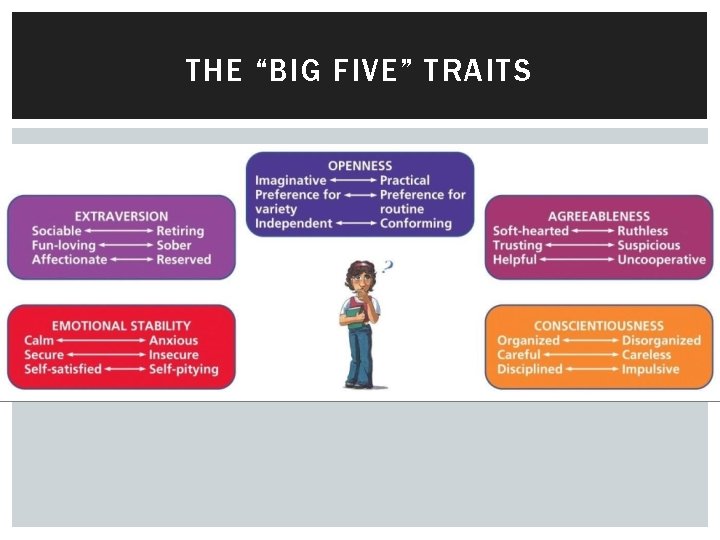
THE NOTORIOUS BIG 5 THEORY Most popular trait theory Robert Mc. Crae and Paul Costa developed the Big Five Personality Source Traits, which are considered the building blocks of personality § Essential building blocks of personality can be described in 5 basic personality dimensions.
THE NOTORIOUS BIG 5 THEORY Human behavior is the result of interaction between traits and situations. Described somewhat differently among researchers but can be found cross culturally. Research shows them to be stable over time & consistent over different situations.
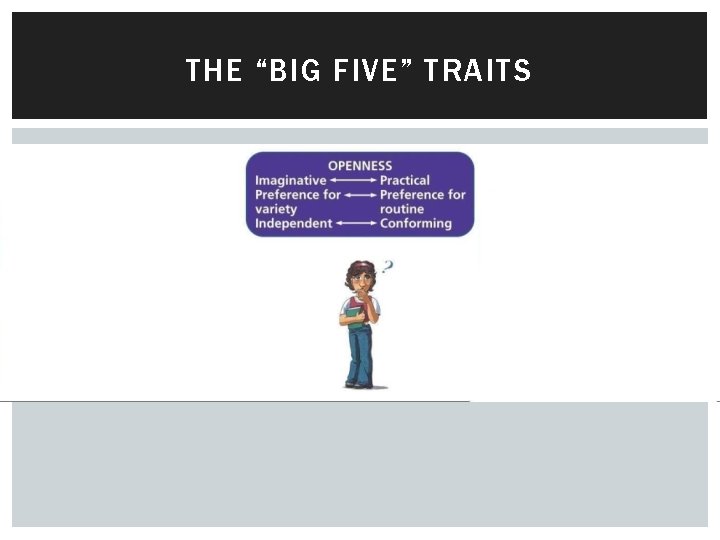
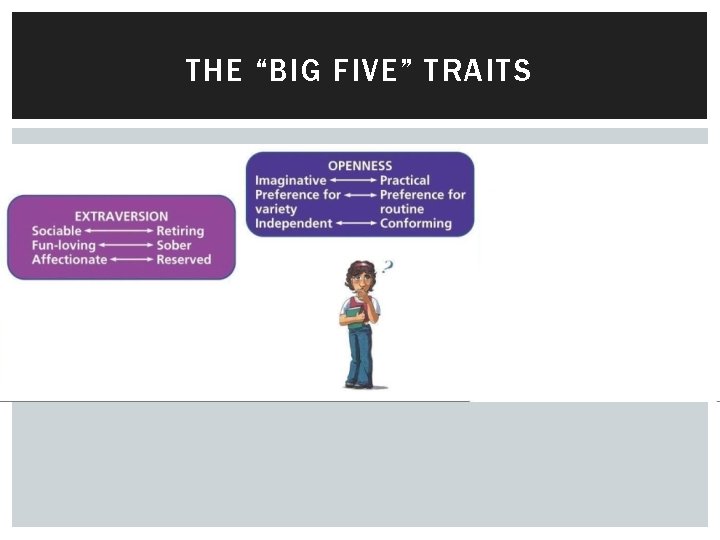
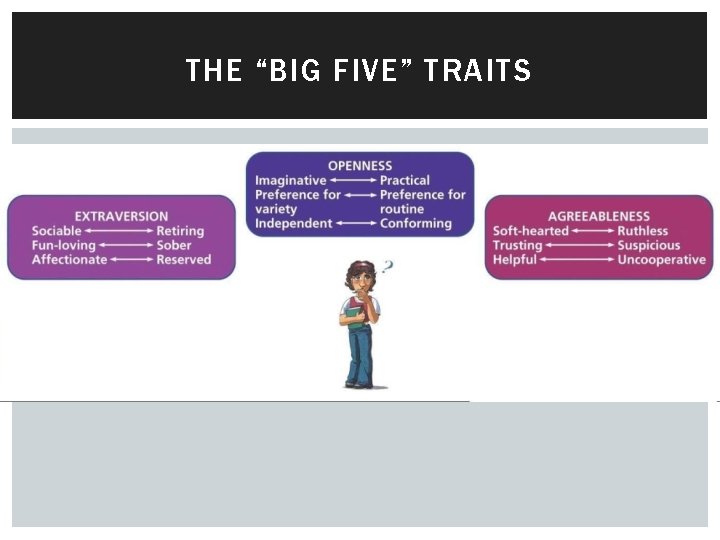
O. C. E. A. N. (OR C. A. N. O. E. ) O PENNESS – How open you are to new experiences & learning? C ONSCIENTIOUSNESS – The degree to which one is responsible, hard working, reliable (dependability) E XTROVERSION – How outgoing, expressive, active & social are you? A GREEABLENESS – How honest, considerate, likeable & tolerant are you? N EUROTICISM – How anxious, self-conscious or impulsive are you?
THE “BIG FIVE” TRAITS
THE “BIG FIVE” TRAITS
THE “BIG FIVE” TRAITS
THE “BIG FIVE” TRAITS
THE “BIG FIVE” TRAITS
EVALUATING TRAIT PERSPECTIVE Trait Theories of Psychology
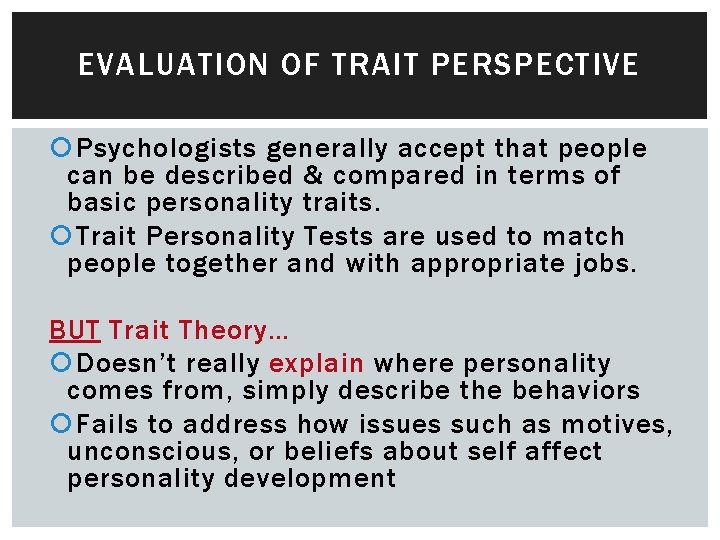
EVALUATION OF TRAIT PERSPECTIVE Psychologists generally accept that people can be described & compared in terms of basic personality traits. Trait Personality Tests are used to match people together and with appropriate jobs. BUT Trait Theory… Doesn’t really explain where personality comes from, simply describe the behaviors Fails to address how issues such as motives, unconscious, or beliefs about self affect personality development
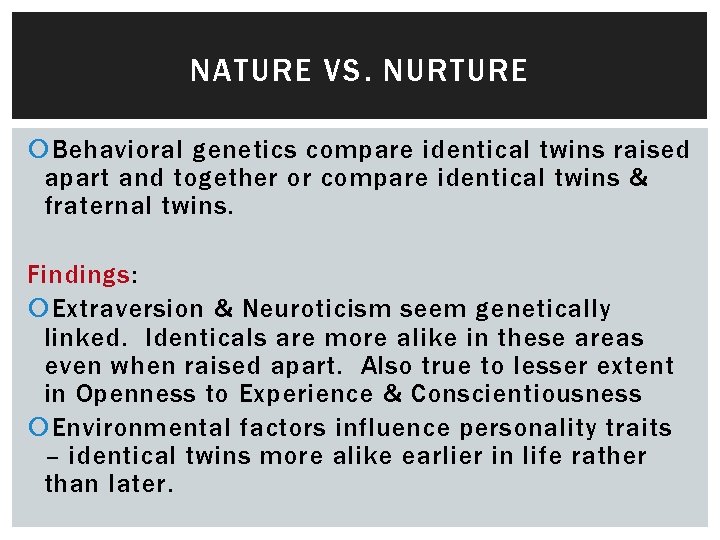
NATURE VS. NURTURE Behavioral genetics compare identical twins raised apart and together or compare identical twins & fraternal twins. Findings: Extraversion & Neuroticism seem genetically linked. Identicals are more alike in these areas even when raised apart. Also true to lesser extent in Openness to Experience & Conscientiousness Environmental factors influence personality traits – identical twins more alike earlier in life rather than later.