
TraintheTrainer Workshop Welcome to MONEY SMART FOR SMALL
- Slides: 75
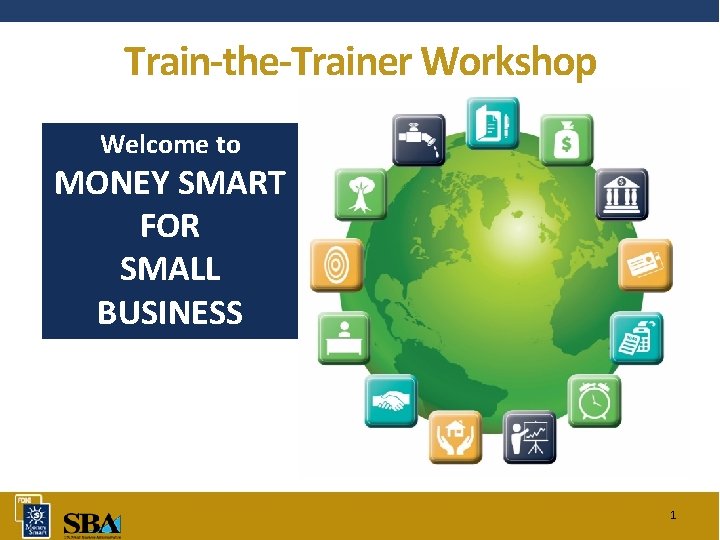
Train-the-Trainer Workshop Welcome to MONEY SMART FOR SMALL BUSINESS 1
Introduction Presenter Name Title Organization Contact Information 2
Ground Rules • Participate • Ask questions • Tell me what you think • Cell phones on vibrate 3
Training Materials • Train-the-Trainer Participant Guide • Managing Cash Flow – Instructor Guide – Participant Guide – Power. Point Slides • Glossary Terms • Success Tips 4
Parking Lot • To help manage time, we may need to “park” some questions • We will assess at the end to see if your questions were answered • If not, we can plan to follow up 5
Agenda • • Welcome Learning Objectives MSSB Curriculum Overview The Thirteen Modules A Deep Dive Getting Started with MSSB Success Tips 6
Icebreaker What are the top [1 -3] products/services offered by your organization/branch that entrepreneurs love? or What are the top [1 -3] resources that your organization/branch has that organizations serving entrepreneurs love? 7
Learning Objectives • Simply state – Introduce the MSSB Curriculum • What it is • Why it was created • Who can benefit • How they benefit • Getting started! 8
MSSB: What It Is • A business education tool • Collaboratively developed by the FDIC & SBA • 13 modules • Covers a wide range of business topics 9
MSSB: Why It Was Created • To assist financial institutions and community organizations • To help entrepreneurs think • To have deep and sustainable impact • To spur economic activity 10
MSSB: Who Can Benefit • Financial Institutions and Community Organizations Small Business/Economic Development Organizations Community Banks/Financial Institutions Government Programs Chambers of Commerce or Business Chambers/Trade Associations – Independent Small Business Consultants – – • Aspiring and Existing Entrepreneurs • Urban and Rural Communities 11
MSSB: How They Benefit • Financial Institutions and Community Organizations • Aspiring and Existing Entrepreneurs • Urban and Rural Communities 12
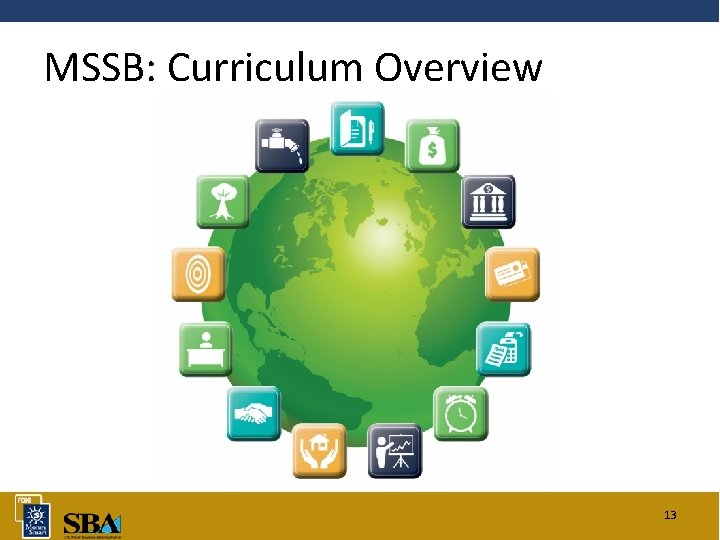
MSSB: Curriculum Overview 13
MSSB: Curriculum Components • Instructor’s Guide • Participant’s Guide/Workbook • Power. Point Slides 14
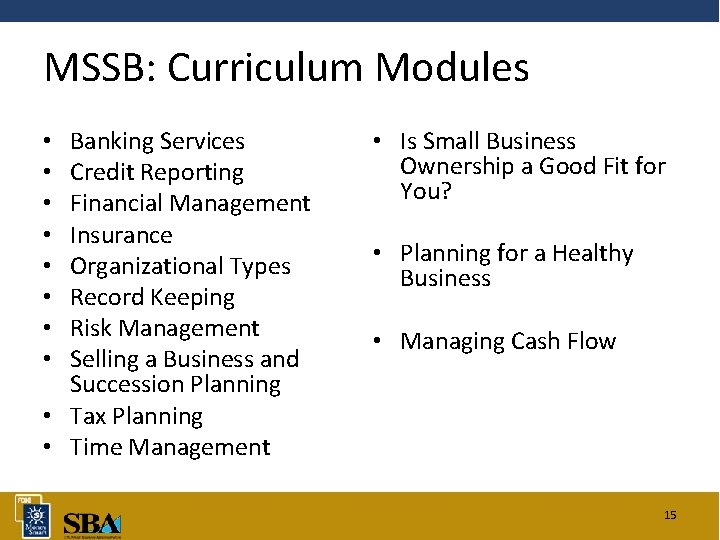
MSSB: Curriculum Modules Banking Services Credit Reporting Financial Management Insurance Organizational Types Record Keeping Risk Management Selling a Business and Succession Planning • Tax Planning • Time Management • • • Is Small Business Ownership a Good Fit for You? • Planning for a Healthy Business • Managing Cash Flow 15
Banking Services Understanding the Value for Small Businesses 16
Banking Services • Entrepreneurs will – Gain a solid understanding of the banking products and services available to small business owners – Understand the importance of building effective long-term relationships with a banker or lender – Recognize the role of a personal credit score in the lending process 17
Credit Reporting Demystified 18
Credit Reporting • Entrepreneurs will – Understand the full scope of credit reporting and the impact of credit reports on the operation or growth of a small business – Discover strategies for building or improving business credit – Appreciate how personal credit scores impact the ability of a business to obtain credit 19
Financial Management Appropriate Allocation of Resources 20
Financial Management • Entrepreneurs will – Grasp the importance of sound financial management – Understand the basics of small business financial management including: • • Startup financing Financing for a growing business Financing working capital Financing fixed assets 21
Insurance Planning for the Unexpected 22
Insurance • Entrepreneurs will – Recognize the importance of small business insurance – Understand the full range of insurance products and services • Required coverage • Other coverage 23
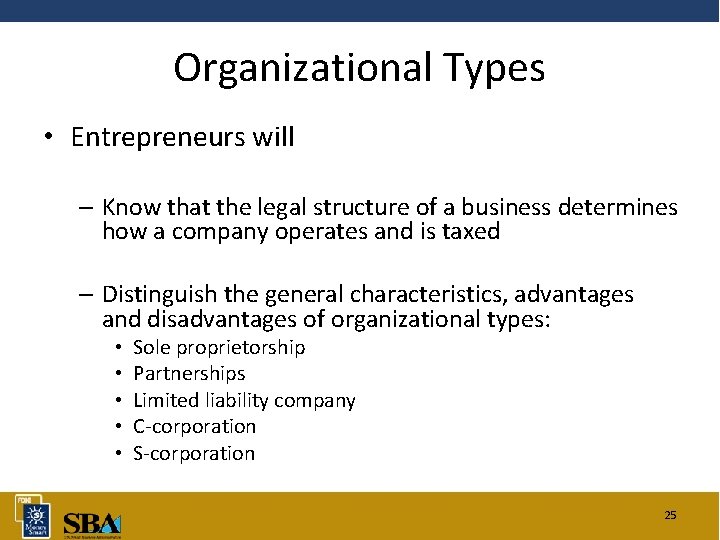
Organizational Types Advantages and Disadvantages of Business Structures 24
Organizational Types • Entrepreneurs will – Know that the legal structure of a business determines how a company operates and is taxed – Distinguish the general characteristics, advantages and disadvantages of organizational types: • • • Sole proprietorship Partnerships Limited liability company C-corporation S-corporation 25
Record Keeping Critical Managerial Tool 26
Record Keeping • Entrepreneurs will – Comprehend the necessity for good record keeping – Learn about the practices and rules of record keeping for small businesses – Discover record keeping software tools. 27
Risk Management Be Prepared for Negative Outcomes 28
Risk Management • Entrepreneurs will – Understand the common risks associated with a small business – Identify the external and internal factors which can cause risks for a small business – Implement, monitor and evaluate a risk management plan for a small business 29
Selling a Business and Succession Planning Exit Strategies 30
Selling a Business and Succession Planning • Entrepreneurs will – Learn how to change the ownership of a business through selling, closing or transferring the business to successors – Know how to establish an exit strategy for retirement which includes a succession plan, transferring ownership of the business and paying taxes 31
Tax Planning Understanding the Details 32
Tax Planning and Reporting • Entrepreneurs will – Understand the range of state, local and federal tax reporting requirements of a small business and its owner – Be able to research general tax reporting requirements – Understand the importance of establishing a plan to pay taxes 33
Time Management Steps on Effective Use of Time 34
Time Management • Entrepreneurs will – Understand the importance of time management – Discover commonly used time management practices like • • Pareto analysis ABC method Eisenhower method POSEC method 35
Is Small Business Ownership a Good Fit for You? Strength Assessments 36
Is Small Business Ownership a Good Fit for You? • Entrepreneurs will – Discern between the myths and realities of small business ownership – Start a self-assessment to determine their readiness to become a small business owner – Gain insight about their readiness to start a business 37
Planning for a Healthy Business Startup Costs and Beyond 38
Planning for a Healthy Business • Entrepreneurs will – Discover a 4 -Step Business Planning process, via a case study, that will help them create a long-term healthy business • • Back-of-Napkin Plan Resource Plan Business Plan Action Plan 39
Managing Cash Flow Practical Problem-Solving 40
Managing Cash Flow • Entrepreneurs will – Learn how critically important cash flow management is for a small business – Act as advisors to Bob and The Wired Cup – Understand the need for expert assistance and advice 41
The Deep Dive Managing Cash Flow 42
Pre-Test In y ticip our ant Gui de • Locate the Pre- and Post-Test Form at Par the back of your Participant Guide. • Complete the BEFORE Training column to assess your knowledge on this topic before participating in this class. MANAGING CASH FLOW 43
Agenda • Welcome, Pre-Test, Agenda, and Learning Objectives • Introductions • Case Study: Bob and The Wired Cup • The Opening Balance Sheet • Three Views of Cash Flow • What Can Bob Do? • Summary, Post-Test, and Evaluation MANAGING CASH FLOW 44
Learning Objectives • Describe the purpose of cash flow management in a start-up small business. • Assess a cash flow cycle and make some cash flow projections. • Describe how a cash flow statement can help assess and improve the financial health of a start-up. Continued … MANAGING CASH FLOW 45
Learning Objectives, cont. • Identify some ways to manage cash flow in terms of managing costs and potential income. • Identify ways to seek out expert technical assistance to improve cash flow management. MANAGING CASH FLOW 46
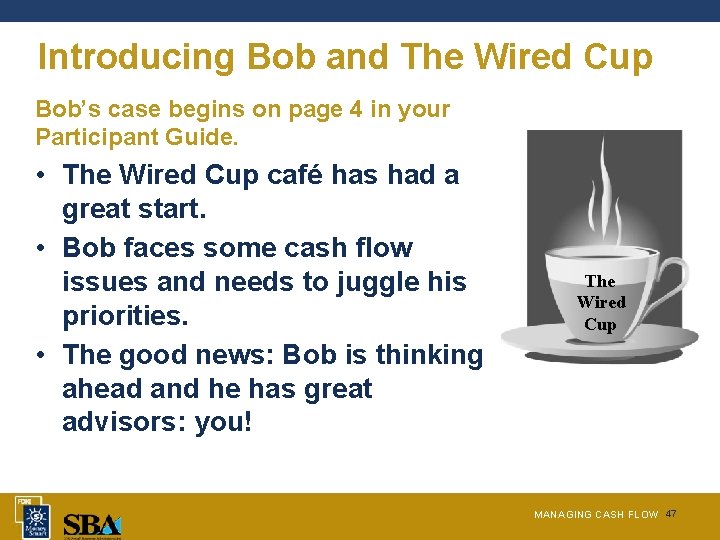
Introducing Bob and The Wired Cup Bob’s case begins on page 4 in your Participant Guide. • The Wired Cup café has had a great start. • Bob faces some cash flow issues and needs to juggle his priorities. • The good news: Bob is thinking ahead and he has great advisors: you! The Wired Cup MANAGING CASH FLOW 47
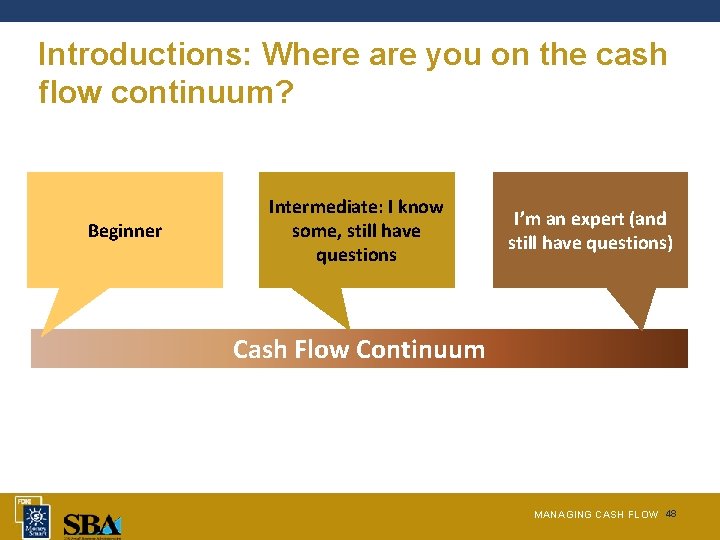
Introductions: Where are you on the cash flow continuum? Beginner Intermediate: I know some, still have questions I’m an expert (and still have questions) Cash Flow Continuum MANAGING CASH FLOW 48
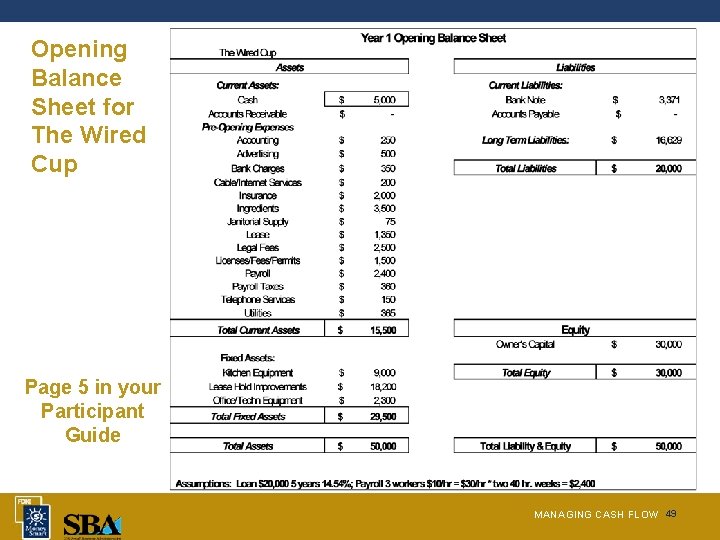
Opening Balance Sheet for The Wired Cup Page 5 in your Participant Guide MANAGING CASH FLOW 49
A Few Notes About Debt • It takes effort to obtain a small business loan. • Your credit score will directly influence your ability to secure a loan. • Talk with a bank’s commercial loan officer before you need the loan. • Other modules in this Money Smart series can help! MANAGING CASH FLOW 50
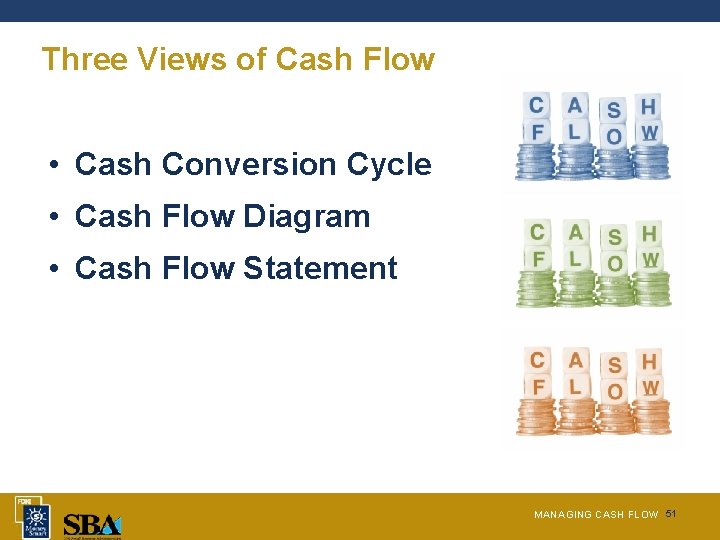
Three Views of Cash Flow • Cash Conversion Cycle • Cash Flow Diagram • Cash Flow Statement MANAGING CASH FLOW 51
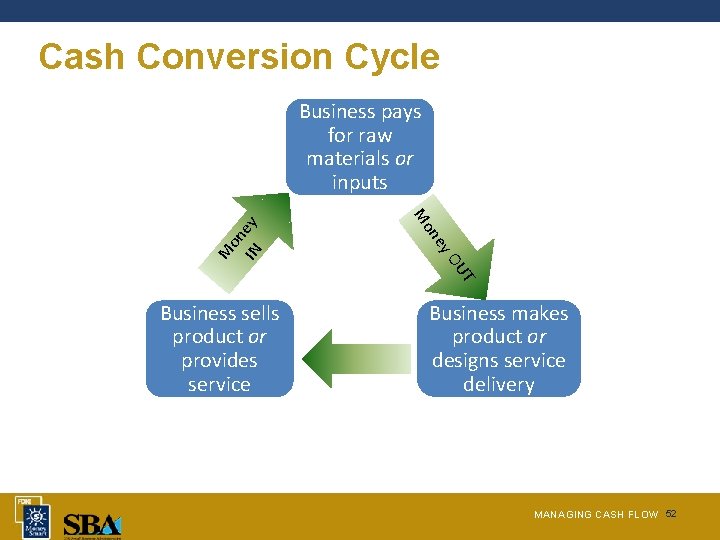
Cash Conversion Cycle T OU IN on e ey on M M y Business pays for raw materials or inputs Business sells product or provides service Business makes product or designs service delivery MANAGING CASH FLOW 52
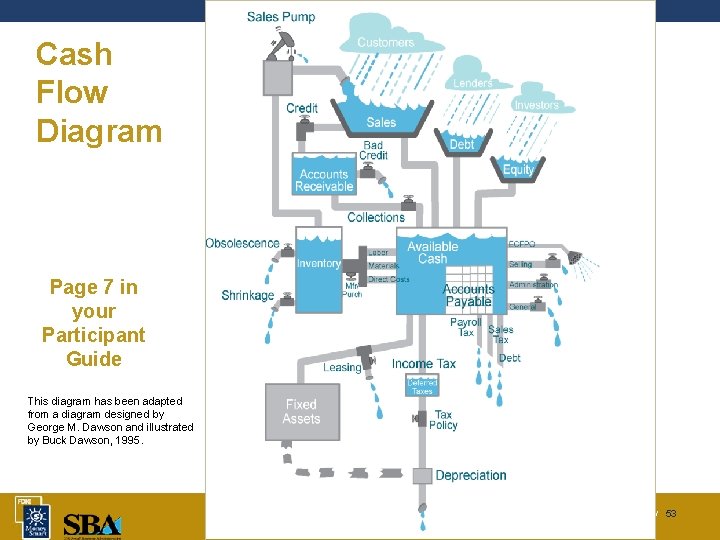
Cash Flow Diagram Page 7 in your Participant Guide This diagram has been adapted from a diagram designed by George M. Dawson and illustrated by Buck Dawson, 1995. MANAGING CASH FLOW 53
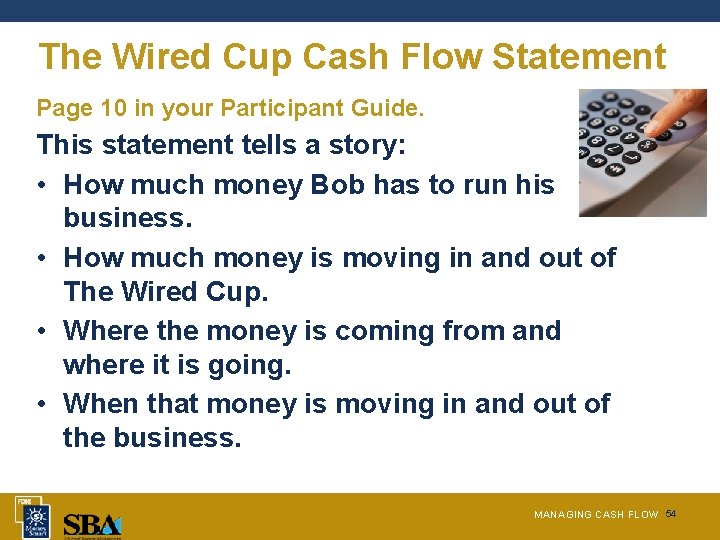
The Wired Cup Cash Flow Statement Page 10 in your Participant Guide. This statement tells a story: • How much money Bob has to run his business. • How much money is moving in and out of The Wired Cup. • Where the money is coming from and where it is going. • When that money is moving in and out of the business. MANAGING CASH FLOW 54
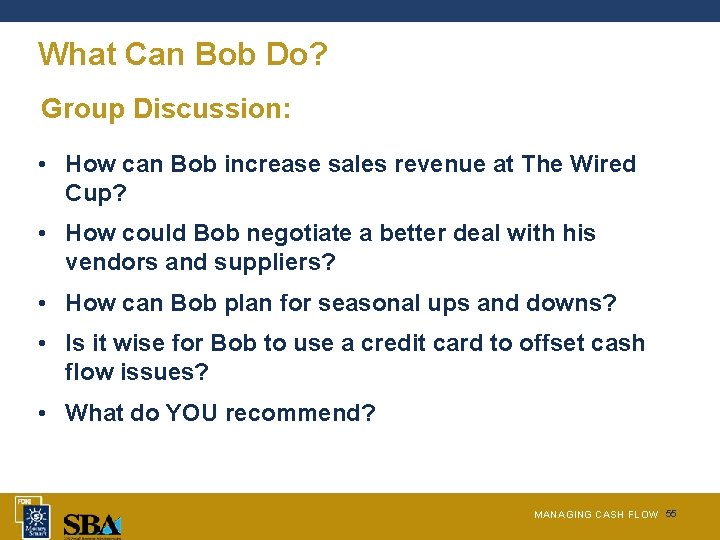
What Can Bob Do? Group Discussion: • How can Bob increase sales revenue at The Wired Cup? • How could Bob negotiate a better deal with his vendors and suppliers? • How can Bob plan for seasonal ups and downs? • Is it wise for Bob to use a credit card to offset cash flow issues? • What do YOU recommend? MANAGING CASH FLOW 55
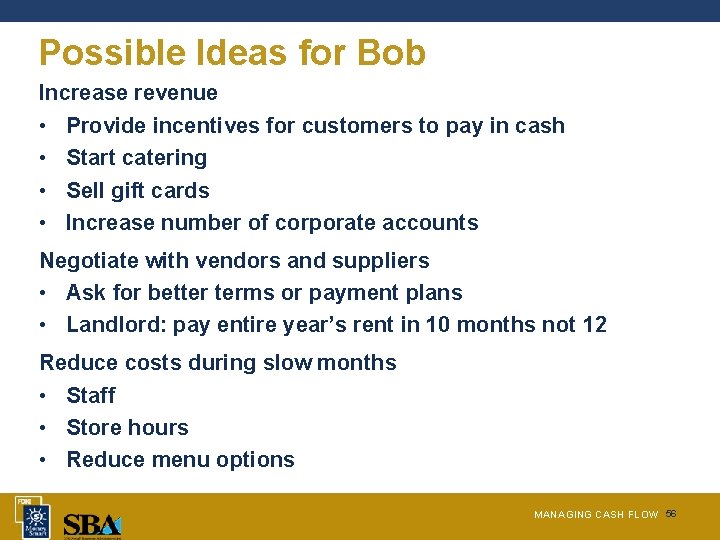
Possible Ideas for Bob Increase revenue • Provide incentives for customers to pay in cash • Start catering • Sell gift cards • Increase number of corporate accounts Negotiate with vendors and suppliers • Ask for better terms or payment plans • Landlord: pay entire year’s rent in 10 months not 12 Reduce costs during slow months • Staff • Store hours • Reduce menu options MANAGING CASH FLOW 56
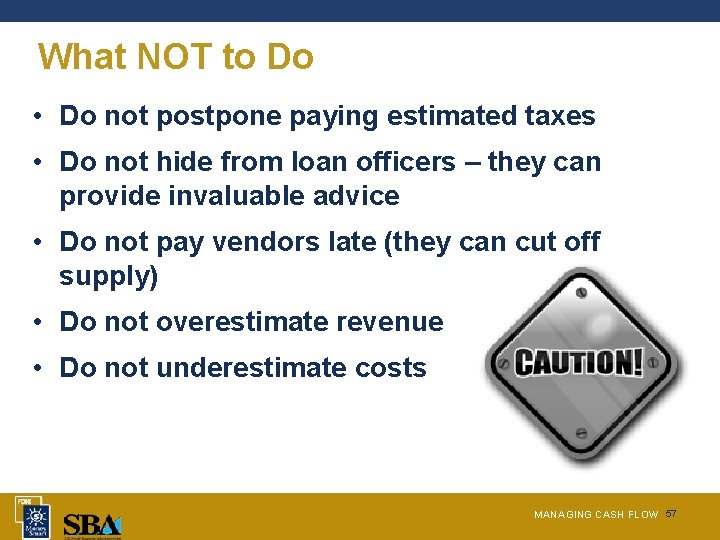
What NOT to Do • Do not postpone paying estimated taxes • Do not hide from loan officers – they can provide invaluable advice • Do not pay vendors late (they can cut off supply) • Do not overestimate revenue • Do not underestimate costs MANAGING CASH FLOW 57
Key Points to Remember 1. Managing cash flow is a core competency of small business ownership. 2. An opening balance sheet tells a compelling story. 3. A cash flow statement continues the story. Use it to monitor projected and actual income and expenses. 4. Plan for seasonal fluctuations. 5. Try to maintain a rapid cash conversion cycle. 6. Manage your paperwork like a pro. 7. Ask an accountant for advice. MANAGING CASH FLOW 58
Toolkit of Resources • Glossary of Cash Flow Terms • Cash Flow Statement Template See the Toolkit of Resources in your Participant Guide for more details. • Negotiating Better Terms • For More Information: technical assistance options – many of these are free! End of The Deep Dive MANAGING CASH FLOW 59
Evaluation Best Practices • Each module should be evaluated for two main reasons: – Evaluate the quality and impact of each module – Identify what is next 60
Evaluate for Quality and Impact • The Participant Guide for each module includes an evaluation form on the last page. • The forms are easy to complete. • Evaluation forms are effective tools for gauging immediate reactions to a class. 61
What’s Next • At the end of a class, conduct a debriefing conversation with the class. Ask, “What should happen next? ” • Scan the Parking Lot for questions that indicate a need for additional classes. • Interview guest experts for their ideas. They can offer great advice based on the questions the participants ask of them. 62
? Questions 63
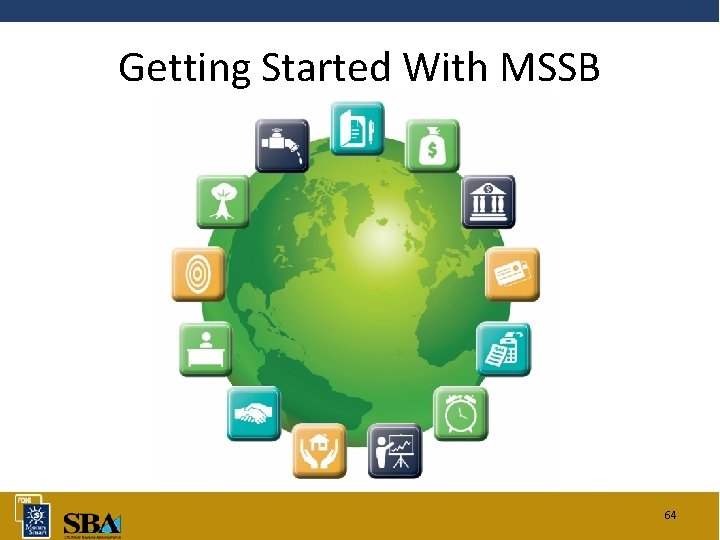
Getting Started With MSSB 64
Selecting Modules There is more than one way to customize a Money Smart Program 65
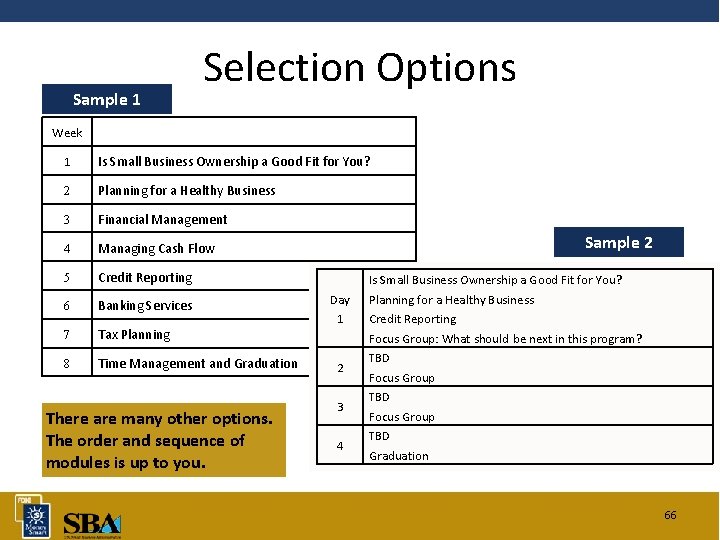
Sample 1 Selection Options Week 1 Is Small Business Ownership a Good Fit for You? 2 Planning for a Healthy Business 3 Financial Management 4 Managing Cash Flow 5 Credit Reporting 6 Banking Services 7 Tax Planning 8 Time Management and Graduation There are many other options. The order and sequence of modules is up to you. Sample 2 Day 1 Is Small Business Ownership a Good Fit for You? Planning for a Healthy Business Credit Reporting Focus Group: What should be next in this program? 2 TBD Focus Group 3 TBD Focus Group 4 TBD Graduation 66
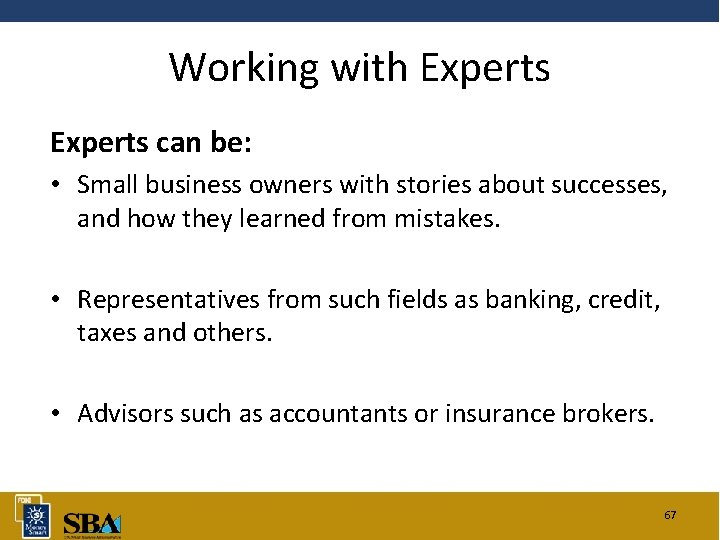
Working with Experts can be: • Small business owners with stories about successes, and how they learned from mistakes. • Representatives from such fields as banking, credit, taxes and others. • Advisors such as accountants or insurance brokers. 67
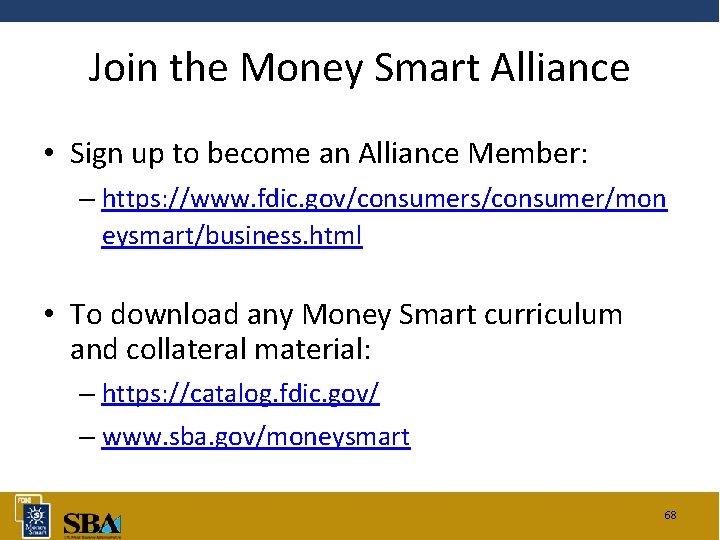
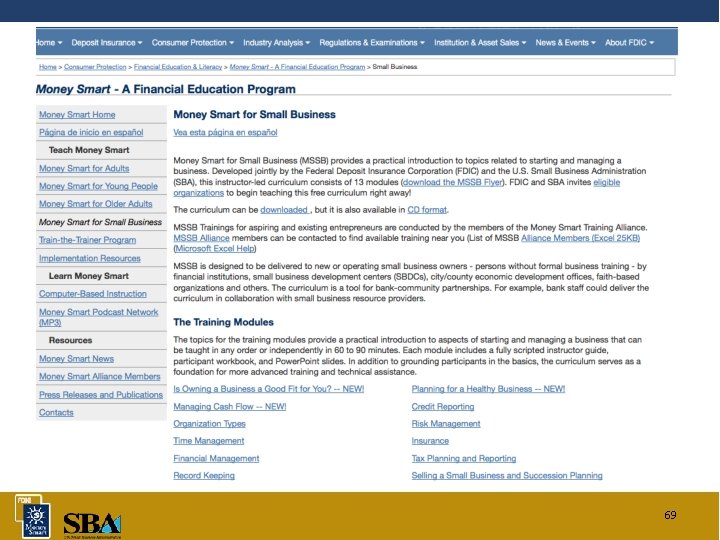
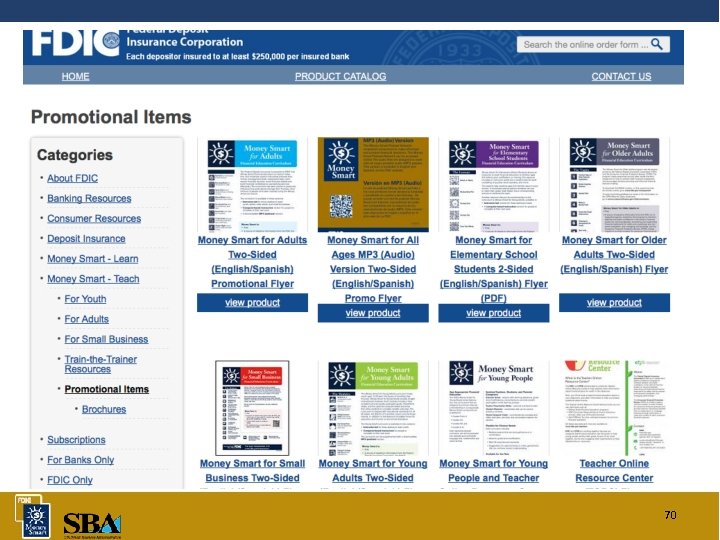
Join the Money Smart Alliance • Sign up to become an Alliance Member: – https: //www. fdic. gov/consumers/consumer/mon eysmart/business. html • To download any Money Smart curriculum and collateral material: – https: //catalog. fdic. gov/ – www. sba. gov/moneysmart 68
69
70
Success Tips • Resources • Tools • Tips 71
Learning Objectives • Recap • What it is • Why it was created • Who can benefit • How they benefit • Getting started! 72
Key Points To Remember • Curriculum is free • A stand-alone product • A complete package • Out-of-the box ready • Customizable • Objective information from the FDIC • Available in English and Spanish • An award-winning curriculum that can bring proven results 73
Parking Lot 74
THANK YOU! Presenter Name Title Organization Contact Information 75