
Trainings and capacity building activities in WHO Prequalification
Trainings and capacity building activities in WHO Prequalification Programme Quality Assurance and Safety: Medicines (QSM) Essential Medicines and Policy (EMP) Dr. Milan Smid
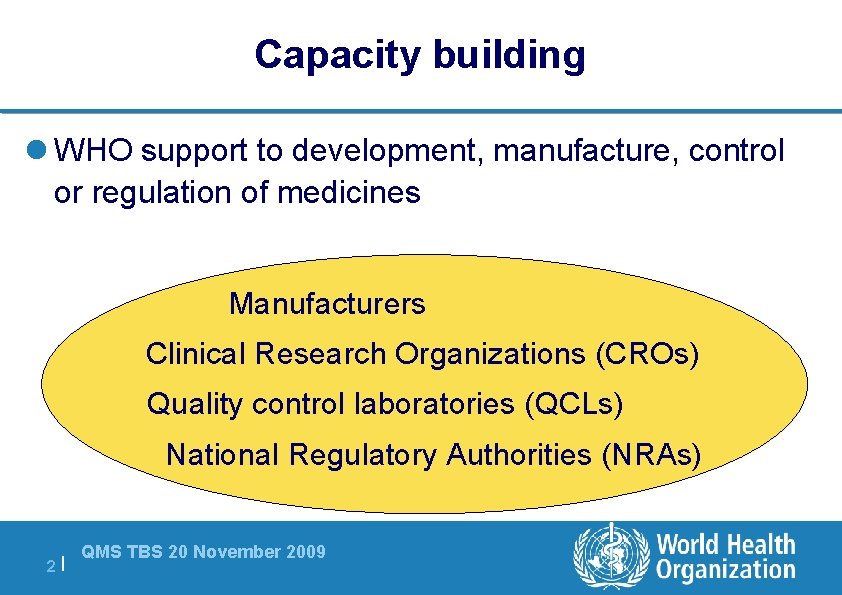
Capacity building l WHO support to development, manufacture, control or regulation of medicines Manufacturers Clinical Research Organizations (CROs) Quality control laboratories (QCLs) National Regulatory Authorities (NRAs) 2| QMS TBS 20 November 2009
Capacity building l l l How to manufacture according to WHO Good Manufacturing Practice (GMP) standards How to compile a dossier for WHO Prequalification Programme How NRAs can benefit from WHO Prequalification Programme How to be in compliance with Good Practices for Quality Control (QC) laboratories Relevant sources of information Stimulate submissions to WHO Prequalification Programme Stimulate submissions for prequalification of QC laboratories 3| QMS TBS 20 November 2009
Capacity building Prequalification Programme is in itself capacity building: l Learning from assessment (deficiency) letters and technical meetings l Learning from GMP and GCP inspections l Learning from WHOPARs/WHOPIRs etc 4| QMS TBS 20 November 2009
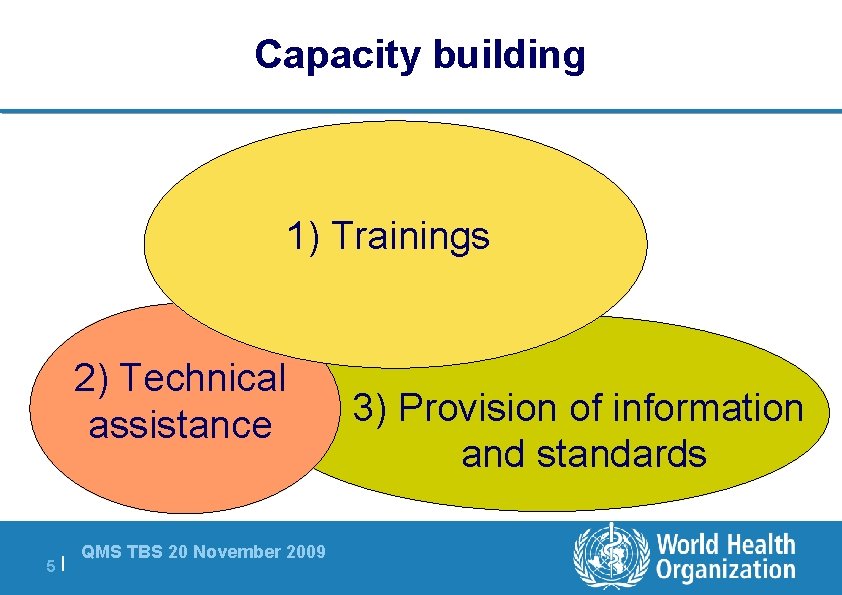
Capacity building 1) Trainings 2) Technical assistance 5| QMS TBS 20 November 2009 3) Provision of information and standards
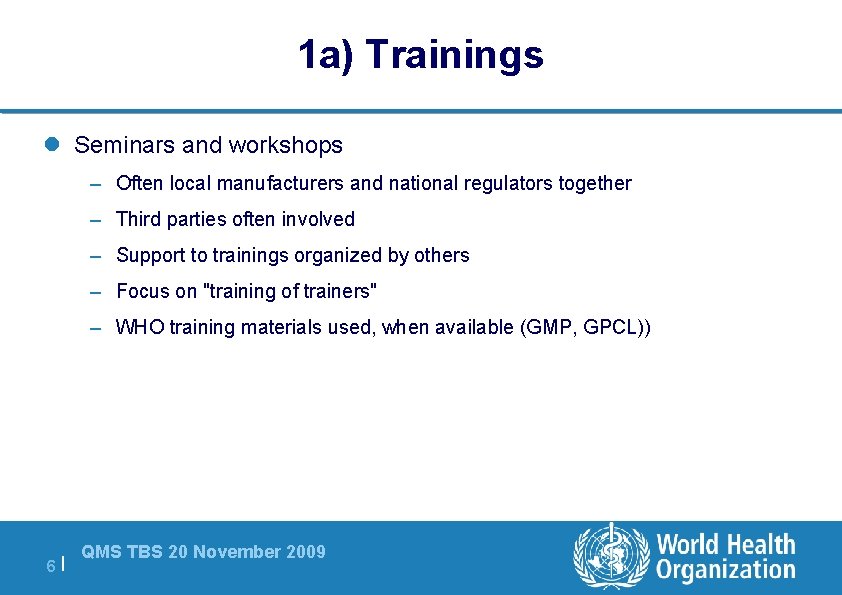
1 a) Trainings l Seminars and workshops – Often local manufacturers and national regulators together – Third parties often involved – Support to trainings organized by others – Focus on "training of trainers" – WHO training materials used, when available (GMP, GPCL)) 6| QMS TBS 20 November 2009
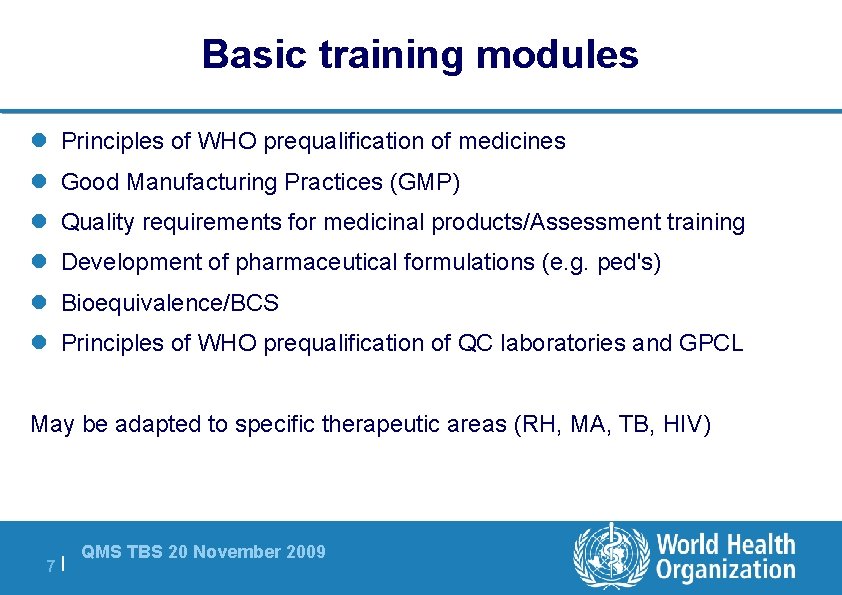
Basic training modules l Principles of WHO prequalification of medicines l Good Manufacturing Practices (GMP) l Quality requirements for medicinal products/Assessment training l Development of pharmaceutical formulations (e. g. ped's) l Bioequivalence/BCS l Principles of WHO prequalification of QC laboratories and GPCL May be adapted to specific therapeutic areas (RH, MA, TB, HIV) 7| QMS TBS 20 November 2009
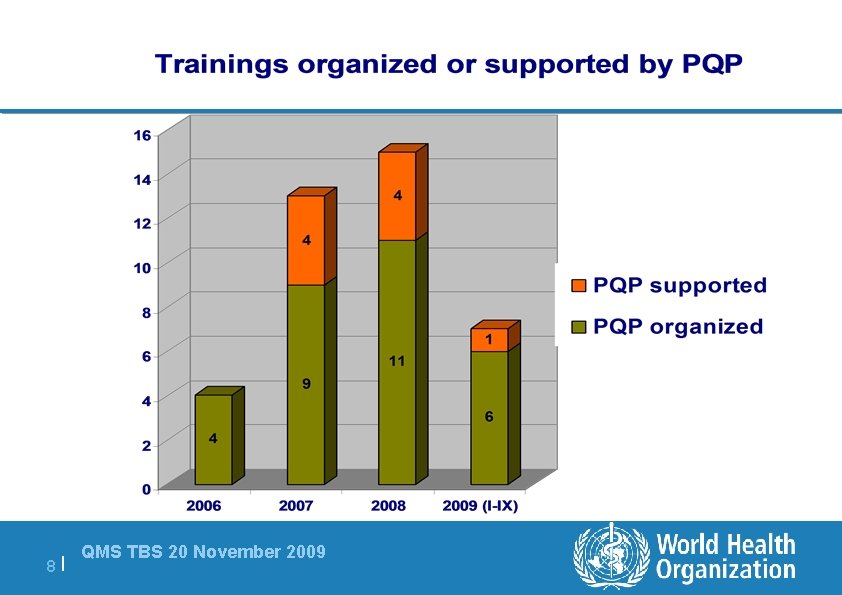
8| QMS TBS 20 November 2009
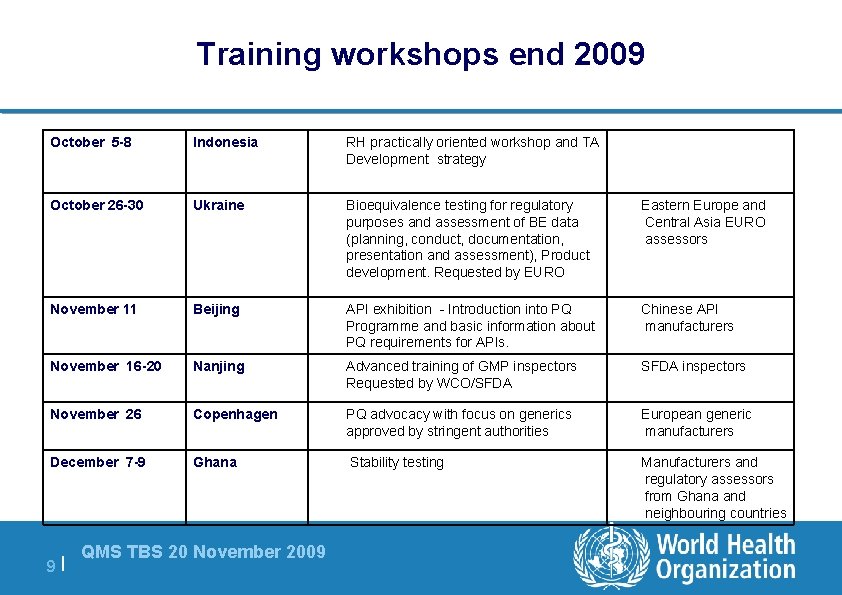
Training workshops end 2009 October 5 -8 Indonesia RH practically oriented workshop and TA Development strategy October 26 -30 Ukraine Bioequivalence testing for regulatory purposes and assessment of BE data (planning, conduct, documentation, presentation and assessment), Product development. Requested by EURO Eastern Europe and Central Asia EURO assessors November 11 Beijing API exhibition - Introduction into PQ Programme and basic information about PQ requirements for APIs. Chinese API manufacturers November 16 -20 Nanjing Advanced training of GMP inspectors Requested by WCO/SFDA inspectors November 26 Copenhagen PQ advocacy with focus on generics approved by stringent authorities European generic manufacturers December 7 -9 Ghana Stability testing Manufacturers and regulatory assessors from Ghana and neighbouring countries 9| QMS TBS 20 November 2009
10 | QMS TBS 20 November 2009
11 | QMS TBS 20 November 2009
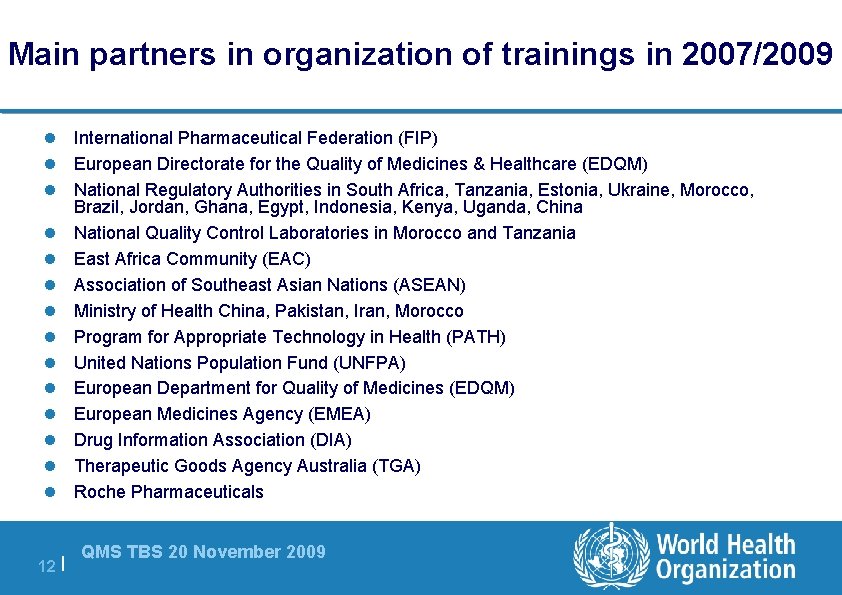
Main partners in organization of trainings in 2007/2009 l International Pharmaceutical Federation (FIP) l European Directorate for the Quality of Medicines & Healthcare (EDQM) l National Regulatory Authorities in South Africa, Tanzania, Estonia, Ukraine, Morocco, Brazil, Jordan, Ghana, Egypt, Indonesia, Kenya, Uganda, China l National Quality Control Laboratories in Morocco and Tanzania l East Africa Community (EAC) l Association of Southeast Asian Nations (ASEAN) l Ministry of Health China, Pakistan, Iran, Morocco l Program for Appropriate Technology in Health (PATH) l United Nations Population Fund (UNFPA) l European Department for Quality of Medicines (EDQM) l European Medicines Agency (EMEA) l Drug Information Association (DIA) l Therapeutic Goods Agency Australia (TGA) l Roche Pharmaceuticals 12 | QMS TBS 20 November 2009
1 b) Individualized trainings l Involvement of assessors from NRAs in CPH sessions l Involvement of inspectors from NRAs in PQ inspections l 3 -month rotation of assessors from NRAs* at WHO HQ Capacity building of experts from NRAs (regional resource persons - improvement of NRA practices/procedures, trainings, networking, product issues) *Ethiopia, Kenya, Tanzania, Uganda, Ukraine, Zimbabwe, Ghana… 13 | QMS TBS 20 November 2009
2) Technical Assistance l Provision of expert consultants to – Manufacturers – QC laboratories l Assistance focuses on – GMP, GCP or GLP compliance – Data development and compilation of dossier – Regulatory guidance l Assistance is separate from assessments/inspections and may be followed by specific training 14 | QMS TBS 20 November 2009
Conditions for technical assistance Manufacturers: l Participation in the PQ programme l Capable and willing to improve l Location in a developing country Products: l Inclusion in the Invitation for Expression of Interest (EOI) l High public health value l Poorly represented on the Prequalification list. 15 | QMS TBS 20 November 2009
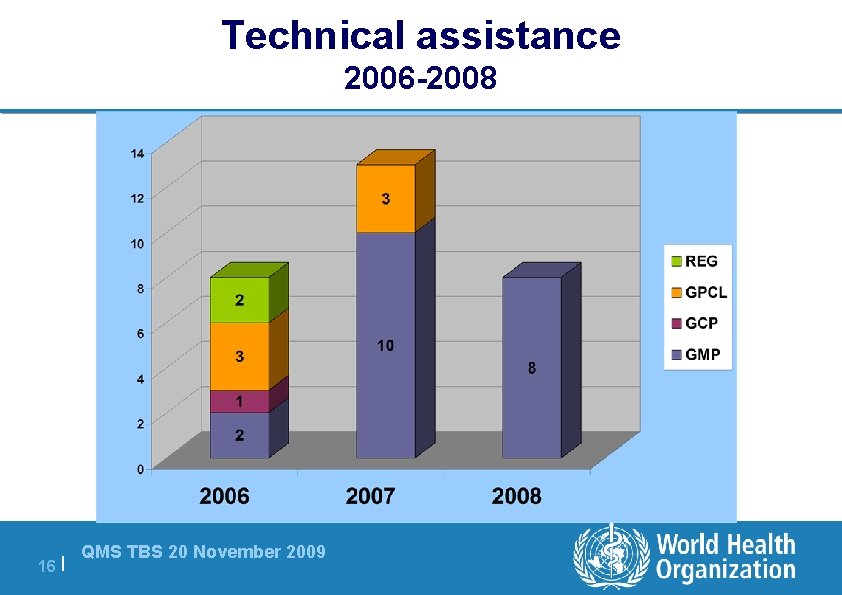
Technical assistance 2006 -2008 16 | QMS TBS 20 November 2009
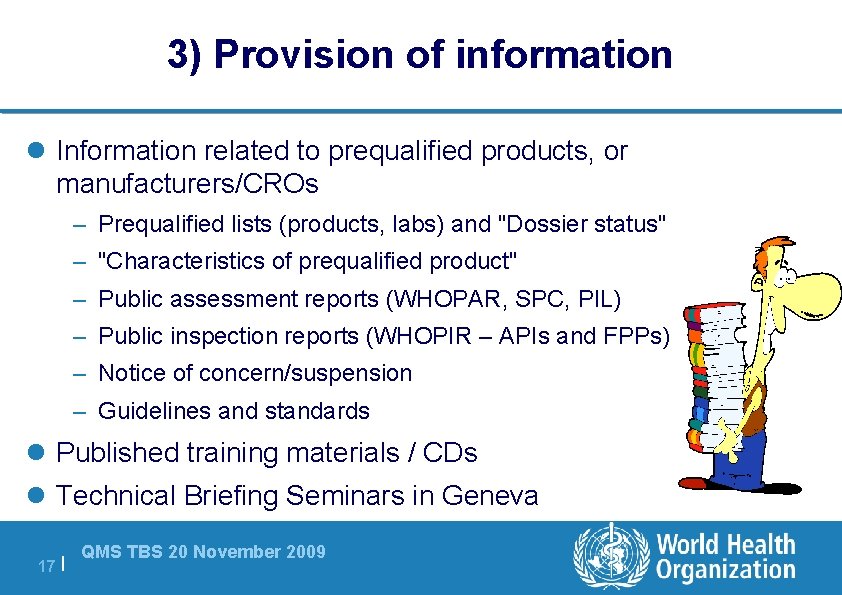
3) Provision of information l Information related to prequalified products, or manufacturers/CROs – Prequalified lists (products, labs) and "Dossier status" – "Characteristics of prequalified product" – Public assessment reports (WHOPAR, SPC, PIL) – Public inspection reports (WHOPIR – APIs and FPPs) – Notice of concern/suspension – Guidelines and standards l Published training materials / CDs l Technical Briefing Seminars in Geneva 17 | QMS TBS 20 November 2009
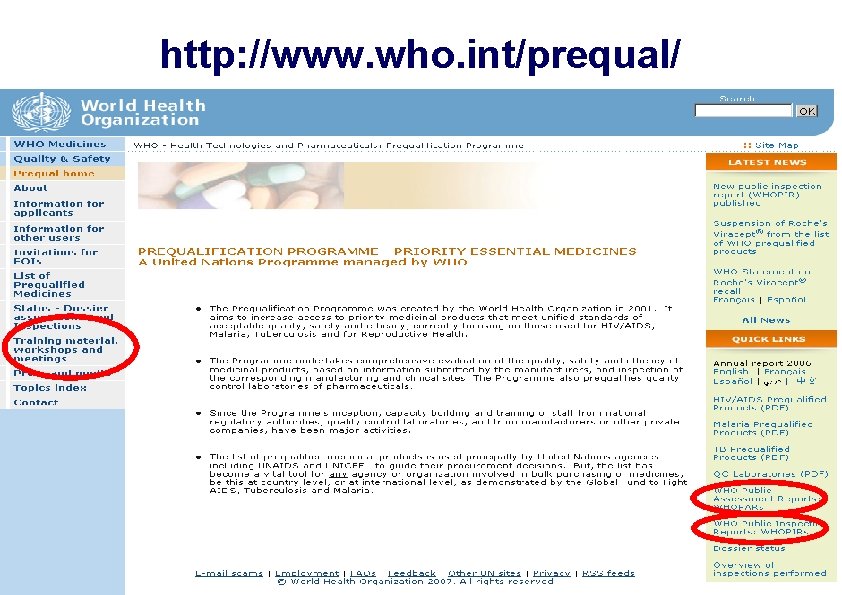
http: //www. who. int/prequal/ 18 | QMS TBS 20 November 2009
- Slides: 18