
TrainingofTrainers Division of Instructional Support Objectives Content Objective
Training-of-Trainers Division of Instructional Support
Objectives Content Objective – Participants will explore how to plan effective instruction that addresses the language development process of ELLs identified at the beginning and intermediate proficiency levels in grade 3 or higher. Language Objective – Participants will discuss how to design instruction to provide an intensive and ongoing foundation in second language acquisition. Division of Instructional Support
Navigating the ELPS Instructional Tool • *Open the tool and read p. 5. • Discuss with a partner why this tool can help you target students who are identified as beginning, and intermediate. Division of Instructional Support
• • • What Will You Use to Craft Your Lesson? TEKS ELPS Assessment results Student data ELPS Instructional Tool Division of Instructional Support How I am going to do it?
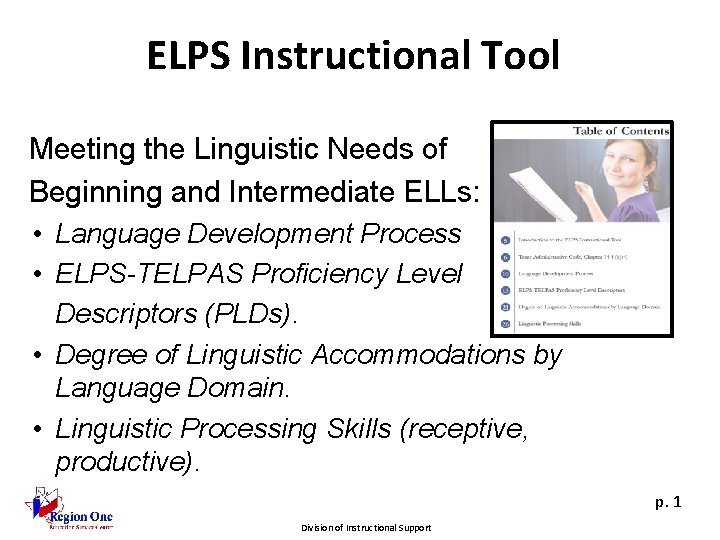
ELPS Instructional Tool Meeting the Linguistic Needs of Beginning and Intermediate ELLs: • Language Development Process • ELPS-TELPAS Proficiency Level Descriptors (PLDs). • Degree of Linguistic Accommodations by Language Domain. • Linguistic Processing Skills (receptive, productive). p. 1 Division of Instructional Support
ELPS in Review Statutory Requirement 19 Texas Administrative Code, § 74. 4 Curriculum Requirements Subchapter A. Required Curriculum § 74. 4 English Language Proficiency Standards p. 6 Division of Instructional Support
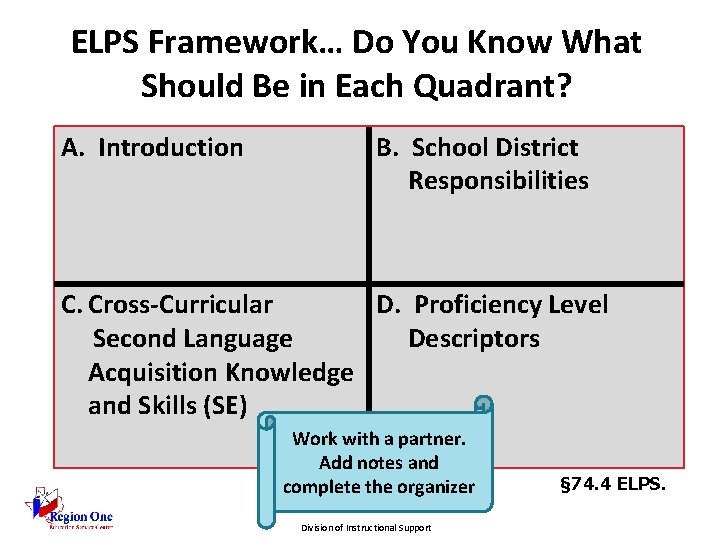
ELPS Framework… Do You Know What Should Be in Each Quadrant? A. Introduction B. School District Responsibilities C. Cross-Curricular D. Proficiency Level Second Language Descriptors Acquisition Knowledge and Skills (SE) Work with a partner. Add notes and complete the organizer Division of Instructional Support § 74. 4 ELPS.
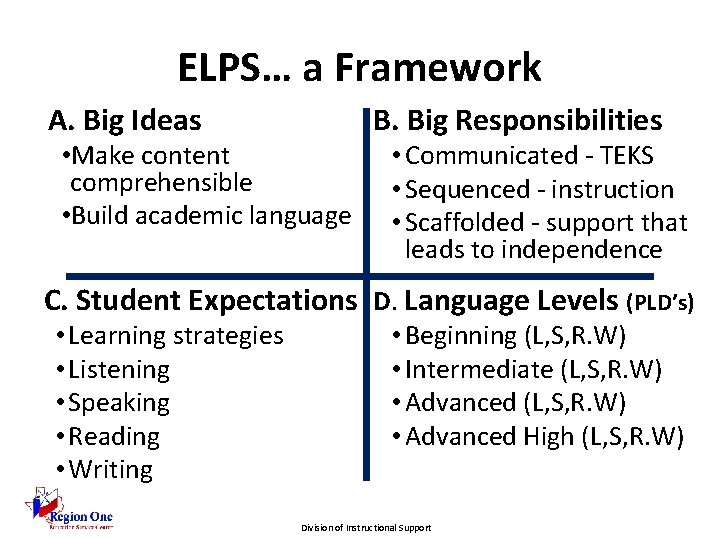
ELPS… a Framework A. Big Ideas • Make content comprehensible • Build academic language B. Big Responsibilities • Communicated - TEKS • Sequenced - instruction • Scaffolded - support that leads to independence C. Student Expectations D. Language Levels (PLD’s) • Learning strategies • Listening • Speaking • Reading • Writing • Beginning (L, S, R. W) • Intermediate (L, S, R. W) • Advanced High (L, S, R. W) Division of Instructional Support
High Five • Mingle around the room. • Find a partner and “high five” with him/her. • Discuss what the ELPS mean according to the Texas Administrative Code (Statute 74. 4). • Discuss what they mean to you according to your responsibilities as a teacher of ELLs. • Share with the group. How are we addressing the needs of ELLS at my campus? What are we doing to instruct them? Division of Instructional Support
We are. . . § 74. 4 ELPS (a) Introduction • ELPS part of required curriculum • ELL need to know social and academic language • Integrate second language acquisition with content area instruction for all language skills • ELL must read, write, listen and speak with increasing complexity • ELPS SE apply K-12 • Level descriptors serve as a road map Division of Instructional Support
§ 74. 4 ELPS (b) (1) to (b) (3) School Districts Shall… • Identify students language proficiency levels. • Provide instruction of the foundation and enrichment curriculum according to the student’s English language proficiency. • Provide content-based instruction based on ELPS standards in a manner that is linguistically accommodated. p. 9 Division of Instructional Support
Talking Chips • Each person will take a chip (marker). • If you want to talk, place your marker in the center of the table. • You can not talk again until everyone has placed his/her marker in the center of the table • Once all the markers have been used you can retrieve your marker and any one can talk again Division of Instructional Support 1
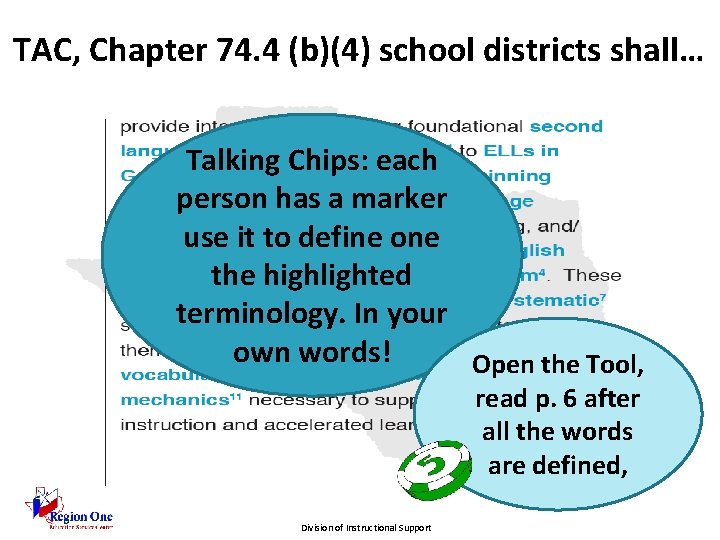
TAC, Chapter 74. 4 (b)(4) school districts shall… Talking Chips: each person has a marker use it to define one the highlighted terminology. In your own words! Open the Tool, read p. 6 after all the words are defined, Division of Instructional Support
Word/Definition Matching Game • Get a set of cards (at your table). • With your ELPS Instructional Tool closed. • Match the words to the corresponding definition or statement. Objective: To understand TAC, Chapter 74. 4 (b) (4). Use your Tool, p. 7 to check your answers p. 7 Division of Instructional Support
Second Language Acquisition • What is second language acquisition? • What are receptive skills? • What are expressive skills? • Read silently p. 8. Reflect. p. 8 Division of Instructional Support
Paraphrase Passport • In groups, one of your members' will discuss what Receptive Skills are (p. 8) • Another person must correctly paraphrase that statement, a third person will give feedback with regard to the completeness and accuracy of the paraphrase. • A fourth person will discuss the “Expressive Skills”, a fifth person will paraphrase • Any member can help giving cues or feedback. Division of Instructional Support
Second Language Acquisition Let’s discuss the content of p. 8. Why is it important to remember that second language acquisition is an interdependent process? • What is second language acquisition? • What are receptive skills? • What are expressive skills? • Share with our whole group. p. 8 Division of Instructional Support
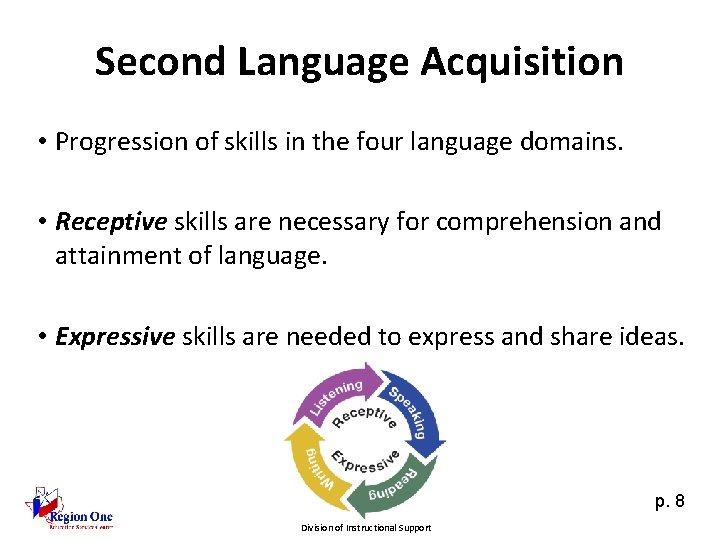
Second Language Acquisition • Progression of skills in the four language domains. • Receptive skills are necessary for comprehension and attainment of language. • Expressive skills are needed to express and share ideas. p. 8 Division of Instructional Support
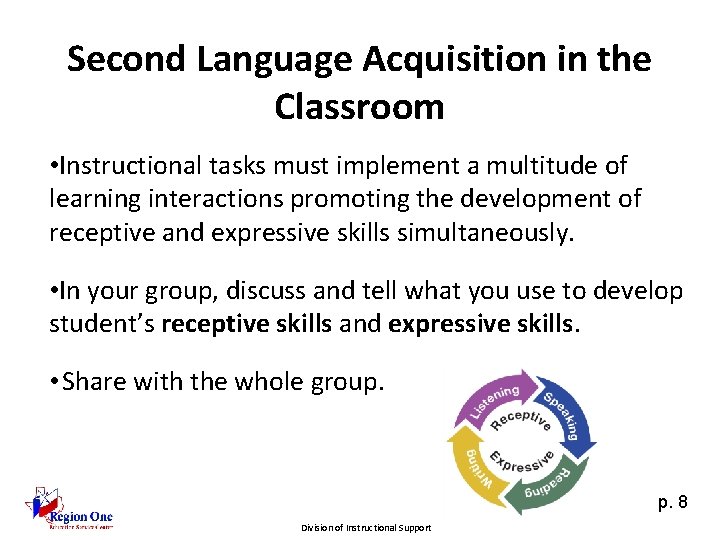
Second Language Acquisition in the Classroom • Instructional tasks must implement a multitude of learning interactions promoting the development of receptive and expressive skills simultaneously. • In your group, discuss and tell what you use to develop student’s receptive skills and expressive skills. • Share with the whole group. p. 8 Division of Instructional Support
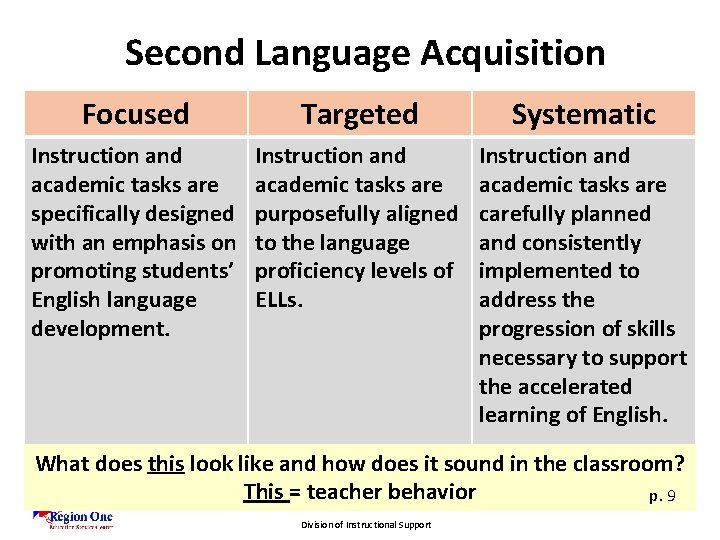
Second Language Acquisition Focused Targeted Systematic Instruction and academic tasks are specifically designed with an emphasis on promoting students’ English language development. Instruction and academic tasks are purposefully aligned to the language proficiency levels of ELLs. Instruction and academic tasks are carefully planned and consistently implemented to address the progression of skills necessary to support the accelerated learning of English. What does this look like and how does it sound in the classroom? This = teacher behavior p. 9 Division of Instructional Support
Timed Turns: How Are the ELPS Implemented? • No one can talk for more than a minute. Have a Timekeeper on each group. • Take turns sharing. How do you include linguistic accommodations in the design and delivery of content-based instruction? (routines, activities, and strategies to develop ELL’s receptive and expressive skills). • Volunteers share with our whole group How often? Examples on p. 9 Division of Instructional Support
Count-Off 1 to 4 • Go to p. 9 of your ELPS Instructional Tool and read on your own the section titled: “Foundations of English Language. ” • Continue taking turns and timing the speakers • You will discuss each of the four bulleted statements that will be shown on the next slide. • You will discuss how the information can help teachers support ELLs English language development and TEKS based content comprehension. p. 9 Division of Instructional Support
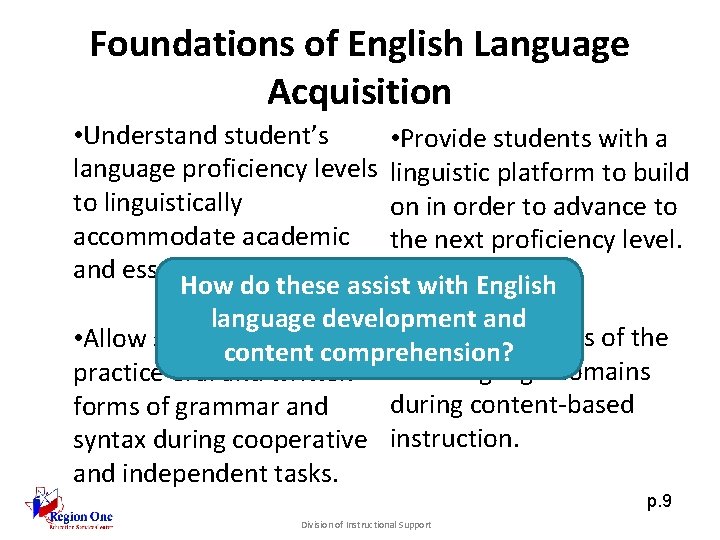
Foundations of English Language Acquisition • Understand student’s • Provide students with a language proficiency levels linguistic platform to build to linguistically on in order to advance to accommodate academic the next proficiency level. and essential vocabulary. How do these assist with English language development and • Include elements of the • Allow students to content comprehension? practice oral and written four language domains during content-based forms of grammar and syntax during cooperative instruction. and independent tasks. p. 9 Division of Instructional Support
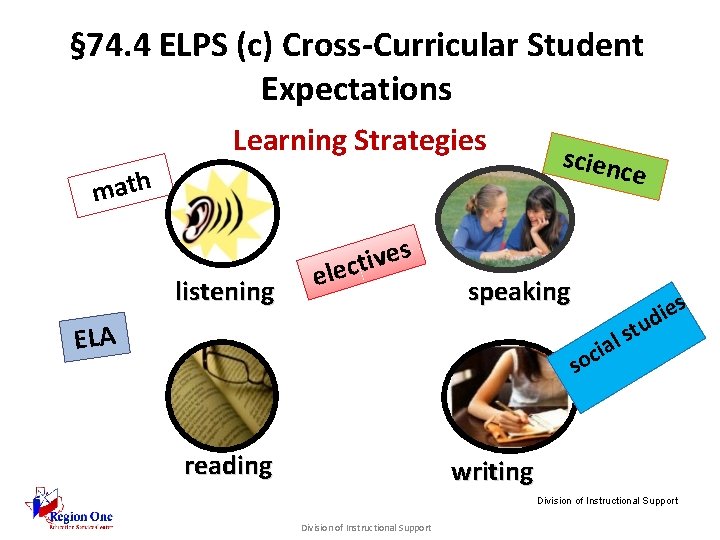
§ 74. 4 ELPS (c) Cross-Curricular Student Expectations Learning Strategies math listening s e v i lect e scienc e speaking s e i d u t s al i c o ELA s reading writing Division of Instructional Support
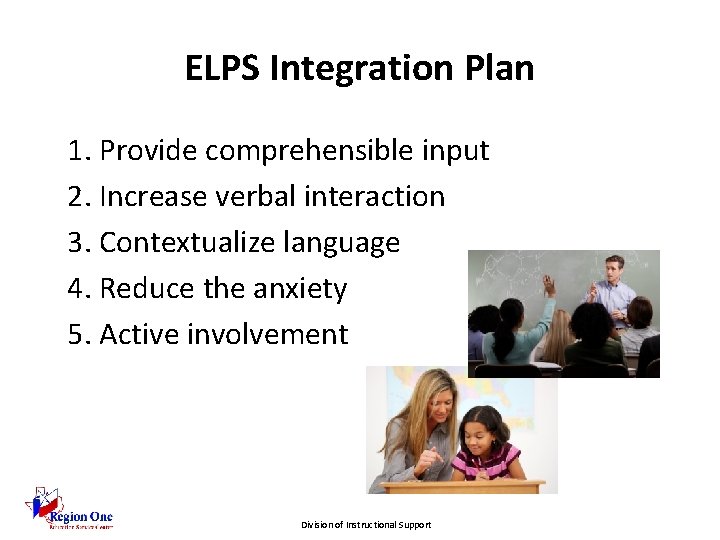
ELPS Integration Plan 1. Provide comprehensible input 2. Increase verbal interaction 3. Contextualize language 4. Reduce the anxiety 5. Active involvement Division of Instructional Support
Language Development Process Includes… • • • PLDs Linguistic Accommodations Language Development Activities Supplementary Activities Progress Monitoring pp 10 -11 Division of Instructional Support
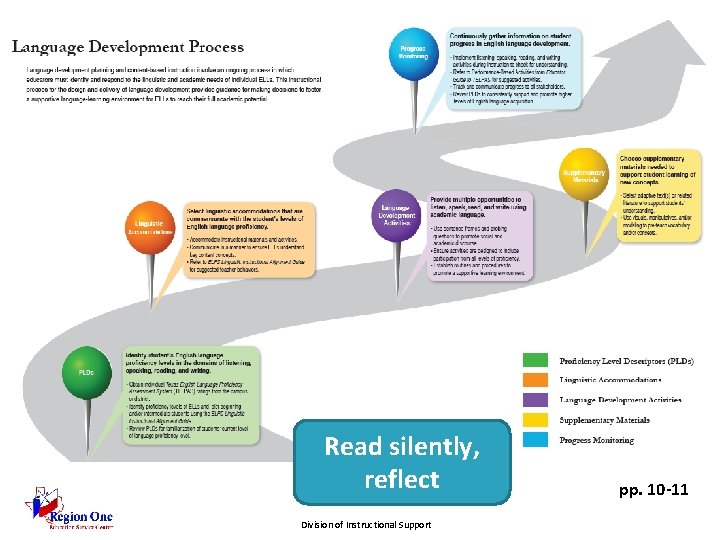
Read silently, reflect Division of Instructional Support pp. 10 -11
Dice Processing Activity • Work in pairs or in groups of 4. Take turns rolling the dice, which ever term it lands on, that person will use that term to complete a question stem(s). • Plug the Language Development Process term in the blank space and read the complete sentence to your group. • Have group conversations to agree, disagree or add to the response. • Take turns until all the terms have been used to complete the question stems. Division of Instructional Support 1
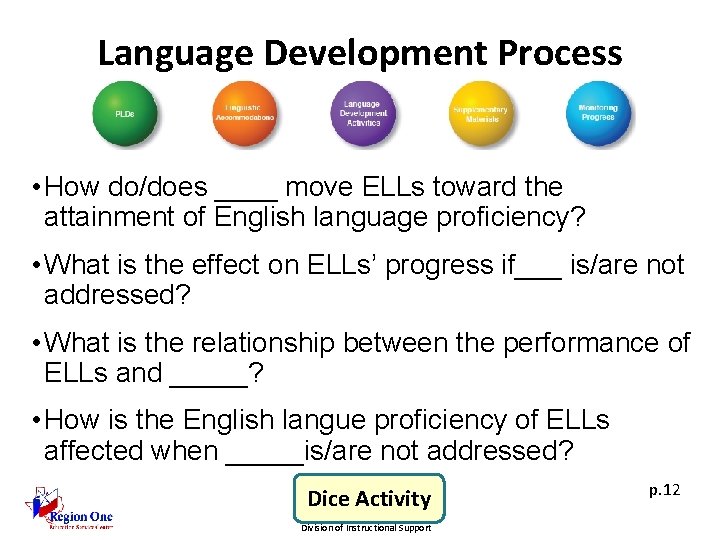
Language Development Process • How do/does ____ move ELLs toward the attainment of English language proficiency? • What is the effect on ELLs’ progress if___ is/are not addressed? • What is the relationship between the performance of ELLs and _____? • How is the English langue proficiency of ELLs affected when _____is/are not addressed? Dice Activity Division of Instructional Support p. 12
What is Language Proficiency? Think-Pair-Share • “So what were the conversations? ” Share. • Turn to your partner and discuss what is language proficiency. Division of Instructional Support
What is Language Proficiency? Language proficiency is the level of skills demonstrated when receiving messages (input) and expressing meaning (output). p. 13 Division of Instructional Support
Read-Reflect • What is a PLD? • Why should I know how to use them? • Read silently p. 14 and the first paragraph of p. 15. Highlight key words and concepts as you read. p. 14 -15 Division of Instructional Support
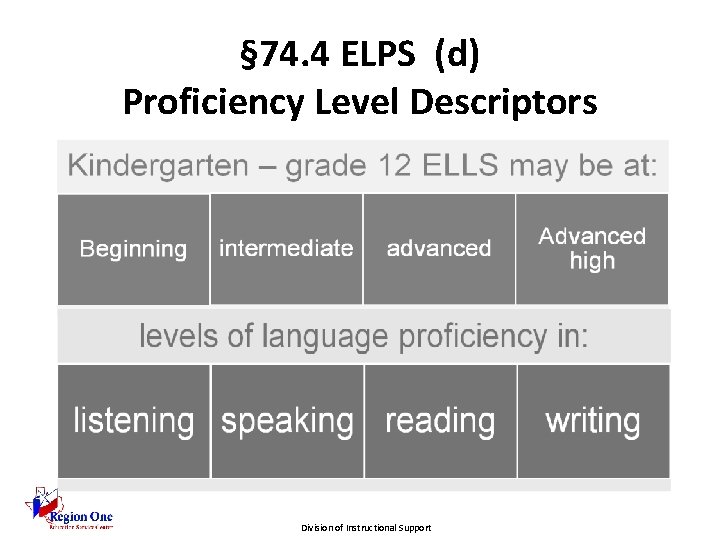
§ 74. 4 ELPS (d) Proficiency Level Descriptors Division of Instructional Support
Using Language Proficiency Levels for Classroom Learning Interactions Read-Reflect-Share • Now that you read page 14 and the first paragraph of page 15 on your own, • Reflect on the linguistic needs of beginning and intermediate students • Explain what is the purpose of this section of the ELPS Instructional Tool. p. 14 -15 Division of Instructional Support
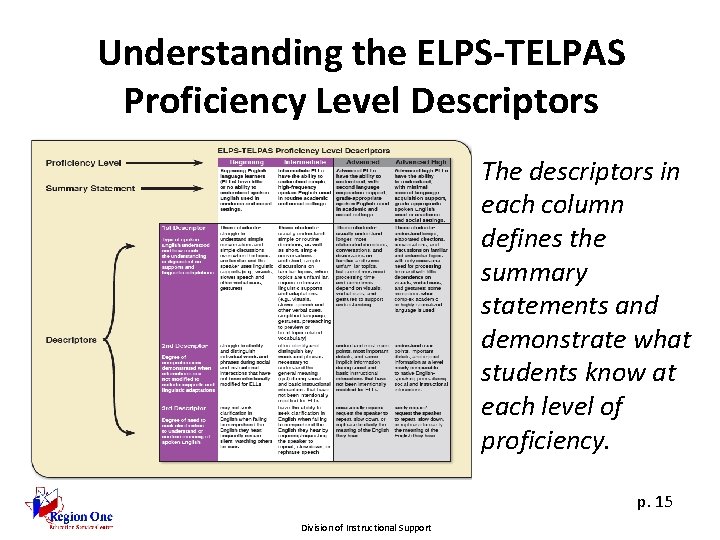
Understanding the ELPS-TELPAS Proficiency Level Descriptors The descriptors in each column defines the summary statements and demonstrate what students know at each level of proficiency. p. 15 Division of Instructional Support
ELPS-TELPAS PLDs • Read the information on p. 16. • Count-off 1 -4. Assign a language domain p. 17 -20. • Each person will review the descriptors of their assigned language domain (listening, speaking, reading, and writing). • Create a T-Chart to compare and contrast all the descriptors of a beginning and intermediate student. pp. 17 -20 Division of Instructional Support
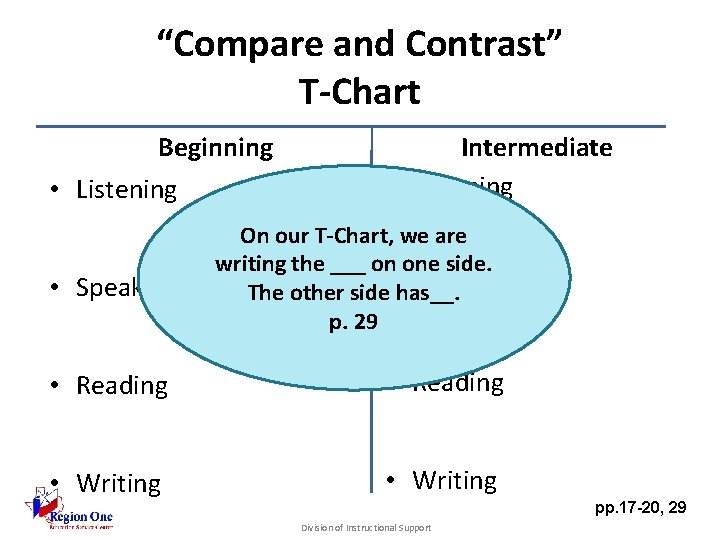
“Compare and Contrast” T-Chart Beginning • Listening • Speaking Intermediate • Listening On our T-Chart, we are writing the ___ on one side. Speaking The other side • has__. p. 29 • Reading • Writing pp. 17 -20, 29 Division of Instructional Support
Planning Linguistically Accommodated Instruction Using the ELPS-TELPAS PLDs • Take into account the ELPS Cross-Curricular student expectations and the PLDs. • Choose appropriate lesson activities, supplementary materials and linguistic accommodations. Familiarization with the PLDS allows educators to work efficiently within students’ current proficiency levels and assist students in developing the skills necessary to progress the next proficiency level. Re-visit p. 16 Division of Instructional Support
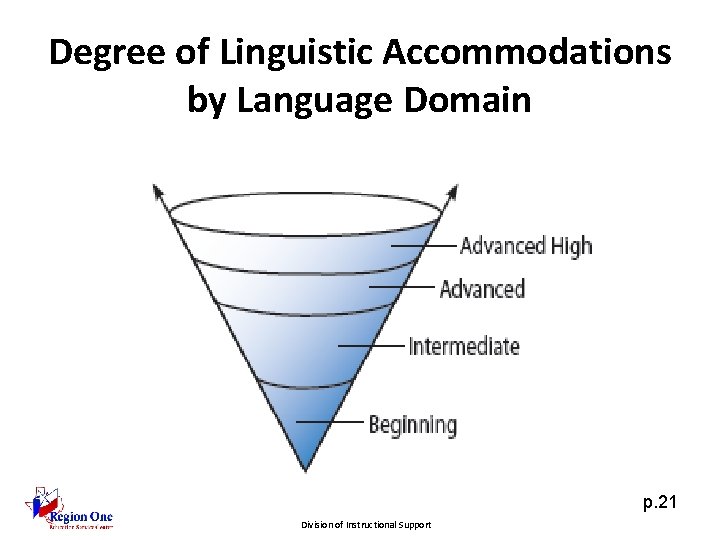
Degree of Linguistic Accommodations by Language Domain p. 21 Division of Instructional Support
Jig-Saw Processing Activity • The next section provides an overview of the degree of linguistic accommodations by language domain. • The tables on p. 22 -25 are color coded by language domain. • Work in groups of 4 and assign one of the language domains to each group member. • Each person will read and share the degree of linguistic accommodations for a Beginner or Intermediate student. p. 22 Division of Instructional Support
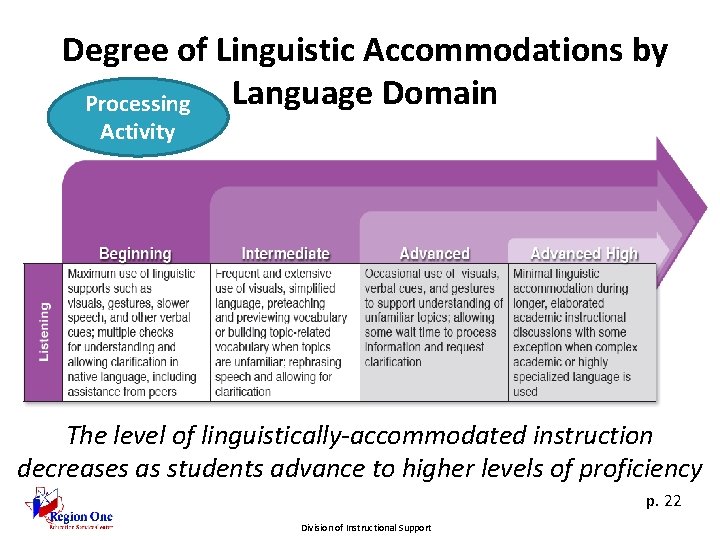
Degree of Linguistic Accommodations by Language Domain Processing Activity The level of linguistically-accommodated instruction decreases as students advance to higher levels of proficiency p. 22 Division of Instructional Support
Timed Turns: Comparing Degrees of Linguistic Accommodations • No one can talk for more than a minute. Have a Timekeeper on each group. • Take turns sharing the domain’s classroom activities, teacher supports, student outcomes, and teacher tips that can be used to help children move from simple to complex language. • Volunteers share what they learn about the “Teacher Tips” of each domain with our whole group. Division of Instructional Support
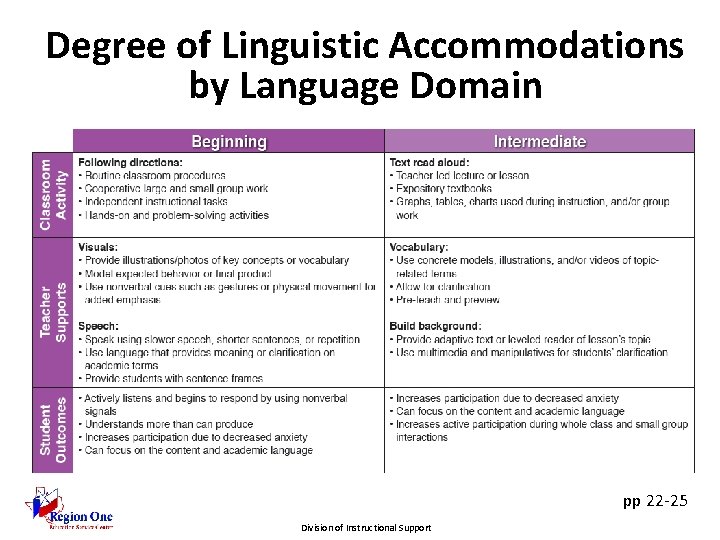
Degree of Linguistic Accommodations by Language Domain pp 22 -25 Division of Instructional Support
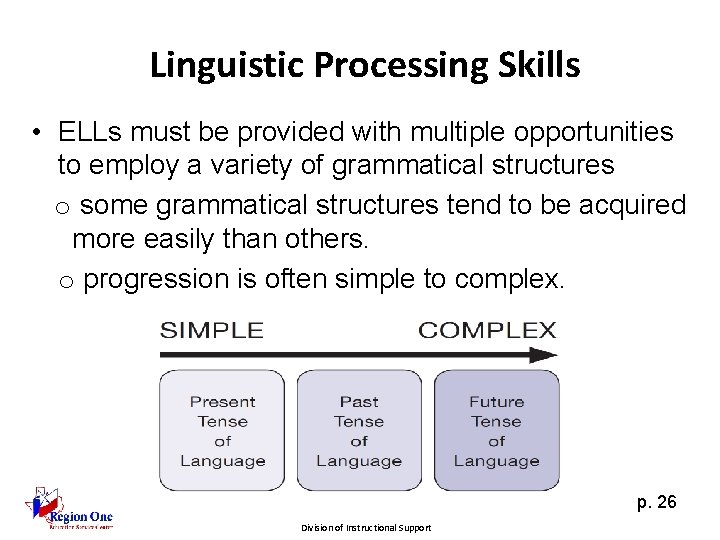
Linguistic Processing Skills • ELLs must be provided with multiple opportunities to employ a variety of grammatical structures o some grammatical structures tend to be acquired more easily than others. o progression is often simple to complex. p. 26 Division of Instructional Support
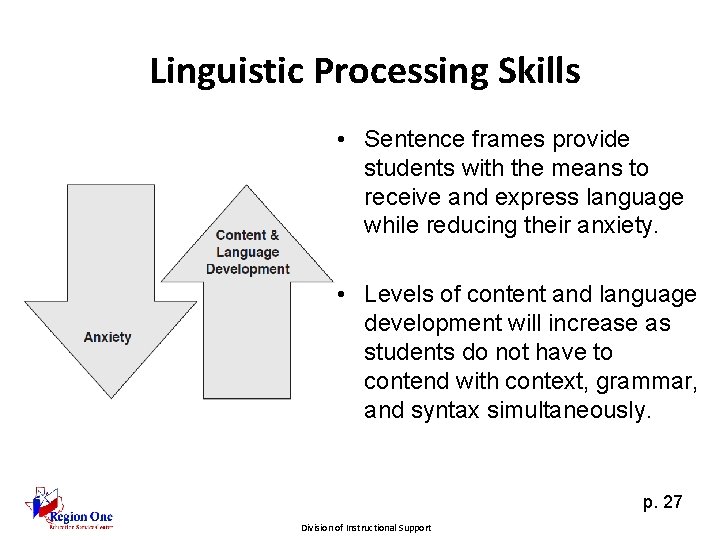
Linguistic Processing Skills • Sentence frames provide students with the means to receive and express language while reducing their anxiety. • Levels of content and language development will increase as students do not have to contend with context, grammar, and syntax simultaneously. p. 27 Division of Instructional Support
Elements of Appropriate “Leveled” Questions • Provide cues and probing question that focus on what is important. • High cognitive questions result in deeper comprehension than low-cognitive level questions. • Pose a question and give time before you ask students to respond. It allows ELLs students to process their thoughts and increase student participation. • Probing questions are effective teaching tools when used with sentence stems. Division of Instructional Support
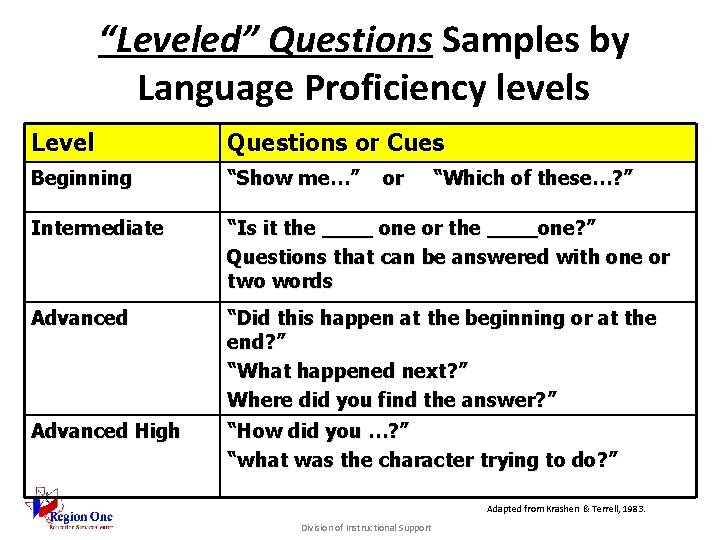
“Leveled” Questions Samples by Language Proficiency levels Level Questions or Cues Beginning “Show me…” Intermediate “Is it the ____ one or the ____one? ” Questions that can be answered with one or two words Advanced “Did this happen at the beginning or at the end? ” “What happened next? ” Where did you find the answer? ” Advanced High “How did you …? ” “what was the character trying to do? ” or “Which of these…? ” Adapted from Krashen & Terrell, 1983. Division of Instructional Support
Steps to Create “Leveled Questions” 1. Observe, document your student’s language levels (keep updating). 2. Choose, gather materials: Visuals, artifacts help students demonstrate their understanding. 3. Plan a hierarchy of questions: Plan a series of appropriate questions at different levels to clarify concepts. Division of Instructional Support
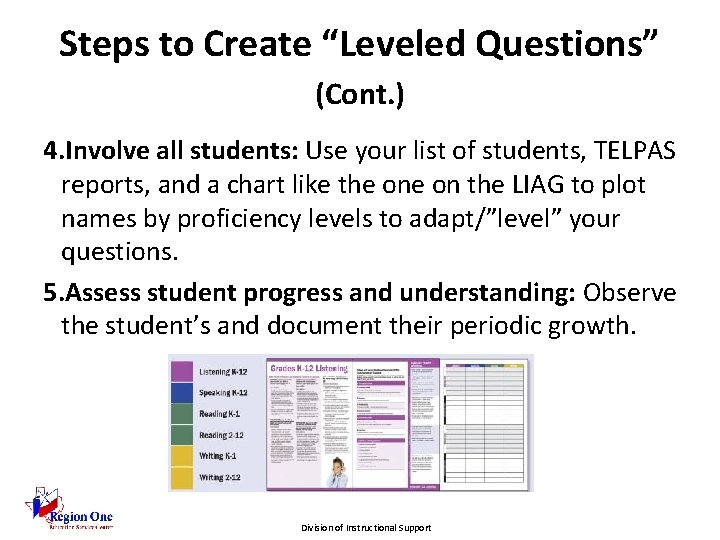
Steps to Create “Leveled Questions” (Cont. ) 4. Involve all students: Use your list of students, TELPAS reports, and a chart like the on the LIAG to plot names by proficiency levels to adapt/”level” your questions. 5. Assess student progress and understanding: Observe the student’s and document their periodic growth. Division of Instructional Support
Leveled Probing Questions • Use any lesson, an index card and the Instructional Tool. Now, let’s put the pieces together! • Select a sentence stem to create a probing question for a beginner or for an intermediate ELL student. • Write it on an index card, pose the probing question to your group, let somebody answer. • Explain why you think your question can promote language development. • Check each other’s sample questions to see if they match the appropriate proficiency level. Division of Instructional Support
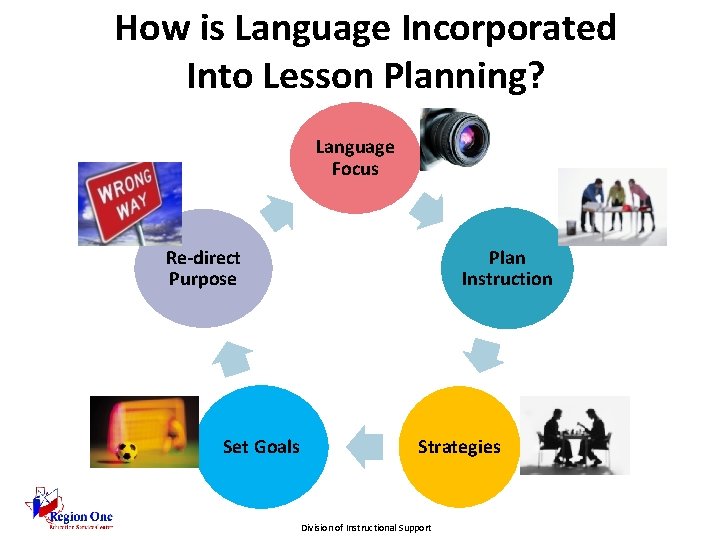
How is Language Incorporated Into Lesson Planning? Language Focus Plan Instruction Re-direct Purpose Set Goals Strategies Division of Instructional Support
ELPS Standards, the TEKS, and the TELPAS must align with grade level content standards and be based on “academic language”. So…. . How Do We Plan Instruction? Division of Instructional Support
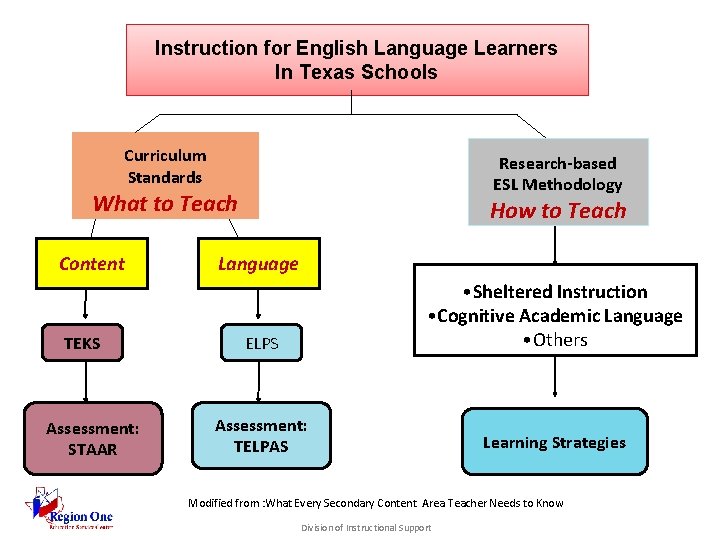
Instruction for English Language Learners In Texas Schools Curriculum Standards Research-based ESL Methodology What to Teach Content TEKS Assessment: STAAR How to Teach Language ELPS • Sheltered Instruction • Cognitive Academic Language • Others Assessment: TELPAS Learning Strategies Modified from : What Every Secondary Content Area Teacher Needs to Know Division of Instructional Support
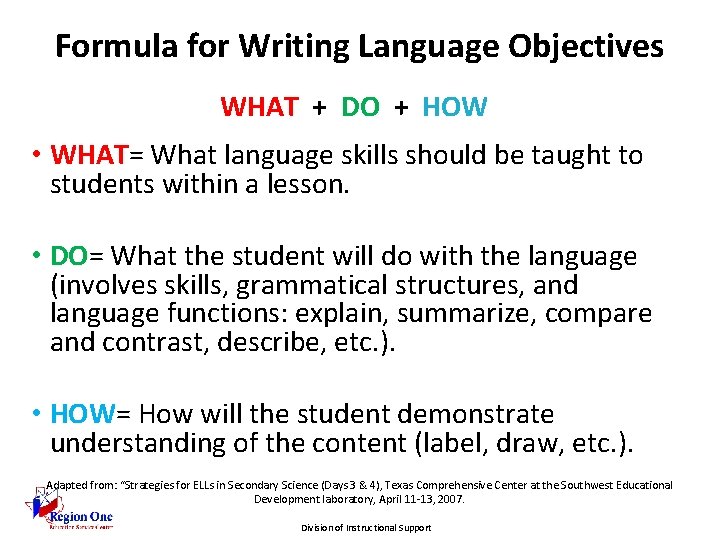
Formula for Writing Language Objectives WHAT + DO + HOW • WHAT= What language skills should be taught to students within a lesson. • DO= What the student will do with the language (involves skills, grammatical structures, and language functions: explain, summarize, compare and contrast, describe, etc. ). • HOW= How will the student demonstrate understanding of the content (label, draw, etc. ). Adapted from: “Strategies for ELLs in Secondary Science (Days 3 & 4), Texas Comprehensive Center at the Southwest Educational Development laboratory, April 11 -13, 2007. Division of Instructional Support
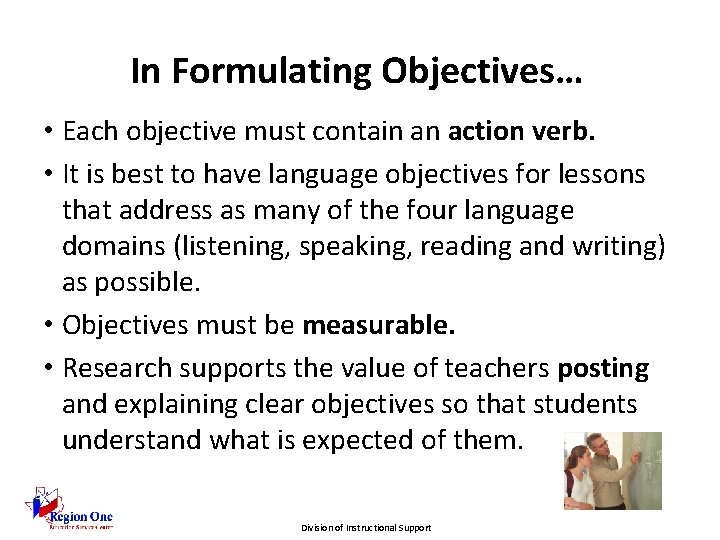
In Formulating Objectives… • Each objective must contain an action verb. • It is best to have language objectives for lessons that address as many of the four language domains (listening, speaking, reading and writing) as possible. • Objectives must be measurable. • Research supports the value of teachers posting and explaining clear objectives so that students understand what is expected of them. Division of Instructional Support
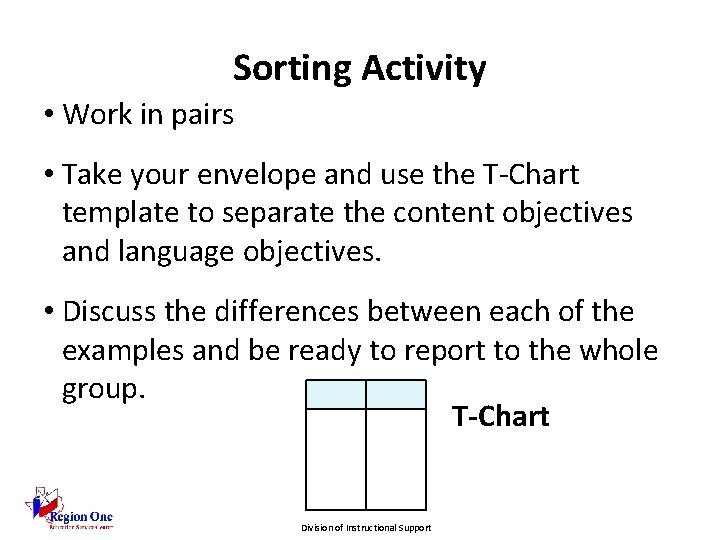
Sorting Activity • Work in pairs • Take your envelope and use the T-Chart template to separate the content objectives and language objectives. • Discuss the differences between each of the examples and be ready to report to the whole group. T-Chart Division of Instructional Support
When Writing Content and Language Objectives… �Content Objectives: TEKS �Language Objectives: ELPS �Provide students with clear direction for what they need to learn/master. �Set learning goals. Encourages students to be responsible for their own learning, set goals and pace their learning. �Provide strategies/activities appropriate for the various English language proficiency levels. Division of Instructional Support
Language Objectives Can Focus on: • Vocabulary: -Words, terms • Strategies for understanding. • Skill building: Reading, writing • Functional language. How to ask questions, disagree, etc. • Relevant grammar. • Language that relates to higher order thought processes. Division of Instructional Support
Examples of Content and Language Objectives Content Objective: Distinguish cause and effect in a story, text, newspapers. Language Objective: The student will read the text provided while highlighting words that will help distinguish between cause and effect. Sentence Stem: Select a sentence stem to explain the cause as well as the effects that are stated in some of the passages (select one from pp. 28 -33). Classroom Activity: (Select one from pp. 22 -25). Division of Instructional Support
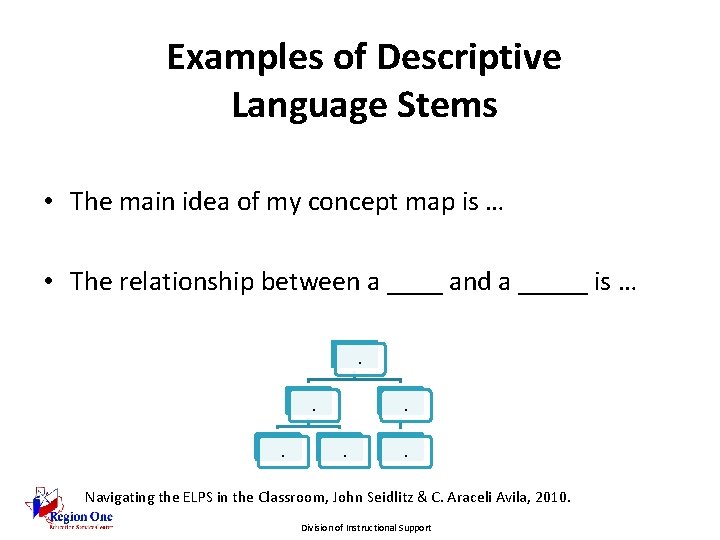
Examples of Descriptive Language Stems • The main idea of my concept map is … • The relationship between a ____ and a _____ is …. . . Navigating the ELPS in the Classroom, John Seidlitz & C. Araceli Avila, 2010. Division of Instructional Support
Example • Content objective: The student will identify the properties of an atom 8. 8 B. • Language Objective: The student will know key vocabulary to discuss or write about atoms. • Language function: Summarize and paraphrase. • Language form: Use singular/plural nouns. -Use sentence stems like: The number of ____affect the properties of the atom. • Activities or strategies: Students create a semantic feature map in their journals to demonstrate their understanding of the features of the parts of the atom. Division of Instructional Support
Lesson Plan Activity Division of Instructional Support
“Think-Pair-Share” Steps to Integrate Language Objectives • Use the Linguistic Accommodations Planning Tool • ELPS Lesson Plan Example: Conductors and insulators. • In pairs, select a language proficiency level (beginner, or intermediate). • Review the lesson with a partner and select the lesson’s academic vocabulary (highlight it). Division of Instructional Support
Degrees of Linguistic Accommodations in Planning Instruction • Use the Linguistic Accommodations Planning Tool • ELPS Lesson Plan Example: Conductors and insulators. • Write four accommodations to support a Beginning or Intermediate student • Use your tool to select examples of classroom activities and teacher support pp. 22 -25. • Share out. Division of Instructional Support
“Think-Pair-Share” Steps to Integrate Language Objectives 1. Based on WHAT the content objective is, determine what language will the student need to discuss, read, or write about the topic. Use the ELPS, and write a language objective. 2. In pairs, use the lesson to identify what students will DO with the language skills and grammatical structures. Adapted from: “Strategies for ELLs in Secondary Science (Days 3&4), Texas Comprehensive Center at the Southwest Educational Development laboratory, April 11 -13, 2007. Division of Instructional Support
“Think-Pair-Write” 5. Write HOW will students demonstrate their understanding of the content, and what language will be embedded in the assignment? * What other materials/resources will make content comprehensible for your ELL students? 6. Find a partner from another table and share. Adapted from: “Strategies for ELLs in Secondary Science (Days 3&4), Texas Comprehensive Center at the Southwest Educational Development laboratory, April 11 -13, 2007. Division of Instructional Support
Remember: Language Objectives… • Are Posted for students to see and refer back to. • Are dictated by the content of the lesson: – What do students need to do with language in order to achieve the content objectives? – What opportunities for language development exist within the lesson? Division of Instructional Support
Inside-Outside Points to Remember Division of Instructional Support
Points to Remember When Writing Language Objectives 1. Determine key technical vocabulary, concepts words, and other words needed to read or write about the topic of the lesson (e. g. , names of important people and places, processes, concepts, content specific, specialized terms). Division of Instructional Support
Points to Remember When Writing Language Objectives 2. Consider the language functions students will use in the lesson (e. g. , Will they define terms, describe or explain, classify, compare, or summarize? ) and teach/reinforce the function within the lesson activities. Division of Instructional Support
Points to Remember When Writing Language Objectives 3. Decide which language skills are needed to accomplish the activities in the lesson and provide explicit instruction in the skills. Do students have to read for main idea? Are they asked to listen and give an opinion? Will they edit sentences or essays about the topic? Division of Instructional Support
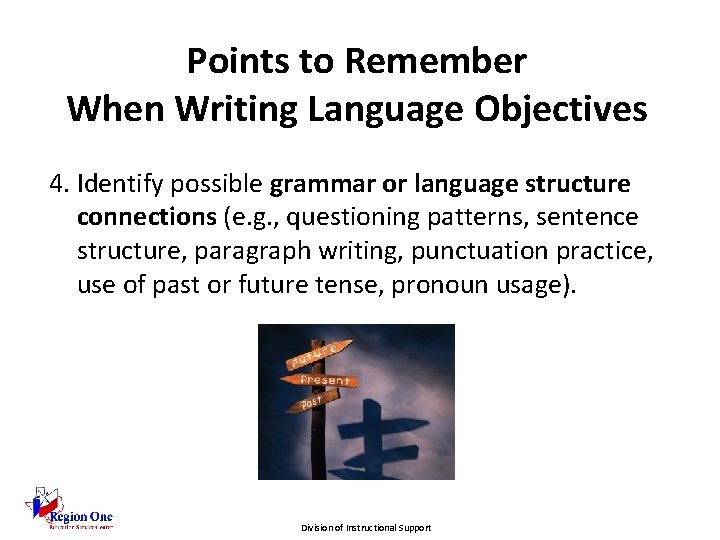
Points to Remember When Writing Language Objectives 4. Identify possible grammar or language structure connections (e. g. , questioning patterns, sentence structure, paragraph writing, punctuation practice, use of past or future tense, pronoun usage). Division of Instructional Support
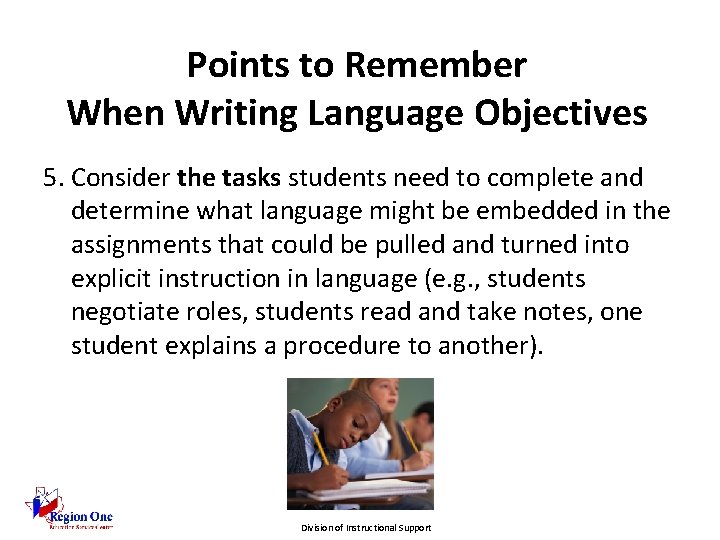
Points to Remember When Writing Language Objectives 5. Consider the tasks students need to complete and determine what language might be embedded in the assignments that could be pulled and turned into explicit instruction in language (e. g. , students negotiate roles, students read and take notes, one student explains a procedure to another). Division of Instructional Support
Points to Remember When Writing Language Objectives 6. Explore possible language learning strategies to share in the lesson (e. g. , language of prediction or hypothesis, use of cognates, preview of text via illustration and bold print, note taking). Division of Instructional Support
Points to Remember When Writing Language Objectives 7. Integrate the English Language Proficiency Standards (ELPS) by first analyzing the content, concepts, process, and skills of the lesson and determining what type of language development is a natural fit that will at once increase comprehension of instruction (content, concepts. etc. ) and develop language proficiency. Division of Instructional Support
Did We Meet Our Goals? Content Objective – Participants will explore how to plan effective instruction that addresses the language development process of ELLs identified at the beginning and intermediate proficiency levels in grade 3 or higher. Language Objective – Participants will discuss how to design instruction to provide an intensive and ongoing foundation in second language acquisition. Division of Instructional Support
3 -2 -1 Reflection Think-Write-Share-Pair Think and write on post-it notes • 3 new ideas I learned about language objectives are________. • 2 ways I am going to use the ideas learned in this session are______ and______. • 1 question I still have about ______ is____. • Share with a partner. Division of Instructional Support
You made it! YEAHH! • Your feedback is important to us! Please evaluate this training online. • The system will generate your certificate. Division of Instructional Support
Contact Information: Karina Chapa Director - Language Proficiency, Biliteracy, and Cultural Diversity kchapa@esc 1. net 956 -984 -6246 Perla Roerig Bilingual/ESL Specialist proerig@esc 1. net 956 - 984 -6238 Division of Instructional Support
- Slides: 79