
Training Workforce for Health Information Security and Privacy


- Slides: 36
Training Workforce for Health Information Security and Privacy
Six Dumbest Ideas #5 Educating Users • If it were going to work, it would have already done so. • Why educate your users how to cope with a problem if you can drive a stake through the problem’s heart? • In 10 years users that need education will be out of the high-tech workforce entirely – Marcus Ranum
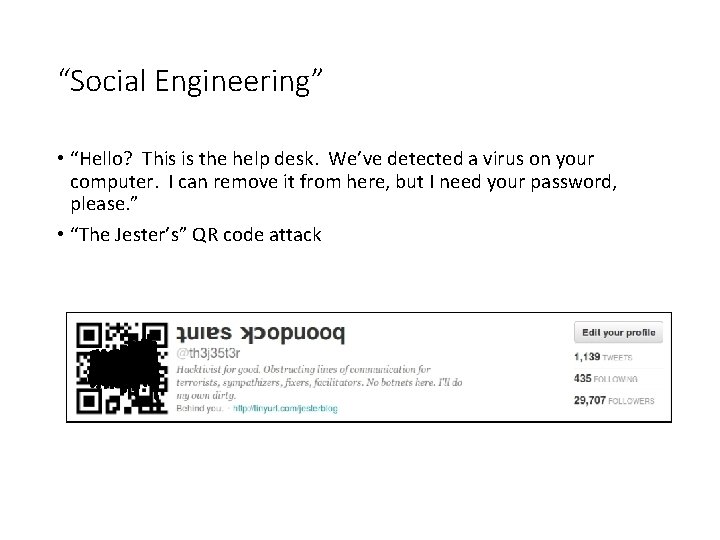
“Social Engineering” • “Hello? This is the help desk. We’ve detected a virus on your computer. I can remove it from here, but I need your password, please. ” • “The Jester’s” QR code attack
Others • Contractors, Consultants, Vendors • Temporary Workers • Volunteers • Physicians • Former Employees
Training Methods • Newsletters • Posters • Web • Email (? ) • Swag and bling • Town halls, lunch-and-learn
Awareness • Seeks to inform and focus an employee’s attention on security issues • threats, vulnerabilities, impacts, responsibility • Must be tailored to organization’s needs… • …using a variety of means: events, promo materials, briefings, policy documents • Every organization should have an employee security policy document 6
Training • Teaches what people should do and how they do it to perform IT tasks securely • Encompasses a spectrum covering: • general users • good computer security practices • programmers, developers, maintainers • security mindset, secure code development • managers • tradeoffs involving security risks, costs, benefits • executives • risk management goals, measurement, leadership 7
Education • Most in depth • Targeted at security professionals whose jobs require expertise in security • More about employee career development • More focused on underlying principles than specific tasks • Often provided by outside sources • college courses • specialized educational programs 8
Education and Training The purpose of higher education is not to produce job ready graduates, it’s to produce life ready citizens. – James Wagner, President, Emory University April 3, 2013 9
Personnel Security Policy • “A formal statement of rules by which people given access to organization’s technology and information assets must abide” –RFC 2196 • Policy defines “security. ” A system that does not violate policy is, by definition, secure. 10
Personnel Security Policy • Every organization needs a written security policy document for employees… • …to define acceptable behavior, expected practices, and responsibilities • makes clear what is protected and why • articulates security procedures / controls • states responsibility for protection • provides basis to resolve conflicts • Must reflect executive security decisions to: • protect information • comply with law • meet organizational goals 11
Policy Development Resources • ISO 27002 (Renumbered from ISO 17799 and British Standard 7799) • Widely-used international standard • With a comprehensive set of controls • Provides a convenient framework for policy authors • COBIT • Business-oriented set of standards • Includes IT security and control practices • Standard of Good Practice for Information Security • Other organizations, e. g. CERT-CC, CIO. gov 12
Personnel Security Considerations • Employment practices • Job descriptions • Background checks • Employment contracts • Orientation and training • Performance evaluation • Termination 13
Employment Policies and Practices • Management should integrate information security concepts into the organization’s employment policies and practices • The organization should make information security a documented part of every employee’s job description 14
Employment Policies and Practices • From an information security perspective, hiring of employees is a responsibility laden with potential security pitfalls. (Don’t hire a crook. ) • CISO and information security manager should provide human resources with information security input to personnel hiring guidelines 15
Job Descriptions • Integrating information security perspectives into hiring process begins with reviewing and updating all job descriptions 16
Background Checks • Investigation into a candidate’s past • Should be conducted before organization extends offer to candidate • Background checks differ in level of detail and depth with which candidate is examined • May include identity check, education and credential check, previous employment verification, references check, drug history, credit history, and more 17
Employment Contracts • Once a candidate has accepted the job offer, employment contract becomes important security instrument • Many security policies require an employee to agree in writing • You can specify “employment contingent upon agreement, ” whereby employee is not offered the position unless binding organizational policies are agreed to 18
New Hire Orientation • New employees should receive extensive information security briefing on policies, procedures and requirements for information security • Levels of authorized access are outlined; training provided on secure use of information systems • By the time employees start, they should be thoroughly briefed and ready to perform duties securely 19
New Hire Orientation • New employees should receive extensive information security briefing on policies, procedures and requirements for information security • Levels of authorized access are outlined; training provided on secure use of information systems • By the time employees start, they should be thoroughly briefed and ready to perform duties securely 20
On-the-Job Security Training • Organization should conduct periodic security awareness training • Keeping security at the forefront of employees’ minds and minimizing employee mistakes is important part of information security awareness mission • External and internal seminars also increase level of security awareness for all employees, particularly security employees 21
Performance Evaluation • Organizations should incorporate information security components into employee performance evaluations • Employees pay close attention to job performance evaluations; if evaluations include information security tasks, employees are motivated to perform these tasks at a satisfactory level 22
Termination • When employee leaves organization, there a number of security-related issues • Key idea is protection of all information to which employee had access: • Keys, keycards, badges, etc. • Access codes • Removable media • Many organizations use the exit interview to remind former employee of contractual obligations and to obtain feedback 23
Security Considerations For Nonemployees • Individuals not subject to screening, contractual obligations, and eventual secured termination often have access to sensitive organizational information • Relationships with these individuals should be carefully managed to prevent possible information leak or theft 24
Temporary Employees • Hired by organization to serve in temporary position or to supplement existing workforce • Often not subject to contractual obligations or general policies; if temporary employees breach a policy or cause a problem, possible actions are limited • Access to information for temporary employees should be limited to that necessary to perform duties • Temporary employee’s supervisor must restrict the information to which access is possible 25
Contract Employees • Typically hired to perform specific services for organization • Host company often makes contract with parent organization rather than with individual for a particular task • In secure facility, all contract employees escorted from room to room, as well as into and out of facility • There is need for restrictions or requirements to be negotiated into contract agreements when they are activated 26
Consultants • Should be handled like contract employees, with special requirements for information or facility access integrated into contract • Security and technology consultants must be prescreened, escorted, and subjected to nondisclosure agreements to protect organization. • Just because security consultant is paid doesn’t make the protection of organization’s information the consultant’s number one priority 27
Business Partners • Businesses find themselves in strategic alliances with other organizations, desiring to exchange information or integrate systems • There must be meticulous, deliberate process of determining what information is to be exchanged, in what format, and to whom • Non-disclosure agreements and the level of security of both systems must be examined before any physical integration takes place 28
Separation of Duties and Collusion • Cornerstone in protection of information assets and against financial loss • Separation of duties: control used to reduce chance of individual violating information security; stipulates that completion of significant task requires at least two people • Collusion: unscrupulous workers conspiring to commit unauthorized task 29
Separation of Duties • Separation: tasks are split into subtasks performed by different people. • Two-man control: two individuals review and approve each other’s work before the task is categorized as finished • Job rotation: employees know each others’ job skills and tasks rotate 30
Email and Internet Use Policies • E-mail and Web access for employees is common in offices and some factories • It is necessary to have e-mail and Internet use policies in organization’s security policy • Due to concerns regarding: • • work time lost computer / bandwidth resources consumed risk of importing malware possibility of harm, harassment, bad conduct 31
“Web-ware” and Security • Cookies • Web bugs, web beacons • Zombie cookies
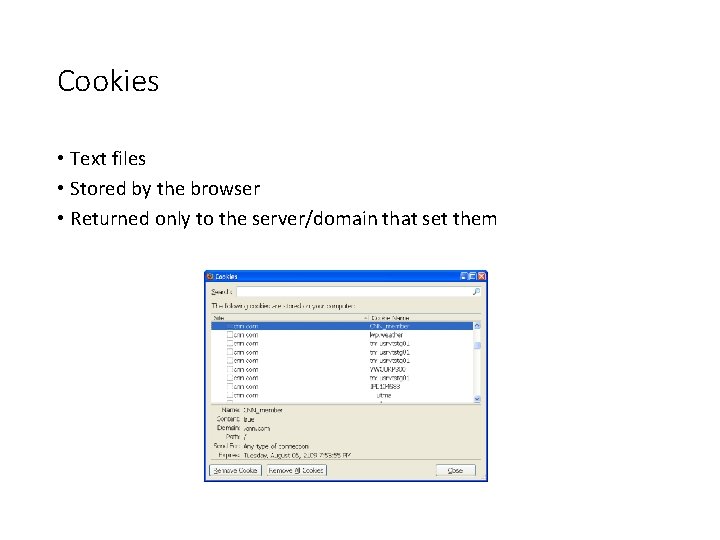
Cookies • Text files • Stored by the browser • Returned only to the server/domain that set them
Third Party Cookies • Ads on web sites are often served by an “advertising” site like Doubleclick. • So, Doubleclick gets to set a cookie when you see their ad on CNN. • When you see a Doubleclick ad on WSJ. com, the “CNN” cookie is returned. • Doubleclick knows where you’ve been! • That is how advertisements “follow you around. ” • Cookies can contain sensitive information.
Web Bugs or Beacons • The ad doesn’t have to be visible! • A single pixel clear GIF set from a third-party server is enough to set a cookie, which will be returned when the rules allow. • Images in email that are HTTP links can show that an email message has been opened.
Questions