
Training structure Safety and good quality work EFFO
- Slides: 34
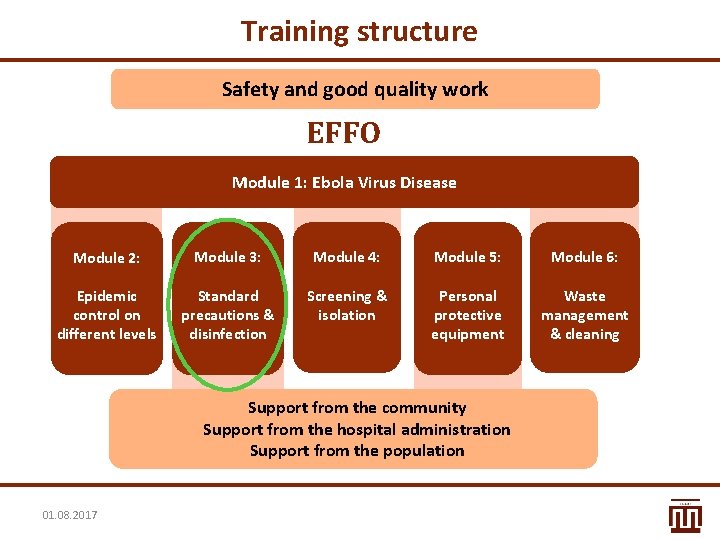
Training structure Safety and good quality work EFFO Module 1: Ebola Virus Disease Module 2: Module 3: Module 4: Module 5: Module 6: Epidemic control on different levels Standard precautions & disinfection Screening & isolation Personal protective equipment Waste management & cleaning Support from the community Support from the hospital administration Support from the population 01. 08. 2017
Standard precautions & disinfection Module 3 01. 08. 2017
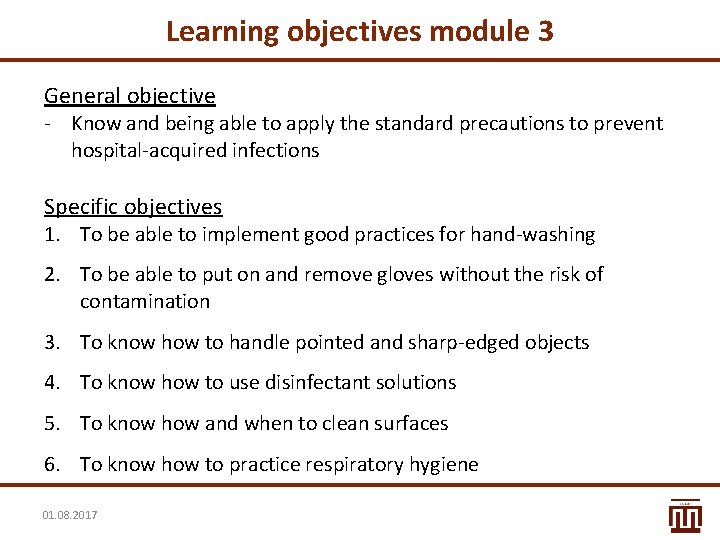
Learning objectives module 3 General objective - Know and being able to apply the standard precautions to prevent hospital-acquired infections Specific objectives 1. To be able to implement good practices for hand-washing 2. To be able to put on and remove gloves without the risk of contamination 3. To know how to handle pointed and sharp-edged objects 4. To know how to use disinfectant solutions 5. To know how and when to clean surfaces 6. To know how to practice respiratory hygiene 01. 08. 2017
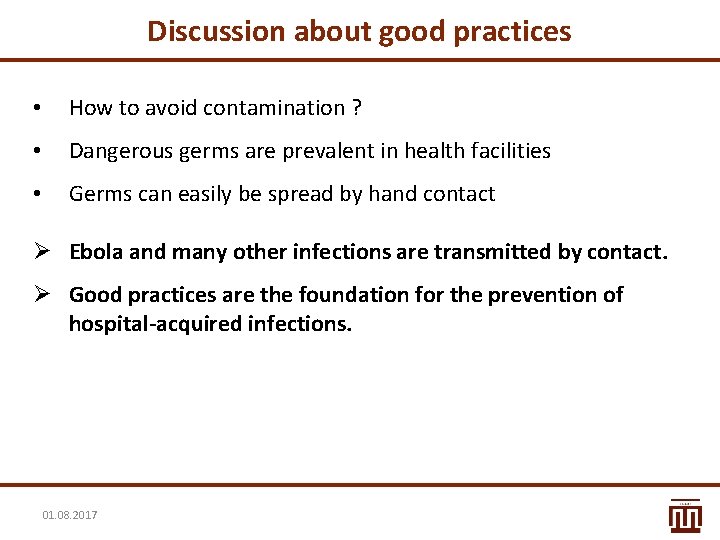
Discussion about good practices • How to avoid contamination ? • Dangerous germs are prevalent in health facilities • Germs can easily be spread by hand contact Ø Ebola and many other infections are transmitted by contact. Ø Good practices are the foundation for the prevention of hospital-acquired infections. 01. 08. 2017
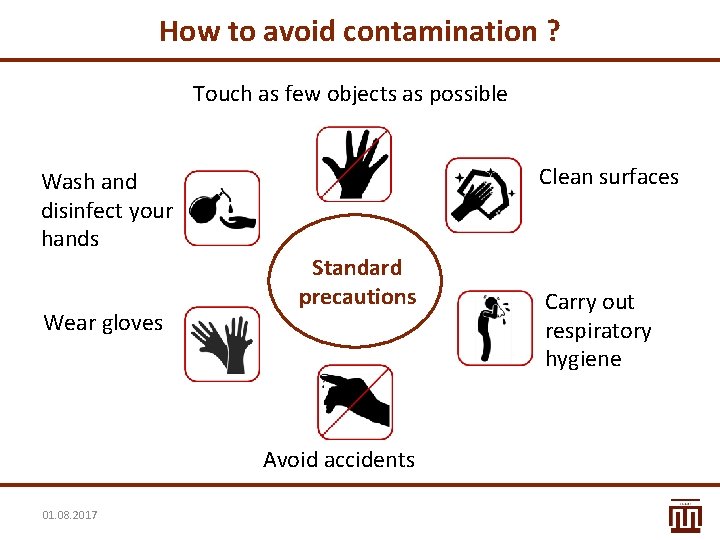
How to avoid contamination ? Touch as few objects as possible Wash and disinfect your hands Wear gloves Clean surfaces Standard precautions Avoid accidents 01. 08. 2017 Carry out respiratory hygiene
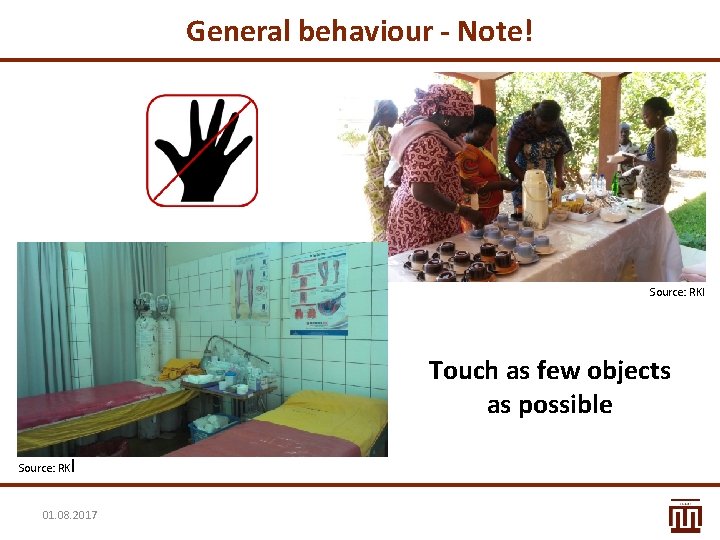
General behaviour - Note! Source: RKI Touch as few objects as possible Source: RKI 01. 08. 2017
General behaviour - examples In a hospital: • Avoid touching your face • Do not share a bottle • Put your name on your bottle • Wash your hands before meals (do not dry them on a towel which has already been used) • Check your clothes (wear closed-toe shoes, change your clothes if necessary, … ) 01. 08. 2017
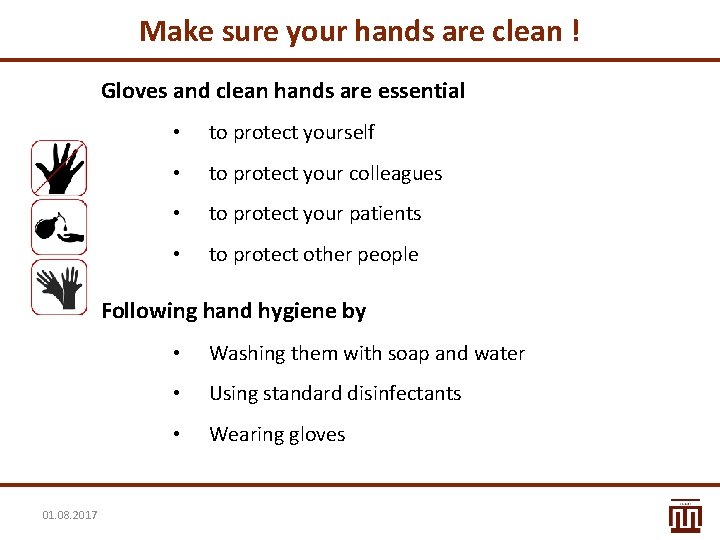
Make sure your hands are clean ! Gloves and clean hands are essential • to protect yourself • to protect your colleagues • to protect your patients • to protect other people Following hand hygiene by 01. 08. 2017 • Washing them with soap and water • Using standard disinfectants • Wearing gloves
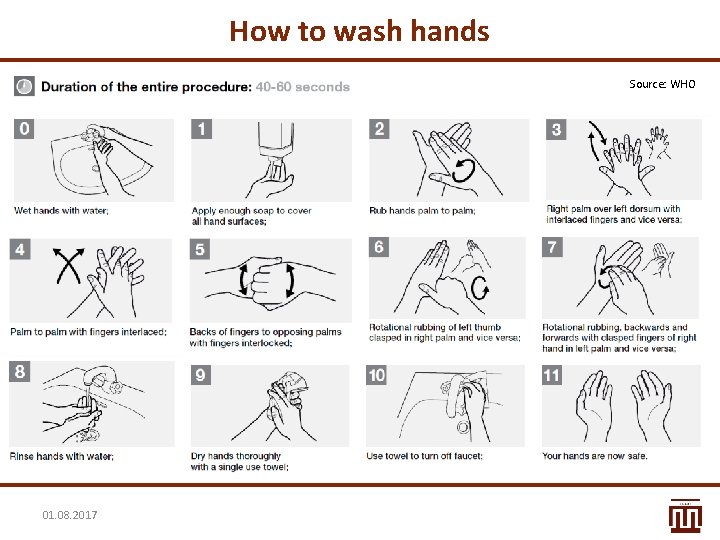
How to wash hands Source: WHO 01. 08. 2017
Hand care Skin which is in good condition is a very important natural barrier. The frequent use of soap and disinfectants may irritate the skin and make hands dry : Ø Hands need to be cared for regularly! Ø Use hand cream 01. 08. 2017
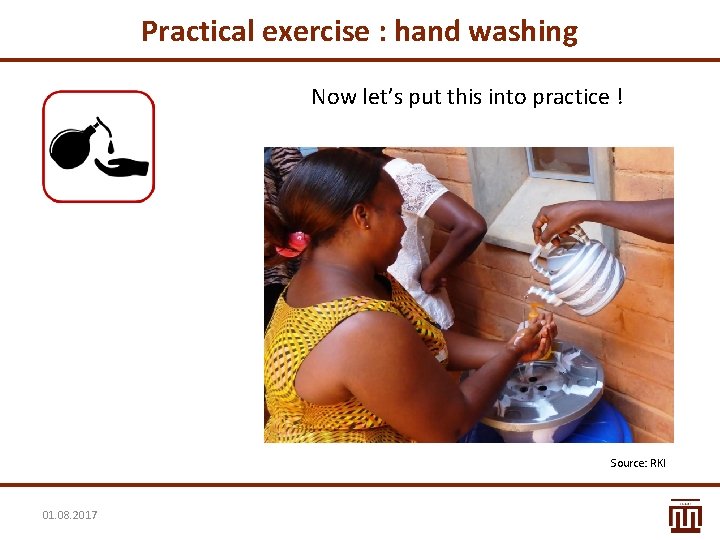
Practical exercise : hand washing Now let’s put this into practice ! Source: RKI 01. 08. 2017
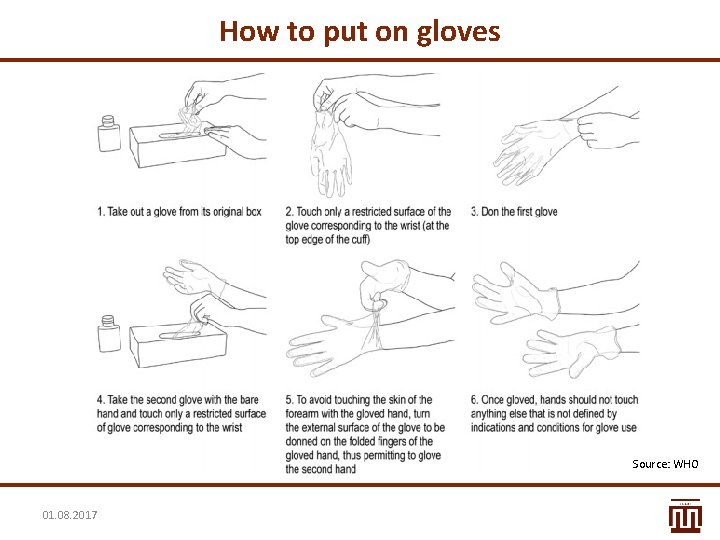
Wearing gloves to protect your hands • If available, use gloves for - an additional barrier for your hands - Protecting the skin of your hands • Practise putting on and removing gloves to improve protection and avoid contamination • Gloves should be changed regularly ! - One patient – one action – one pair of gloves 01. 08. 2017
How to put on gloves Source: WHO 01. 08. 2017
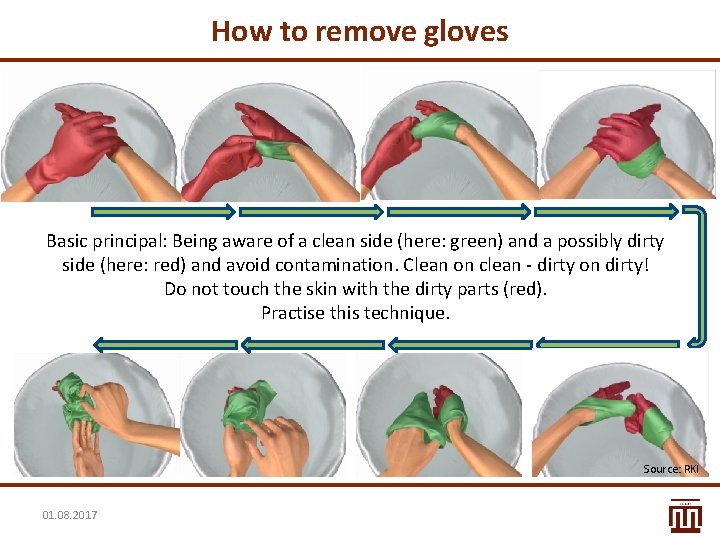
How to remove gloves Basic principal: Being aware of a clean side (here: green) and a possibly dirty side (here: red) and avoid contamination. Clean on clean - dirty on dirty! Do not touch the skin with the dirty parts (red). Practise this technique. Source: RKI 01. 08. 2017
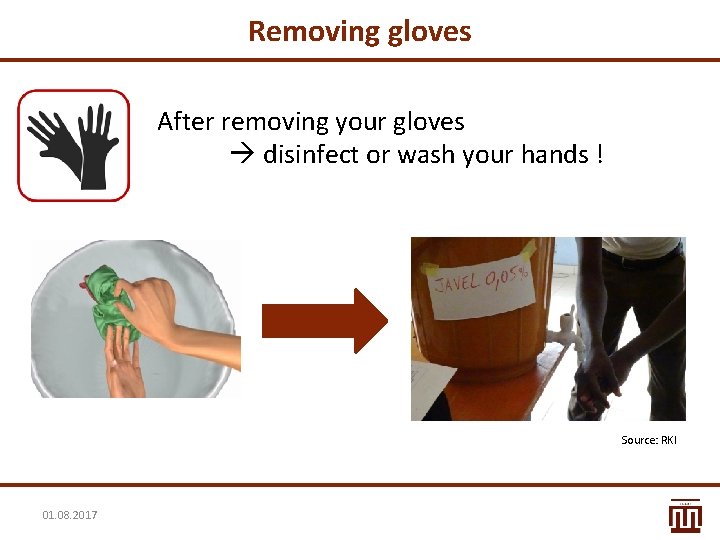
Removing gloves After removing your gloves disinfect or wash your hands ! Source: RKI 01. 08. 2017
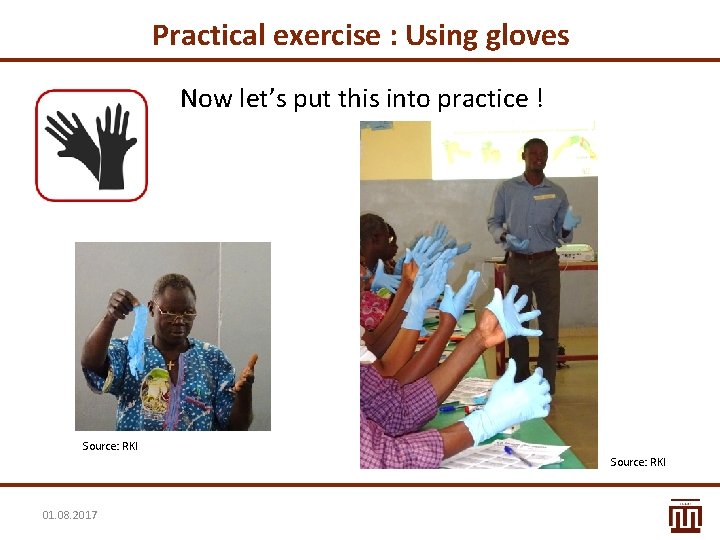
Practical exercise : Using gloves Now let’s put this into practice ! MI Source: RKI 01. 08. 2017
What to do if there are not enough gloves ? • In general, do not use the same gloves for different activities. • When you cannot change gloves after treating a patient, disinfect the gloves (for example, with 0. 5 % chlorine solution). • Watch out ! Gloves may become porous depending on the disinfectant used, the number of times the gloves have been disinfected, and what the gloves are made of. Damaged gloves might not protect adequately. 01. 08. 2017
What to do if there are no gloves ? Try to avoid direct patient contact as far as possible. If this is not possible : 01. 08. 2017 • Use standard hand disinfectants or wash your hands with soap and water before and after contact with each patient. • Care for the skin of your hands in order to protect the natural barrier (avoid the development of small lesions). • Avoid touching dirty surfaces.
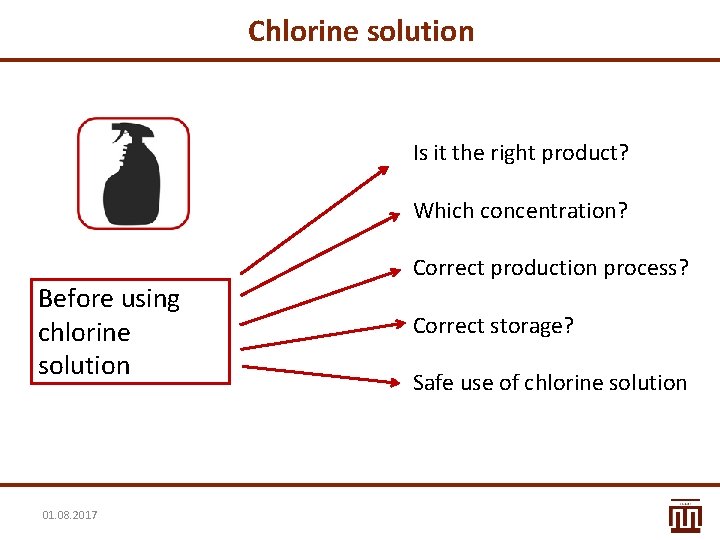
Chlorine solution Is it the right product? Which concentration? Before using chlorine solution 01. 08. 2017 Correct production process? Correct storage? Safe use of chlorine solution
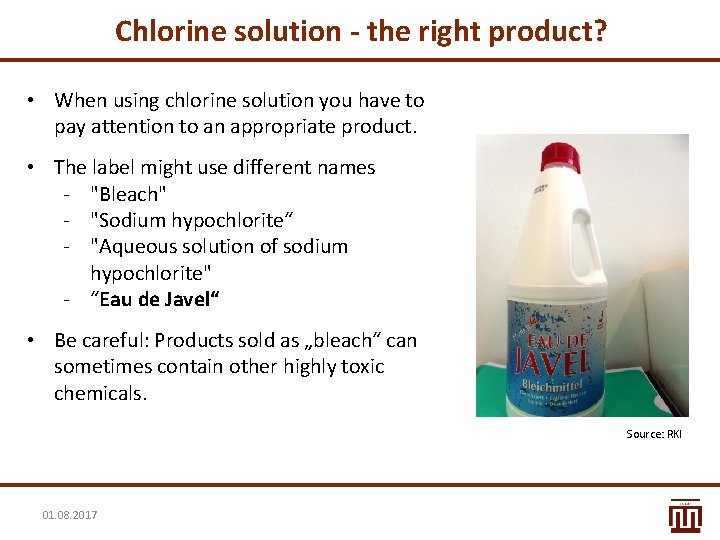
Chlorine solution - the right product? • When using chlorine solution you have to pay attention to an appropriate product. • The label might use different names - "Bleach" - "Sodium hypochlorite“ - "Aqueous solution of sodium hypochlorite" - “Eau de Javel“ • Be careful: Products sold as „bleach“ can sometimes contain other highly toxic chemicals. Source: RKI 01. 08. 2017
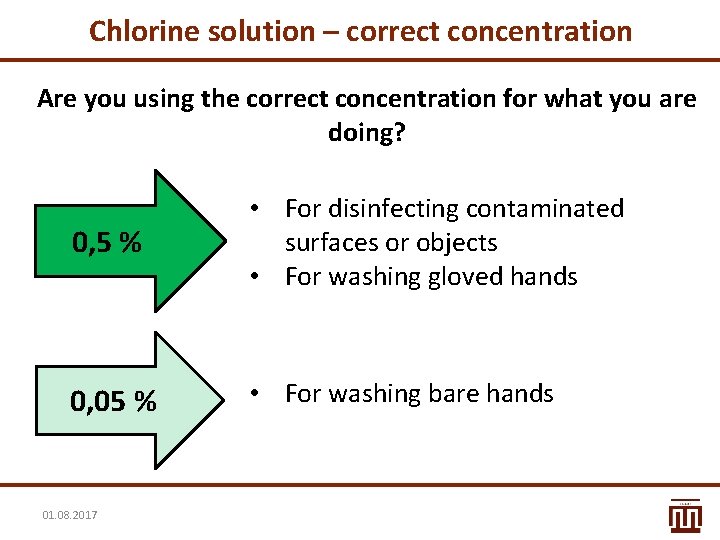
Chlorine solution – correct concentration Are you using the correct concentration for what you are doing? 0, 5 % • For disinfecting contaminated surfaces or objects • For washing gloved hands 0, 05 % • For washing bare hands 01. 08. 2017
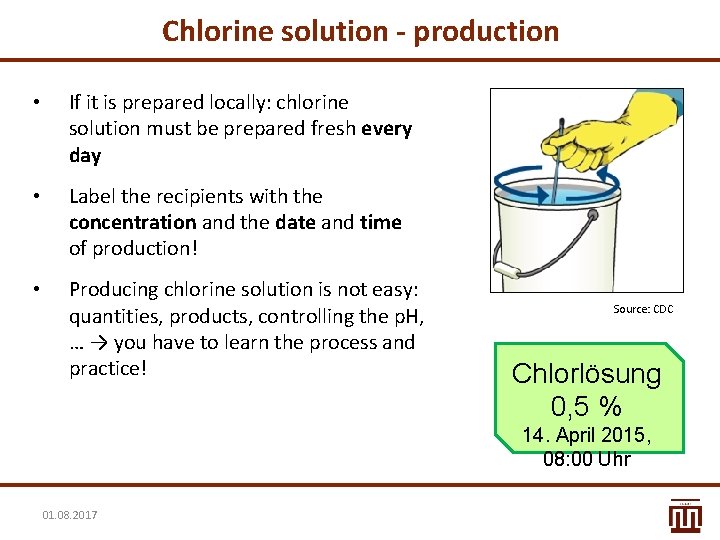
Chlorine solution - production • If it is prepared locally: chlorine solution must be prepared fresh every day • Label the recipients with the concentration and the date and time of production! • Producing chlorine solution is not easy: quantities, products, controlling the p. H, … → you have to learn the process and practice! Source: CDC Chlorlösung 0, 5 % 14. April 2015, 08: 00 Uhr 01. 08. 2017
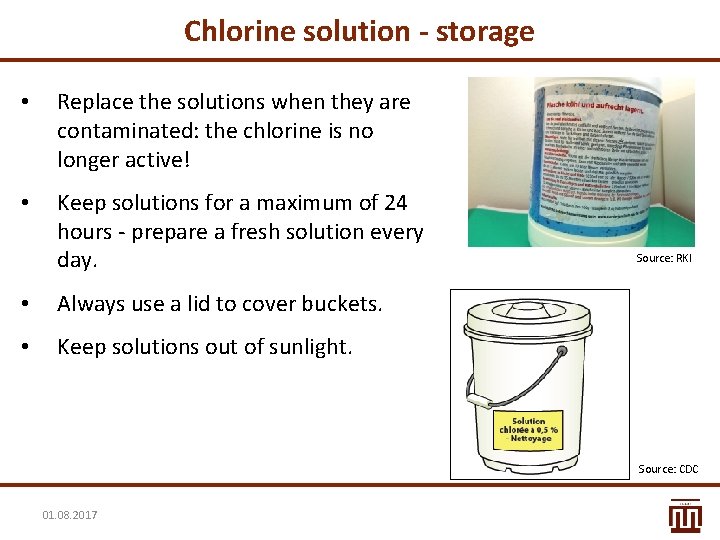
Chlorine solution - storage • Replace the solutions when they are contaminated: the chlorine is no longer active! • Keep solutions for a maximum of 24 hours - prepare a fresh solution every day. • Always use a lid to cover buckets. • Keep solutions out of sunlight. Source: RKI Source: CDC 01. 08. 2017
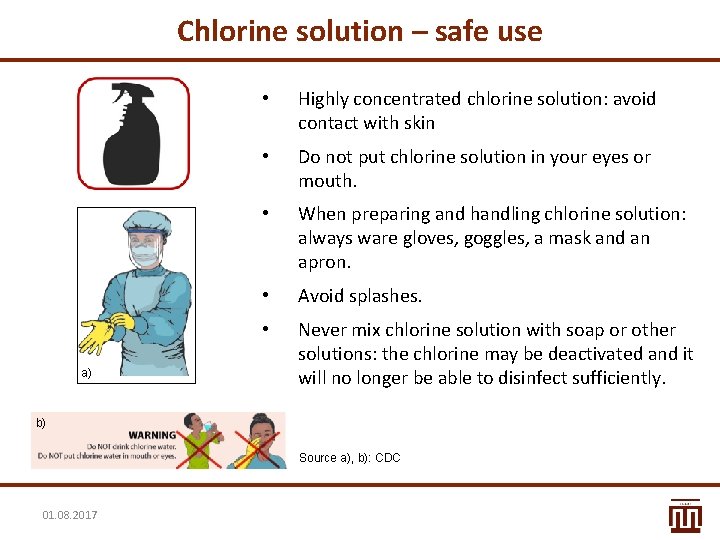
Chlorine solution – safe use a) • Highly concentrated chlorine solution: avoid contact with skin • Do not put chlorine solution in your eyes or mouth. • When preparing and handling chlorine solution: always ware gloves, goggles, a mask and an apron. • Avoid splashes. • Never mix chlorine solution with soap or other solutions: the chlorine may be deactivated and it will no longer be able to disinfect sufficiently. b) Source a), b): CDC 01. 08. 2017
Cleaning surfaces • Clean and disinfect as soon as possible (everyone’s task !) : Ø any surface or object contaminated with blood, body fluids, secretions or excretions • At least once a day, clean with water and detergent : Ø Floors and work surfaces • Let the surfaces dry naturally before using them again • Use the appropriate disinfectant • Be meticulous, critical and alert ! 01. 08. 2017
Cleaning – Attention ! • First clean - then disinfect • Always start cleaning in the ‘cleanest’ places and ending with the ‘dirtiest’ places • Never sweep or clean without using liquids or dampened materials • Cloths containing dust must not be shaken • Change the cleaning solutions frequently throughout the day 01. 08. 2017
Respiratory hygiene People who present with respiratory problems should take the following precautions : • When you cough or sneeze, cover your nose and mouth with a paper tissue or a mask • Have single use tissues • Spit into a disposable tissue • Throw away used tissues and masks • If there are no paper tissues, cough or sneeze into your elbow or upper arm • Wash or disinfect your hands after touching respiratory secretions • Examine patients in a well-ventilated room (with good air circulation) 01. 08. 2017
Prevention of accidents (I) Accidents associated with pointed objects are a major risk for infection. Risks are greatest if barbed or sharp objects are used : • when a patient is agitated • when the barbed or sharp object is not correctly packaged 01. 08. 2017
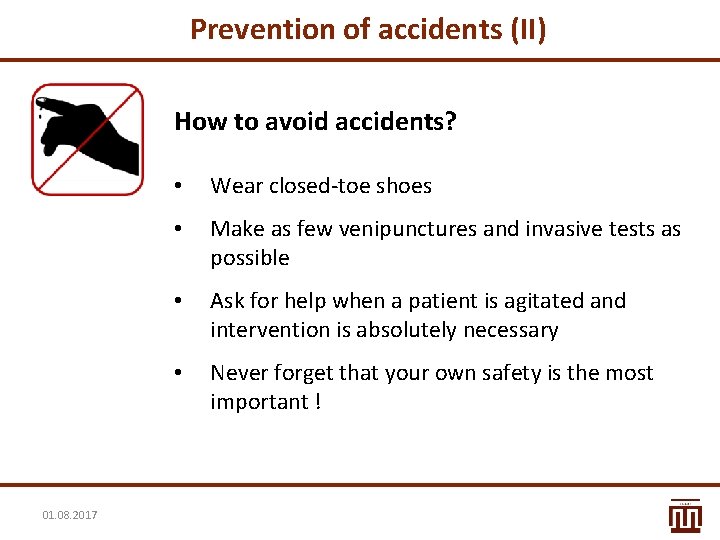
Prevention of accidents (II) How to avoid accidents? 01. 08. 2017 • Wear closed-toe shoes • Make as few venipunctures and invasive tests as possible • Ask for help when a patient is agitated and intervention is absolutely necessary • Never forget that your own safety is the most important !
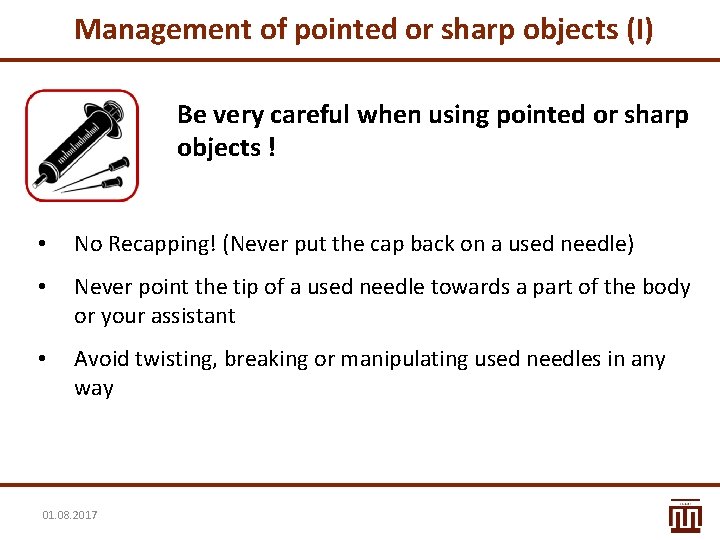
Management of pointed or sharp objects (I) Be very careful when using pointed or sharp objects ! • No Recapping! (Never put the cap back on a used needle) • Never point the tip of a used needle towards a part of the body or your assistant • Avoid twisting, breaking or manipulating used needles in any way 01. 08. 2017
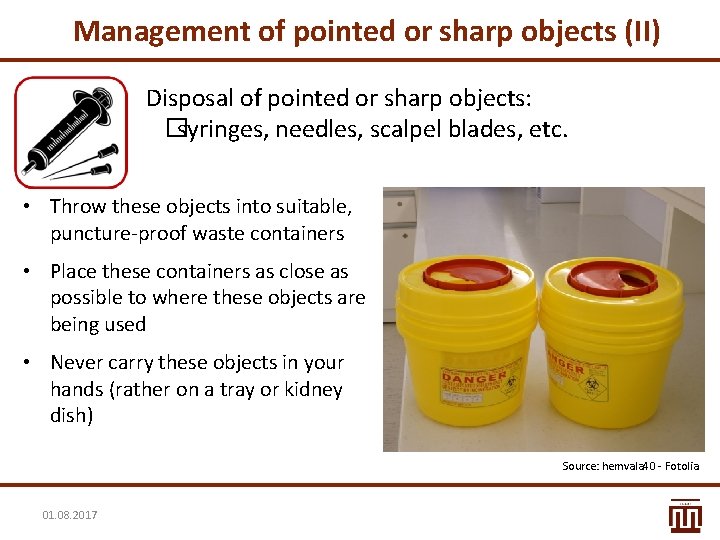
Management of pointed or sharp objects (II) Disposal of pointed or sharp objects: �syringes, needles, scalpel blades, etc. • Throw these objects into suitable, puncture-proof waste containers • Place these containers as close as possible to where these objects are being used • Never carry these objects in your hands (rather on a tray or kidney dish) Source: hemvala 40 - Fotolia 01. 08. 2017
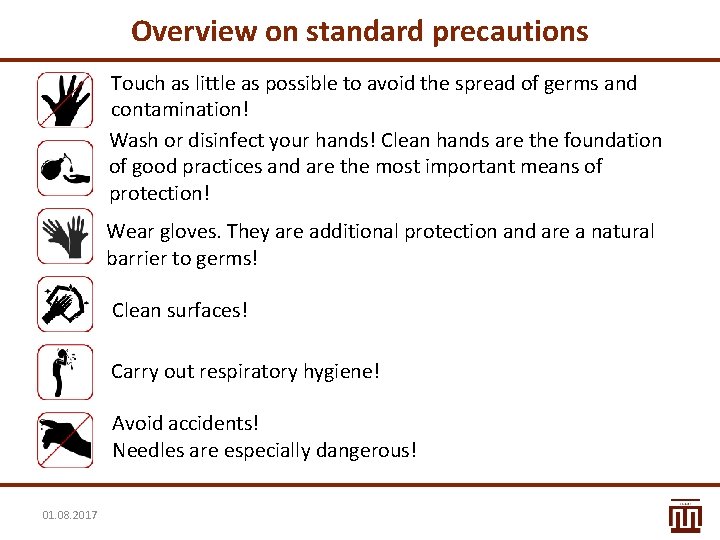
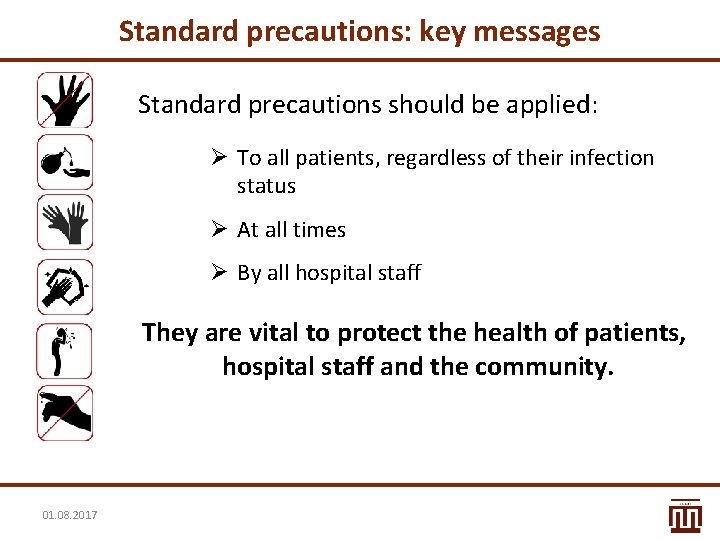
Overview on standard precautions Touch as little as possible to avoid the spread of germs and contamination! Wash or disinfect your hands! Clean hands are the foundation of good practices and are the most important means of protection! Wear gloves. They are additional protection and are a natural barrier to germs! Clean surfaces! Carry out respiratory hygiene! Avoid accidents! Needles are especially dangerous! 01. 08. 2017
Standard precautions: key messages Standard precautions should be applied: Ø To all patients, regardless of their infection status Ø At all times Ø By all hospital staff They are vital to protect the health of patients, hospital staff and the community. 01. 08. 2017
Thank you for your attention ! Copyright images © sdp_creations – Fotolia. com © theblackrhino – Fotolia. com 01. 08. 2017 ©Adam – Fotolia. com © Jane Osina – Fotolia. com © Hu. Hu Lin – Fotolia. com © Strezhnev Pavel – Fotolia. com © vladis_studio - Fotolia. com