
Training Scenarios Terminology A client in the database
Training Scenarios
Terminology A client, in the database, is defined as a business, unless it is a pre-venture entrepreneur looking for education or assistance in starting a business. One client may have multiple contacts within their record, i. e. several employees are contacts listed for one company or pre-venture.
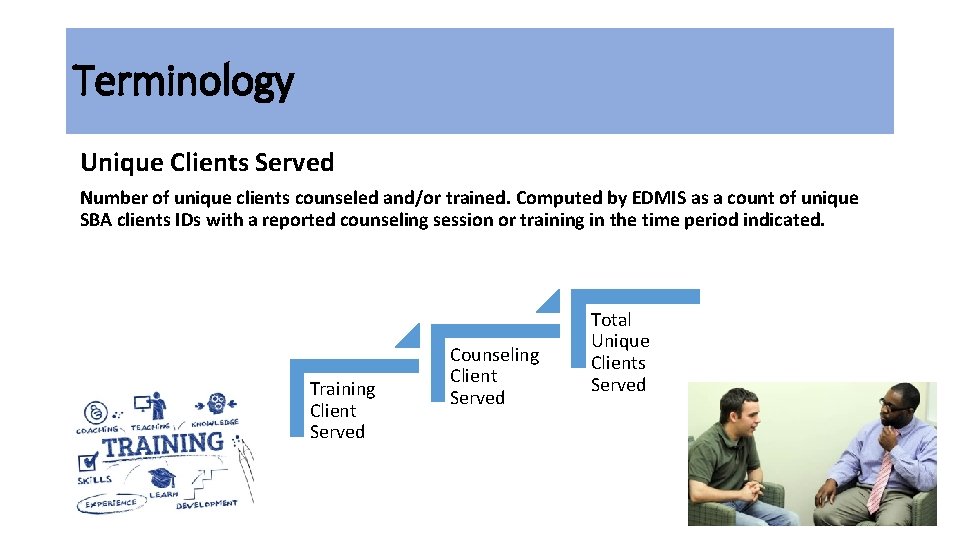
Terminology Unique Clients Served Number of unique clients counseled and/or trained. Computed by EDMIS as a count of unique SBA clients IDs with a reported counseling session or training in the time period indicated. Training Client Served Counseling Client Served Total Unique Clients Served
Counseling Client Vs. Training Client Counseling clients served must give the SBDC the data and sign the 641 form whereas a training client served only needs to give the SBDC the data from the 641. Several states have already created a template for the training clients served to make certain they capture the necessary 641 data. Preventure clients, even if related, may be captured as a training client served (unique client), but only one training client served (unique client) may be established for an in-business entity. All other contacts/employees/attendees must be associates or members in the CRM system if multiple attendees.
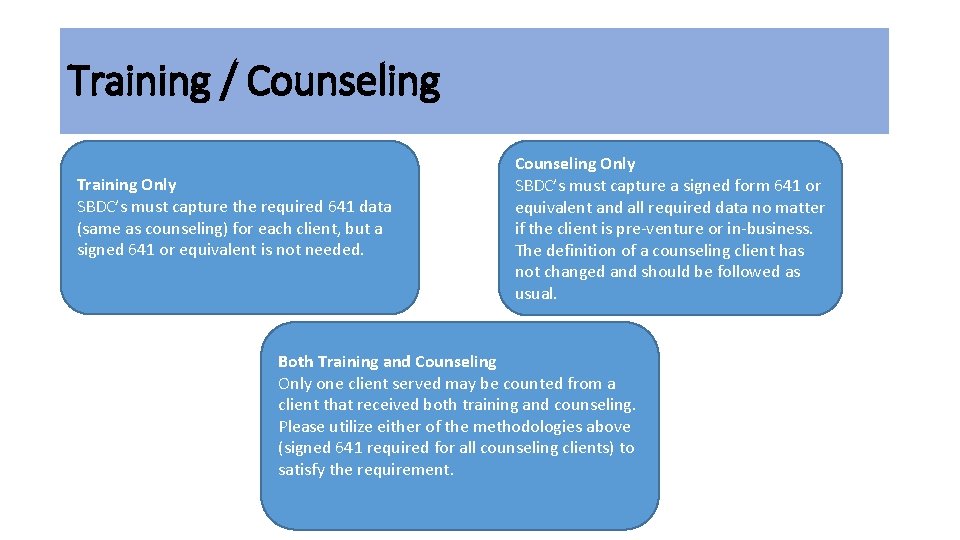
Training / Counseling Training Only SBDC’s must capture the required 641 data (same as counseling) for each client, but a signed 641 or equivalent is not needed. Counseling Only SBDC’s must capture a signed form 641 or equivalent and all required data no matter if the client is pre-venture or in-business. The definition of a counseling client has not changed and should be followed as usual. Both Training and Counseling Only one client served may be counted from a client that received both training and counseling. Please utilize either of the methodologies above (signed 641 required for all counseling clients) to satisfy the requirement.
641 Difference What is the difference between getting a 641 completed and needing 641 data? 641 vs. 641 Data SBDC networks have been using the provided 641 or customized it to keep the necessary information/questions while potentially incorporating some of their own. The 641 data is the information provided by the client including demographic data as well as baseline business information without needing the signature.
Scenario One My SBDC network offers over 200 training sessions per year, both online and in-person. The trainings are for business starts as well as for existing businesses. Do I need to have all the training participants complete a 641 and have it signed? SBDC networks are not required to have training participants complete a full 641. If a network would like to have a training participant be counted as a training client served, the network will need the training participant to complete the partial 641 or gather the 641 data and document it in their CRM. At no time is SBA requiring training participants to complete a full 641, which is the 641 data AND a signature. If a training participant would like to receive consulting services, the full 641 is required, which includes a signature.
Scenario Two Collaboration with SCORE and WBC have been very effective in our state. So much that we don’t offer any trainings unless one of our partners helps with the marketing and delivery of the training. Which partner organization is able to claim the training participants? If the SBDC network completes an 888 and has the training participant complete the 641 data, the SBDC network is able to document the participants in the CRM as a training client served. The collaborating resource partner is also able to follow their CRM requirements and record the training participant as a training client served. The 888 must be uploaded and the training client served must reference the corresponding 888. SBA’s position is that if two organizations collaborate together and offer a valuable training program for entrepreneurs and small businesses, then both organizations should be permitted to claim the participant as a training client served as long as the proper documentation is completed and recorded in each organization’s CRM.
Scenario Three Fred, Sally and Suzanne work for the local manufacturer, Stamp and Weld. All three participate in a number of my network’s training programs. Am I am able to count each of the individuals as a training client served if the individuals complete the required 641 data? Regardless of the number of small business employees attending a training, the small business is the client and will count as one training client served according to the SBA’s definition. Many SBDC networks continually monitor training participants and join all the employee engagements of one small business into one client record. Only one employee of the small business needs to complete the required portions of a 641 in order for the employee trainings to count as one business served.
Scenario Four Since training was not an SBDC goal, my SBDC network decided three years ago to not offer training programs to small businesses. Instead, we promote the trainings of local partners. How am I supposed to achieve the unique clients served goal if my network does not offer trainings? How an SBDC network achieves their SBA goals is up to the state director. If a network is not capturing training participants as clients served and you think there will be a gap in the number of consulting clients to clients served, the network will need to figure out how to increase the consulted clients. *The goal is on unique clients served and SBA allows each SBDC to meet the goal as they see fit according to what works the most successfully for their program. Here are several ideas • Partner Events/Trainings Co-host – work with your strategic partners to host events • Chamber trainings • SCORE • Community College Continued Education Departments • Start Smart Workshops • Short 2 hour workshops for preventure • Similar to having multiple pre-venture clients in the same room • One way to maximize time
Questions?
- Slides: 11