
TRAINING PROVIDER INFORMATION SESSION BY FANNY PHETLA DOMINICUS
TRAINING PROVIDER INFORMATION SESSION BY FANNY PHETLA/ DOMINICUS YOTWANA DATE: MARCH 2009
PURPOSE OF THIS PRESENTATION • Background information • NQF landscape • Reposition: stakeholders • Agri. SETA ETQA ‘s Position • Questions
Background information: new quality assurance architecture • SETA ETQAs will be combined in order to streamline quality-assurance processes • There are few legislations and Acts which will be affected by the implementation of the new framework • The Higher Education Act, FET Act, Skills Development Act and SAQA Act. • All the amendment bills for these acts have been signed by the president

Background information: new quality assurance architecture cont. • The Skills Development Act Amendment Bill introduces the Quality Council for Trades and Occupations (QCTO) • FET Act Amendment Bill provides the basis for cooperation between Umalusi and QCTO. • The Higher Education Act Amendment Bill provides the basis for cooperation between CHE and QCTO • SAQA Act Amendment Bill provides the basis for cooperation between SAQA, CHE , FETand QCTO 4
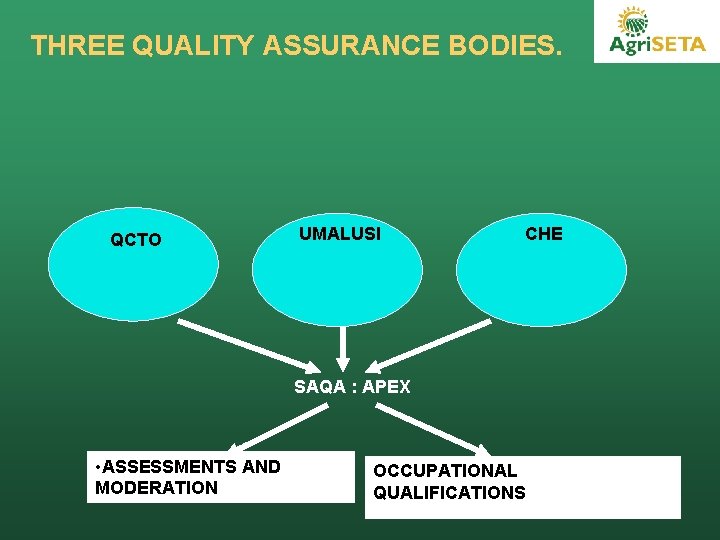
THREE QUALITY ASSURANCE BODIES. QCTO UMALUSI CHE SAQA : APEX • ASSESSMENTS AND MODERATION OCCUPATIONAL QUALIFICATIONS
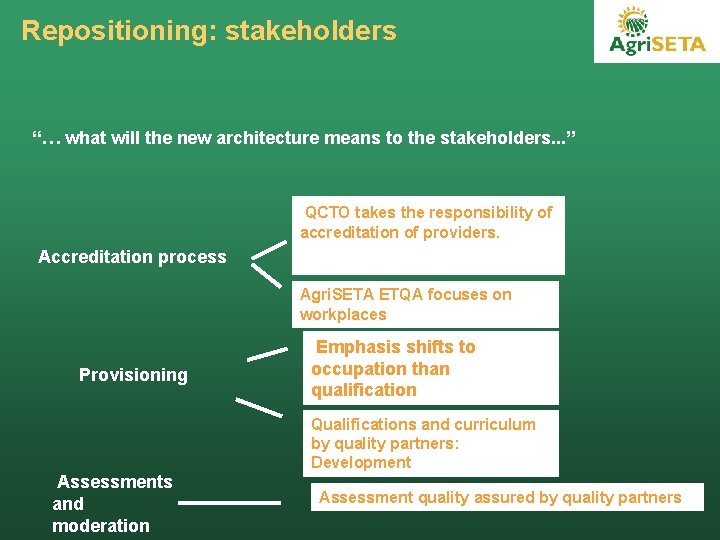
Repositioning: stakeholders “… what will the new architecture means to the stakeholders. . . ” QCTO takes the responsibility of accreditation of providers. Accreditation process Agri. SETA ETQA focuses on workplaces Provisioning Emphasis shifts to occupation than qualification Qualifications and curriculum by quality partners: Development Assessments and moderation Assessment quality assured by quality partners
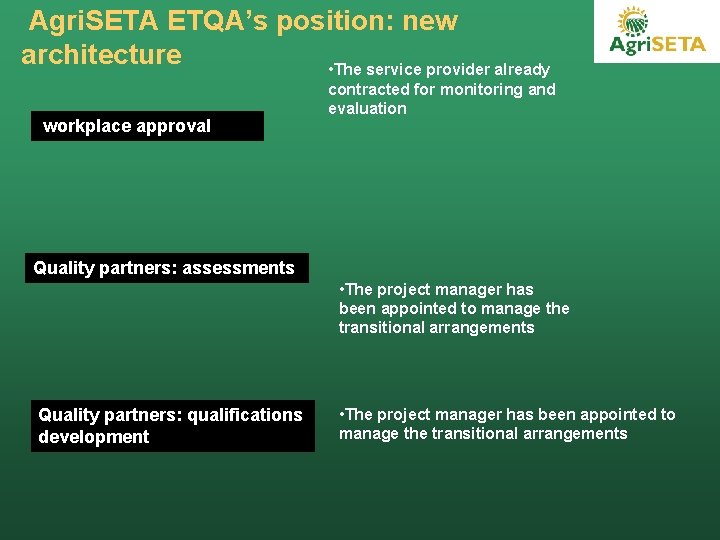
Agri. SETA ETQA’s position: new architecture • The service provider already workplace approval contracted for monitoring and evaluation Quality partners: assessments • The project manager has been appointed to manage the transitional arrangements Quality partners: qualifications development • The project manager has been appointed to manage the transitional arrangements
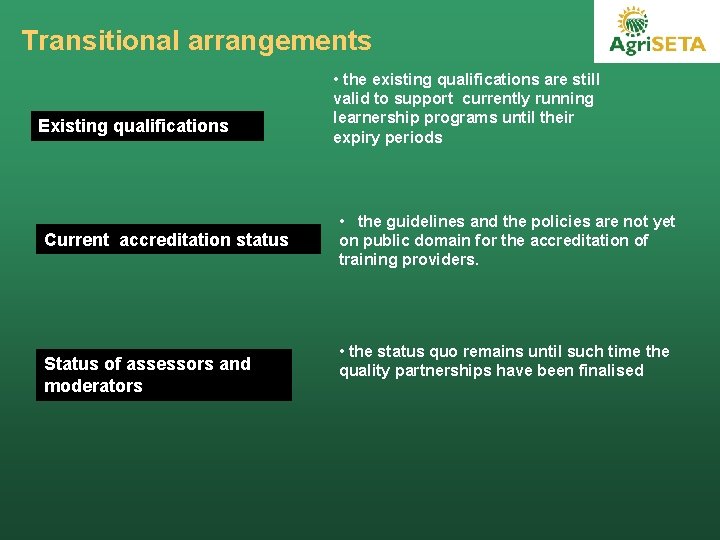
Transitional arrangements Existing qualifications Current accreditation status Status of assessors and moderators • the existing qualifications are still valid to support currently running learnership programs until their expiry periods • the guidelines and the policies are not yet on public domain for the accreditation of training providers. • the status quo remains until such time the quality partnerships have been finalised
WAYFORWARD HOW DO WE POSITION OURSELVES INTO THE NEW LANDSCAPES? • Strengthen providers forums • Establish Assessors and moderators forums • Sharing of best practice amongst the providers • Invest more on the new system • Align ourselves to scare and critical skills

Conclusions • the changes are inevitable Let’s change our mindset and tackle the challenges The market place is going to change shape, let shape ourselves accordingly: networking, training plans, create new avenues.
THANKS
- Slides: 11