
Training Parents in Positive Parenting Skills and Direct

- Slides: 15
Training Parents in Positive Parenting Skills and Direct Behavior Ratings Sayward Harrison, MA/CAS
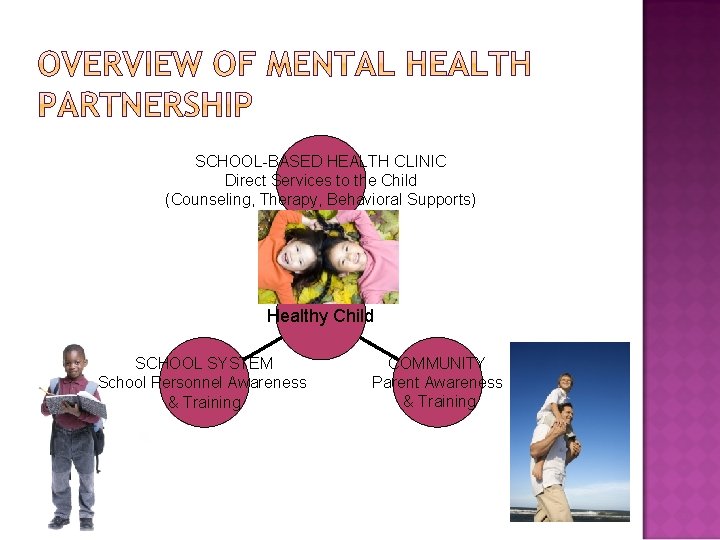
SCHOOL-BASED HEALTH CLINIC Direct Services to the Child (Counseling, Therapy, Behavioral Supports) Healthy Child SCHOOL SYSTEM School Personnel Awareness & Training COMMUNITY Parent Awareness & Training
� Parents trained to alter child’s behavior at home � Based on behavioral & social learning principles (Skinner, Bandura) � Addresses multiple domains: �e. g. , child compliance, tantrums, enuresis, eating disorders, hyperactivity, medical adherence � Targets �e. g. , multiple populations: preschoolers to adolescents, children with autism, MR, LD, ADHD
� Tend to focus on children ages 3 -10 (Kazdin, 1997) � Seldom have addressed ethnic and cultural issues (Forehand & Kotchick, 1996) � Have � neglected parents of adolescents BUT…the teenage years are critical
An Evidence-Based Method for Parent Training � Compared to control groups, parent trainings which used VTM can produce significant behavioral change, including: �Reduced child behavior problems �More prosocial behavior �Fewer incidents of spanking �Decreased parental stress �More positive parent-child interactions
� Initially conceptualized as parent training group � BUT…multiple community barriers! � Now Individual sessions with parents to train in behavioral management techniques and positive parenting skills �Videotape modeling, didactic presentation, coaching, practice & feedback, training in DBR…
Possible topics… �Getting to Know and Connecting with your Teenager �Communicating Positively and Effectively �Encouraging and Listening to your Child �Establishing Rules and Boundaries �Teaching Teenagers Responsibility �Positive Discipline Strategies �Dealing with Conflict �Solving Problems Together
Pre- & Post-measures to assess changes in discipline strategies, perceived problems, communication, etc. Direct Behavior Ratings (DBRs) to monitor & communicate, as well as intervention component
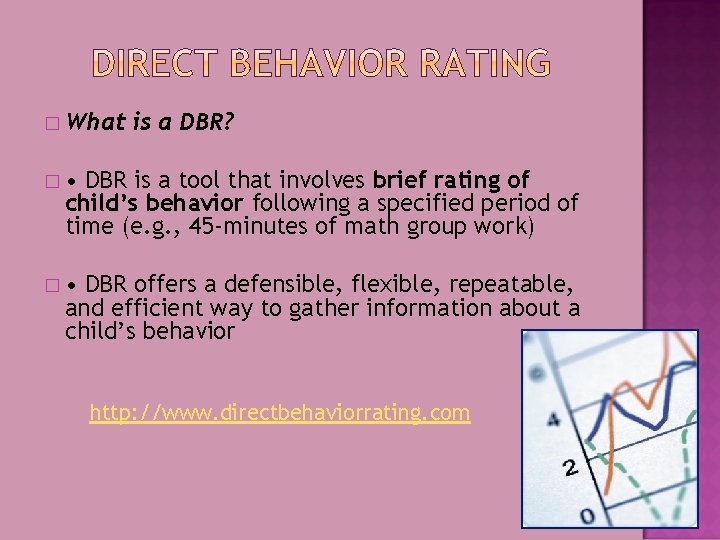
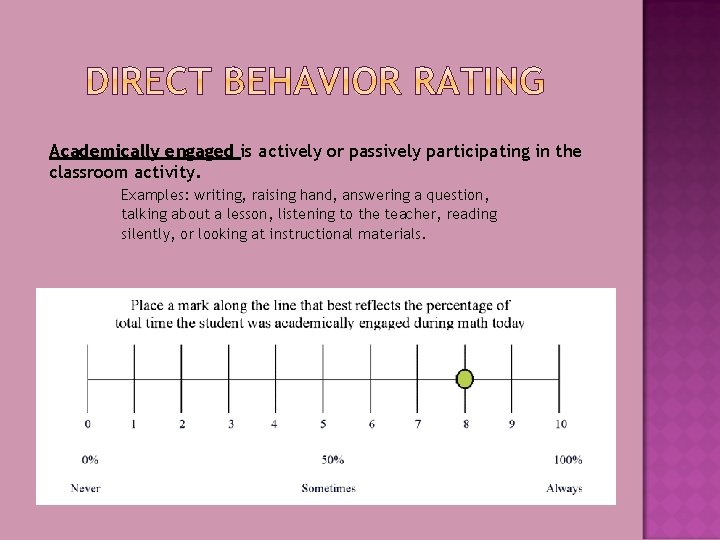
� What is a DBR? � • DBR is a tool that involves brief rating of child’s behavior following a specified period of time (e. g. , 45 -minutes of math group work) � • DBR offers a defensible, flexible, repeatable, and efficient way to gather information about a child’s behavior http: //www. directbehaviorrating. com
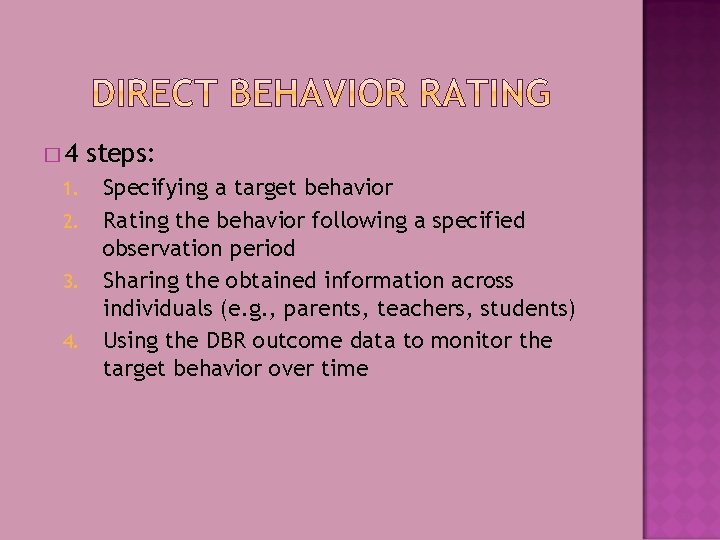
� 4 1. 2. 3. 4. steps: Specifying a target behavior Rating the behavior following a specified observation period Sharing the obtained information across individuals (e. g. , parents, teachers, students) Using the DBR outcome data to monitor the target behavior over time
Academically engaged is actively or passively participating in the classroom activity. Examples: writing, raising hand, answering a question, talking about a lesson, listening to the teacher, reading silently, or looking at instructional materials.
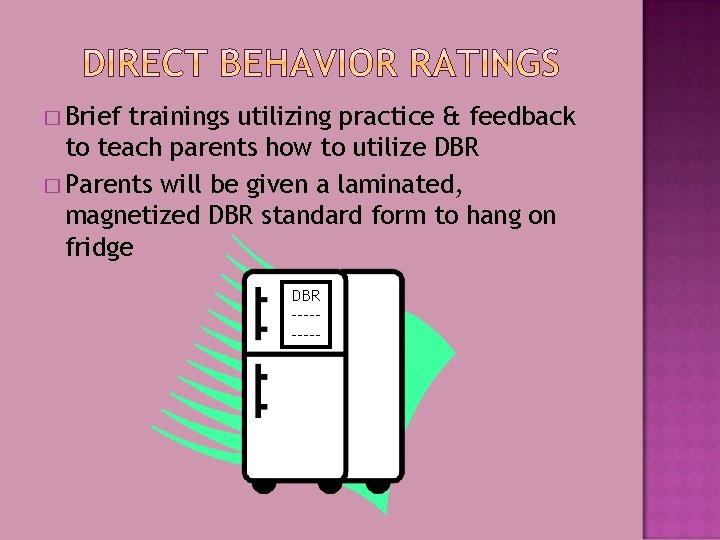
� Brief trainings utilizing practice & feedback to teach parents how to utilize DBR � Parents will be given a laminated, magnetized DBR standard form to hang on fridge DBR -----
� Parents will use DBR to rate teen’s target behaviors following specified time (e. g. , family dinner) � Will record DBR via text, email, or BASIS � Will be given tokens as incentives for use in the clinic store
� During “check-in” portion of parent sessions, parents will receive feedback on DBR data, including graphs for visual assessment � DBR will be used to analyze changes in teen behavior over course of treatment
� � � � � Chafouleas, S. M. ; Riley-Tillman, T. C. , & Sugai G. (2007). School Based Behavior Assessment: Informing Instruction and Intervention. New York, NY: The Guilford Press. Chafouleas, S. M. ; Riley-Tillman, T. C. , & Mc. Dougal, J. (2002). "Good, bad, or in-between: How does the daily behavior report card rate? ". Psychology in the Schools 39: 157 -169. Chafouleas, S. M. ; Riley-Tillman, T. C. , & Sassu, K. A. (2006). "Acceptability and reported use of Daily Behavior Report Cards among teachers". Journal of Positive Behavior Interventions, (8): 174 -182. Forehand, R. & Kotchick, B. A. (1996). Cultural diversity: A wake-up call for parent training. Behaviioral Therapy, 27, 187 -206. Kazdin, A. (1997). Parent management training: Evidence, outcomes, and issues. Journal of the American Academy of Child and Adolescent Psychiatry, 36(10), 1349– 1356. Riley-Tillman, T. C. ; Chafouleas, S. M. , & Eckert, T. (2008). "Daily Behavior Report Cards and Systematic Direct Observation: An Investigation of the Acceptability, Reported Training and Use, and Decision Reliability among School Psychologists". Journal of Behavioral Education. Sharry, J. , Guerin, S. , Griffin, C. , & Drumm, M. (2005). An evaluation of the Parents Plus Early Years Programme: A video-based early intervention for parents of pre-school children with behavioral and developmental difficulties. Clinical Child Psychology and Psychiatry, 10(3), 319 -336. Webster-Stratton, C. , Kolpacoff, M. & Hollinsworth, T. (1988). Self-administered videotape therapy for families with conduct-problem children: Comparison with two cost-effective treatments and a control group. Journal of Consulting and Clinical Psychology, 56(4), 558 -566. Webster-Stratton, C. , Hollinsworht, T. , & Kolpacoff, M. (1989). The long-term effectiveness and clinical significance of three cost-effective training programs for families with conductproblem children. Journal of Consulting and Clinical Psychology, 57(4), 550 -553.