
Training on STR Typing Using Commercial Kits and
- Slides: 33
Training on STR Typing Using Commercial Kits and ABI 310/3100 Margaret C. Kline, Janette W. Redman, John M. Butler National Institute of Standards and Technology October 22 -26, 2001
Human Identity Testing • Forensic cases -- matching suspect with evidence • • • Paternity testing -- identifying father Historical investigations Missing persons investigations Mass disasters -- putting pieces back together Military DNA “dog tag” Convicted felon DNA databases
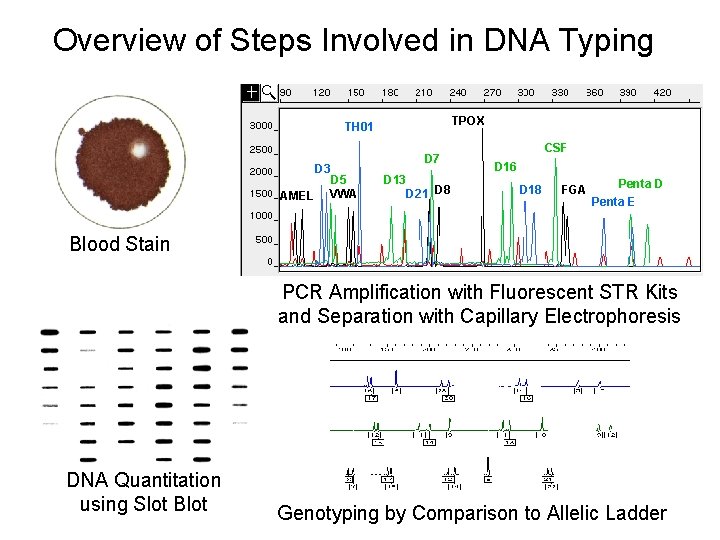
Overview of Steps Involved in DNA Typing TPOX TH 01 D 3 AMEL D 5 VWA D 7 D 13 D 21 D 8 CSF D 16 D 18 FGA Penta D Penta E Blood Stain PCR Amplification with Fluorescent STR Kits and Separation with Capillary Electrophoresis DNA Quantitation using Slot Blot Genotyping by Comparison to Allelic Ladder
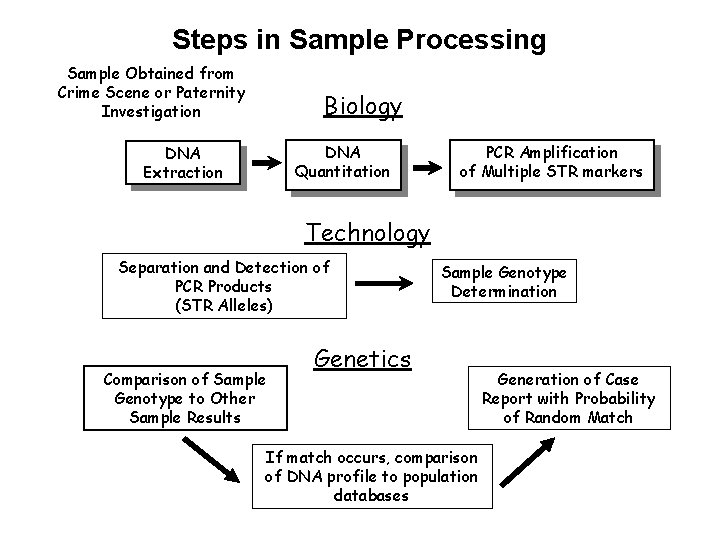
Steps in Sample Processing Sample Obtained from Crime Scene or Paternity Investigation Biology DNA Quantitation DNA Extraction PCR Amplification of Multiple STR markers Technology Separation and Detection of PCR Products (STR Alleles) Comparison of Sample Genotype to Other Sample Results Sample Genotype Determination Genetics If match occurs, comparison of DNA profile to population databases Generation of Case Report with Probability of Random Match
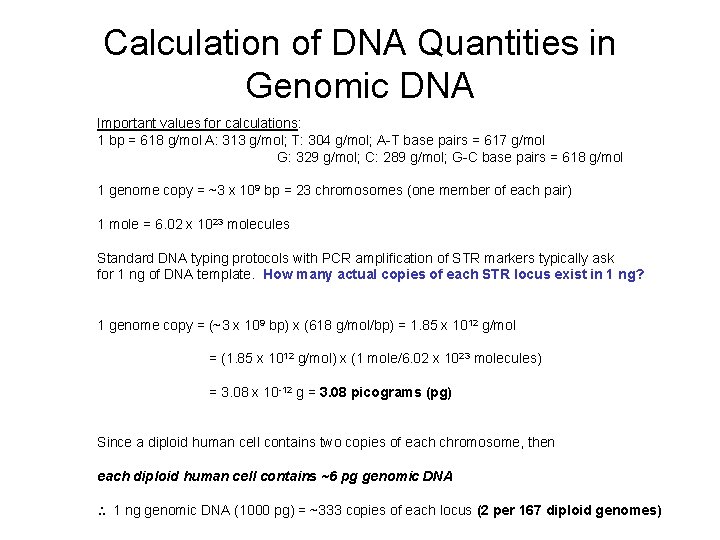
Calculation of DNA Quantities in Genomic DNA Important values for calculations: 1 bp = 618 g/mol A: 313 g/mol; T: 304 g/mol; A-T base pairs = 617 g/mol G: 329 g/mol; C: 289 g/mol; G-C base pairs = 618 g/mol 1 genome copy = ~3 x 10⁹ bp = 23 chromosomes (one member of each pair) 1 mole = 6. 02 x 1023 molecules Standard DNA typing protocols with PCR amplification of STR markers typically ask for 1 ng of DNA template. How many actual copies of each STR locus exist in 1 ng? 1 genome copy = (~3 x 10⁹ bp) x (618 g/mol/bp) = 1. 85 x 1012 g/mol = (1. 85 x 1012 g/mol) x (1 mole/6. 02 x 1023 molecules) = 3. 08 x 10 -12 g = 3. 08 picograms (pg) Since a diploid human cell contains two copies of each chromosome, then each diploid human cell contains ~6 pg genomic DNA 1 ng genomic DNA (1000 pg) = ~333 copies of each locus (2 per 167 diploid genomes)
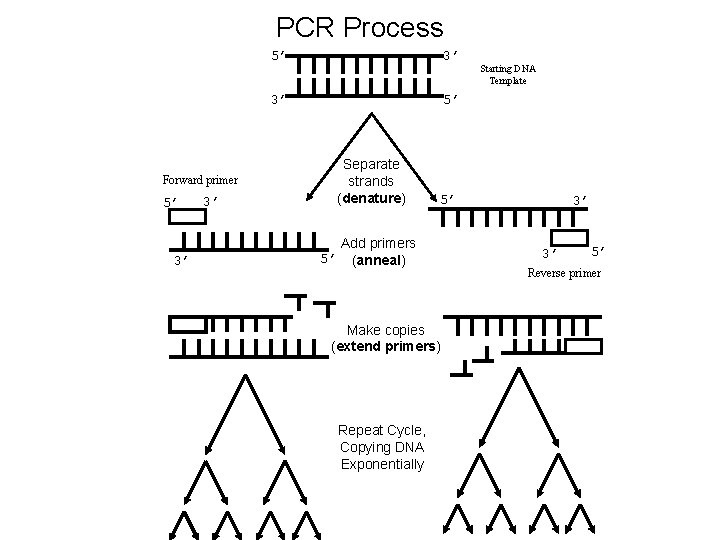
PCR Process 5’ 3’ 3’ 5’ Separate strands (denature) Forward primer 5’ 3’ 3’ 5’ 5’ Add primers (anneal) Make copies (extend primers) Repeat Cycle, Copying DNA Exponentially Starting DNA Template 3’ 3’ 5’ Reverse primer
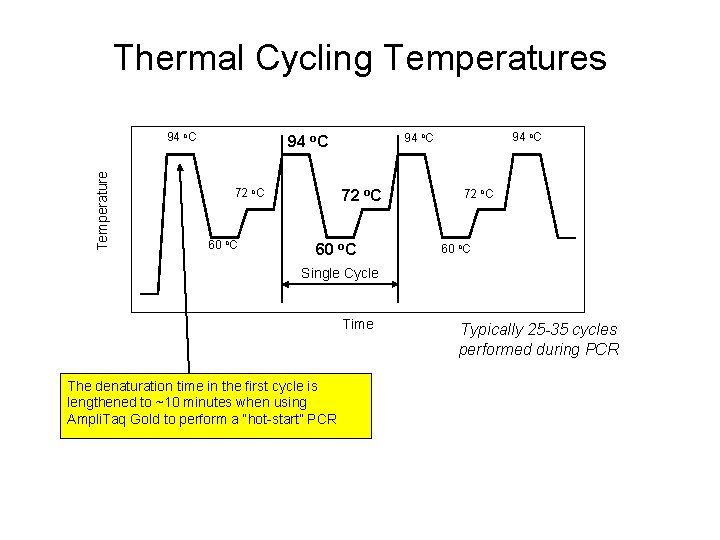
Thermal Cycling Temperatures Temperature 94 o. C 72 o. C 60 o. C Single Cycle Time The denaturation time in the first cycle is lengthened to ~10 minutes when using Ampli. Taq Gold to perform a “hot-start” PCR Typically 25 -35 cycles performed during PCR
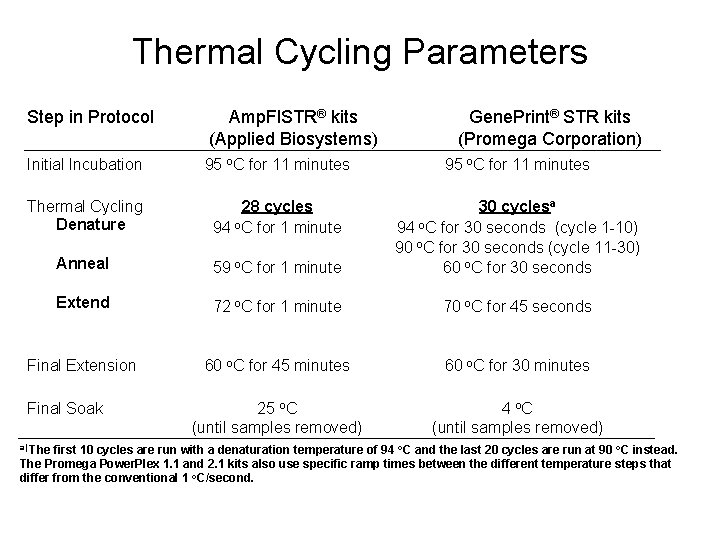
Thermal Cycling Parameters Step in Protocol Amp. Fl. STR® kits (Applied Biosystems) Gene. Print® STR kits (Promega Corporation) Initial Incubation Thermal Cycling Denature 95 o. C for 11 minutes 28 cycles 94 o. C for 1 minute Anneal 59 o. C for 1 minute 95 o. C for 11 minutes 30 cyclesa 94 o. C for 30 seconds (cycle 1 -10) 90 o. C for 30 seconds (cycle 11 -30) 60 o. C for 30 seconds Extend 72 o. C for 1 minute 70 o. C for 45 seconds Final Extension Final Soak 60 o. C for 45 minutes 25 o. C (until samples removed) 60 o. C for 30 minutes 4 o. C (until samples removed) a) The first 10 cycles are run with a denaturation temperature of 94 o. C and the last 20 cycles are run at 90 o. C instead. The Promega Power. Plex 1. 1 and 2. 1 kits also use specific ramp times between the different temperature steps that differ from the conventional 1 o. C/second.
Advantages of PCR • Minute amounts of DNA template may be used from as little as a single cell. • DNA degraded to fragments only a few hundred base pairs in length can serve as effective templates for amplification. • Large numbers of copies of specific DNA sequences can be amplified simultaneously with multiplex PCR reactions. • Contaminant DNA, such as fungal and bacterial sources, will not amplify because human-specific primers are used. • Commercial kits are now available for easy PCR reaction setup and amplification.
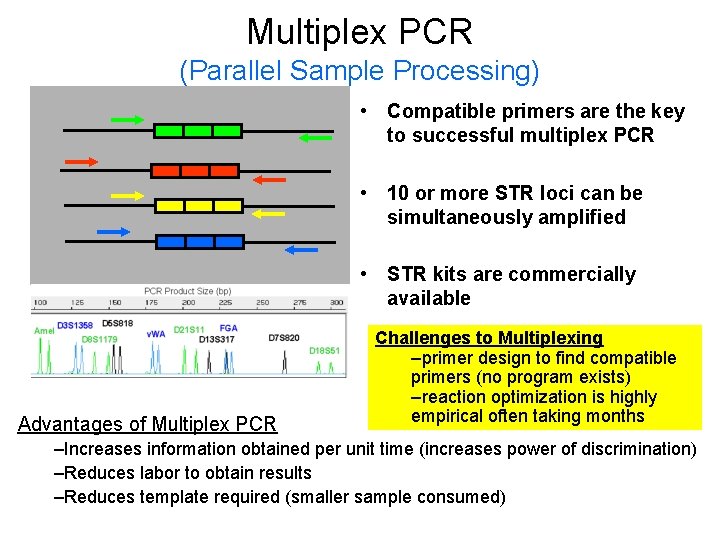
Multiplex PCR (Parallel Sample Processing) • Compatible primers are the key to successful multiplex PCR • 10 or more STR loci can be simultaneously amplified • STR kits are commercially available Advantages of Multiplex PCR Challenges to Multiplexing –primer design to find compatible primers (no program exists) –reaction optimization is highly empirical often taking months –Increases information obtained per unit time (increases power of discrimination) –Reduces labor to obtain results –Reduces template required (smaller sample consumed)
Potential Pitfalls of PCR • The target DNA template may not amplify due to the presence of PCR inhibitors in the extracted DNA • Amplification may fail due to sequence changes in the primer binding region of the genomic DNA template • Contamination from other human DNA sources besides the forensic evidence at hand or previously amplified DNA samples is possible without careful laboratory technique and validated protocols
Tips for Avoiding Contamination • Pre- and post-PCR sample processing areas should be physically separated. • Equipment, such as pipettors, and reagents for setting up PCR should be kept separate from other lab supplies, especially those used for analysis of PCR products. • Disposable gloves should be worn and changed frequently. • Reactions may also be set up in a laminar flow hood, if available. • Aerosol-resistant pipet tips should be used and changed on every new sample to prevent cross-contamination during liquid transfers. • Reagents should be carefully prepared to avoid the presence of any contaminating DNA or nucleases. • Ultraviolet irradiation of laboratory PCR set-up space when the area is not in use and cleaning workspaces and instruments with isopropanol and/or 10% bleach solutions help to insure that extraneous DNA molecules are destroyed prior to DNA extraction or PCR set-up
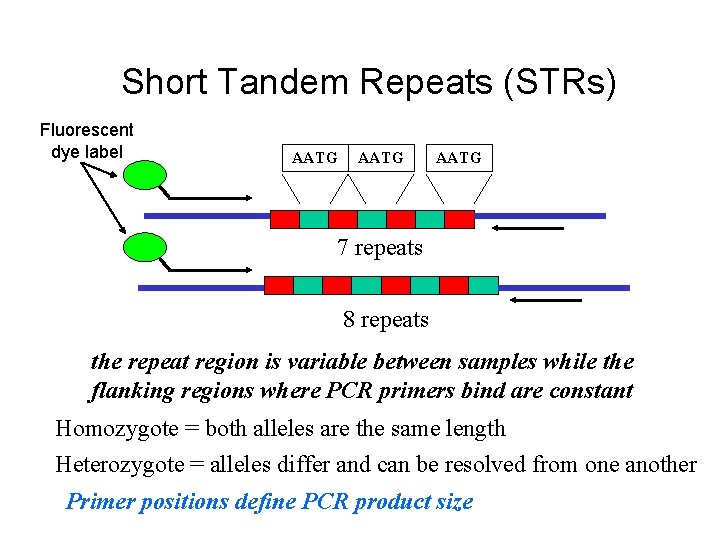
Short Tandem Repeats (STRs) Fluorescent dye label AATG 7 repeats 8 repeats the repeat region is variable between samples while the flanking regions where PCR primers bind are constant Homozygote = both alleles are the same length Heterozygote = alleles differ and can be resolved from one another Primer positions define PCR product size
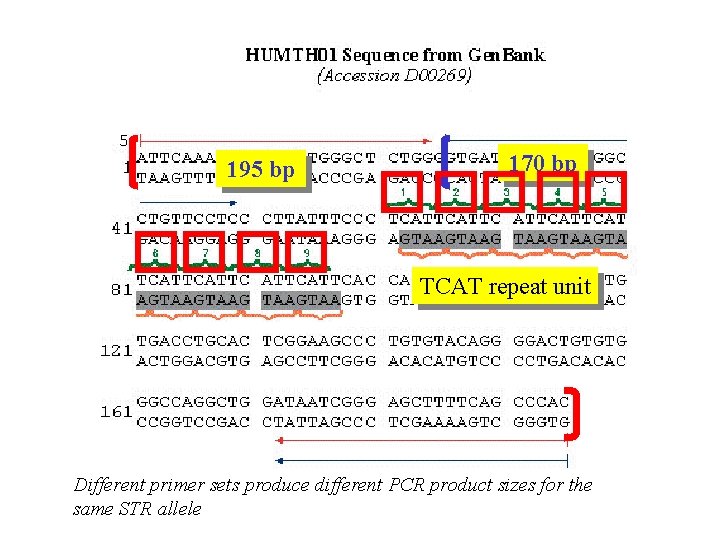
195 bp 170 bp TCAT repeat unit Different primer sets produce different PCR product sizes for the same STR allele
Why STRs are Preferred Genetic Markers • • Rapid processing is attainable Abundant throughout the genome Highly variable within various populations Small size range allows multiplex development Discrete alleles allow digital record of data Allelic ladders simplify interpretation PCR allows use of small amounts of DNA material Small product size compatible with degraded DNA
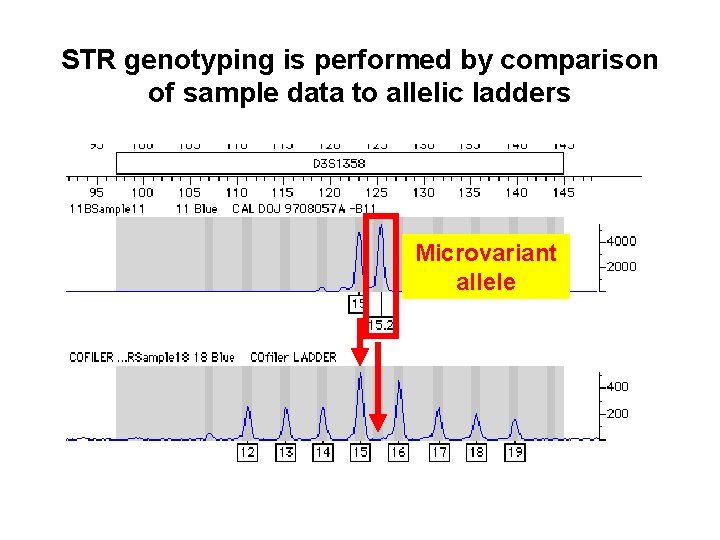
STR genotyping is performed by comparison of sample data to allelic ladders Microvariant allele
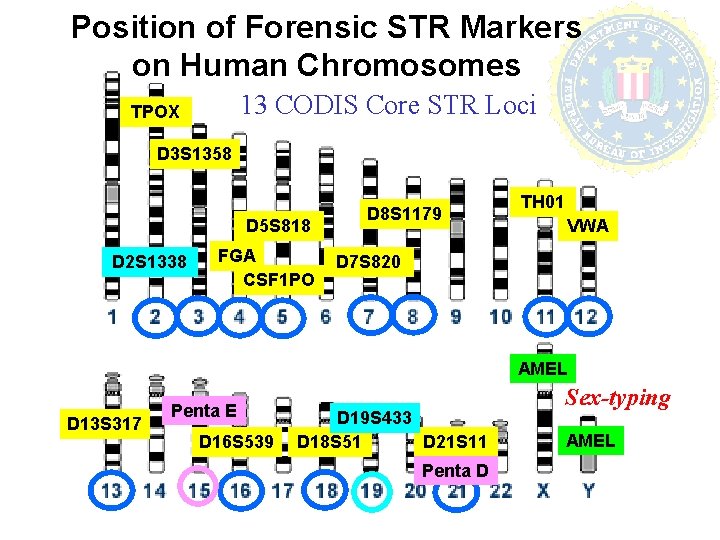
Position of Forensic STR Markers on Human Chromosomes 13 CODIS Core STR Loci TPOX D 3 S 1358 D 5 S 818 D 2 S 1338 FGA CSF 1 PO D 8 S 1179 TH 01 VWA D 7 S 820 AMEL D 13 S 317 Penta E D 16 S 539 D 19 S 433 D 18 S 51 D 21 S 11 Penta D Sex-typing AMEL
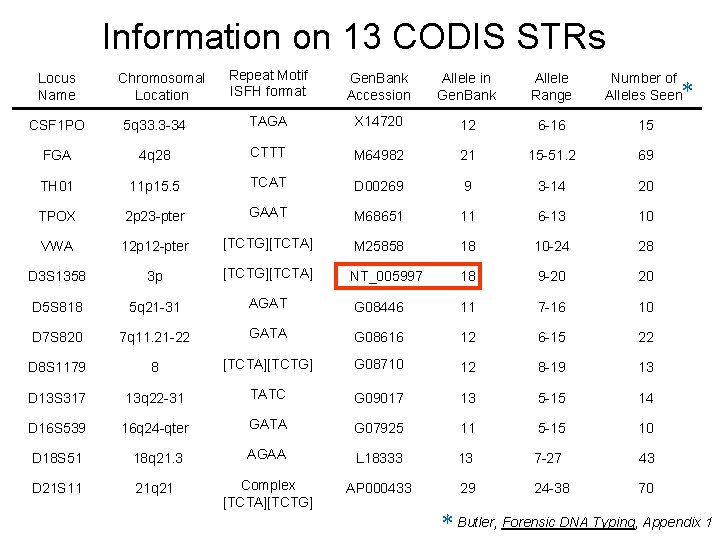
Information on 13 CODIS STRs Locus Name CSF 1 PO FGA TH 01 TPOX VWA D 3 S 1358 D 5 S 818 D 7 S 820 D 8 S 1179 D 13 S 317 D 16 S 539 D 18 S 51 D 21 S 11 Repeat Motif ISFH format Gen. Bank Accession Allele in Gen. Bank Allele Range Number of Alleles Seen 5 q 33. 3 -34 TAGA X 14720 12 6 -16 15 4 q 28 CTTT M 64982 21 15 -51. 2 69 11 p 15. 5 TCAT D 00269 9 3 -14 20 2 p 23 -pter GAAT M 68651 11 6 -13 10 12 p 12 -pter [TCTG][TCTA] M 25858 18 10 -24 28 3 p [TCTG][TCTA] NT_005997 18 9 -20 20 5 q 21 -31 AGAT G 08446 11 7 -16 10 7 q 11. 21 -22 GATA G 08616 12 6 -15 22 8 [TCTA][TCTG] G 08710 12 8 -19 13 13 q 22 -31 TATC G 09017 13 5 -15 14 16 q 24 -qter GATA G 07925 11 5 -15 10 18 q 21. 3 AGAA L 18333 13 7 -27 43 21 q 21 Complex [TCTA][TCTG] AP 000433 29 24 -38 70 Chromosomal Location * * Butler, Forensic DNA Typing, Appendix 1
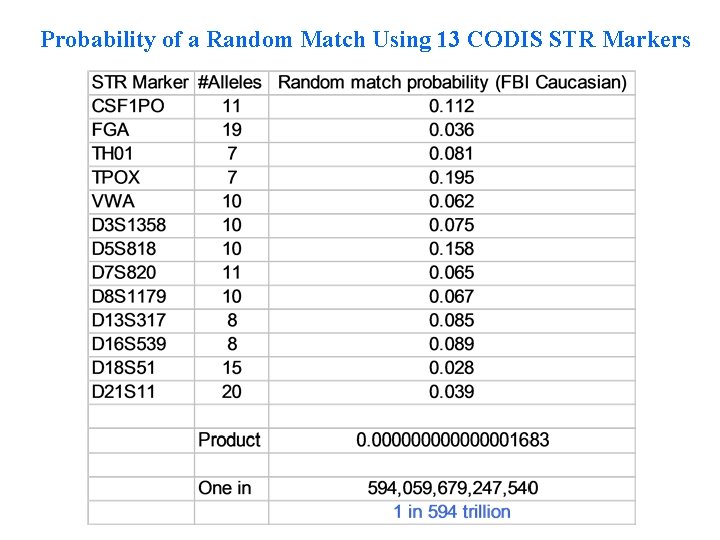
Probability of a Random Match Using 13 CODIS STR Markers
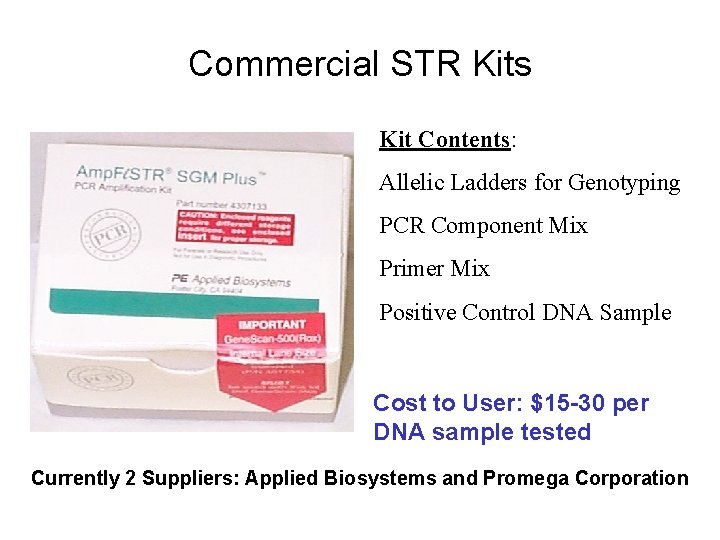
Commercial STR Kits Kit Contents: Allelic Ladders for Genotyping PCR Component Mix Primer Mix Positive Control DNA Sample Cost to User: $15 -30 per DNA sample tested Currently 2 Suppliers: Applied Biosystems and Promega Corporation
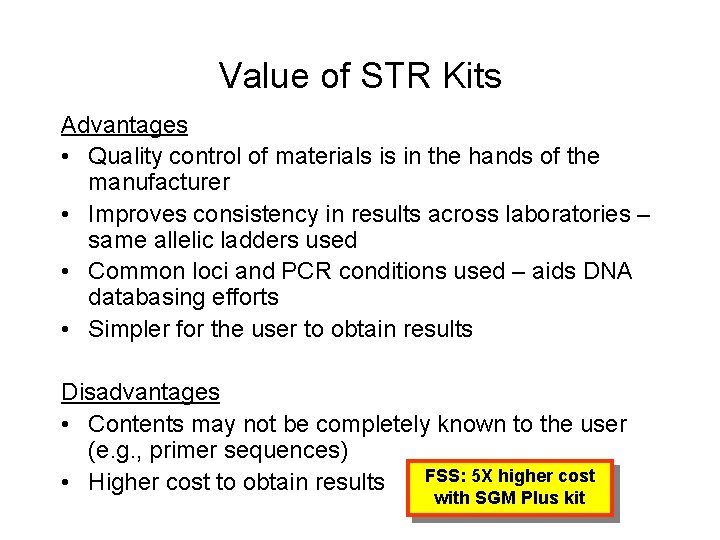
Value of STR Kits Advantages • Quality control of materials is in the hands of the manufacturer • Improves consistency in results across laboratories – same allelic ladders used • Common loci and PCR conditions used – aids DNA databasing efforts • Simpler for the user to obtain results Disadvantages • Contents may not be completely known to the user (e. g. , primer sequences) FSS: 5 X higher cost • Higher cost to obtain results with SGM Plus kit
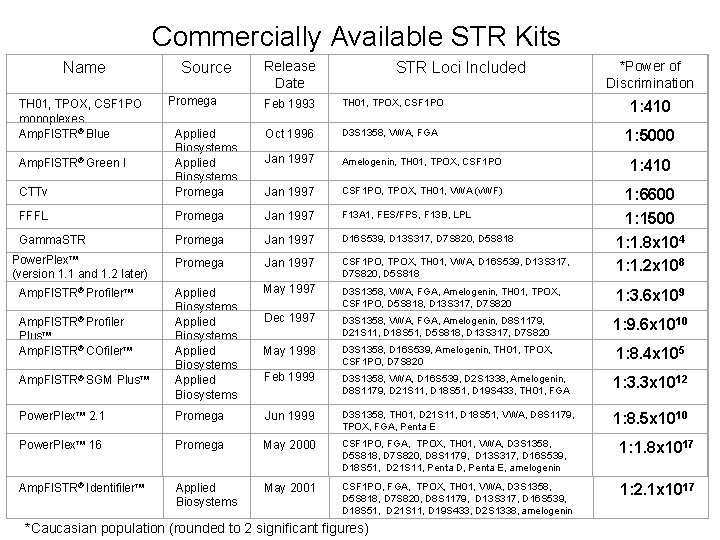
Commercially Available STR Kits Name TH 01, TPOX, CSF 1 PO monoplexes Amp. Fl. STR Blue Source Promega Release Date STR Loci Included Feb 1993 TH 01, TPOX, CSF 1 PO *Power of Discrimination 1: 410 Oct 1996 D 3 S 1358, VWA, FGA Jan 1997 Amelogenin, TH 01, TPOX, CSF 1 PO 1: 410 CTTv Applied Biosystems Promega Jan 1997 CSF 1 PO, TPOX, TH 01, VWA (v. WF) FFFL Promega Jan 1997 F 13 A 1, FES/FPS, F 13 B, LPL Gamma. STR Promega Jan 1997 D 16 S 539, D 13 S 317, D 7 S 820, D 5 S 818 Promega Jan 1997 CSF 1 PO, TPOX, TH 01, VWA, D 16 S 539, D 13 S 317, D 7 S 820, D 5 S 818 1: 6600 1: 1500 1: 1. 8 x 10⁴ 1: 1. 2 x 10⁸ Applied Biosystems May 1997 D 3 S 1358, VWA, FGA, Amelogenin, TH 01, TPOX, CSF 1 PO, D 5 S 818, D 13 S 317, D 7 S 820 1: 3. 6 x 10⁹ Dec 1997 D 3 S 1358, VWA, FGA, Amelogenin, D 8 S 1179, D 21 S 11, D 18 S 51, D 5 S 818, D 13 S 317, D 7 S 820 1: 9. 6 x 10¹⁰ May 1998 D 3 S 1358, D 16 S 539, Amelogenin, TH 01, TPOX, CSF 1 PO, D 7 S 820 1: 8. 4 x 10⁵ Feb 1999 D 3 S 1358, VWA, D 16 S 539, D 2 S 1338, Amelogenin, D 8 S 1179, D 21 S 11, D 18 S 51, D 19 S 433, TH 01, FGA 1: 3. 3 x 10¹² Power. Plex 2. 1 Promega Jun 1999 D 3 S 1358, TH 01, D 21 S 11, D 18 S 51, VWA, D 8 S 1179, TPOX, FGA, Penta E 1: 8. 5 x 10¹⁰ Power. Plex 16 Promega May 2000 CSF 1 PO, FGA, TPOX, TH 01, VWA, D 3 S 1358, D 5 S 818, D 7 S 820, D 8 S 1179, D 13 S 317, D 16 S 539, D 18 S 51, D 21 S 11, Penta D, Penta E, amelogenin 1: 1. 8 x 10¹⁷ Amp. Fl. STR Identifiler Applied Biosystems May 2001 CSF 1 PO, FGA, TPOX, TH 01, VWA, D 3 S 1358, D 5 S 818, D 7 S 820, D 8 S 1179, D 13 S 317, D 16 S 539, D 18 S 51, D 21 S 11, D 19 S 433, D 2 S 1338, amelogenin 1: 2. 1 x 10¹⁷ Amp. Fl. STR Green I Power. Plex (version 1. 1 and 1. 2 later) Amp. Fl. STR Profiler Plus Amp. Fl. STR COfiler Amp. Fl. STR SGM Plus *Caucasian population (rounded to 2 significant figures) 1: 5000
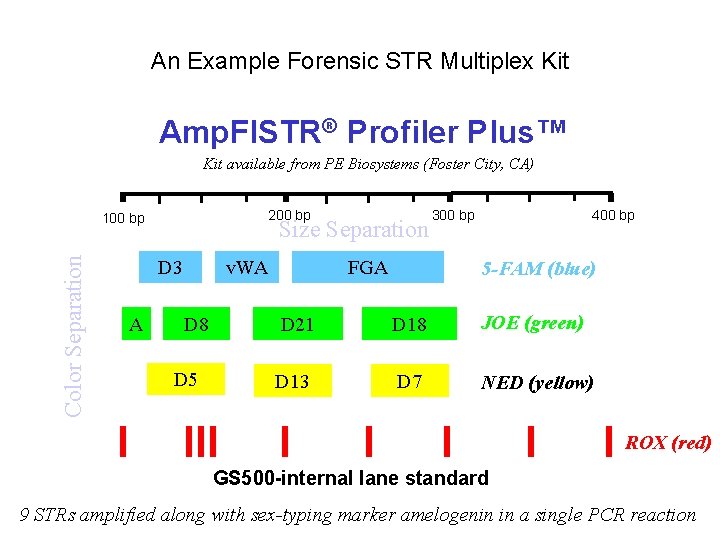
An Example Forensic STR Multiplex Kit Amp. Fl. STR® Profiler Plus™ Kit available from PE Biosystems (Foster City, CA) 200 bp Color Separation 100 bp Size Separation D 3 A v. WA D 8 D 5 FGA 300 bp 400 bp 5 -FAM (blue) D 21 D 18 JOE (green) D 13 D 7 NED (yellow) ROX (red) GS 500 -internal lane standard 9 STRs amplified along with sex-typing marker amelogenin in a single PCR reaction
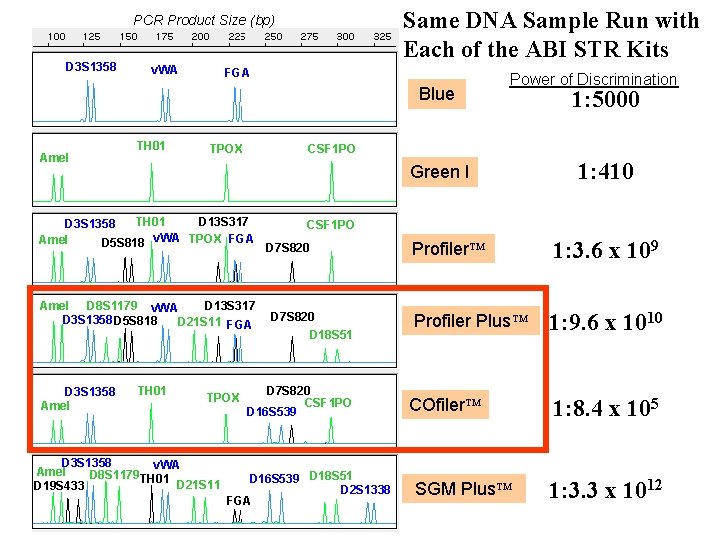
Same DNA Sample Run with Each of the ABI STR Kits PCR Product Size (bp) D 3 S 1358 v. WA FGA Blue Amel TH 01 Green I D 13 S 317 Amel D 8 S 1179 v. WA D 3 S 1358 D 5 S 818 D 21 S 11 FGA TH 01 TPOX D 3 S 1358 v. WA Amel D 8 S 1179 TH 01 D 21 S 11 D 19 S 433 1: 5000 CSF 1 PO TPOX TH 01 D 13 S 317 D 3 S 1358 Amel D 5 S 818 v. WA TPOX FGA D 3 S 1358 Amel Power of Discrimination 1: 410 CSF 1 PO D 7 S 820 D 18 S 51 D 7 S 820 CSF 1 PO D 16 S 539 D 18 S 51 D 2 S 1338 FGA Profiler 1: 3. 6 x 10⁹ Profiler Plus 1: 9. 6 x 10¹⁰ COfiler 1: 8. 4 x 10⁵ SGM Plus 1: 3. 3 x 10¹²
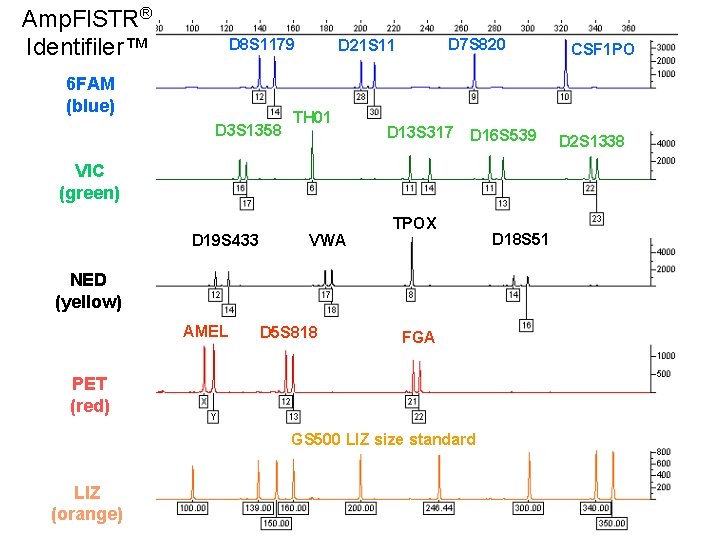
Amp. Fl. STR® Identifiler™ D 8 S 1179 6 FAM (blue) D 3 S 1358 D 7 S 820 D 21 S 11 TH 01 D 13 S 317 D 16 S 539 VIC (green) D 19 S 433 VWA TPOX NED (yellow) AMEL D 5 S 818 FGA PET (red) GS 500 LIZ size standard LIZ (orange) D 18 S 51 CSF 1 PO D 2 S 1338
Requirements for Accurate STR Typing • High precision (to permit comparison of allelic ladders to sequentially processed STR samples) • Color separation of different dye sets used (to avoid bleed through between different colors) • Resolution of at least 1 bp to >300 bp (to detect microvariants) • Reliable sizing over 75 -450 bp region Accurate typing can be achieved with ABI 310
Components of ABI 310 • Chemistry – STR kits, fluorescent dyes, matrix samples, capillary, buffers, polymer, formamide • Hardware – CCD camera, laser, electrodes, pump block, hot plate for temperature control, autosampler • Software – Data collection, color separation, peak sizing & calling, genotyping, stutter removal
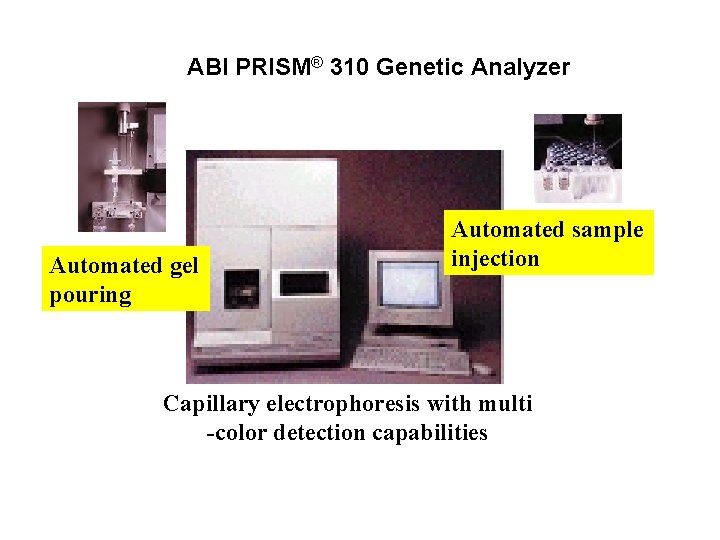
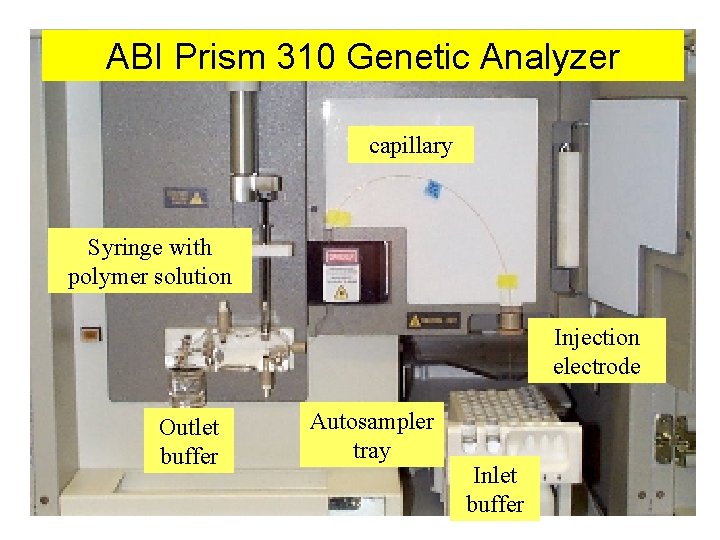
ABI PRISM® 310 Genetic Analyzer Automated gel pouring Automated sample injection Capillary electrophoresis with multi -color detection capabilities
ABI Prism 310 Genetic Analyzer capillary Syringe with polymer solution Injection electrode Outlet buffer Autosampler tray Inlet buffer
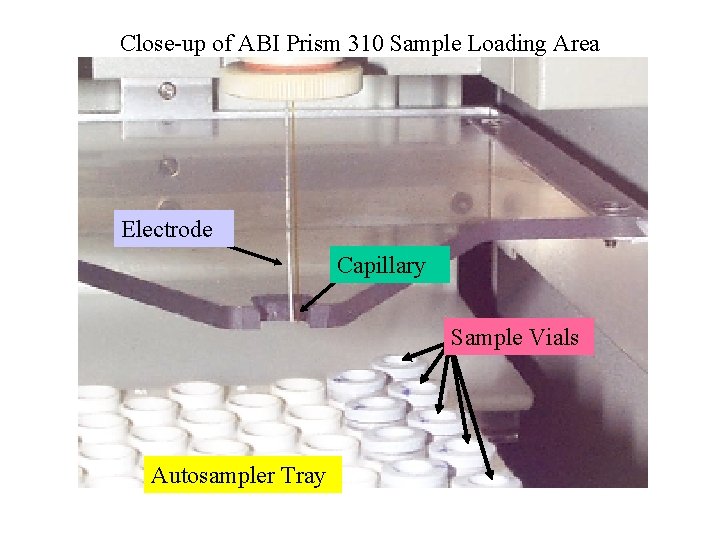
Close-up of ABI Prism 310 Sample Loading Area Electrode Capillary Sample Vials Autosampler Tray
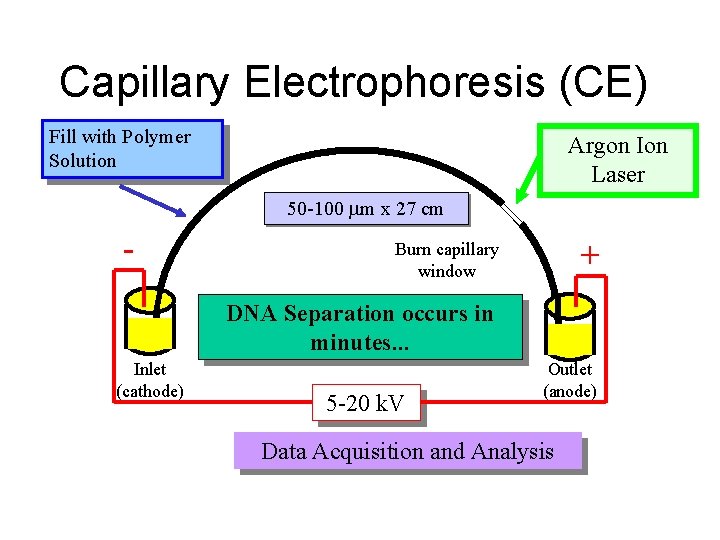
Capillary Electrophoresis (CE) Fill with Polymer Solution Argon Ion Laser 50 -100 m x 27 cm - + Burn capillary window DNA Separation occurs in minutes. . . Inlet (cathode) 5 -20 k. V Outlet (anode) Data Acquisition and Analysis
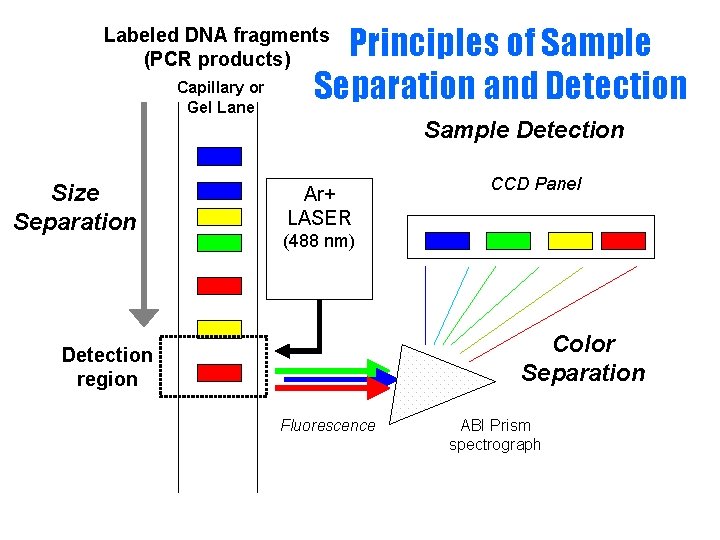
Principles of Sample Separation and Detection Labeled DNA fragments (PCR products) Capillary or Gel Lane Sample Detection Size Separation Ar+ LASER CCD Panel (488 nm) Color Separation Detection region Fluorescence ABI Prism spectrograph
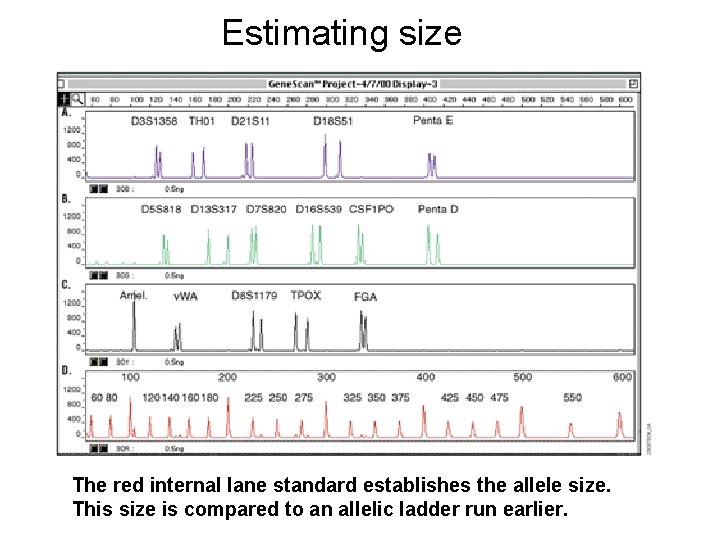
Estimating size The red internal lane standard establishes the allele size. This size is compared to an allelic ladder run earlier.