
Training of trainers break download resources from www
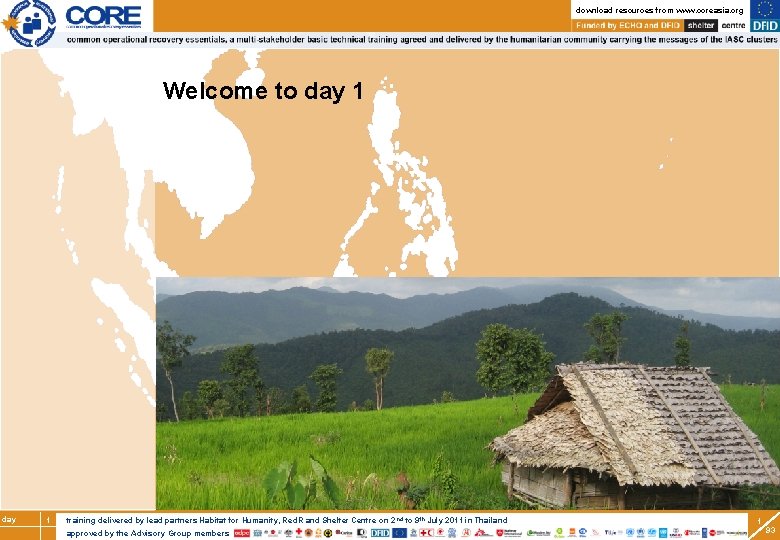
Training of trainers break download resources from www. coreasia. org Welcome to day 1 day. S 3. 1 1 training delivered by lead partners Habitat for Humanity, Red. R and Shelter Centre on 2 nd to 9 th July 2011 in Thailand approved by the Advisory Group members 1 93
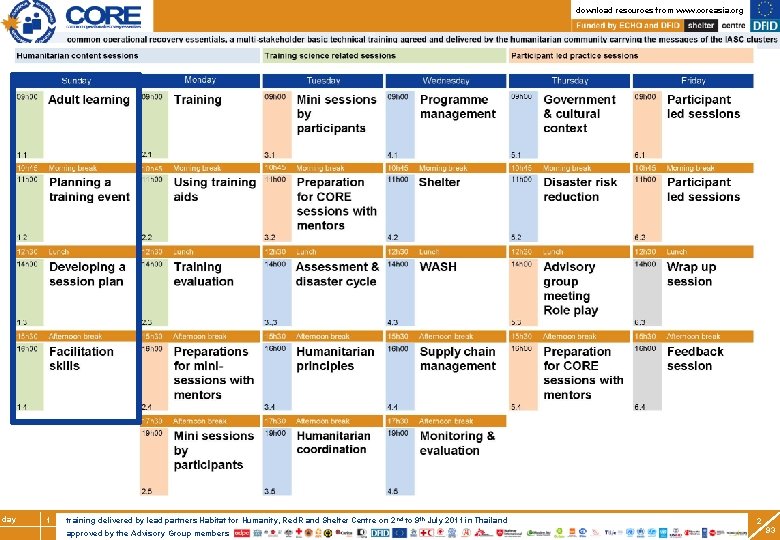
Training of trainers break day. S 3. 1 1 training delivered by lead partners Habitat for Humanity, Red. R and Shelter Centre on 2 nd to 9 th July 2011 in Thailand approved by the Advisory Group members download resources from www. coreasia. org 2 93
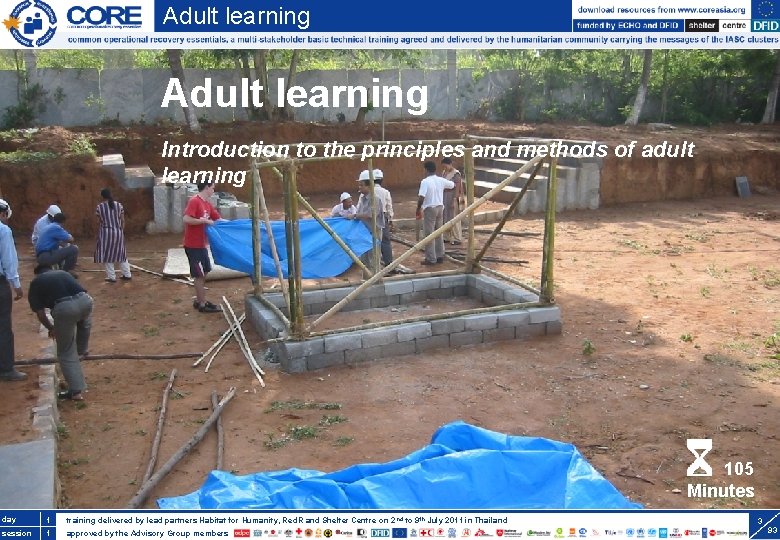
Adult learning Introduction to the principles and methods of adult learning 105 Minutes day. S 3. 1 1 training delivered by lead partners Habitat for Humanity, Red. R and Shelter Centre on 2 nd to 9 th July 2011 in Thailand session approved by the Advisory Group members 1 3 93
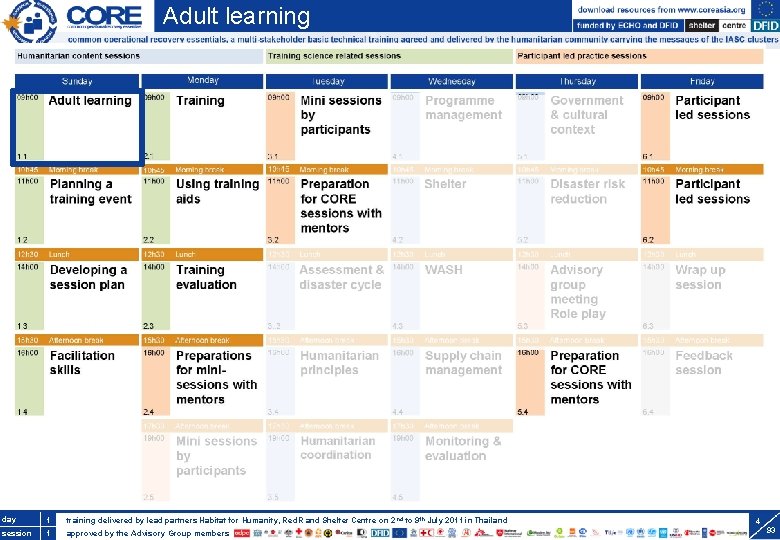
Training Adult learning of trainers break day. S 3. 1 1 training delivered by lead partners Habitat for Humanity, Red. R and Shelter Centre on 2 nd to 9 th July 2011 in Thailand session approved by the Advisory Group members 1 download resources from www. coreasia. org 44 93

Adult learning Learning objectives By the end of this session, you will have an understanding of Objective 1 Principles of adult learning Objective 2 The three stages of learning Objective 3 Understanding and remembering Objective 4 Adult learning environment Objective 5 Adult learning strategies day. S 3. 1 1 training delivered by lead partners Habitat for Humanity, Red. R and Shelter Centre on 2 nd to 9 th July 2011 in Thailand session approved by the Advisory Group members 1 5 93
Adult learning Objective 1 Principles of adult learning Adults need to know why they are learning something Learning should be relevant to the individual Problem based learning & task based learning is more effective day. S 3. 1 1 training delivered by lead partners Habitat for Humanity, Red. R and Shelter Centre on 2 nd to 9 th July 2011 in Thailand session approved by the Advisory Group members 1 6 93
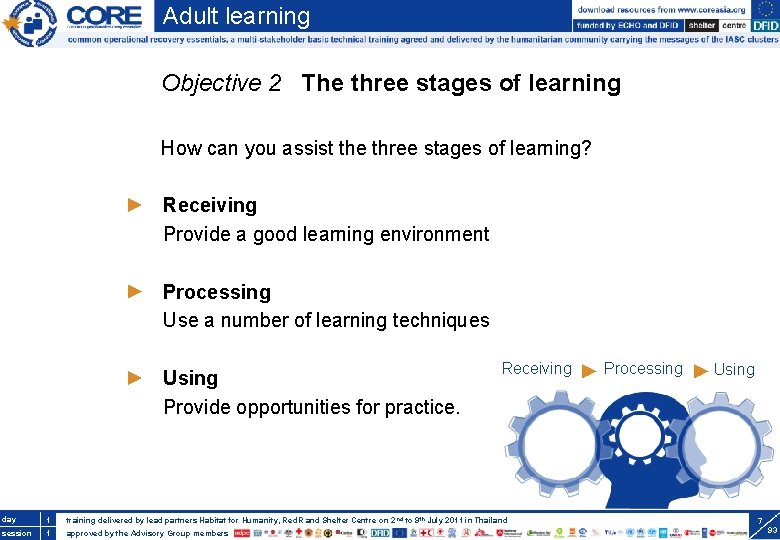
Adult learning Objective 2 The three stages of learning How can you assist the three stages of learning? Receiving Provide a good learning environment Processing Use a number of learning techniques Using Provide opportunities for practice. Receiving day. S 3. 1 1 training delivered by lead partners Habitat for Humanity, Red. R and Shelter Centre on 2 nd to 9 th July 2011 in Thailand session approved by the Advisory Group members 1 Processing Using 7 93
Adult learning Objective 3 Understanding and remembering Key points on understanding and remembering Understanding is developing initial perceptions We remember based on what we already know We understand better when learning is related to a project day. S 3. 1 1 training delivered by lead partners Habitat for Humanity, Red. R and Shelter Centre on 2 nd to 9 th July 2011 in Thailand session approved by the Advisory Group members 1 8 93
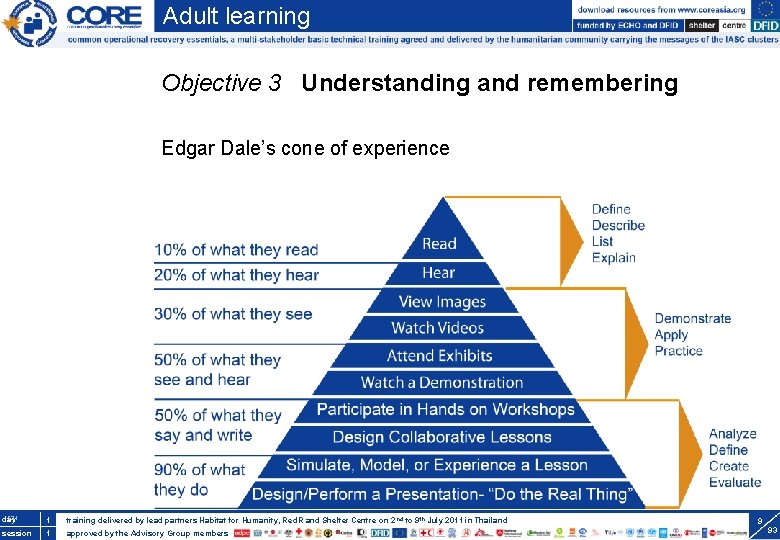
Adult learning Objective 3 Understanding and remembering Edgar Dale’s cone of experience S 31 day S 3. 1 1 training delivered by lead partners Habitat for Humanity, Red. R and Shelter Centre on 2 nd to 9 th July 2011 in Thailand session approved by the Advisory Group members 1 9 93
Adult learning Discussion in pairs Write down key points Question Which methods do you use to help you/others remember? Task In pairs, come up with three examples Discussion in pairs 15 minutes day. S 3. 1 1 training delivered by lead partners Habitat for Humanity, Red. R and Shelter Centre on 2 nd to 9 th July 2011 in Thailand session approved by the Advisory Group members 1 10 93
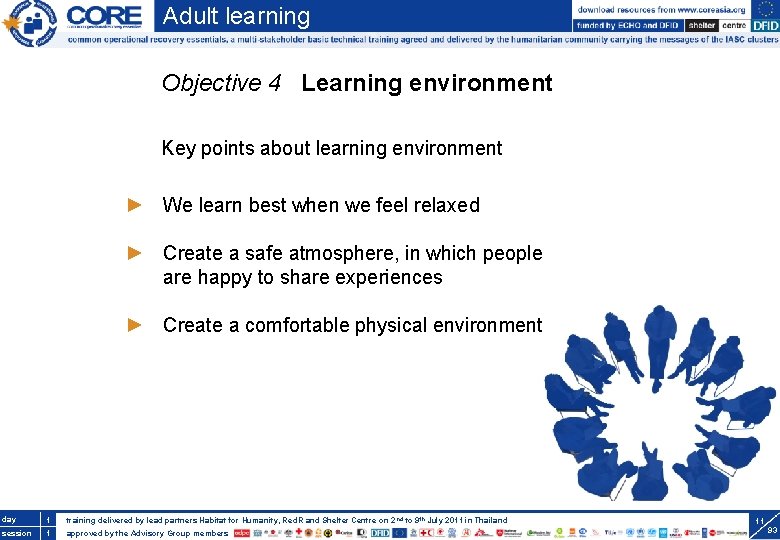
Adult learning Objective 4 Learning environment Key points about learning environment We learn best when we feel relaxed Create a safe atmosphere, in which people are happy to share experiences Create a comfortable physical environment day. S 3. 1 1 training delivered by lead partners Habitat for Humanity, Red. R and Shelter Centre on 2 nd to 9 th July 2011 in Thailand session approved by the Advisory Group members 1 11 93
Adult learning Objective 5 Learning styles What is a learning style? A learning style is a way in which an individual engages with learning Each participant will have their own learning style, and it is up to you as a trainer to tailor the sessions and learning techniques to suit several learning styles day. S 3. 1 1 training delivered by lead partners Habitat for Humanity, Red. R and Shelter Centre on 2 nd to 9 th July 2011 in Thailand session approved by the Advisory Group members 1 12 93
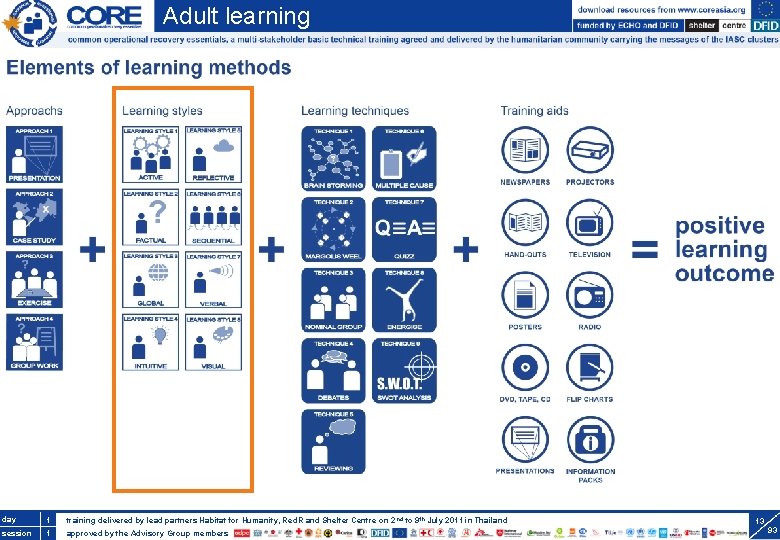
Adult learning day. S 3. 1 1 training delivered by lead partners Habitat for Humanity, Red. R and Shelter Centre on 2 nd to 9 th July 2011 in Thailand session approved by the Advisory Group members 1 13 93
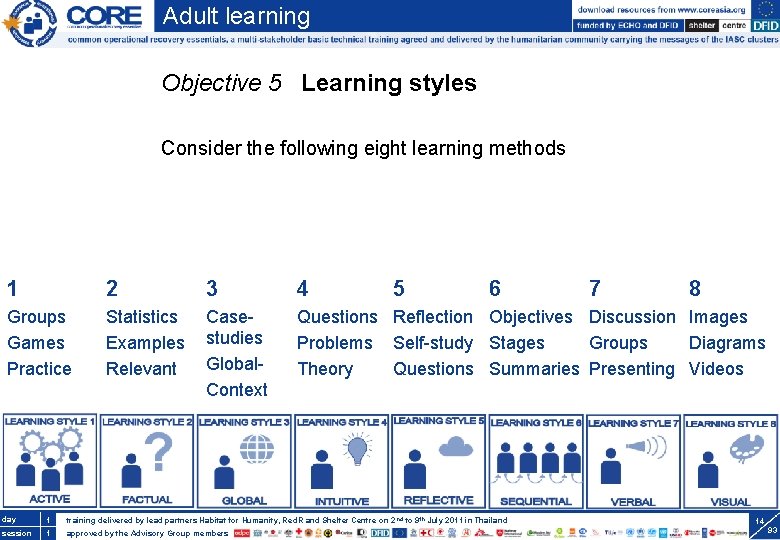
Adult learning Objective 5 Learning styles Consider the following eight learning methods 1 2 3 4 5 6 Groups Games Practice Statistics Examples Relevant Casestudies Global. Context Questions Reflection Objectives Discussion Images Problems Self-study Stages Groups Diagrams Theory Questions Summaries Presenting Videos day. S 3. 1 1 training delivered by lead partners Habitat for Humanity, Red. R and Shelter Centre on 2 nd to 9 th July 2011 in Thailand session approved by the Advisory Group members 1 7 8 14 93
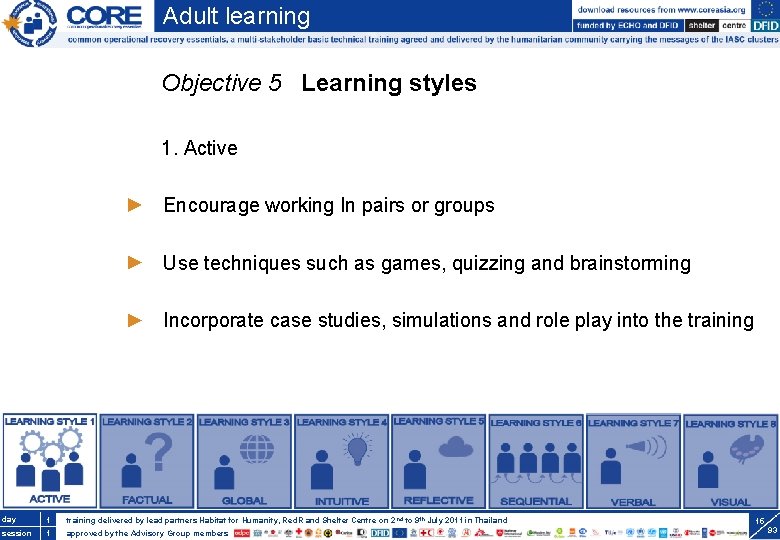
Adult learning Objective 5 Learning styles 1. Active Encourage working In pairs or groups Use techniques such as games, quizzing and brainstorming Incorporate case studies, simulations and role play into the training day. S 3. 1 1 training delivered by lead partners Habitat for Humanity, Red. R and Shelter Centre on 2 nd to 9 th July 2011 in Thailand session approved by the Advisory Group members 1 15 93
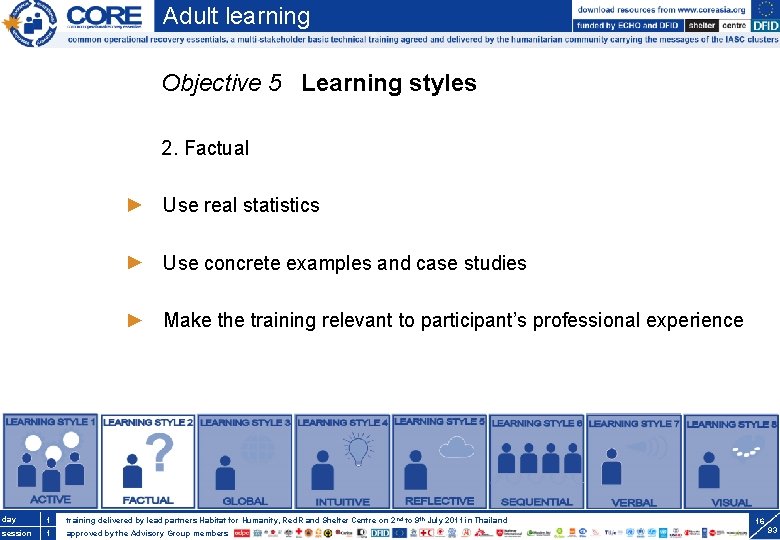
Adult learning Objective 5 Learning styles 2. Factual Use real statistics Use concrete examples and case studies Make the training relevant to participant’s professional experience day. S 3. 1 1 training delivered by lead partners Habitat for Humanity, Red. R and Shelter Centre on 2 nd to 9 th July 2011 in Thailand session approved by the Advisory Group members 1 16 93
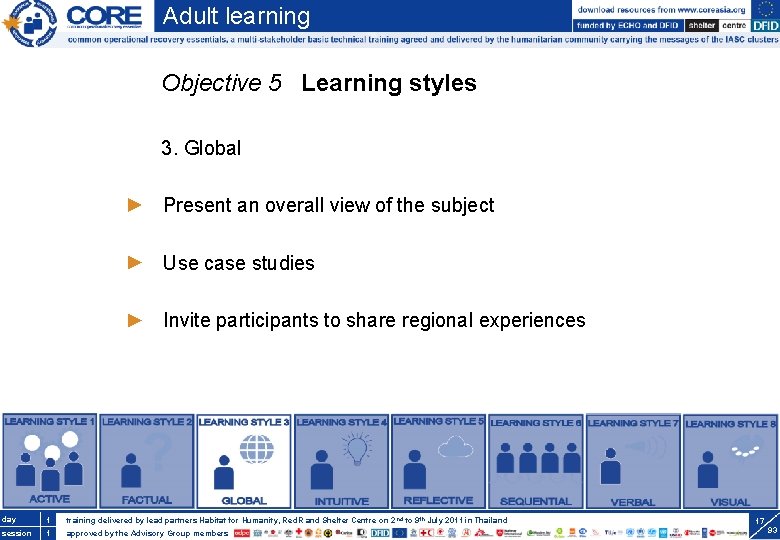
Adult learning Objective 5 Learning styles 3. Global Present an overall view of the subject Use case studies Invite participants to share regional experiences day. S 3. 1 1 training delivered by lead partners Habitat for Humanity, Red. R and Shelter Centre on 2 nd to 9 th July 2011 in Thailand session approved by the Advisory Group members 1 17 93
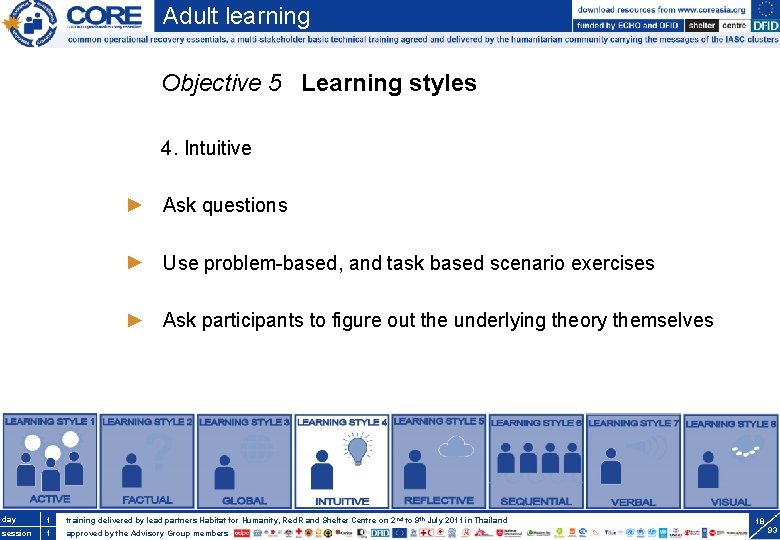
Adult learning Objective 5 Learning styles 4. Intuitive Ask questions Use problem-based, and task based scenario exercises Ask participants to figure out the underlying theory themselves day. S 3. 1 1 training delivered by lead partners Habitat for Humanity, Red. R and Shelter Centre on 2 nd to 9 th July 2011 in Thailand session approved by the Advisory Group members 1 18 93
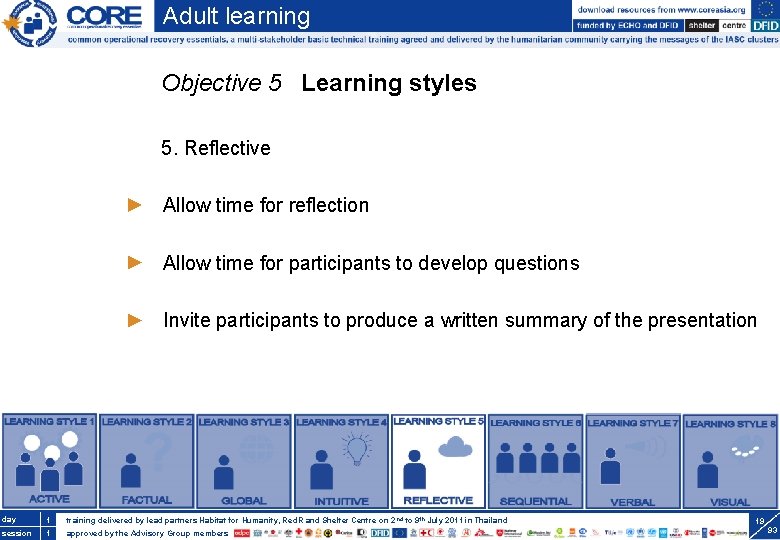
Adult learning Objective 5 Learning styles 5. Reflective Allow time for reflection Allow time for participants to develop questions Invite participants to produce a written summary of the presentation day. S 3. 1 1 training delivered by lead partners Habitat for Humanity, Red. R and Shelter Centre on 2 nd to 9 th July 2011 in Thailand session approved by the Advisory Group members 1 19 93
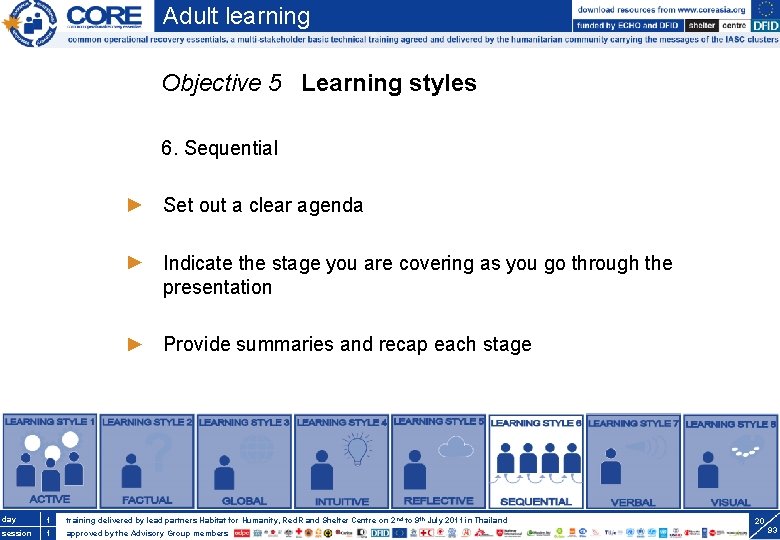
Adult learning Objective 5 Learning styles 6. Sequential Set out a clear agenda Indicate the stage you are covering as you go through the presentation Provide summaries and recap each stage day. S 3. 1 1 training delivered by lead partners Habitat for Humanity, Red. R and Shelter Centre on 2 nd to 9 th July 2011 in Thailand session approved by the Advisory Group members 1 20 93
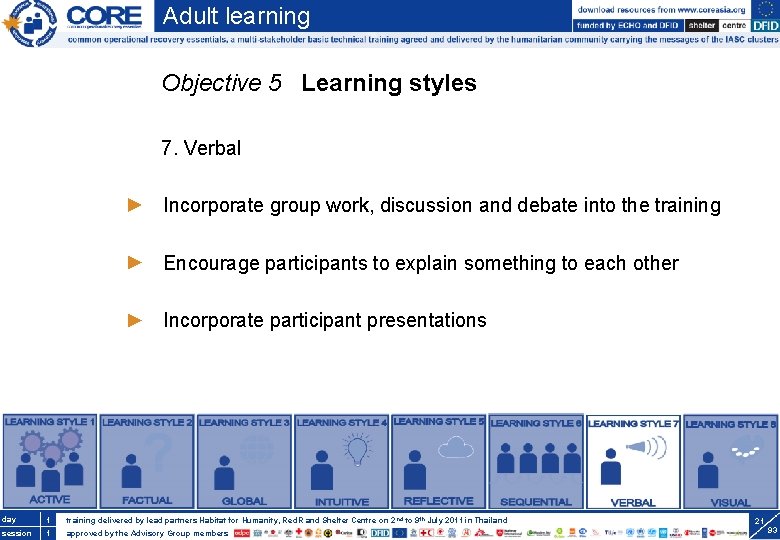
Adult learning Objective 5 Learning styles 7. Verbal Incorporate group work, discussion and debate into the training Encourage participants to explain something to each other Incorporate participant presentations day. S 3. 1 1 training delivered by lead partners Habitat for Humanity, Red. R and Shelter Centre on 2 nd to 9 th July 2011 in Thailand session approved by the Advisory Group members 1 21 93
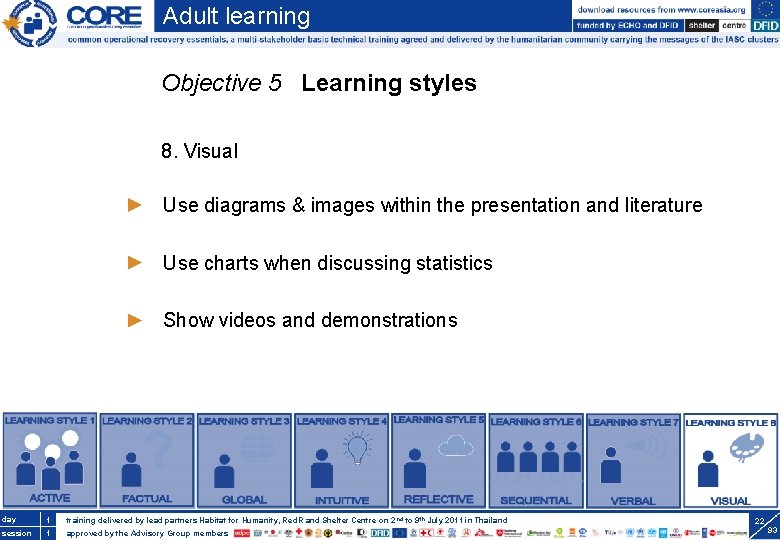
Adult learning Objective 5 Learning styles 8. Visual Use diagrams & images within the presentation and literature Use charts when discussing statistics Show videos and demonstrations day. S 3. 1 1 training delivered by lead partners Habitat for Humanity, Red. R and Shelter Centre on 2 nd to 9 th July 2011 in Thailand session approved by the Advisory Group members 1 22 93
Adult learning Discussion in groups Write down key points Task 1 Come up with eight examples of training methods, based on the eight learning styles. Discussion in groups 15 minutes day. S 3. 1 1 training delivered by lead partners Habitat for Humanity, Red. R and Shelter Centre on 2 nd to 9 th July 2011 in Thailand session approved by the Advisory Group members 1 23 93
Adult learning Any questions? Do you have any comments or experiences you would like to share? Share your experiences Do you have any questions? Any questions 15 minutes day. S 3. 1 1 training delivered by lead partners Habitat for Humanity, Red. R and Shelter Centre on 2 nd to 9 th July 2011 in Thailand session approved by the Advisory Group members 1 24 93
Adult learning Further reading Adult Learning Mechanisms Cegos, 2007 Delivering great training Bryan Hopkins, 2008 day. S 3. 1 1 training delivered by lead partners Habitat for Humanity, Red. R and Shelter Centre on 2 nd to 9 th July 2011 in Thailand session approved by the Advisory Group members 1 25 93
Training of trainers break download resources from www. coreasia. org Coffee break Please be back in time for 30 min Back at 11: 00 day. S 3. 1 1 training delivered by lead partners Habitat for Humanity, Red. R and Shelter Centre on 2 nd to 9 th July 2011 in Thailand approved by the Advisory Group members 26 93
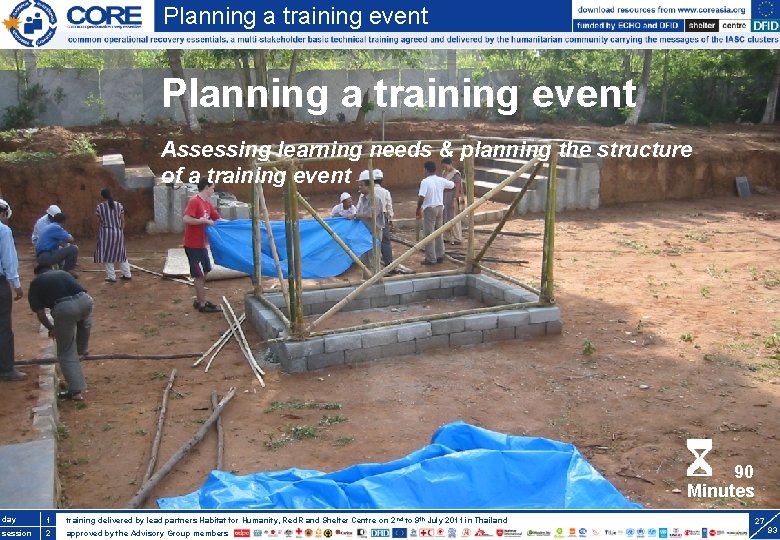
Planning a training event Assessing learning needs & planning the structure of a training event 90 Minutes day. S 3. 1 1 training delivered by lead partners Habitat for Humanity, Red. R and Shelter Centre on 2 nd to 9 th July 2011 in Thailand session approved by the Advisory Group members 2 27 93
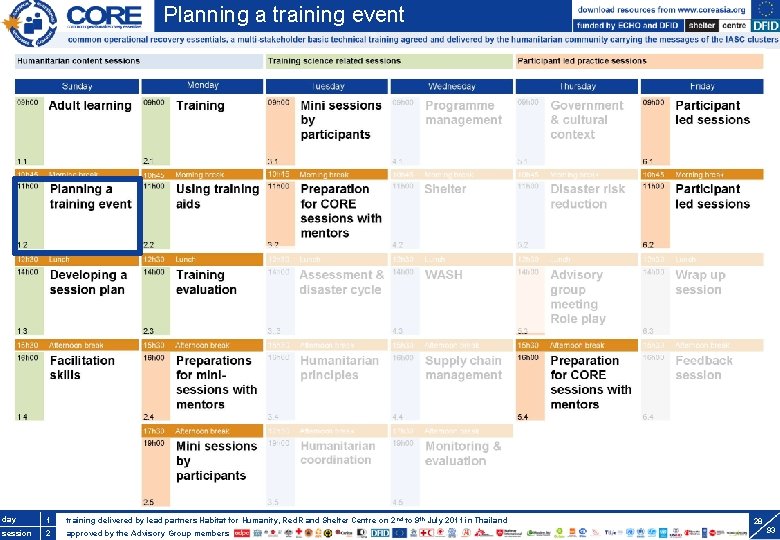
Planning Training aoftraining trainersevent break day. S 3. 1 1 training delivered by lead partners Habitat for Humanity, Red. R and Shelter Centre on 2 nd to 9 th July 2011 in Thailand session approved by the Advisory Group members 2 download resources from www. coreasia. org 28 28 93
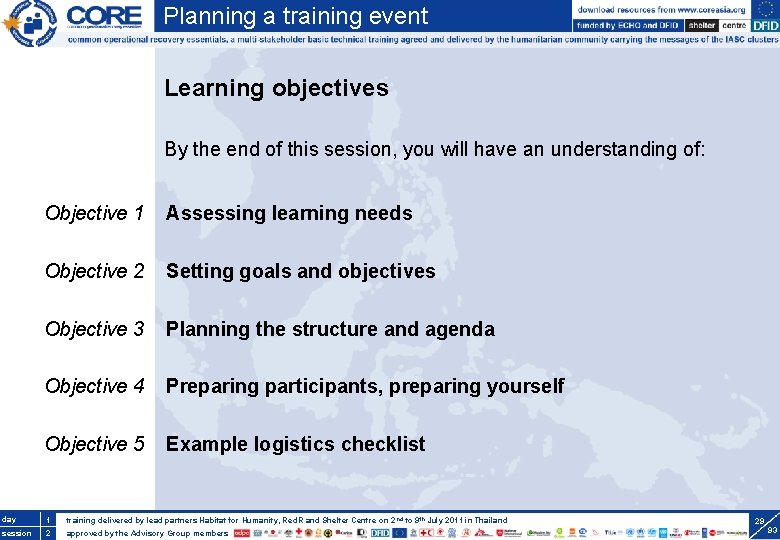
Planning a training event Learning objectives By the end of this session, you will have an understanding of: Objective 1 Assessing learning needs Objective 2 Setting goals and objectives Objective 3 Planning the structure and agenda Objective 4 Preparing participants, preparing yourself Objective 5 Example logistics checklist day. S 3. 1 1 training delivered by lead partners Habitat for Humanity, Red. R and Shelter Centre on 2 nd to 9 th July 2011 in Thailand session approved by the Advisory Group members 2 29 93
Planning a training event Discussion in groups Write down key points Task 1 Discuss your experiences of training events Task 2 Make a list of 5 do’s and don’t of training Task 3 Present your ideas to the group, noting common themes Discussion in groups 15 minutes day. S 3. 1 1 training delivered by lead partners Habitat for Humanity, Red. R and Shelter Centre on 2 nd to 9 th July 2011 in Thailand session approved by the Advisory Group members 2 30 93
Planning a training event Objective 1 Assessing learning needs Who is your target audience? Age, gender, education Knowledge base Job experience Language Motivation day. S 3. 1 1 training delivered by lead partners Habitat for Humanity, Red. R and Shelter Centre on 2 nd to 9 th July 2011 in Thailand session approved by the Advisory Group members 2 31 93
Planning a training event Objective 1 Assessing learning needs What is the current performance in humanitarian response? It is estimated 85% of humanitarian workers have no formal training at all Lack of common understanding Poor collaboration and use of resources day. S 3. 1 1 training delivered by lead partners Habitat for Humanity, Red. R and Shelter Centre on 2 nd to 9 th July 2011 in Thailand session approved by the Advisory Group members 2 32 93
Planning a training event Objective 2 Goals and objectives It is important to set goals and objectives on different levels General goals and objectives Course Learning objectives Enabling objectives day. S 3. 1 1 training delivered by lead partners Habitat for Humanity, Red. R and Shelter Centre on 2 nd to 9 th July 2011 in Thailand session approved by the Advisory Group members 2 33 93
Planning a training event Objective 2 Goals and objectives General objectives for CORE training Basic understanding in DRR+R+R Common language Collaboration Reference to other resources Use of the regional learning platform day. S 3. 1 1 training delivered by lead partners Habitat for Humanity, Red. R and Shelter Centre on 2 nd to 9 th July 2011 in Thailand session approved by the Advisory Group members 2 34 93
Planning a training event Objective 2 Goals and objectives Enabling objectives (EO’s) An enabling objective reflects the behaviour that should be adopted as a result of the training Example: In CORE To. T, an enabling objective is: For trainers to accompany participants, and be good facilitators day. S 3. 1 1 training delivered by lead partners Habitat for Humanity, Red. R and Shelter Centre on 2 nd to 9 th July 2011 in Thailand session approved by the Advisory Group members 2 35 93
Planning a training event Objective 3 Planning the structure and agenda should be determined by overall training objective, and target performance “ Keeping the actual performance at the heart of your training objective guarantees relevant, activity-based training” (UNMIL To. T workshop notes) p 17 day. S 3. 1 1 training delivered by lead partners Habitat for Humanity, Red. R and Shelter Centre on 2 nd to 9 th July 2011 in Thailand session approved by the Advisory Group members 2 36 93
Planning a training event Objective 3 Planning the structure and agenda Hierarchal task analysis In a hierarchical analysis, a task is broken down from top to bottom, thereby, showing a hierarchical relationship amongst the tasks To plan the structure and agenda, use flow charts and brain storming to break down your training objectives The sessions will be formed from breaking down the training objectives day. S 3. 1 1 training delivered by lead partners Habitat for Humanity, Red. R and Shelter Centre on 2 nd to 9 th July 2011 in Thailand session approved by the Advisory Group members 2 37 93
Planning a training event Objective 3 Planning the structure and agenda Structure: key points Think about the order in which you want people to learn Think about time of day people are most effective at absorbing knowledge Remember to use a number of training techniques (from the 8 learning methods) day. S 3. 1 1 training delivered by lead partners Habitat for Humanity, Red. R and Shelter Centre on 2 nd to 9 th July 2011 in Thailand session approved by the Advisory Group members 2 38 93
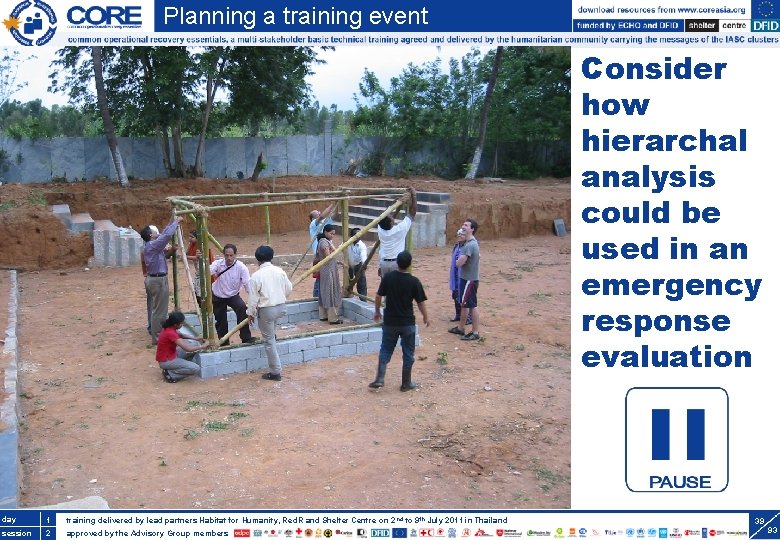
Planning a training event Consider how hierarchal analysis could be used in an emergency response evaluation day. S 3. 1 1 training delivered by lead partners Habitat for Humanity, Red. R and Shelter Centre on 2 nd to 9 th July 2011 in Thailand session approved by the Advisory Group members 2 39 93
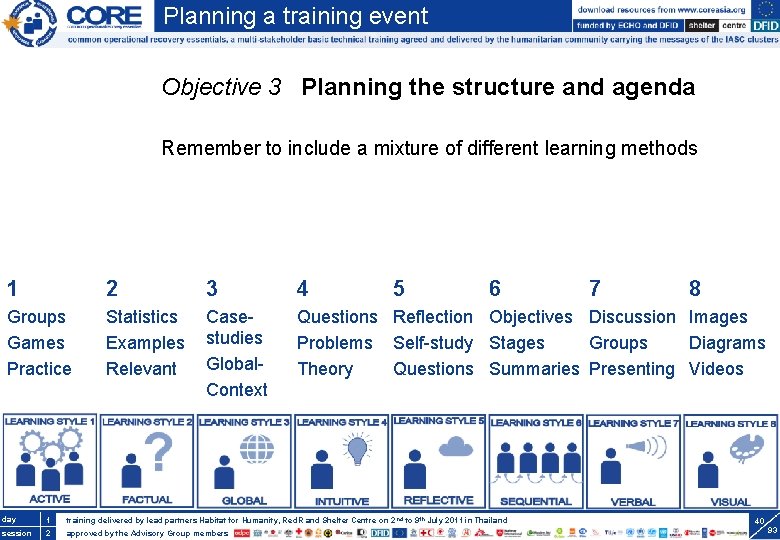
Planning a training event Objective 3 Planning the structure and agenda Remember to include a mixture of different learning methods 1 2 3 4 5 6 Groups Games Practice Statistics Examples Relevant Casestudies Global. Context Questions Reflection Objectives Discussion Images Problems Self-study Stages Groups Diagrams Theory Questions Summaries Presenting Videos day. S 3. 1 1 training delivered by lead partners Habitat for Humanity, Red. R and Shelter Centre on 2 nd to 9 th July 2011 in Thailand session approved by the Advisory Group members 2 7 8 40 93
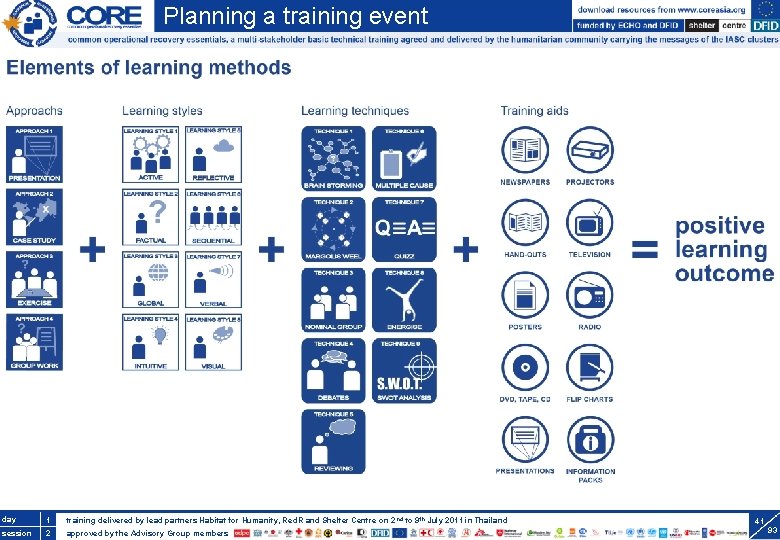
Planning a training event day. S 3. 1 1 training delivered by lead partners Habitat for Humanity, Red. R and Shelter Centre on 2 nd to 9 th July 2011 in Thailand session approved by the Advisory Group members 2 41 93
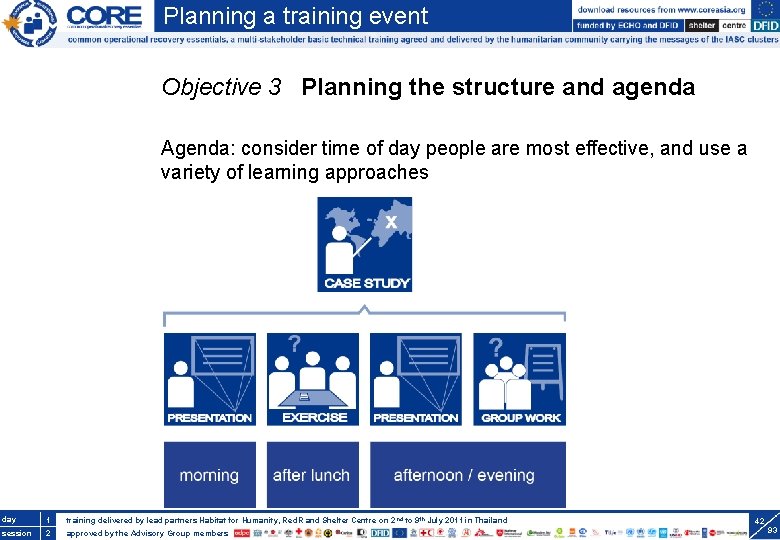
Planning a training event Objective 3 Planning the structure and agenda Agenda: consider time of day people are most effective, and use a variety of learning approaches day. S 3. 1 1 training delivered by lead partners Habitat for Humanity, Red. R and Shelter Centre on 2 nd to 9 th July 2011 in Thailand session approved by the Advisory Group members 2 42 93
Planning a training event Objective 4 Preparation Prepare participants Prepare yourself Prepare equipment and venue day. S 3. 1 1 training delivered by lead partners Habitat for Humanity, Red. R and Shelter Centre on 2 nd to 9 th July 2011 in Thailand session approved by the Advisory Group members 2 43 93
Planning a training event Objective 5 Example logistics checklist Venue Equipment Security Laptop, projector and screen Power supply Flip chart stand, pads, pens Rooms Participant manuals Seating Pens Environment Name badges day. S 3. 1 1 training delivered by lead partners Habitat for Humanity, Red. R and Shelter Centre on 2 nd to 9 th July 2011 in Thailand session approved by the Advisory Group members 2 44 93
Planning a training event Discussion in groups Split into 3 groups, and assess the CORE agenda for the following scenarios Write down key points Group 1 Assess the CORE agenda for several different stakeholder groups; think about what you might change for different audiences Group 2 Assess the CORE agenda for two countries that you have worked in, think about what you might change for different settings Discussion in groups Group 3 Assess the CORE agenda for an area of disaster, and for an area of conflict, what might you change in these settings? 30 minutes day. S 3. 1 1 training delivered by lead partners Habitat for Humanity, Red. R and Shelter Centre on 2 nd to 9 th July 2011 in Thailand session approved by the Advisory Group members 2 45 93
Planning a training event Any questions? Do you have any comments or experiences you would like to share? Share your experiences Do you have any questions? Any questions 15 minutes day. S 3. 1 1 training delivered by lead partners Habitat for Humanity, Red. R and Shelter Centre on 2 nd to 9 th July 2011 in Thailand session approved by the Advisory Group members 2 46 93
Planning a training event Further reading Adult Learning Mechanisms Cegos, 2007 Delivering great training Bryan Hopkins, 2008 Designing Participatory Workshops UNHCR, 2008 How to organize and run learning workshops UNICEF and UN staff college day. S 3. 1 1 training delivered by lead partners Habitat for Humanity, Red. R and Shelter Centre on 2 nd to 9 th July 2011 in Thailand session approved by the Advisory Group members 2 47 93
Training of trainers break download resources from www. coreasia. org Lunch break Please be back in time for 30 min Back at 14: 00 day. S 3. 1 1 training delivered by lead partners Habitat for Humanity, Red. R and Shelter Centre on 2 nd to 9 th July 2011 in Thailand approved by the Advisory Group members 48 93
Training of trainers break download resources from www. coreasia. org Energiser session day. S 3. 1 1 training delivered by lead partners Habitat for Humanity, Red. R and Shelter Centre on 2 nd to 9 th July 2011 in Thailand approved by the Advisory Group members 49 93
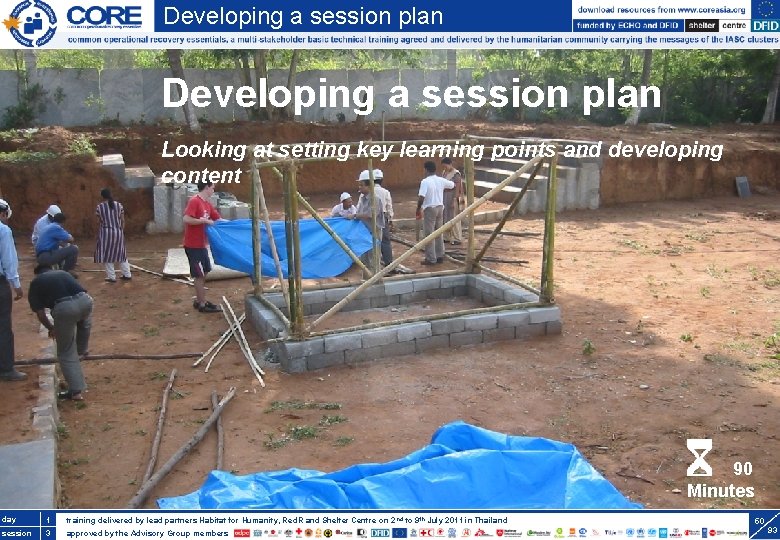
Developing a session plan Looking at setting key learning points and developing content 90 Minutes day. S 3. 1 1 training delivered by lead partners Habitat for Humanity, Red. R and Shelter Centre on 2 nd to 9 th July 2011 in Thailand session approved by the Advisory Group members 3 50 93
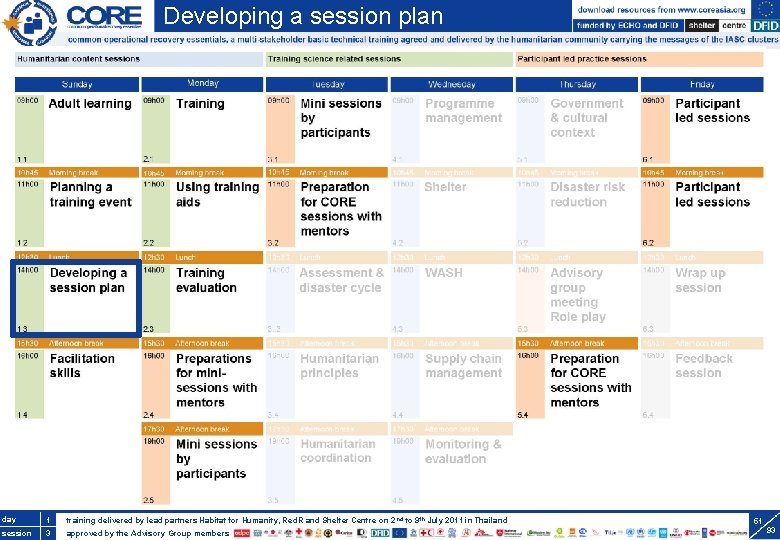
Training of trainers Developing a session break plan day. S 3. 1 1 training delivered by lead partners Habitat for Humanity, Red. R and Shelter Centre on 2 nd to 9 th July 2011 in Thailand session approved by the Advisory Group members 3 download resources from www. coreasia. org 51 51 93
Developing a session plan Learning objectives By the end of this session, you will have an understanding of: Objective 1 How to develop content Objective 2 Mind mapping Objective 3 Setting key learning points Objective 4 Deciding appropriate methods for training day. S 3. 1 1 training delivered by lead partners Habitat for Humanity, Red. R and Shelter Centre on 2 nd to 9 th July 2011 in Thailand session approved by the Advisory Group members 3 52 93
Developing a session plan Objective 1 Developing content In developing content, you should Continue with the hierarchical task analysis method, but go into a finer level of detail Use mind mapping methods day. S 3. 1 1 training delivered by lead partners Habitat for Humanity, Red. R and Shelter Centre on 2 nd to 9 th July 2011 in Thailand session approved by the Advisory Group members 3 53 93
Developing a session plan Objective 2 Mind mapping Key points Represents ideas around one subject Present ideas in a non-linear manor Encourages a brain-storming approach to organisational tasks Branches represent a hierarchy day. S 3. 1 1 training delivered by lead partners Habitat for Humanity, Red. R and Shelter Centre on 2 nd to 9 th July 2011 in Thailand session approved by the Advisory Group members 3 54 93
Developing a session plan Objective 2 Mind mapping demonstration Your trainer will now give a brief demonstration on mind-mapping, around the subject of WASH day. S 3. 1 1 training delivered by lead partners Habitat for Humanity, Red. R and Shelter Centre on 2 nd to 9 th July 2011 in Thailand session approved by the Advisory Group members 3 55 93
Developing a session plan Objective 3 Setting key learning points Key learning points will be developed in your mind-mapping exercise They are generally will come from the main branches of the mind map Take key words from your mind map and develop them into sentences day. S 3. 1 1 training delivered by lead partners Habitat for Humanity, Red. R and Shelter Centre on 2 nd to 9 th July 2011 in Thailand session approved by the Advisory Group members 3 56 93
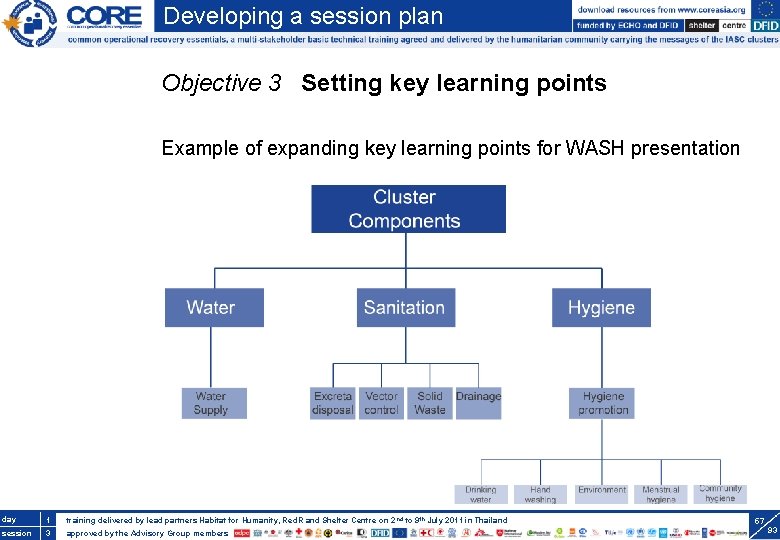
Developing a session plan Objective 3 Setting key learning points Example of expanding key learning points for WASH presentation day. S 3. 1 1 training delivered by lead partners Habitat for Humanity, Red. R and Shelter Centre on 2 nd to 9 th July 2011 in Thailand session approved by the Advisory Group members 3 57 93
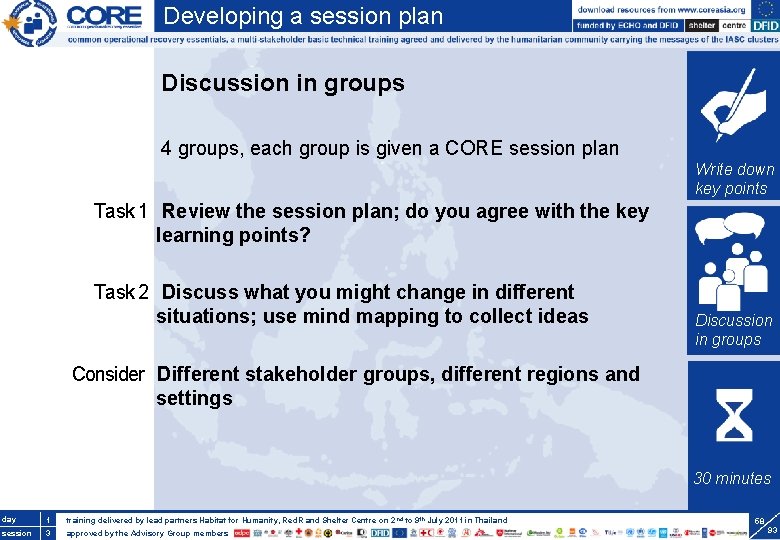
Developing a session plan Discussion in groups 4 groups, each group is given a CORE session plan Write down key points Task 1 Review the session plan; do you agree with the key learning points? Task 2 Discuss what you might change in different situations; use mind mapping to collect ideas Discussion in groups Consider Different stakeholder groups, different regions and settings 30 minutes day. S 3. 1 1 training delivered by lead partners Habitat for Humanity, Red. R and Shelter Centre on 2 nd to 9 th July 2011 in Thailand session approved by the Advisory Group members 3 58 93
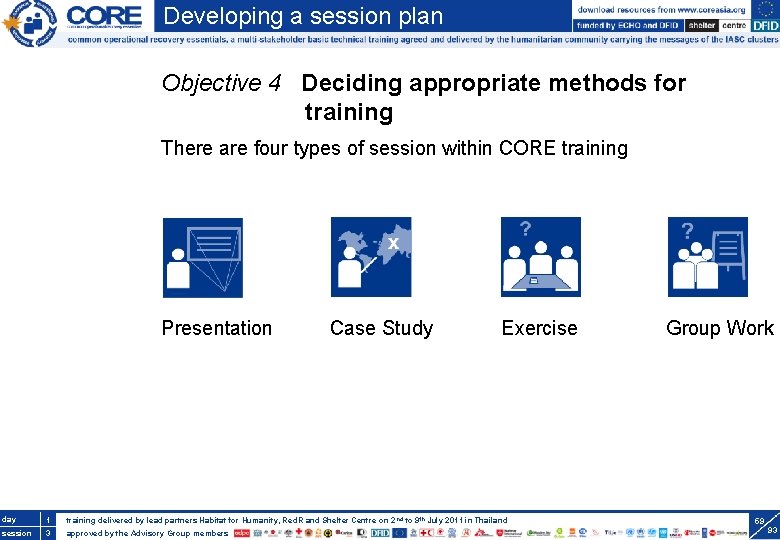
Developing a session plan Objective 4 Deciding appropriate methods for training There are four types of session within CORE training Presentation Case Study Exercise day. S 3. 1 1 training delivered by lead partners Habitat for Humanity, Red. R and Shelter Centre on 2 nd to 9 th July 2011 in Thailand session approved by the Advisory Group members 3 Group Work 59 93
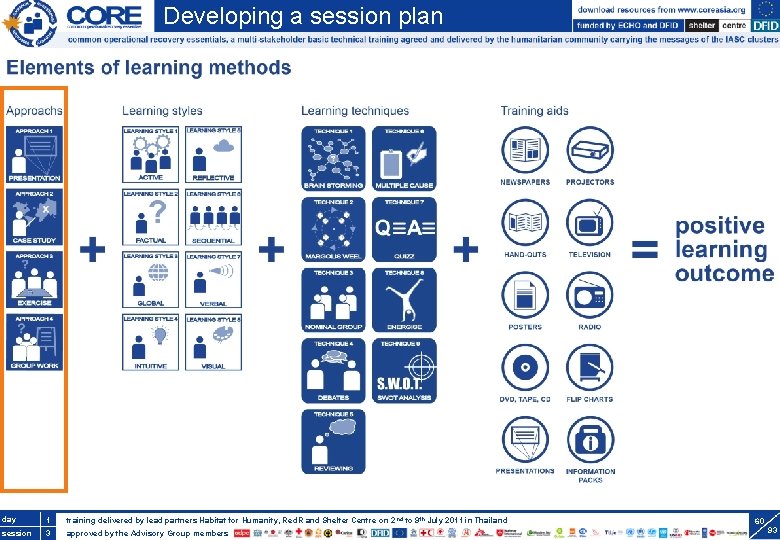
Developing a session plan day. S 3. 1 1 training delivered by lead partners Habitat for Humanity, Red. R and Shelter Centre on 2 nd to 9 th July 2011 in Thailand session approved by the Advisory Group members 3 60 93
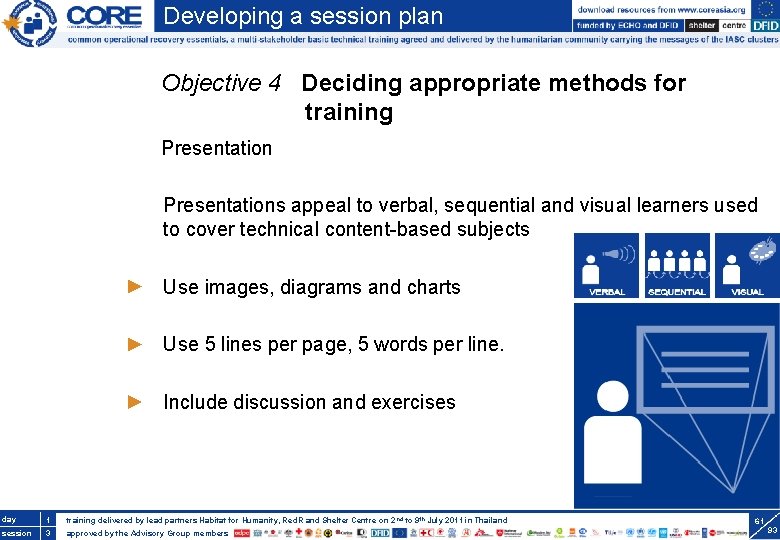
Developing a session plan Objective 4 Deciding appropriate methods for training Presentations appeal to verbal, sequential and visual learners used to cover technical content-based subjects Use images, diagrams and charts Use 5 lines per page, 5 words per line. Include discussion and exercises day. S 3. 1 1 training delivered by lead partners Habitat for Humanity, Red. R and Shelter Centre on 2 nd to 9 th July 2011 in Thailand session approved by the Advisory Group members 3 61 93
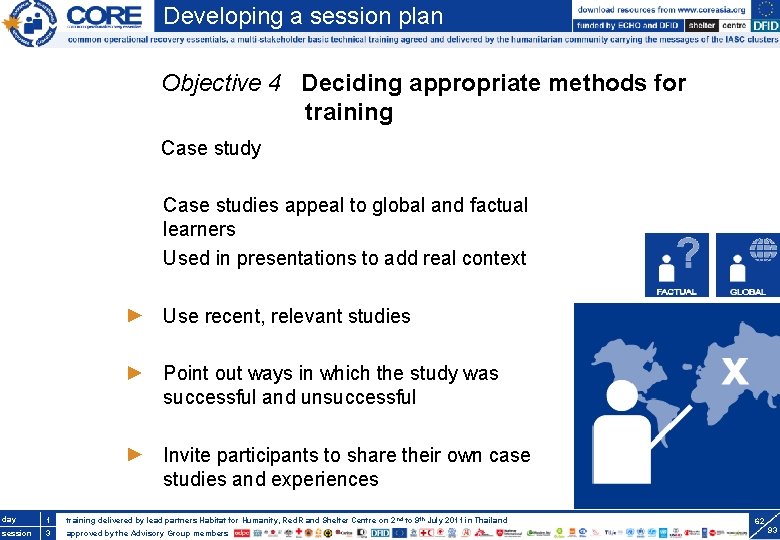
Developing a session plan Objective 4 Deciding appropriate methods for training Case study Case studies appeal to global and factual learners Used in presentations to add real context Use recent, relevant studies Point out ways in which the study was successful and unsuccessful Invite participants to share their own case studies and experiences day. S 3. 1 1 training delivered by lead partners Habitat for Humanity, Red. R and Shelter Centre on 2 nd to 9 th July 2011 in Thailand session approved by the Advisory Group members 3 62 93
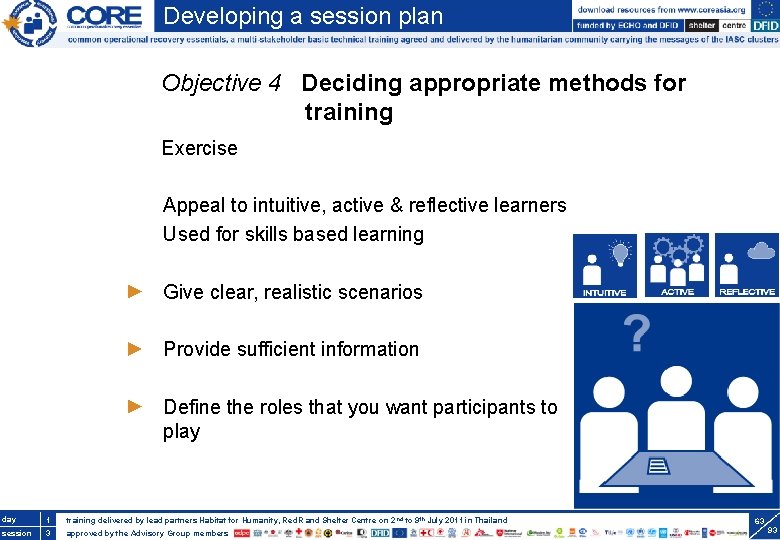
Developing a session plan Objective 4 Deciding appropriate methods for training Exercise Appeal to intuitive, active & reflective learners Used for skills based learning Give clear, realistic scenarios Provide sufficient information Define the roles that you want participants to play day. S 3. 1 1 training delivered by lead partners Habitat for Humanity, Red. R and Shelter Centre on 2 nd to 9 th July 2011 in Thailand session approved by the Advisory Group members 3 63 93
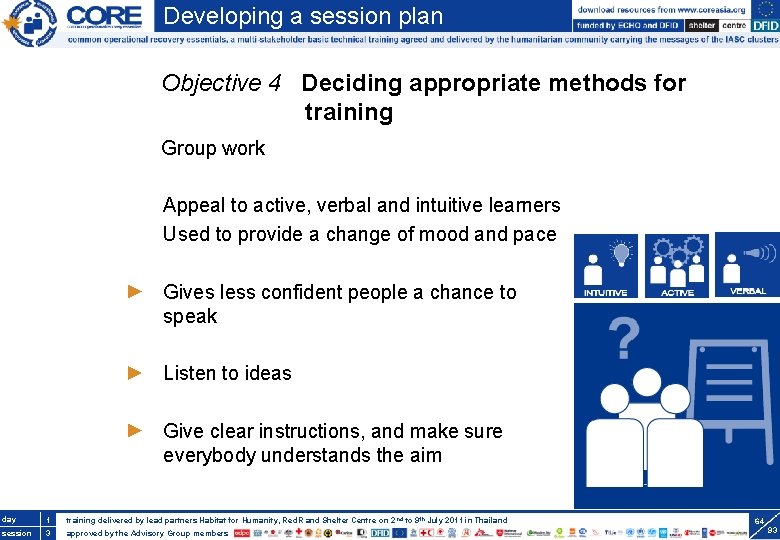
Developing a session plan Objective 4 Deciding appropriate methods for training Group work Appeal to active, verbal and intuitive learners Used to provide a change of mood and pace Gives less confident people a chance to speak Listen to ideas Give clear instructions, and make sure everybody understands the aim day. S 3. 1 1 training delivered by lead partners Habitat for Humanity, Red. R and Shelter Centre on 2 nd to 9 th July 2011 in Thailand session approved by the Advisory Group members 3 64 93
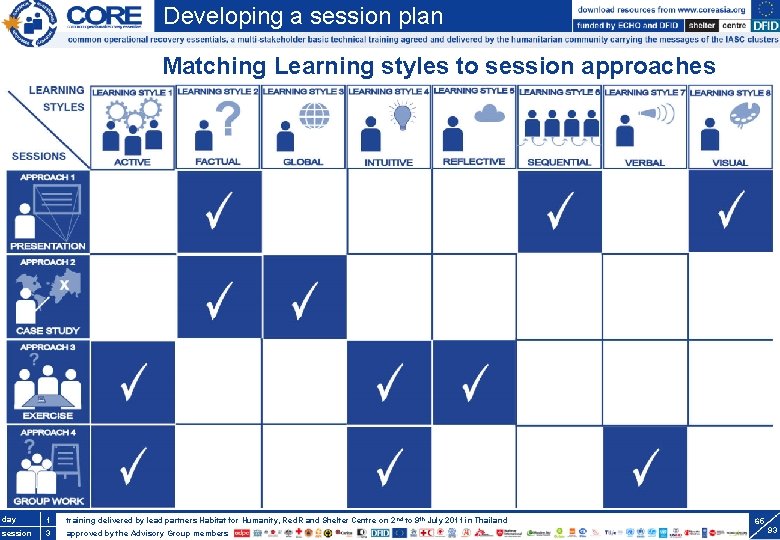
Developing a session plan Matching Learning styles to session approaches day. S 3. 1 1 training delivered by lead partners Habitat for Humanity, Red. R and Shelter Centre on 2 nd to 9 th July 2011 in Thailand session approved by the Advisory Group members 3 65 93
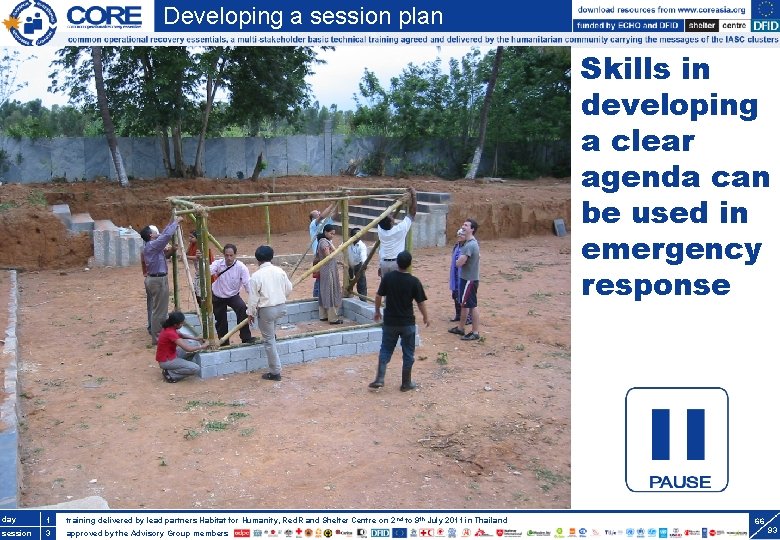
Developing a session plan Skills in developing a clear agenda can be used in emergency response day. S 3. 1 1 training delivered by lead partners Habitat for Humanity, Red. R and Shelter Centre on 2 nd to 9 th July 2011 in Thailand session approved by the Advisory Group members 3 66 93
Developing a session plan Any questions? Do you have any comments or experiences you would like to share? Share your experiences Do you have any questions? Any questions 15 minutes day. S 3. 1 1 training delivered by lead partners Habitat for Humanity, Red. R and Shelter Centre on 2 nd to 9 th July 2011 in Thailand session approved by the Advisory Group members 3 67 93
Developing a session plan Further reading Adult Learning Mechanisms Cegos, 2007 Delivering great training Bryan Hopkins, 2008 Designing Participatory Workshops UNHCR, 2008 How to organize and run learning workshops UNICEF and UN staff college day. S 3. 1 1 training delivered by lead partners Habitat for Humanity, Red. R and Shelter Centre on 2 nd to 9 th July 2011 in Thailand session approved by the Advisory Group members 3 68 93
Training of trainers break download resources from www. coreasia. org Coffee break Please be back in time for 30 min Back at 16: 00 day. S 3. 1 1 training delivered by lead partners Habitat for Humanity, Red. R and Shelter Centre on 2 nd to 9 th July 2011 in Thailand approved by the Advisory Group members 69 93
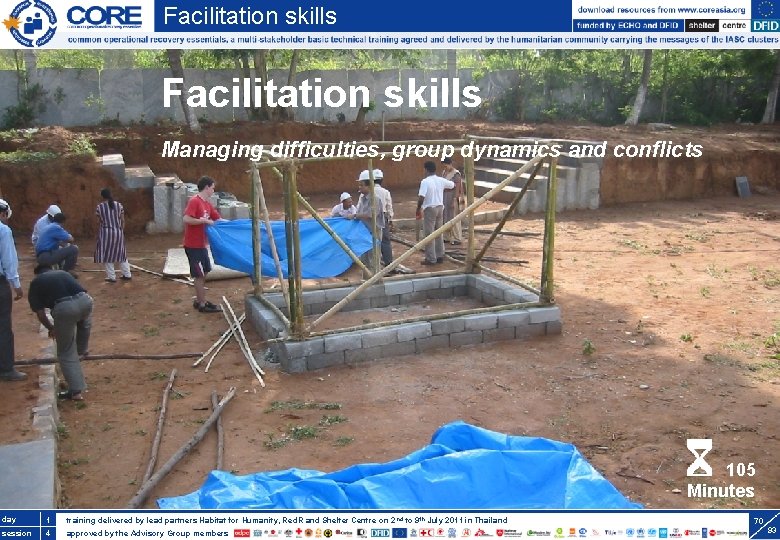
Facilitation skills Managing difficulties, group dynamics and conflicts 105 Minutes day. S 3. 1 1 training delivered by lead partners Habitat for Humanity, Red. R and Shelter Centre on 2 nd to 9 th July 2011 in Thailand session approved by the Advisory Group members 4 70 93
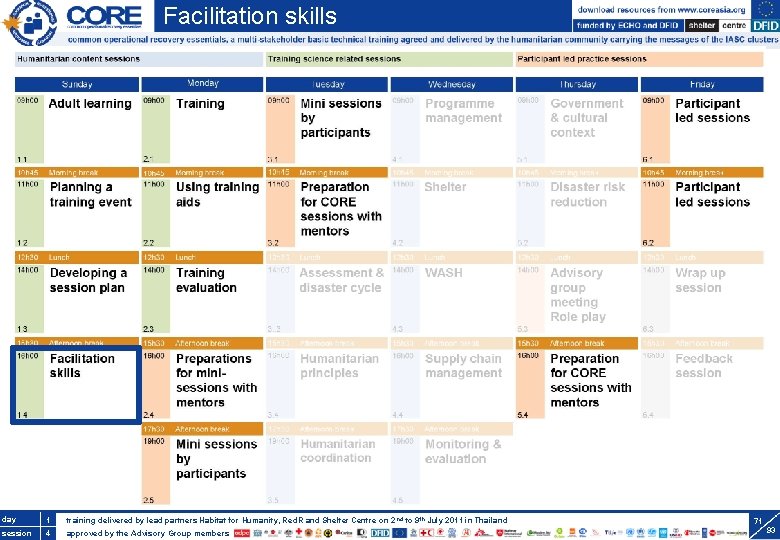
Training of trainers Facilitation skills break day. S 3. 1 1 training delivered by lead partners Habitat for Humanity, Red. R and Shelter Centre on 2 nd to 9 th July 2011 in Thailand session approved by the Advisory Group members 4 download resources from www. coreasia. org 71 71 93
Facilitation skills Learning objectives By the end of this session, you will have an understanding of: Objective 1 Learning Environment Objective 2 Presence and approach Objective 3 Icebreakers and introductions Objective 4 Working in small groups Objective 5 Managing difficulties, conflicts and questions day. S 3. 1 1 training delivered by lead partners Habitat for Humanity, Red. R and Shelter Centre on 2 nd to 9 th July 2011 in Thailand session approved by the Advisory Group members 4 72 93
Facilitation skills Review A video review of your own facilitation skills Video review Task 1 Watch a video of your presentations Task 2 In groups, discuss the good and bad points of your facilitation skills. Think about what you should have done differently Discussion in groups 45 minutes day. S 3. 1 1 training delivered by lead partners Habitat for Humanity, Red. R and Shelter Centre on 2 nd to 9 th July 2011 in Thailand session approved by the Advisory Group members 4 73 93
Facilitation skills Objective 1 Learning environment “A gifted teacher is as rare as a gifted doctor, and makes far less money” Welcome participants- smile and greet Promote friendliness and teamwork Be on hand as soon as participants enter the room Outline the rules: i. e. timekeeping, phones, etc Specify objectives day. S 3. 1 1 training delivered by lead partners Habitat for Humanity, Red. R and Shelter Centre on 2 nd to 9 th July 2011 in Thailand session approved by the Advisory Group members 4 74 93
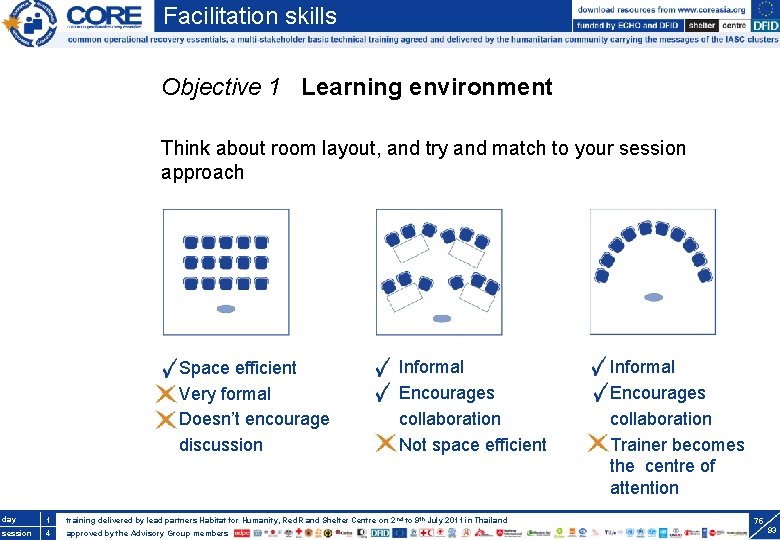
Facilitation skills Objective 1 Learning environment Think about room layout, and try and match to your session approach Space efficient Very formal Doesn’t encourage discussion Informal Encourages collaboration Not space efficient day. S 3. 1 1 training delivered by lead partners Habitat for Humanity, Red. R and Shelter Centre on 2 nd to 9 th July 2011 in Thailand session approved by the Advisory Group members 4 Informal Encourages collaboration Trainer becomes the centre of attention 75 93
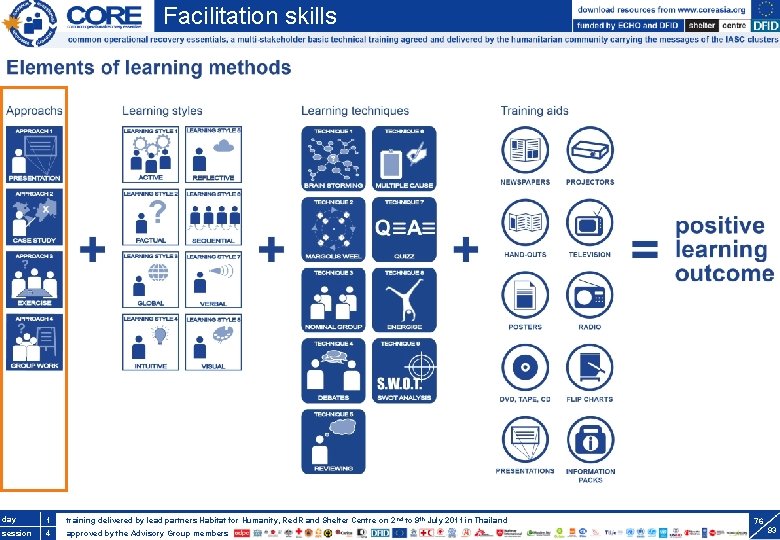
Facilitation skills day. S 3. 1 1 training delivered by lead partners Habitat for Humanity, Red. R and Shelter Centre on 2 nd to 9 th July 2011 in Thailand session approved by the Advisory Group members 4 76 93
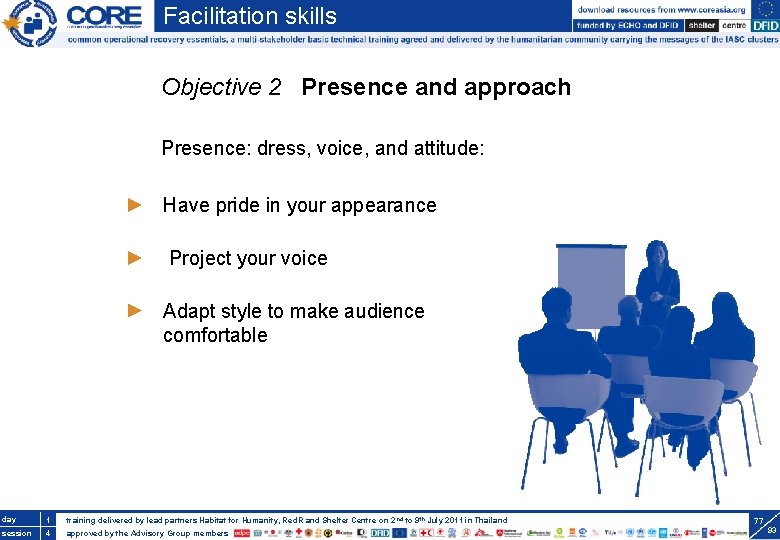
Facilitation skills Objective 2 Presence and approach Presence: dress, voice, and attitude: Have pride in your appearance Project your voice Adapt style to make audience comfortable day. S 3. 1 1 training delivered by lead partners Habitat for Humanity, Red. R and Shelter Centre on 2 nd to 9 th July 2011 in Thailand session approved by the Advisory Group members 4 77 93
Facilitation skills Objective 2 Presence and approach Approach: facilitate - It’s not just a lecture! Be prepared and flexible Build on participants’ person experience and knowledge Use practical approaches, allow questions Evaluate as you progress Adapt to needs of the particular group day. S 3. 1 1 training delivered by lead partners Habitat for Humanity, Red. R and Shelter Centre on 2 nd to 9 th July 2011 in Thailand session approved by the Advisory Group members 4 78 93
Facilitation skills Objective 3 Icebreakers and introductions In addition to name plates and badges! As an instructor introduce yourself, and give a short biography of your experience Icebreakers Work well in small groups Allow everyone to participate Set tone for group dynamic Learn names of group day. S 3. 1 1 training delivered by lead partners Habitat for Humanity, Red. R and Shelter Centre on 2 nd to 9 th July 2011 in Thailand session approved by the Advisory Group members 4 79 93
Facilitation skills Discussion in groups In groups, complete the following exercises Write down key points Task 1 Discuss examples of your favourite icebreakers Task 2 Each group should present one example Discussion in groups 10 minutes day. S 3. 1 1 training delivered by lead partners Habitat for Humanity, Red. R and Shelter Centre on 2 nd to 9 th July 2011 in Thailand session approved by the Advisory Group members 4 80 93
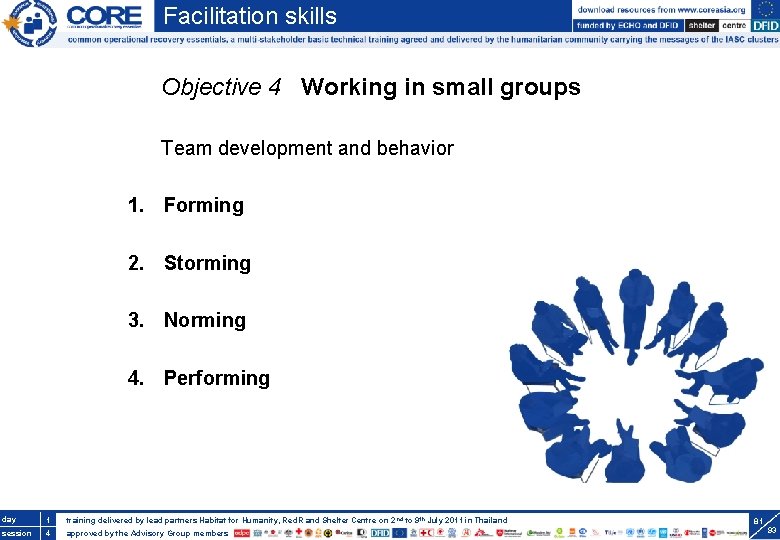
Facilitation skills Objective 4 Working in small groups Team development and behavior 1. Forming 2. Storming 3. Norming 4. Performing day. S 3. 1 1 training delivered by lead partners Habitat for Humanity, Red. R and Shelter Centre on 2 nd to 9 th July 2011 in Thailand session approved by the Advisory Group members 4 81 93
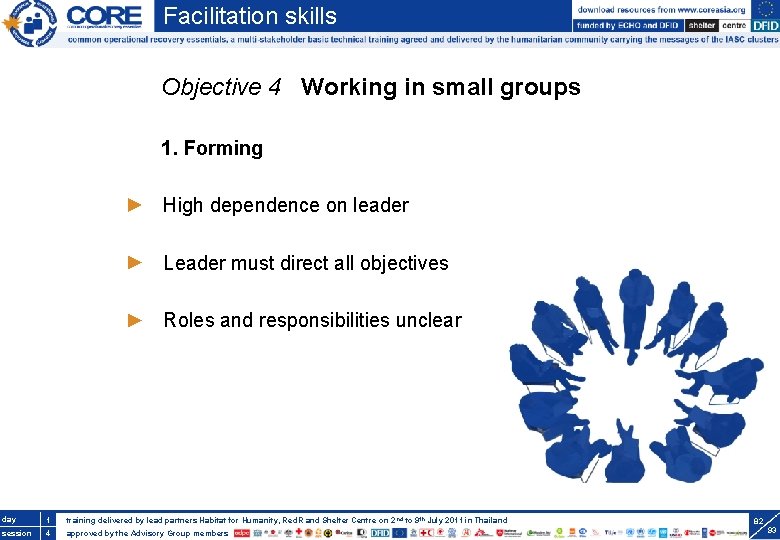
Facilitation skills Objective 4 Working in small groups 1. Forming High dependence on leader Leader must direct all objectives Roles and responsibilities unclear day. S 3. 1 1 training delivered by lead partners Habitat for Humanity, Red. R and Shelter Centre on 2 nd to 9 th July 2011 in Thailand session approved by the Advisory Group members 4 82 93
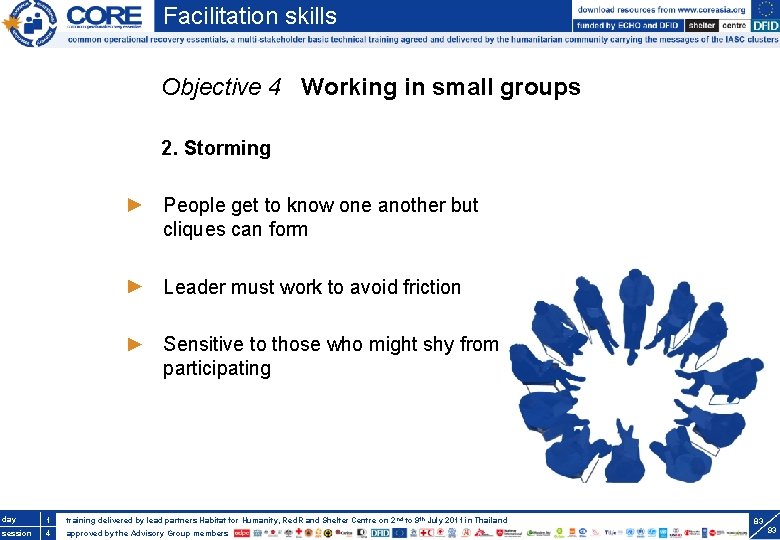
Facilitation skills Objective 4 Working in small groups 2. Storming People get to know one another but cliques can form Leader must work to avoid friction Sensitive to those who might shy from participating day. S 3. 1 1 training delivered by lead partners Habitat for Humanity, Red. R and Shelter Centre on 2 nd to 9 th July 2011 in Thailand session approved by the Advisory Group members 4 83 93
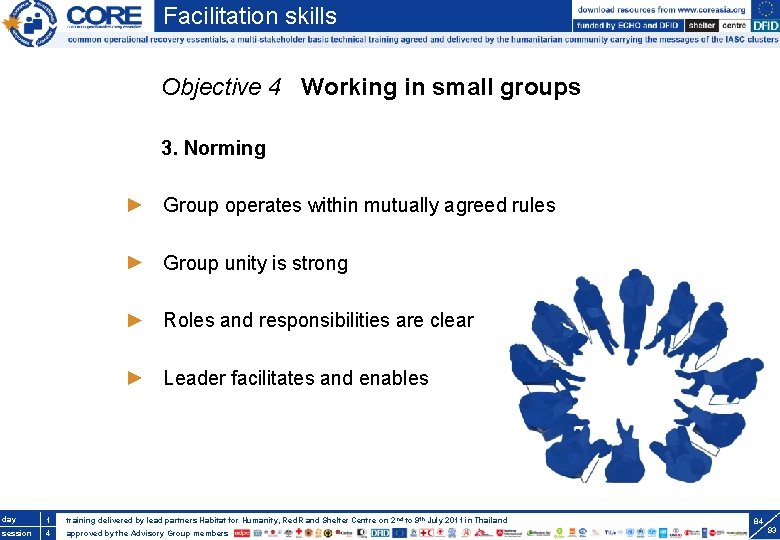
Facilitation skills Objective 4 Working in small groups 3. Norming Group operates within mutually agreed rules Group unity is strong Roles and responsibilities are clear Leader facilitates and enables day. S 3. 1 1 training delivered by lead partners Habitat for Humanity, Red. R and Shelter Centre on 2 nd to 9 th July 2011 in Thailand session approved by the Advisory Group members 4 84 93
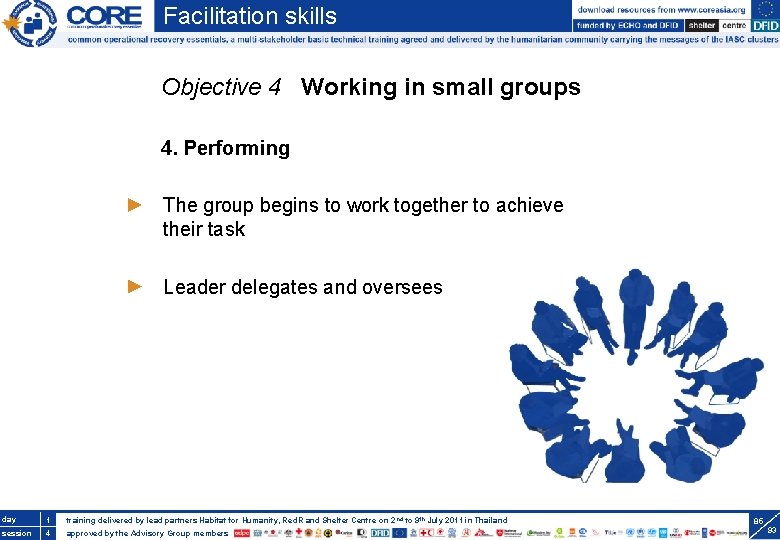
Facilitation skills Objective 4 Working in small groups 4. Performing The group begins to work together to achieve their task Leader delegates and oversees day. S 3. 1 1 training delivered by lead partners Habitat for Humanity, Red. R and Shelter Centre on 2 nd to 9 th July 2011 in Thailand session approved by the Advisory Group members 4 85 93
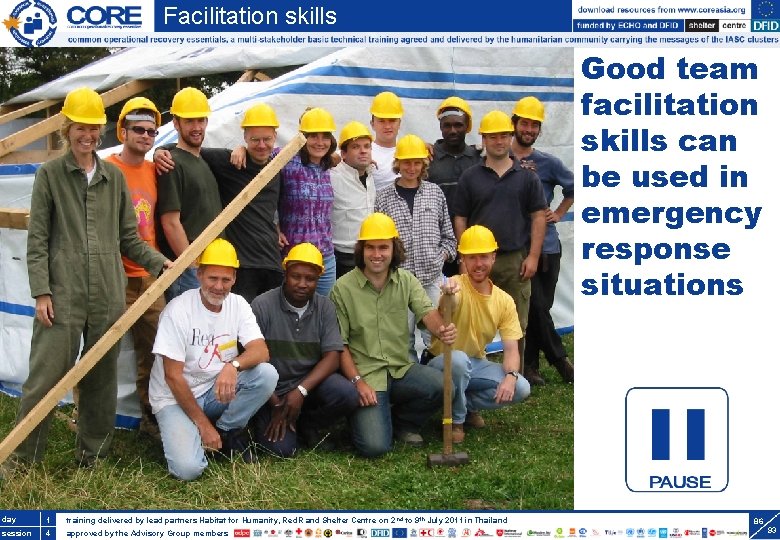
Facilitation skills Good team facilitation skills can be used in emergency response situations day. S 3. 1 1 training delivered by lead partners Habitat for Humanity, Red. R and Shelter Centre on 2 nd to 9 th July 2011 in Thailand session approved by the Advisory Group members 4 86 93
Facilitation skills Discussion in groups 4 groups, each group is given a CORE session plan Write down key points Scenario 1 You have just arrived in the field, and are managing a team following a disaster. The team have only just met Task 1 Discuss ways in which you can facilitate this process, in the most efficient way, so that your team can start working together effectively Discussion in groups 15 minutes day. S 3. 1 1 training delivered by lead partners Habitat for Humanity, Red. R and Shelter Centre on 2 nd to 9 th July 2011 in Thailand session approved by the Advisory Group members 4 87 93
Facilitation skills Objective 5 Managing difficulties, conflicts and questions Answering questions: Make eye contact, ask a direct question Pose question to group as a whole Pose question to group in teams day. S 3. 1 1 training delivered by lead partners Habitat for Humanity, Red. R and Shelter Centre on 2 nd to 9 th July 2011 in Thailand session approved by the Advisory Group members 4 88 93
Facilitation skills Objective 5 Managing difficulties, conflicts and questions Answering questions: Listen carefully, thank participant for question Ricochet – offer praise, then pose it to the rest of the group Rebound – direct question back to the person who asked it Give answer to question Know when you don’t know an answer day. S 3. 1 1 training delivered by lead partners Habitat for Humanity, Red. R and Shelter Centre on 2 nd to 9 th July 2011 in Thailand session approved by the Advisory Group members 4 89 93
Facilitation skills Objective 5 Managing difficulties, conflicts and questions Conflict is inevitable within groups Causes Consequences Resolution Positives and negatives day. S 3. 1 1 training delivered by lead partners Habitat for Humanity, Red. R and Shelter Centre on 2 nd to 9 th July 2011 in Thailand session approved by the Advisory Group members 4 90 93
Facilitation skills Any questions? Do you have any comments or experiences you would like to share? Share your experiences Do you have any questions? Any questions 15 minutes day. S 3. 1 1 training delivered by lead partners Habitat for Humanity, Red. R and Shelter Centre on 2 nd to 9 th July 2011 in Thailand session approved by the Advisory Group members 4 91 93
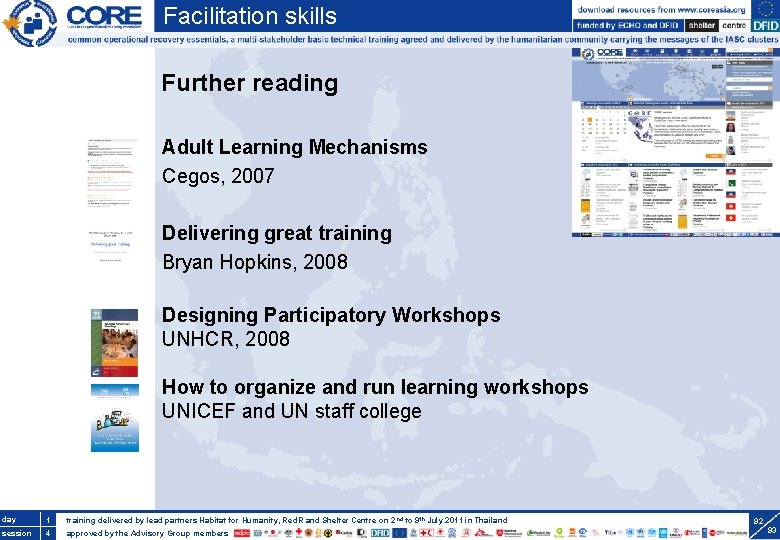
Facilitation skills Further reading Adult Learning Mechanisms Cegos, 2007 Delivering great training Bryan Hopkins, 2008 Designing Participatory Workshops UNHCR, 2008 How to organize and run learning workshops UNICEF and UN staff college day. S 3. 1 1 training delivered by lead partners Habitat for Humanity, Red. R and Shelter Centre on 2 nd to 9 th July 2011 in Thailand session approved by the Advisory Group members 4 92 93

Training of trainers break download resources from www. coreasia. org Thank you Don’t forget to fill in your feedback form day. S 3. 1 1 training delivered by lead partners Habitat for Humanity, Red. R and Shelter Centre on 2 nd to 9 th July 2011 in Thailand approved by the Advisory Group members 93 93
- Slides: 93