
Training Module 1 4 Introduction to metadata management



- Slides: 41
Training Module 1. 4 Introduction to metadata management
This presentation has been created by Pw. C Presentation metadata Authors: Makx Dekkers, Michiel De Keyzer, Nikolaos Loutas and Stijn Goedertier Disclaimer Open Data Support is funded by the European Commission under SMART 2012/0107 ‘Lot 2: Provision of services for the Publication, Access and Reuse of Open Public Data across the European Union, through existing open data portals’(Contract No. 30 -CE 0530965/00 -17). The views expressed in this presentation are purely those of the authors and may not, in any circumstances, be interpreted as stating an official position of the European Commission. The European Commission does not guarantee the accuracy of the information included in this presentation, nor does it accept any responsibility for any use thereof. Reference herein to any specific products, specifications, process, or service by trade name, trademark, manufacturer, or otherwise, does not necessarily constitute or imply its endorsement, recommendation, or favouring by the European Commission. All care has been taken by the author to ensure that s/he has obtained, where necessary, permission to use any parts of manuscripts including illustrations, maps, and graphs, on which intellectual property rights already exist from the titular holder(s) of such rights or from her/his or their legal representative. Slide 2
Learning objectives By the end of this training module you should have an understanding of: • What metadata is; • The terminology and objectives of metadata management; • The different dimensions of metadata quality; • The use of controlled vocabularies for metadata; • Metatada exchange and aggregation; • Metadata management in Open Data Support. Slide 3
Content This module contains. . . • An explanation of what is metadata; • An outline of the metadata lifecycle; • An introduction to metadata quality; • An overview of the metadata management and exchange approach implemented by Open Data Support through the Open Data Interoperability Platform. Slide 4
What is metadata? Definition, examples and reusable standards. Slide 5
What is metadata? “Metadata is structured information that describes, explains, locates, or otherwise makes it easier to retrieve, use, or manage an information resource. Metadata is often called data about data or information about information. ” -- National Information Standards Organization http: //www. niso. org/publications/press/Understanding. Metadata. pdf Metadata provides information enabling to make sense of data (e. g. documents, images, datasets), concepts (e. g. classification schemes) and real-world entities (e. g. people, organisations, places, paintings, products). Slide 6
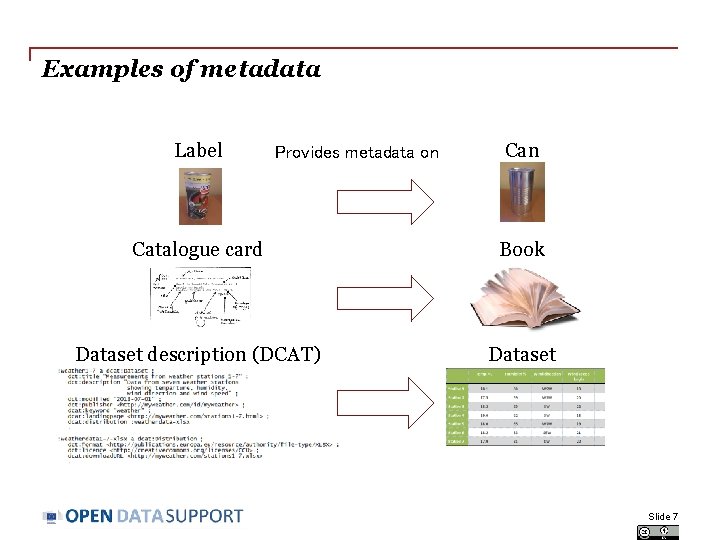
Examples of metadata Label Provides metadata on Catalogue card Book Dataset description (DCAT) Dataset Slide 7
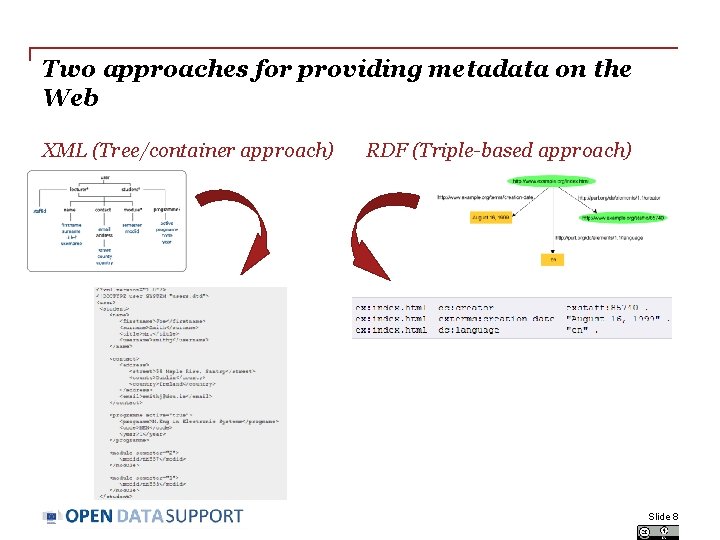
Two approaches for providing metadata on the Web XML (Tree/container approach) RDF (Triple-based approach) Slide 8
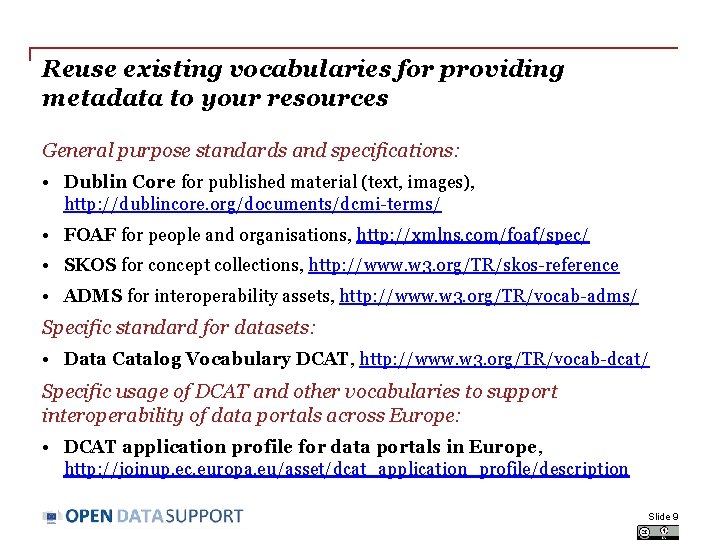
Reuse existing vocabularies for providing metadata to your resources General purpose standards and specifications: • Dublin Core for published material (text, images), http: //dublincore. org/documents/dcmi-terms/ • FOAF for people and organisations, http: //xmlns. com/foaf/spec/ • SKOS for concept collections, http: //www. w 3. org/TR/skos-reference • ADMS for interoperability assets, http: //www. w 3. org/TR/vocab-adms/ Specific standard for datasets: • Data Catalog Vocabulary DCAT, http: //www. w 3. org/TR/vocab-dcat/ Specific usage of DCAT and other vocabularies to support interoperability of data portals across Europe: • DCAT application profile for data portals in Europe, http: //joinup. ec. europa. eu/asset/dcat_application_profile/description Slide 9
Manage your metadata Ensure good governance through the lifecycle of metadata and of the data it describes. Slide 10
Metadata management is important Metadata needs to be managed to ensure. . . • Availability: metadata needs to be stored where it can be accessed and indexed so it can be found. • Quality: metadata needs to be of consistent quality so users know that it can be trusted. • Persistence: metadata needs to be kept over time. • Open License: metadata should be available under a public domain license to enable its reuse. The metadata lifecycle is larger than the data lifecycle: • Metadata may be created before data is created or captured, e. g. to inform about data that will be available in the future. • Metadata needs to be kept after data has been removed, e. g. to inform about data that has been decommissioned or withdrawn. Slide 11
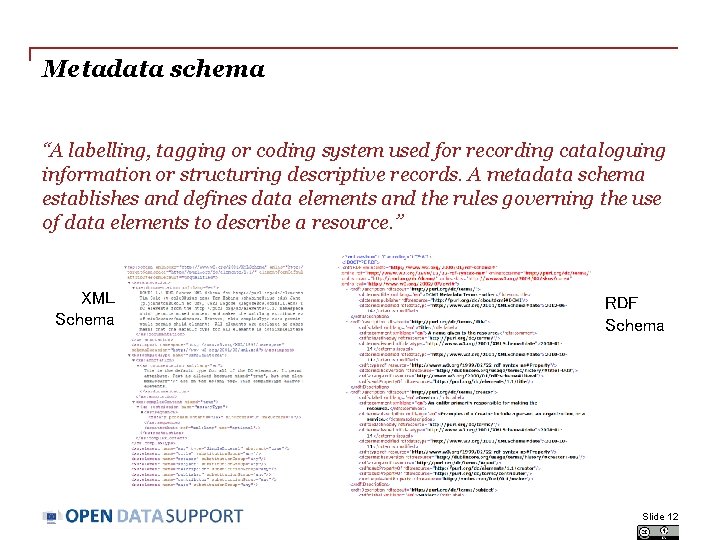
Metadata schema “A labelling, tagging or coding system used for recording cataloguing information or structuring descriptive records. A metadata schema establishes and defines data elements and the rules governing the use of data elements to describe a resource. ” XML Schema RDF Schema Slide 12
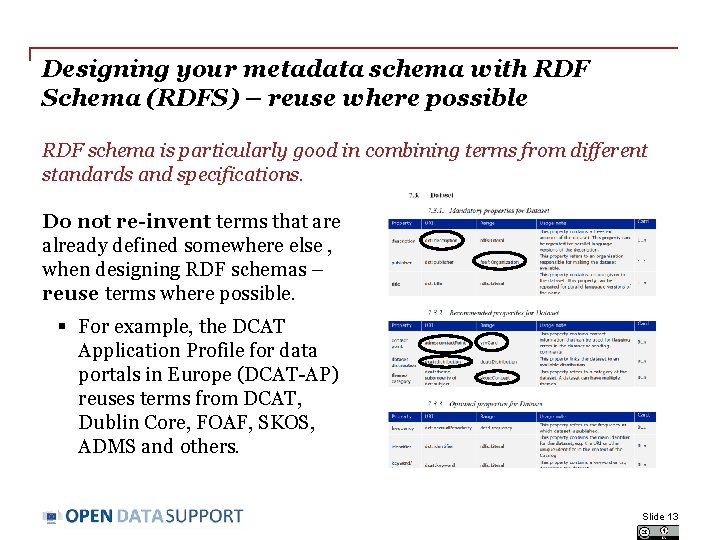
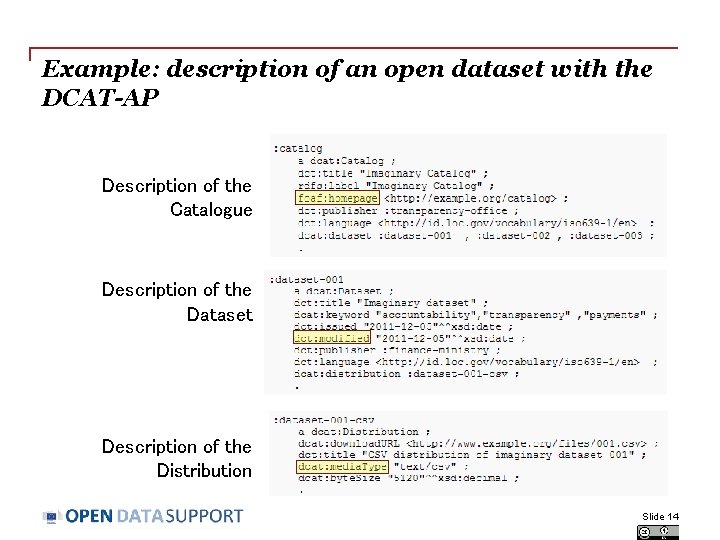
Designing your metadata schema with RDF Schema (RDFS) – reuse where possible RDF schema is particularly good in combining terms from different standards and specifications. Do not re-invent terms that are already defined somewhere else , when designing RDF schemas – reuse terms where possible. § For example, the DCAT Application Profile for data portals in Europe (DCAT-AP) reuses terms from DCAT, Dublin Core, FOAF, SKOS, ADMS and others. Slide 13
Example: description of an open dataset with the DCAT-AP Description of the Catalogue Description of the Dataset Description of the Distribution Slide 14
Controlled vocabularies Using thesauri, taxonomies and standardised lists of terms for assigning values to metadata properties. Slide 15
What are controlled vocabularies? A controlled vocabulary is a predefined list of values to be used as values for a specific property in your metadata schema. • In addition to careful design of schemas, the value spaces of metadata properties are important for the exchange of information, and thus interoperability. • Common controlled vocabularies for value spaces make metadata understandable across systems. Slide 16
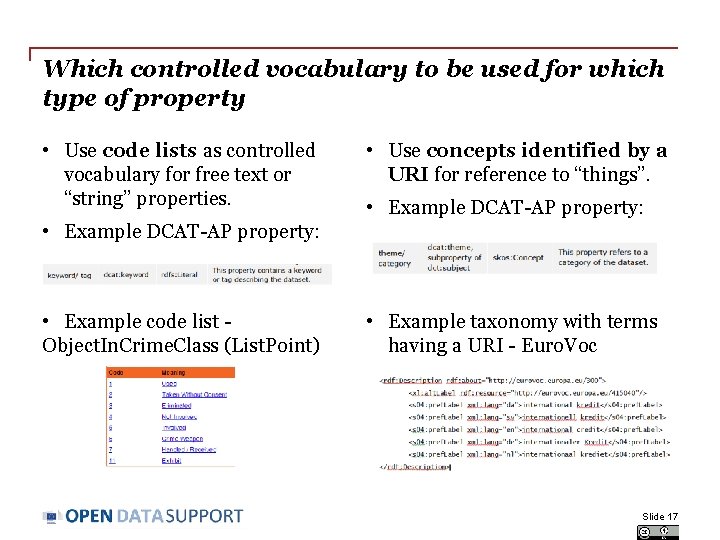
Which controlled vocabulary to be used for which type of property • Use code lists as controlled vocabulary for free text or “string” properties. • Use concepts identified by a URI for reference to “things”. • Example DCAT-AP property: • Example code list - Object. In. Crime. Class (List. Point) • Example taxonomy with terms having a URI - Euro. Voc Slide 17
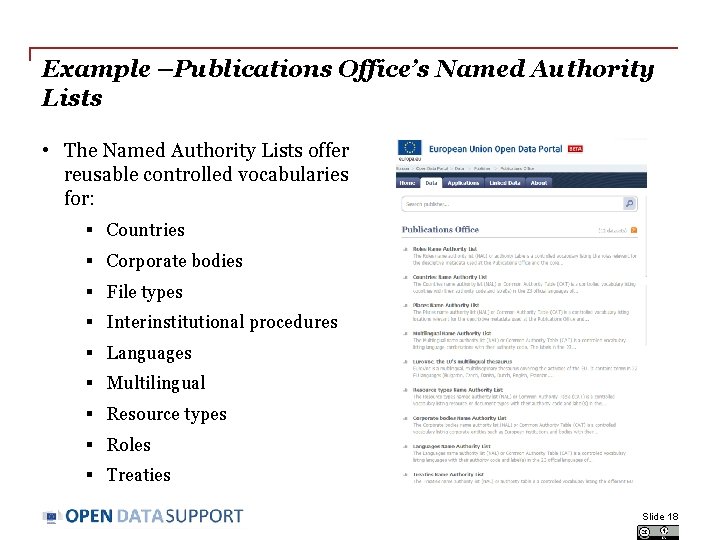
Example –Publications Office’s Named Authority Lists • The Named Authority Lists offer reusable controlled vocabularies for: § Countries § Corporate bodies § File types § Interinstitutional procedures § Languages § Multilingual § Resource types § Roles § Treaties Slide 18
The metadata lifecycle Creating, maintaining, updating, storing, publishing metadata and handling deletion of data. Slide 19
Creating your metadata Metadata creation can be supported by (semi-)automatic processes. • Document properties generated in (office) tools, e. g. creation date. • Spatial and temporal information captured by cameras, sensors. . . • Information from publication workflow, e. g. file location or URL However, other characteristics require human intervention: • What is the resource about (e. g. linking to a subject vocabulary)? • How can the resource be used (e. g. linking to a licence)? • Where can I find more information about this resource (e. g. linking to a Web site or documentation that describes the resource)? • How can quality information be included? Slide 20
Maintaining your metadata Approaches for maintaining metadata need to be appropriate for the type of data that is being published. • If data does not change, metadata can be relatively stable. Changes (bulk conversions) can take place off-line when needed. • If data changes frequently (e. g. real-time sensor data), metadata needs to be closely coupled to the data workflow and changes need to be practically instantaneous. Slide 21
Updating your metadata – planning for change Metadata operates in a global context that is subject to change! • Organisation – departments are established, merge with others, responsibilities are handed over. • Usage of the data – new applications emerge around data. • Reference data – controlled vocabularies evolve and get linked. • Data standards and technologies – technology lifecycle is getting shorter all the time; what will tomorrow’s Web look like? • Tools and systems – evolution of storage, bandwidth, mobile. . . Metadata needs to be kept up-to-date to the extent possible, taking into account the available time and budget. Slide 22
Storing your metadata – what are the options? Depending on operational requirements, metadata can be embedded with the data or stored separately from the data. • Embedding the metadata in the data (e. g. office documents, MP 3, JPG, RDF data) embedding makes data exchange easier. • Separating metadata from data (e. g. in a database), with links to corresponding data files makes management easier. Depending on the availability of tools and requirements on performance and capacity, metadata can be stored in a ‘classic’ relational database or an RDF triple store. Slide 23
Handling deletions of data In many cases, metadata must survive even after deletion of the data it describes. Decommissioning or deletion of data happens, for example: • When data is no longer necessary. • When data is no longer valid. • When data is wrong. • When data is withdrawn by the owner/publisher In that case the metadata should, contain information that the data was deleted, and if it was archived, how and where an archival copy can be requested. Slide 24
Publishing your metadata – what are the options? • ‘Open’ publication: direct access on URIs - This is the option most in line with the vision of Linked Open Data and allows the ‘follow-your-nose’ principle. • Make your metadata available through a SPARQL endpoint - This allows external systems to send queries to an RDF triple store. - Requires knowledge about the schema used in the triple store. • Deferred publication: access to exported file in RDF - Produced by converting non-RDF data to RDF. - Allows off-line bulk harvesting and caching of data collections. - Allows implementation of access control. See also: http: //www. slideshare. net/Open. Data. Support /licence-your-data-metadata Slide 25
Metadata quality The quality and completeness of the description metadata of your datasets, directly infect their searchability and reuse. Slide 26
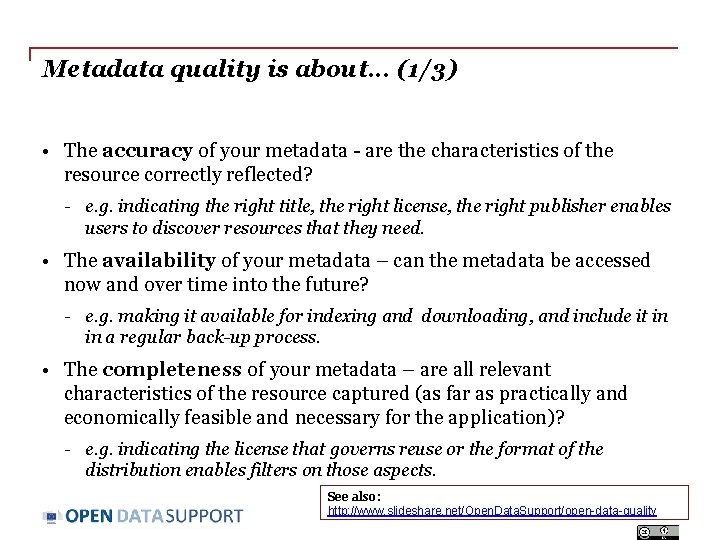
Metadata quality is about. . . (1/3) • The accuracy of your metadata - are the characteristics of the resource correctly reflected? - e. g. indicating the right title, the right license, the right publisher enables users to discover resources that they need. • The availability of your metadata – can the metadata be accessed now and over time into the future? - e. g. making it available for indexing and downloading, and include it in in a regular back-up process. • The completeness of your metadata – are all relevant characteristics of the resource captured (as far as practically and economically feasible and necessary for the application)? - e. g. indicating the license that governs reuse or the format of the distribution enables filters on those aspects. See also: http: //www. slideshare. net/Open. Data. Support/open-data-quality Slide 27
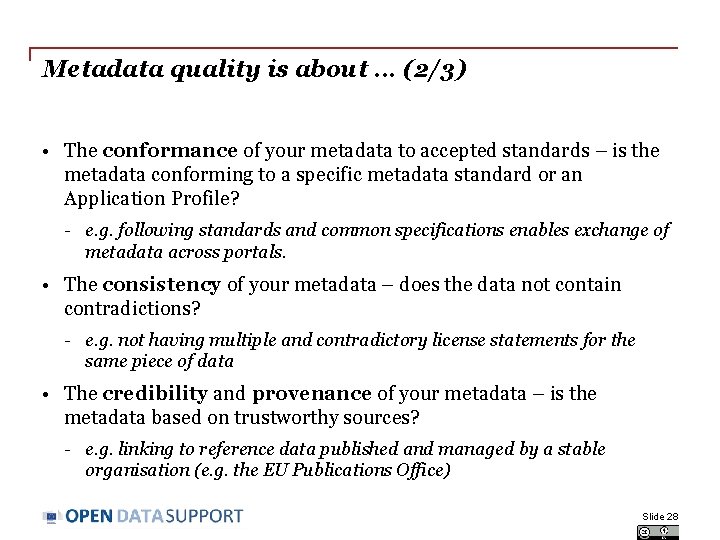
Metadata quality is about. . . (2/3) • The conformance of your metadata to accepted standards – is the metadata conforming to a specific metadata standard or an Application Profile? - e. g. following standards and common specifications enables exchange of metadata across portals. • The consistency of your metadata – does the data not contain contradictions? - e. g. not having multiple and contradictory license statements for the same piece of data • The credibility and provenance of your metadata – is the metadata based on trustworthy sources? - e. g. linking to reference data published and managed by a stable organisation (e. g. the EU Publications Office) Slide 28
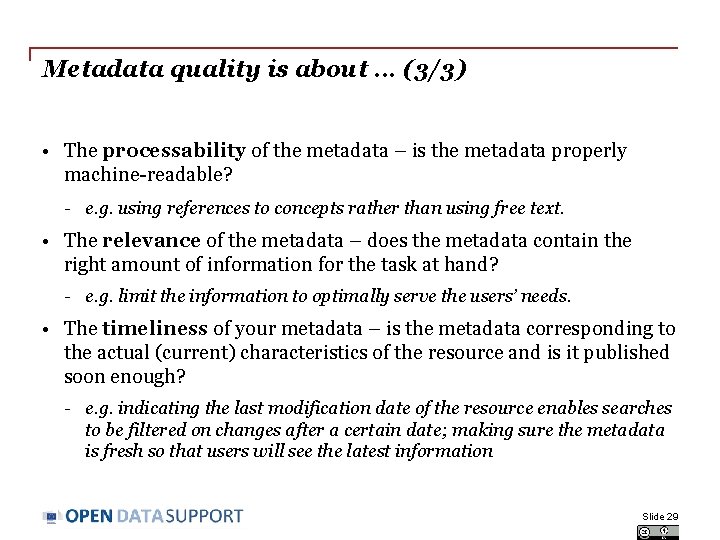
Metadata quality is about. . . (3/3) • The processability of the metadata – is the metadata properly machine-readable? - e. g. using references to concepts rather than using free text. • The relevance of the metadata – does the metadata contain the right amount of information for the task at hand? - e. g. limit the information to optimally serve the users’ needs. • The timeliness of your metadata – is the metadata corresponding to the actual (current) characteristics of the resource and is it published soon enough? - e. g. indicating the last modification date of the resource enables searches to be filtered on changes after a certain date; making sure the metadata is fresh so that users will see the latest information Slide 29
Exchanging metadata Mapping your metadata to a common metadata vocabulary and exchanging the metadata across platforms. Slide 30
Homogenising metadata When exchanged between systems, metadata should be mapped to a common model so that the sender and the recipient share a common understanding on the meaning of the metadata. • On the schema level metadata coming from different sources can be based on different metadata schemas, e. g. DCAT, schema. org, CERIF, own internal model. . . • On the data (value) level, the metadata properties should be assigned values from different controlled vocabularies or syntaxes, e. g. : - Language: English can be expressed as http: //publications. europa. eu/resource/authority/language/ENG or as http: //id. loc. gov/vocabulary/iso 639 -1/en - Dates: ISO 8601 (“ 20130101”) versus W 3 C DTF (“ 2013 -01 -01”) Slide 31
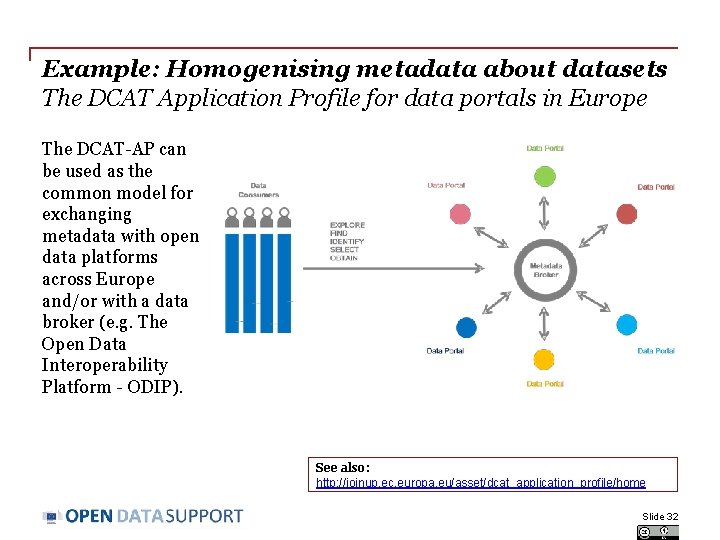
Example: Homogenising metadata about datasets The DCAT Application Profile for data portals in Europe The DCAT-AP can be used as the common model for exchanging metadata with open data platforms across Europe and/or with a data broker (e. g. The Open Data Interoperability Platform - ODIP). See also: http: //joinup. ec. europa. eu/asset/dcat_application_profile/home Slide 32
Mapping example – data. gov. uk dct: title (Dataset) dct: description dct: publisher adms: contact. Point dct: language dct: license Dcat: access. URL dct: title (Distribution) dcat: download. URL, dct: issued, dct: format, dct: description dcat: keyword dct: issued dct: modified dct: spatial dct: theme dct: temporal Slide 33
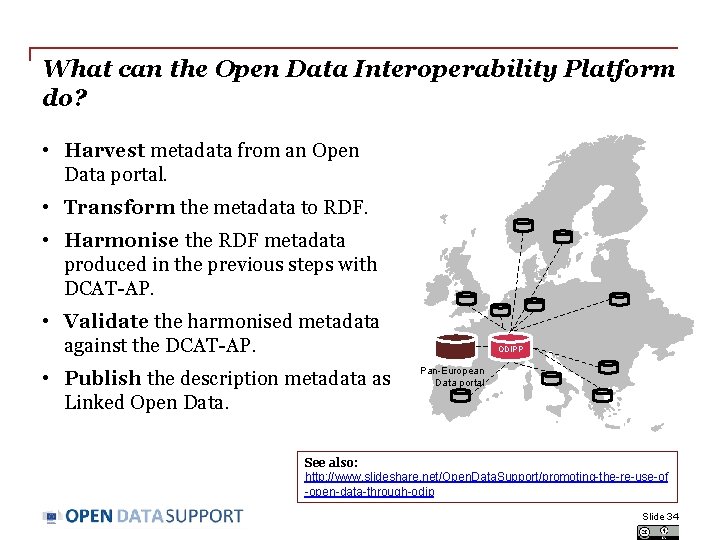
What can the Open Data Interoperability Platform do? • Harvest metadata from an Open Data portal. • Transform the metadata to RDF. • Harmonise the RDF metadata produced in the previous steps with DCAT-AP. • Validate the harmonised metadata against the DCAT-AP. • Publish the description metadata as Linked Open Data. ODIPP Pan-European Data portal See also: http: //www. slideshare. net/Open. Data. Support/promoting-the-re-use-of -open-data-through-odip Slide 34
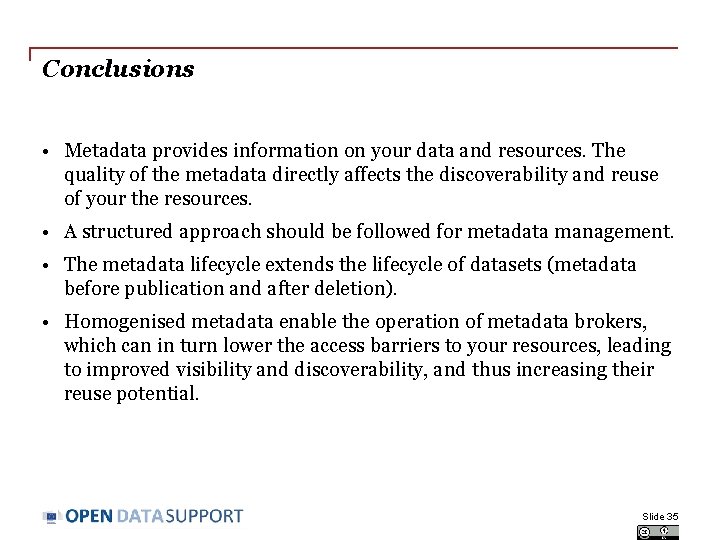
Conclusions • Metadata provides information on your data and resources. The quality of the metadata directly affects the discoverability and reuse of your the resources. • A structured approach should be followed for metadata management. • The metadata lifecycle extends the lifecycle of datasets (metadata before publication and after deletion). • Homogenised metadata enable the operation of metadata brokers, which can in turn lower the access barriers to your resources, leading to improved visibility and discoverability, and thus increasing their reuse potential. Slide 35
Group exercise and questions In groups of two, select one dataset from your country and describe it with the DCAT Application Profile. http: //www. visualpharm. com Does your organisation have a minimum set of metadata to be provided together with Open Data? http: //www. visualpharm. com What would be the main barriers, according to you, for the (re)use of standard controlled vocabularies in your metadata? http: //www. visualpharm. com Do you have any data and/or metadata governance methodology at the corporate level? http: //www. visualpharm. com Slide 36
Thank you!. . . and now YOUR questions? Slide 37
References Slide 6: • NISO. Understanding Metadata. http: //www. niso. org/publications/press/Understanding. Metadata. pdf Slide 8: • Dublin City University. Chapter 3: Introduction to XML. http: //wiki. eeng. dcu. ie/ee 557/g 2/326 -EE. html • W 3 C. RDF Primer. http: //www. w 3. org/TR/rdf-primer/ Slide 17 -18: • European Data Portal. http: //opendata. europa. eu/en/dataset? q=Name+Authority+List&op= • Publications Office. Countries Name Authority List. http: //opendata. europa. eu/en/dataset/2 n. M 4 a. G 8 Ld. HG 6 RBMumfk. Nz. Q Slide 11: • http: //gondolin. rutgers. edu/MIC/text/how/catalog_glossary. htm • Dublin Core. Example XML Schema. http: //dublincore. org/schemas/xmls/qdc/dc. xsd • Dublin Core, Example RDF Schema. http: //dublincore. org/2012/06/14/dcterms. rdf Slide 11, 30 -32: • The ISA Programme. DCAT Application Profile for Data Portals in Europe - Final Draft. https: //joinup. ec. europa. eu/asset/dcat_application_profile/asset_release/dcatapplication-profile-data-portals-europe-final-draf Slide 17: • List. Point. Object. In. Crime. Class. http: //www. listpoint. co. uk/Code. List/details/Object. In. Crime. Class/1. 2/1 Slide 38
Further reading Understanding Metadata, NISO. http: //www. niso. org/publications/press/Understanding. Metadata. pdf Ben Jareo and Malcolm Saldanha. The value proposition of a metadata driven data governance program. Best Practices Metadata. May 2012. https: //community. informatica. com/mpresources/Communities/IW 2 012/Docs/bos_30. pdf John R. Friedrich, II. Metadata Management Best Practices and Lessons Learned. The 10 th Annual Wilshire Meta-Data Conference and the 18 th Annual DAMA International Symposium. April 2006. http: //www. metaintegration. net/Publications/2006 -Wilshire-DAMAMeta. Integration. Best. Practices. pdf Slide 39
Related initiatives Metadata Management. Trainer screencasts, http: //managemetadata. com/screencasts/msa/ MIT Libraries. Data Management and Publishing. Reasons to Manage and Publish Your Data, http: //libraries. mit. edu/guides/subjects/datamanagement/why. html ISA Programme. DCAT Application Profile for European Data Portals, https: //joinup. ec. europa. eu/asset/dcat_application_profile/descripti on Generating ADMS-based descriptions of assets using Open Refine RDF, https: //joinup. ec. europa. eu/asset/adms/document/generateadms-asset-descriptions-spreadsheet-refine-rdf The Dublin Core Medatata Initiative, http: //dublincore. org/ Slide 40
Be part of our team. . . Find us on Join us on Open Data Support http: //www. slideshare. net/Open. Data. Support Open Data Support http: //goo. gl/y 9 ZZI Follow us @Open. Data. Support http: //www. opendatasupport. eu Contact us contact@opendatasupport. eu Slide 41