
Training Module 1 2 Introduction to Linked Data
- Slides: 57
Training Module 1. 2 Introduction to Linked Data Pw. C firms help organisations and individuals create the value they’re looking for. We’re a network of firms in 158 countries with close to 180, 000 people who are committed to delivering quality in assurance, tax and advisory services. Tell us what matters to you and find out more by visiting us at www. pwc. com. Pw. C refers to the Pw. C network and/or one or more of its member firms, each of which is a separate legal entity. Please see www. pwc. com/structure for further details.
This presentation has been created by Pw. C Presentation metadata Open Data Support is funded by the European Commission under SMART 2012/0107 ‘Lot 2: Provision of services for the Publication, Access and Reuse of Open Public Data across the European Union, through existing open data portals’(Contract No. 30 -CE 0530965/00 -17). © 2014 European Commission Authors: Michiel De Keyzer, Nikolaos Loutas, Christophe Colas and Stijn Goedertier Disclaimers 1. The views expressed in this presentation are purely those of the authors and may not, in any circumstances, be interpreted as stating an official position of the European Commission. The European Commission does not guarantee the accuracy of the information included in this presentation, nor does it accept any responsibility for any use thereof. Reference herein to any specific products, specifications, process, or service by trade name, trademark, manufacturer, or otherwise, does not necessarily constitute or imply its endorsement, recommendation, or favouring by the European Commission. All care has been taken by the author to ensure that s/he has obtained, where necessary, permission to use any parts of manuscripts including illustrations, maps, and graphs, on which intellectual property rights already exist from the titular holder(s) of such rights or from her/his or their legal representative. 2. This presentation has been carefully compiled by Pw. C, but no representation is made or warranty given (either express or implied) as to the completeness or accuracy of the information it contains. Pw. C is not liable for the information in this presentation or any decision or consequence based on the use of it. . Pw. C will not be liable for any damages arising from the use of the information contained in this presentation. The information contained in this presentation is of a general nature and is solely for guidance on matters of general interest. This presentation is not a substitute for professional advice on any particular matter. No reader should act on the basis of any matter contained in this publication without considering appropriate professional advice. Slide 2
Learning objectives By the end of this training module you should have an understanding of: • What is linked data; • What is open data; • What is the difference between linked and open data; • How to publish linked data (5 -star schema); • The economic and social aspects of linked data. Slide 3
Content This module contains. . . • An introduction to the linked data principles; • An introduction to linked data technologies; • An outline of the 5 -star scheme for publishing linked data; • An example of how tabular data can be published as linked data using Open Refine; • The expected benefits of linked data for governments; • An overview of linked data initiatives in Europe. Slide 4
What is linked data? Evolution from a document-based Web to a Web of interlinked data. Slide 5
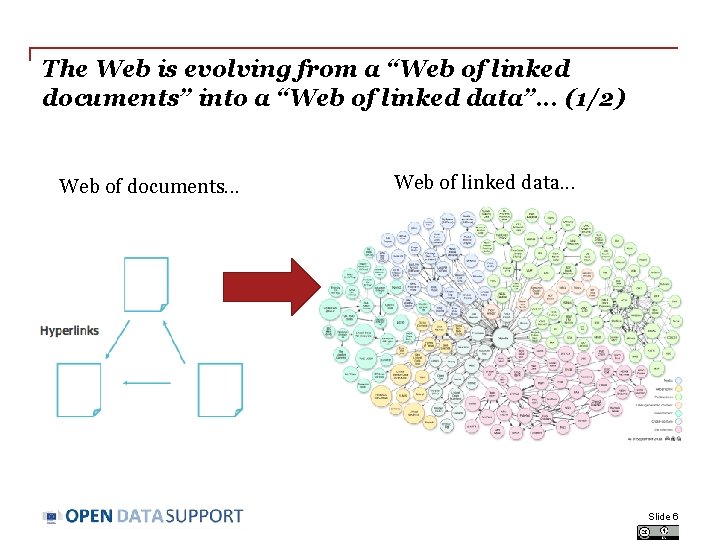
The Web is evolving from a “Web of linked documents” into a “Web of linked data”. . . (1/2) Web of documents. . . Web of linked data. . . Slide 6
The Web is evolving from a “Web of linked documents” into a “Web of linked data”. . . (2/2) • The Web started as a collection of documents published online – accessible at Web location identified by a URL. • These documents often contain data about real-world resources which is mainly human -readable and cannot be understood by machines. • The Web of Data is about enabling the access to this data, by making it available in machine-readable formats and connecting it using Uniform Resource Identifiers (URIs), thus enabling people and machines to collect the data, and put it together to do all kinds of things with it (permitted by the licence). Machine-readable data (or metadata) is data in a format that can be interpreted by a computer. 2 types of machine-readable data: • human-readable data that is marked up so that it can also be understood by computers, e. g. microformats, RDFa; • data formats intended principally for computers, e. g. RDF, XML and JSON. See also: http: //www. ted. com/talks/tim_berners_lee_on_the_next_web. html http: //linkeddatabook. com/editions/1. 0/ Slide 7
Defining linked data. . . “Linked data is a set of design principles for sharing machine-readable data on the Web for use by public administrations, business and citizens. ” EC ISA Case Study: How Linked Data is transforming e. Government The four design principles of Linked Data (by Tim Berners Lee): 1. Use Uniform Resource Identifiers (URIs) as names for things. 2. Use HTTP URIs so that people can look up those names. 3. When someone looks up a URI, provide useful information, using the standards (RDF*, SPARQL). 4. Include links to other URIs so that they can discover more things. See also: http: //www. youtube. com/watch? v=4 x_xz. T 5 e. F 5 Q http: //www. w 3. org/Design. Issues/Linked. Data. html http: //www. youtube. com/watch? v=uju 4 w. T 9 u. BIA Slide 8
Linked (open) government data – value proposition • Flexible data integration: LOGD facilitates data integration and enables the interconnection of previously disparate government datasets. • Increase in data quality: The increased (re)use of LOGD triggers a growing demand to improve data quality. Through crowd-sourcing and self-service mechanisms, errors are progressively corrected. • New services: The availability of LOGD gives rise to new services offered by the public and/or private sector. • Cost reduction: The reuse of LOGD in e-Government applications leads to considerable cost reductions. See also: ISA Study on Business Models for LOGD https: //joinup. ec. europa. eu/community/semic/document/study-businessmodels-linked-open-government-data-bm 4 logd 9
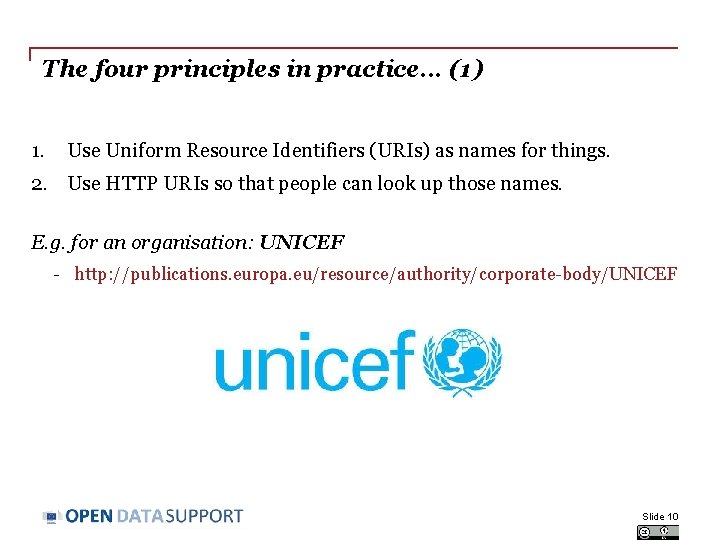
The four principles in practice. . . (1) 1. Use Uniform Resource Identifiers (URIs) as names for things. 2. Use HTTP URIs so that people can look up those names. E. g. for an organisation: UNICEF - http: //publications. europa. eu/resource/authority/corporate-body/UNICEF Slide 10
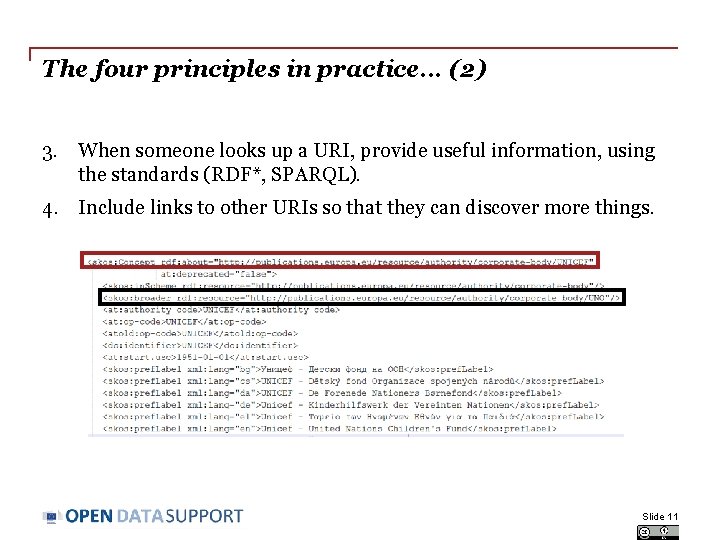
The four principles in practice. . . (2) 3. When someone looks up a URI, provide useful information, using the standards (RDF*, SPARQL). 4. Include links to other URIs so that they can discover more things. Slide 11
Linked data vs. open data “Open data is data that can be freely used, reused and redistributed by anyone – subject only, at most, to the requirement to attribute and sharealike. ” - Open. Definition. org Open data Data can be published and be publicly available under an open licence without linking to other data sources. Linked data Data can be linked to URIs from other data sources, using open standards such as RDF without being publicly available under an open licence. See also: Cobden et al. , A research agenda for Linked Closed Data http: //ceur-ws. org/Vol-782/Cobden. Et. Al_COLD 2011. pdf Slide 12
Linked data foundations URIs for naming things, RDF for describing data and SPARQL for querying it. Slide 13
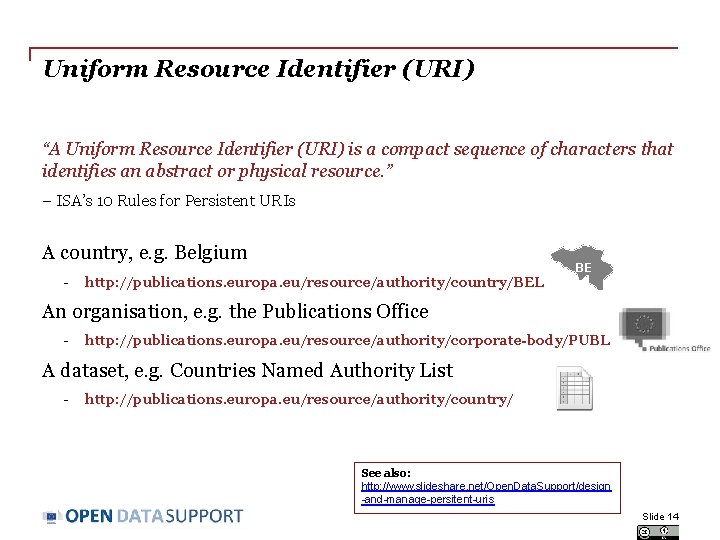
Uniform Resource Identifier (URI) “A Uniform Resource Identifier (URI) is a compact sequence of characters that identifies an abstract or physical resource. ” – ISA’s 10 Rules for Persistent URIs A country, e. g. Belgium - http: //publications. europa. eu/resource/authority/country/BEL BE An organisation, e. g. the Publications Office - http: //publications. europa. eu/resource/authority/corporate-body/PUBL A dataset, e. g. Countries Named Authority List - http: //publications. europa. eu/resource/authority/country/ See also: http: //www. slideshare. net/Open. Data. Support/design -and-manage-persitent-uris Slide 14
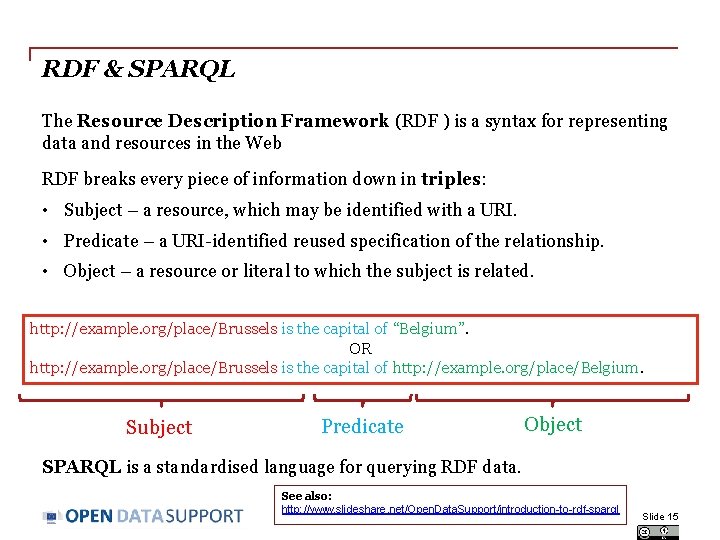
RDF & SPARQL The Resource Description Framework (RDF ) is a syntax for representing data and resources in the Web RDF breaks every piece of information down in triples: • Subject – a resource, which may be identified with a URI. • Predicate – a URI-identified reused specification of the relationship. • Object – a resource or literal to which the subject is related. http: //example. org/place/Brussels is the capital of “Belgium”. OR http: //example. org/place/Brussels is the capital of http: //example. org/place/Belgium. Subject Predicate Object SPARQL is a standardised language for querying RDF data. See also: http: //www. slideshare. net/Open. Data. Support/introduction-to-rdf-sparql Slide 15
How to publish linked data? Paving the way towards 5 -star linked data Slide 16
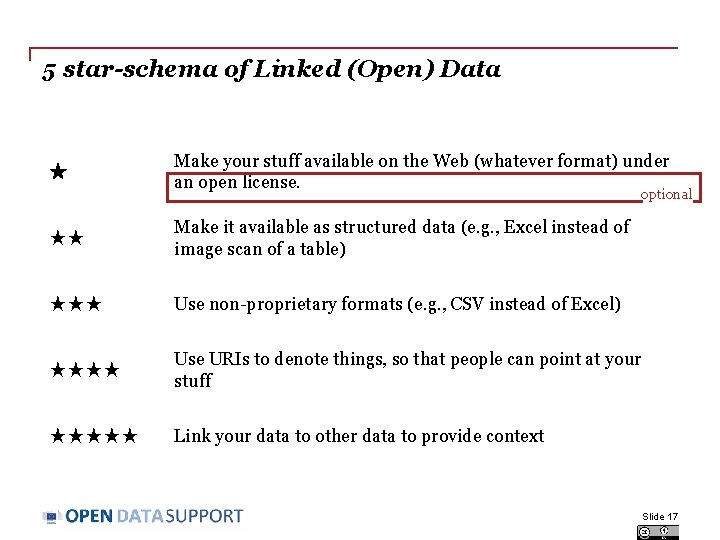
5 star-schema of Linked (Open) Data ★ Make your stuff available on the Web (whatever format) under an open license. optional ★★ Make it available as structured data (e. g. , Excel instead of image scan of a table) ★★★ Use non-proprietary formats (e. g. , CSV instead of Excel) ★★★★ Use URIs to denote things, so that people can point at your stuff ★★★★★ Link your data to other data to provide context Slide 17
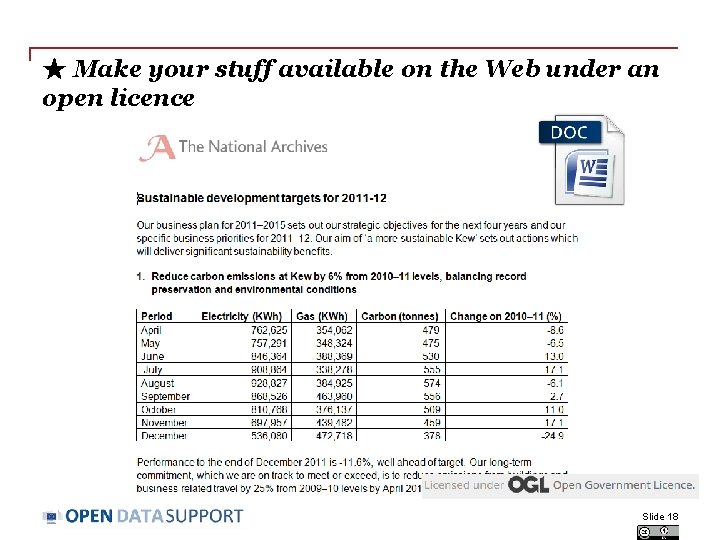
★ Make your stuff available on the Web under an open licence Slide 18
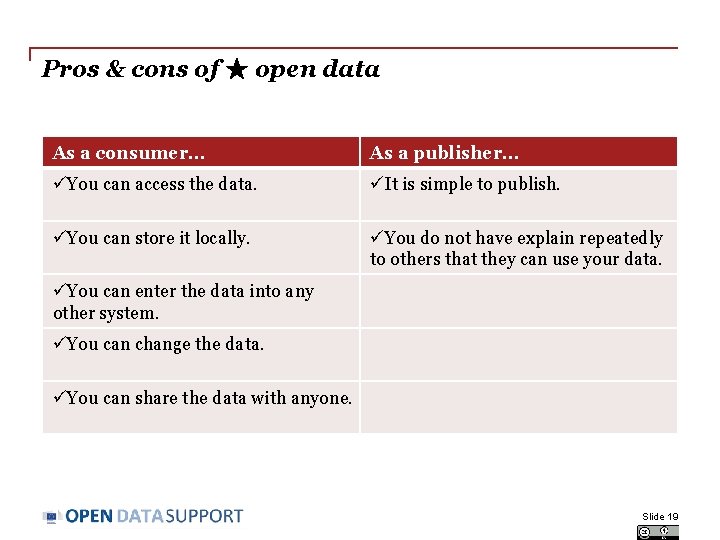
Pros & cons of ★ open data As a consumer. . . As a publisher. . . üYou can access the data. üIt is simple to publish. üYou can store it locally. üYou do not have explain repeatedly to others that they can use your data. üYou can enter the data into any other system. üYou can change the data. üYou can share the data with anyone. Slide 19
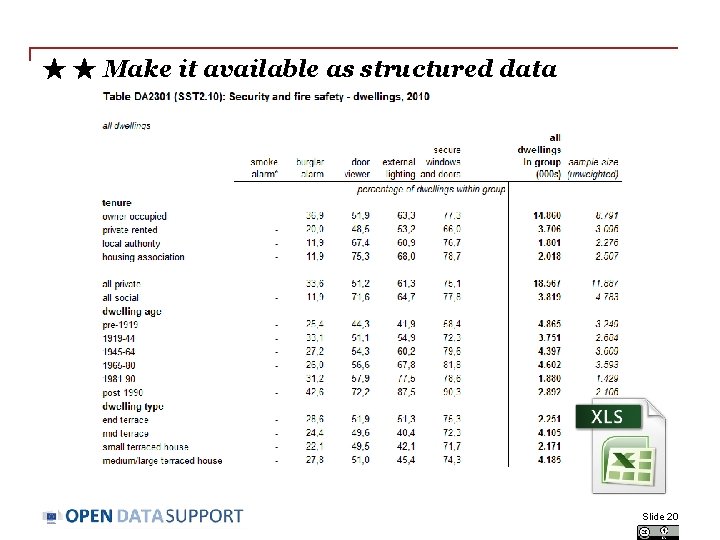
★ ★ Make it available as structured data Slide 20
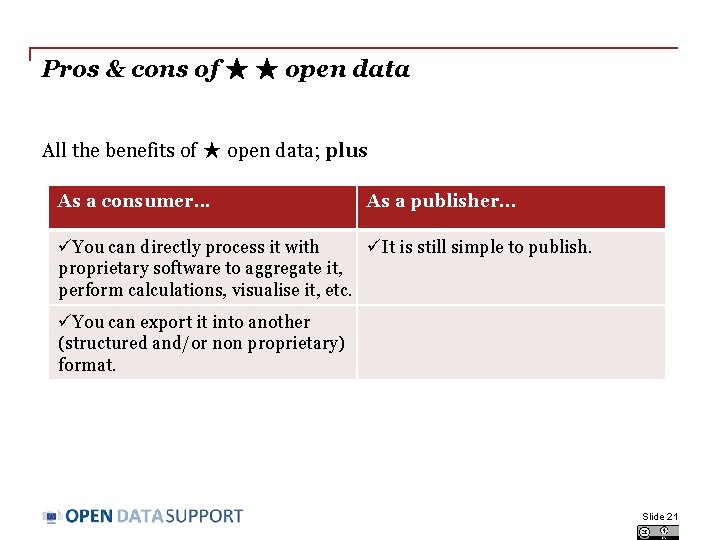
Pros & cons of ★ ★ open data All the benefits of ★ open data; plus As a consumer. . . As a publisher. . . üYou can directly process it with üIt is still simple to publish. proprietary software to aggregate it, perform calculations, visualise it, etc. üYou can export it into another (structured and/or non proprietary) format. Slide 21
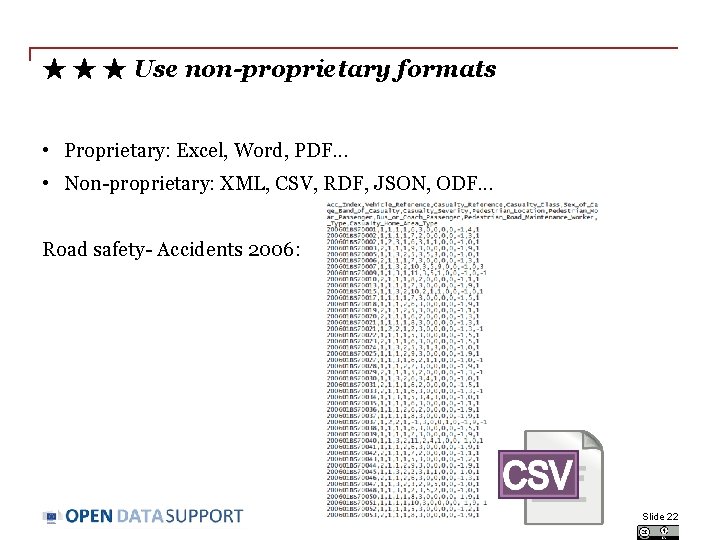
★ ★ ★ Use non-proprietary formats • Proprietary: Excel, Word, PDF. . . • Non-proprietary: XML, CSV, RDF, JSON, ODF. . . Road safety- Accidents 2006: Slide 22
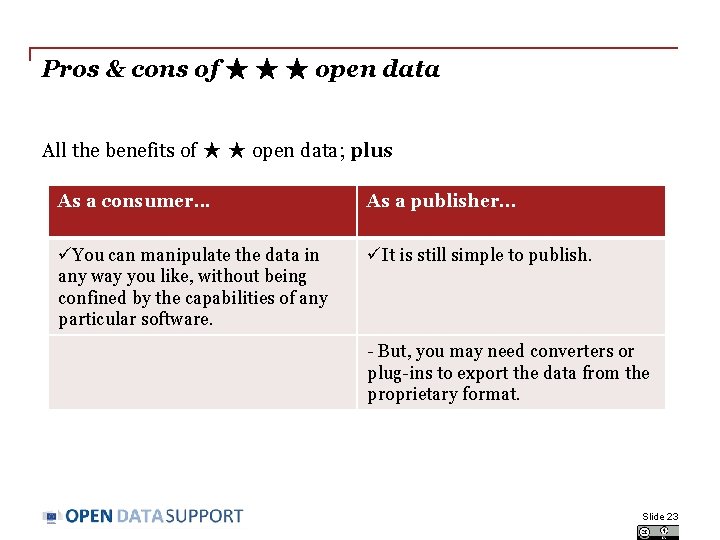
Pros & cons of ★ ★ ★ open data All the benefits of ★ ★ open data; plus As a consumer. . . As a publisher. . . üYou can manipulate the data in any way you like, without being confined by the capabilities of any particular software. üIt is still simple to publish. - But, you may need converters or plug-ins to export the data from the proprietary format. Slide 23
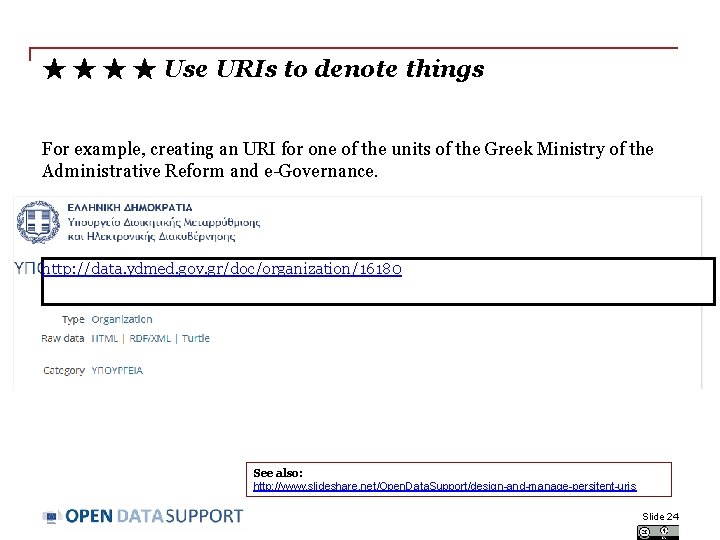
★ ★ Use URIs to denote things For example, creating an URI for one of the units of the Greek Ministry of the Administrative Reform and e-Governance. http: //data. ydmed. gov. gr/doc/organization/16180 See also: http: //www. slideshare. net/Open. Data. Support/design-and-manage-persitent-uris Slide 24
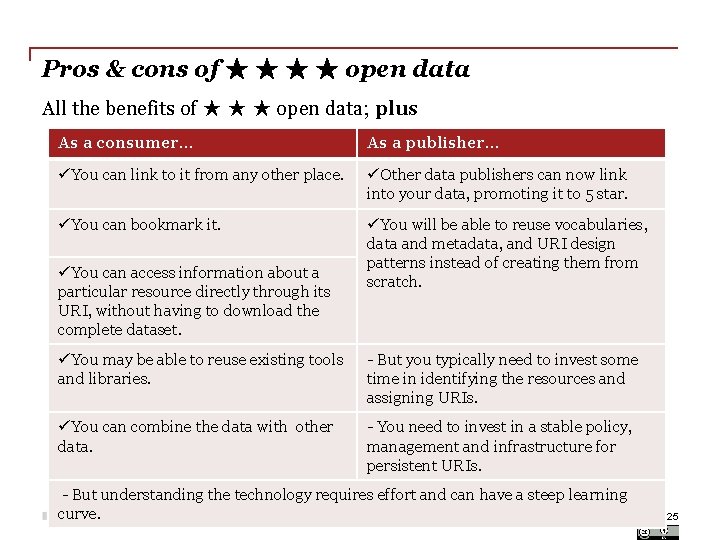
Pros & cons of ★ ★ open data All the benefits of ★ ★ ★ open data; plus As a consumer. . . As a publisher. . . üYou can link to it from any other place. üOther data publishers can now link into your data, promoting it to 5 star. üYou can bookmark it. üYou will be able to reuse vocabularies, data and metadata, and URI design patterns instead of creating them from scratch. üYou can access information about a particular resource directly through its URI, without having to download the complete dataset. üYou may be able to reuse existing tools and libraries. - But you typically need to invest some time in identifying the resources and assigning URIs. üYou can combine the data with other data. - You need to invest in a stable policy, management and infrastructure for persistent URIs. - But understanding the technology requires effort and can have a steep learning curve. Slide 25
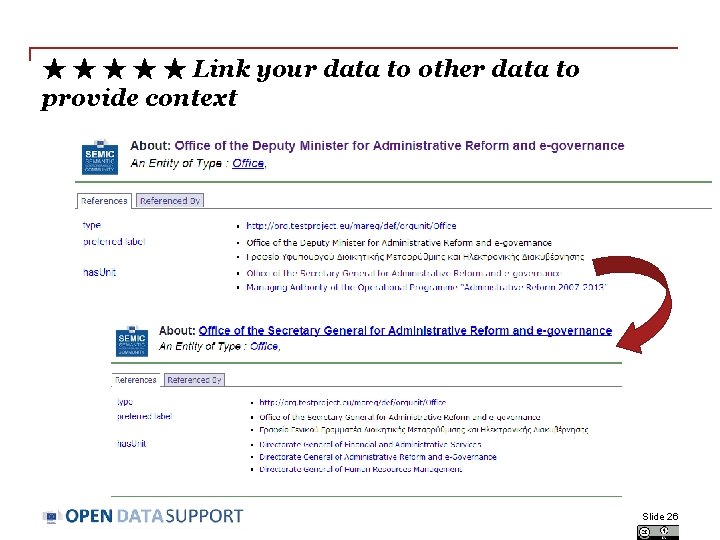
★ ★ ★ Link your data to other data to provide context Slide 26
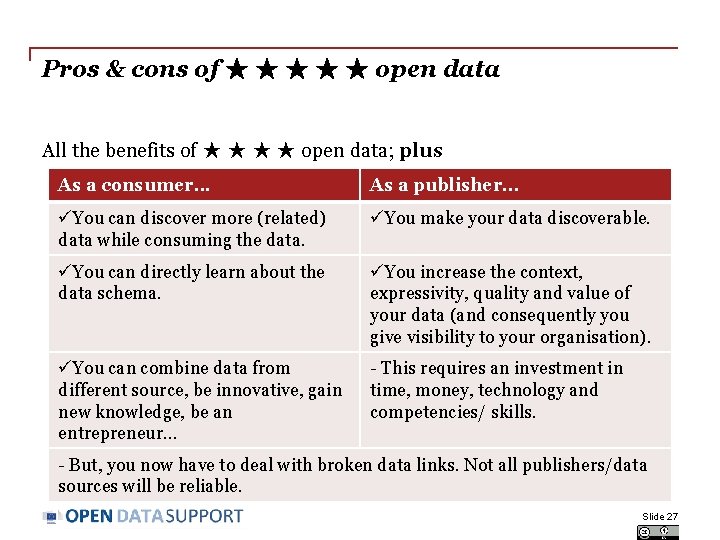
Pros & cons of ★ ★ ★ open data All the benefits of ★ ★ open data; plus As a consumer. . . As a publisher. . . üYou can discover more (related) data while consuming the data. üYou make your data discoverable. üYou can directly learn about the data schema. üYou increase the context, expressivity, quality and value of your data (and consequently you give visibility to your organisation). üYou can combine data from different source, be innovative, gain new knowledge, be an entrepreneur. . . - This requires an investment in time, money, technology and competencies/ skills. - But, you now have to deal with broken data links. Not all publishers/data sources will be reliable. Slide 27
Prepare your data for publishing The LOGD lifecycle Slide 28
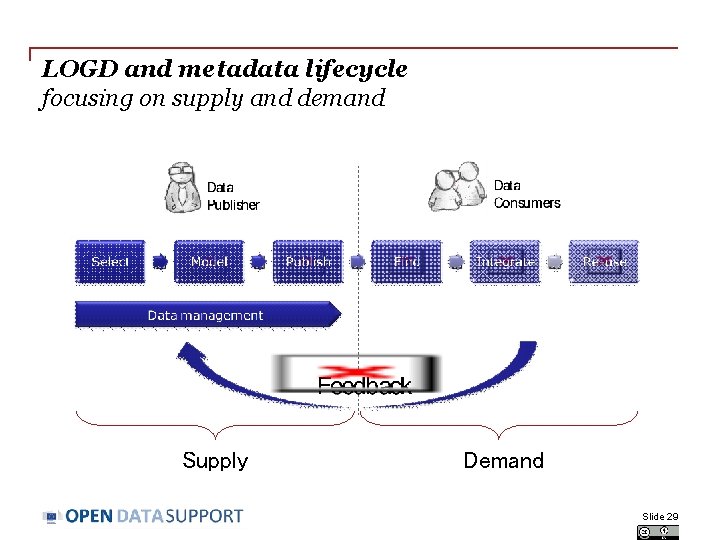
LOGD and metadata lifecycle focusing on supply and demand Supply Demand Slide 29
Selection of high-value data Several dimensions can be considered in the selection process of Linked Open Government Data, both from the publisher’s and the reuser’s point of view: • Transparency: Does the publication of the dataset increase transparency and openness of the government towards its citizens? • Legal requirements: Is there a law that makes open publication mandatory or is there no specific obligation? • Relation to public task: Is the data the direct result of the primary public task of government or is it a product of a non-essential activity? • Current status of open publication: Is the data already openly available or does it still need to be opened up? • Type of value: Is the data useful for social engagement or does it have commercial value? • Audience: Is the data primarily intended for the public or is it primarily aimed at back-office integration? Slide 30
Modelling your data & metadata is about. . . • Making your data available in a structured, comprehensible and machine-readable way. • Reusing what already exists in terms of vocabularies and reference data. • Reaching the right quality level by cleansing your data. • Providing licensing information so that data consumers know what the conditions of reuse are. • Providing a rich description (metadata). • Using semantic technologies (RDF, HTTP URIs. . . ) for describing your data. Slide 31
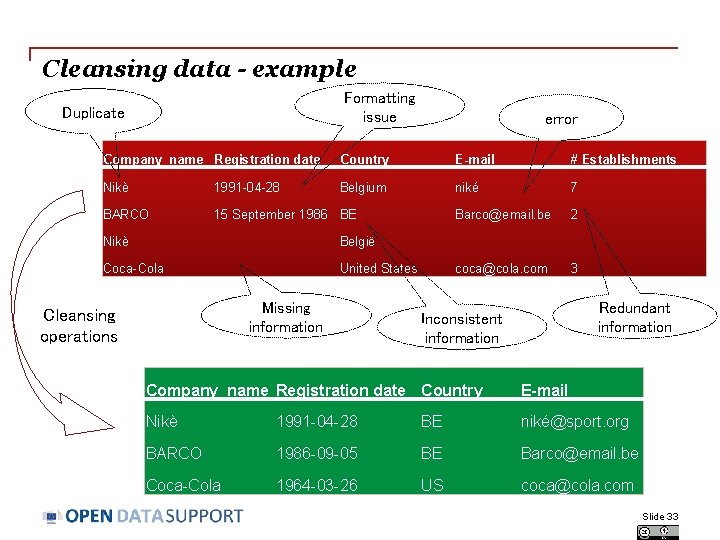
Cleansing your data & metadata To ensure data and metadata can be published with an appropriate level of quality and minimum errors. This means: • Fixing errors. • Transforming/homogenising formats. • Aligning inconsistencies in data and metadata. • Removing duplicate/redundant information. • Adding lacking information. • Making sure the information is up-to-date. See also: http: //www. slideshare. net/Open. Data. Support/introduction-to-rdf-sparql Cleanse your data with Open Refine (Google Refine) https: //code. google. com/p/google-refine/ Slide 32
Cleansing data - example Formatting issue Duplicate error Company_name Registration date Country E-mail # Establishments Nikè 1991 -04 -28 Belgium niké 7 BARCO 15 September 1986 BE Barco@email. be 2 coca@cola. com 3 Nikè België Coca-Cola United States Missing information Cleansing operations Redundant information Inconsistent information Company_name Registration date Country E-mail Nikè 1991 -04 -28 BE niké@sport. org BARCO 1986 -09 -05 BE Barco@email. be Coca-Cola 1964 -03 -26 US coca@cola. com Slide 33
Publishing linked data is about. . . Breaking down the walls of the silos in order to create more value. • Making your data and metadata publically and easily accessible on the Web. • Linking your data and metadata to other data (or metadata) in order to: § Attach meaning and content to it. § Give context to it. § Enrich it. § Allow people to discover more. Slide 34
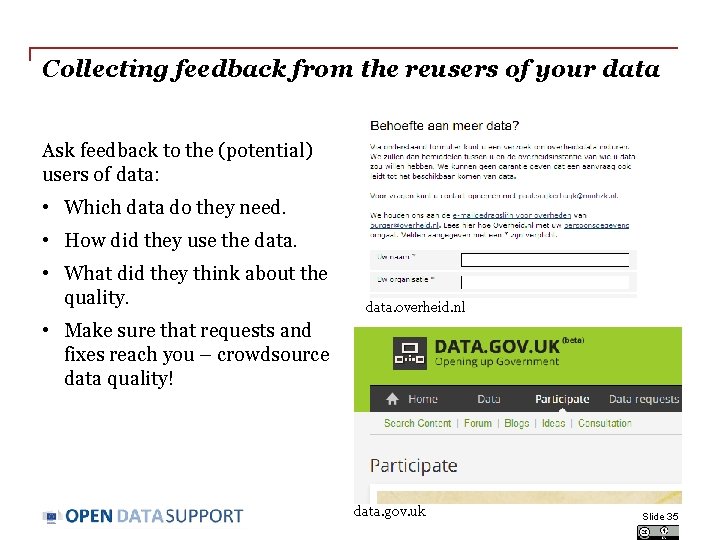
Collecting feedback from the reusers of your data Ask feedback to the (potential) users of data: • Which data do they need. • How did they use the data. • What did they think about the quality. data. overheid. nl • Make sure that requests and fixes reach you – crowdsource data quality! data. gov. uk Slide 35
Example Using Open Refine for RDF to publish tabular data as Linked Data. Slide 36
What is Open Refine RDF extension, allows you to easily import data in different formats such as : § CSV; § Excel(. xls and. xlsx); § JSON; § XML; and § RDF/XML. And then determine the intended structure of an RDF dataset, by drawing a template graph. See also: LOD 2 Webinar – Open Refine http: //www. youtube. com/watch? v=4 Ve 93 C 238 g. I Slide 37
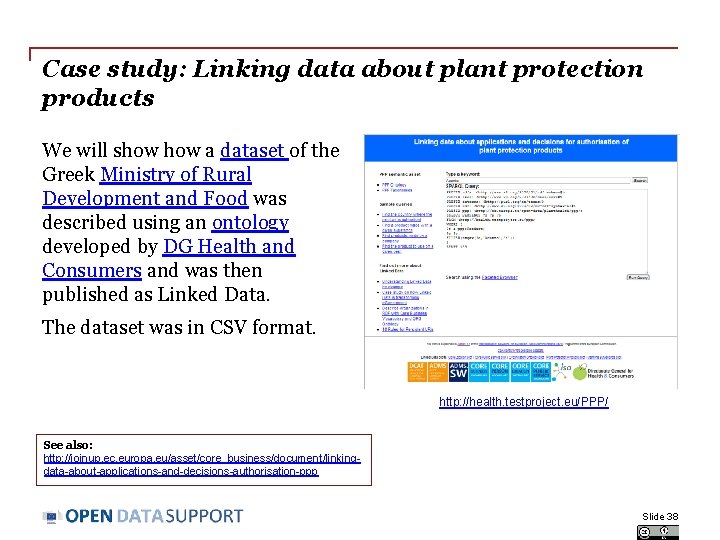
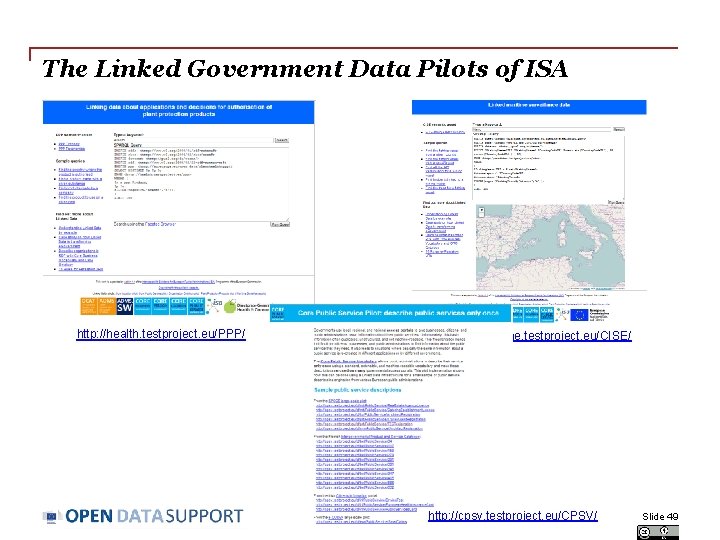
Case study: Linking data about plant protection products We will show a dataset of the Greek Ministry of Rural Development and Food was described using an ontology developed by DG Health and Consumers and was then published as Linked Data. The dataset was in CSV format. http: //health. testproject. eu/PPP/ See also: http: //joinup. ec. europa. eu/asset/core_business/document/linkingdata-about-applications-and-decisions-authorisation-ppp Slide 38
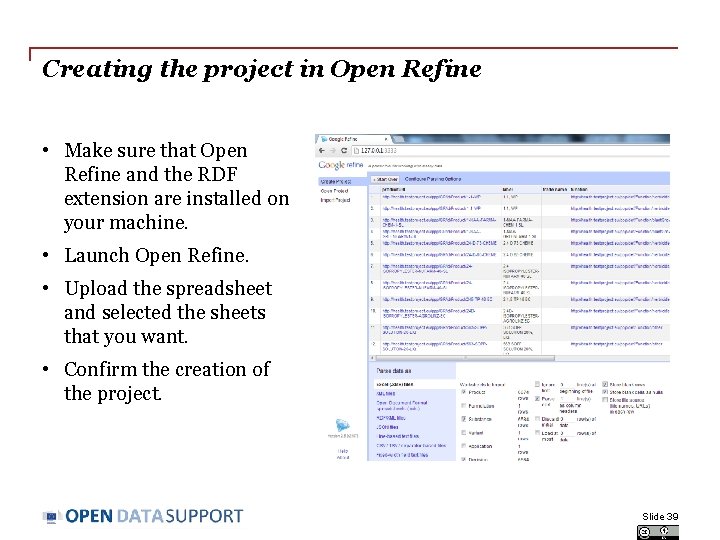
Creating the project in Open Refine • Make sure that Open Refine and the RDF extension are installed on your machine. • Launch Open Refine. • Upload the spreadsheet and selected the sheets that you want. • Confirm the creation of the project. Slide 39
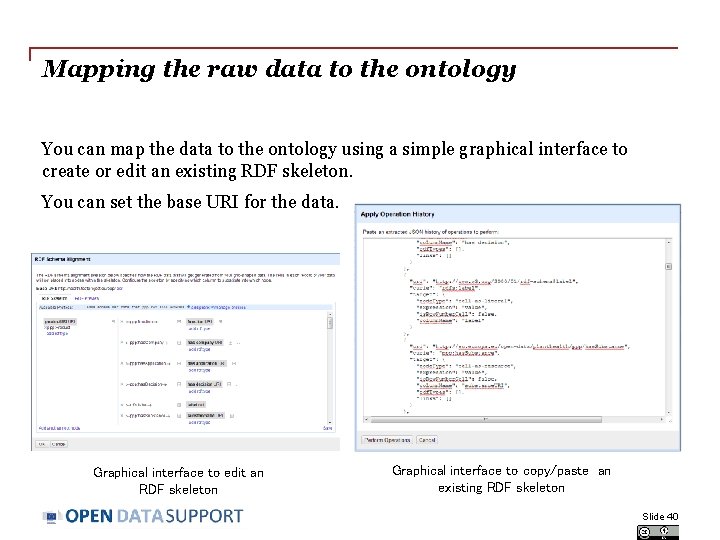
Mapping the raw data to the ontology You can map the data to the ontology using a simple graphical interface to create or edit an existing RDF skeleton. You can set the base URI for the data. Graphical interface to edit an RDF skeleton Graphical interface to copy/paste an existing RDF skeleton Slide 40
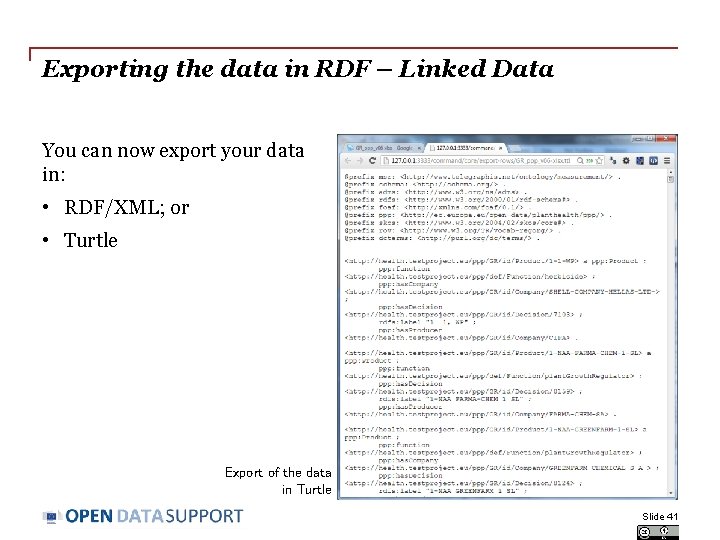
Exporting the data in RDF – Linked Data You can now export your data in: • RDF/XML; or • Turtle Export of the data in Turtle Slide 41
LOGD enablers & roadblocks From the study on Business Models for LOGD of the ISA Programme of the European Commission. Slide 42
LOGD enablers • Efficiency gains in data integration – the network effect. • Forward-looking strategies. • Increased linking and integrated services. • Ease of model updates. • Ease of navigation. • Open licensing and free access. • Enthusiasm from ‘champions’. • Emerging best practice guidance. See also: ISA Study on Business Models for LOGD https: //joinup. ec. europa. eu/community/semic/document/study-businessmodels-linked-open-government-data-bm 4 logd 43
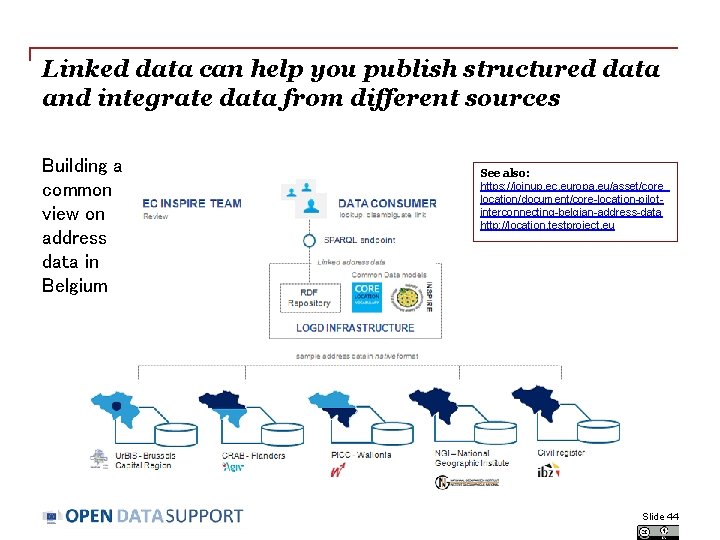
Linked data can help you publish structured data and integrate data from different sources Building a common view on address data in Belgium See also: https: //joinup. ec. europa. eu/asset/core_ location/document/core-location-pilotinterconnecting-belgian-address-data http: //location. testproject. eu Slide 44
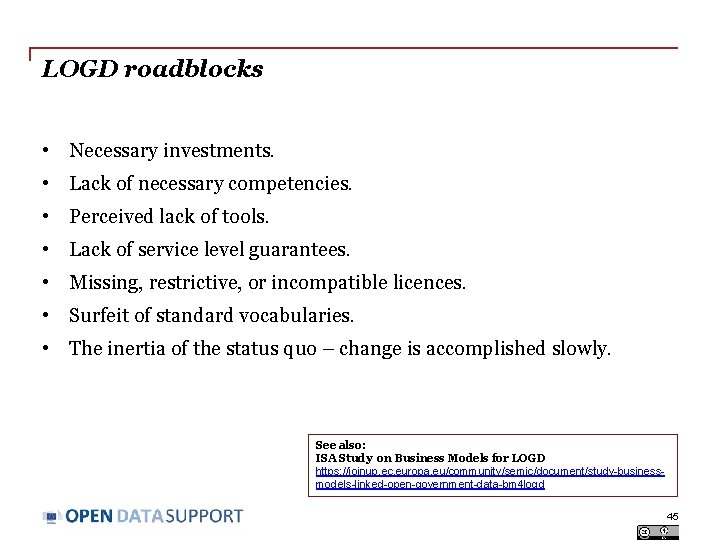
LOGD roadblocks • Necessary investments. • Lack of necessary competencies. • Perceived lack of tools. • Lack of service level guarantees. • Missing, restrictive, or incompatible licences. • Surfeit of standard vocabularies. • The inertia of the status quo – change is accomplished slowly. See also: ISA Study on Business Models for LOGD https: //joinup. ec. europa. eu/community/semic/document/study-businessmodels-linked-open-government-data-bm 4 logd 45
Linked data initiatives in Europe Some examples on supra-national, regional and private initiatives in the area of linked (open) data across Europe. Slide 46
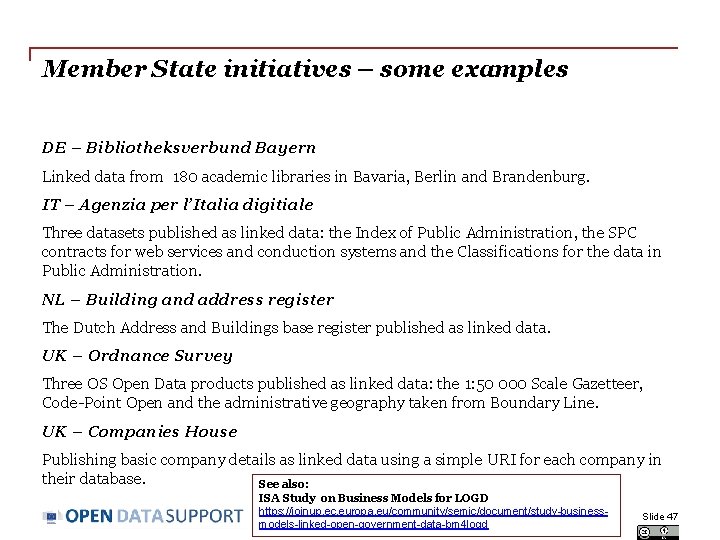
Member State initiatives – some examples DE – Bibliotheksverbund Bayern Linked data from 180 academic libraries in Bavaria, Berlin and Brandenburg. IT – Agenzia per l’Italia digitiale Three datasets published as linked data: the Index of Public Administration, the SPC contracts for web services and conduction systems and the Classifications for the data in Public Administration. NL – Building and address register The Dutch Address and Buildings base register published as linked data. UK – Ordnance Survey Three OS Open Data products published as linked data: the 1: 50 000 Scale Gazetteer, Code-Point Open and the administrative geography taken from Boundary Line. UK – Companies House Publishing basic company details as linked data using a simple URI for each company in their database. See also: ISA Study on Business Models for LOGD https: //joinup. ec. europa. eu/community/semic/document/study-businessmodels-linked-open-government-data-bm 4 logd Slide 47
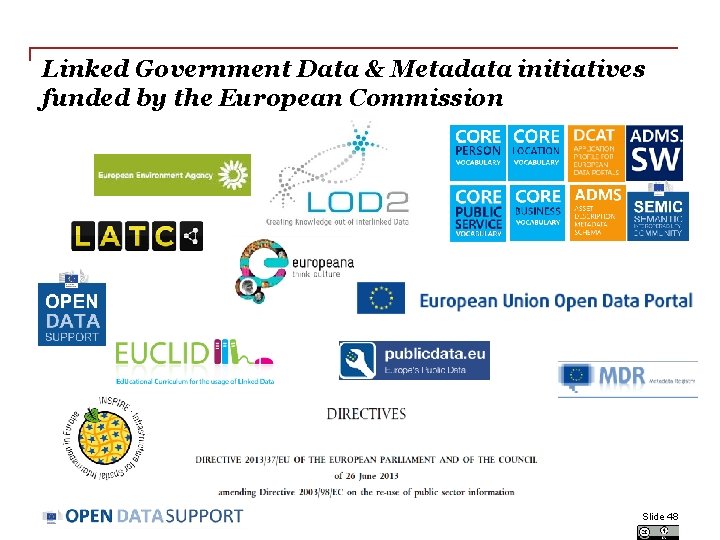
Linked Government Data & Metadata initiatives funded by the European Commission Slide 48
The Linked Government Data Pilots of ISA http: //health. testproject. eu/PPP/ http: //maritime. testproject. eu/CISE/ http: //cpsv. testproject. eu/CPSV/ Slide 49
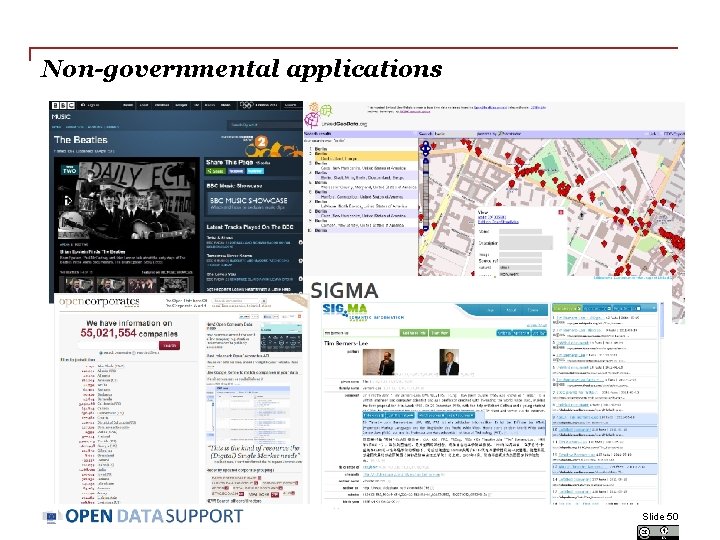
Non-governmental applications Slide 50
Conclusions • Linked data is a set of design principles for sharing machine-readable data on the Web. • Linked data and open data are not the same. • URIs, RDF and SPARQL form the foundational layer for Linked data. • Linked data offers a number of advantages for: o Data integration with small impact on legacy systems; o Enables for semantic interoperability; o Enables creativity and innovation through context and knowledgecreation. Slide 51
Group questions Is there supply and demand for (Linked) Open Government Data in your country? http: //www. visualpharm. com What are, in your opinion, the expected benefits and pitfalls of Linked Data? http: //www. visualpharm. com Are there any Linked (Open) Data initiatives in your country? If so, how many stars would you give them? http: //www. visualpharm. com Take also the online test here! Slide 52
Thank you!. . . and now YOUR questions? Slide 53
References Slide 6: Slide 21: • EUCLID. Course 1: Introduction and Application Scenarios. http: //www. euclidproject. eu/modules/course 1 • • Linking Open Data cloud diagram, by Richard Cyganiak and Anja Jentzsch. http: //lodcloud. net/ Data. gov. uk. Housing stock. http: //data. gov. uk/dataset/uk-housing-stock Slide 23: • Data. gov. uk. Road Safety Data. http: //data. gov. uk/dataset/road-accidents-safety-data Slides 8: , 13, 36, 38: Slide 25 & 27: • ISA Programme. Case study on how Linked Data is transforming e. Government. https: //joinup. ec. europa. eu/community/semic/document/case-study-how-linked-datatransforming-egovernment • • Tim Berners-Lee. Linked Data. http: //www. w 3. org/Design. Issues/Linked. Data. html ISA Organization Ontology pilot - Linking public sector's organisational data, https: //joinup. ec. europa. eu/asset/core_business/document/organization-ontology-pilotlinking-public-sectors-organisational-data http: //data. ydmed. gov. gr/ Slide 9: , Slide 37: • • ISA Programme Study on Business Models for LOGD https: //joinup. ec. europa. eu/community/semic/document/study-business-models-linkedopen-government-data-bm 4 logd ISA Programme. Core Location Pilot - Interconnecting Belgian Address Data. https: //joinup. ec. europa. eu/asset/core_location/document/core-location-pilotinterconnecting-belgian-address-data Slide 12: Slides 30 -34: • • Open Refine: https: //github. com/Open. Refine Slides 18 -28: • RDF Extension: http: //refine. deri. ie/ • • ISA Programme, Linking data about applications and decisions for authorisation of PPP, http: //joinup. ec. europa. eu/asset/core_business/document/linking-data-about-applicationsand-decisions-authorisation-ppp The Open Knowledge Foundation. Open Data – An Introduction. http: //okfn. org/opendata/ 5 ★ Open Data. http: //5 stardata. info/ Slide 19: • UK National Archives, Sustainable development targets 2011 -12. Slide 40 • Bibliotheksverbund Bayern, http: //lod. b 3 kat. de/doc • Agenzia per l’Italia Digitale, http: //spcdata. digitpa. gov. it/data. html • NL – Building and address register, http: //lod. Geodan. nl • UK Ordnance Survey, http: //data. ordnancesurvey. co. uk/ • UK Companies House, http: //companieshouse. gov. uk/ Slide 54
Further reading Linked Open Data: The Essentials. Florian Bauer, Martin Kaltenböck. http: //www. semantic-web. at/LOD-The. Essentials. pdf Linked Data: Evolving the Web into a Global Data Space. Tom Heath and Christian Bizer. http: //linkeddatabook. com/editions/1. 0/ Linked Open Government Data. Li Ding Qualcomm, Vassilios Peristeras and Michael Hausenblas. http: //ieeexplore. ieee. org/stamp. jsp? tp=&arnumber=6237454 EUCLID - Course 1: Introduction and Application Scenarios http: //www. euclid-project. eu/modules/course 1 Slide 55
Related projects and initiatives LOD 2 FP 7 project, http: //lod 2. eu/ The Open Knowledge Foundation, http: //okfn. org/ W 3 C Semantic Web, http: //www. w 3. org/standards/semanticweb/ EUCLID, http: //projecteuclid. org/ ISA Programme, http: //ec. europa. eu/isa/ W 3 C LOGD WG, http: //www. w 3. org/2011/gld/wiki/Main_Page LOD Around The Clock FP 7 project, http: //latc-project. eu/ Data. gov. uk, http: //data. gov. uk/linked-data Slide 56
Be part of our team. . . Find us on Join us on Open Data Support http: //www. slideshare. net/Open. Data. Support Open Data Support http: //goo. gl/y 9 ZZI Follow us @Open. Data. Support http: //www. opendatasupport. eu Contact us contact@opendatasupport. eu Slide 57