
Training Instructional Design Needs Analysis Unit 2 a

![References Clark DR. Bloom’s Taxonomy [monograph on the Internet]. Big Dog & Little Dog’s](https://slidetodoc.com/presentation_image_h2/160c6cc4b6f27df9050c6564ebb19a90/image-39.jpg "References Clark DR. Bloom’s Taxonomy [monograph on the Internet]. Big Dog & Little Dog’s")
- Slides: 39
Training & Instructional Design Needs Analysis Unit 2 a This material (Comp 20_Unit 2 a) was developed by Columbia University, funded by the Department of Health and Human Services, Office of the National Coordinator for Health Information Technology under Award Number 1 U 24 OC 000003.
Lecture Objectives • Identify an instructional problem • Plan and implement an instructional needs assessment • Analyze learner, task, and situational characteristics Health IT Workforce Curriculum Version 3. 0/Spring 2012 Training & Instructional Design Needs Analysis Unit 2 a 2
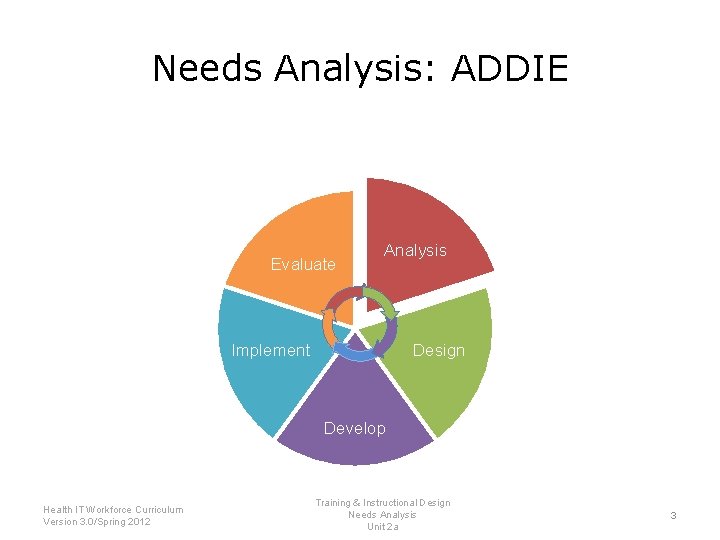
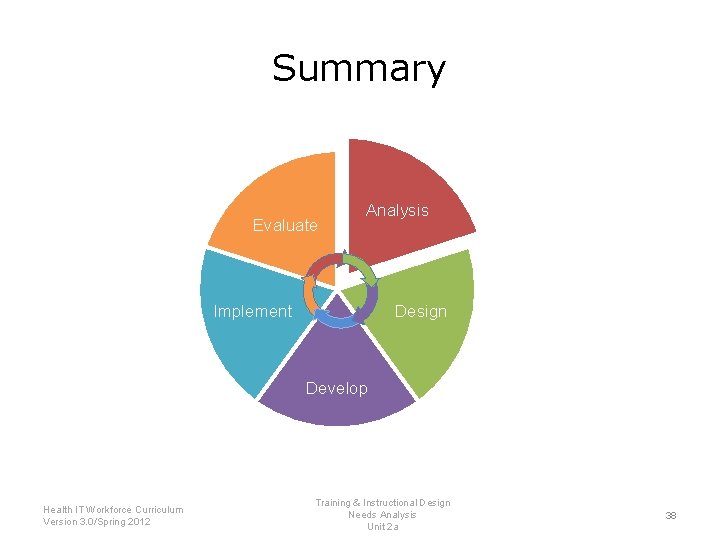
Needs Analysis: ADDIE Evaluate Analysis Implement Design Develop Health IT Workforce Curriculum Version 3. 0/Spring 2012 Training & Instructional Design Needs Analysis Unit 2 a 3
Defining Need A need is a discrepancy or gap between a desired state of affairs and the current state of affairs (Kaufman, 1976) If employees lack the knowledge or skills needed to successfully perform the various tasks that comprise their jobs, a training need is identified Health IT Workforce Curriculum Version 3. 0/Spring 2012 Training & Instructional Design Needs Analysis Unit 2 a 4
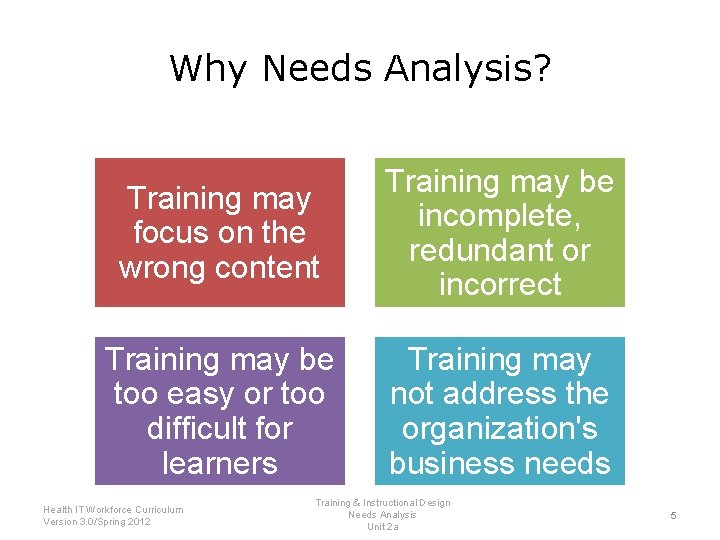
Why Needs Analysis? Training may focus on the wrong content Training may be incomplete, redundant or incorrect Training may be too easy or too difficult for learners Training may not address the organization's business needs Health IT Workforce Curriculum Version 3. 0/Spring 2012 Training & Instructional Design Needs Analysis Unit 2 a 5
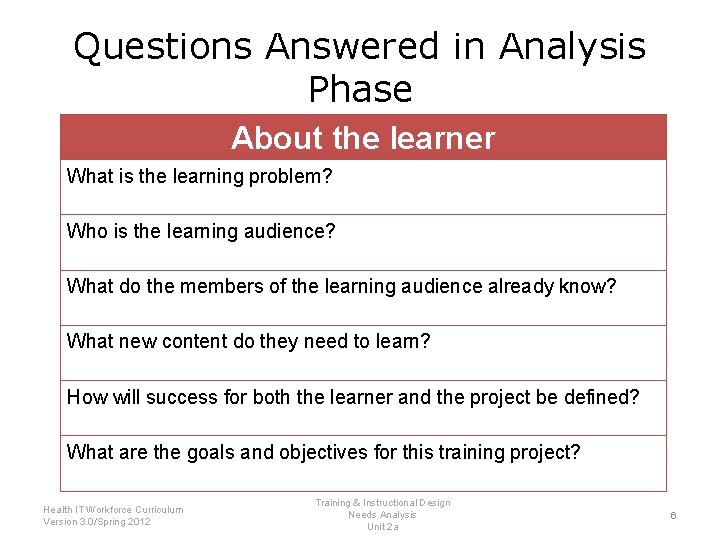
Questions Answered in Analysis Phase About the learner What is the learning problem? Who is the learning audience? What do the members of the learning audience already know? What new content do they need to learn? How will success for both the learner and the project be defined? What are the goals and objectives for this training project? Health IT Workforce Curriculum Version 3. 0/Spring 2012 Training & Instructional Design Needs Analysis Unit 2 a 6
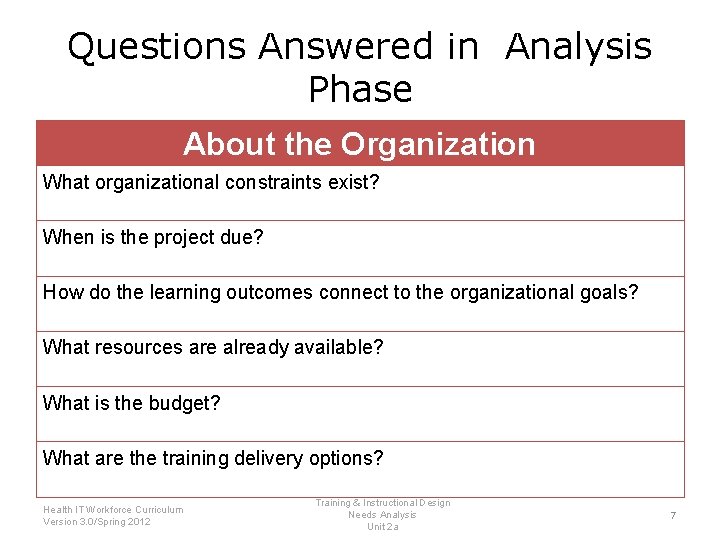
Questions Answered in Analysis Phase About the Organization What organizational constraints exist? When is the project due? How do the learning outcomes connect to the organizational goals? What resources are already available? What is the budget? What are the training delivery options? Health IT Workforce Curriculum Version 3. 0/Spring 2012 Training & Instructional Design Needs Analysis Unit 2 a 7
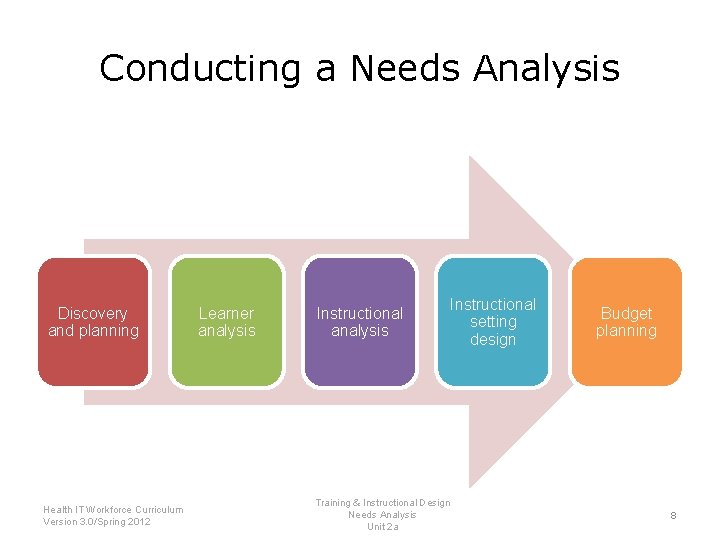
Conducting a Needs Analysis Discovery and planning Health IT Workforce Curriculum Version 3. 0/Spring 2012 Learner analysis Instructional setting design Training & Instructional Design Needs Analysis Unit 2 a Budget planning 8
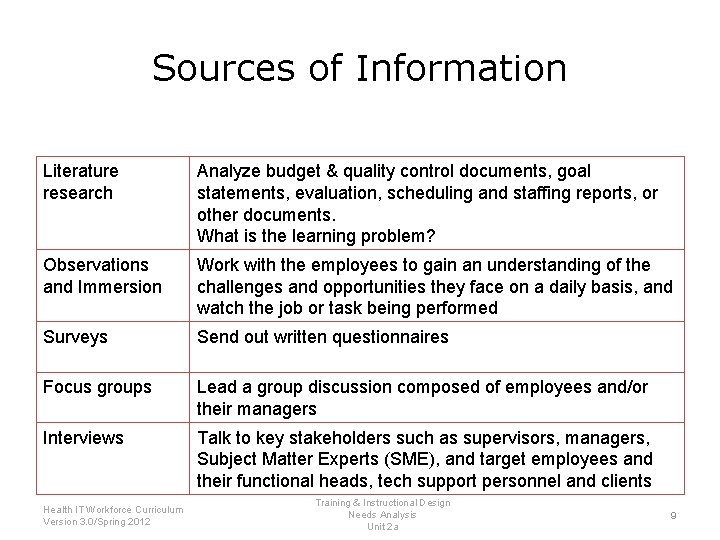
Sources of Information Literature research Analyze budget & quality control documents, goal statements, evaluation, scheduling and staffing reports, or other documents. What is the learning problem? Observations and Immersion Work with the employees to gain an understanding of the challenges and opportunities they face on a daily basis, and watch the job or task being performed Surveys Send out written questionnaires Focus groups Lead a group discussion composed of employees and/or their managers Interviews Talk to key stakeholders such as supervisors, managers, Subject Matter Experts (SME), and target employees and their functional heads, tech support personnel and clients Health IT Workforce Curriculum Version 3. 0/Spring 2012 Training & Instructional Design Needs Analysis Unit 2 a 9
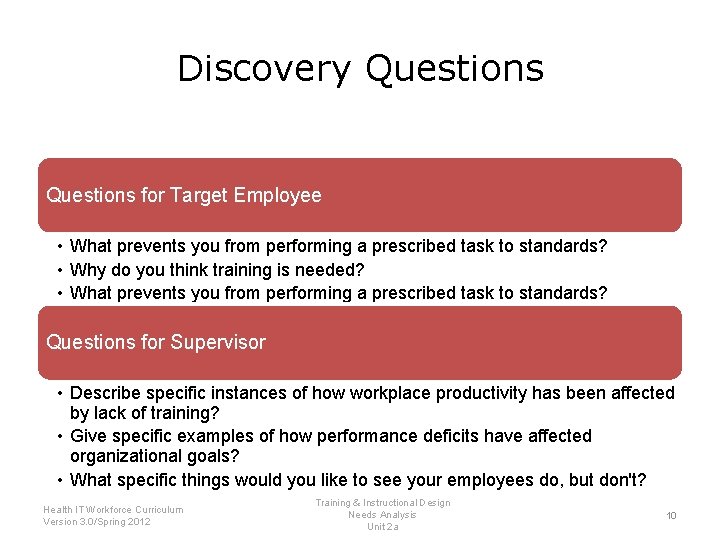
Discovery Questions for Target Employee • What prevents you from performing a prescribed task to standards? • Why do you think training is needed? • What prevents you from performing a prescribed task to standards? Questions for Supervisor • Describe specific instances of how workplace productivity has been affected by lack of training? • Give specific examples of how performance deficits have affected organizational goals? • What specific things would you like to see your employees do, but don't? Health IT Workforce Curriculum Version 3. 0/Spring 2012 Training & Instructional Design Needs Analysis Unit 2 a 10
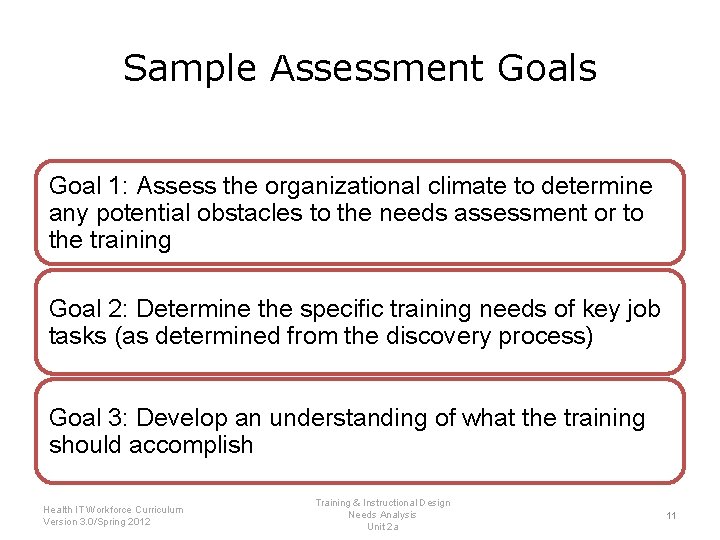
Sample Assessment Goals Goal 1: Assess the organizational climate to determine any potential obstacles to the needs assessment or to the training Goal 2: Determine the specific training needs of key job tasks (as determined from the discovery process) Goal 3: Develop an understanding of what the training should accomplish Health IT Workforce Curriculum Version 3. 0/Spring 2012 Training & Instructional Design Needs Analysis Unit 2 a 11
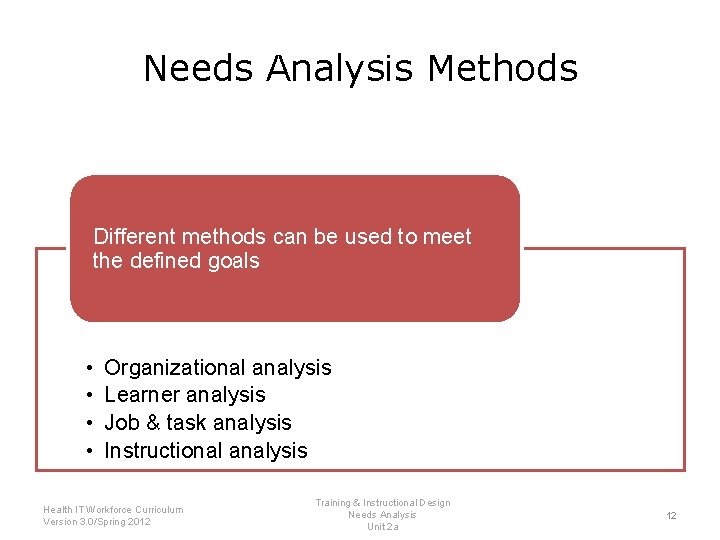
Needs Analysis Methods Different methods can be used to meet the defined goals • • Organizational analysis Learner analysis Job & task analysis Instructional analysis Health IT Workforce Curriculum Version 3. 0/Spring 2012 Training & Instructional Design Needs Analysis Unit 2 a 12
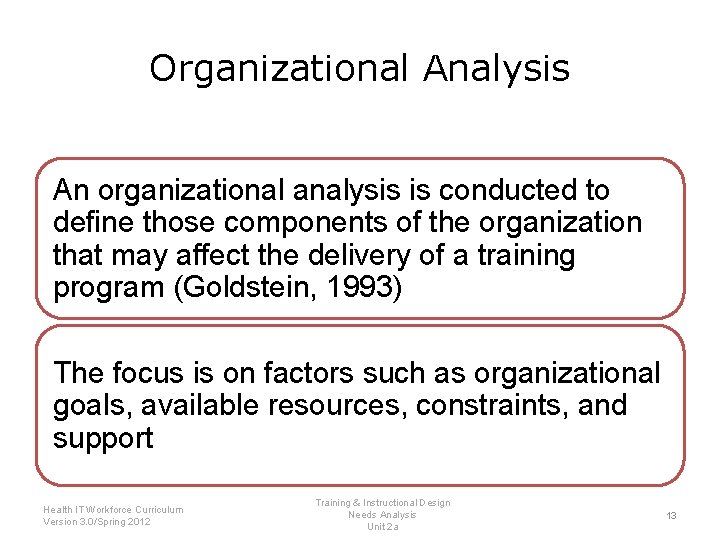
Organizational Analysis An organizational analysis is conducted to define those components of the organization that may affect the delivery of a training program (Goldstein, 1993) The focus is on factors such as organizational goals, available resources, constraints, and support Health IT Workforce Curriculum Version 3. 0/Spring 2012 Training & Instructional Design Needs Analysis Unit 2 a 13
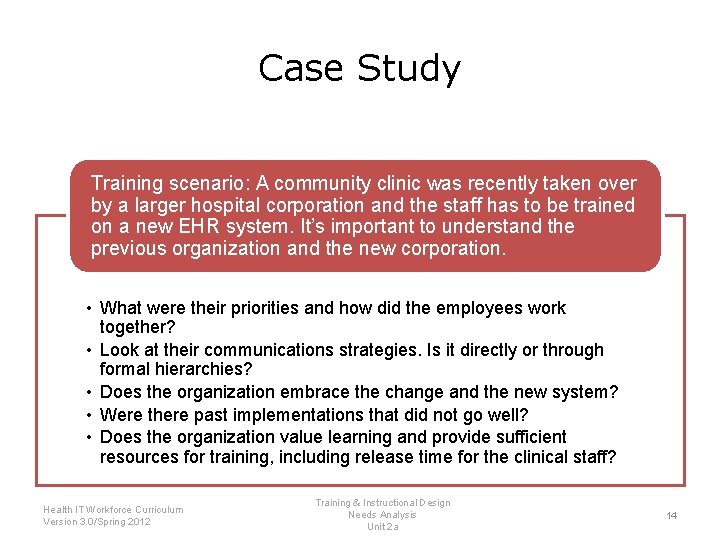
Case Study Training scenario: A community clinic was recently taken over by a larger hospital corporation and the staff has to be trained on a new EHR system. It’s important to understand the previous organization and the new corporation. • What were their priorities and how did the employees work together? • Look at their communications strategies. Is it directly or through formal hierarchies? • Does the organization embrace the change and the new system? • Were there past implementations that did not go well? • Does the organization value learning and provide sufficient resources for training, including release time for the clinical staff? Health IT Workforce Curriculum Version 3. 0/Spring 2012 Training & Instructional Design Needs Analysis Unit 2 a 14
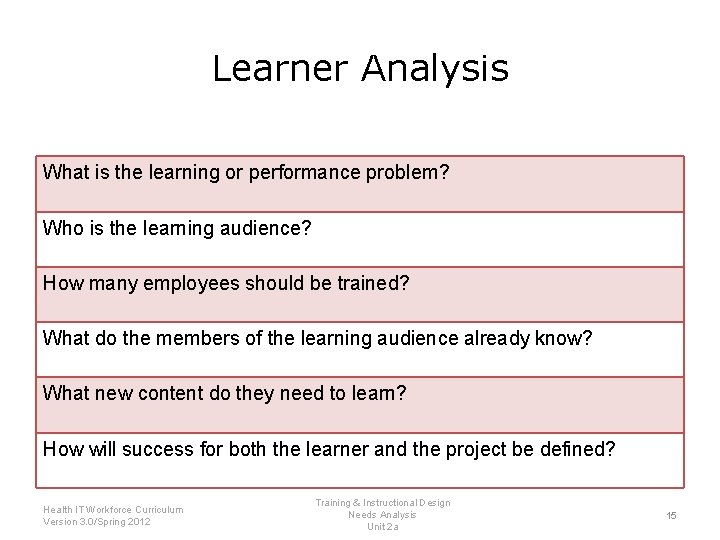
Learner Analysis What is the learning or performance problem? Who is the learning audience? How many employees should be trained? What do the members of the learning audience already know? What new content do they need to learn? How will success for both the learner and the project be defined? Health IT Workforce Curriculum Version 3. 0/Spring 2012 Training & Instructional Design Needs Analysis Unit 2 a 15
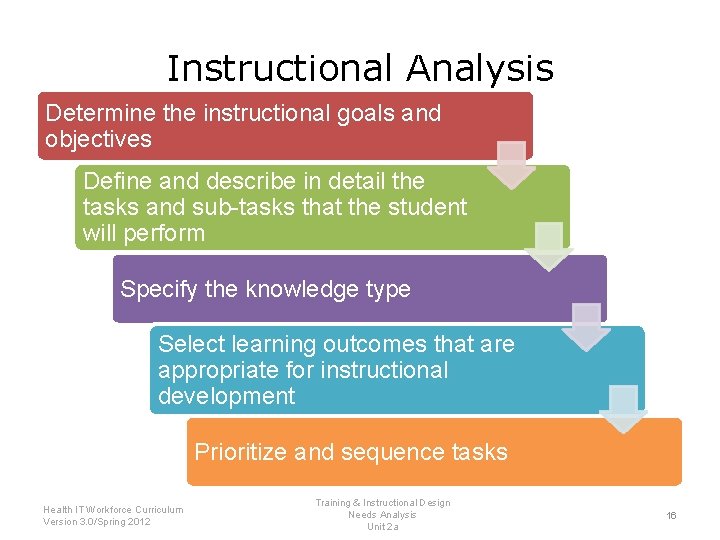
Instructional Analysis Determine the instructional goals and objectives Define and describe in detail the tasks and sub-tasks that the student will perform Specify the knowledge type Select learning outcomes that are appropriate for instructional development Prioritize and sequence tasks Health IT Workforce Curriculum Version 3. 0/Spring 2012 Training & Instructional Design Needs Analysis Unit 2 a 16
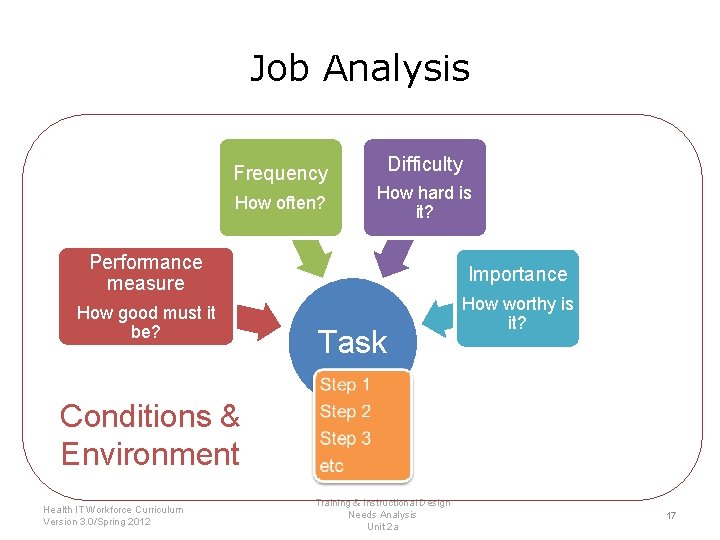
Job Analysis Frequency How often? Difficulty How hard is it? Performance measure How good must it be? Importance Task How worthy is it? Conditions & Environment Health IT Workforce Curriculum Version 3. 0/Spring 2012 Training & Instructional Design Needs Analysis Unit 2 a 17
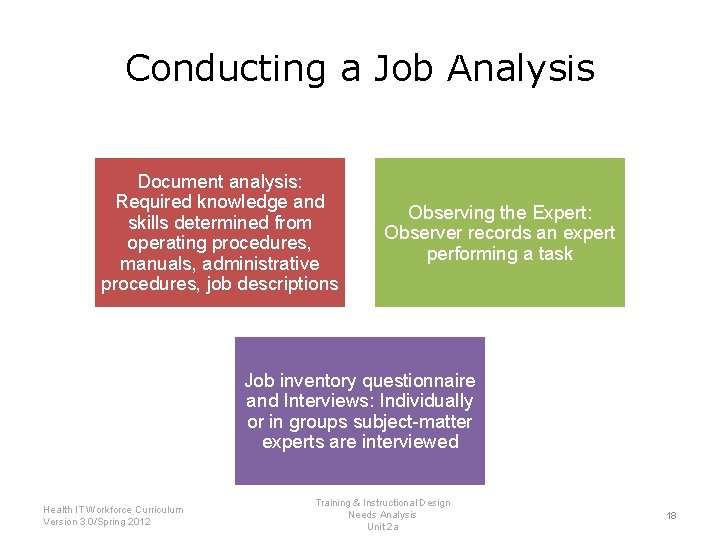
Conducting a Job Analysis Document analysis: Required knowledge and skills determined from operating procedures, manuals, administrative procedures, job descriptions Observing the Expert: Observer records an expert performing a task Job inventory questionnaire and Interviews: Individually or in groups subject-matter experts are interviewed Health IT Workforce Curriculum Version 3. 0/Spring 2012 Training & Instructional Design Needs Analysis Unit 2 a 18
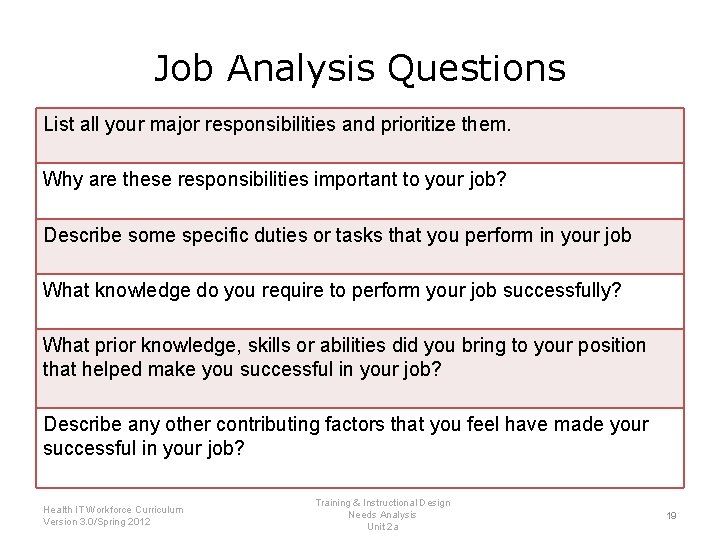
Job Analysis Questions List all your major responsibilities and prioritize them. Why are these responsibilities important to your job? Describe some specific duties or tasks that you perform in your job What knowledge do you require to perform your job successfully? What prior knowledge, skills or abilities did you bring to your position that helped make you successful in your job? Describe any other contributing factors that you feel have made your successful in your job? Health IT Workforce Curriculum Version 3. 0/Spring 2012 Training & Instructional Design Needs Analysis Unit 2 a 19
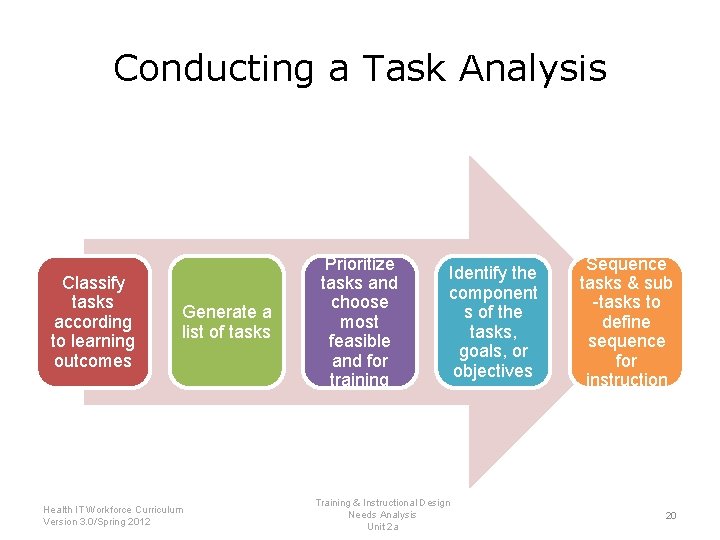
Conducting a Task Analysis Classify tasks according to learning outcomes Generate a list of tasks Health IT Workforce Curriculum Version 3. 0/Spring 2012 Prioritize tasks and choose most feasible and for training Identify the component s of the tasks, goals, or objectives Training & Instructional Design Needs Analysis Unit 2 a Sequence tasks & sub -tasks to define sequence for instruction 20
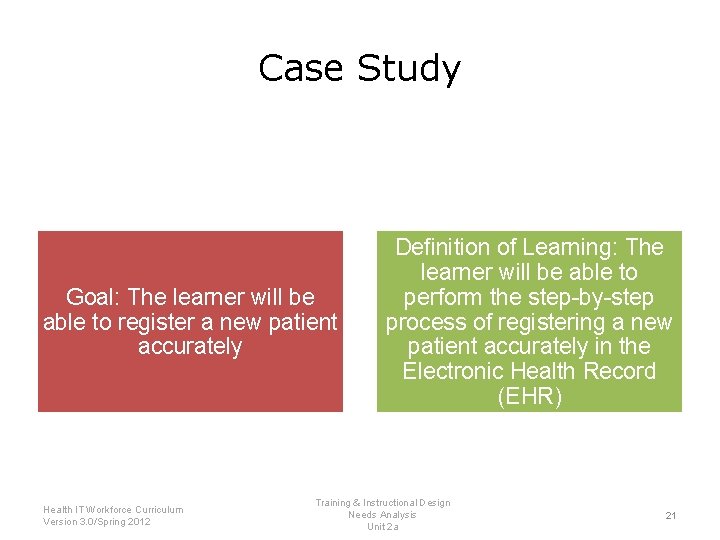
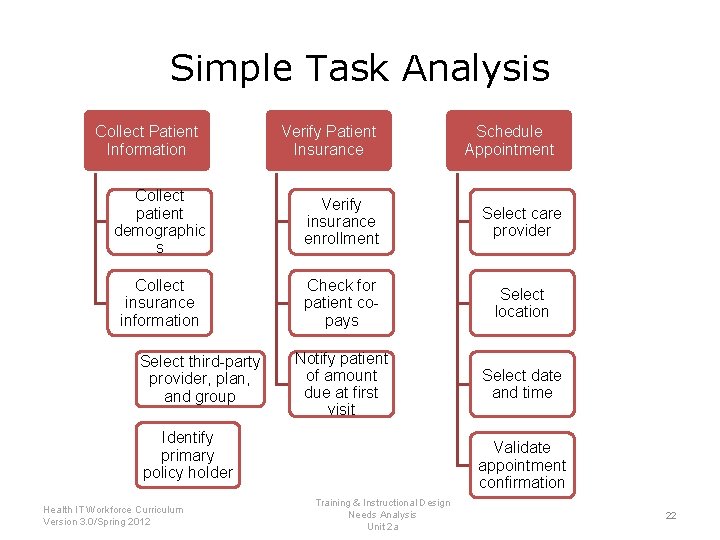
Case Study Goal: The learner will be able to register a new patient accurately Health IT Workforce Curriculum Version 3. 0/Spring 2012 Definition of Learning: The learner will be able to perform the step-by-step process of registering a new patient accurately in the Electronic Health Record (EHR) Training & Instructional Design Needs Analysis Unit 2 a 21
Simple Task Analysis Collect Patient Information Verify Patient Insurance Schedule Appointment Collect patient demographic s Verify insurance enrollment Select care provider Collect insurance information Check for patient copays Select location Notify patient of amount due at first visit Select date and time Select third-party provider, plan, and group Identify primary policy holder Health IT Workforce Curriculum Version 3. 0/Spring 2012 Validate appointment confirmation Training & Instructional Design Needs Analysis Unit 2 a 22
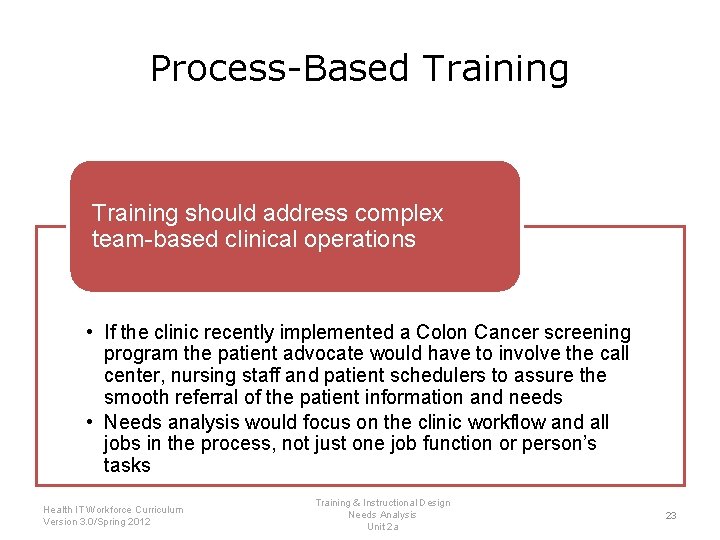
Process-Based Training should address complex team-based clinical operations • If the clinic recently implemented a Colon Cancer screening program the patient advocate would have to involve the call center, nursing staff and patient schedulers to assure the smooth referral of the patient information and needs • Needs analysis would focus on the clinic workflow and all jobs in the process, not just one job function or person’s tasks Health IT Workforce Curriculum Version 3. 0/Spring 2012 Training & Instructional Design Needs Analysis Unit 2 a 23
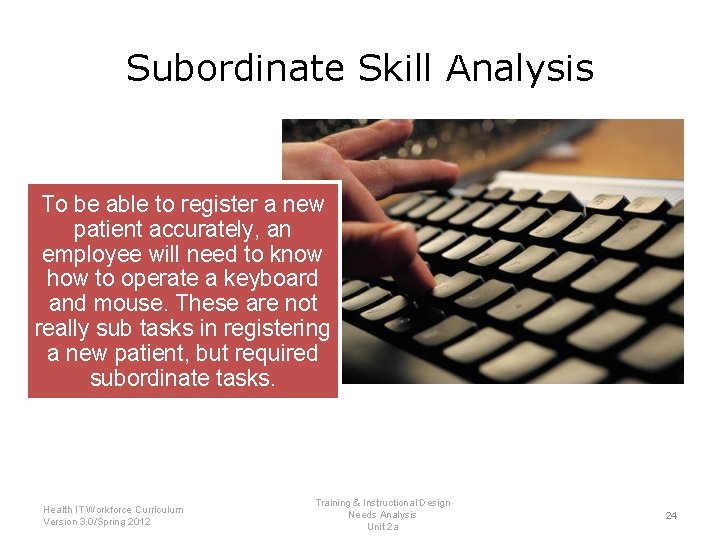
Subordinate Skill Analysis To be able to register a new patient accurately, an employee will need to know how to operate a keyboard and mouse. These are not really sub tasks in registering a new patient, but required subordinate tasks. Health IT Workforce Curriculum Version 3. 0/Spring 2012 Training & Instructional Design Needs Analysis Unit 2 a 24
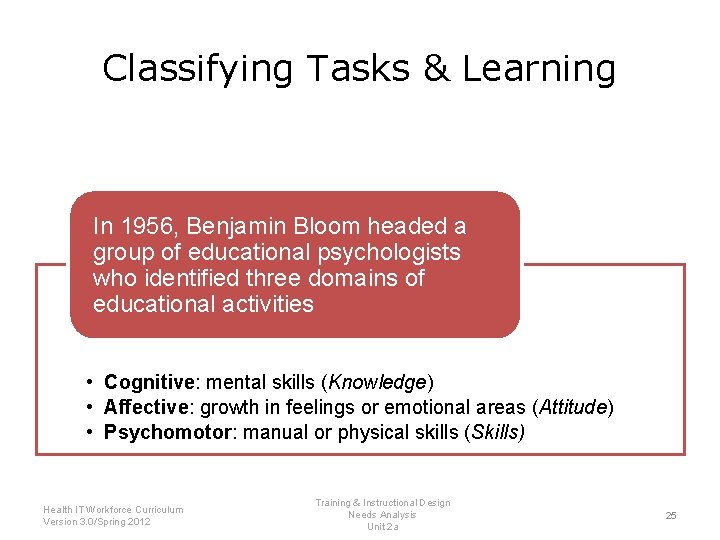
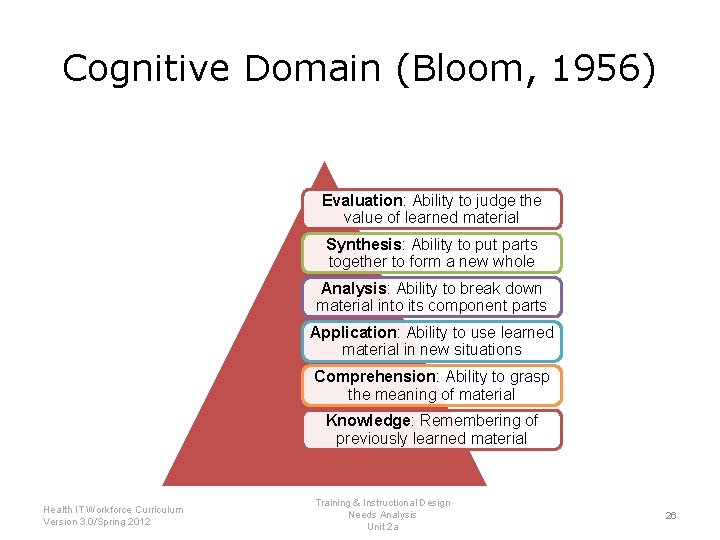
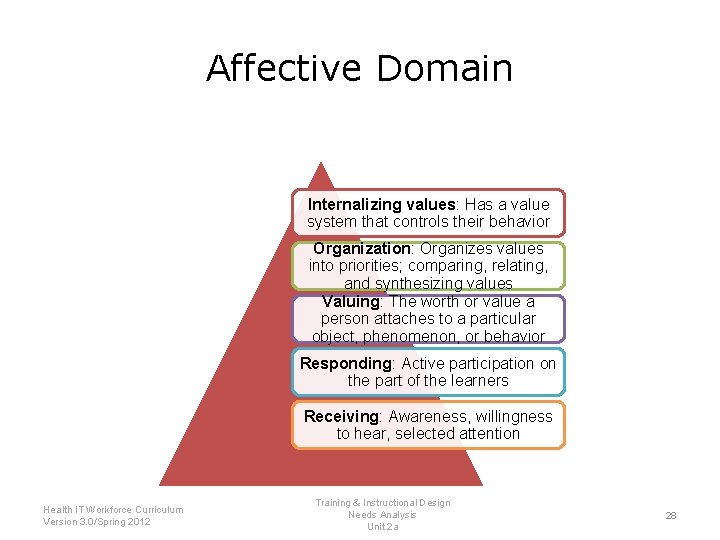
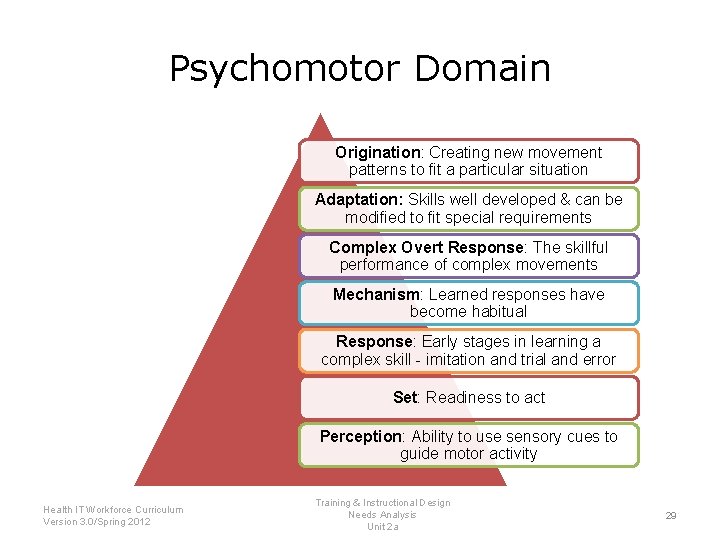
Classifying Tasks & Learning In 1956, Benjamin Bloom headed a group of educational psychologists who identified three domains of educational activities • Cognitive: mental skills (Knowledge) • Affective: growth in feelings or emotional areas (Attitude) • Psychomotor: manual or physical skills (Skills) Health IT Workforce Curriculum Version 3. 0/Spring 2012 Training & Instructional Design Needs Analysis Unit 2 a 25
Cognitive Domain (Bloom, 1956) Evaluation: Ability to judge the value of learned material Synthesis: Ability to put parts together to form a new whole Analysis: Ability to break down material into its component parts Application: Ability to use learned material in new situations Comprehension: Ability to grasp the meaning of material Knowledge: Remembering of previously learned material Health IT Workforce Curriculum Version 3. 0/Spring 2012 Training & Instructional Design Needs Analysis Unit 2 a 26
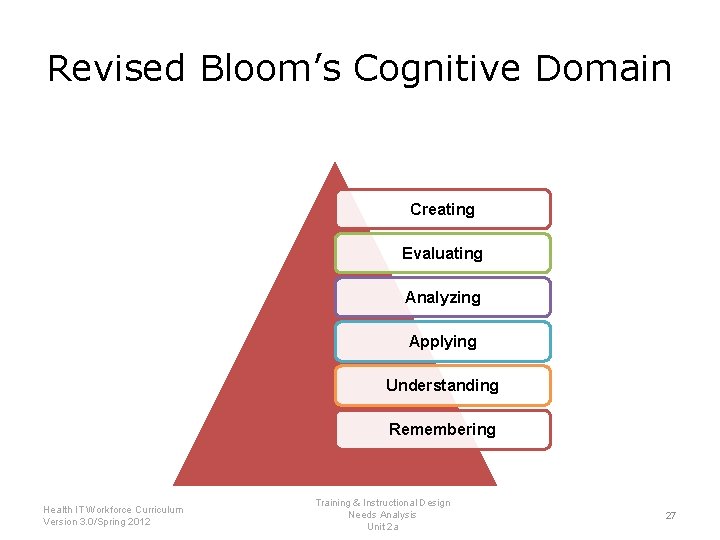
Revised Bloom’s Cognitive Domain Creating Evaluating Analyzing Applying Understanding Remembering Health IT Workforce Curriculum Version 3. 0/Spring 2012 Training & Instructional Design Needs Analysis Unit 2 a 27
Affective Domain Internalizing values: Has a value system that controls their behavior Organization: Organizes values into priorities; comparing, relating, and synthesizing values Valuing: The worth or value a person attaches to a particular object, phenomenon, or behavior Responding: Active participation on the part of the learners Receiving: Awareness, willingness to hear, selected attention Health IT Workforce Curriculum Version 3. 0/Spring 2012 Training & Instructional Design Needs Analysis Unit 2 a 28
Psychomotor Domain Origination: Creating new movement patterns to fit a particular situation Adaptation: Skills well developed & can be modified to fit special requirements Complex Overt Response: The skillful performance of complex movements Mechanism: Learned responses have become habitual Response: Early stages in learning a complex skill - imitation and trial and error Set: Readiness to act Perception: Ability to use sensory cues to guide motor activity Health IT Workforce Curriculum Version 3. 0/Spring 2012 Training & Instructional Design Needs Analysis Unit 2 a 29
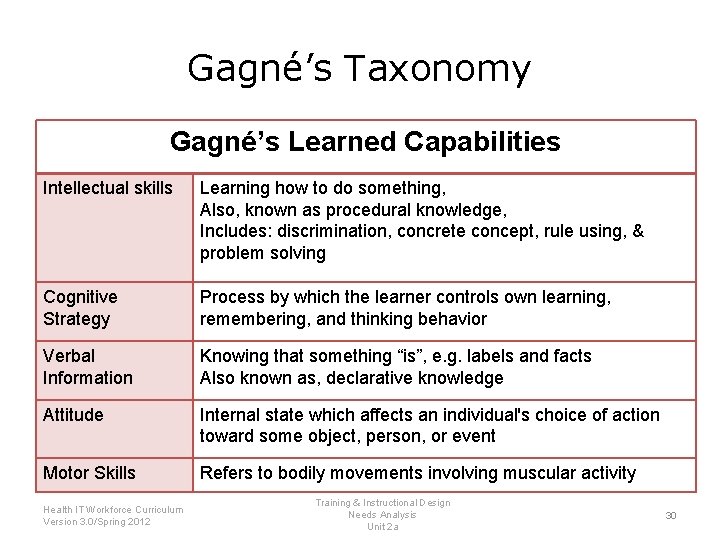
Gagné’s Taxonomy Gagné’s Learned Capabilities Intellectual skills Learning how to do something, Also, known as procedural knowledge, Includes: discrimination, concrete concept, rule using, & problem solving Cognitive Strategy Process by which the learner controls own learning, remembering, and thinking behavior Verbal Information Knowing that something “is”, e. g. labels and facts Also known as, declarative knowledge Attitude Internal state which affects an individual's choice of action toward some object, person, or event Motor Skills Refers to bodily movements involving muscular activity Health IT Workforce Curriculum Version 3. 0/Spring 2012 Training & Instructional Design Needs Analysis Unit 2 a 30
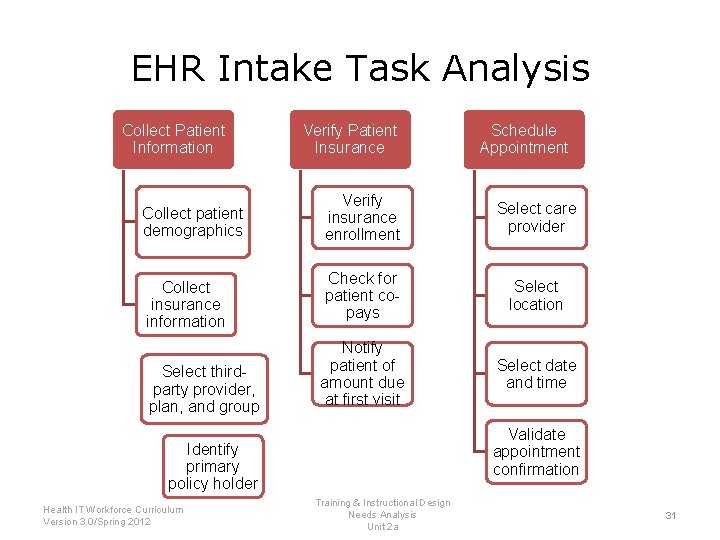
EHR Intake Task Analysis Collect Patient Information Collect patient demographics Collect insurance information Select thirdparty provider, plan, and group Verify Patient Insurance Verify insurance enrollment Select care provider Check for patient copays Select location Notify patient of amount due at first visit Select date and time Validate appointment confirmation Identify primary policy holder Health IT Workforce Curriculum Version 3. 0/Spring 2012 Schedule Appointment Training & Instructional Design Needs Analysis Unit 2 a 31
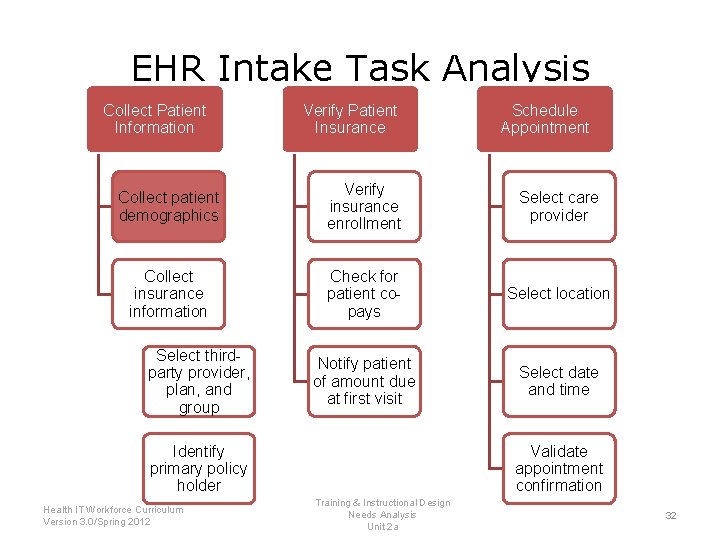
EHR Intake Task Analysis Collect Patient Information Verify Patient Insurance Schedule Appointment Collect patient demographics Verify insurance enrollment Select care provider Collect insurance information Check for patient copays Select location Notify patient of amount due at first visit Select date and time Select thirdparty provider, plan, and group Identify primary policy holder Health IT Workforce Curriculum Version 3. 0/Spring 2012 Validate appointment confirmation Training & Instructional Design Needs Analysis Unit 2 a 32
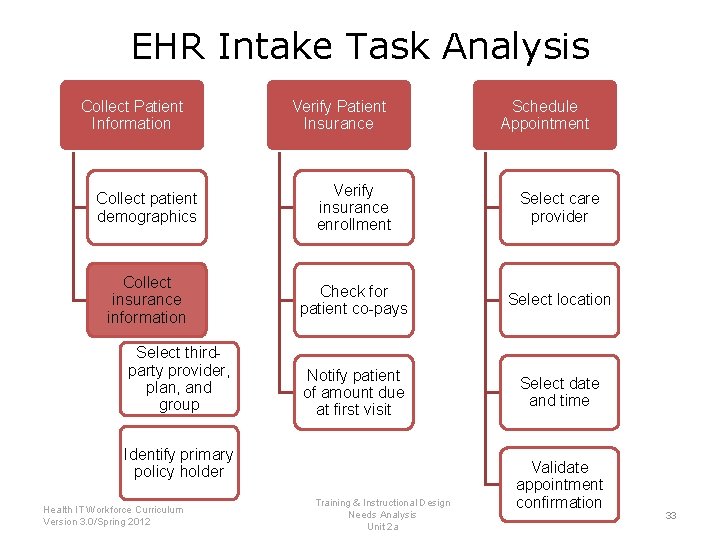
EHR Intake Task Analysis Collect Patient Information Verify Patient Insurance Schedule Appointment Collect patient demographics Verify insurance enrollment Select care provider Collect insurance information Check for patient co-pays Select location Notify patient of amount due at first visit Select date and time Select thirdparty provider, plan, and group Identify primary policy holder Health IT Workforce Curriculum Version 3. 0/Spring 2012 Training & Instructional Design Needs Analysis Unit 2 a Validate appointment confirmation 33
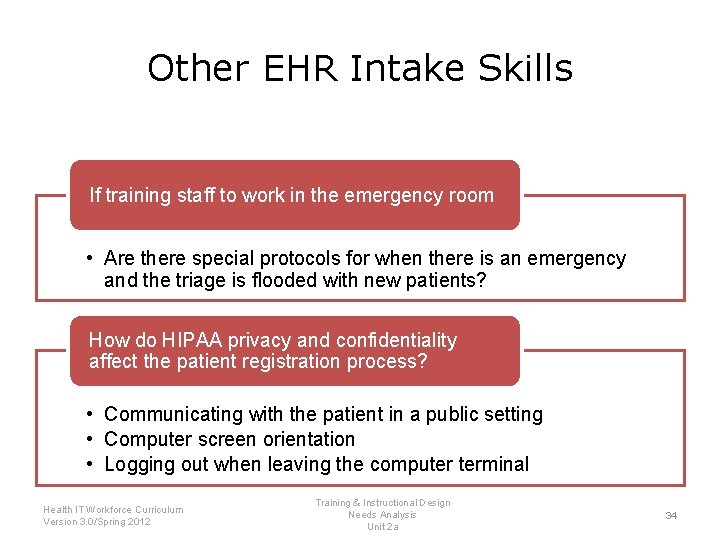
Other EHR Intake Skills If training staff to work in the emergency room • Are there special protocols for when there is an emergency and the triage is flooded with new patients? How do HIPAA privacy and confidentiality affect the patient registration process? • Communicating with the patient in a public setting • Computer screen orientation • Logging out when leaving the computer terminal Health IT Workforce Curriculum Version 3. 0/Spring 2012 Training & Instructional Design Needs Analysis Unit 2 a 34
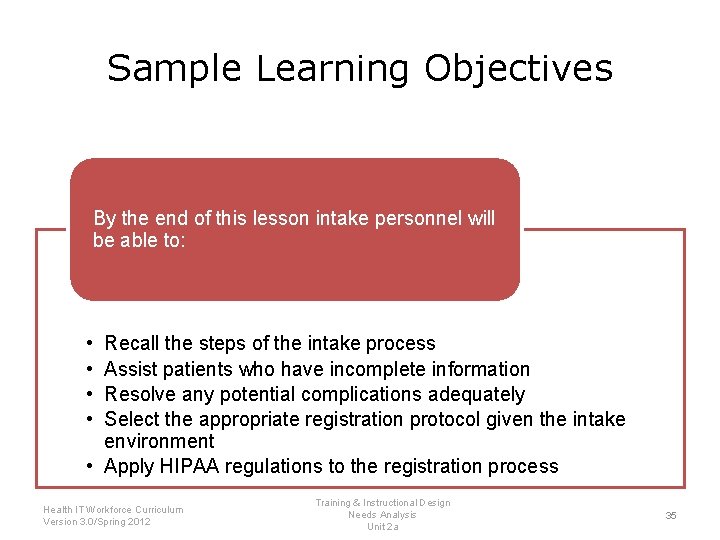
Sample Learning Objectives By the end of this lesson intake personnel will be able to: • • Recall the steps of the intake process Assist patients who have incomplete information Resolve any potential complications adequately Select the appropriate registration protocol given the intake environment • Apply HIPAA regulations to the registration process Health IT Workforce Curriculum Version 3. 0/Spring 2012 Training & Instructional Design Needs Analysis Unit 2 a 35
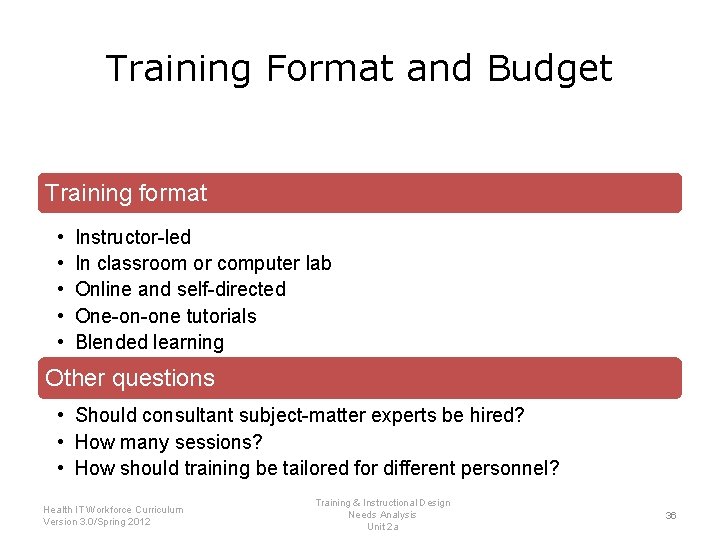
Training Format and Budget Training format • • • Instructor-led In classroom or computer lab Online and self-directed One-on-one tutorials Blended learning Other questions • Should consultant subject-matter experts be hired? • How many sessions? • How should training be tailored for different personnel? Health IT Workforce Curriculum Version 3. 0/Spring 2012 Training & Instructional Design Needs Analysis Unit 2 a 36
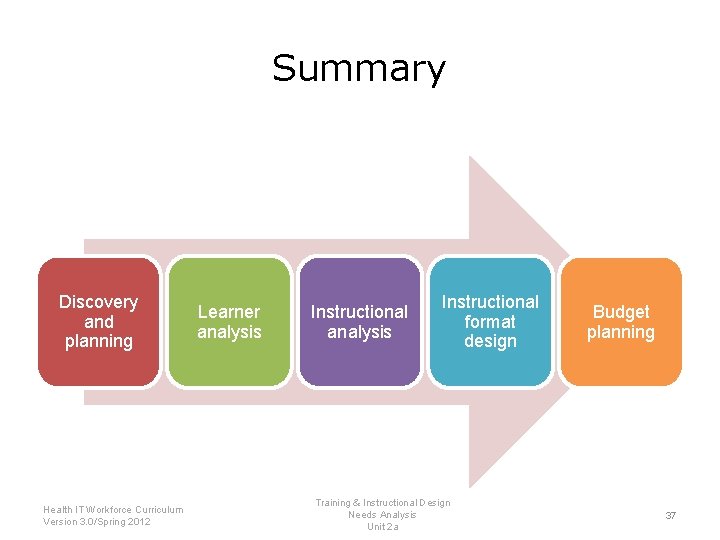
Summary Discovery and planning Health IT Workforce Curriculum Version 3. 0/Spring 2012 Learner analysis Instructional format design Training & Instructional Design Needs Analysis Unit 2 a Budget planning 37
Summary Evaluate Analysis Implement Design Develop Health IT Workforce Curriculum Version 3. 0/Spring 2012 Training & Instructional Design Needs Analysis Unit 2 a 38
References Clark DR. Bloom’s Taxonomy [monograph on the Internet]. Big Dog & Little Dog’s Performance Juxtaposition; c 2004 [cited 2010 Jun 21]. Available from: http: //www. nwlink. com/~donclark/hrd/sat. html. Clark DR. Instructional System Design (ISD). Big Dog & Little Dog’s Performance Juxtaposition; c 2004 [cited 2010 Jun 21]. Available from: http: //nwlink. com/~donclark/hrd/ahold/isd. html. Carkhuff RR, Fisher SG. Instructional systems design: volumes I & II. Amherst, MA: Human Resource Development Press; 1984. Carliner S. Training Design. Danvers, MA: American Society for Training and Development; 2003. Gagne RM, Wager WW, & Golas K. Principles of Instructional Design (5 th ed. ). California: Wadsworth Publishing, 2004. Reigeluth CM. Instructional-design Theories and Models: A new paradigm of instructional theory. New Jersey: Lawrence Erlbaum Associates, Inc, 1999. Health IT Workforce Curriculum Version 3. 0/Spring 2012 Training & Instructional Design Needs Analysis Unit 2 a 39