
Training for Volunteer Facilitators Mid West Aries Project
- Slides: 47
Training for Volunteer Facilitators Mid West Aries Project Tuesday 8 th & Wednesday 9 th November 2016 Aoife Boland - Peer Educator Dan Taylor – Ed. & Dev. Officer
Welcome, please review our group agreement
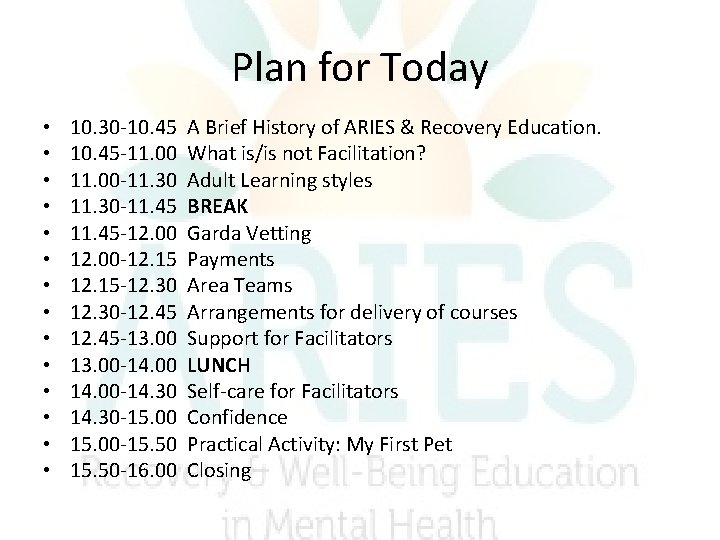
Plan for Today • • • • 10. 30 -10. 45 -11. 00 -11. 30 -11. 45 -12. 00 -12. 15 -12. 30 -12. 45 -13. 00 -14. 30 -15. 00 -15. 50 -16. 00 A Brief History of ARIES & Recovery Education. What is/is not Facilitation? Adult Learning styles BREAK Garda Vetting Payments Area Teams Arrangements for delivery of courses Support for Facilitators LUNCH Self-care for Facilitators Confidence Practical Activity: My First Pet Closing
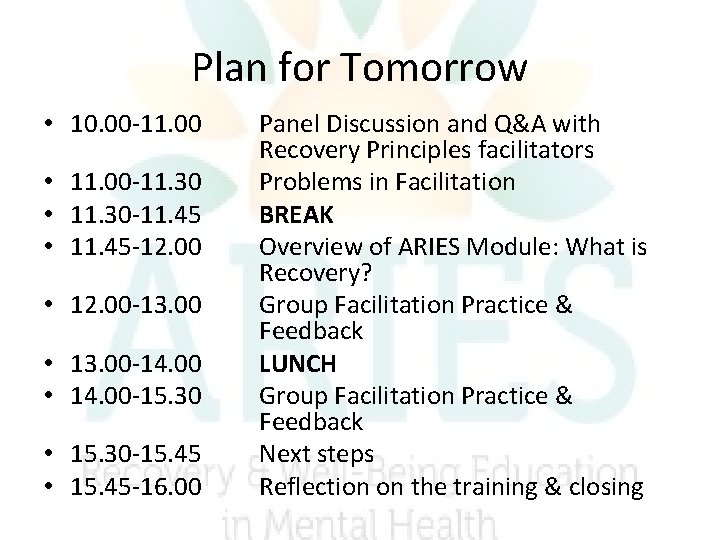
Plan for Tomorrow • 10. 00 -11. 00 • 11. 00 -11. 30 • 11. 30 -11. 45 • 11. 45 -12. 00 • 12. 00 -13. 00 • 13. 00 -14. 00 • 14. 00 -15. 30 • 15. 30 -15. 45 • 15. 45 -16. 00 Panel Discussion and Q&A with Recovery Principles facilitators Problems in Facilitation BREAK Overview of ARIES Module: What is Recovery? Group Facilitation Practice & Feedback LUNCH Group Facilitation Practice & Feedback Next steps Reflection on the training & closing
• Aim(s): To provide learners with the knowledge, skills and confidence to facilitate ARIES workshops.
Icebreaker • “Concerns in a box” • Write your concern on a post-it • Take a turn to place your concern in the box (scrunching optional) • Exchange it for a strength • Please say your name and read the strength • Fix your strength to the wall • Aoife & Dan will try to address all concerns over the two days
ARIES Project • Genio funded Pilot Project April 2016 - April 2017 • Vision: To provide the Mid West Region with an inspirational and inclusive educational programme on Recovery and Well Being. • Courses & Resources on Recovery & Well-Being in Mental Health • People with lived experience, family members, mental health workers (Co-production) • 70 Volunteers involved, 5 Modules developed • Training & roll out of workshops in November
What is Facilitation? • The definition of facilitate is "to make easy" or "ease a process. " What a facilitator does is plan, guide and manage a group event to ensure that the group's objectives are met effectively, with clear thinking, good participation and full buyin from everyone who is involved.
What is Facilitation? • [Facilitation is] … the art of leading people through processes toward agreed-upon objectives in a manner that encourages participation, ownership and creativity from all involved.
Facilitation in Recovery Colleges • “Recovery Colleges put education in to the service of Recovery” • Transformation, not transmission • Neutral stance • Always ask- Is this promoting recovery?
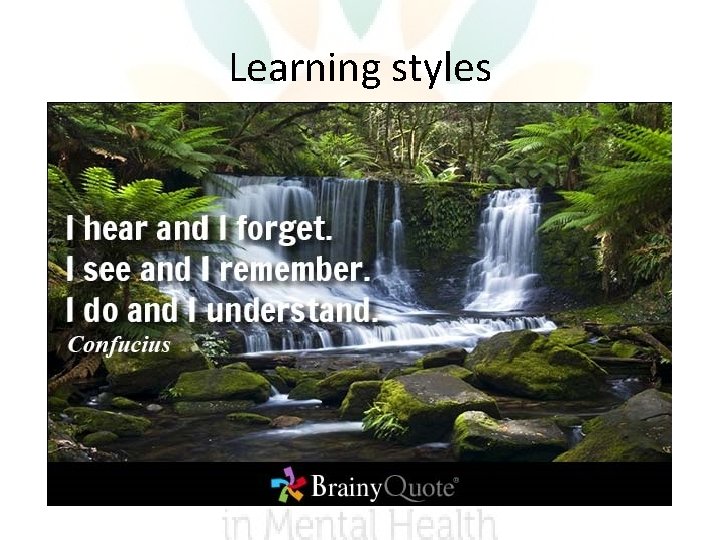
Learning styles
Learning styles • Honey and Mumford have produced a questionnaire (Honey and Mumford 1986) that can identify your preferred learning styles. But you may be able to decide yourself by reading the following descriptions; do you recognise yourself? • “Activist, Reflector, Theorist, Pragmatist”
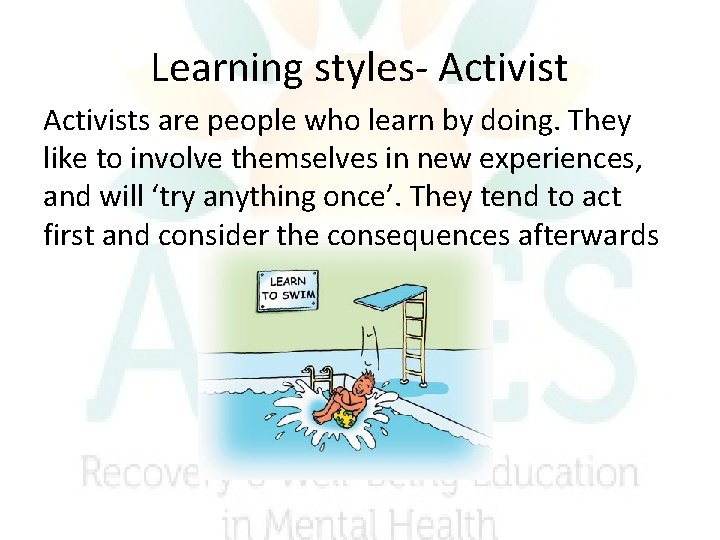
Learning styles- Activists are people who learn by doing. They like to involve themselves in new experiences, and will ‘try anything once’. They tend to act first and consider the consequences afterwards
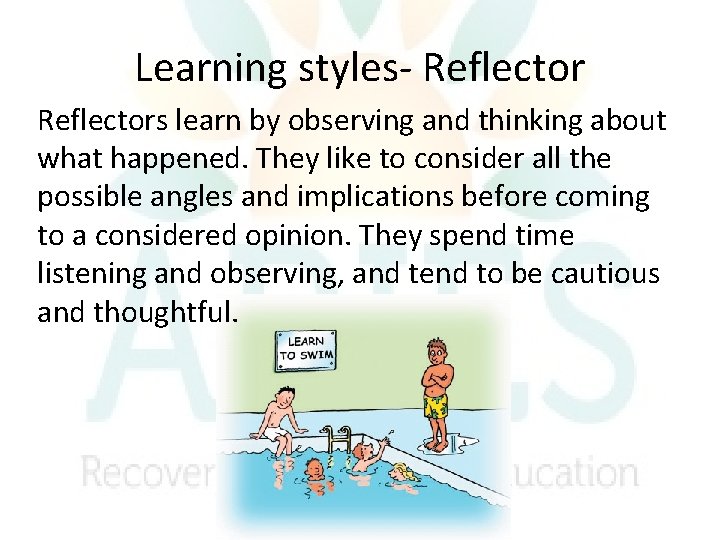
Learning styles- Reflectors learn by observing and thinking about what happened. They like to consider all the possible angles and implications before coming to a considered opinion. They spend time listening and observing, and tend to be cautious and thoughtful.
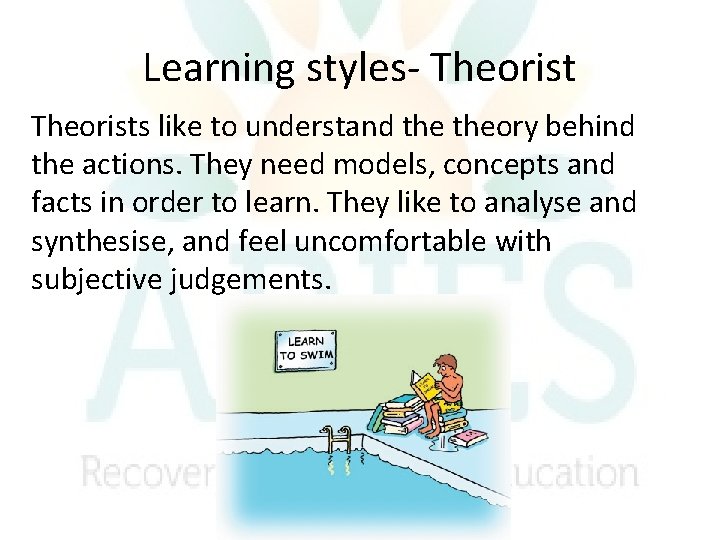
Learning styles- Theorists like to understand theory behind the actions. They need models, concepts and facts in order to learn. They like to analyse and synthesise, and feel uncomfortable with subjective judgements.
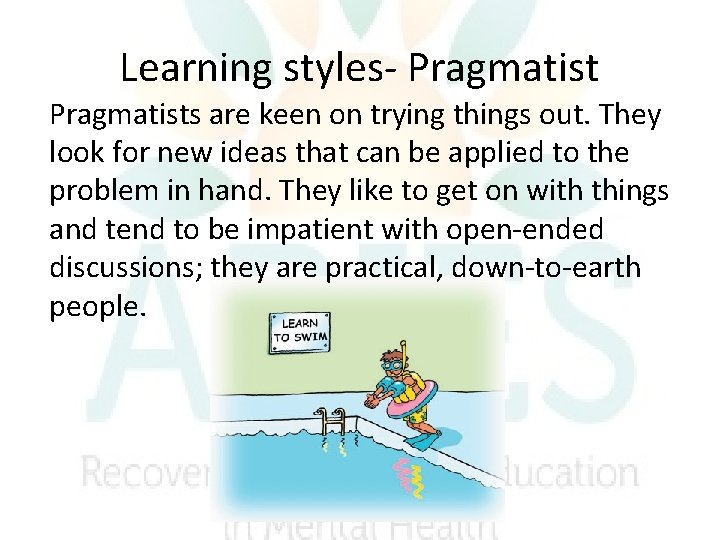
Learning styles- Pragmatists are keen on trying things out. They look for new ideas that can be applied to the problem in hand. They like to get on with things and tend to be impatient with open-ended discussions; they are practical, down-to-earth people.
Activity • What is your Learning style? • Take a coloured paper dot and put it on the Learning Style that most closely matches your own
Practicalities of being a volunteer: Garda Vetting • All volunteers must undergo Garda Vetting procedure • You must declare any convictions on the form • A conviction doesn’t necessarily mean you can’t volunteer • An external panel will review your vetting form and make a decision • Niamh & John will explain further
Practicalities of being a volunteer: Payments • Payments: € 26 per hour for 3 -hour courses • We are a pilot project and there is a limited budget for payments • You choose whether to be paid or not • If you are on a Social Welfare payment, there will be guidance from the HSE on how to manage your payments from ARIES
Practicalities of being a volunteer: Area Teams • • A way of getting informal support from peers Local to your area Agree frequency of meetings (e. g. Monthly) Choose a neutral venue (i. e. not homes) Get to know your co-facilitators Get to know material for courses Link in with Aoife & Dan, ARI Mid West, National ARI
Practicalities of being a volunteer: Delivering a Course • Organising venue: Aoife & Dan • Arranging dates: Aoife & Dan- dependent on your availability • Booking places: Aoife & Dan • Providing flipchart, paper, pens, handouts, laptop, projector, etc: Aoife & Dan • Delivering workshop, collecting feedback sheets & materials: You
Support for facilitators • • • • Phone numbers of project leaders for back –up support Mentoring provided Continuous training Supervision Continuous volunteer meet-ups for extra support/brainstorming re: delivery of course Peer Support Administration support Regular meetings Team approach to facilitation Access after session /support/de-briefing feedback Training booklet to refer to facilitators who deliver to come together as a team Deal with situation (crisis management) Someone to discuss difficult situations with as they arise Resourced Not to forget about self care
What you get from being a volunteer 100% Support from ARIES team Become part of a team Gain greater confidence & new skills Sharing your expertise by experience Service user, family member, mental health worker, work together • Making a difference to mental health services • • •
Lunchtime
Self-care for Facilitators • This is about Recovery- if it’s too much, don’t do it, and don’t feel bad • The Oxygen Mask • Self-care is always important: -Before, -During, -After
Self-care for Facilitators Before a course • Are you free? Plan as far ahead as you can Consider your own schedule and plan accordingly Get to know the material- preparation is key Share any concerns with friends, family, cofacilitators, Dan and Aoife • Create a routine that settles you • It’s okay to cancel • •
Self-care for Facilitators During a course • Focus on the current task/activity • Lean on your co-facilitators • “There’s no such thing as a mistake, it just depends which note you play next” • Any criticism is not aimed at you personally • Use breaks to refocus • Allow participants to do the work- they have the answers
Self-care for Facilitators After a course • • • Process/ wind down in a safe-place Take time to reflect with your co-facilitators Absorb the learning, feel the joy Focus on the positive aspects Reward yourself Quiet time, mindfulness, unwinding walk
Confidence • What is confidence (brainstorm) Dictionary Definition ‘confidence’: “The feeling or belief that one can have faith in or rely on someone or something”. • What inspires confidence in me? • Confidence as an individual • Confidence in public speaking • Confidence in telling my story
Confidence as an individual Sitting in this room today Turn to the person to your right Clap them on the back (not too hard) Why? Because. . . it has taken massive confidencerecovery gains- to get you in this seat today • Confidence and self-compassion (Aoife) • • •
Confidence in public speaking • 82% cite public speaking/facilitation as one of their biggest fears • Like all fears, it gets eradicated with practice • Stand up • (stance, diaphragm, vocal chords, voice projection) • You can have answers to every question, as long as one of the answers is ‘I don’t know’
Elephant in the room • Fear around doing this is perfectly normal • Use your teams for support and to inspire confidence in each other • The greatest performers in the world get nervous before going on stage • Find a routine that uses up the nervous energy • (e. g. Quick walk, mindfulness, talk with a friend, naming your fear) • ARIES is here to support you and is proud of you
Confidence in telling my story • The first, middle, and final rule: • You tell your story only when it is okay for you to do so. No one but you makes that decision. • What you share is completely up to you • You have control over this. It’s your life, and your life-story • More and more people are sharing their story of Recovery
Activity- my first pet • In groups of 3 • One person tells the other two people all about their first pet • Be as ‘creative’ as you want • All 3 must present • 5 minutes to prepare • Present any way you want (sing, dance, mime)
Thank you • Congratulations on completing Day One. • Please come back tomorrow
Welcome, please review our group agreement
Plan for Today • 10. 00 -11. 00 • 11. 00 -11. 30 • 11. 30 -11. 45 • 11. 45 -12. 00 • 12. 00 -13. 00 • 13. 00 -14. 00 • 14. 00 -15. 30 • 15. 30 -15. 45 • 15. 45 -16. 00 Panel Discussion and Q&A with Recovery Principles facilitators Problems in Facilitation BREAK Overview of ARIES Module: What is Recovery? Group Facilitation Practice & Feedback LUNCH Group Facilitation Practice & Feedback Next steps Reflection on the training & closing
Panel Discussion and Q&A with Recovery Principles facilitators
Problems in Facilitation • Problems are inevitable when you are doing something worthwhile • Technical malfunct#@#!? ion- use printout of slides • Conflict within group- silent majority rules, so use them. . . healthy differences • Medical emergency- I. C. E. • “Problematic Behaviours”. . . .
Examples of Problem Behaviours • • Silence Monopolistic Behaviour Storytelling Giving advice Questioning Dependency Intellectualizing
Dealing with Problem Behaviours Check how you are feeling Avoid responding with sarcasm/aggression Sate your observations in a tentative way Use ‘I’ statements Avoid taking behaviours personally Give the whole group an opportunity to work through conflicts • “Is this promoting Recovery? ” • • •
Overview of Module • • 3 hours Interactive workshop Discussion, not direction “A conversation with a shape” -Understand different views on Recovery -Inside and Outside factors in Recovery -Think about individual Recovery -Barriers to Recovery and ways to overcome them -What Recovery means to me and tools to help me in Recovery • Group work, discussion, observation, reflection, feedback, creativity
Practice Time • • • In groups of 3 Take a section of the module Agree who is doing what Use any teaching aids, exercises you like Practice in group, then deliver Enjoy the moment and the energy
Next Steps • ARIES Launch 16 th November, Greenhills Hotel • ARIES Workshops in Le Cheile, Health Hub • Await Garda Vetting • Refresher Day? • Develop Area Teams
Contact us Daniel Taylor, Education www. hse. ie/mwaries & Development Officer 085 8768517 ARIES Project Daniel. Taylor@hse. ie ARI Mid West Project Office Aoife Boland, St Joseph's Hospital Peer Educator Mulgrave Street 085 8589546 Limerick Aoife. Boland@hse. ie 061 461226
References • https: //www. mindtools. com/pages/article/Ro leof. AFacilitator. htm [accessed on 26/10/16] • http: //www. exedes. com/articles/What-is-agroup-facilitator. htm [accessed on 4/11/16]