
TRAINING FOR SUCCESS Honor Broderick Programme Manager Rationale
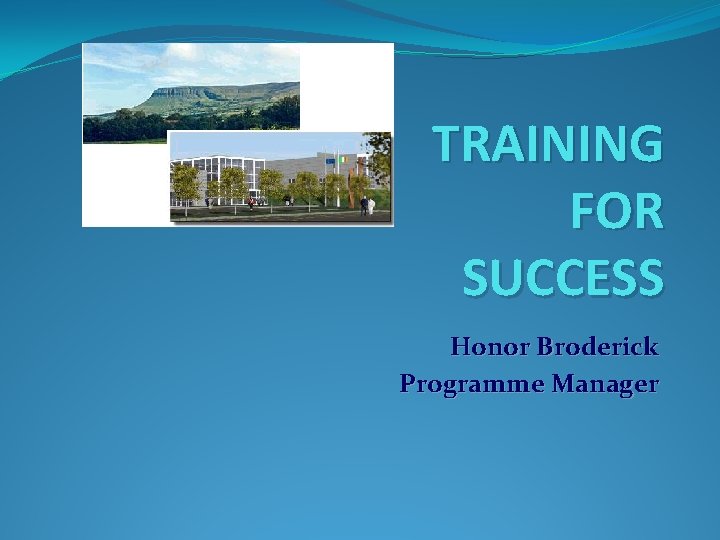
TRAINING FOR SUCCESS Honor Broderick Programme Manager
Rationale Children with epilepsy have lower levels of academic achievement than children with other chronic conditions (Austin et al 1998). Long term study of children with epilepsy in Finland found this group had fewer years in formal education and higher unemployment rates than average (Sillanpaa et al, 1998) Unemployment and underemployment are more common for people with epilepsy. (Chaplin and Fraser, 2001)
Background of the development of the course Brainwave involved in pre employment training since 1993. Planning My Future Dublin. 1996 -1998 Transnational Project Training for Success. Horizon. 1998 Training for Success established in Sligo.
Location Institute of Technology Sligo. Modern Third Level College with 5, 000 students Mainstream focus is beneficial Opportunity to mix and socialise with other students doing different courses. Informal as well as formal learning. Positive attitude towards epilepsy.
Participant Profile �People with epilepsy �Typically in the 18 to 30 age group though no upper age bracket exists. �Are recruited nationally, students come from a wide geographical spread representing all counties in the Republic of Ireland. �Occasionally from abroad. �Are fully registered students of the Institute. �Are registered with FÁS (Funding agency).
Demographics 154 people have participated in the course 65% Male 35% Female Youngest 17 Oldest 45 Mean = 26
Aims and Objectives � To impart the necessary skills and attitudes in order that people with epilepsy make a successful transition from dependency to adult independence and full integration into; full or part time employment, sheltered/supported employment, further vocational training, return to education, community/voluntary work. � To educate participants about epilepsy and develop good self management skills thereby ensuring restrictions imposed by the condition are limited. � To support students to identify their own personal goals and plan to achieve them.
Aims and Objectives (contd. ) �To improve self confidence and self esteem. �To develop independence, personal responsibility and self directed learning. �To ameliorate the negative impact epilepsy may have on education and employment opportunities �To develop a realist attainable career focus.
Modules Induction Creative writing Epilepsy awareness Career planning Computer Skills Communications. Spanish Mathematics Health and fitness Work experience First Aid Drama Art Introduction to Humanities
Motivation
Keep down stress levels
Stress levels
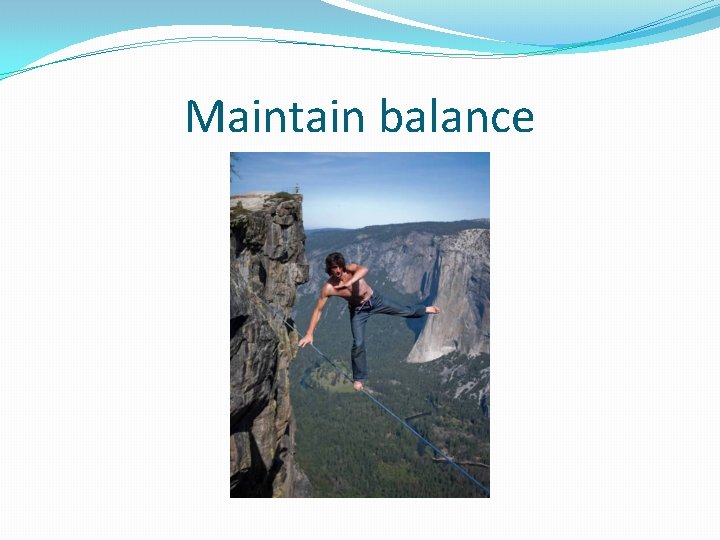
Maintain balance
Training for Success Duration 12 months Five days per week Full timetable for 30 hours per week Eight weeks work placement
PERSON CENTERED PLANNING An Individual fitness plan is worked out for each student at the beginning of the year. Individual Education/Training plans are developed and modified throughout the year.
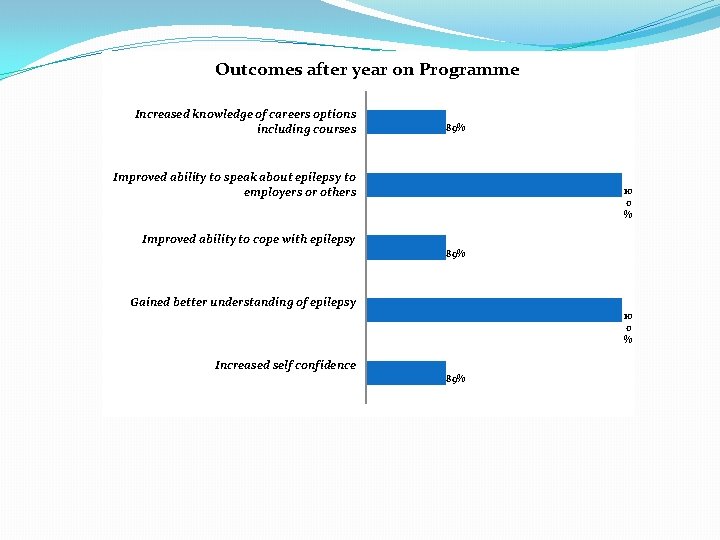
Outcomes after year on Programme Increased knowledge of careers options including courses 89% Outcomes after year on Programme Improved ability to speak about epilepsy to Increased knowledge of careers employers oroptions others including courses Improved ability to speak about epilepsy to Improved ability to cope with epilepsy employers or others 89% Improved ability to cope with epilepsy Gained better understanding of epilepsy Increased self confidence Increased 10 0 % 89% 10 10 0 0 % % 89%
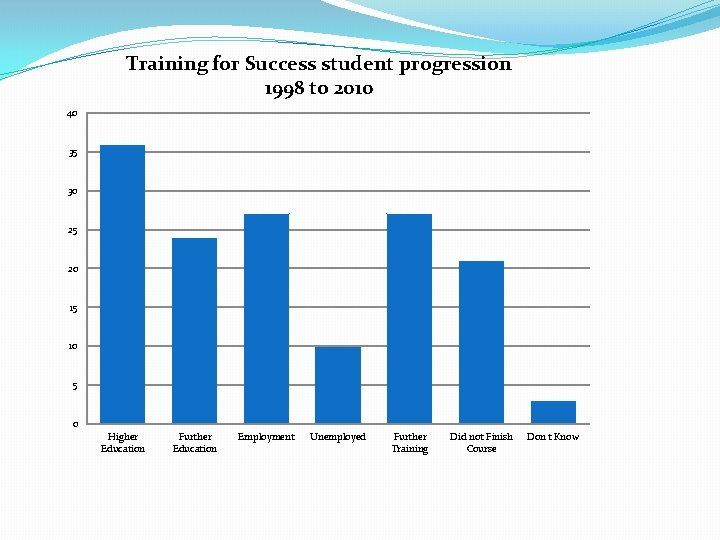
Training for Success student progression 1998 to 2010 40 35 30 25 20 15 10 5 0 Higher Education Further Education Employment Unemployed Further Training Did not Finish Course Don't Know
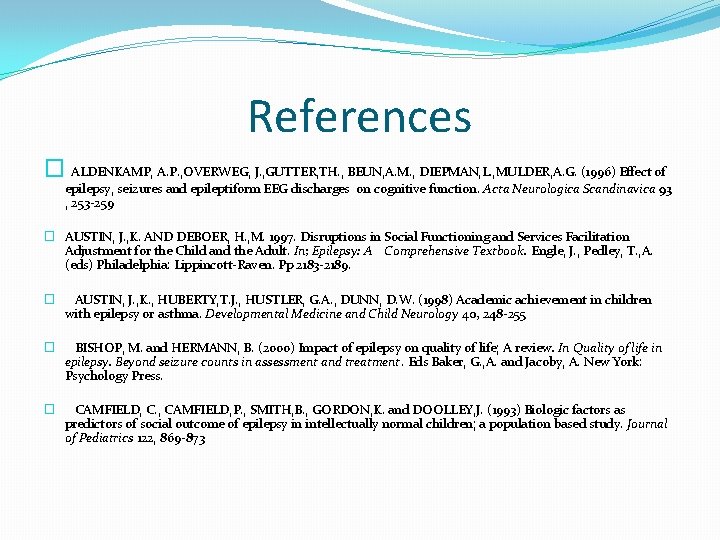
References � ALDENKAMP, A. P. , OVERWEG, J. , GUTTER, TH. , BEUN, A. M. , DIEPMAN, L. , MULDER, A. G. (1996) Effect of epilepsy, seizures and epileptiform EEG discharges on cognitive function. Acta Neurologica Scandinavica 93 , 253 -259 � AUSTIN, J. , K. AND DEBOER, H. , M. 1997. Disruptions in Social Functioning and Services Facilitation Adjustment for the Child and the Adult. In; Epilepsy: A Comprehensive Textbook. Engle, J. , Pedley, T. , A. (eds) Philadelphia: Lippincott-Raven. Pp 2183 -2189. � AUSTIN, J. , K. , HUBERTY, T. J. , HUSTLER, G. A. , DUNN, D. W. (1998) Academic achievement in children with epilepsy or asthma. Developmental Medicine and Child Neurology 40, 248 -255 � BISHOP, M. and HERMANN, B. (2000) Impact of epilepsy on quality of life; A review. In Quality of life in epilepsy. Beyond seizure counts in assessment and treatment. Eds Baker, G. , A. and Jacoby, A. New York: Psychology Press. � CAMFIELD, C. , CAMFIELD, P. , SMITH, B. , GORDON, K. and DOOLLEY, J. (1993) Biologic factors as predictors of social outcome of epilepsy in intellectually normal children; a population based study. Journal of Pediatrics 122, 869 -873
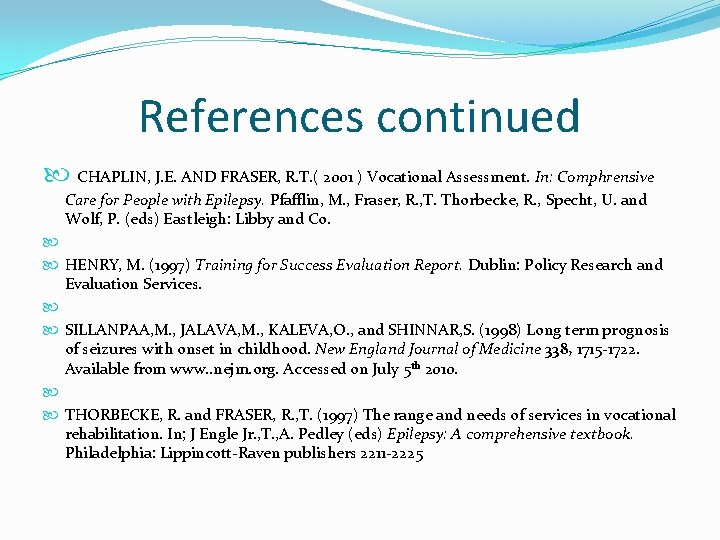
References continued CHAPLIN, J. E. AND FRASER, R. T. ( 2001 ) Vocational Assessment. In: Comphrensive Care for People with Epilepsy. Pfafflin, M. , Fraser, R. , T. Thorbecke, R. , Specht, U. and Wolf, P. (eds) Eastleigh: Libby and Co. HENRY, M. (1997) Training for Success Evaluation Report. Dublin: Policy Research and Evaluation Services. SILLANPAA, M. , JALAVA, M. , KALEVA, O. , and SHINNAR, S. (1998) Long term prognosis of seizures with onset in childhood. New England Journal of Medicine 338, 1715 -1722. Available from www. . nejm. org. Accessed on July 5 th 2010. THORBECKE, R. and FRASER, R. , T. (1997) The range and needs of services in vocational rehabilitation. In; J Engle Jr. , T. , A. Pedley (eds) Epilepsy: A comprehensive textbook. Philadelphia: Lippincott-Raven publishers 2211 -2225
Discussion Topics Should similar courses be developed in other countries for people with epilepsy? Do you think a course like this would work in your country?
- Slides: 20