
Training for Inactivated Poliovirus Vaccine IPV introduction Module
- Slides: 21
Training for Inactivated Poliovirus Vaccine (IPV) introduction Module 4 IPV vaccine administration
Learning objectives l At the end of the module, the participant will be able to: – Identify the necessary steps to assure good vaccine quality – Describe the method to administer the vaccine l Duration – 30 minutes 2| IPV vaccine administration | Module 4 – February 2015
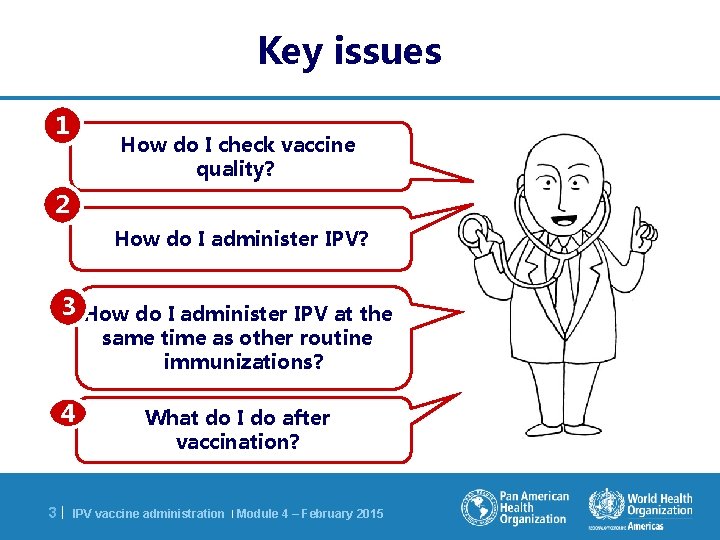
Key issues 1 How do I check vaccine quality? 2 How do I administer IPV? 3 How do I administer IPV at the same time as other routine immunizations? 4 3| What do I do after vaccination? IPV vaccine administration | Module 4 – February 2015
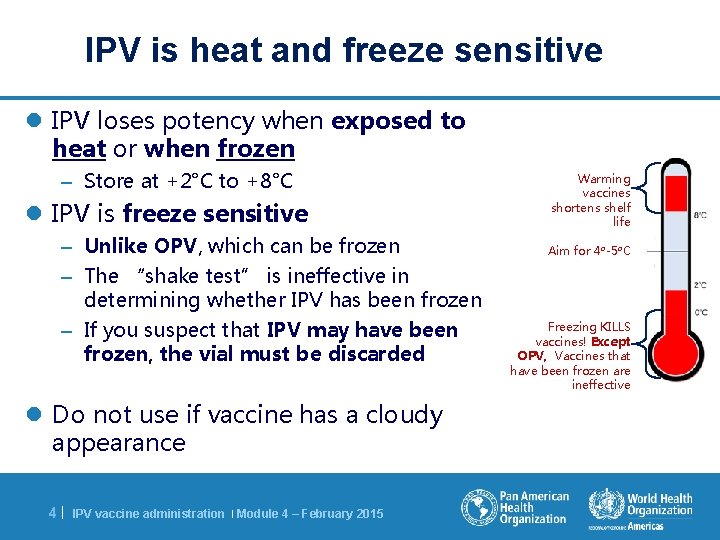
IPV is heat and freeze sensitive l IPV loses potency when exposed to heat or when frozen – Store at +2°C to +8°C l IPV is freeze sensitive – Unlike OPV, which can be frozen – The “shake test” is ineffective in determining whether IPV has been frozen – If you suspect that IPV may have been frozen, the vial must be discarded l Do not use if vaccine has a cloudy appearance 4| IPV vaccine administration | Module 4 – February 2015 Warming vaccines shortens shelf life Aim for 4⁰-5⁰C Freezing KILLS vaccines! Except OPV, Vaccines that have been frozen are ineffective
IPV has high heat sensitivity l IPV has increased susceptibility to heat than many existing heat sensitive vaccines l Proper temperature monitoring and stock management is required to avoid wasting IPV vials 5| IPV vaccine administration | Module 4 – February 2015
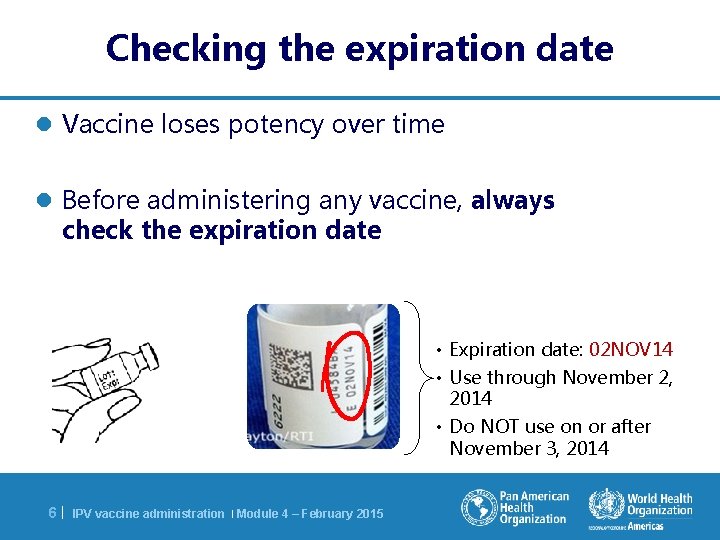
Checking the expiration date l Vaccine loses potency over time l Before administering any vaccine, always check the expiration date • Expiration date: 02 NOV 14 • Use through November 2, 2014 • Do NOT use on or after November 3, 2014 6| IPV vaccine administration | Module 4 – February 2015
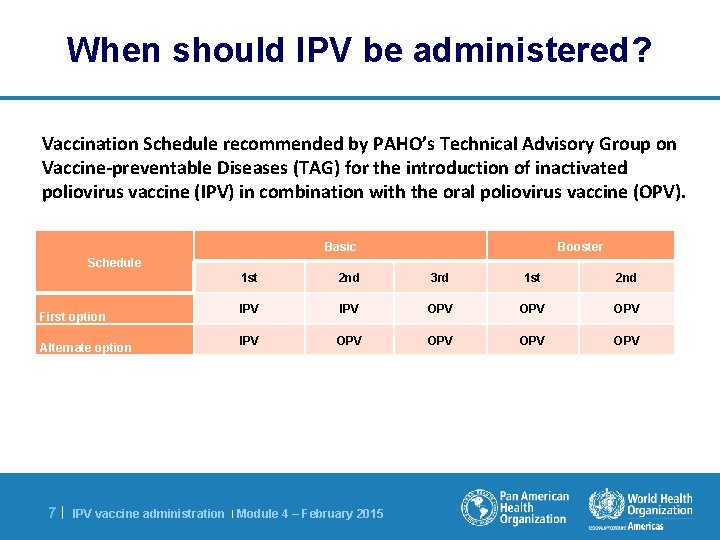
When should IPV be administered? Vaccination Schedule recommended by PAHO’s Technical Advisory Group on Vaccine-preventable Diseases (TAG) for the introduction of inactivated poliovirus vaccine (IPV) in combination with the oral poliovirus vaccine (OPV). Basic Booster Schedule First option Alternate option 7| 1 st 2 nd 3 rd 1 st 2 nd IPV OPV OPV IPV vaccine administration | Module 4 – February 2015
How to prepare for vaccination l IPV can be administered with any of the following routine childhood vaccines without interfering with their effectiveness: – Rotavirus vaccine – pentavalent vaccine (DTP, Haemophilus influenzae type b vaccine, Hepatitis B) – Pneumococcal vaccine l Never mix IPV with other vaccines in the same vial or syringe 8| IPV vaccine administration | Module 4 – February 2015
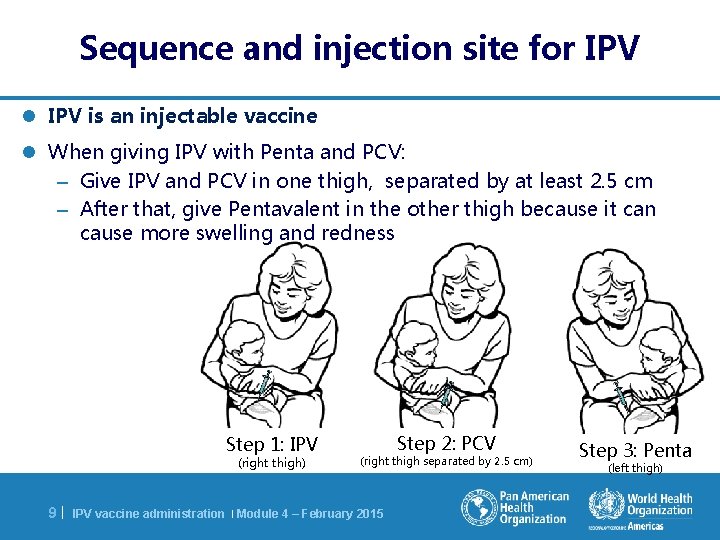
Sequence and injection site for IPV l IPV is an injectable vaccine l When giving IPV with Penta and PCV: – Give IPV and PCV in one thigh, separated by at least 2. 5 cm – After that, give Pentavalent in the other thigh because it can cause more swelling and redness Step 1: IPV (right thigh) 9| Step 2: PCV (right thigh separated by 2. 5 cm) IPV vaccine administration | Module 4 – February 2015 Step 3: Penta (left thigh)
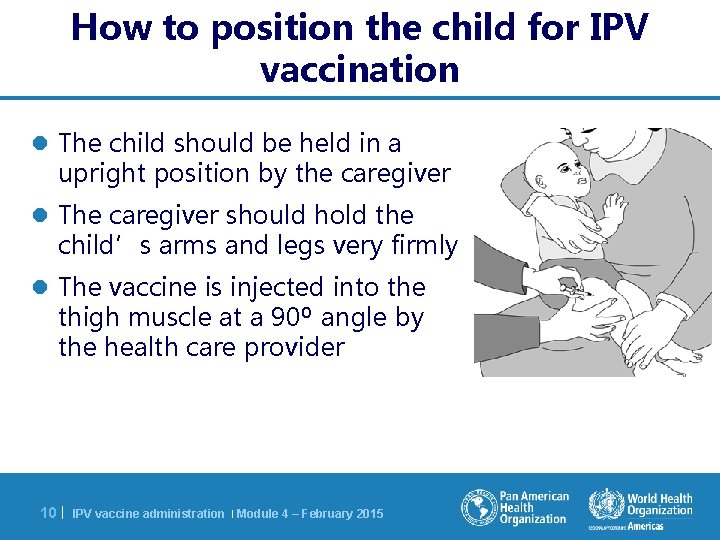
How to position the child for IPV vaccination l The child should be held in a upright position by the caregiver l The caregiver should hold the child’s arms and legs very firmly l The vaccine is injected into the thigh muscle at a 90⁰ angle by the health care provider 10 | IPV vaccine administration | Module 4 – February 2015
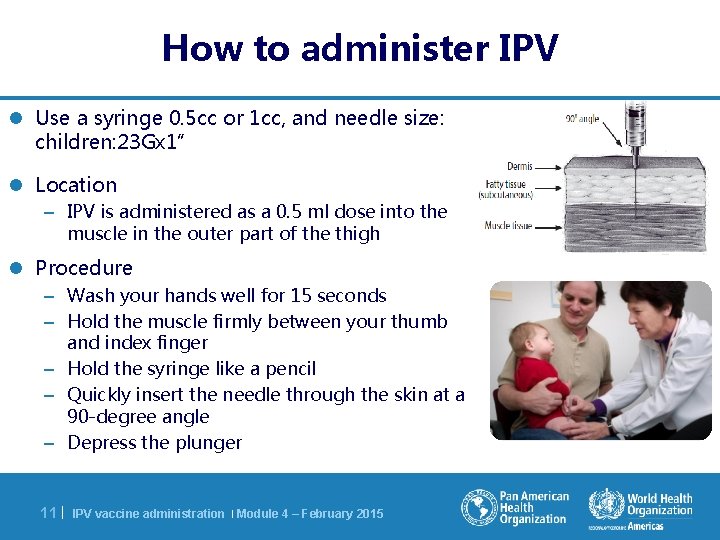
How to administer IPV l Use a syringe 0. 5 cc or 1 cc, and needle size: children: 23 Gx 1” l Location – IPV is administered as a 0. 5 ml dose into the muscle in the outer part of the thigh l Procedure – Wash your hands well for 15 seconds – Hold the muscle firmly between your thumb and index finger – Hold the syringe like a pencil – Quickly insert the needle through the skin at a 90 -degree angle – Depress the plunger 11 | IPV vaccine administration | Module 4 – February 2015
IPV multi-dose viales l IPV is prequalified and approved for use up to 28 days after opening, provided that the following WHO defined criteria are fully met: – The expiration date has not passed – The vial has been and continues to be stored at the recommended temperature – The vial has been protected from sunlight and freezing l If you suspect a vial has been frozen, it should be discarded immediately 12 | IPV vaccine administration | Module 4 – February 2015
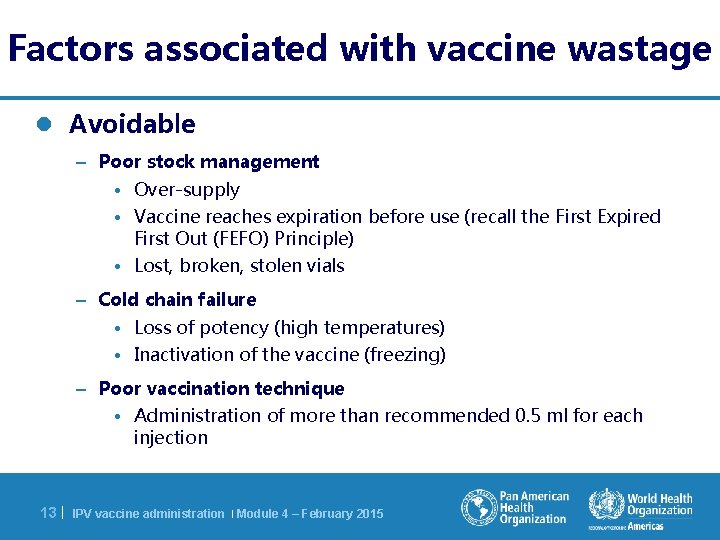
Factors associated with vaccine wastage l Avoidable – Poor stock management • Over-supply • Vaccine reaches expiration before use (recall the First Expired First Out (FEFO) Principle) • Lost, broken, stolen vials – Cold chain failure • Loss of potency (high temperatures) • Inactivation of the vaccine (freezing) – Poor vaccination technique • Administration of more than recommended 0. 5 ml for each injection 13 | IPV vaccine administration | Module 4 – February 2015
Concerns about wastage should not stop you from vaccinating a child l Wastage rates will vary by facility, and should be monitored l Do not let concerns about opening a vial for only one child stop you from offering the vaccine to a child 14 | IPV vaccine administration | Module 4 – February 2015
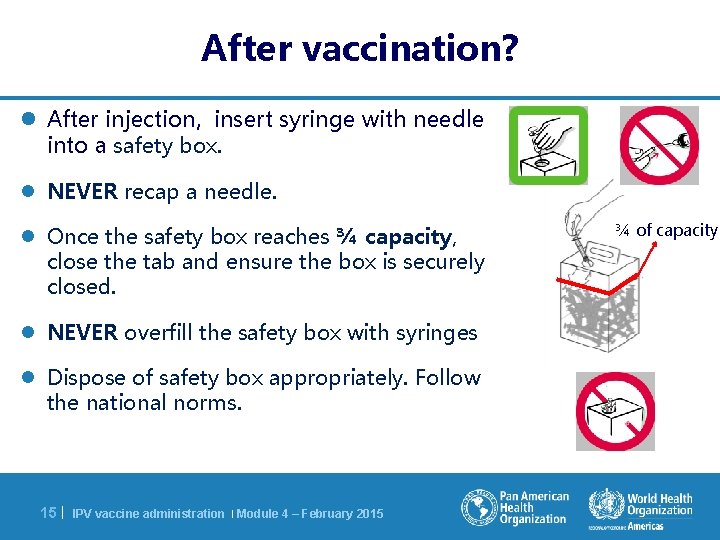
After vaccination? l After injection, insert syringe with needle into a safety box. l NEVER recap a needle. l Once the safety box reaches ¾ capacity, close the tab and ensure the box is securely closed. l NEVER overfill the safety box with syringes l Dispose of safety box appropriately. Follow the national norms. 15 | IPV vaccine administration | Module 4 – February 2015 ¾ of capacity
What should you do in this scenario? What are some ways to reduce pain when giving an injection? 16 | IPV vaccine administration | Module 4 – February 2015
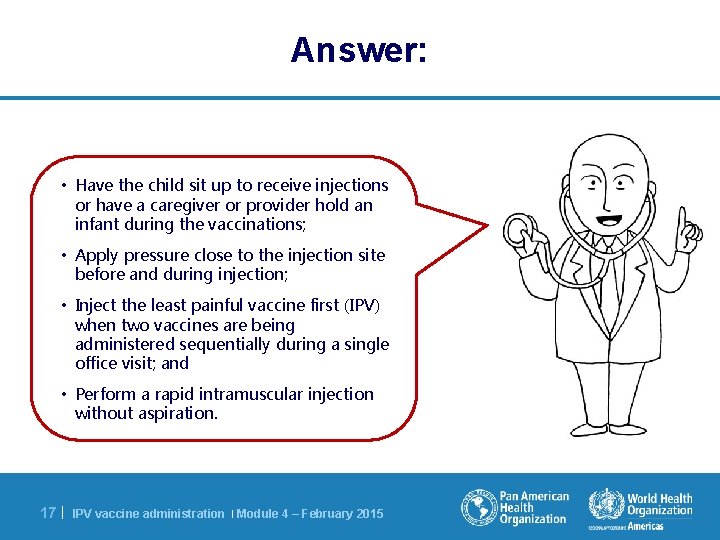
Answer: • Have the child sit up to receive injections or have a caregiver or provider hold an infant during the vaccinations; • Apply pressure close to the injection site before and during injection; • Inject the least painful vaccine first (IPV) when two vaccines are being administered sequentially during a single office visit; and • Perform a rapid intramuscular injection without aspiration. 17 | IPV vaccine administration | Module 4 – February 2015
What should you do in this scenario? The child is 2 months old. You give him/her Rota, IPV, PCV and pentavalent vaccines. In which order should you give the vaccines? 18 | IPV vaccine administration | Module 4 – February 2015
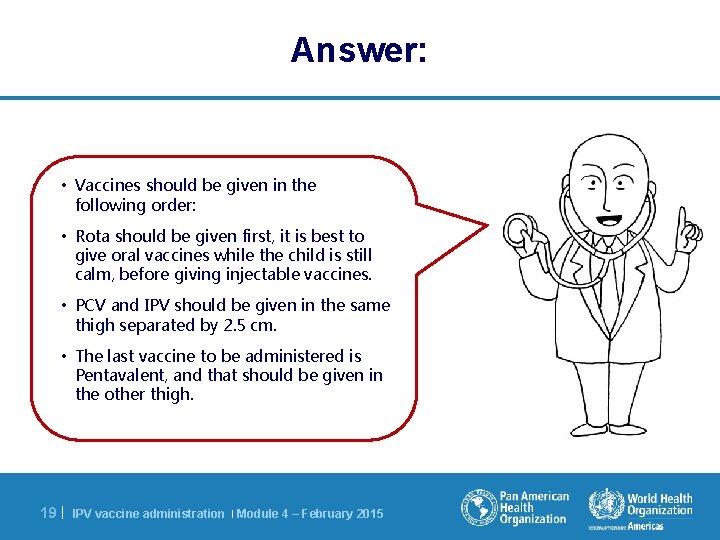
Answer: • Vaccines should be given in the following order: • Rota should be given first, it is best to give oral vaccines while the child is still calm, before giving injectable vaccines. • PCV and IPV should be given in the same thigh separated by 2. 5 cm. • The last vaccine to be administered is Pentavalent, and that should be given in the other thigh. 19 | IPV vaccine administration | Module 4 – February 2015
Key messages l IPV is prepared and administered similarly to other intramuscular injections – Prepare and dispose of IPV as you do other injectable vaccines l Have the caregiver comfortably hold the child upright while inserting the needle into the thigh muscle at a 90⁰ angle l Administer IPV and PCV in one thigh at least 2. 5 cm apart and Pentavalent in the other thigh 20 | IPV vaccine administration | Module 4 – February 2015
End of module Thank you for your attention! 21 | IPV vaccine administration | Module 4 – February 2015