
Training Development Creating an Empowered Learning Culture CHUCK
- Slides: 35
Training & Development: Creating an Empowered Learning Culture CHUCK OLSSON CHIEF HUMAN RESOURCES OFFICER FIRST UNITED BANK & TRUST
Question: Why Does Training Fail?
Question: What is Empowerment?
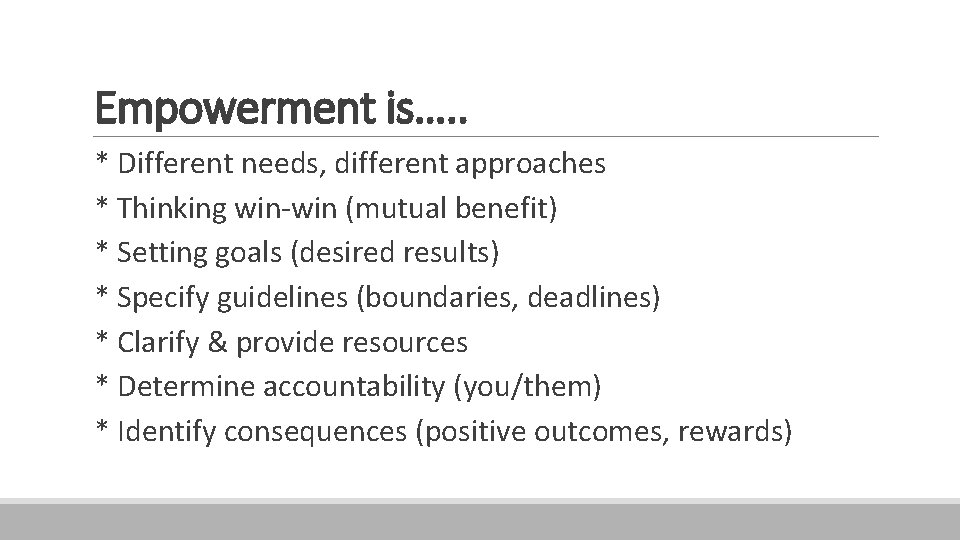
Empowerment is…. . * Different needs, different approaches * Thinking win-win (mutual benefit) * Setting goals (desired results) * Specify guidelines (boundaries, deadlines) * Clarify & provide resources * Determine accountability (you/them) * Identify consequences (positive outcomes, rewards)
Empowerment is not…. - Controlling - Abandonment
Empowered Learning Model Learning and performance improvement lies with individuals. No one can force another to learn; however, we can cultivate an environment where people can exercise their unique human capacities to learn, grow and change…. . the word “empowered” reflects this reality.
A Strategic Vision… The Competitive Advantage “We live in a time of great change and opportunity; where visionary leaders and businesses who advantage themselves in this moment, will propel their organizations to the highest levels of their mission and goals. To do so will require new thinking about how employee cultures are developed and leveraged to create a competitive advantage. ”
First United Bank & Trust Strategic Objectives: “Be the employer of choice for a customeroriented, cross-trained, multifunctional staff” “Create an environment that supports employee enablement”
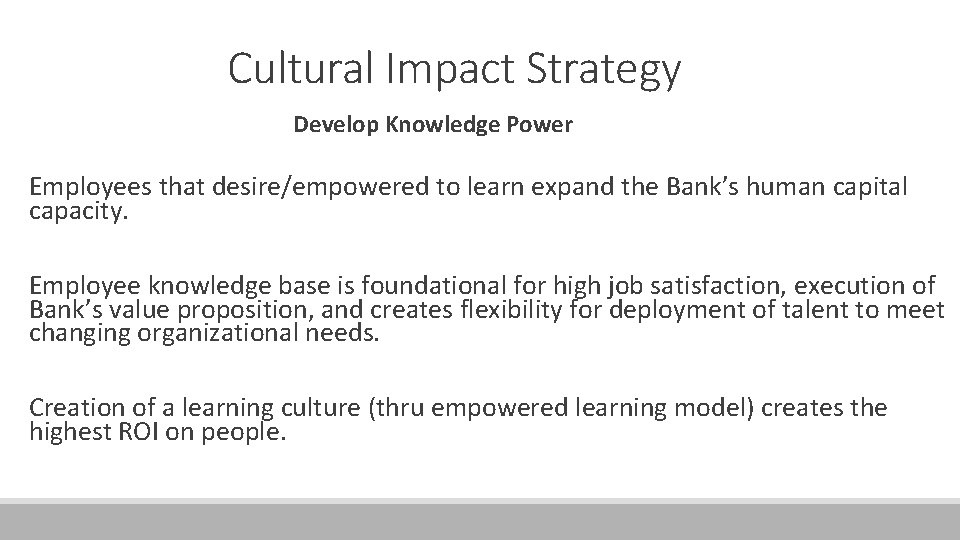
Cultural Impact Strategy Develop Knowledge Power Employees that desire/empowered to learn expand the Bank’s human capital capacity. Employee knowledge base is foundational for high job satisfaction, execution of Bank’s value proposition, and creates flexibility for deployment of talent to meet changing organizational needs. Creation of a learning culture (thru empowered learning model) creates the highest ROI on people.
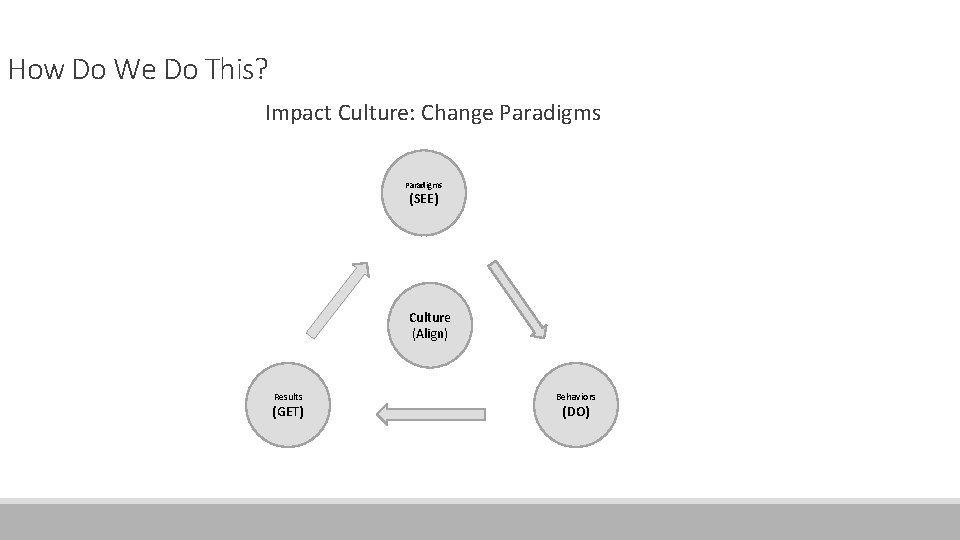
How Do We Do This? Impact Culture: Change Paradigms (SEE) Culture (Align) Results (GET) Behaviors (DO)
Learning Culture Formation: Required Leadership Paradigms 100% employee participation: your either a learner or a teacher.
Learning Culture Formation: Required Leadership Paradigms Employees do not have the necessary skills to be successful and need continuous training.
Learning Culture Formation: Required Leadership Paradigms Managers are responsible for coaching and reinforcing training, and are incented to do so.
Learning Culture Formation: Required Leadership Paradigms Employees are responsible and accountable for assessing their knowledge, skills and abilities; and are required to initiate personal development plans and take actions to achieve development goals.
Learning Culture Formation: Required Leadership Paradigms Employees who are continually trained and apply learnings perform at the highest levels, have high job satisfaction and retention.
Tactical Plan: Hire “Learners” - Change interview/selection process - High learner = high performers - High performers require empowered learning; effective at self-assessment/correcting, thirst for knowledge, desire coaching & feedback for advancement - Needs of Millennial's (quick learners, impatient, curious, questions the “why”)
Tactical Plan: Training & Development -Create a “company-owned” training & development structure. - Model a corporate-university structure; the development and administration roles of an empowered learning system are similar to higher education systems.
University Trustees = Executive Mgmt Executive management is responsible for determining general areas of development and skill-sets required to drive and achieve strategic goals. They direct the University Chancellor (HR) in setting training priorities and assessing results (ROI) on an annual basis.
University Chancellor = HR Director is responsible for setting annual training objectives. Ensures the training system is effective in meeting demand. Works with University Deans (senior managers) in creation of tactical implementation plans for specific areas of development (schools of learning).
University Deans = Senior Managers Senior managers organize training into strategic areas of development that house specific training and certification programs. Deans work with HR/Training to create specific courses & learning content, set eligibility criteria, evaluate effectiveness and manage the learning reinforcement process.
University Professors = Subject Matter Experts (SME’s) SME’s within the company, trained in learning facilitation techniques, provide the most value for instructor lead training. External trainers and vendors are contracted with objective to train-the-trainer; providing better content customization and application.
University Advisor = Department Managers Department managers are responsible for supporting the creation of individual development plans (IDP’s). Assessing applicability of training programs and scheduling. Establishing pre-training learning objectives and providing feedback on post-training application.
University Administration = Learning & Development Director Under the leadership of the Learning Director, training departments are responsible for development of all courses & content, delivery and learning method, program administration (learning management system), and effectiveness evaluation & reporting.
Training Design & Learning Methodology Adults are not very good learners - “hard-wired” by experience - short attention span, limited absorption abilities - require experiential, interactive learning opportunities Blended learning methods are the most effective means to support adult learning
Tactical Plan: Blended Learning Design - On demand learning (web/technology based) - Self-paced (web/technology based) - Chunking (multiple short learning periods over time) - Instructor lead through facilitated learning agendas - Mentoring & coaching - Reading - Formal development programs (placement, advancement) - External training & conferences (to augment internal training)
Empowered Learning & Reinforcement Retention and application of learning will not take place without a structured reinforcement process - Employees - Managers - Mentors - Measurements
Empowered Learning & Reinforcement Employees are responsible: - Creating personal development plans (IDP’s) with their manager. - Self assess and determine specific learning objectives prior to training. - Post-training requirement to teach others (3 -person teaching within 48 hours).
Tactical Plan: Implement IDP’s Basic IDP Design: - Areas of Strength - Areas of Learning Development - Action Plan: Learning Activities & Opportunities - Mentors: Identify Mentors and/or Learning Partners - Results of Development Plan
Tactical Plan: Required 3 -Person Teaching FIRST PERSON: someone who shares knowledge with a second person. SECOND PERSON: teaches the new knowledge to a third person thru capture (understanding basic content), expand (analyze & add personal experience), and apply (examples of application). THRID PERSON: receives added-value knowledge. People learn better if they are preparing to teach someone else
Empowered Learning & Reinforcement Managers are responsible: - Providing continuous feedback and coaching. - Setting training learning objectives with the employee. - Creating opportunities to apply learning to the employee’s job.
Empowered Learning & Reinforcement Formal learning mentors are trained and positioned throughout the company, and are rewarded for assuming this role.
Tactical Plan: Formal Mentors & Learning Partners - Focused concentration and immersion in a learning experience. - A shared context that facilitates implementation and performance improvement. - Creation of ongoing learning relationships. - A safe place to practice new behaviors. - Exposure to other perspectives and active dialog - Inspiration, motivation and vision to change behaviors. Learning is an inherently social activity
Empowered Learning & Reinforcement Performance Measurement: quantitative & qualitative data is required to determine training effectiveness
Tactical Plan: Training Measurement - Program test scores and means - Training effectiveness surveys (level 1 -3) - ROI (level 4) - Internal transfers & promotions - Employee performance evaluation - Development/certification program participation
Empowered Learning Culture - Hire learners - Company-owned training & development structure - Blended learning design - Implement IDP’s - Require 3 -person teaching - Formal mentors & learning partners - Measure results