
TRAINING COURSE ON NEUTRON DOSIMETRY RADIOBIOLOGY AND INSTRUMENTATION
TRAINING COURSE ON NEUTRON DOSIMETRY, RADIOBIOLOGY AND INSTRUMENTATION: Passive detectors: activation detectors and superheated emulsions Stefano AGOSTEO, POLIMI Wed. 24/6/2015, 17: 00 – 18: 00 pm 2 r e b 1 20 , m 20 ve o N 1
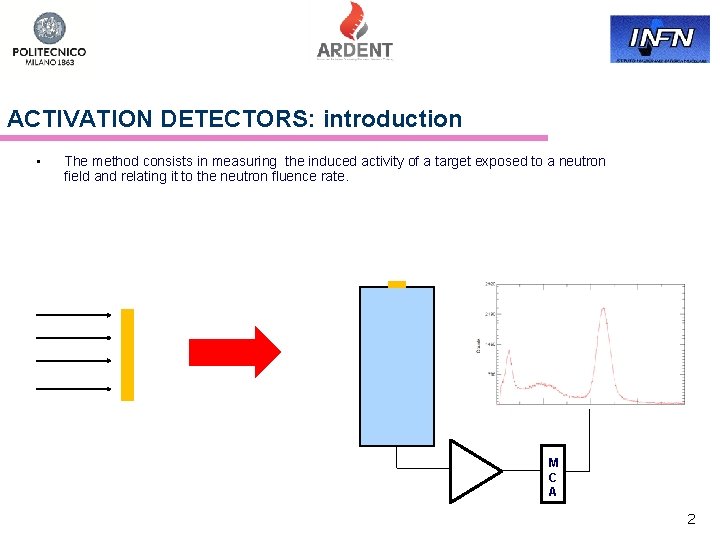
ACTIVATION DETECTORS: introduction • The method consists in measuring the induced activity of a target exposed to a neutron field and relating it to the neutron fluence rate. M C A 2
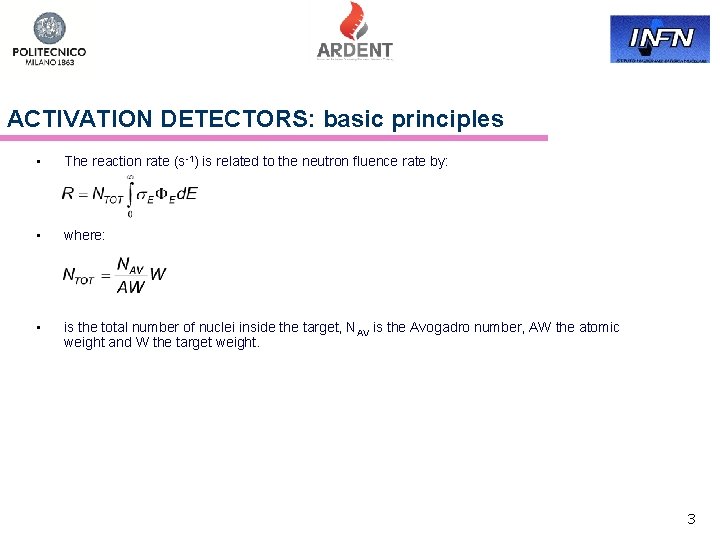
ACTIVATION DETECTORS: basic principles • The reaction rate (s-1) is related to the neutron fluence rate by: • where: • is the total number of nuclei inside the target, NAV is the Avogadro number, AW the atomic weight and W the target weight. 3
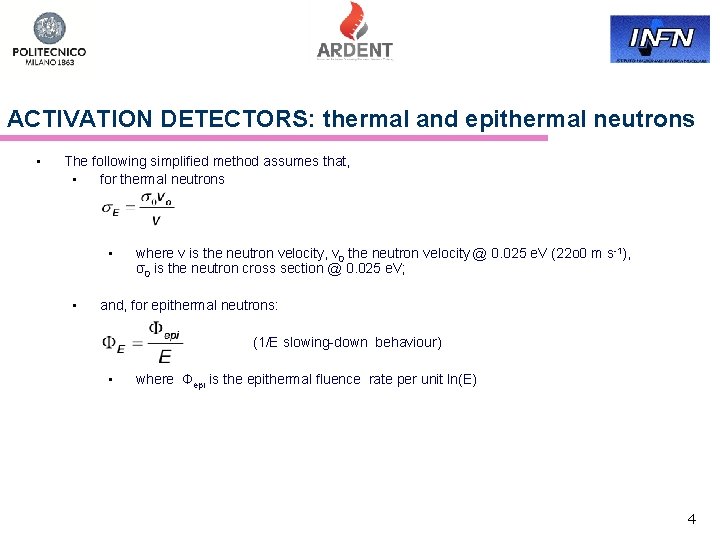
ACTIVATION DETECTORS: thermal and epithermal neutrons • The following simplified method assumes that, • for thermal neutrons • • where v is the neutron velocity, v 0 the neutron velocity @ 0. 025 e. V (22 o 0 m s-1), σ0 is the neutron cross section @ 0. 025 e. V; and, for epithermal neutrons: (1/E slowing-down behaviour) • where Φepi is the epithermal fluence rate per unit ln(E) 4
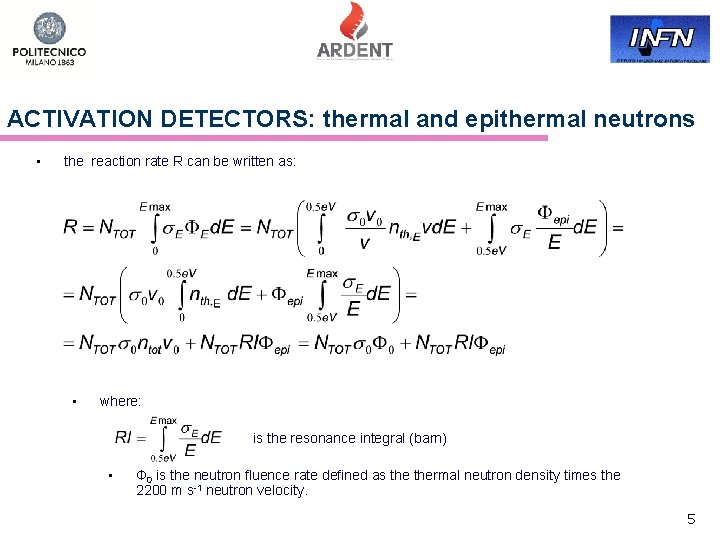
ACTIVATION DETECTORS: thermal and epithermal neutrons • the reaction rate R can be written as: • where: is the resonance integral (barn) • Φ 0 is the neutron fluence rate defined as thermal neutron density times the 2200 m s-1 neutron velocity. 5
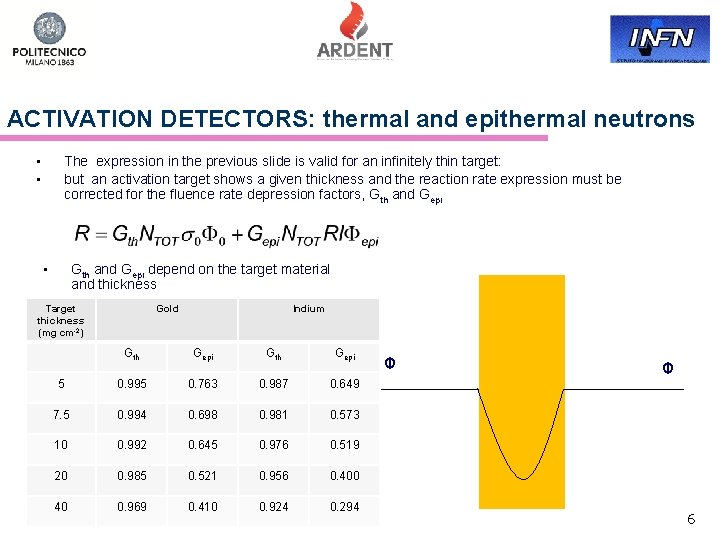
ACTIVATION DETECTORS: thermal and epithermal neutrons The expression in the previous slide is valid for an infinitely thin target: but an activation target shows a given thickness and the reaction rate expression must be corrected for the fluence rate depression factors, Gth and Gepi • • Gth and Gepi depend on the target material and thickness • Target thickness (mg cm-2) Gold Indium Gth Gepi 5 0. 995 0. 763 0. 987 0. 649 7. 5 0. 994 0. 698 0. 981 0. 573 10 0. 992 0. 645 0. 976 0. 519 20 0. 985 0. 521 0. 956 0. 400 40 0. 969 0. 410 0. 924 0. 294 Φ Φ 6
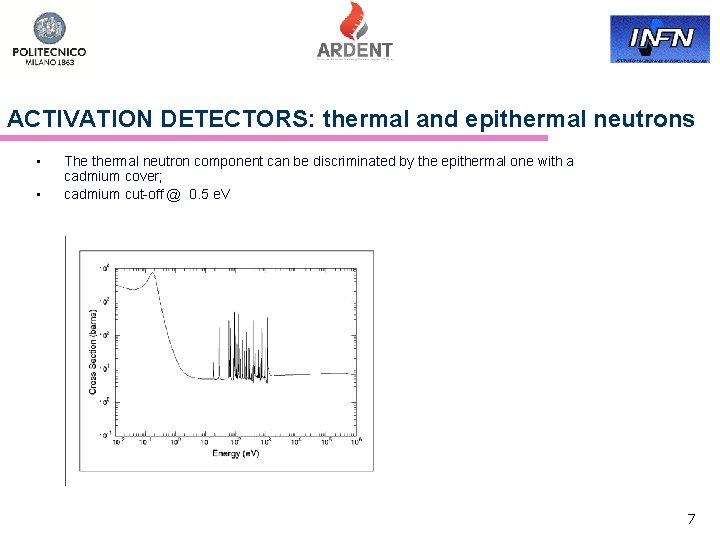
ACTIVATION DETECTORS: thermal and epithermal neutrons • • The thermal neutron component can be discriminated by the epithermal one with a cadmium cover; cadmium cut-off @ 0. 5 e. V 7
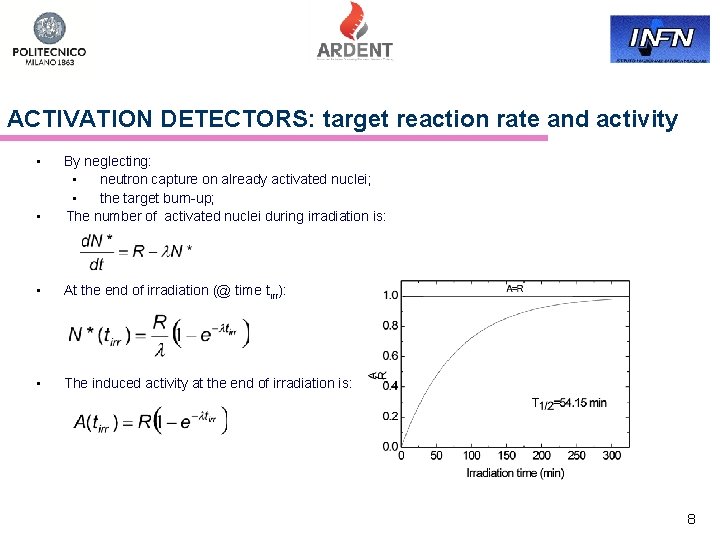
ACTIVATION DETECTORS: target reaction rate and activity • By neglecting: • neutron capture on already activated nuclei; • the target burn-up; The number of activated nuclei during irradiation is: • At the end of irradiation (@ time tirr): • The induced activity at the end of irradiation is: • 8
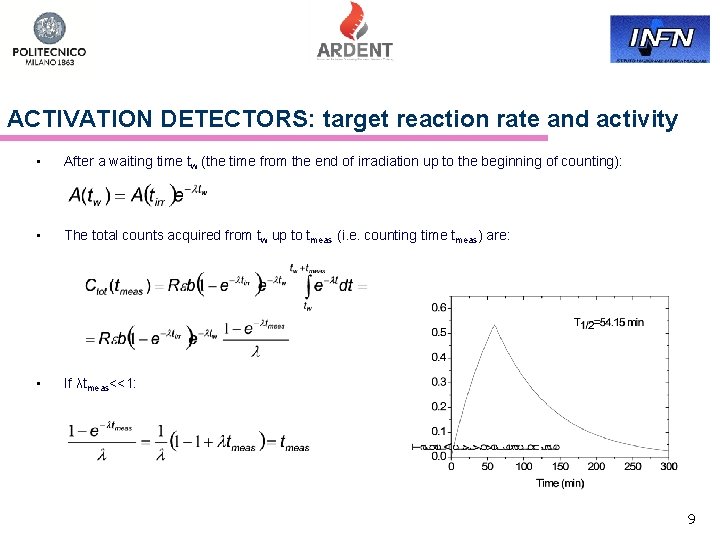
ACTIVATION DETECTORS: target reaction rate and activity • After a waiting time tw (the time from the end of irradiation up to the beginning of counting): • The total counts acquired from tw up to tmeas (i. e. counting time tmeas) are: • If λtmeas<<1: 9
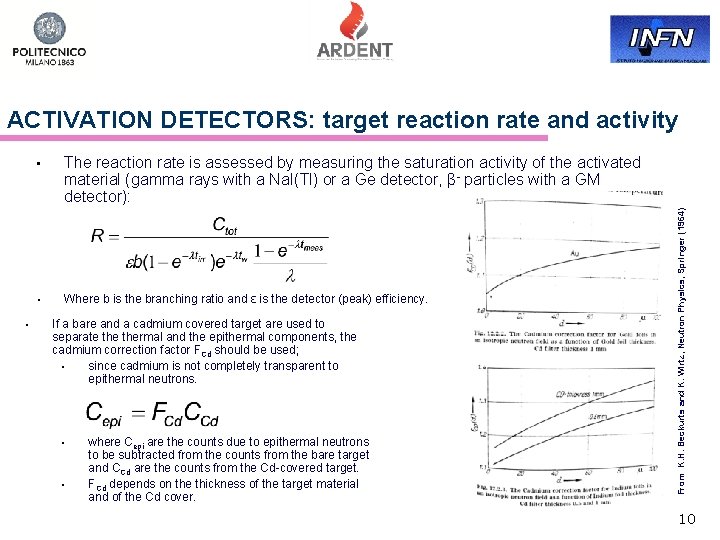
• • The reaction rate is assessed by measuring the saturation activity of the activated material (gamma rays with a Na. I(Tl) or a Ge detector, β- particles with a GM detector): • Where b is the branching ratio and ε is the detector (peak) efficiency. If a bare and a cadmium covered target are used to separate thermal and the epithermal components, the cadmium correction factor FCd should be used; • since cadmium is not completely transparent to epithermal neutrons. • • where Cepi are the counts due to epithermal neutrons to be subtracted from the counts from the bare target and CCd are the counts from the Cd-covered target. FCd depends on the thickness of the target material and of the Cd cover. From K. H. Beckurts and K. Wirtz, Neutron Physics, Springer (1964) ACTIVATION DETECTORS: target reaction rate and activity 10
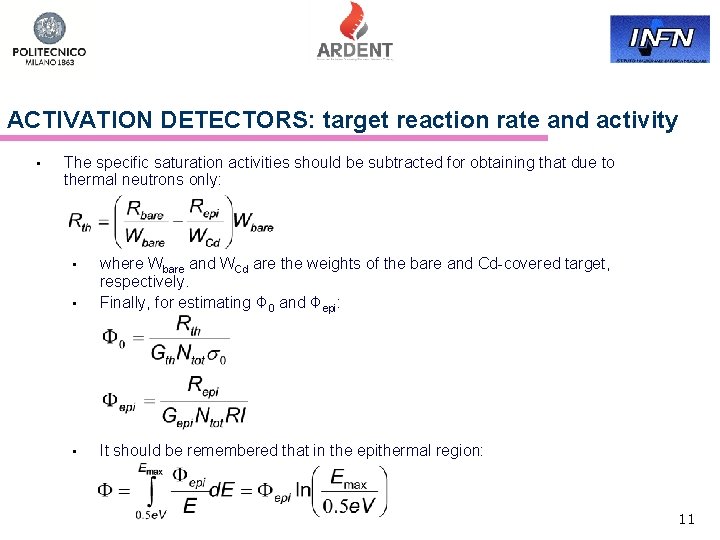
ACTIVATION DETECTORS: target reaction rate and activity • The specific saturation activities should be subtracted for obtaining that due to thermal neutrons only: • where Wbare and WCd are the weights of the bare and Cd-covered target, respectively. Finally, for estimating Φ 0 and Φepi: • It should be remembered that in the epithermal region: • 11
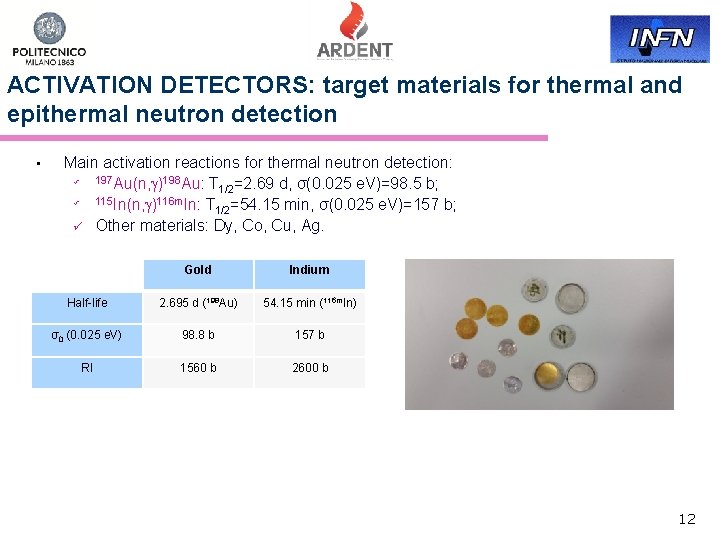
ACTIVATION DETECTORS: target materials for thermal and epithermal neutron detection • Main activation reactions for thermal neutron detection: 197 Au(n, )198 Au: T =2. 69 d, σ(0. 025 e. V)=98. 5 b; ü 1/2 115 In(n, )116 m. In: T =54. 15 min, σ(0. 025 e. V)=157 b; ü 1/2 ü Other materials: Dy, Co, Cu, Ag. Gold Indium Half-life 2. 695 d (198 Au) 54. 15 min (116 m. In) σ0 (0. 025 e. V) 98. 8 b 157 b RI 1560 b 2600 b 12
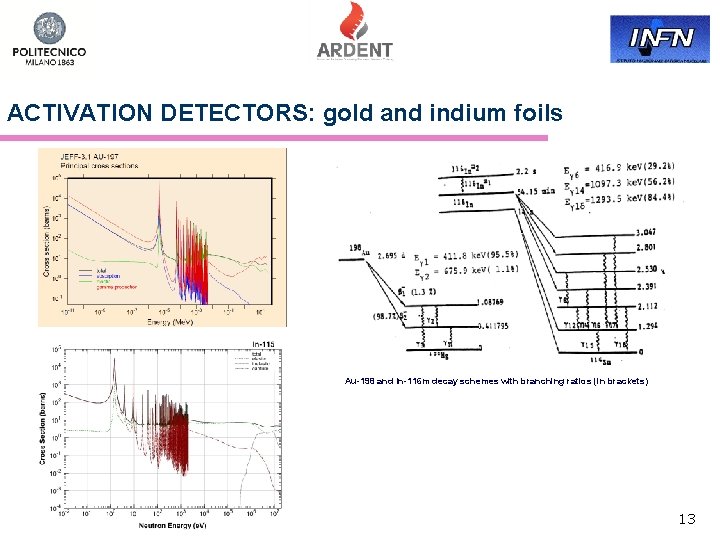
ACTIVATION DETECTORS: gold and indium foils Au-198 and In-116 m decay schemes with branching ratios (in brackets) 13
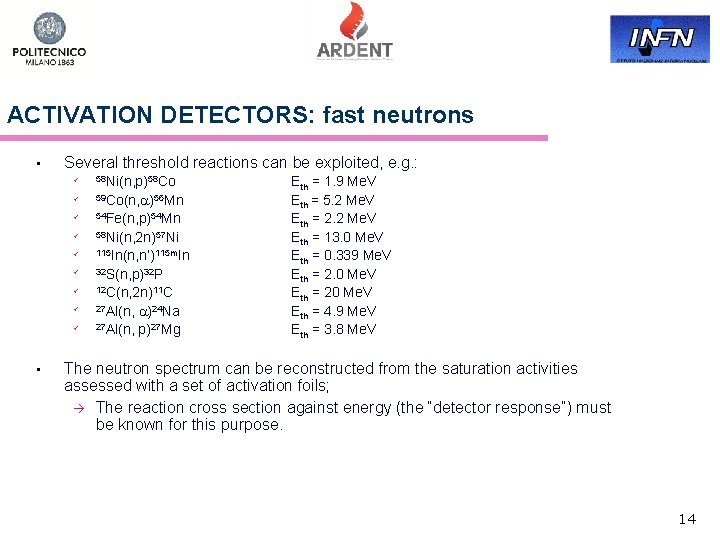
ACTIVATION DETECTORS: fast neutrons • • Several threshold reactions can be exploited, e. g. : ü 58 Ni(n, p)58 Co ü 59 Co(n, )56 Mn ü 54 Fe(n, p)54 Mn ü 58 Ni(n, 2 n)57 Ni ü 115 In(n, n’)115 m. In ü 32 S(n, p)32 P ü 12 C(n, 2 n)11 C ü 27 Al(n, )24 Na ü 27 Al(n, p)27 Mg Eth = 1. 9 Me. V Eth = 5. 2 Me. V Eth = 2. 2 Me. V Eth = 13. 0 Me. V Eth = 0. 339 Me. V Eth = 2. 0 Me. V Eth = 20 Me. V Eth = 4. 9 Me. V Eth = 3. 8 Me. V The neutron spectrum can be reconstructed from the saturation activities assessed with a set of activation foils; à The reaction cross section against energy (the “detector response”) must be known for this purpose. 14
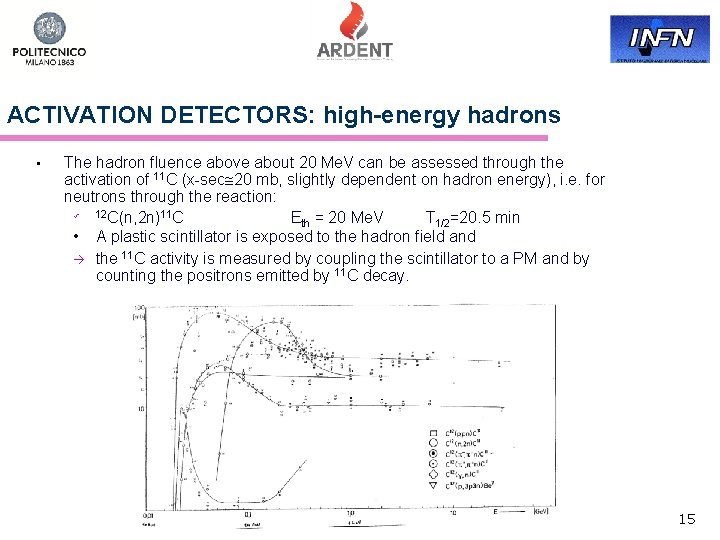
ACTIVATION DETECTORS: high-energy hadrons • The hadron fluence above about 20 Me. V can be assessed through the activation of 11 C (x-sec 20 mb, slightly dependent on hadron energy), i. e. for neutrons through the reaction: 12 C(n, 2 n)11 C ü Eth = 20 Me. V T 1/2=20. 5 min • A plastic scintillator is exposed to the hadron field and à the 11 C activity is measured by coupling the scintillator to a PM and by counting the positrons emitted by 11 C decay. 15
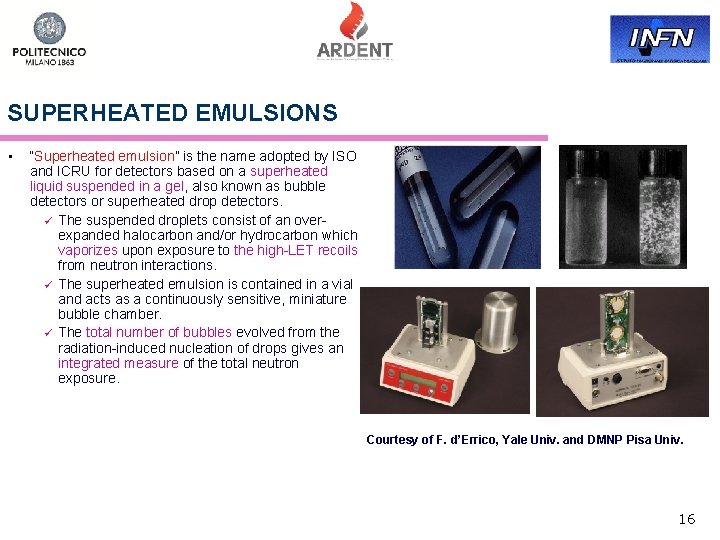
SUPERHEATED EMULSIONS • “Superheated emulsion” is the name adopted by ISO and ICRU for detectors based on a superheated liquid suspended in a gel, also known as bubble detectors or superheated drop detectors. ü The suspended droplets consist of an overexpanded halocarbon and/or hydrocarbon which vaporizes upon exposure to the high-LET recoils from neutron interactions. ü The superheated emulsion is contained in a vial and acts as a continuously sensitive, miniature bubble chamber. ü The total number of bubbles evolved from the radiation-induced nucleation of drops gives an integrated measure of the total neutron exposure. Courtesy of F. d’Errico, Yale Univ. and DMNP Pisa Univ. 16
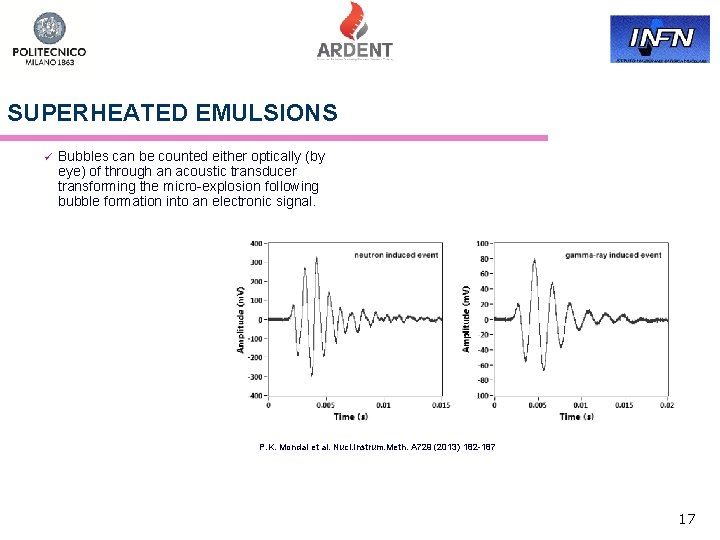
SUPERHEATED EMULSIONS ü Bubbles can be counted either optically (by eye) of through an acoustic transducer transforming the micro-explosion following bubble formation into an electronic signal. P. K. Mondal et al. Nucl. Instrum. Meth. A 729 (2013) 182 -187 17
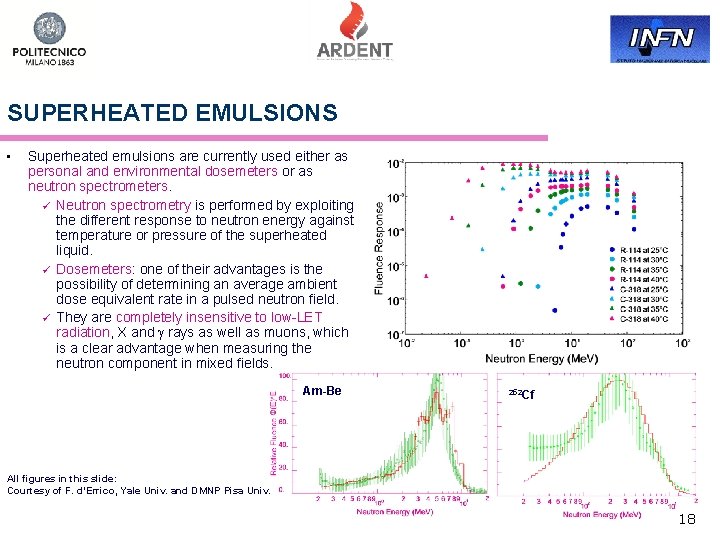
SUPERHEATED EMULSIONS • Superheated emulsions are currently used either as personal and environmental dosemeters or as neutron spectrometers. ü Neutron spectrometry is performed by exploiting the different response to neutron energy against temperature or pressure of the superheated liquid. ü Dosemeters: one of their advantages is the possibility of determining an average ambient dose equivalent rate in a pulsed neutron field. ü They are completely insensitive to low-LET radiation, X and rays as well as muons, which is a clear advantage when measuring the neutron component in mixed fields. Am-Be 252 Cf All figures in this slide: Courtesy of F. d’Errico, Yale Univ. and DMNP Pisa Univ. 18
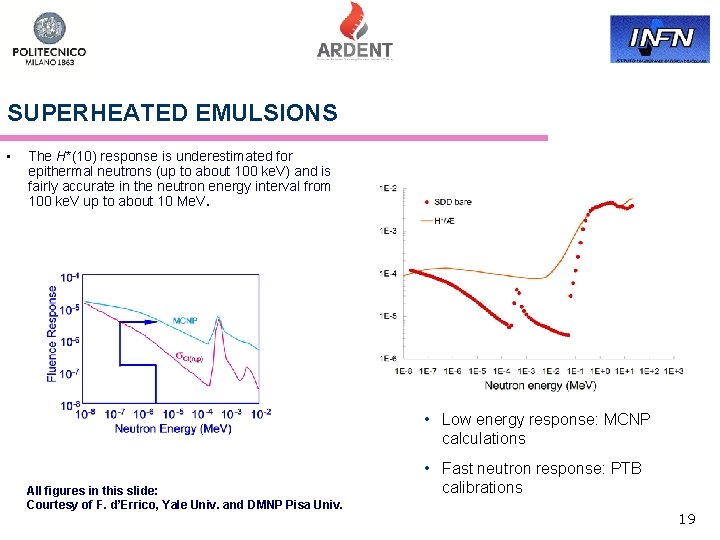
SUPERHEATED EMULSIONS • The H*(10) response is underestimated for epithermal neutrons (up to about 100 ke. V) and is fairly accurate in the neutron energy interval from 100 ke. V up to about 10 Me. V. • Low energy response: MCNP calculations All figures in this slide: Courtesy of F. d’Errico, Yale Univ. and DMNP Pisa Univ. • Fast neutron response: PTB calibrations 19
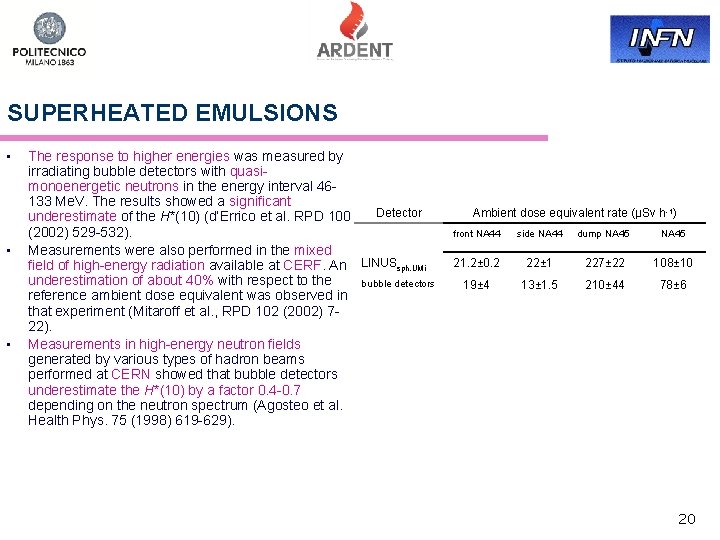
SUPERHEATED EMULSIONS • • • The response to higher energies was measured by irradiating bubble detectors with quasimonoenergetic neutrons in the energy interval 46133 Me. V. The results showed a significant Detector underestimate of the H*(10) (d’Errico et al. RPD 100 (2002) 529 -532). Measurements were also performed in the mixed field of high-energy radiation available at CERF. An LINUSsph, UMi underestimation of about 40% with respect to the bubble detectors reference ambient dose equivalent was observed in that experiment (Mitaroff et al. , RPD 102 (2002) 722). Measurements in high-energy neutron fields generated by various types of hadron beams performed at CERN showed that bubble detectors underestimate the H*(10) by a factor 0. 4 -0. 7 depending on the neutron spectrum (Agosteo et al. Health Phys. 75 (1998) 619 -629). Ambient dose equivalent rate (µSv h-1) front NA 44 side NA 44 dump NA 45 21. 2± 0. 2 22± 1 227± 22 108± 10 19± 4 13± 1. 5 210± 44 78± 6 20
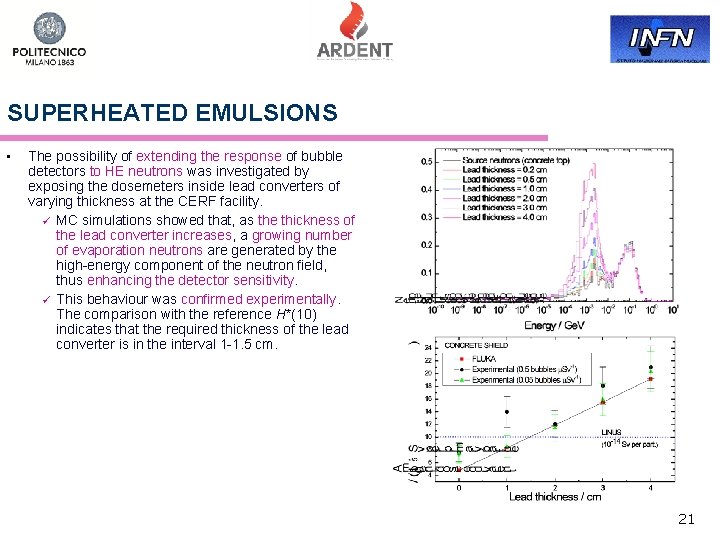
SUPERHEATED EMULSIONS • The possibility of extending the response of bubble detectors to HE neutrons was investigated by exposing the dosemeters inside lead converters of varying thickness at the CERF facility. ü MC simulations showed that, as the thickness of the lead converter increases, a growing number of evaporation neutrons are generated by the high-energy component of the neutron field, thus enhancing the detector sensitivity. ü This behaviour was confirmed experimentally. The comparison with the reference H*(10) indicates that the required thickness of the lead converter is in the interval 1 -1. 5 cm. 21
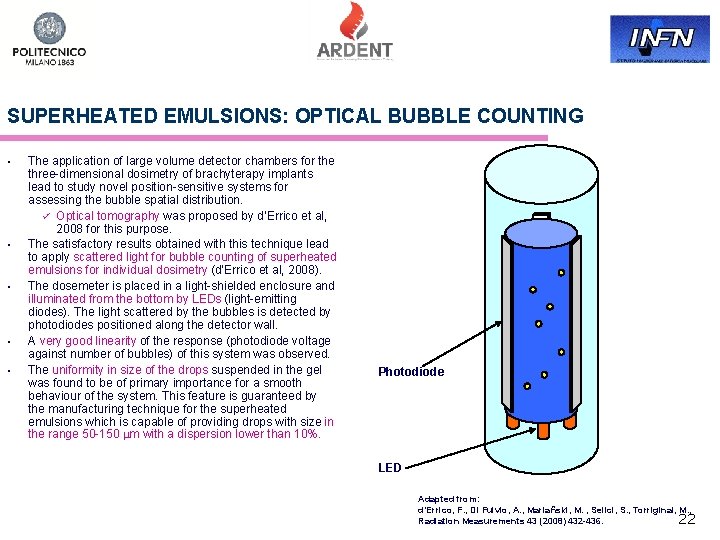
SUPERHEATED EMULSIONS: OPTICAL BUBBLE COUNTING • • • The application of large volume detector chambers for the three-dimensional dosimetry of brachyterapy implants lead to study novel position-sensitive systems for assessing the bubble spatial distribution. ü Optical tomography was proposed by d’Errico et al, 2008 for this purpose. The satisfactory results obtained with this technique lead to apply scattered light for bubble counting of superheated emulsions for individual dosimetry (d’Errico et al, 2008). The dosemeter is placed in a light-shielded enclosure and illuminated from the bottom by LEDs (light-emitting diodes). The light scattered by the bubbles is detected by photodiodes positioned along the detector wall. A very good linearity of the response (photodiode voltage against number of bubbles) of this system was observed. The uniformity in size of the drops suspended in the gel was found to be of primary importance for a smooth behaviour of the system. This feature is guaranteed by the manufacturing technique for the superheated emulsions which is capable of providing drops with size in the range 50 -150 m with a dispersion lower than 10%. Photodiode LED Adapted from: d’Errico, F. , Di Fulvio, A. , Mariañski, M. , Selici, S. , Torriginai, M. , Radiation Measurements 43 (2008) 432 -436. 22
- Slides: 22