
Training Assessing Training Needs Management objectives products customers
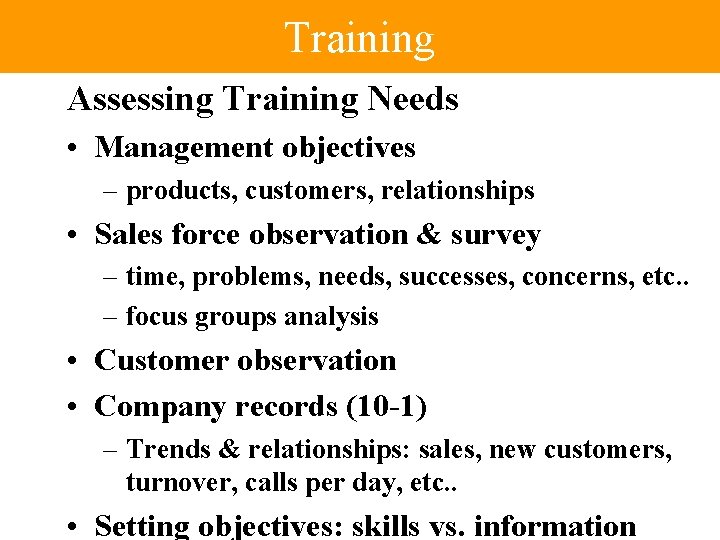
Training Assessing Training Needs • Management objectives – products, customers, relationships • Sales force observation & survey – time, problems, needs, successes, concerns, etc. . – focus groups analysis • Customer observation • Company records (10 -1) – Trends & relationships: sales, new customers, turnover, calls per day, etc. . • Setting objectives: skills vs. information
Training Assessing Training Needs • What other companies do (10 -2 & 3) • Steps in performing training analysis (10 -4)

Training Evaluating Sales Training Level One: Reactions Are trainees satisfied? This also provides information so that the parts they don’t like can be improved. Level Two: Learning Did the training change attitudes, increase knowledge, or improve the skills of the trainees? This usually requires testing before and after the training.
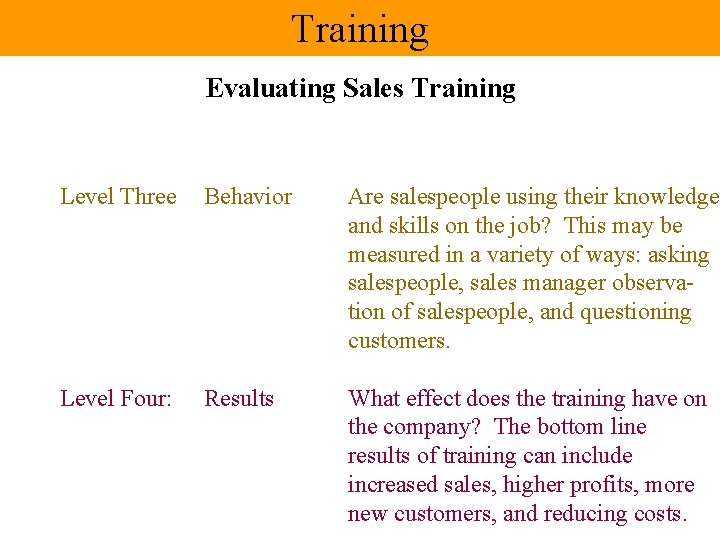
Training Evaluating Sales Training Level Three Behavior Are salespeople using their knowledge and skills on the job? This may be measured in a variety of ways: asking salespeople, sales manager observation of salespeople, and questioning customers. Level Four: Results What effect does the training have on the company? The bottom line results of training can include increased sales, higher profits, more new customers, and reducing costs.
Training In-Class Exercise 10 -1 1. What special problems exist in this scenario? 2. What are some of the unstated problems that may exist in this situation? 3. If you were the sales manager, what additional directions would you give the marketing manager in preparation for presenting the training plan in the second scene? 4. Does the sales manager run any risks with respect to this training session?
Training In-Class Exercise 10 -1 5. What will salespeople want to know about the new product? 6. What are the alternative approaches or pedagogy that you could use in training? 7. Give a detailed outline of how you would run this meeting. Include time segments for each part of the meeting.

Assess Training Needs What Topics? Setting Objectives Where to Train? Setting Budget Training Methods? Evaluating Training Follow-Up Training Trainers?

Training How much to spend on training? Averages for new salespeople $$$$ Time Consumer $5, 513 4. 2 months Industrial $8, 913 4. 1 months Service $8, 014 4. 1 months Source: Dartnell Corporation: Sales Force Compensation Survey, 1996
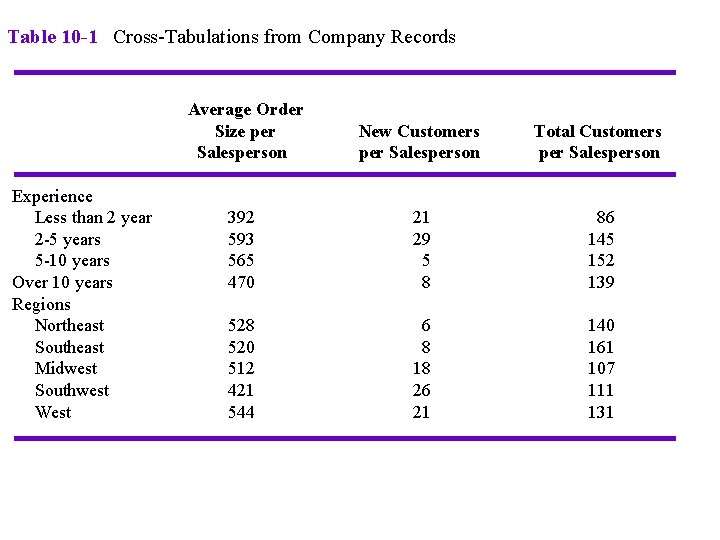
Table 10 -1 Cross-Tabulations from Company Records Experience Less than 2 year 2 -5 years 5 -10 years Over 10 years Regions Northeast Southeast Midwest Southwest West Average Order Size per Salesperson New Customers per Salesperson Total Customers per Salesperson 392 593 565 470 21 29 5 8 86 145 152 139 528 520 512 421 544 6 8 18 26 21 140 161 107 111 131
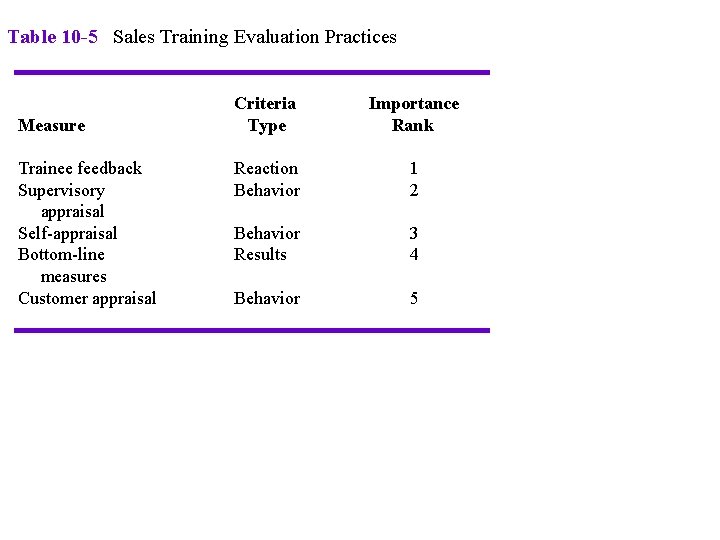
Table 10 -5 Sales Training Evaluation Practices Measure Trainee feedback Supervisory appraisal Self-appraisal Bottom-line measures Customer appraisal Criteria Type Importance Rank Reaction Behavior 1 2 Behavior Results 3 4 Behavior 5
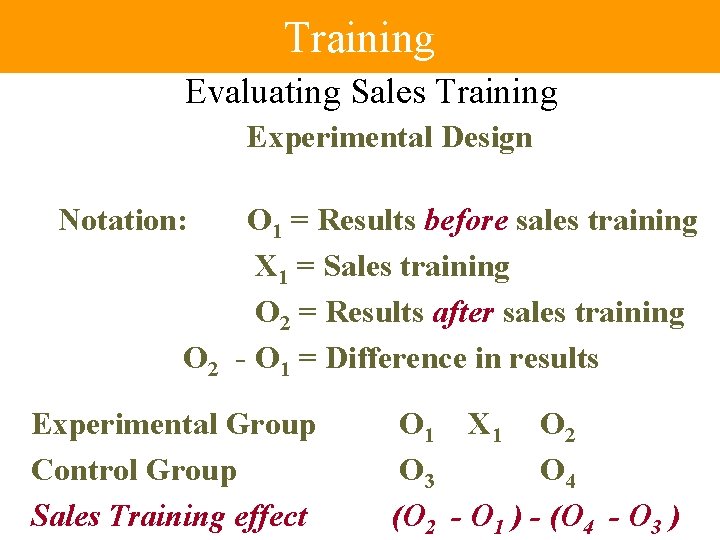
Training Evaluating Sales Training Experimental Design Notation: O 1 = Results before sales training X 1 = Sales training O 2 = Results after sales training O 2 - O 1 = Difference in results Experimental Group Control Group Sales Training effect O 1 X 1 O 2 O 3 O 4 (O 2 - O 1 ) - (O 4 - O 3 )

BUILDING A SALES TRAINING PROGRAM 1. Treat all employees as potential career employees. 2. Require regular re-training. 3. Spend time and money generously. 4. Salespeople and sales managers must take the lead in developing what goes into the program. 5. In times of crisis, increase, rather than decrease, the training program.
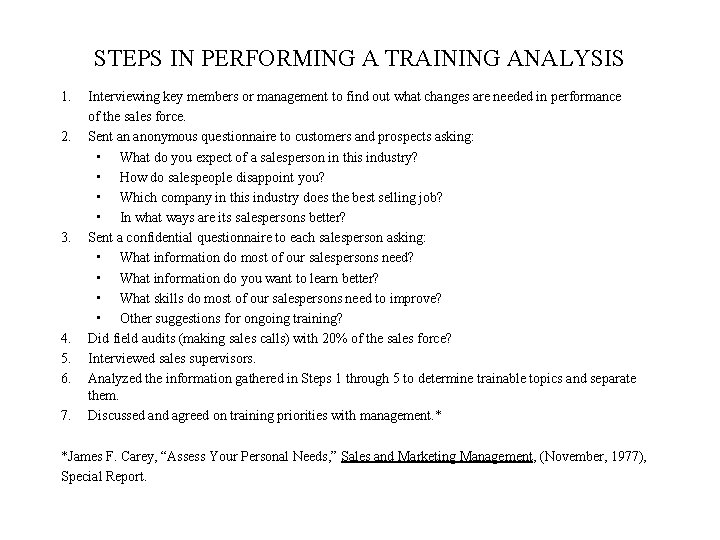
STEPS IN PERFORMING A TRAINING ANALYSIS 1. 2. 3. 4. 5. 6. 7. Interviewing key members or management to find out what changes are needed in performance of the sales force. Sent an anonymous questionnaire to customers and prospects asking: • What do you expect of a salesperson in this industry? • How do salespeople disappoint you? • Which company in this industry does the best selling job? • In what ways are its salespersons better? Sent a confidential questionnaire to each salesperson asking: • What information do most of our salespersons need? • What information do you want to learn better? • What skills do most of our salespersons need to improve? • Other suggestions for ongoing training? Did field audits (making sales calls) with 20% of the sales force? Interviewed sales supervisors. Analyzed the information gathered in Steps 1 through 5 to determine trainable topics and separate them. Discussed and agreed on training priorities with management. * *James F. Carey, “Assess Your Personal Needs, ” Sales and Marketing Management, (November, 1977), Special Report.
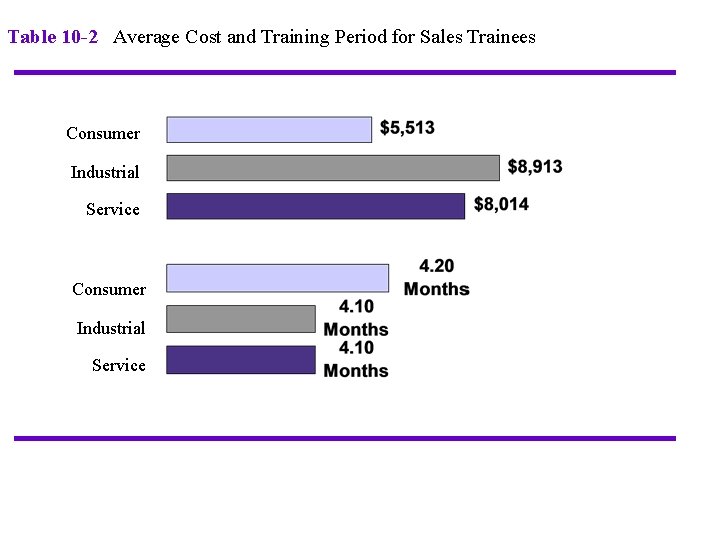
Table 10 -2 Average Cost and Training Period for Sales Trainees Consumer Industrial Service
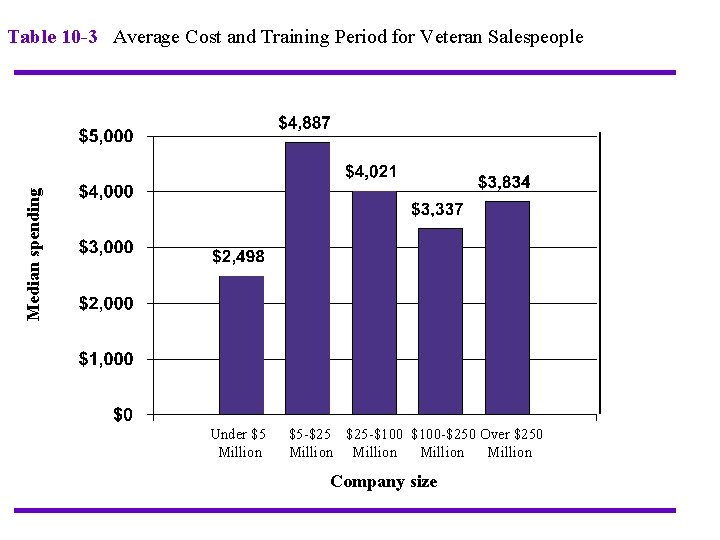
Median spending Table 10 -3 Average Cost and Training Period for Veteran Salespeople Under $5 Million $5 -$25 $25 -$100 -$250 Over $250 Million Company size
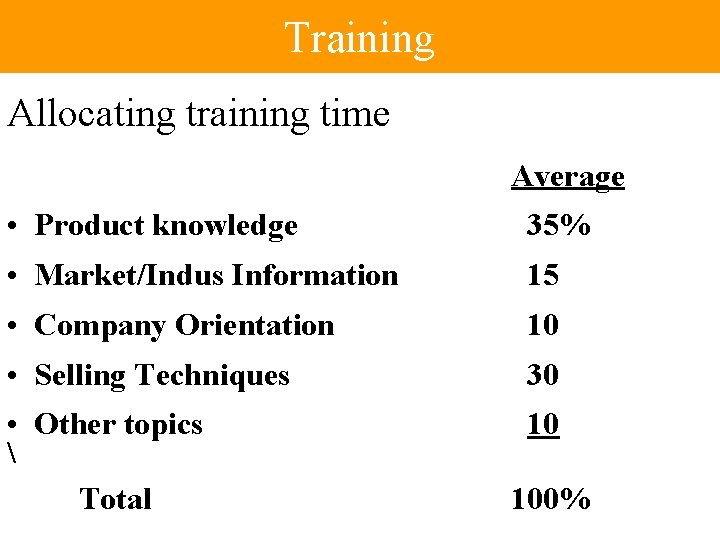
Training Allocating training time Average • Product knowledge 35% • Market/Indus Information 15 • Company Orientation 10 • Selling Techniques 30 • Other topics Total 10 100%
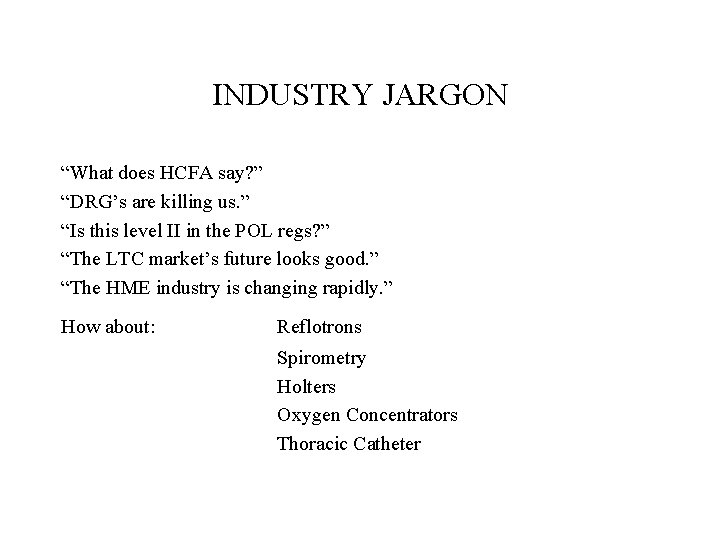
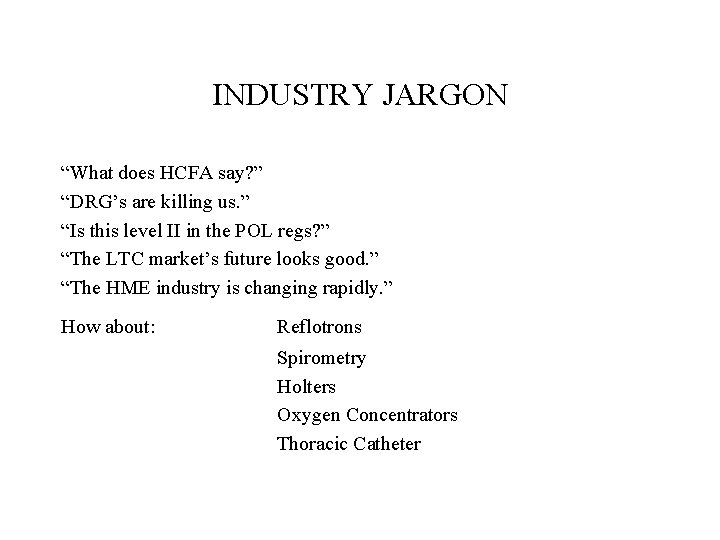
INDUSTRY JARGON “What does HCFA say? ” “DRG’s are killing us. ” “Is this level II in the POL regs? ” “The LTC market’s future looks good. ” “The HME industry is changing rapidly. ” How about: Reflotrons Spirometry Holters Oxygen Concentrators Thoracic Catheter
INDUSTRY JARGON “What does HCFA say? ” “DRG’s are killing us. ” “Is this level II in the POL regs? ” “The LTC market’s future looks good. ” “The HME industry is changing rapidly. ” How about: Reflotrons Spirometry Holters Oxygen Concentrators Thoracic Catheter
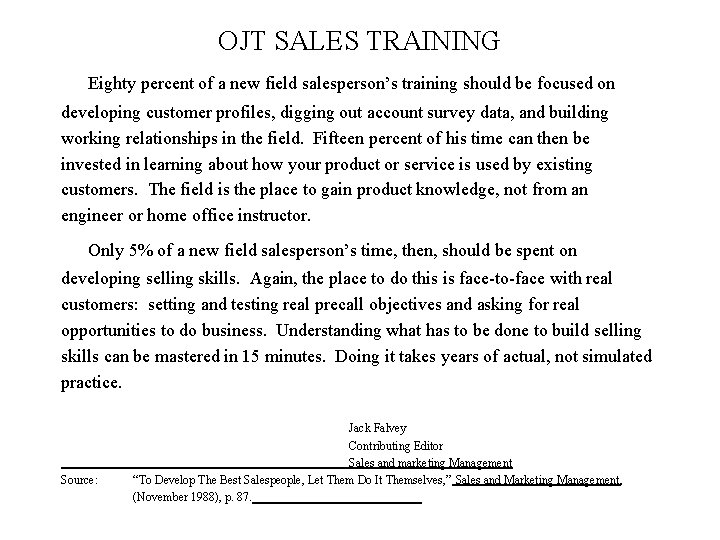
OJT SALES TRAINING Eighty percent of a new field salesperson’s training should be focused on developing customer profiles, digging out account survey data, and building working relationships in the field. Fifteen percent of his time can then be invested in learning about how your product or service is used by existing customers. The field is the place to gain product knowledge, not from an engineer or home office instructor. Only 5% of a new field salesperson’s time, then, should be spent on developing selling skills. Again, the place to do this is face-to-face with real customers: setting and testing real precall objectives and asking for real opportunities to do business. Understanding what has to be done to build selling skills can be mastered in 15 minutes. Doing it takes years of actual, not simulated practice. Source: Jack Falvey Contributing Editor Sales and marketing Management “To Develop The Best Salespeople, Let Them Do It Themselves, ” Sales and Marketing Management, (November 1988), p. 87.
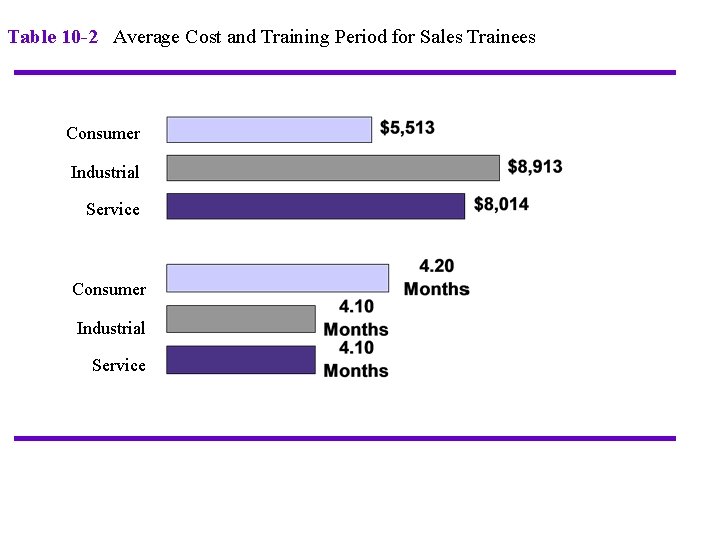
Table 10 -2 Average Cost and Training Period for Sales Trainees Consumer Industrial Service
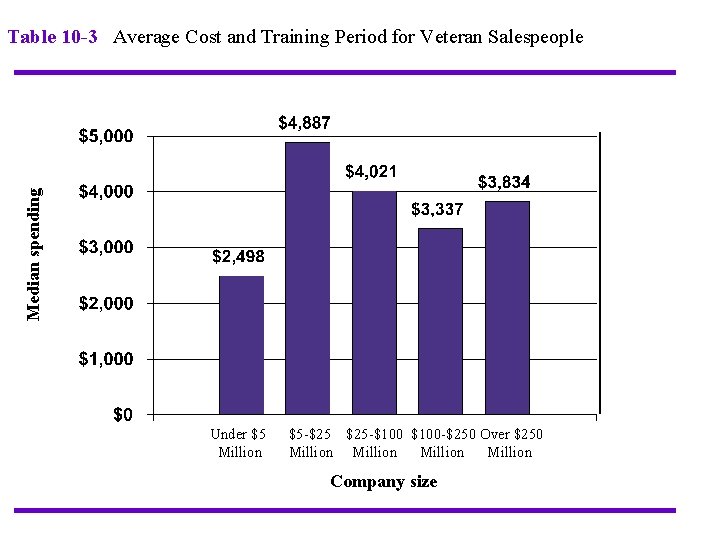
Median spending Table 10 -3 Average Cost and Training Period for Veteran Salespeople Under $5 Million $5 -$25 $25 -$100 -$250 Over $250 Million Company size
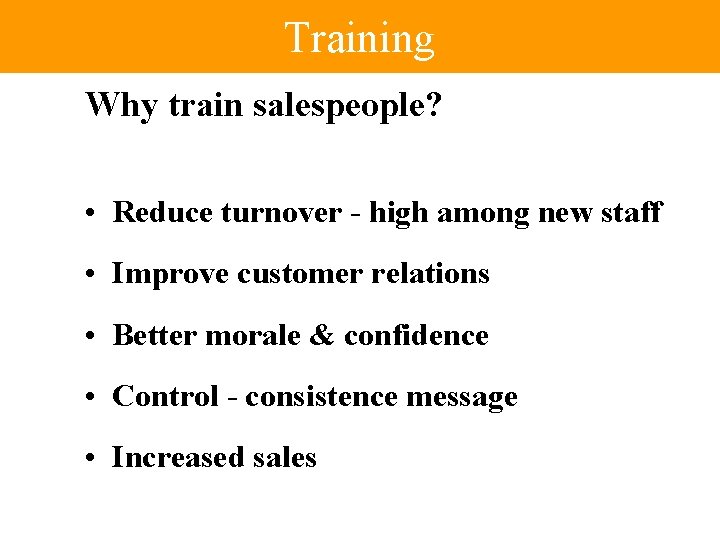
Training Why train salespeople? • Reduce turnover - high among new staff • Improve customer relations • Better morale & confidence • Control - consistence message • Increased sales
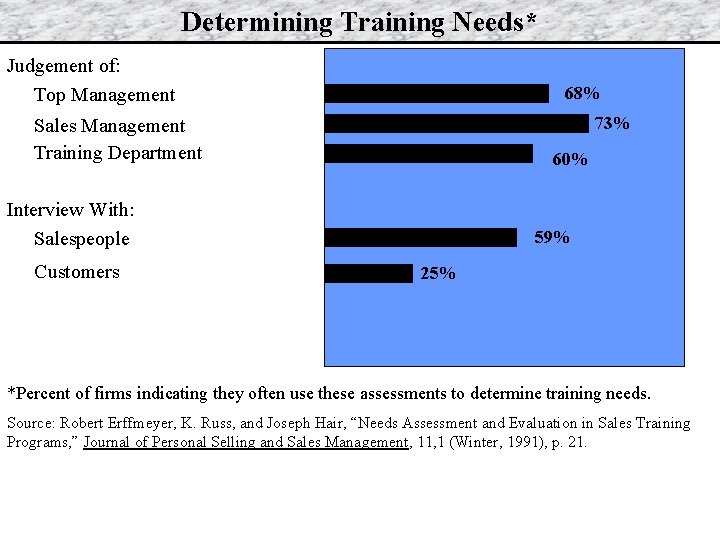
Determining Training Needs* Judgement of: Top Management 68% 73% Sales Management Training Department 60% Interview With: Salespeople Customers 59% 25% *Percent of firms indicating they often use these assessments to determine training needs. Source: Robert Erffmeyer, K. Russ, and Joseph Hair, “Needs Assessment and Evaluation in Sales Training Programs, ” Journal of Personal Selling and Sales Management, 11, 1 (Winter, 1991), p. 21.
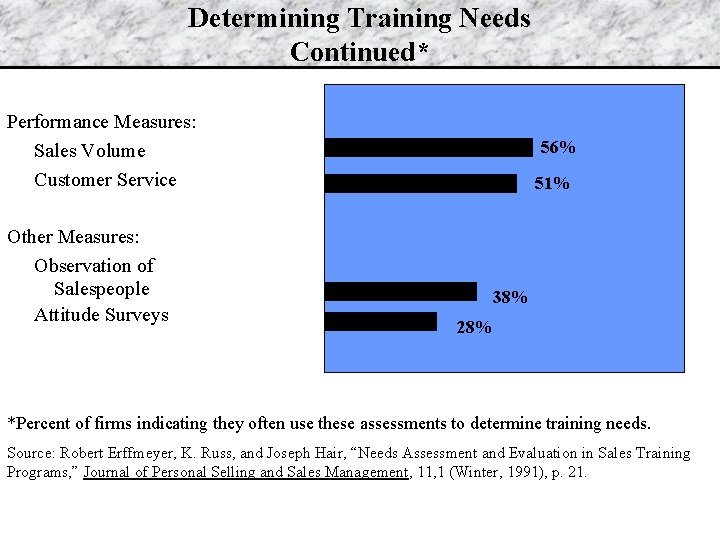
Determining Training Needs Continued* Performance Measures: Sales Volume Customer Service Other Measures: Observation of Salespeople Attitude Surveys 56% 51% 38% 28% *Percent of firms indicating they often use these assessments to determine training needs. Source: Robert Erffmeyer, K. Russ, and Joseph Hair, “Needs Assessment and Evaluation in Sales Training Programs, ” Journal of Personal Selling and Sales Management, 11, 1 (Winter, 1991), p. 21.
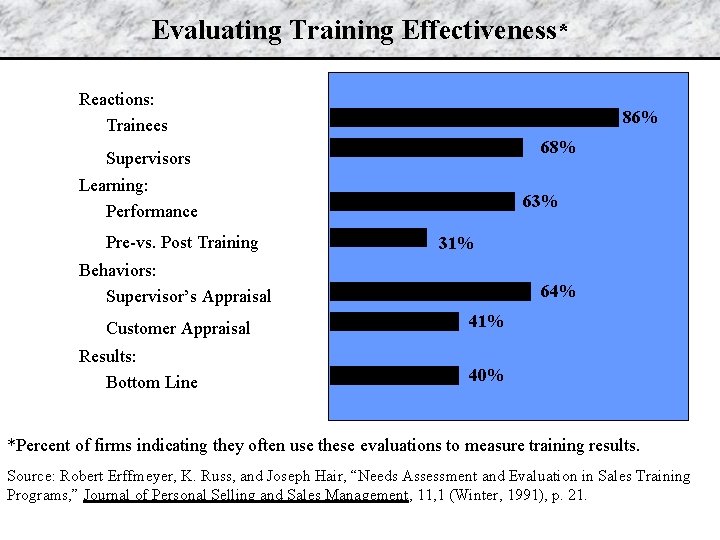
Evaluating Training Effectiveness* Reactions: Trainees 86% 68% Supervisors Learning: Performance Pre-vs. Post Training 63% 31% Behaviors: Supervisor’s Appraisal Customer Appraisal Results: Bottom Line 64% 41% 40% *Percent of firms indicating they often use these evaluations to measure training results. Source: Robert Erffmeyer, K. Russ, and Joseph Hair, “Needs Assessment and Evaluation in Sales Training Programs, ” Journal of Personal Selling and Sales Management, 11, 1 (Winter, 1991), p. 21.
- Slides: 25