
Tragedy of the Commons Ecological Footprint and Sustainability
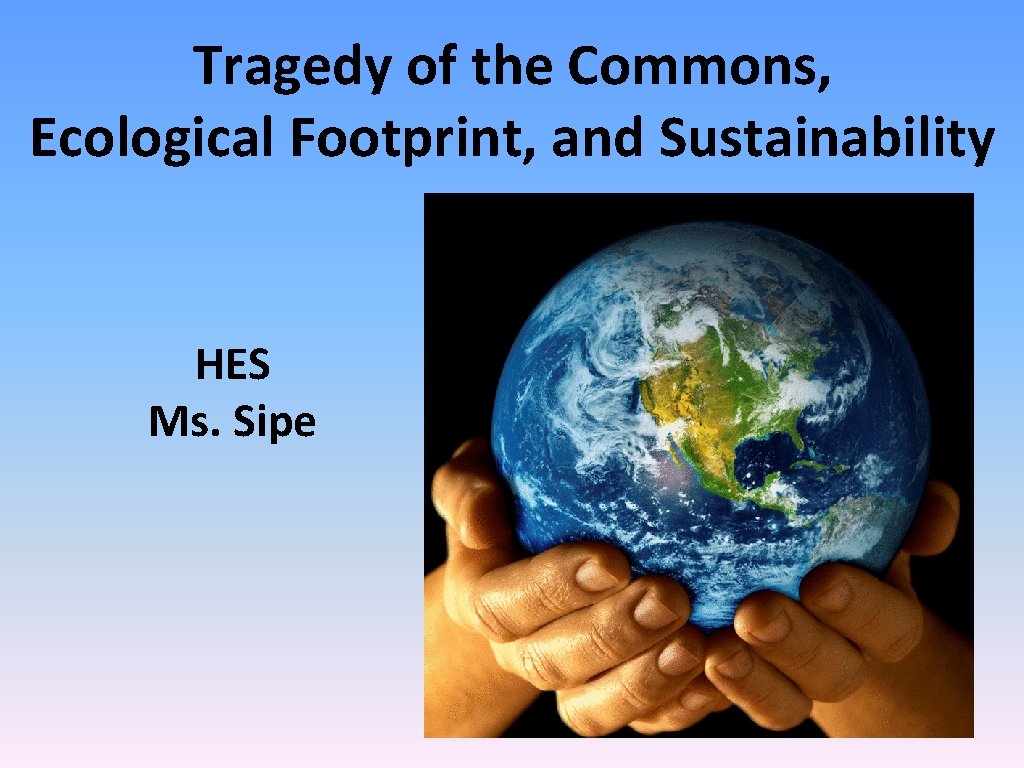
Tragedy of the Commons, Ecological Footprint, and Sustainability HES Ms. Sipe
The Tragedy of the Commons is… When a resource that is shared without responsibility or accountability, becomes degraded and depleted. There is a conflict between the good of the individual and what’s good for all. http: //www. youtube. com/watch? v=EZFk. Uele. HPY
Tragedy of the Commons Lab: “Fishing from a Communal Lake” Goals: Ø Maximize your benefits as fishers to provide for you, your family, and earn a living. Ø To understand the concept of “The Tragedy of the Commons”. Ø To understand how we as a society can put a stop to this tragedy.
Tragedy of the Commons Lab: “Fishing from a Communal Lake” In Groups of 3 -4 at a lab station: • • • You and your partners will fish in a communal lake You will fish once per year for five years Each fishing season lasts 10 seconds Nine fish are needed each season for your survival Surviving fish reproduce, but the lake cannot exceed 120 fish Game 1 - NO TALKING Game 2 - YOU MAY TALK
Tragedy of the Commons Lab: “Fishing from a Communal Lake” Once Data is collected: • Return the lab station to its original condition; obtain teacher signature • Create a double line graph showing how the starting fish population changed over time for both games • Answer analysis Questions #1 -9 • Lab Extension TBD later this week; will be done in class if time allows
Science 1968 Garrett Hardin’s Tragedy of the Commons • "Freedom in a common brings ruin to all. " • Shared resources are considered “the commons” • A “Tragedy” develops whenever a finite resource is being consumed at a steady or increasing rate. • Welfare “cheats” commons by handicapping the population- if you’re struggling, here’s $$ Can you come up with examples of modern commons?
The Great Pacific Garbage Patch (GPGP): A real life “Tragedy of Commons” Oprah Documentary http: //www. youtube. com/watch? v=FTurihx. STn. I Picture Slide show http: //www. youtube. com/watch? v=y 5 y 1 W 5 xdui. E Is there a solution to “Tragedy of the Commons?
Tragedy of the Commons Is there a solution? • Privatization- Creates incentive for individuals to minimize abuse of commons • Restrict Access through rules/regulations • Trout stamps, water rights for irrigation, catch limits • Changing our values/lifestyle: The best solution, but most difficult to achieve • The power of the consumer…

Consumerism The decisions you make as a consumer can have enormous impact on the environment • Food: why buy organic? Why go vegetarian or vegan? • Energy: would you pay extra for solar? • Packaging: How much plastic do you purchase through packaging? • Transportation: hummers vs. hybrids, function vs. fashion • What do you value? What does your family value?
Can we measure what you consume?
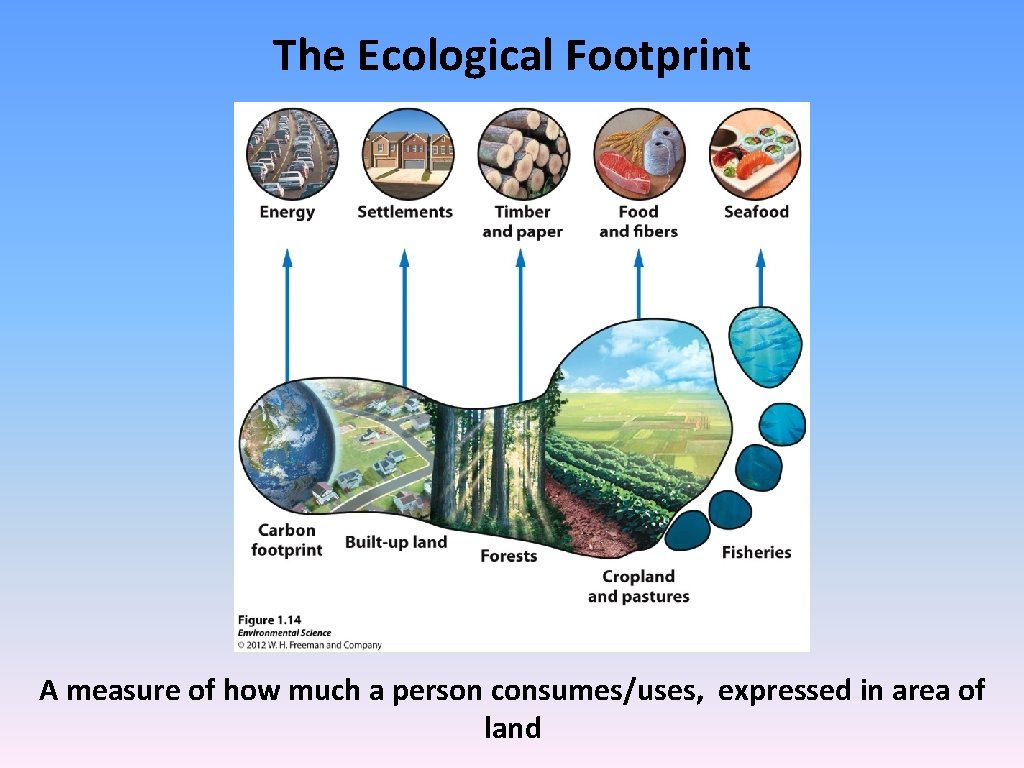
The Ecological Footprint A measure of how much a person consumes/uses, expressed in area of land
Ecological Footprint The area of land/sea that is required to sustain your current lifestyle (in acres/hectares) 1 acre ~ 1 football field in area 1 hectare ~ 10, 000 m 2 (1 ha > 1 acre) Developed Countries have LARGER footprints More $ means more consumption, waste Developing countries have smaller impact person, but faster population growth, increasing demand for resources 3 rd world dreams of 1 st world luxuries (can you blame them? )
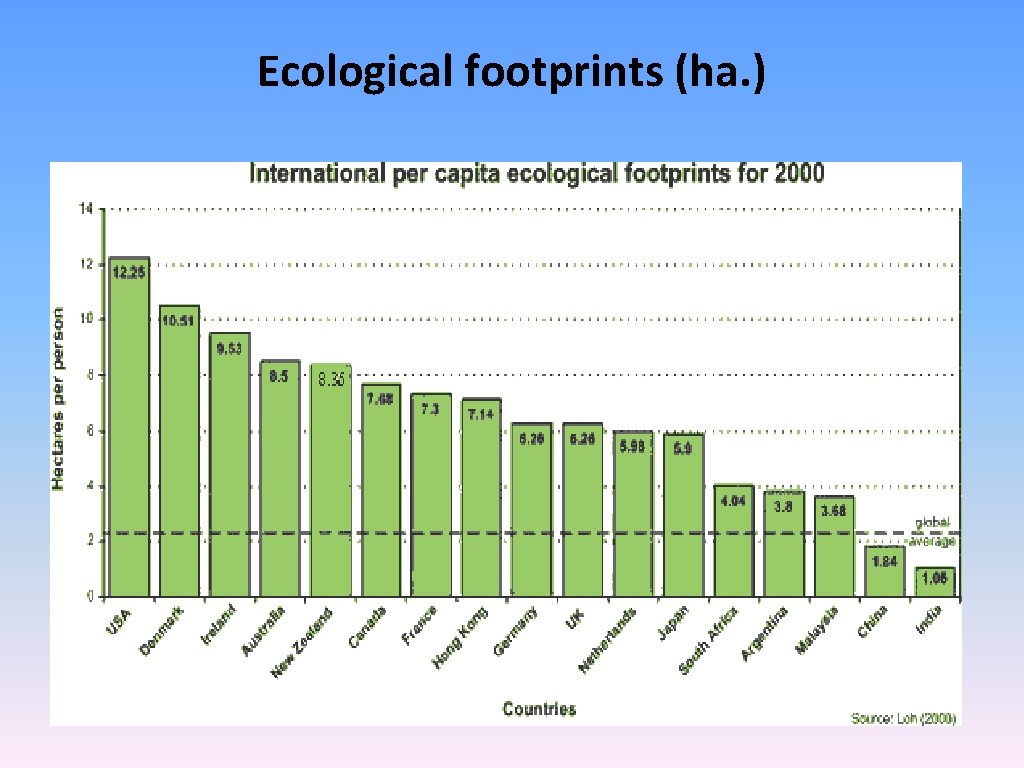
Ecological footprints (ha. )
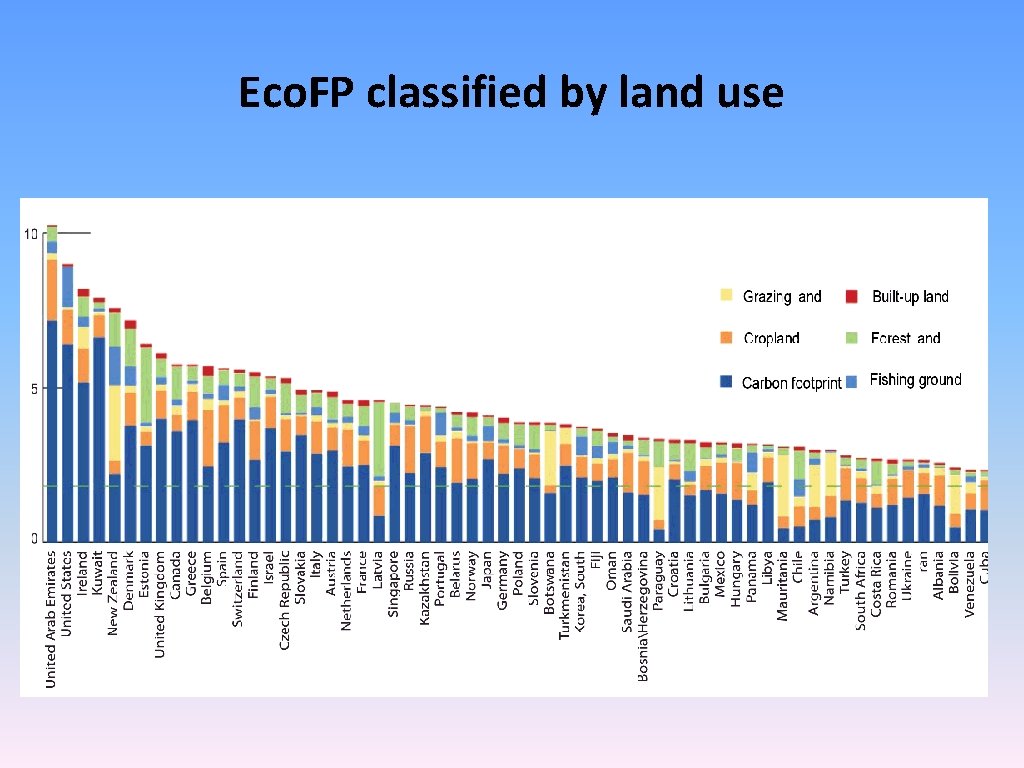
Eco. FP classified by land use
In your opinion, what is “The American Dream”? How may that “dream” pose a contradiction to themes of this course?

“The American Dream” Own a large home Big Yard for kids to play White picket fence, etc. Drive a large car(s) Raise a large, happy family Send your kids to college Retire with money to spend Source: www. npr. org
How can we reduce our ecological footprint? Write your answer in your journal.
Recycle products Buy recycled products Re-Use materials and avoid disposable products (not everything is recyclable) Reduce the amount we buy (Do I NEED another pair of jeans? ? ? ) Find products that have less packaging/Buy in Bulk Use re-usable water bottles. Shop from environmentally friendly companies (you’ll have to do some research) Buy locally produced materials Buy organic food Use environmentally friendly alternatives to household chemicals
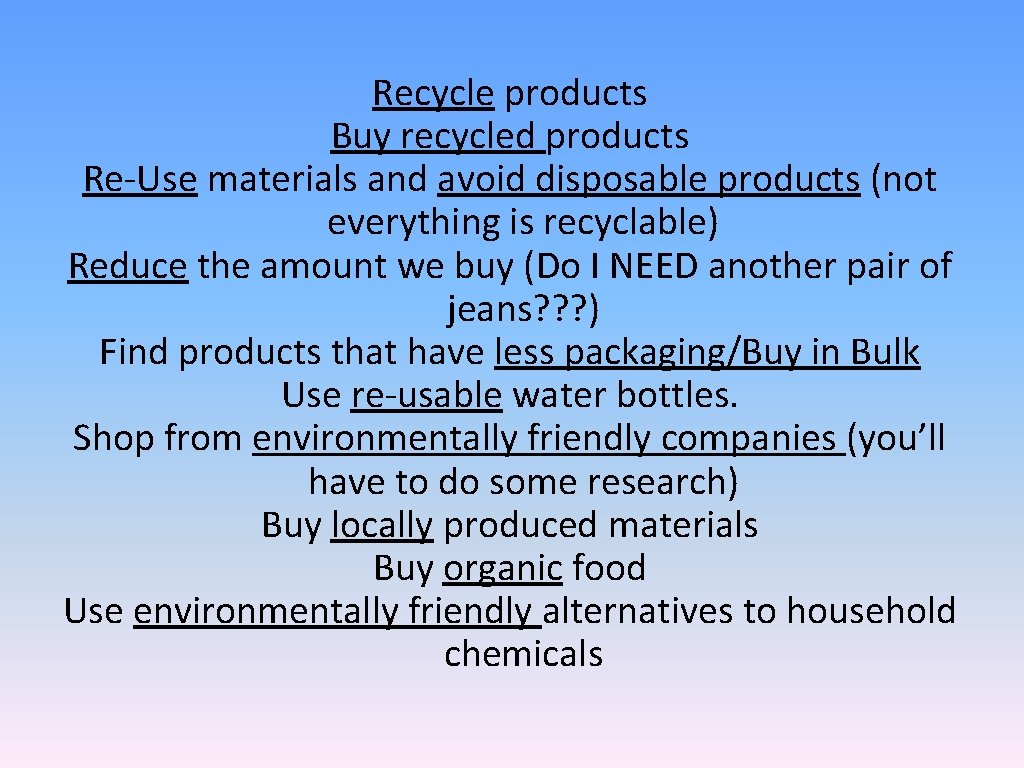
Re-useable Shopping Bags Don’t buy/order more food than you will actually eat Eat less red meat (or become a vegetarian) Walk, ride a bike or use Public Transportation Don’t heat or air condition to extremes Buy “Energy Star” appliances Buy Fuel-Efficient cars and keep them in good repair Wear clothes made from cotton, wool and natural fabrics instead of synthetics Carpool to work/school or walk! Insulate buildings and homes Turn lights off when not using them Take shorter showers (5 minutes less everyday? ? )

What else can we do? ? ? http: //www. youtube. com/watch? v=n. P 1 nz. Cqo. T 9 g
Human Population Growth The root cause of all environmental issues! More people means more demand for Food Clean water Energy Other resources like minerals, lumber, etc. Jobs At what expense?
The Goal: Sustainability Scientists still debate over the definition “Wise use” Sustainable Society- balancing human development and resource conservation to preserve for future generations Sustainable Economy- can grow w/o irrevocable harm to environment
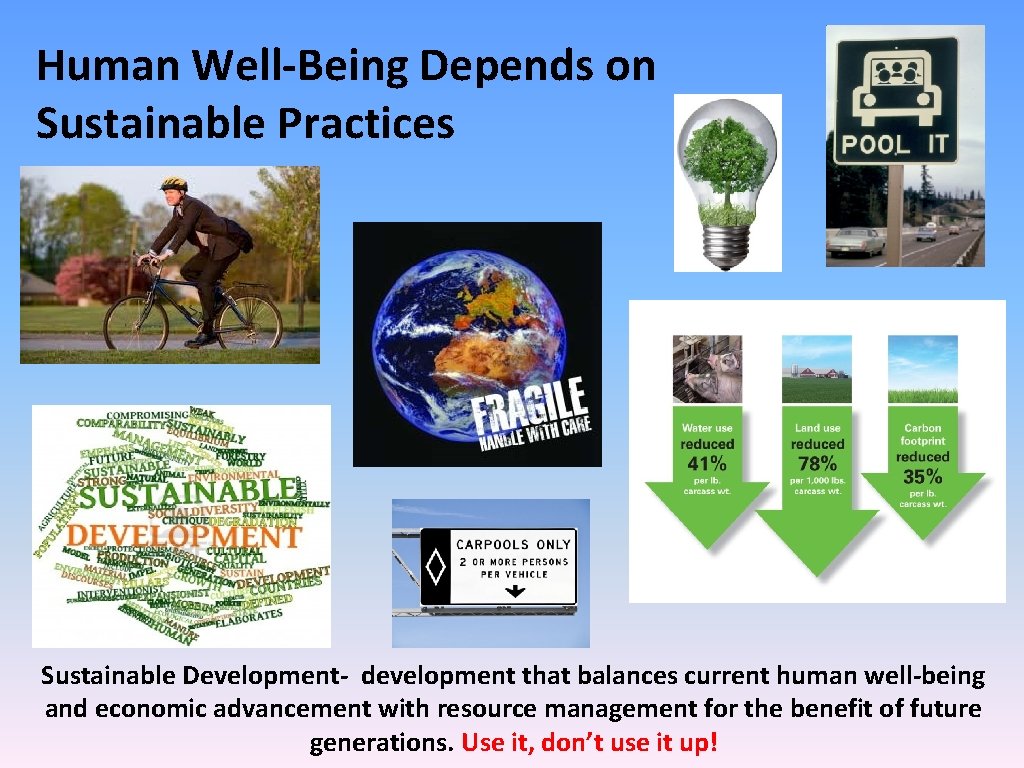
Human Well-Being Depends on Sustainable Practices Sustainable Development- development that balances current human well-being and economic advancement with resource management for the benefit of future generations. Use it, don’t use it up!
Homework • Calculate your EFP 2 ways, if not done during class • Capture a screenshot of your online EFP calculation • EFP reflective essay- 1 -2 paragraphs max! • Watch the following TED Talks- Sustainability Video at the link below http: //www. ted. com/talks/alex_steffen_sees_a_sustai nable_future. html All Due NLT Fri 9/18
- Slides: 24