
Tragedy from The Seven Basic Plots by Christopher
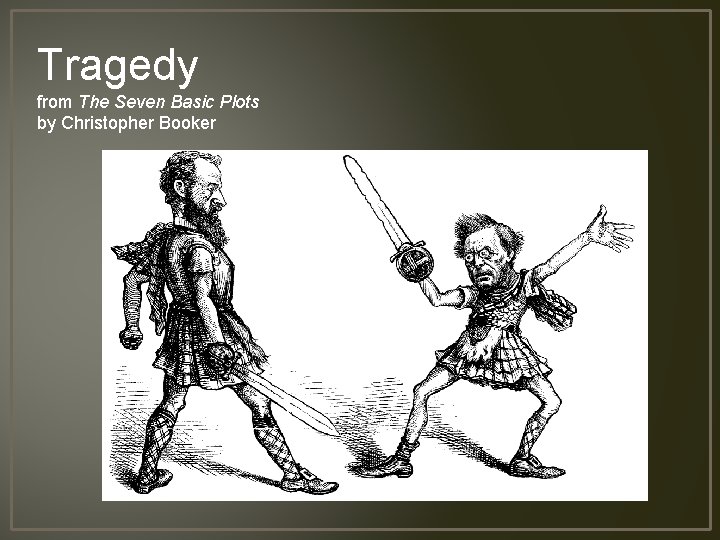
Tragedy from The Seven Basic Plots by Christopher Booker
The plots are: • • Overcoming the Monster Rags to Riches The Quest Voyage and Return Comedy Tragedy Rebirth
Tragedy I: Five Stages • “We might almost say that, for a story to resolve in a way which really seems final and complete, it can only do so in one of two ways. Either it ends with a man and a woman united in love. Or it ends in death. ”
Five Stages • 1. Anticipation Stage: • hero is in some way incomplete or unfulfilled. Some object of desire or course of action presents itself to the hero. • When the hero succumbs to this desire or thought, he has found his “focus”: • Macbeth decides to assassinate King Duncan, Icarus yields to his desire to fly close to the sun; Dr. Jekyll drinks his potion.
Five Stages • 2. Dream Stage: hero commits to his focus, and for a while everything goes almost improbably well for the hero. He feels gratified and seems to be getting away with his crime or error. • 3. Frustration Stage: Things begin to go wrong. Hero feels restless and insecure, commits further dark acts to secure or retain his position and feelings from the Dream Stage.
Five Stages • 4. Nightmare Stage: Things are now slipping completely out of the hero’s control. Forces of opposition and fate are closing in on him; hero falls into rage or despair. • 5. Destruction or Death Wish: either by the forces he has aroused against him, or by some final act of violence which precipitates his own death, the hero is destroyed.
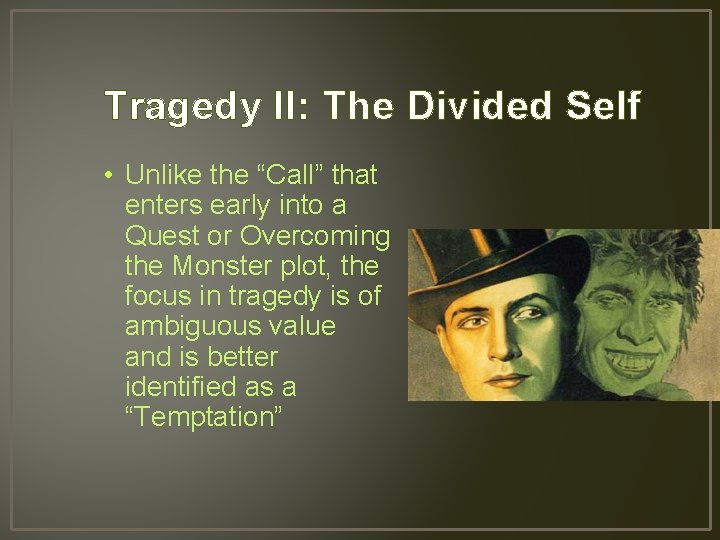
Tragedy II: The Divided Self • Unlike the “Call” that enters early into a Quest or Overcoming the Monster plot, the focus in tragedy is of ambiguous value and is better identified as a “Temptation”
The Divided Self • As the hero yields to his temptation, we are intuitively aware of the fact that he is willing to violate and defy some prohibition, law, convention, or duty. • Initially a part of the hero is reluctant to commit to the Temptation, leading to a “divided self”
The Divided Self • It comes back to “light” and “dark”. • The dark, shadowy side of the hero is the one initially hidden from the world, the one which attaches itself to the Focus/Temptation and then consumes the hero. • “The heroes and heroines of Tragedy are becoming ensnared by some obsessive desire which springs ultimately from themselves. ” • “They are set more and more at odds with the reality of the world around them -- until finally it begins to close in on them, demanding a reckoning.
The Divided Self • The very essence of tragedy is that the hero or heroine becomes separated from society. • They break the bonds of loyalty, family, friendship, and all the elements required for a happy ending. The only resolution left is death. • The tragic hero destroys relationships with a few key archetypes (notice the parallel with the Quest)…
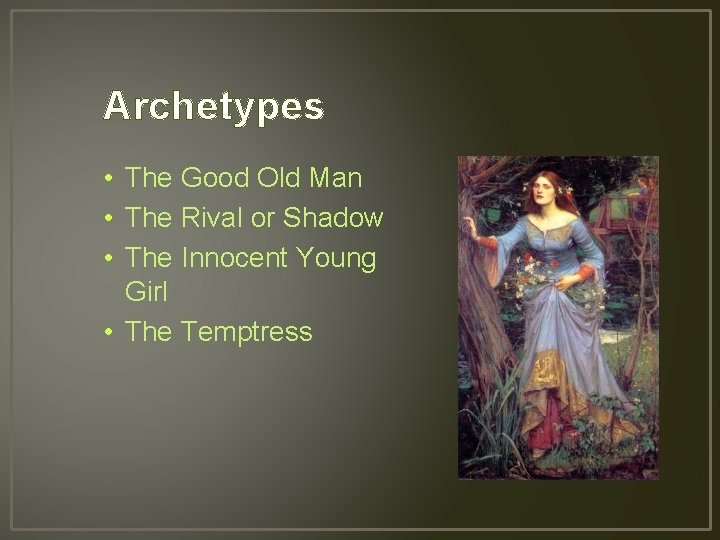
Archetypes • The Good Old Man • The Rival or Shadow • The Innocent Young Girl • The Temptress
Archetypes • The Good Old Man • • Older than the hero Represents the established authority Often a kingly or father figure Duncan, killed by Macbeth; Julius Caesar, killed by Brutus
Archetypes • The Rival or “Shadow” • A figure who is in some way on the same level as the hero (age, rank, similar background) • Becomes the “opposite” of the increasingly dark hero and is a threat to him/her
Archetypes • The Innocent Young Girl • One of the most poignant of the hero’s victims • The “good angel” who fails to sway the hero back to his light self • Othello’s murder of Desdemona is a dramatic example and illustrates the correlation of such an event with the Nightmare Stage
Archetypes • The Temptress • The other feminine figure often present in tragedies is a “dark” figure herself. • Leads the hero on • Almost invariably dies a violent death, often adjacent to the hero
The Divided Self • The tragic hero as an incomplete, egocentric figure who meets a lonely and violent end sure sounds like a figure from another plot already discussed. Can you guess which one? …
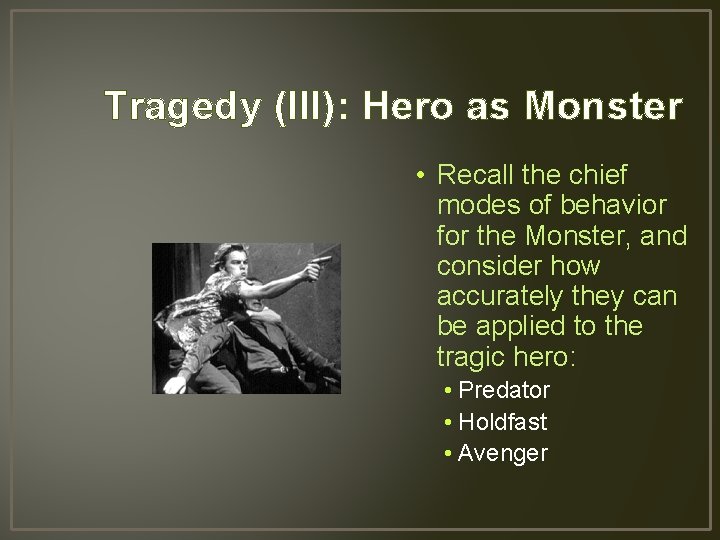
Tragedy (III): Hero as Monster • Recall the chief modes of behavior for the Monster, and consider how accurately they can be applied to the tragic hero: • Predator • Holdfast • Avenger
Tragedy (III): Tragedies of Redemption and Fulfillment • Some tragedies can end on a note of solemn rejoicing because the hero/life-denying monster has been destroyed, and life can begin to flow again. • “Ultimately the destruction of the dark hero has been a victory for light. ”
- Slides: 18