
Tragedy and Tragic Hero Characteristics from Aristotles Poetics
- Slides: 20
Tragedy and Tragic Hero Characteristics from Aristotle’s Poetics and Shakespeare’s Julius Caesar
TRAGEDY A serious play that depicts the fall and/or death of a noble character l Character in conflict with forces beyond his/her control l
Poetics l l Aristotle viewed drama as an imitative art (mimesis). He believed that imitation was an instinctual tendency in human beings, and allowed us to recognize facets of our world. l “Tragedy, then, is an imitation of an action that is serious, complete, and of a certain magnitude; in language embellished with each kind of artistic ornament, the several kinds being found in separate parts of the play; in the form of action, not of narrative…therefore, the purpose of a tragedy is to arouse the emotions of pity and fear and thus to produce in the audience a catharsis of these emotions…”
l Plot is the most important aspect of tragedy: “But most important of all is the structure of the incidents. For Tragedy is an imitation, not of men, but of an action and of life”. l A complex plot must deal with serious (worthy) matters or problems and usually in the form of a play or drama
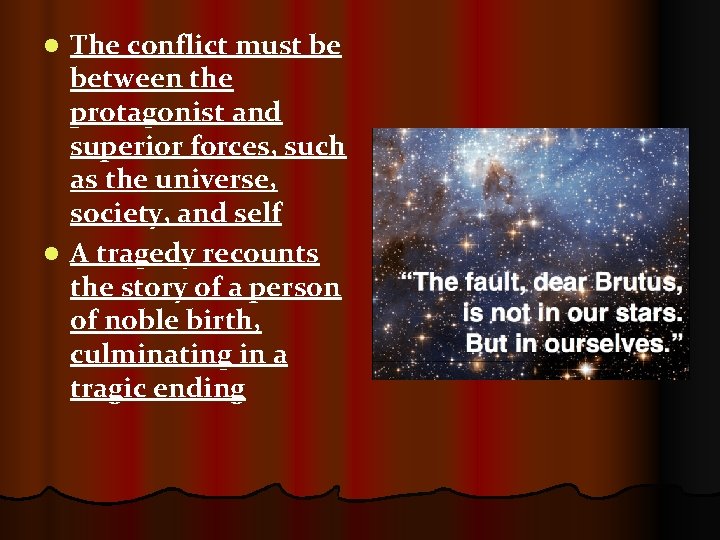
The conflict must be between the protagonist and superior forces, such as the universe, society, and self l A tragedy recounts the story of a person of noble birth, culminating in a tragic ending l
Tragic Hero l l Of noble birth (highly regarded) Acts nobly or honorably – respected by all Makes choices that lead to a situation from which there is no escape Has a tragic flaw that leads to his destruction
Tragic flaw (“hamartia”) is a subtle weakness of character, and includes accidents and mistakes, wrongdoing, error, or sin – usually as a result of pride. l Hubris, in modern terms, is exaggerated self pride or selfconfidence, often resulting in character feeling invincible, infallible, or invulnerable. l The tragic hero should be of noble birth—a ranking politician, military figure, prince, king, etc. This produces the feeling of fear; if it can happen to someone of noble birth, it can happen to us. l
HAMARTIA l An error of judgment. Hamartia, “fault”, is sometimes known as the tragic flaw because it represents a fatal weakness that causes the downfall of a protagonist in tragedy. l This hamartia may be caused by inherited weakness, by faulty character traits, or by poor judgment; whatever the cause, the result is action or inaction, that leads to destruction or death.
HUBRIS l Arrogance; excessive self-pride and self- confidence. Hubris, “insolence”, referred to the emotions in Greek tragic heroes that led them to ignore warnings from the gods and thus invite catastrophe. Hubris is that form of hamartia that stems from overbearing pride and self-assumed superiority. l The original sin of the Greek tragic hero is hubris, believing that one is god-like. Nobody can be tempted into hubris except one who is exceptionally fortunate.
l The hero should not be morally better than an average person. This produces "fear" because the hero is imperfect like us, and we can identify with him. It also produces "pity" because if the hero were perfect or totally good, we would be outraged by his fate. If he were completely evil, we would feel like he had gotten what he deserved.
l “The change of fortune should be not from bad to good, but, reversely, from good to bad. It should come about as the result not of vice, but of some great error or frailty, in a character either such as we have described, or better rather than worse. ” l The reversal of fortune is called the Peripetia l Because of the tragic flaw, the hero must suffer and the punishment must be more severe than the crime committed.
Tragic Hero, Continued l The tragic hero will eventually gain ANAGNORISIS (RECOGNITION) and recognize the error of his/her way, experiencing a sudden awakening – but it will be too late to undo the damage l By this time, the actions of the hero have resulted in suffering of innocents people l The tragic hero’s life ends in death – a direct result of his/her own actions
Key Points: Aristotle's Definition of a tragic hero: l l l 1. Comes from nobility (high position such as a king or outstanding person) 2. Tragic Flaw (caused by a simple mistake or a character flaw - a virtue carried to the extreme, maybe pride or jealousy) 3. Undergoes a Reversal of Fortune (Falls from high to low / happiness to misery) 4. Has a Downfall (misfortunes) 5. Recognizes his mistakes (in a catharsis/ cleansing of emotions or purgation of pity and fear)
Tragedy l 1. Tragedy is meant to reaffirm the fact that life is worth living, regardless of the suffering or pain that is part of human existence. l 2. Tragedies are about people in conflict with the universe. l Tragedies are always about spiritual conflicts, never about every day events.
Tragedy l 3. Tragic actions arise from a character's inner conflict. l A tragic protagonist must have magnitude; his struggles are great because he is important to society. l 4. The tragic protagonist must fall from high to low; they will have a noble soul. l The audience must care about the tragic protagonist.
Tragedy l 5. The tragic protagonist is a decent person, but not perfect (not completely virtuous or villainous). l He usually suffers from hubris (Pride) as shown through hamartia (character flaw or error in judgment). l Once the transgression is realized, the character enters the stage of anagnorisis (recognition) and will undergo a peripeteia (reversal of fortune or fall from high to low). l In other words, the character grows and gains self- knowledge.
Tragedy l 6. The protagonist's actions should arouse feelings of both pity, fear, and compassion in the audience. l Pity because the protagonist is better than we are, so we place ourselves into his position (empathy). l Fear because we too do not know our future or fate. l However much the audience may feel for the character, it does not leave with depression.
Tragedy l 7. By the end of the play, the audience should be purged of pity and fear, so they go through a catharsis (purgation of pity and fear). l 8. The tragic protagonist must ask the first and last of all questions: What does it mean to be? l He must face the world alone, unaided, and kick against his fate. l He can never escape his fate, but he will insist upon accepting fate on his own terms.
CATHARSIS l According to Aristotle, tragedy serves as a catharsis l An audience filled with confusion and unhealthy emotions, such as pity and fear, comes to see a play developing make -believe actions that would be harmful if occurring in real life.
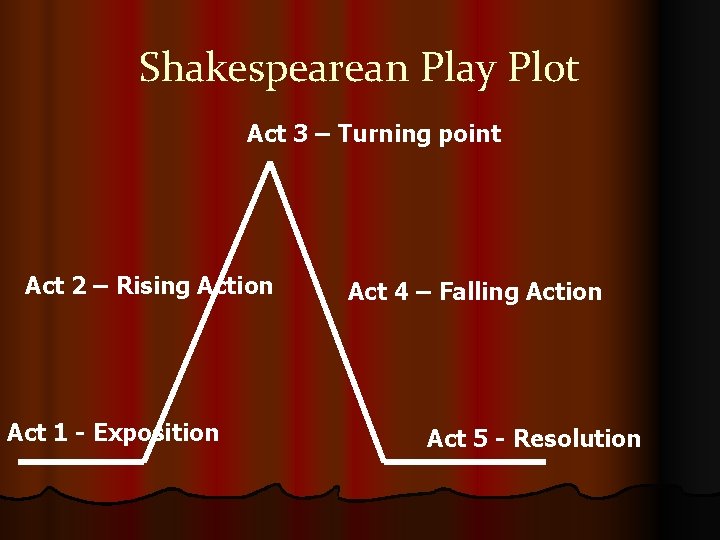
Shakespearean Play Plot Act 3 – Turning point Act 2 – Rising Action Act 1 - Exposition Act 4 – Falling Action Act 5 - Resolution