
Traffic stream models Transportation Systems Engineering TVMIITB20080814 Traffic
Traffic stream models Transportation Systems Engineering TVM_IITB_20080814 Traffic Stream Model
Traffic stream models • Macroscopic – Expression of the average behaviour of the vehicles at the specific location and time • Mesoscopic – Small group of traffic entities with activities and interactions • Microscopic – space-time behaviour of the systems’ entities (i. e. vehicle and drivers) TVM_IITB_20080814 Traffic Stream Model 2
Traffic stream models • Macroscopic Stream Models – Greenshield's model – Greenberg's logarithmic model – Underwood's exponential model – Pipe's generalized model – Multiregime models TVM_IITB_20080814 Traffic Stream Model 3
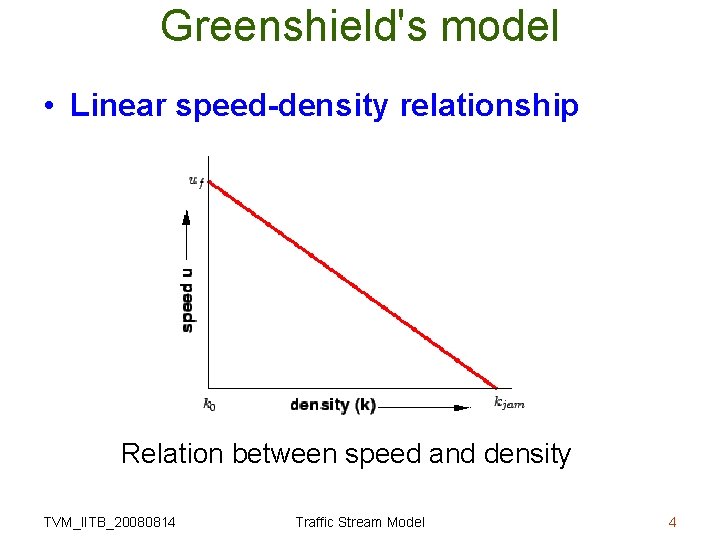
Greenshield's model • Linear speed-density relationship Relation between speed and density TVM_IITB_20080814 Traffic Stream Model 4
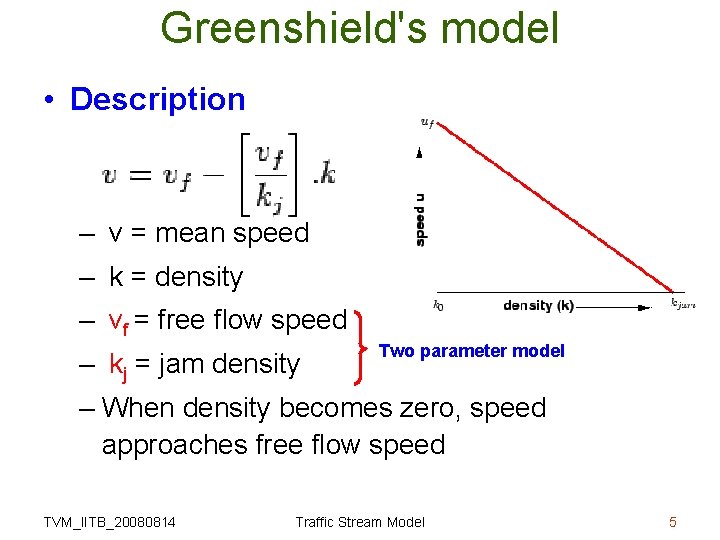
Greenshield's model • Description – v = mean speed – k = density – vf = free flow speed – kj = jam density Two parameter model – When density becomes zero, speed approaches free flow speed TVM_IITB_20080814 Traffic Stream Model 5
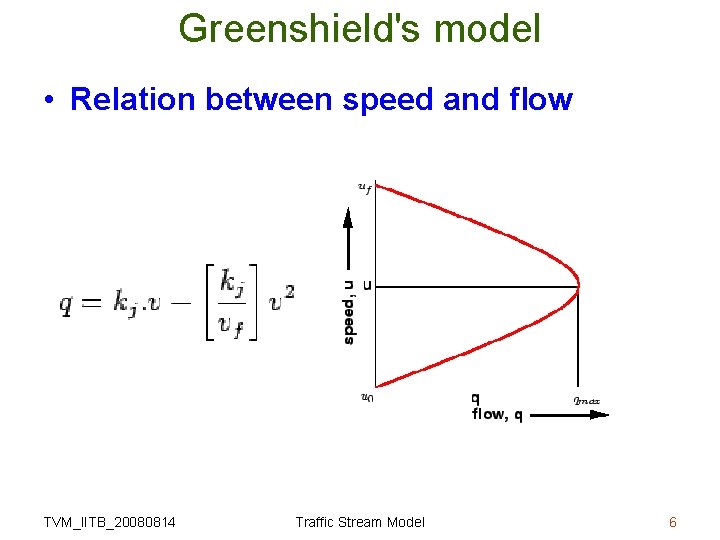
Greenshield's model • Relation between speed and flow TVM_IITB_20080814 Traffic Stream Model 6
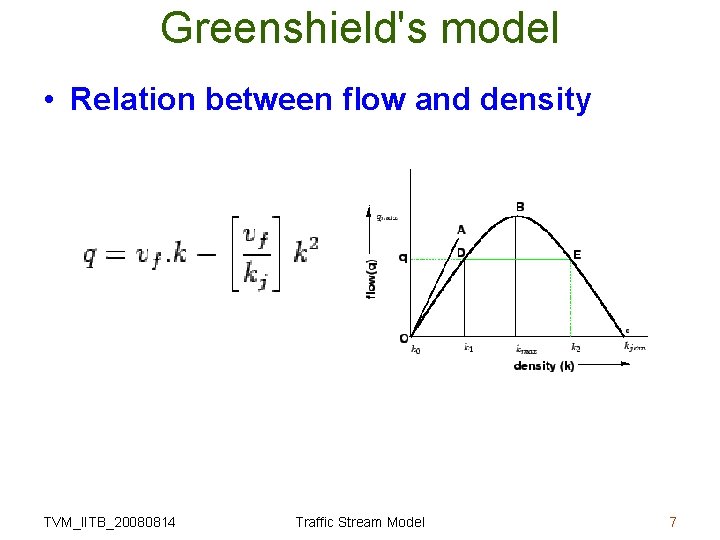
Greenshield's model • Relation between flow and density TVM_IITB_20080814 Traffic Stream Model 7
Greenshield's model • Boundary conditions – Maximum flow – Density corresponding to max. flow – Speed corresponding to max. flow • Model parameters – Jam density – Free flow speed TVM_IITB_20080814 Traffic Stream Model 8
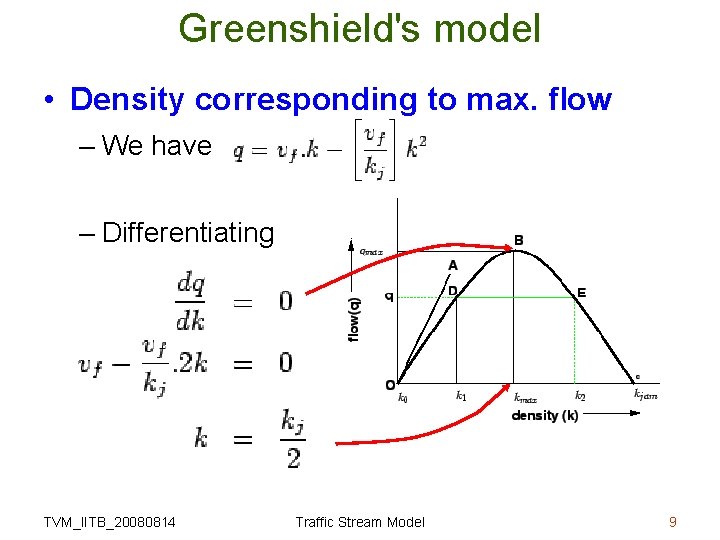
Greenshield's model • Density corresponding to max. flow – We have – Differentiating TVM_IITB_20080814 Traffic Stream Model 9
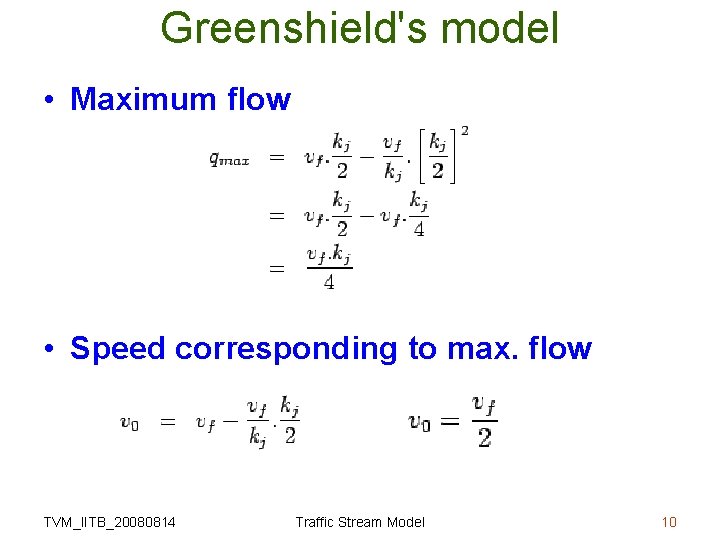
Greenshield's model • Maximum flow • Speed corresponding to max. flow TVM_IITB_20080814 Traffic Stream Model 10
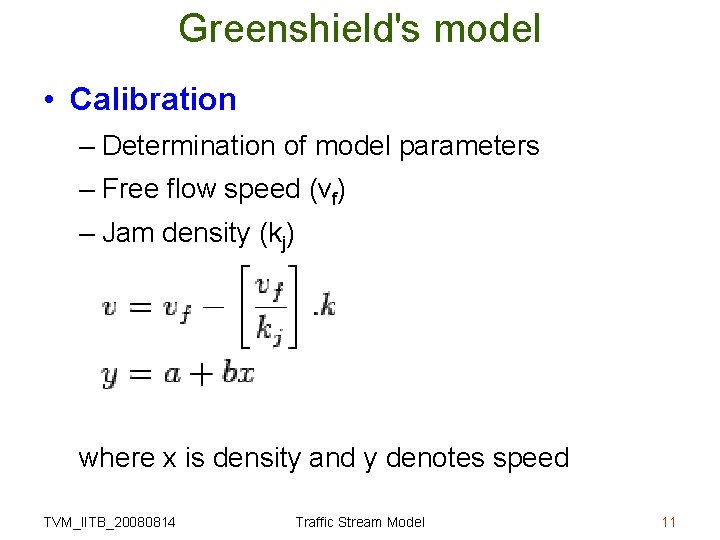
Greenshield's model • Calibration – Determination of model parameters – Free flow speed (vf) – Jam density (kj) where x is density and y denotes speed TVM_IITB_20080814 Traffic Stream Model 11
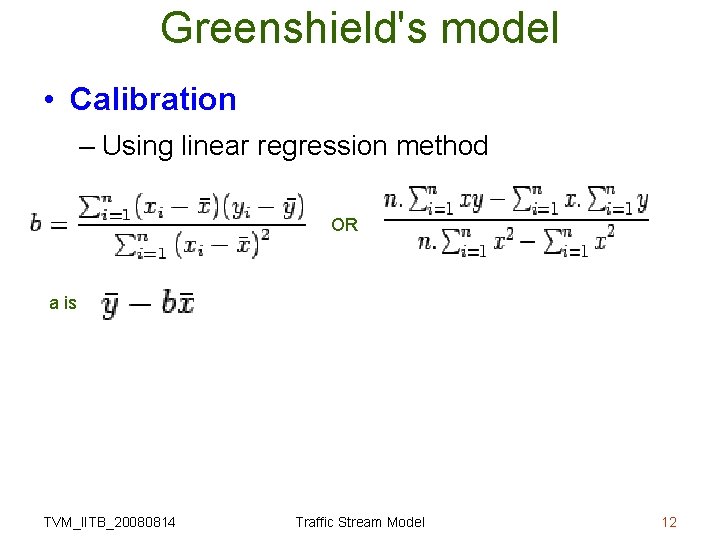
Greenshield's model • Calibration – Using linear regression method OR a is TVM_IITB_20080814 Traffic Stream Model 12
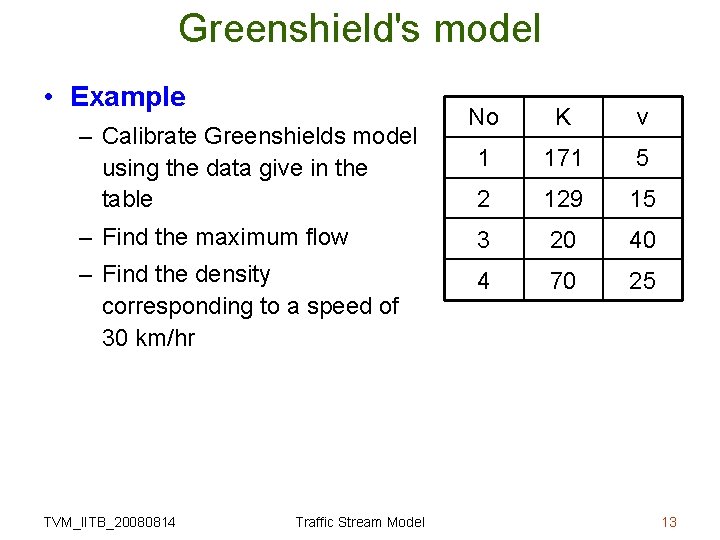
Greenshield's model • Example No K v 1 171 5 2 129 15 – Find the maximum flow 3 20 40 – Find the density corresponding to a speed of 30 km/hr 4 70 25 – Calibrate Greenshields model using the data give in the table TVM_IITB_20080814 Traffic Stream Model 13
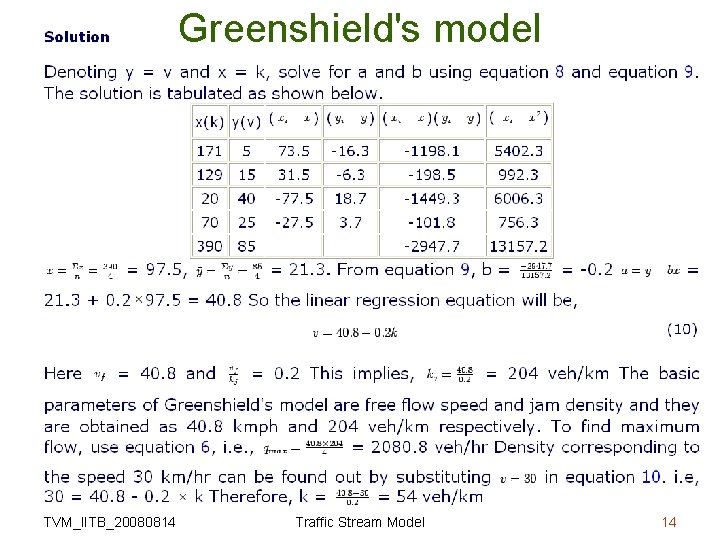
Greenshield's model TVM_IITB_20080814 Traffic Stream Model 14
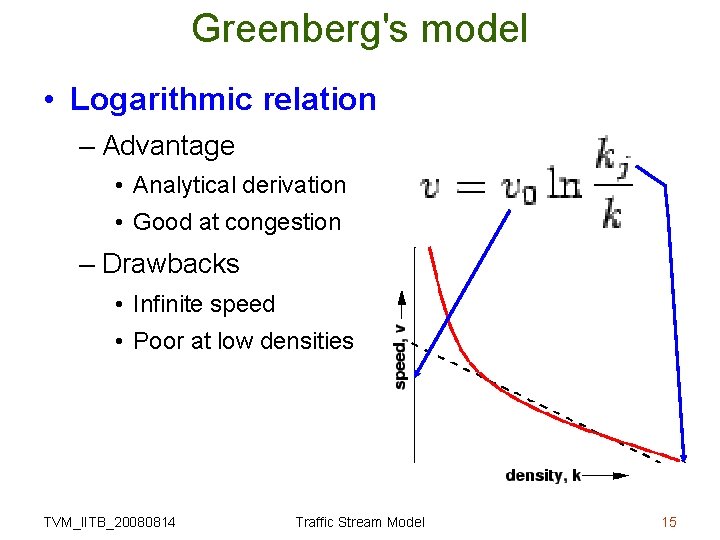
Greenberg's model • Logarithmic relation – Advantage • Analytical derivation • Good at congestion – Drawbacks • Infinite speed • Poor at low densities TVM_IITB_20080814 Traffic Stream Model 15
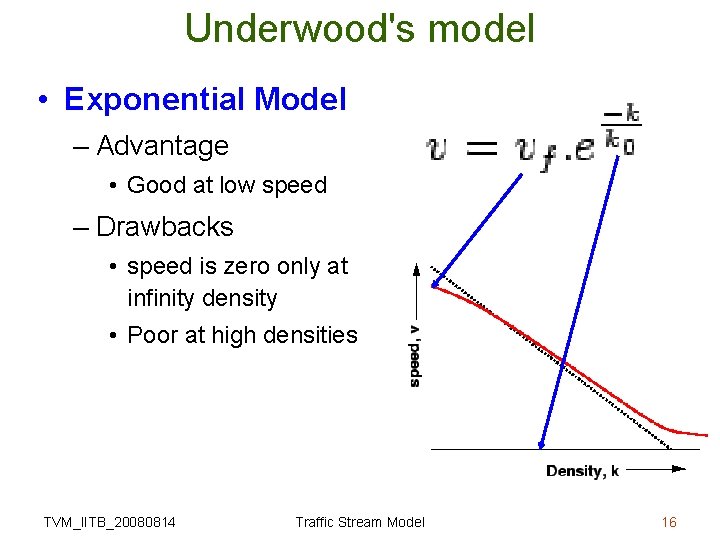
Underwood's model • Exponential Model – Advantage • Good at low speed – Drawbacks • speed is zero only at infinity density • Poor at high densities TVM_IITB_20080814 Traffic Stream Model 16
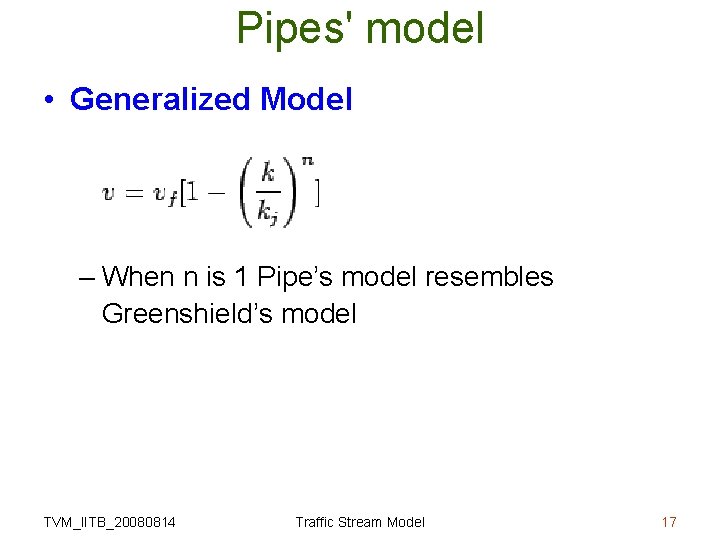
Pipes' model • Generalized Model – When n is 1 Pipe’s model resembles Greenshield’s model TVM_IITB_20080814 Traffic Stream Model 17
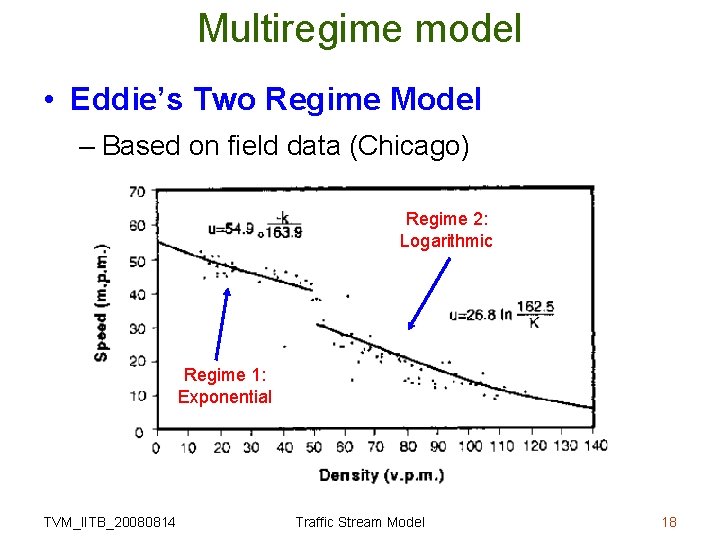
Multiregime model • Eddie’s Two Regime Model – Based on field data (Chicago) Regime 2: Logarithmic Regime 1: Exponential TVM_IITB_20080814 Traffic Stream Model 18
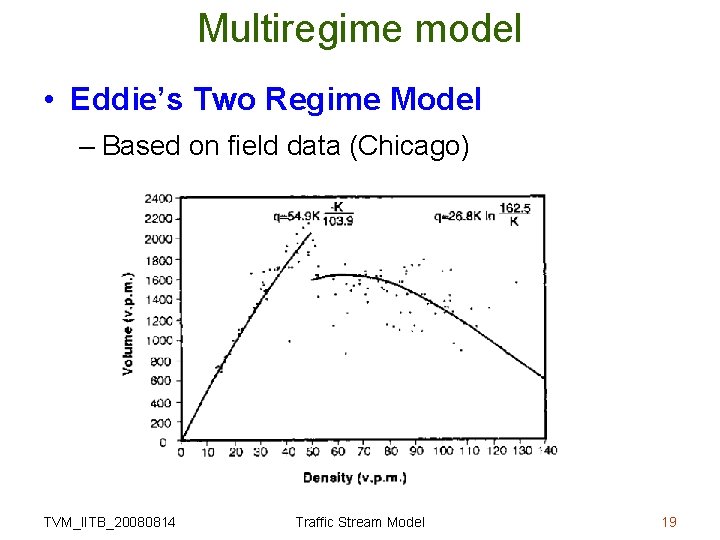
Multiregime model • Eddie’s Two Regime Model – Based on field data (Chicago) TVM_IITB_20080814 Traffic Stream Model 19
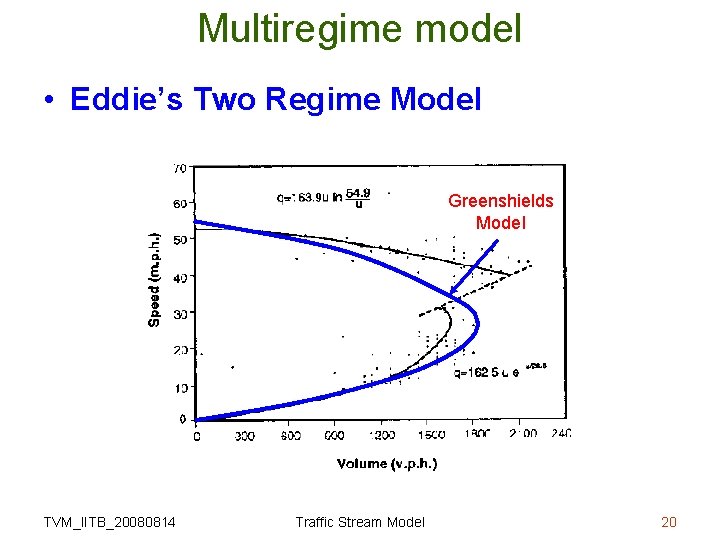
Multiregime model • Eddie’s Two Regime Model Greenshields Model TVM_IITB_20080814 Traffic Stream Model 20
Multiregime model • Three Regime Model – Free flow – Normal – Congested TVM_IITB_20080814 Traffic Stream Model 21
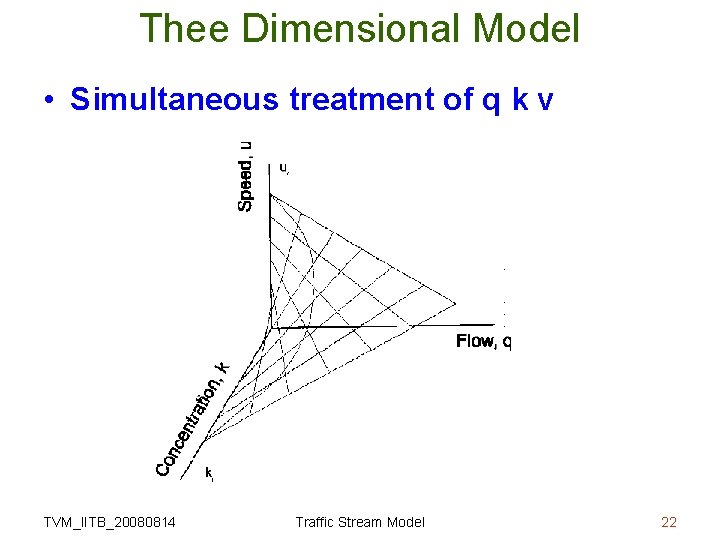
Thee Dimensional Model • Simultaneous treatment of q k v TVM_IITB_20080814 Traffic Stream Model 22
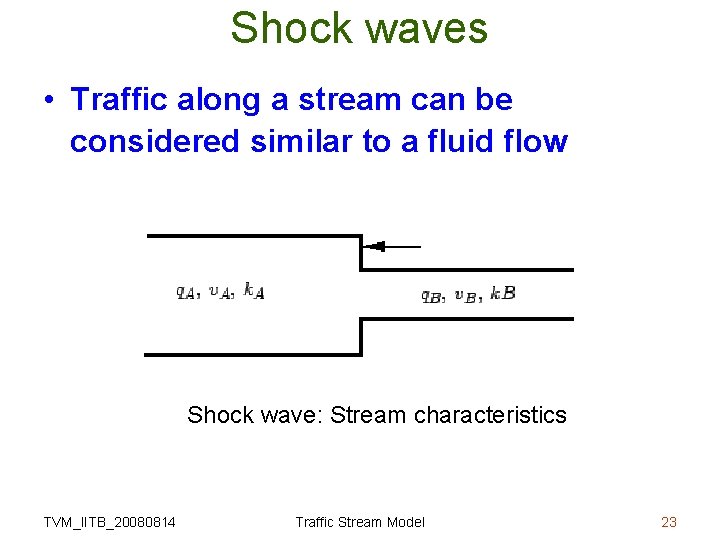
Shock waves • Traffic along a stream can be considered similar to a fluid flow Shock wave: Stream characteristics TVM_IITB_20080814 Traffic Stream Model 23
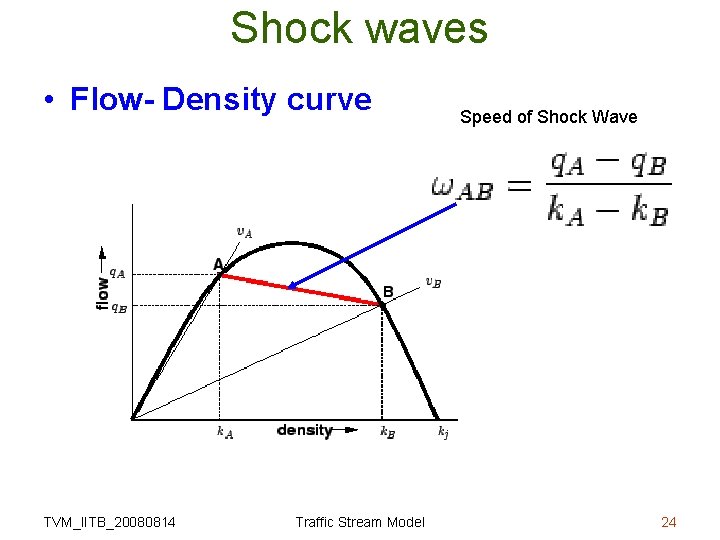
Shock waves • Flow- Density curve TVM_IITB_20080814 Traffic Stream Model Speed of Shock Wave 24
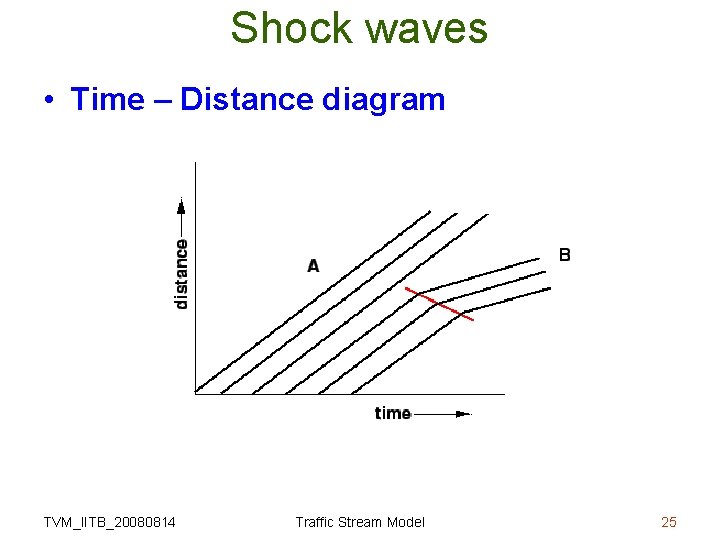
Shock waves • Time – Distance diagram TVM_IITB_20080814 Traffic Stream Model 25
Conclusion • Concerns – The current status of mathematical models for speedflow concentration relationships is in a state of flux – The models that dominated for nearly 30 years are incompatible with the data currently being obtained – but no replacement models have yet been developed Lieu 1999, Traffic-Flow Theory US DOT, Federal Highway Administration http: //www. tfhrc. gov/pubrds/janfeb 99/traffic. htm TVM_IITB_20080814 Traffic Stream Model 26
Conclusion • Trends – Despite those words of caution, it is important to note that there have been significant advances in understanding traffic stream behavior since 1980’s leading to a better understanding of traffic operation – Efforts to implement ITS will provide challenges for applying this improvement – Equally important, ITS will likely provide the opportunity for acquiring more and better data to advance understanding of traffic operations TVM_IITB_20080814 Traffic Stream Model 27

Thank You tomvmathew@gmail. com TVM_IITB_20080814 Traffic Stream Model
- Slides: 28