
Traffic Stream Characterisation Visual Courtesy Madras Traffic photo


- Slides: 28
Traffic Stream Characterisation
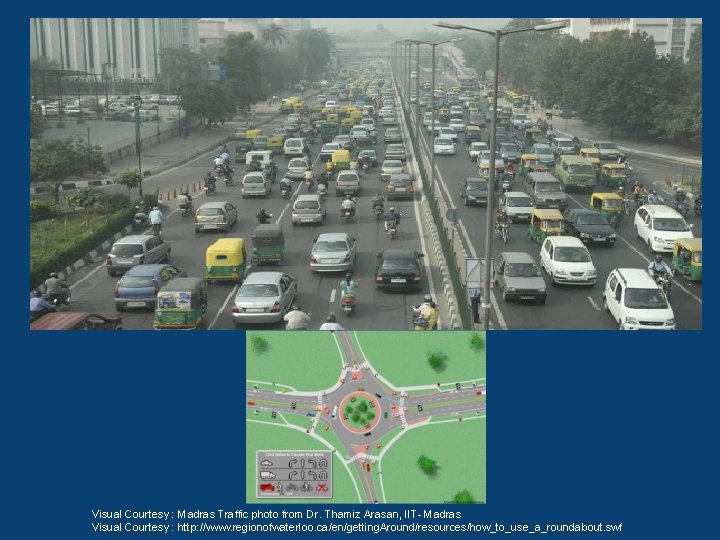
Visual Courtesy : Madras Traffic photo from Dr. Thamiz Arasan, IIT- Madras Visual Courtesy : http: //www. regionofwaterloo. ca/en/getting. Around/resources/how_to_use_a_roundabout. swf
Hello, Good day everybody… In today’s presentation, I will talk about traffic stream characterisation. In our day to day life, we come across vehicular traffic on the road. We experiences various traffic conditions. Some times Traffic jam, some chaos and many times free flow condition. Let us look at this small video showing traffic condition in Mumbai, Delhi and Jaipur city.
This is Mumbai traffic. Here you can see that, one side of the road has very high volume of traffic and vehicles are travelling back to back. While in other side, vehicles are relatively spaced apart and are free to drive easily with high speed.
Now this Delhi traffic is somewhat similar to Mumbai traffic, but you may can observe that traffic composition, means proportion of various types of vehicles is different here. Vehicles in left side of the road has speed less compare to right side. This is Jaipur city traffic. You can observe that total vehicle volume is less. Two wheelers are more. Also cars are parked on road reducing usable road space affectting the traffic stream.
Let’s see, one more video. This video is from Gurgaon, and is recorded using a drone. You can observe traffic on eight lane divided road. In right most lane, cars are travelling back to back. Here, there is curvature on the road. Here, you can see, cars are having sufficient space to drive comfortably with high speed.
Here in left side of the road, you can observe that cars are travelling back to back having relatively low speed. Now, after seeing these various traffic conditions in videos, Let’s come back to our presentation.
Learning Outcomes After attending this presentation, you will be able to: 1. Describe traffic condition. 2. Define traffic stream parameters. 3. List traffic stream parameters. 4. Explain inter relationship between traffic stream parameters.
Traffic Stream Parameters v Identification of traffic stream parameters. v Traffic stream at macro level can be described mainly by three parameters. • Flow • Speed • Density v At micro level, one more parameter headway is also required.
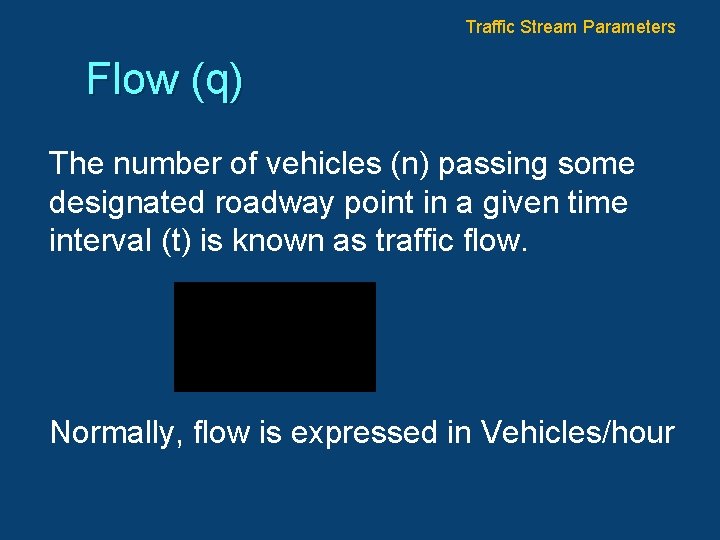
Traffic Stream Parameters Flow (q) The number of vehicles (n) passing some designated roadway point in a given time interval (t) is known as traffic flow. Normally, flow is expressed in Vehicles/hour
Traffic Stream Parameters Speed v Each vehicle within traffic stream having different speed. v. Traffic stream speed is representative of all vehicles in the stream. Defined as: (a) Time mean speed (b) Space mean speed
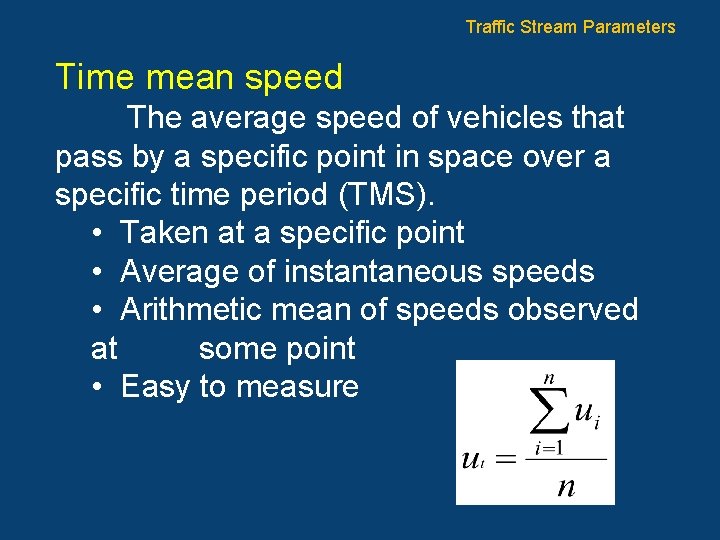
Traffic Stream Parameters Time mean speed The average speed of vehicles that pass by a specific point in space over a specific time period (TMS). • Taken at a specific point • Average of instantaneous speeds • Arithmetic mean of speeds observed at some point • Easy to measure
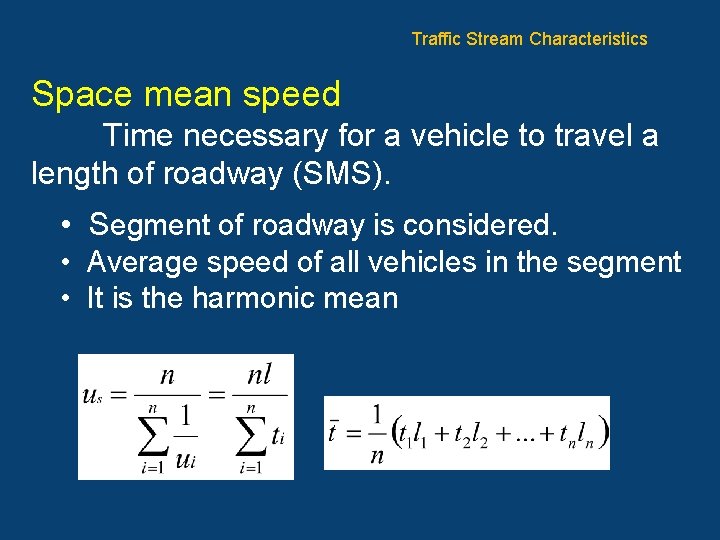
Traffic Stream Characteristics Space mean speed Time necessary for a vehicle to travel a length of roadway (SMS). • Segment of roadway is considered. • Average speed of all vehicles in the segment • It is the harmonic mean
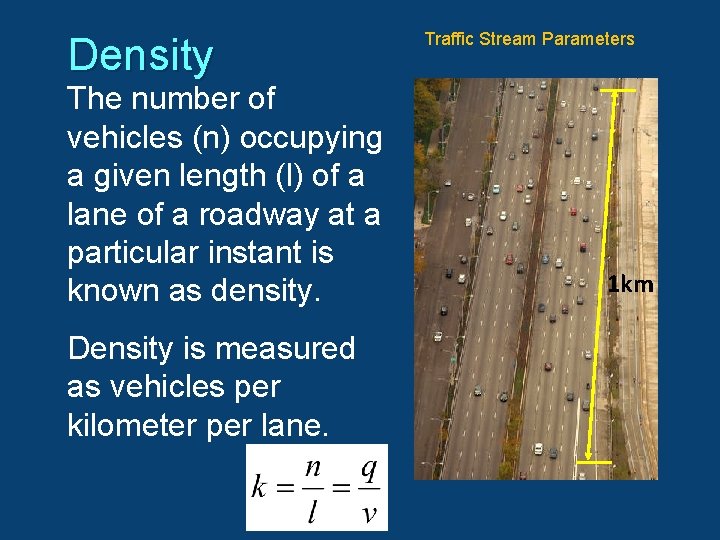
Density The number of vehicles (n) occupying a given length (l) of a lane of a roadway at a particular instant is known as density. Density is measured as vehicles per kilometer per lane. Traffic Stream Parameters 1 km
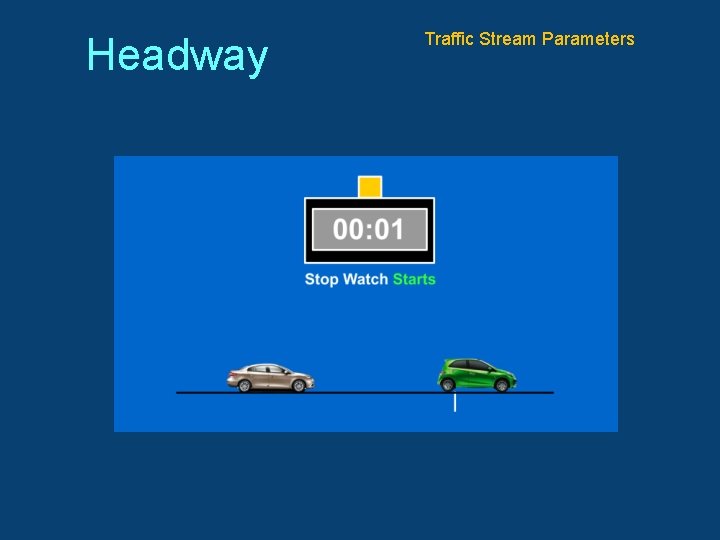
Traffic Stream Parameters Headway Time Headway The time (in seconds) between successive vehicles, as their front bumpers pass a given point.
Headway Traffic Stream Parameters
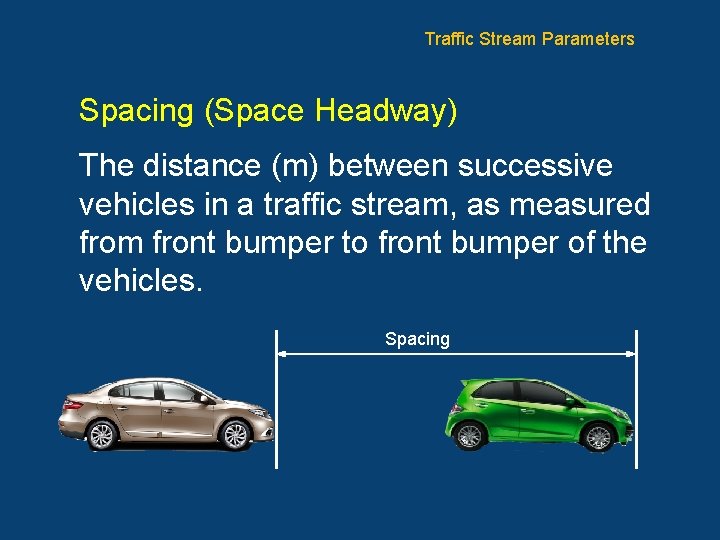
Traffic Stream Parameters Spacing (Space Headway) The distance (m) between successive vehicles in a traffic stream, as measured from front bumper to front bumper of the vehicles. Spacing
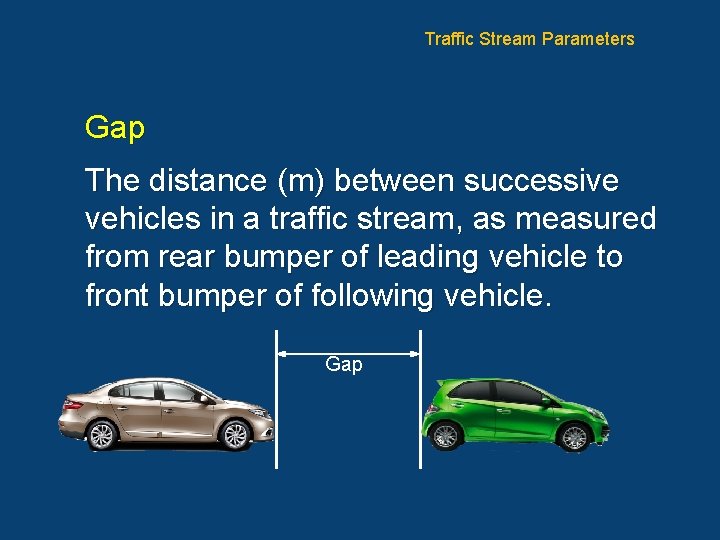
Traffic Stream Parameters Gap The distance (m) between successive vehicles in a traffic stream, as measured from rear bumper of leading vehicle to front bumper of following vehicle. Gap
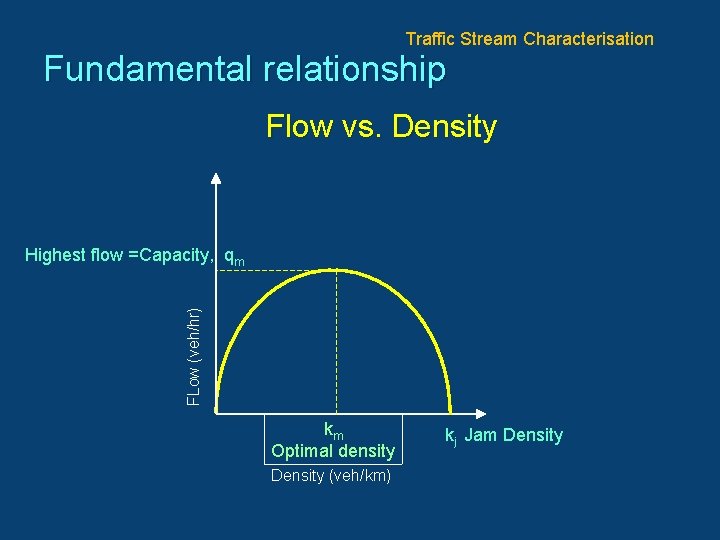
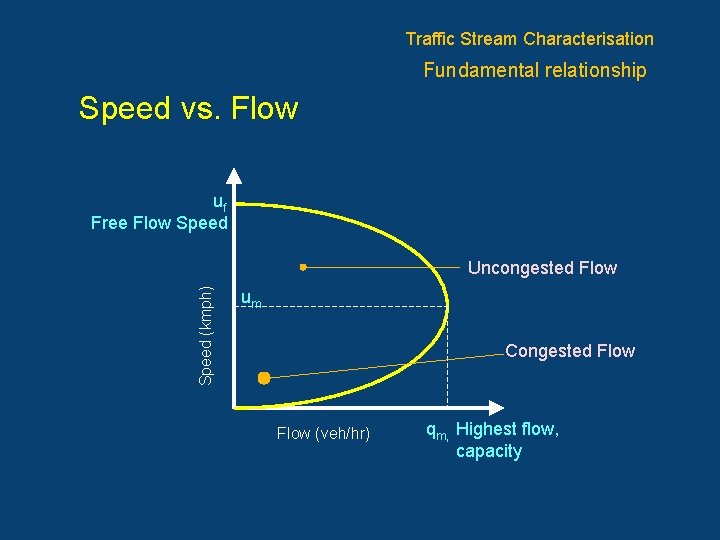
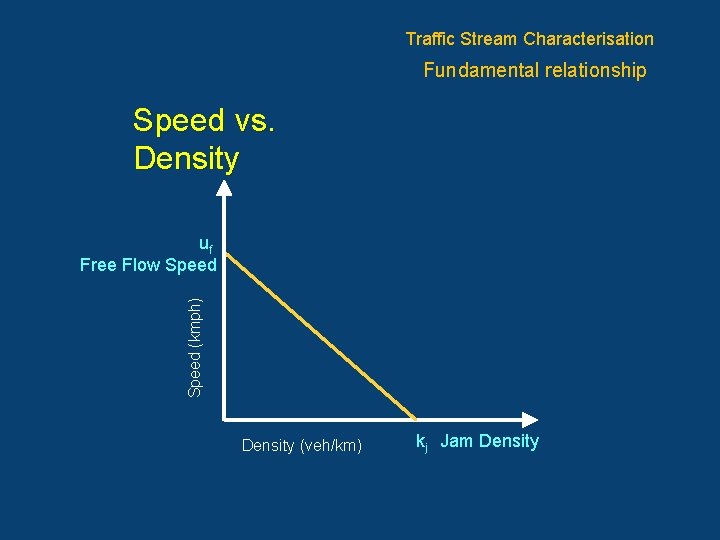
Traffic Stream Characterisation Fundamental relationship • Traffic stream characterisation is nothing but to establish inter relationship between traffic stream parameters. • There is a definite relationship between flow, density and speed for each road. • This fundamental relationships can be established from field measured data. • Fundamental relationship is very useful for traffic analysis and design of road facilities.
Traffic Stream Characterisation Fundamental relationship Flow vs. Density FLow (veh/hr) Highest flow =Capacity, qm km Optimal density Density (veh/km) kj Jam Density
Traffic Stream Characterisation Fundamental relationship Speed vs. Flow uf Free Flow Speed (kmph) Uncongested Flow um Congested Flow (veh/hr) qm, Highest flow, capacity
Traffic Stream Characterisation Fundamental relationship Speed vs. Density Speed (kmph) uf Free Flow Speed Density (veh/km) kj Jam Density
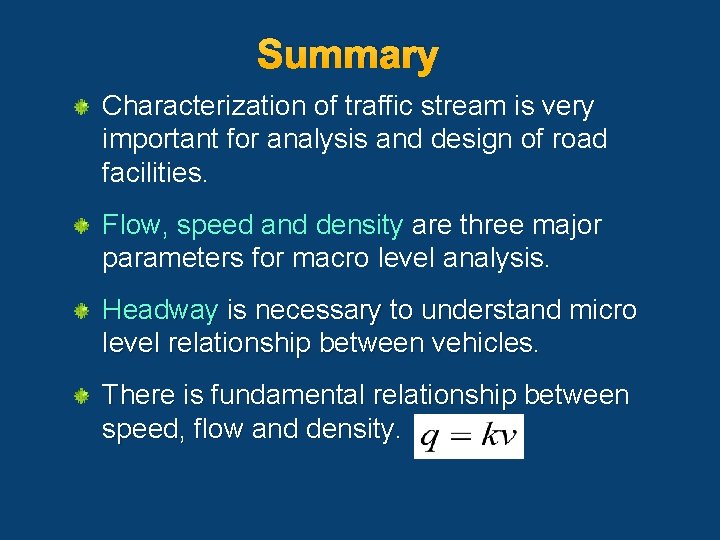
Summary Characterization of traffic stream is very important for analysis and design of road facilities. Flow, speed and density are three major parameters for macro level analysis. Headway is necessary to understand micro level relationship between vehicles. There is fundamental relationship between speed, flow and density.
Self Assessment 1) 2) 3) 4) 5) 6) List traffic stream parameters. Define traffic density. State unit of traffic flow. What is Time Mean Speed ? Differentiate between spacing and gap. State the type of relationship between traffic stream speed and flow.
References �Highway Engineering by Khanna & Justo, Khanna Publishers, New Delhi �Traffic Engineering and Transport Planning by Dr. L. R. Kadiyali, Khanna Publishers, New Delhi
This is all about the traffic stream characterisation. I hope you must have enjoyed this presentation. Thank you very much…. .
Presented By Dinesh H. Vagadia Lecturer in Civil Engineering Government Polytechnic Rajkot