
Traffic Signal Equipment Update The Role and Impact

- Slides: 10
Traffic Signal Equipment Update
The Role and Impact of Traffic Signals and Systems in a Community • Traffic Signals impact virtually everyone in a community. • From drivers going through town -> To children crossing for school at a Signalized Intersection. • Drivers confidently place their own, and their passenger's safety in a Traffic Signal operating properly. • Inefficient Traffic Signals, not only impact the safety of the community, but can impact the public by silently stealing dollars with increased fuel cost and longer travel times.
Conditions Which Create a Need to Upgrade or Install New Traffic Equipment • Community Growth and an increase use of the roadway. • Obsolete Equipment o Frequent failure of older traffic equipment that results in degraded and inefficient on-street operation. • The need to obtain improved traffic control using modern hardware and software not supported by existing traffic equipment. • Traffic Equipment Reliability • Vendor support and spare parts no longer available with older traffic equipment. • Future technology not compatible with outdated equipment.
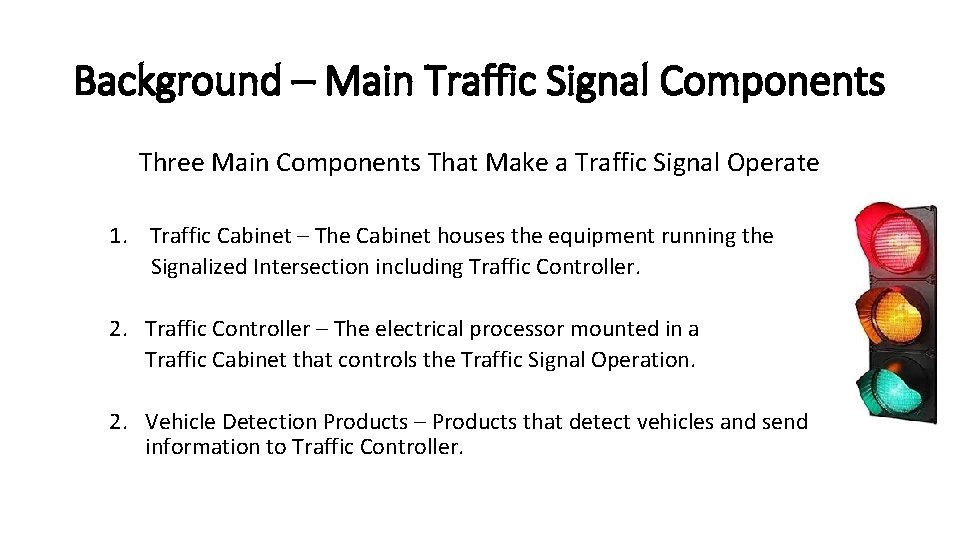
Background – Main Traffic Signal Components Three Main Components That Make a Traffic Signal Operate 1. Traffic Cabinet – The Cabinet houses the equipment running the Signalized Intersection including Traffic Controller. 2. Traffic Controller – The electrical processor mounted in a Traffic Cabinet that controls the Traffic Signal Operation. 2. Vehicle Detection Products – Products that detect vehicles and send information to Traffic Controller.
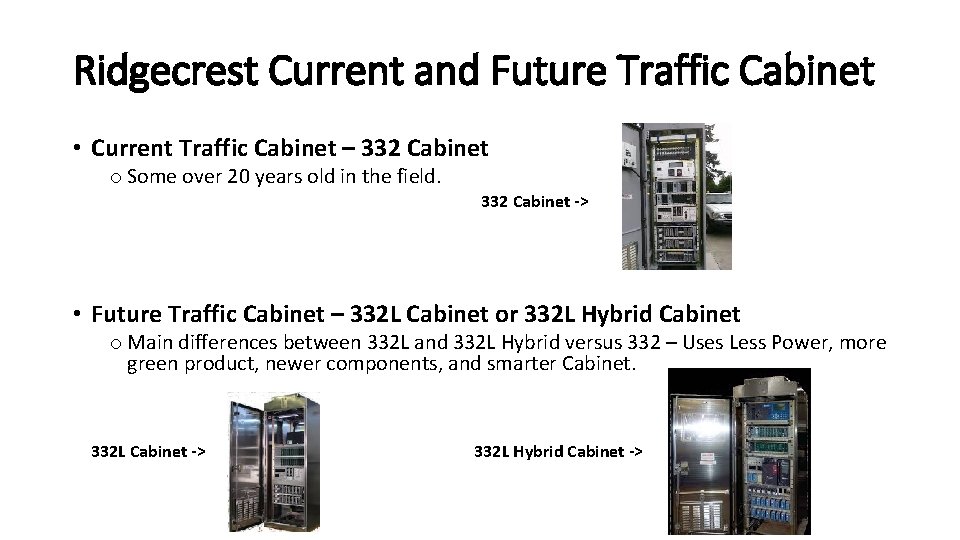
Ridgecrest Current and Future Traffic Cabinet • Current Traffic Cabinet – 332 Cabinet o Some over 20 years old in the field. 332 Cabinet -> • Future Traffic Cabinet – 332 L Cabinet or 332 L Hybrid Cabinet o Main differences between 332 L and 332 L Hybrid versus 332 – Uses Less Power, more green product, newer components, and smarter Cabinet. 332 L Cabinet -> 332 L Hybrid Cabinet ->
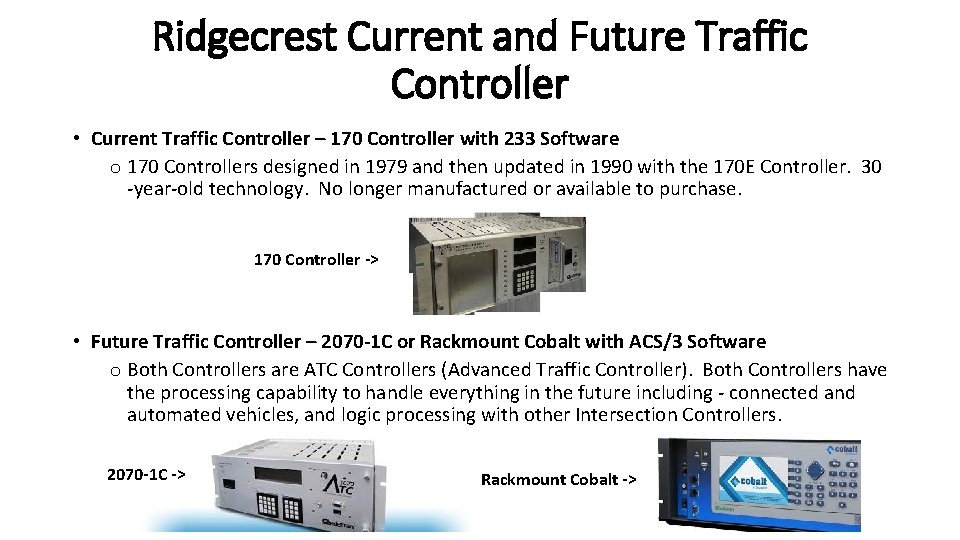
Ridgecrest Current and Future Traffic Controller • Current Traffic Controller – 170 Controller with 233 Software o 170 Controllers designed in 1979 and then updated in 1990 with the 170 E Controller. 30 -year-old technology. No longer manufactured or available to purchase. 170 Controller -> • Future Traffic Controller – 2070 -1 C or Rackmount Cobalt with ACS/3 Software o Both Controllers are ATC Controllers (Advanced Traffic Controller). Both Controllers have the processing capability to handle everything in the future including - connected and automated vehicles, and logic processing with other Intersection Controllers. 2070 -1 C -> Rackmount Cobalt ->
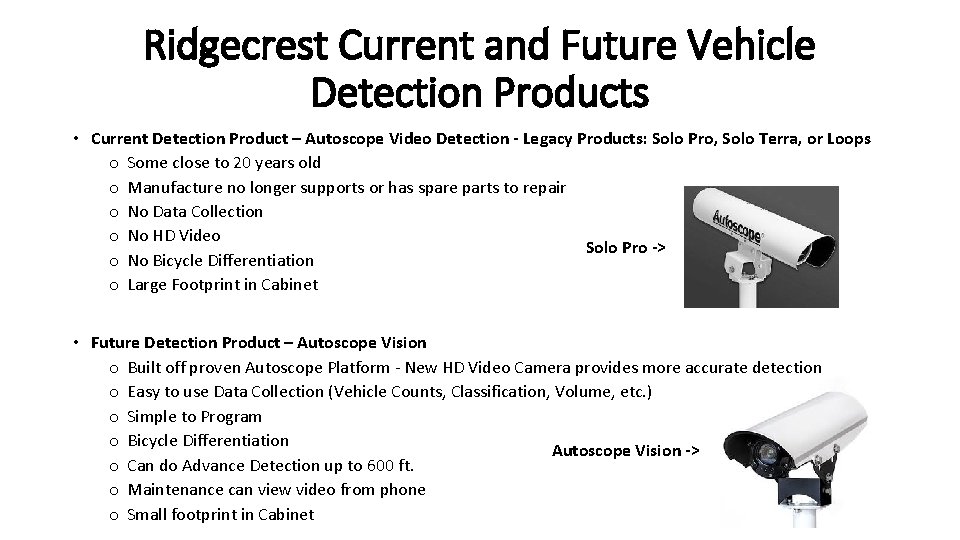
Ridgecrest Current and Future Vehicle Detection Products • Current Detection Product – Autoscope Video Detection - Legacy Products: Solo Pro, Solo Terra, or Loops o Some close to 20 years old o Manufacture no longer supports or has spare parts to repair o No Data Collection o No HD Video Solo Pro -> o No Bicycle Differentiation o Large Footprint in Cabinet • Future Detection Product – Autoscope Vision o Built off proven Autoscope Platform - New HD Video Camera provides more accurate detection o Easy to use Data Collection (Vehicle Counts, Classification, Volume, etc. ) o Simple to Program o Bicycle Differentiation Autoscope Vision -> o Can do Advance Detection up to 600 ft. o Maintenance can view video from phone o Small footprint in Cabinet
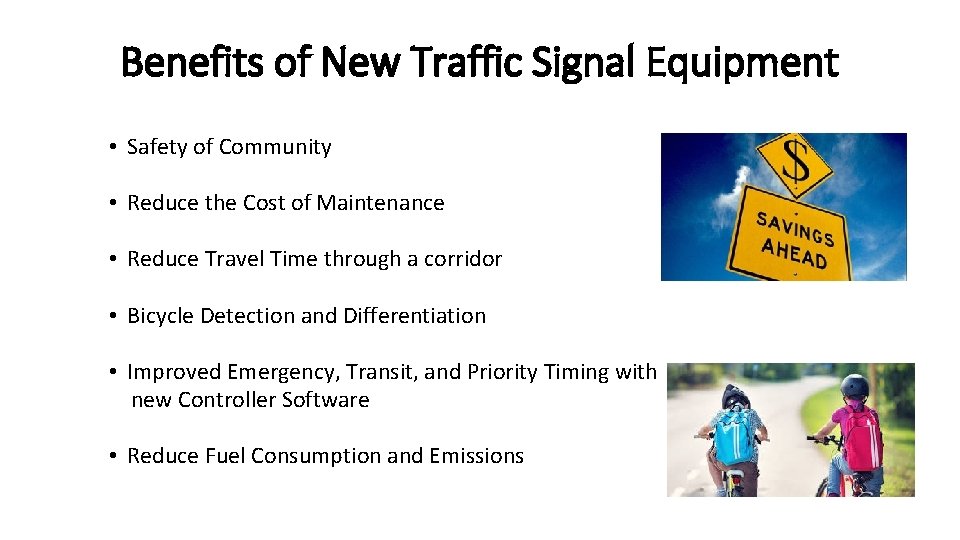
Benefits of New Traffic Signal Equipment • Safety of Community • Reduce the Cost of Maintenance • Reduce Travel Time through a corridor • Bicycle Detection and Differentiation • Improved Emergency, Transit, and Priority Timing with new Controller Software • Reduce Fuel Consumption and Emissions
Pricing to Update Equipment • Price for New Cabinet - $8, 000 • Price for New Controller - $3, 500 • Price for New Video Detection (4 -Approach Intersection) - $21, 000 • Please note pricing for Budgetary Estimates
Sources • https: //ops. fhwa. dot. gov/publications/fhwahop 06006/index. htm • https: //www. access-board. gov/research/completedresearch/interfacing-aps-with-traffic-signal-controlequipment/appendix-a