
Traffic and mobility psychologyeducation Insights on childrens behaviour
Traffic and mobility psychology/education Insights on children’s behaviour Mobiel 21 – March 2008 Elke Bossaert, Lies Lambert CONNECT – Developing & Disseminating Excellent Mobility Management Measures for Young People
Contents 1. Children ≠ small adults 2. Traffic & mobility education 3. How and why of campaigns such as the Traffic Snake Game CONNECT – Developing & Disseminating Excellent Mobility Management Measures for Young People
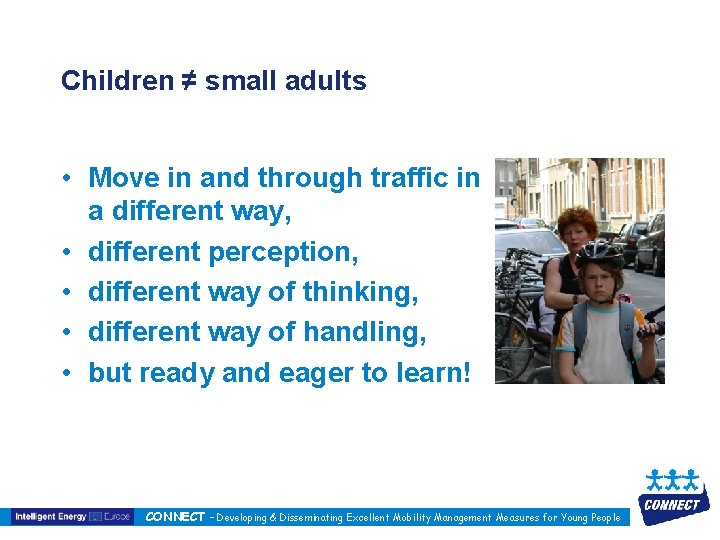
Children ≠ small adults • Move in and through traffic in a different way, • different perception, • different way of thinking, • different way of handling, • but ready and eager to learn! CONNECT – Developing & Disseminating Excellent Mobility Management Measures for Young People
Perceiving / Perception • Seeing – Children have a different point of view…. literally • Hearing – Directions are difficult and hard to determine • Attention – Experiencing the world from a self-centred point of view – Attention is diversified; before the age of 8 it is difficult, if not impossible to give attention to the most important things in traffic CONNECT – Developing & Disseminating Excellent Mobility Management Measures for Young People

Perceiving / Perception (2) Viewing behaviour of a 9 -year old without cycling experience (number of fixation = 13 ) CONNECT – Developing & Disseminating Excellent Mobility Management Measures for Young People
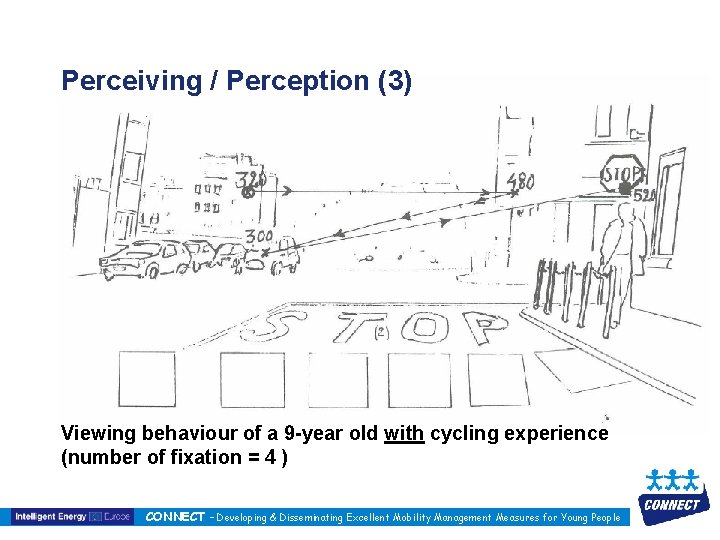
Perceiving / Perception (3) Viewing behaviour of a 9 -year old with cycling experience (number of fixation = 4 ) CONNECT – Developing & Disseminating Excellent Mobility Management Measures for Young People
Thinking • Magical Thinking – Magical thinking is a child's belief that what he or she wishes or expects can affect what really happens – Till the age of 4 to 5, reality and fantasy seem to collide with each other – Difficulty to understand that what they want is not always what they will get CONNECT – Developing & Disseminating Excellent Mobility Management Measures for Young People
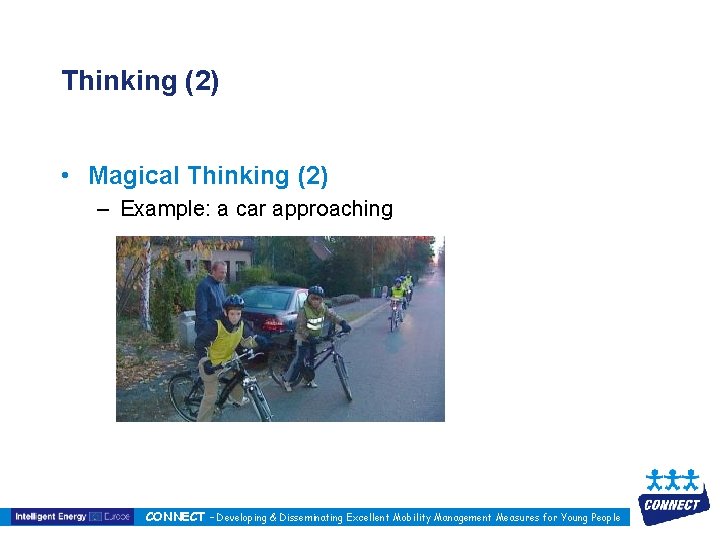
Thinking (2) • Magical Thinking (2) – Example: a car approaching CONNECT – Developing & Disseminating Excellent Mobility Management Measures for Young People
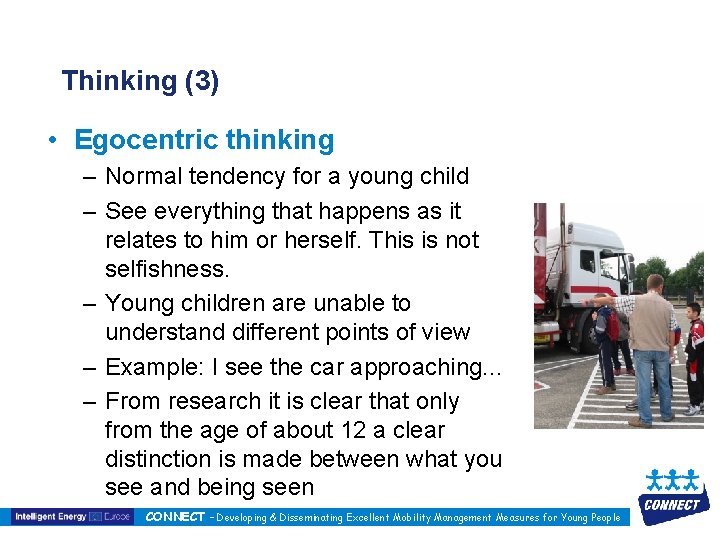
Thinking (3) • Egocentric thinking – Normal tendency for a young child – See everything that happens as it relates to him or herself. This is not selfishness. – Young children are unable to understand different points of view – Example: I see the car approaching. . . – From research it is clear that only from the age of about 12 a clear distinction is made between what you see and being seen CONNECT – Developing & Disseminating Excellent Mobility Management Measures for Young People
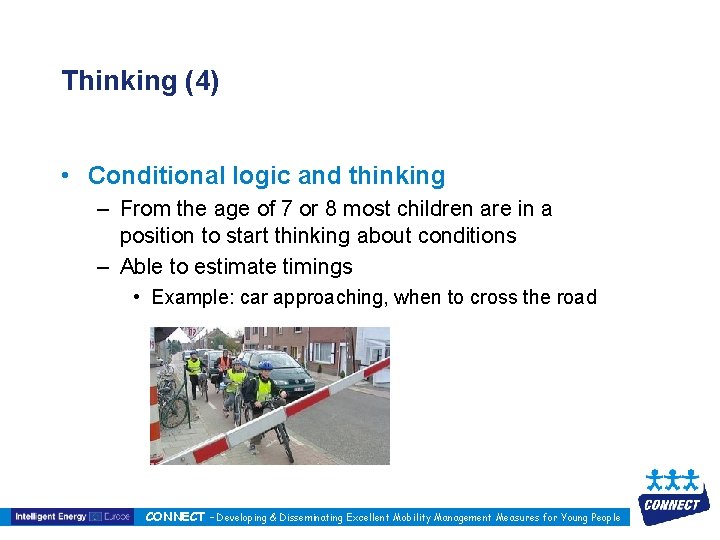
Thinking (4) • Conditional logic and thinking – From the age of 7 or 8 most children are in a position to start thinking about conditions – Able to estimate timings • Example: car approaching, when to cross the road CONNECT – Developing & Disseminating Excellent Mobility Management Measures for Young People
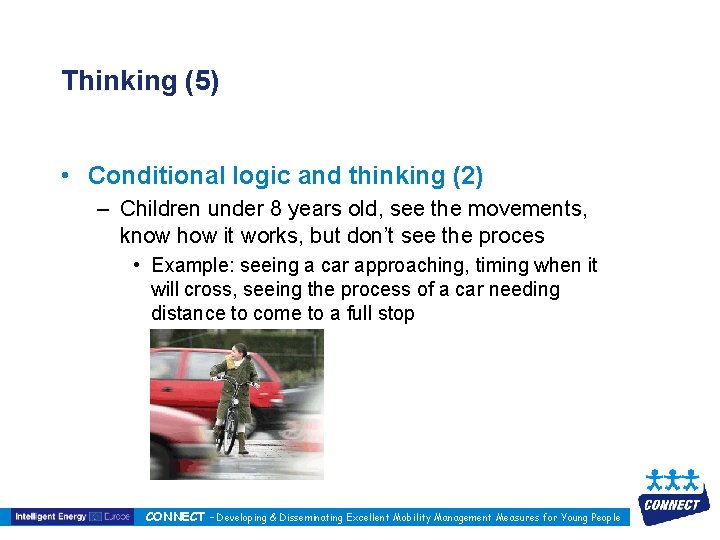
Thinking (5) • Conditional logic and thinking (2) – Children under 8 years old, see the movements, know how it works, but don’t see the proces • Example: seeing a car approaching, timing when it will cross, seeing the process of a car needing distance to come to a full stop CONNECT – Developing & Disseminating Excellent Mobility Management Measures for Young People
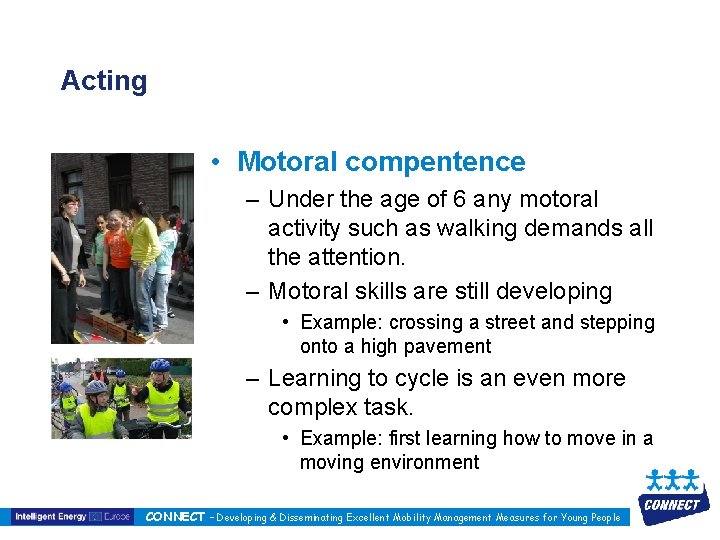
Acting • Motoral compentence – Under the age of 6 any motoral activity such as walking demands all the attention. – Motoral skills are still developing • Example: crossing a street and stepping onto a high pavement – Learning to cycle is an even more complex task. • Example: first learning how to move in a moving environment CONNECT – Developing & Disseminating Excellent Mobility Management Measures for Young People
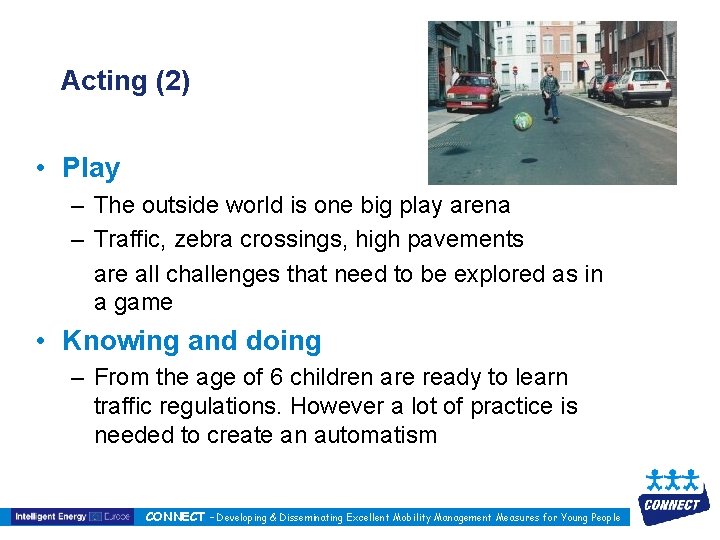
Acting (2) • Play – The outside world is one big play arena – Traffic, zebra crossings, high pavements are all challenges that need to be explored as in a game • Knowing and doing – From the age of 6 children are ready to learn traffic regulations. However a lot of practice is needed to create an automatism CONNECT – Developing & Disseminating Excellent Mobility Management Measures for Young People
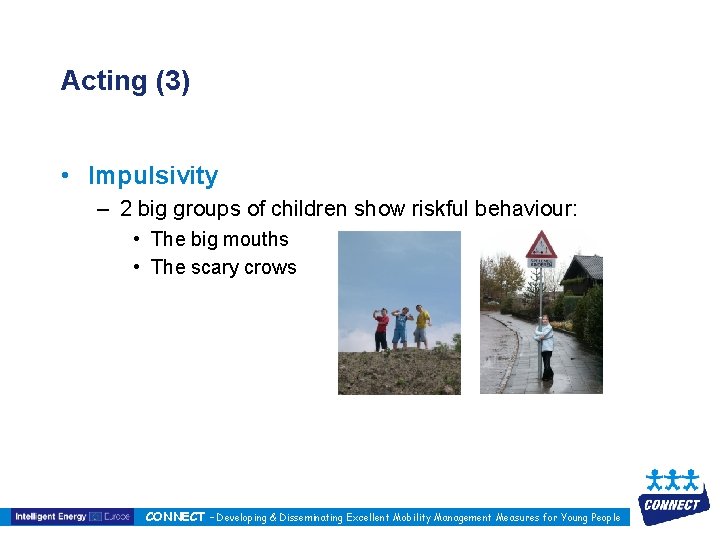
Acting (3) • Impulsivity – 2 big groups of children show riskful behaviour: • The big mouths • The scary crows CONNECT – Developing & Disseminating Excellent Mobility Management Measures for Young People
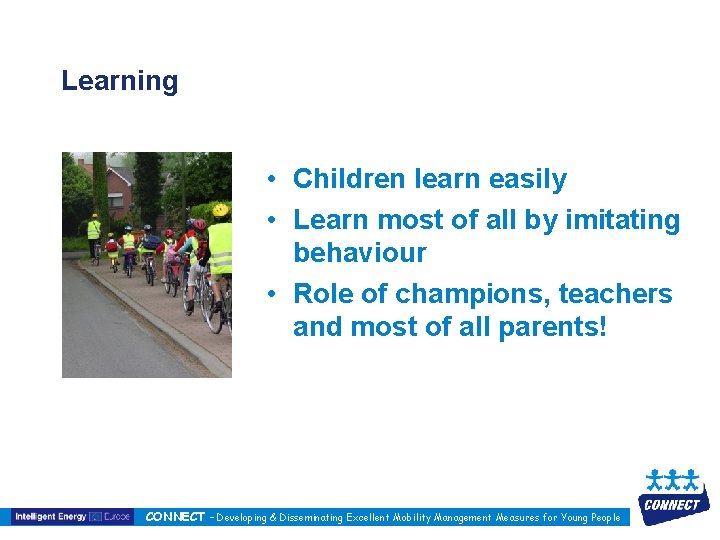
Learning • Children learn easily • Learn most of all by imitating behaviour • Role of champions, teachers and most of all parents! CONNECT – Developing & Disseminating Excellent Mobility Management Measures for Young People
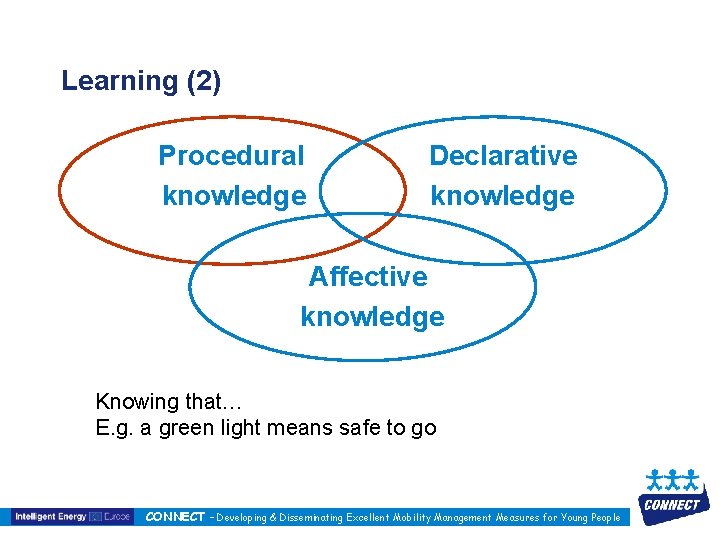
Learning (2) Procedural knowledge Declarative knowledge Affective knowledge Knowing that… E. g. a green light means safe to go CONNECT – Developing & Disseminating Excellent Mobility Management Measures for Young People
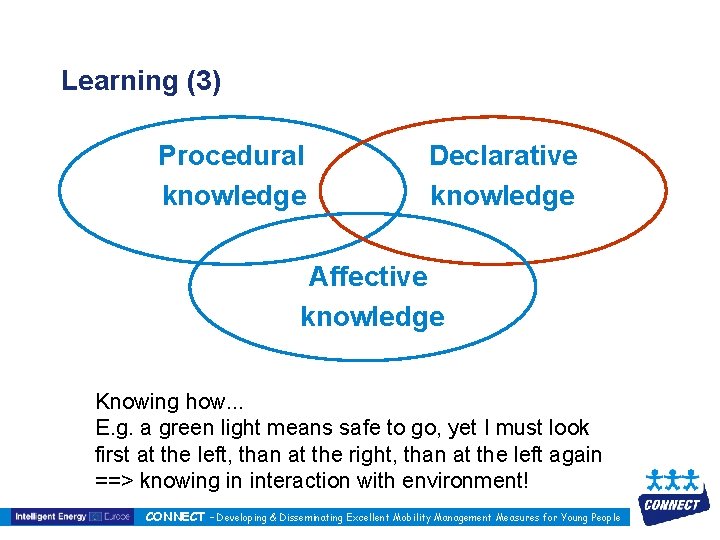
Learning (3) Procedural knowledge Declarative knowledge Affective knowledge Knowing how. . . E. g. a green light means safe to go, yet I must look first at the left, than at the right, than at the left again ==> knowing in interaction with environment! CONNECT – Developing & Disseminating Excellent Mobility Management Measures for Young People
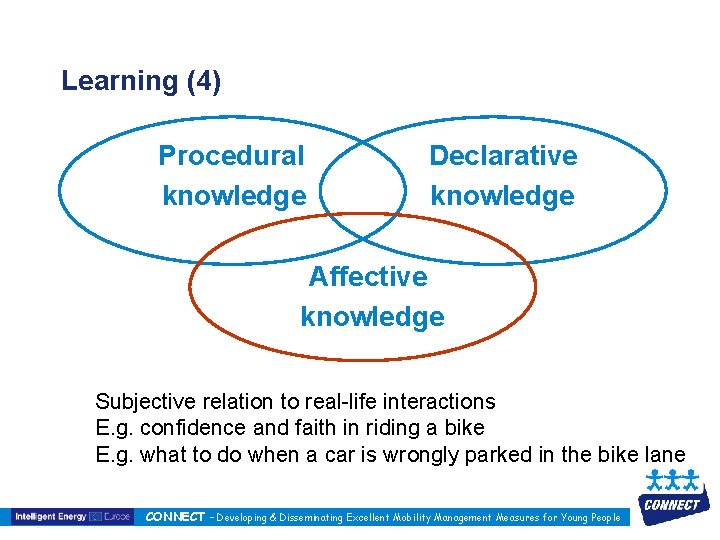
Learning (4) Procedural knowledge Declarative knowledge Affective knowledge Subjective relation to real-life interactions E. g. confidence and faith in riding a bike E. g. what to do when a car is wrongly parked in the bike lane CONNECT – Developing & Disseminating Excellent Mobility Management Measures for Young People
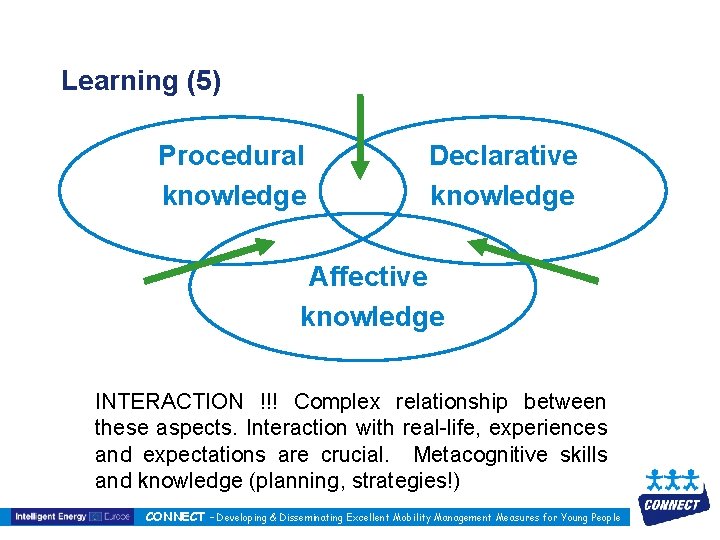
Learning (5) Procedural knowledge Declarative knowledge Affective knowledge INTERACTION !!! Complex relationship between these aspects. Interaction with real-life, experiences and expectations are crucial. Metacognitive skills and knowledge (planning, strategies!) CONNECT – Developing & Disseminating Excellent Mobility Management Measures for Young People
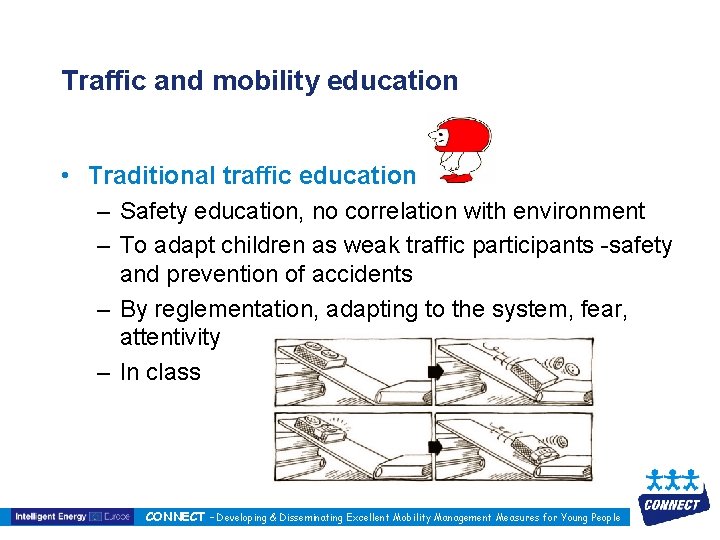
Traffic and mobility education • Traditional traffic education – Safety education, no correlation with environment – To adapt children as weak traffic participants -safety and prevention of accidents – By reglementation, adapting to the system, fear, attentivity – In class CONNECT – Developing & Disseminating Excellent Mobility Management Measures for Young People
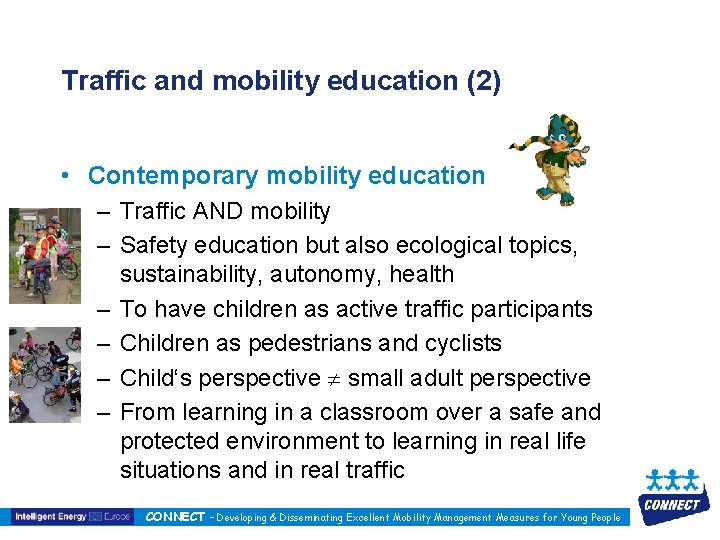
Traffic and mobility education (2) • Contemporary mobility education – Traffic AND mobility – Safety education but also ecological topics, – – sustainability, autonomy, health To have children as active traffic participants Children as pedestrians and cyclists Child‘s perspective small adult perspective From learning in a classroom over a safe and protected environment to learning in real life situations and in real traffic CONNECT – Developing & Disseminating Excellent Mobility Management Measures for Young People
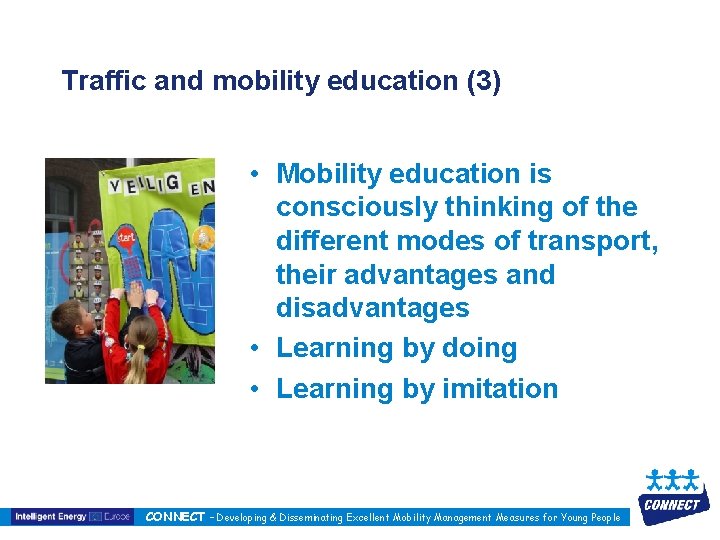
Traffic and mobility education (3) • Mobility education is consciously thinking of the different modes of transport, their advantages and disadvantages • Learning by doing • Learning by imitation CONNECT – Developing & Disseminating Excellent Mobility Management Measures for Young People
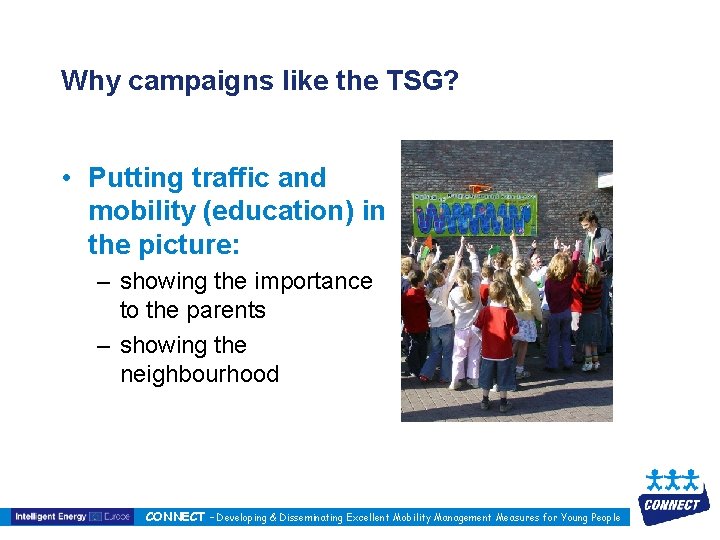
Why campaigns like the TSG? • Putting traffic and mobility (education) in the picture: – showing the importance to the parents – showing the neighbourhood CONNECT – Developing & Disseminating Excellent Mobility Management Measures for Young People
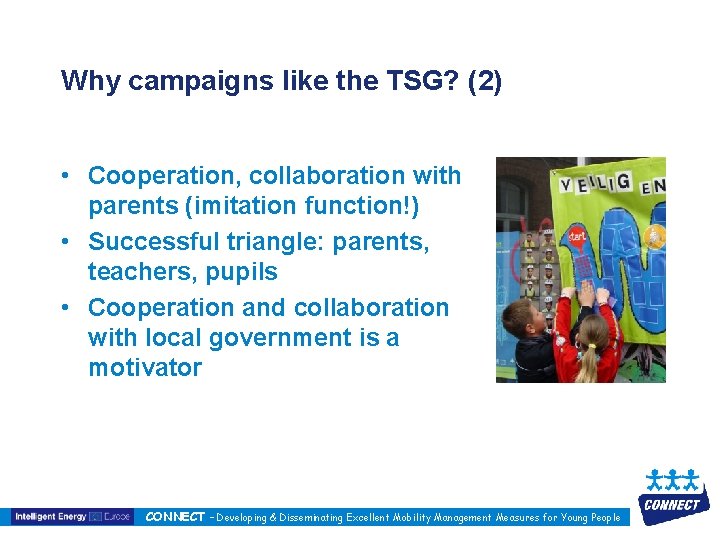
Why campaigns like the TSG? (2) • Cooperation, collaboration with parents (imitation function!) • Successful triangle: parents, teachers, pupils • Cooperation and collaboration with local government is a motivator CONNECT – Developing & Disseminating Excellent Mobility Management Measures for Young People
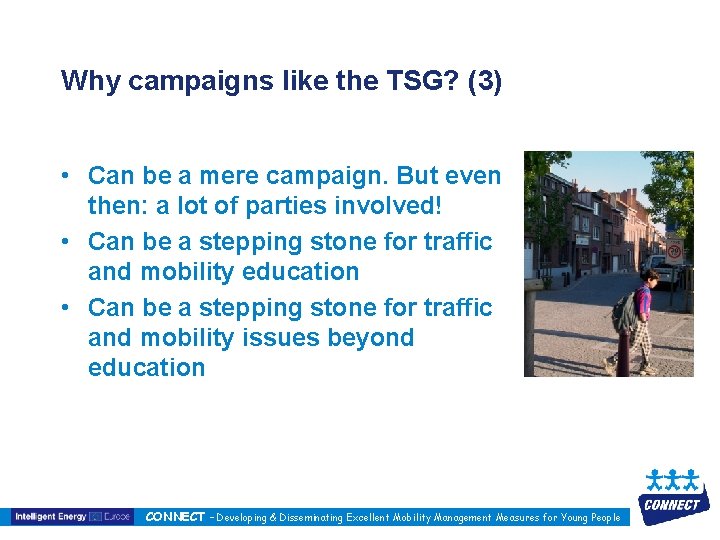
Why campaigns like the TSG? (3) • Can be a mere campaign. But even then: a lot of parties involved! • Can be a stepping stone for traffic and mobility education • Can be a stepping stone for traffic and mobility issues beyond education CONNECT – Developing & Disseminating Excellent Mobility Management Measures for Young People
- Slides: 25