
Traditional Tales Myths Folktales Fables Legends and Tall
Traditional Tales Myths, Folktales, Fables, Legends and Tall Tales
Traditional Tales: • Fiction • Told primarily to entertain, but also to educate. • Were first told by storytellers without books. • They were passed down through the generations. • They tell us how to behave in a way that is entertaining and easy to remember.
Types of Traditional Tales: • Fairy Tales: – Magic of some sort: a magical being, a spell or enchantment, a magical place, a magical object, a magical event. – Clear good and bad characters, often in a struggle with each other. – Good characters are often beautiful, bad characters are often ugly. – No specific time or place. – Often include repetition of words, events, or characters in groups of three.
Myths: • Ancient tales told in the oral tradition in nearly every culture. • Told to explain the mysteries of nature and the world around the people. • Characters are often gods, or animals with human qualities (talking, reasoning, planning). • Often the main character is given some sort of punishment or consequences for being foolish or angering someone else.
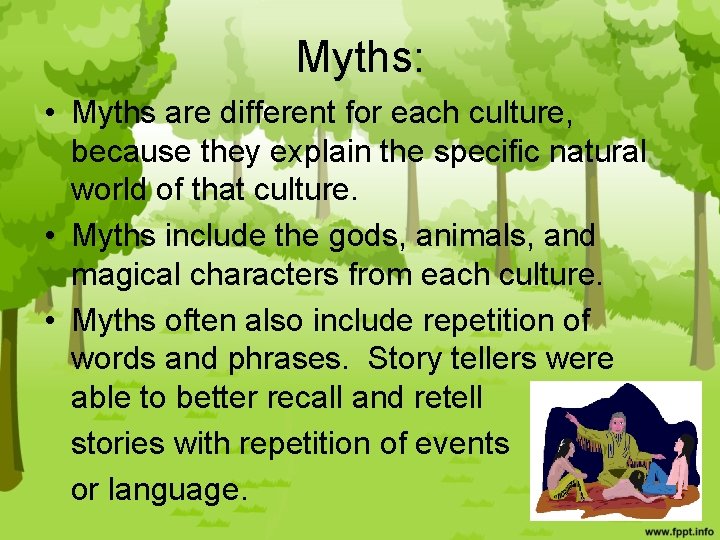
Myths: • Myths are different for each culture, because they explain the specific natural world of that culture. • Myths include the gods, animals, and magical characters from each culture. • Myths often also include repetition of words and phrases. Story tellers were able to better recall and retell stories with repetition of events or language.
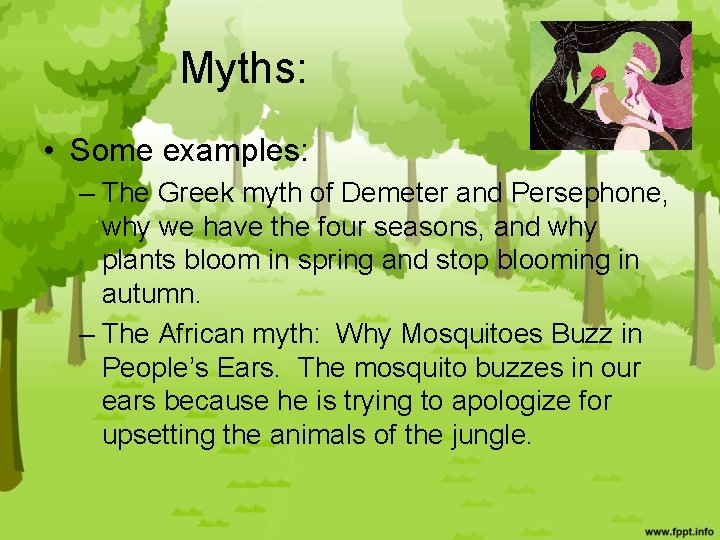
Myths: • Some examples: – The Greek myth of Demeter and Persephone, why we have the four seasons, and why plants bloom in spring and stop blooming in autumn. – The African myth: Why Mosquitoes Buzz in People’s Ears. The mosquito buzzes in our ears because he is trying to apologize for upsetting the animals of the jungle.
Folktales • Stories about regular “folk” • Usually do not involve magic. • Like fairy tales and fables, they usually have a lesson for the listener. • Like fairy tales, they are often structured to have repetition, and to be easy to remember and retell. • Like fairy tales, often have a nonspecific setting.
Folktales • Some examples: • Stone Soup: Three travelers use a harmless trick to get a good meal and a warm bed for the night. The stingy villagers learn to be generous with strangers, and to combine resources for the good of everyone. • The Empty Pot: A humble Chinese child is the only honest contestant in a contest to be the new heir to the throne. His example teaches other children the importance of honesty, and the idea that good behavior is rewarded.
Fables • May involve people, but usually involve animals acting like humans. • Very short stories. • The moral, or lesson, of the story, is clearly stated at the end. • Told to teach people how to behave in an entertaining way that they will remember.
Fables: Authors • Fables exist in most cultures. • Most of the fables we are familiar with are said to have come from the Greek storyteller Aesop, who told his fables over 2500 years ago. • Little is known for certain about Aesop. Some sources say he was an African slave in Greece, some say he was blind, and some say he never existed at all.
Fables – Some Examples: • The Tortoise and the Hare: Slow and steady wins the race. Don’t rush – stick with your task and work through it carefully and with persistence. • The Grasshopper and the Ants: There is a time for work and a time for play. Do your work first, so you are prepared for hard times ahead, then you may play. Be prepared!
Legends • Stories that contain characters that may have been real people, but their qualities have been exaggerated over time in the story. • May be historically accurate is some ways. • The real people have been given superhuman, or heroic qualities in the legend.

Legends: Examples • Johnny Appleseed: John Chapman did exist, but some of his actions in the stories about him probably did not happen as they are told. • Davy Crockett: A real person, but the stories told and written about him are often exaggerated or made up.
Tall Tales • Tall Tales are American. • Like legends in that there is much exaggeration of real or make believe folks. • The exaggeration is so extreme because it is meant to be funny and seem impossible. • The characters are often super-human, but have a laid back attitude. • The characters have a problem, and often use trickery to solve it.
Tall Tales: Examples • • • Paul Bunyan and Babe, his blue ox Josh Mc. Broom Pecos Bill Old Stormalong Calamity Jane Mike Fink
Quiz Time! • In which genre are gods and goddesses often characters? • What is the purpose of these types of stories? • What is an example of this genre?
Quiz Time! • In which genre are gods and goddesses often characters? Myths • What is the purpose of these types of stories? To explain the natural world • What is an example of this genre? Persephone and Demeter, Why Mosquitoes Buzz in People’s Ears, Pandora’s Box.
Quiz Time • In which genre will you read about animals acting like people? • What is the purpose of this type of story? • What is an example of this genre?
Quiz Time • In which genre will you read about animals acting like people? Fables • What is the purpose of this type of story? To teach a lesson using a moral. • What is an example of this genre? The Tortoise and the Hare, The Grasshopper and the Ants.
Quiz Time! • In which genre will you find exaggeration so great as to seem impossible and funny? • What is another characteristic of this genre? • What is an example of this genre?
Quiz Time! • In which genre will you find exaggeration so great as to seem impossible and funny? Tall Tales • What is another characteristic of this genre? They are American. The main character often uses trickery to solve his problem • What is an example of this genre? Paul Bunyan, Pecos Bill, Calamity Jane, Josh Mc. Broom
Next Steps: • Go to Thatquiz. org, and take the Fairy Tales Characteristics Quiz. The code is: 69 ao 9 aih • Go to your bookshelves, or to the library, and read some traditional tales. Look for the characteristics you learned about. • Go to www. goldridge 08. com, click on third grade, click on myths and legends. Have fun!
- Slides: 22