
Traditional practices of application of N fertilizer New
![Corn N Fertilization: N rate (lb/A) = 35 + [1. 2 x EY (bu/A)]](https://slidetodoc.com/presentation_image_h2/695ad6d2fa2618ff024d3f0a1d1c3301/image-2.jpg "Corn N Fertilization: N rate (lb/A) = 35 + [1. 2 x EY (bu/A)]")

- Slides: 22
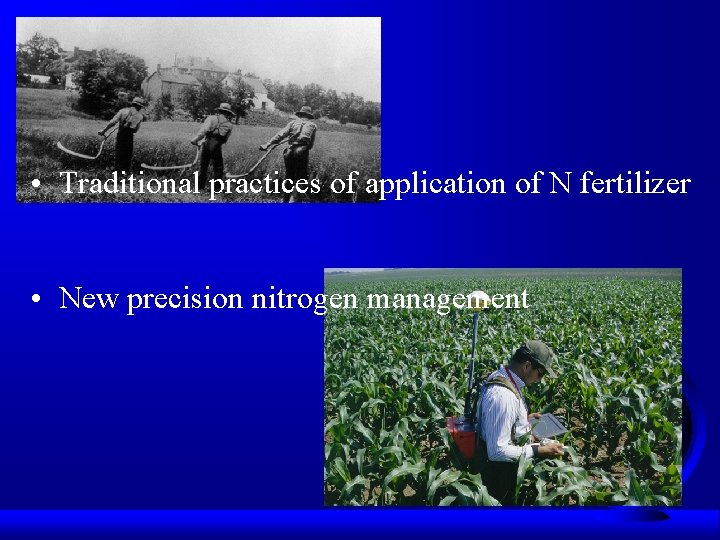
• Traditional practices of application of N fertilizer • New precision nitrogen management
Corn N Fertilization: N rate (lb/A) = 35 + [1. 2 x EY (bu/A)] - [8 x avg. ppm NO 3 -N in soil*] - [0. 14 x EY (bu/A) x %OM] - other N credits (lb/A) Other credits: manure applications; legume crop, NO 3 in irrigation water, etc. EY = expected yield %OM = percent organic matter * in the top 2 ft of soil.
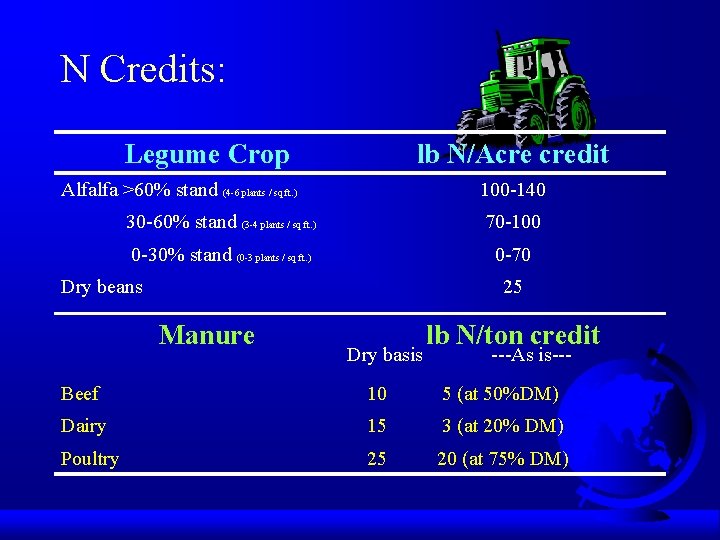
N Credits: Legume Crop lb N/Acre credit Alfalfa >60% stand (4 -6 plants / sq ft. ) 100 -140 30 -60% stand (3 -4 plants / sq ft. ) 70 -100 0 -30% stand (0 -3 plants / sq ft. ) 0 -70 Dry beans 25 Manure Dry basis lb N/ton credit ---As is--- Beef 10 5 (at 50%DM) Dairy 15 3 (at 20% DM) Poultry 25 20 (at 75% DM)
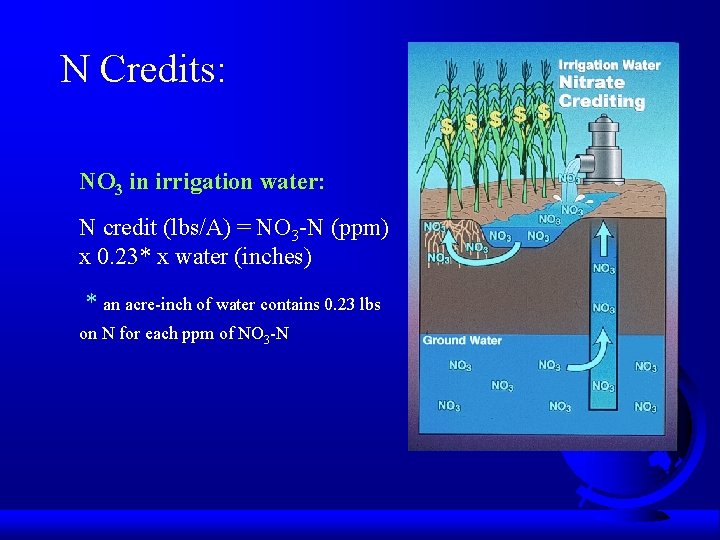
N Credits: NO 3 in irrigation water: N credit (lbs/A) = NO 3 -N (ppm) x 0. 23* x water (inches) * an acre-inch of water contains 0. 23 lbs on N for each ppm of NO 3 -N
Timing: Sprinkler irrigated: Starter band N; plus Side-dress at V 6 -V 8 and additional N via fertigation Furrow irrigated: Majority pre-plant apply N (heavy texture) Plus some side-dress (light texture) With manure application*, they typically apply in Fall/Spring plus side-dress N * Many farmers do not credit for manure, use it for disposal purposes
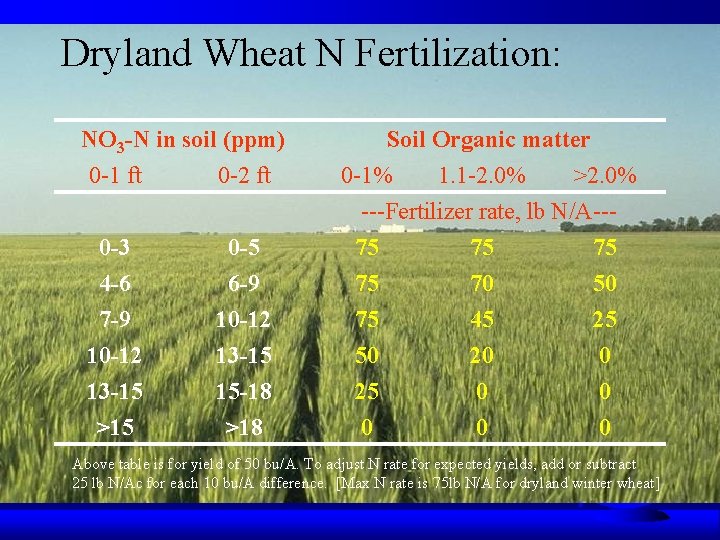
Dryland Wheat N Fertilization: NO 3 -N in soil (ppm) 0 -1 ft 0 -2 ft 0 -3 0 -5 4 -6 7 -9 10 -12 13 -15 >15 6 -9 10 -12 13 -15 15 -18 >18 Soil Organic matter 0 -1% 1. 1 -2. 0% >2. 0% ---Fertilizer rate, lb N/A--75 75 75 50 25 0 70 45 20 0 0 50 25 0 0 0 Above table is for yield of 50 bu/A. To adjust N rate for expected yields, add or subtract 25 lb N/Ac for each 10 bu/A difference. [Max N rate is 75 lb N/A for dryland winter wheat]
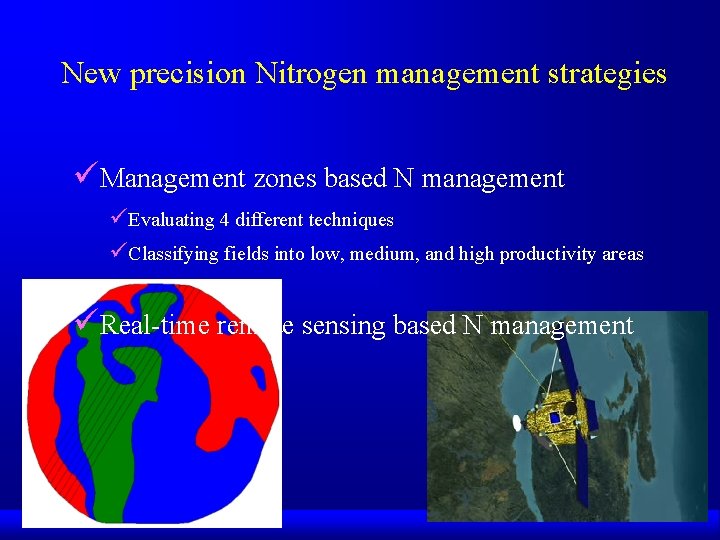
New precision Nitrogen management strategies üManagement zones based N management üEvaluating 4 different techniques üClassifying fields into low, medium, and high productivity areas üReal-time remote sensing based N management
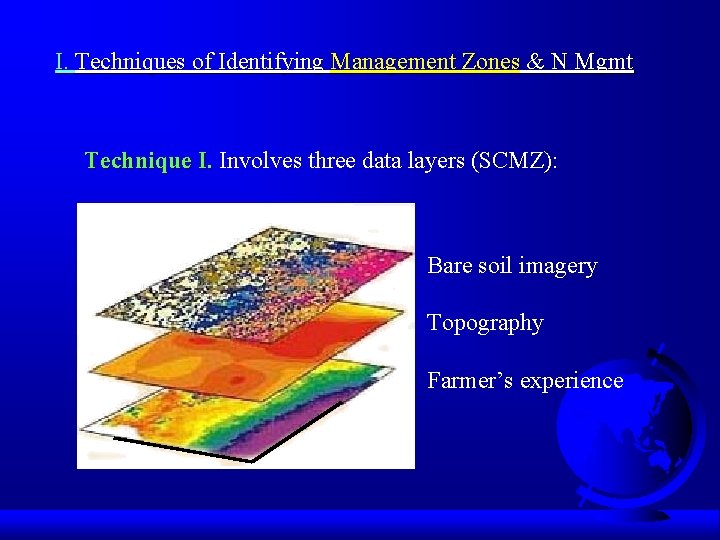
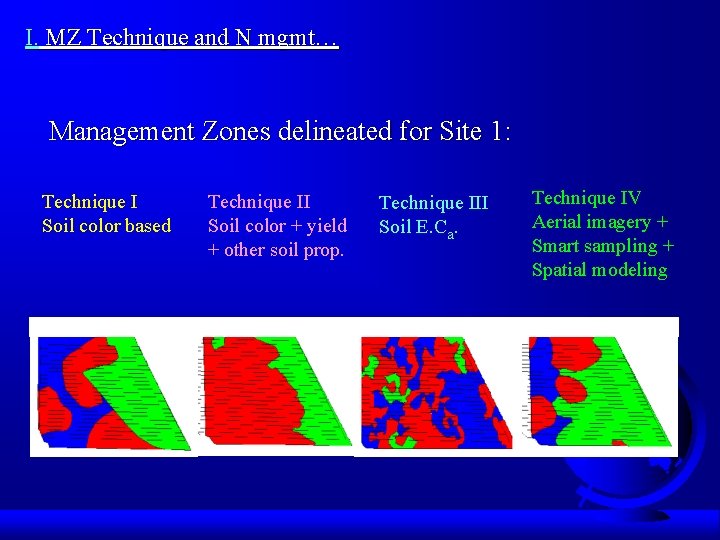
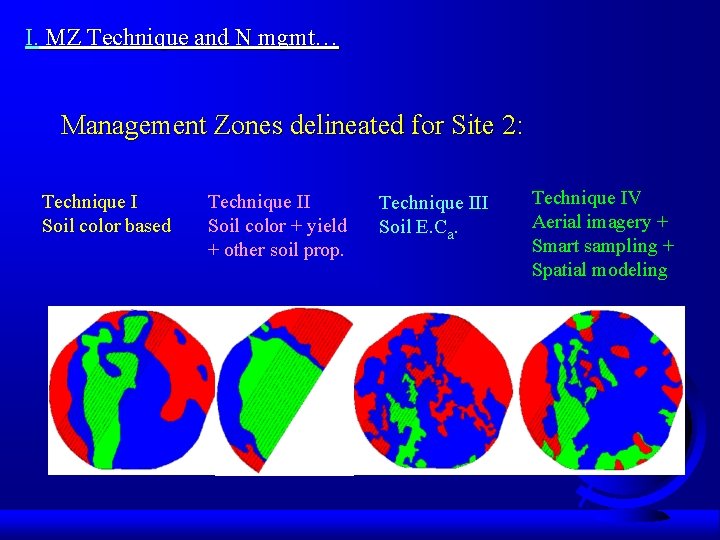
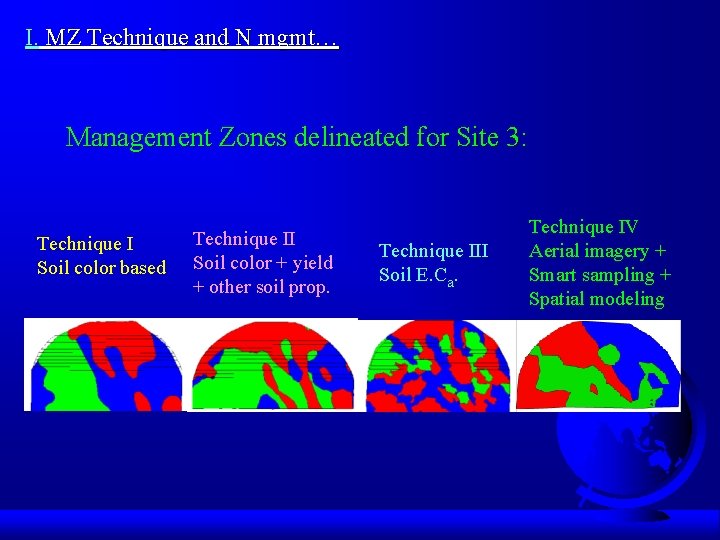
I. Techniques of Identifying Management Zones & N Mgmt Technique I. Involves three data layers (SCMZ): Bare soil imagery Topography Farmer’s experience
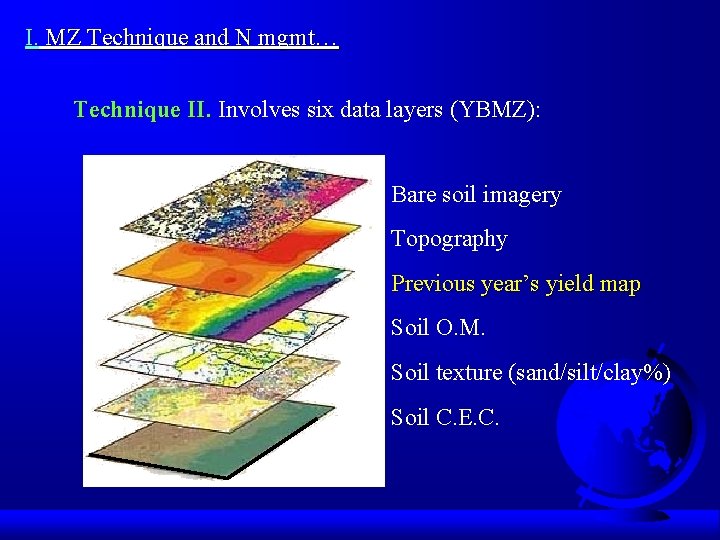
I. MZ Technique and N mgmt… Technique II. Involves six data layers (YBMZ): Bare soil imagery Topography Previous year’s yield map Soil O. M. Soil texture (sand/silt/clay%) Soil C. E. C.
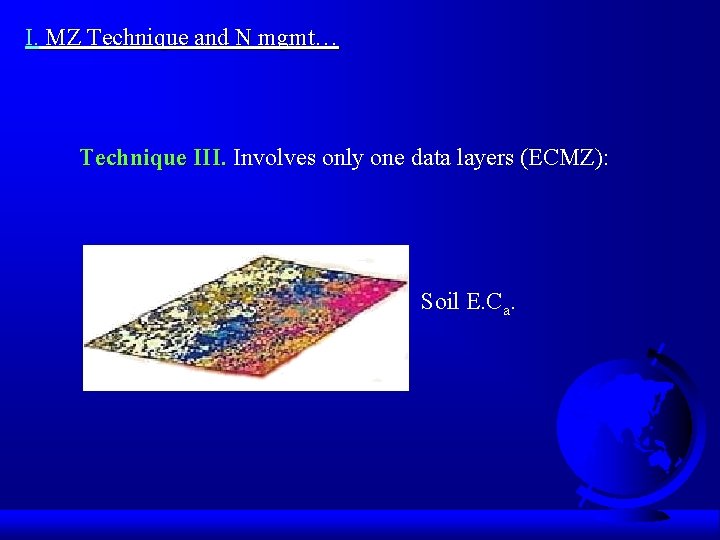
I. MZ Technique and N mgmt… Technique III. Involves only one data layers (ECMZ): Soil E. Ca.
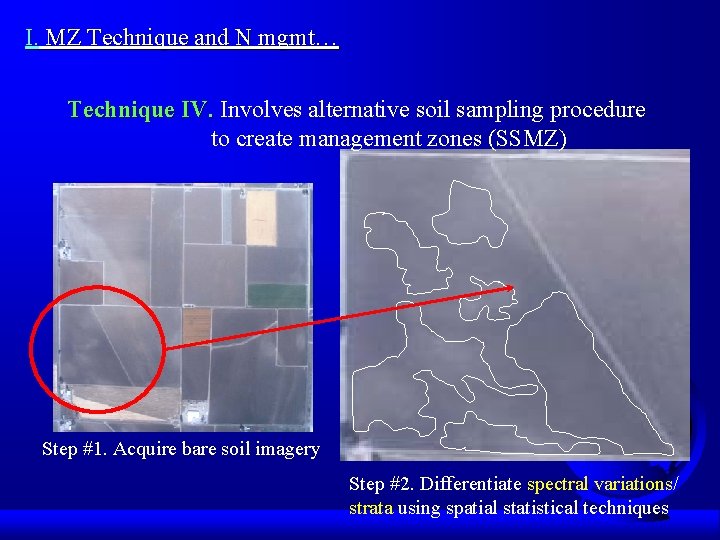
I. MZ Technique and N mgmt… Technique IV. Involves alternative soil sampling procedure to create management zones (SSMZ) Step #1. Acquire bare soil imagery Step #2. Differentiate spectral variations/ strata using spatial statistical techniques
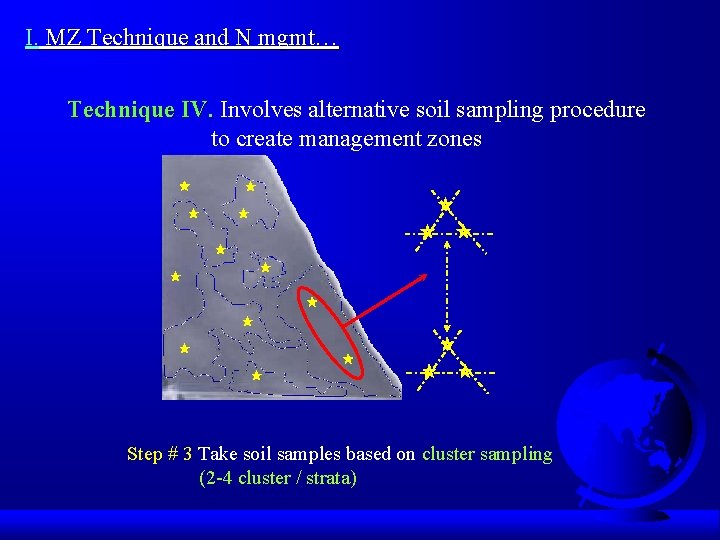
I. MZ Technique and N mgmt… Technique IV. Involves alternative soil sampling procedure to create management zones Step # 3 Take soil samples based on cluster sampling (2 -4 cluster / strata)
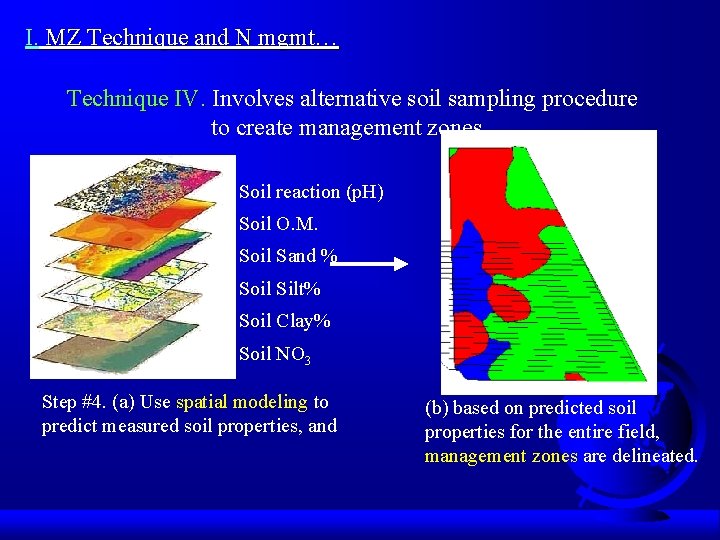
I. MZ Technique and N mgmt… Technique IV. Involves alternative soil sampling procedure to create management zones Soil reaction (p. H) Soil O. M. Soil Sand % Soil Silt% Soil Clay% Soil NO 3 Step #4. (a) Use spatial modeling to predict measured soil properties, and (b) based on predicted soil properties for the entire field, management zones are delineated.
I. MZ Technique and N mgmt… Management Zones delineated for Site 1: Technique I Soil color based Technique II Soil color + yield + other soil prop. Technique III Soil E. Ca. Technique IV Aerial imagery + Smart sampling + Spatial modeling
I. MZ Technique and N mgmt… Management Zones delineated for Site 2: Technique I Soil color based Technique II Soil color + yield + other soil prop. Technique III Soil E. Ca. Technique IV Aerial imagery + Smart sampling + Spatial modeling
I. MZ Technique and N mgmt… Management Zones delineated for Site 3: Technique I Soil color based Technique II Soil color + yield + other soil prop. Technique III Soil E. Ca. Technique IV Aerial imagery + Smart sampling + Spatial modeling
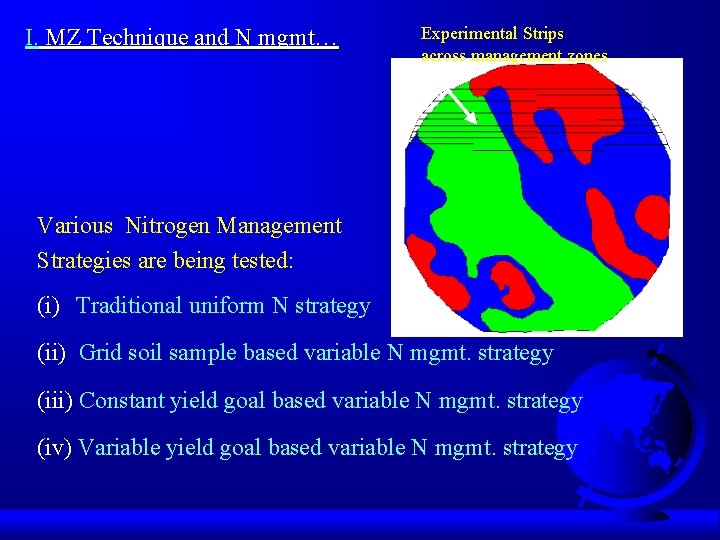
I. MZ Technique and N mgmt… Experimental Strips across management zones Various Nitrogen Management Strategies are being tested: (i) Traditional uniform N strategy (ii) Grid soil sample based variable N mgmt. strategy (iii) Constant yield goal based variable N mgmt. strategy (iv) Variable yield goal based variable N mgmt. strategy
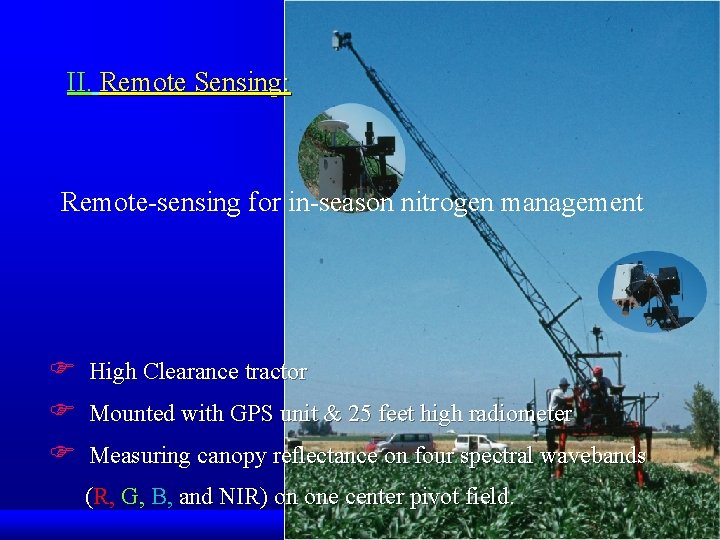
II. Remote Sensing: Remote-sensing for in-season nitrogen management F F F High Clearance tractor Mounted with GPS unit & 25 feet high radiometer Measuring canopy reflectance on four spectral wavebands (R, G, B, and NIR) on one center pivot field.
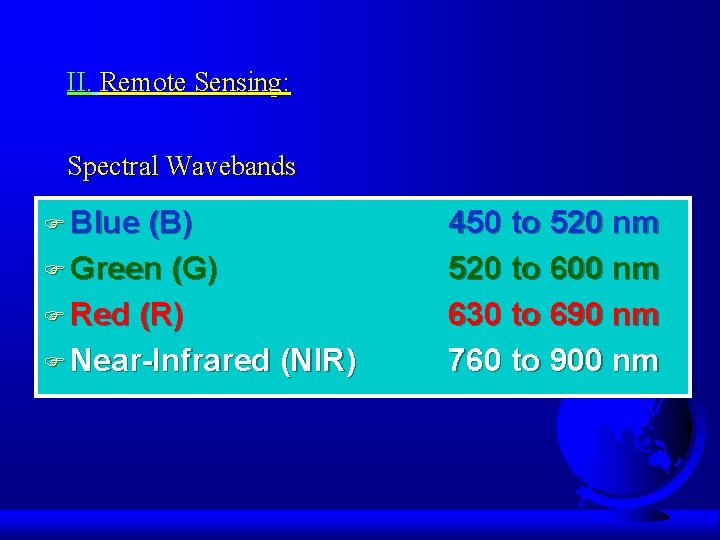
II. Remote Sensing: Spectral Wavebands F Blue (B) F Green (G) F Red (R) F Near-Infrared (NIR) 450 to 520 nm 520 to 600 nm 630 to 690 nm 760 to 900 nm
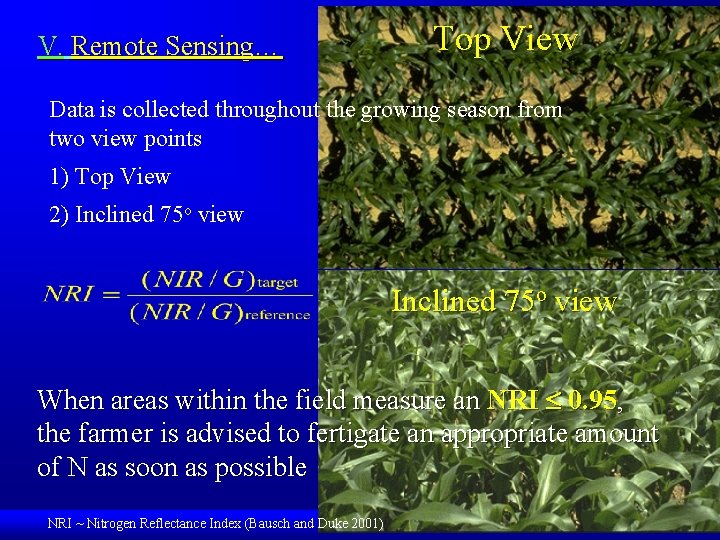
V. Remote Sensing… Top View Data is collected throughout the growing season from two view points 1) Top View 2) Inclined 75 o view When areas within the field measure an NRI 0. 95, the farmer is advised to fertigate an appropriate amount of N as soon as possible NRI ~ Nitrogen Reflectance Index (Bausch and Duke 2001)
Thank you