
Traditional Portuguese Instruments Traditional Portuguese Instruments GUITARRA PORTUGUESA
- Slides: 11
Traditional Portuguese Instruments
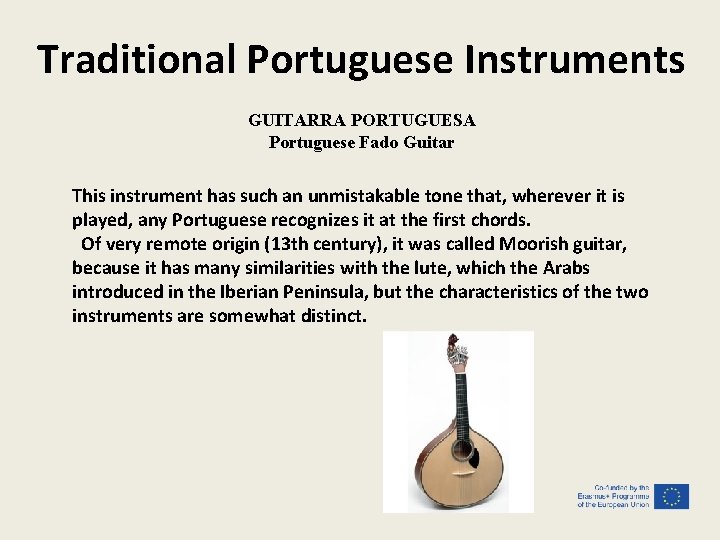
Traditional Portuguese Instruments GUITARRA PORTUGUESA Portuguese Fado Guitar This instrument has such an unmistakable tone that, wherever it is played, any Portuguese recognizes it at the first chords. Of very remote origin (13 th century), it was called Moorish guitar, because it has many similarities with the lute, which the Arabs introduced in the Iberian Peninsula, but the characteristics of the two instruments are somewhat distinct.
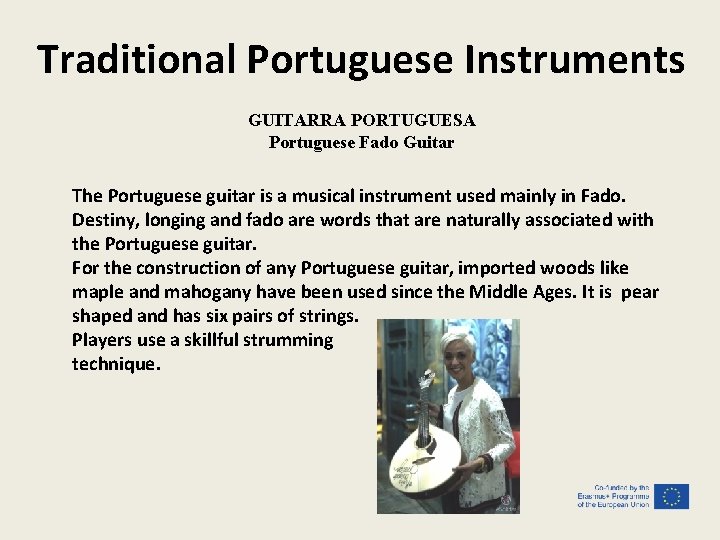
Traditional Portuguese Instruments GUITARRA PORTUGUESA Portuguese Fado Guitar The Portuguese guitar is a musical instrument used mainly in Fado. Destiny, longing and fado are words that are naturally associated with the Portuguese guitar. For the construction of any Portuguese guitar, imported woods like maple and mahogany have been used since the Middle Ages. It is pear shaped and has six pairs of strings. Players use a skillful strumming technique.
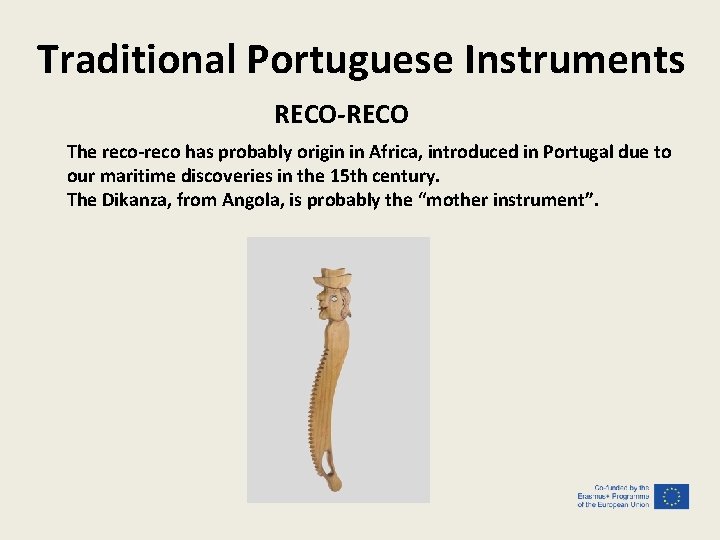
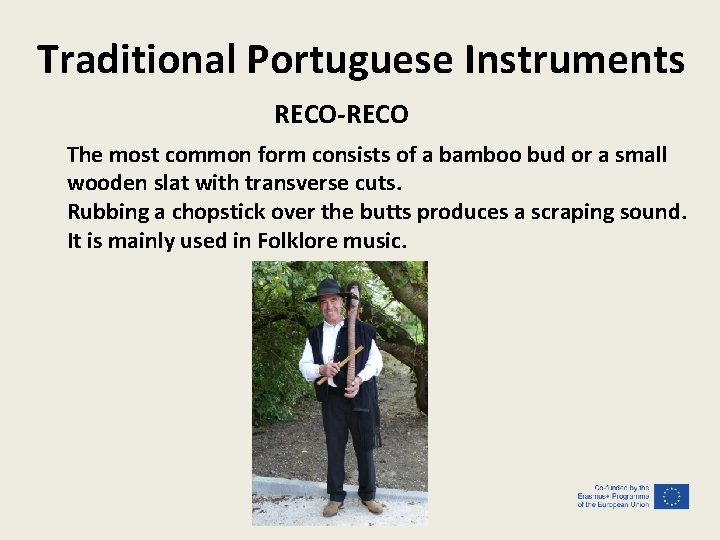
Traditional Portuguese Instruments RECO-RECO The reco-reco has probably origin in Africa, introduced in Portugal due to our maritime discoveries in the 15 th century. The Dikanza, from Angola, is probably the “mother instrument”.
Traditional Portuguese Instruments RECO-RECO The most common form consists of a bamboo bud or a small wooden slat with transverse cuts. Rubbing a chopstick over the butts produces a scraping sound. It is mainly used in Folklore music.
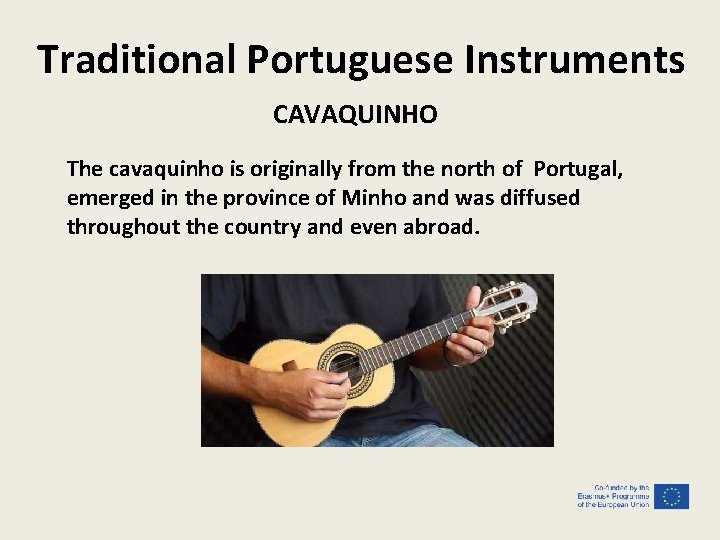
Traditional Portuguese Instruments CAVAQUINHO The cavaquinho is originally from the north of Portugal, emerged in the province of Minho and was diffused throughout the country and even abroad.
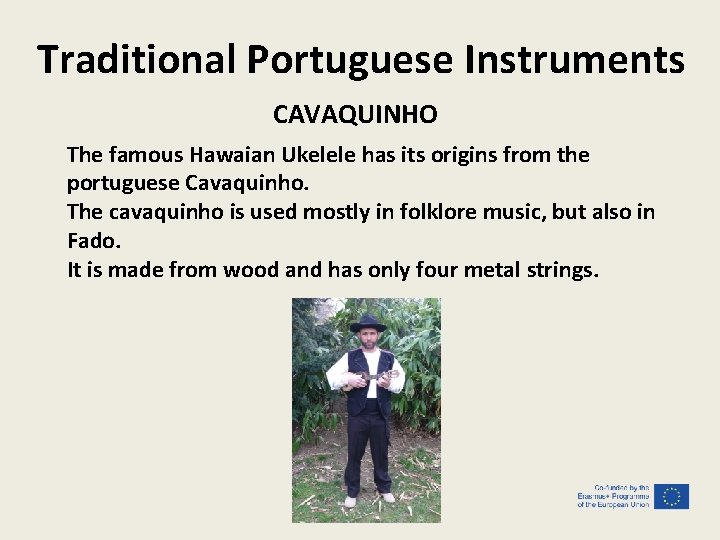
Traditional Portuguese Instruments CAVAQUINHO The famous Hawaian Ukelele has its origins from the portuguese Cavaquinho. The cavaquinho is used mostly in folklore music, but also in Fado. It is made from wood and has only four metal strings.
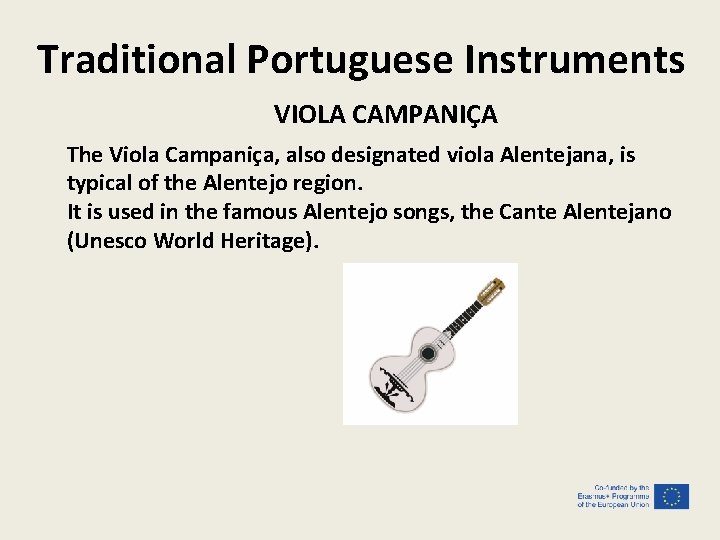
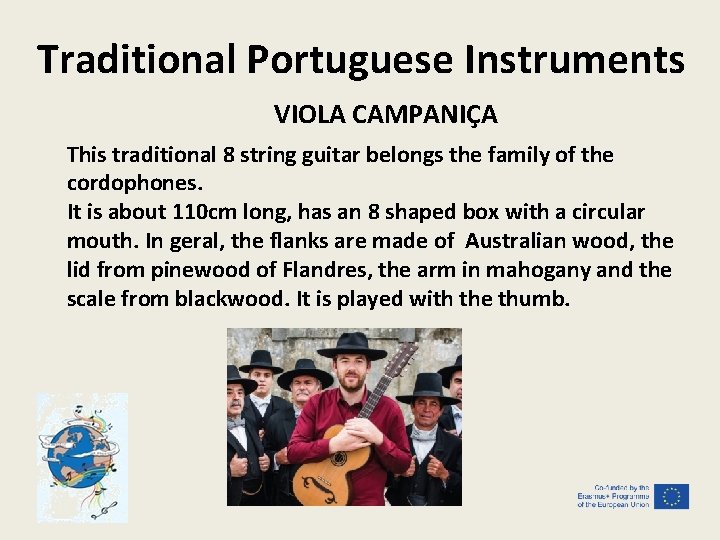
Traditional Portuguese Instruments VIOLA CAMPANIÇA The Viola Campaniça, also designated viola Alentejana, is typical of the Alentejo region. It is used in the famous Alentejo songs, the Cante Alentejano (Unesco World Heritage).
Traditional Portuguese Instruments VIOLA CAMPANIÇA This traditional 8 string guitar belongs the family of the cordophones. It is about 110 cm long, has an 8 shaped box with a circular mouth. In geral, the flanks are made of Australian wood, the lid from pinewood of Flandres, the arm in mahogany and the scale from blackwood. It is played with the thumb.
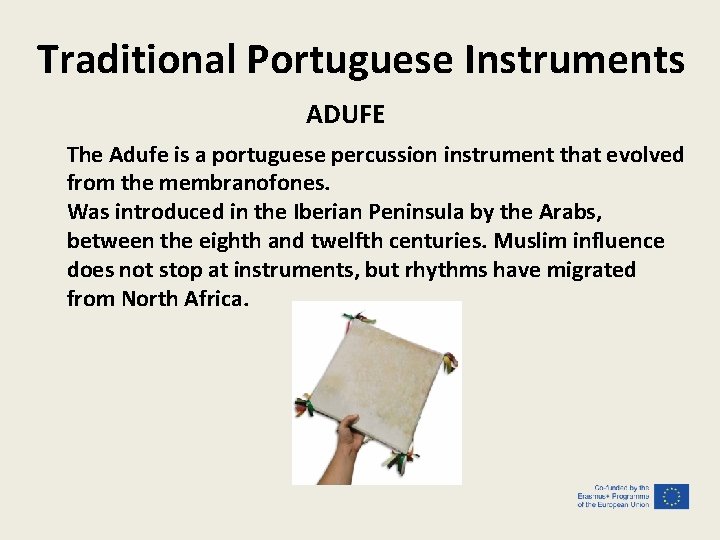
Traditional Portuguese Instruments ADUFE The Adufe is a portuguese percussion instrument that evolved from the membranofones. Was introduced in the Iberian Peninsula by the Arabs, between the eighth and twelfth centuries. Muslim influence does not stop at instruments, but rhythms have migrated from North Africa.
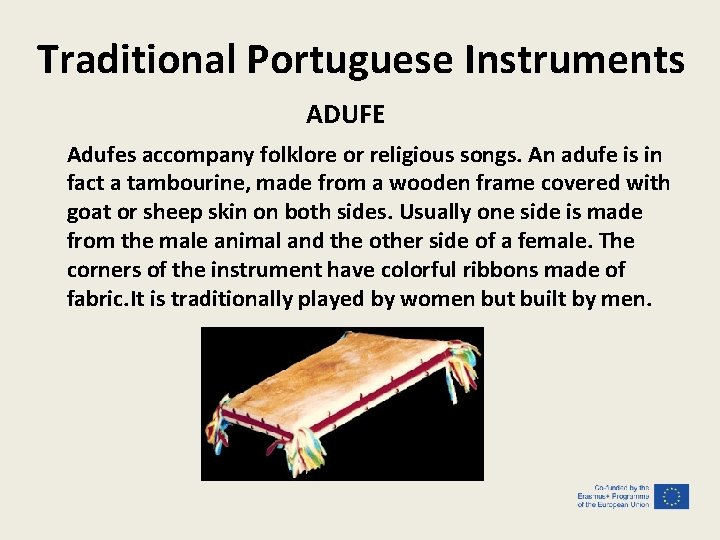
Traditional Portuguese Instruments ADUFE Adufes accompany folklore or religious songs. An adufe is in fact a tambourine, made from a wooden frame covered with goat or sheep skin on both sides. Usually one side is made from the male animal and the other side of a female. The corners of the instrument have colorful ribbons made of fabric. It is traditionally played by women but built by men.