
TRADITIONAL METHOD OF PERFORMANCE APPRAISAL TRADITIONAL METHODS n

- Slides: 10
TRADITIONAL METHOD OF PERFORMANCE APPRAISAL
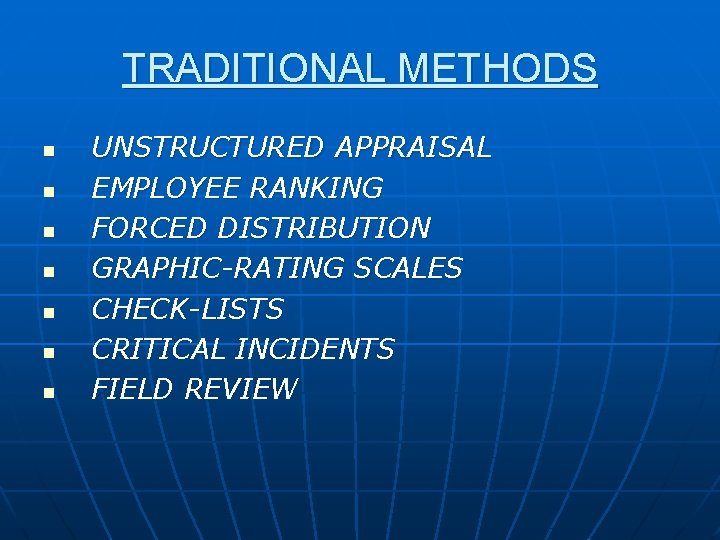
TRADITIONAL METHODS n n n n UNSTRUCTURED APPRAISAL EMPLOYEE RANKING FORCED DISTRIBUTION GRAPHIC-RATING SCALES CHECK-LISTS CRITICAL INCIDENTS FIELD REVIEW
UNSTRUCTURED APPRAISAL n n The appraiser is required to write down his impression about the person being appraised in an unstructured way. In some organisations, comments are required to be grouped under specific headings such as quality of job. performance, reasons for specific job behaviours, personality traits, and development needs. This system is highly subjective and has got its merit in its simplicitly and it especially use in small firms.
EMPLOYEE RANKING METHOD n n Ranking method is a simple process of placing employees in a rank according to their performance. It permits comparison of all employees in any single rating group regardless of the type of work. All workers are judged on the same factors and they are rated on the overall basis with reference to their job performance instead of individual assessment of traits. In this way , the best placed first in the rank and poorest in the last rank.
FORCED DISTRIBUTION METHOD n n The forced distribution system is devised to force the appraiser to fit the employees being appraised into predetermined ranges of scales. It has advantage over the paired comparison system in that two or more employees can be equal ratings. This system is based on the presumption that employees can be divided into five points scale of outstanding, above average, below average and poor.
GRAPHIC RATING SCALE n n Under this method, scales are established for a number of specific factors and qualities. Five degrees are established for each factor and general definitions appear at points along the scale. The selection of factors to be measured on the graphic rating scale is an important point under this system. these are of two types (a)Characteristics initiative and dependability. (b) Contributions – quantity and quality of work. Since certain of areas of job performance cannot be objectively measured, it is likely that graphic scale will continue to use a mixture of both characteristics and contributions.
CHECK LIST It also consists of two techniques: (a)Weighted check list (b) Forced choice Weighted check list : Under this method, various statements are prepared in such a manner that they describe various types and levels of behaviours for a particular job. Each statement is attached with a scale value. After the weigh is attached to the individualtraits, the rating upto this level is gathered on the rating sheet. Then the weights is averaged and employee is evaluated. The weighted check-list should be prepared by the persons throughly acquainted with job and perfect at preparing and weighing statements. They rank the employees from poor to excellent.
CONT… (b)FORCED CHOICE : This method is used particularly with the objective of avoiding scope for personal prejudices. Under this method the rater is forced to choose between descriptive statements of seemingly equal worth describing the question. The rater may feel that neither of the two statements in a pair is applicable , but he must select the one that is more descriptive. The main advantage of establishing this system of performance appraisal is that it has greater objectivity than most other methods.
CRITICAL INCIDENT MTHOD n A critical incident means a significant act by an employee exceeding or failing any of the requirements of his job. It represents an exceptional behaviour of an employee at work. This method requires every supervisor to record all such significant incidents in each employee’s behaviour which indicate effective or successful action and those which indicate ineffective or poor behaviour. Under this method, the supervisor is supposed to refrain from passing overall judgements and concentrate upon discussing facts as he sees them. This methods suffers from the defect that outstanding incidents happens so frequently that individual’s appraisal may not vary markedly between any two time periods. The usual procedure in constructing the specimen checklist is to collect behaviour incidents from certain experts in this area.
FIELD REVIEW n Under this method, the supervisors are interviwed by an expert from the personnel department. The workers are usually classified into three catagories as outstanding, satisfactory and unsatisfactory. The interviewer questions the supervisor about the requirements of each job in his unit and about the performance of each man in his job. He probes to find out not only how a man is doing but also why he does that way and what can be done to improve or develop him. The supervisor is required to give his opinion about his subordinates. The success of field review method depends upon the competence of the interviewer. If he knows his job, he can contribute significantly to accurate appraisals. It also ensures a greater likelihood that the supervisors will give adequate attention to the appraisals because the personnel department largely controls the process.